Showing posts with label BMI. Show all posts

Thursday, 14 March 2024

Supporting people with Severe Mental Illness who face food insecurity to access a nourishing meal

Sally Smith, Peer Lead for Research, Tees, Esk and Wear Valleys NHS Foundation Trust (TEWV)

I have met many wonderful and interesting people on the inside of a psychiatric ward. The immediacy and depth of connection between peers in there was an unexpected comfort in the most challenging of environments.

Illustration by Sally Smith


I remember lots of the stories shared in the smoking corners of gardens. We often reflected on how misunderstood we felt in the ward and in the world.

One young woman was desperate to stay on the ward as she knew that was the only way she was certain of ongoing access to food. Her cupboards empty, her benefits paused, she was terrified about discharge. I was unsure how much Dialectical Behavioural Therapy or anti-depressants would help: wouldn’t anyone feel miserable with no food or money?

I remember physical health checks on the ward being introduced. Being weighed and measured, compared to the graphs…. and yet being given medication that makes you want to eat sugar out of the bag, being locked on a ward with no way to exercise, offered beige food four times a day and feeling so damn lousy and desperate that motivation to even clean your teeth was a challenge.

It felt cruel and shaming. It certainly never helped me to change anything.

In my mind it is no surprise that the mortality gap for people with severe mental illness (SMI) continues to rise, the challenges and barriers around nutrition that people living with SMI face continue to go unseen. No amount of lessons on what makes a healthy plate will make avocado cost less than crisps, and no knowledge of a healthy Body Mass Index (BMI) will reduce the intense effects of psychiatric medication.

And perhaps this is more of an issue than ever with austerity and the cost-of-living crisis exacerbating people’s struggles.


Increasing accessibility of affordable healthy food to adults living with SMI in Middlesbrough

With this perspective in mind, I was delighted to join the team working on this National Institute for Health and Care Research (NIHR) Communities study as a peer researcher. With co-production and the voice of lived experience running throughout the project, we are seeking to develop practical solutions for people living with SMI who face food insecurity in Middlesbrough.

The project is a collaboration, bringing together lived experience with the best bits of Tees, Esk and Wear Valleys NHS Foundation Trust (TEWV), Teesside University and Middlesbrough Environmental City, a charity dedicated to promoting healthy and sustainable living.

Over a period of 16 weeks, we plan to co-design and co-develop a nutritious meal with surplus fresh ingredients from local Eco shops (social supermarkets) that would otherwise go to waste.

With the support of the food scientists at Teesside University, this will then be turned into a healthy ready meal and distributed back to Eco shops in Middlesbrough. Aiming to be an appetising, nourishing and accessible meal for local people battling severe mental illness, who for whatever reason may struggle to cook the fresh ingredients themselves.

Through the design and delivery group we are hopeful that there may be additional benefits for all participants and the collaborating organisations, for example:
  • The opportunity to learn some cooking skills and explore recipes that are good to cook on a budget.
  • The opportunity to develop peer relationships amongst the delivery group that support connection and foster hope for change.
  • The opportunity for organisations to learn from one another’s strengths and take a fully bio-psycho-social lens on mental health difficulties.
We are currently in the recruitment phase for participants and a collaboration of this type has not been without substantial challenge. It is has not been easy to marry NHS language and expectations and academic protocols with how a community organisation runs. It has not always been easy to find middle ground between the clinical expertise and lived experience expertise. However, I look forward to sharing the progress we make as the delivery team becomes established.
 

Research published by the project team

This study published today explores food insecurity prevalence and the experiences of adults with Severe Mental Illness (SMI) living in Northern England.

This systematic review paper found that people with SMI are more likely to experience food insecurity.

Another recently published paper identified strategies to tackle food insecurity centred on making food banks more accessible and improving the quality of available food available.

Friday, 17 December 2021

The way the Government talks about ‘childhood obesity’ is flawed. Should we even be talking about it at all…?

Posted by Naomi Griffin, Fuse SPHR Post Doctoral Research Associate, Sport and Exercise Department, Durham University

‘Childhood obesity’ has been a key public health priority area for those with an interest in challenging health inequalities among children and young people. This is because we can see, at a population level, that children living in the most deprived areas in England are twice as likely to measure as ‘obese’ than children in the most affluent groups (as measured by Body Mass Index (BMI)*). The gap between the most and least deprived is growing.

Logic may suggest that if certain children are more likely to be categorised as ‘obese’, we should focus on ‘childhood obesity’. However, when exploring wider evidence, it is clear that this approach misses out important pieces of the puzzle. Our research used an approach to policy analysis developed by Professor Carol Bacchi called 'What’s the problem represented to be?', whereby the researcher infers what the policy makers are implying the ‘problem’ to be addressed is by looking at what is proposed. For example, if a policy calls for teacher training, the problem is represented to be: teachers lack training. We used this approach to investigate the way UK government ‘childhood obesity’ policy (which I will call ‘The Policy’ from this point) frames the ‘problem’ of ‘childhood obesity’ in relation to health inequalities.

What we did in our research


Firstly, we looked at the way ‘obesity’ is defined in the policy. The Policy’s definition of ‘obesity’ focuses on child weight status, rather than presence of health problems, where the determinants of change are calories consumed vs energy expended: 
at its root obesity is caused by an energy imbalance: taking in more energy through food than we use through activity’ (Chapter 1, p.3).
However, the causes of ‘obesity’ (as defined by BMI) are embedded in an extremely complex biological system that interact with cultural, structural and economic contextual factors, none of which exist in isolation. In truth, BMI is a rather crude measure of height versus weight. BMI data can tell us about population level trends in BMI, but it is not complex enough to tell us about individual health status. It is also not a particularly appropriate measure for children as it was designed for use in adults.

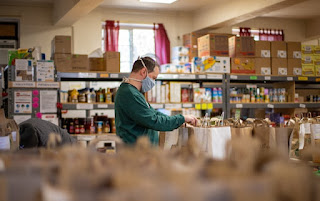
Food bank volunteer
Secondly, The Policy proposes ideas around ‘choice’ and ‘informed decisions’, implying the ‘problem’ is a lack of information or poor choices. For example:

I want to see parents empowered to make informed decisions about the food they are buying for their families when eating out.’ (Chapter 2, p.5).

However, it lacks consideration of the accessibility of a balanced diet due to: affordability of food, practical considerations on physical cooking equipment and energy costs of preparing and cooking food, skipping meals, needing to use food banks, or varied availability of healthy food options.

Thirdly, in The Policy, ‘stigma’ was given as a reason for the need for a childhood obesity policy, as children deemed ‘obese’ are likely to experience:
bullying, stigmatization and low self-esteem’ (Chapter 1, p6). 
However, there was no targeted response to stigma itself. The attention paid to stigma is necessary. The physical and psychological harms caused by stigma, and the negative impact that stigma can have on the quality of healthcare has been evidenced. Not only is stigma and misinformation about ‘obesity’ likely to impact an individual’s health and wellbeing, it also causes barriers to appropriate and timely treatment of many health concerns, not just those that have been linked to weight status. By framing stigma as the result of ‘obesity’, rather than a problem to challenge head-on, The Policy supports individual behaviour change and responsibility, rather than addressing the wider determinants that are necessary to understand these social trends and the negative impacts of weight stigma.

Challenging inequality


So, is ‘childhood obesity’ really the policy ‘problem’ we should be addressing in order to challenge health inequalities? I don’t think so. We propose that inequality itself is the ‘problem’ we need to challenge. For example, the unequal distribution of wealth that leaves millions of children in poverty, increasing food insecurity, unequal access to healthy food and green spaces, and unequal opportunities for physical activity. Policy decisions that have drained public services and policy approaches that unfairly tip the scales of responsibility for addressing the effects structural inequalities onto individuals must be challenged.

The proposals in The Policy, and the evidence bases drawn on (and those absent), reflect a broader ideological trend in government policy on health to move from addressing social/structural dynamics to focussing on individual responsibility. The Policy reflects ideological decisions which are difficult to challenge. The notable absence of the impact of austerity on health budgets and spending on child health inequalities in The Policy is evidence of this.

With Chapter 3 of The Policy potentially delayed due to COVID-19, I hope that government will revisit and review the aims of The Policy with a focus on structural dynamics like health inequality and poverty. At the very least, the government must work to remove barriers to healthy eating and physical activity, regardless of socioeconomic or weight status, for healthier outcomes for all young people.

Failing this, the government’s messaging about ‘obesity’ directly impacts the wider conversation and so I feel that it is the duty of those of us working in public health to challenge the ineffective proposals and damaging narratives that have been put forward in these policies, especially where we cannot change the policies themselves. I hope that our review can be used to challenge and strengthen future policy development, pushing for effective action against health inequalities and policy/intervention-generated inequalities in child health.

Reference: An open access research article detailing the project which informed this blog post is available via BMC Public Health.

For further information on the research project, please visit the NIHR School for Public Health Research website.