Showing posts with label EGiles. Show all posts

Friday, 3 July 2020

Would easy-read documents for all mean a more inclusive healthcare system?

Posted by Kate Byrnes, Graduate Tutor & PhD Student, and Emma Giles, Reader in Public Health Behaviour Change, Teesside University

When you receive letters from the hospital or the doctors, what do they look like? Text heavy, with no pictures, and in a small font size? That is how the letter looked when I received my invitation to cervical screening.

Traditional appointment letter
Now imagine that instead of getting that letter, you received a letter which was written in a large font, used shorter sentences and included pictures. How would you react? Would you feel like the information was simple and clear to understand? Would you feel like you were being patronised and treated like a child? Or, would you even care?

Public Health England, have developed a cancer screening invitation letter in an ‘easy read’ format along with an easy read booklet. Both of which can be provided to support women with learning disabilities to access cervical screening. 
 
PHE cervical screening: easy read invitation letter template
Within an easy read document, the images are left-aligned on the page, with text for each image on the right side. This helps the reader gain an understanding of what the written text says.

However, women with a learning disability, do not receive these easy read versions as standard. Every women invited to screening is given a booklet along with the invite letter which goes some way to explain both what happens during the appointment and the content of the letter. However, would it not be better for everyone to receive an easy-read version in the first instance?

Someone may only receive additional information in an easy read format, if they are identified by their GP surgery as having a learning disability, or because they receive support from healthcare services for people with a learning disability.

What about women who have a mild learning disability and do not receive any support? Or people who struggle to understand written information? It is possible these groups of people will be less likely to attend cancer screening simply because they do not understand the invitation letter.

Four in 10 adults in the UK struggle to understand and use typical medical information designed for the public (NHS, 2020). This is called ‘health literacy’. Having low health literacy has been linked to a range of problems, including poor general health, inappropriate use of health services and reduced life expectancy (NHS, 2020). One mechanism to limit the effects of poor health literacy, is having information in plain English, with simple and short sentences, without jargon.

Therefore, if the NHS is to use standardised letters, should they all be in a simplified, easy read format? This could help services meet the requirements of the Equality Act (2010) which stated that services need to make “reasonable adjustments” to their provision including to the information they provide.

The need for reasonable adjustments within the cervical and breast cancer screening programmes has been highlighted in my PhD research. The research is exploring the attitudes and opinions of women with a learning disability, family carers, and paid care workers towards cervical and breast cancer screening. Within the interviews each participant completes a Q sort (a card sorting task) to identify whether participants agree, disagree, or are neutral towards 28 statements. Each statement is placed on an individual card. The card is then placed onto a grid, to reflect how much they agree or disagree with the statement. Upon completion, it represents a picture of a participant’s range of attitudes and opinions towards cervical and breast cancer screening. The below figure shows a completed Q sort by a women with a learning disability.

Q sort by a women with a learning disability
When designing my PhD research, woman with a learning disability where involved in Patient and Public Involvement (PPI). PPI is defined as “research being carried out ‘with’ or ‘by’ members of the public rather than ‘to’, ‘about’ or ‘for’ them” (INVOLVE, 2020). The Health Research Authority (HRA) has acknowledged that public involvement can positively impact upon the design of research, especially in the design stage (Health Research Authority, 2017). By including Experts-by-Experience it is possible to find out what matters most to the public, especially when the research is controversial or on a sensitive topic. This is the primary reason that I wanted to use PPI during the research. Additionally, there has been very limited research conducted in England on this topic, and involving people with a learning disability in the design of the research.

The PPI in my research was split into three consecutive phases; identifying women’s preferences for how they would like written information to be presented to them; checking the easy-read documentation developed for the research, and obtaining the women’s preferences on the design of the Q grid. The importance of removing jargon and medical terms was highlighted in the results of the PPI, when the phrase ‘lady bits’ was used, women with a learning disability understood the location and some of the problems they might face going for screening, but didn’t always understand the word ‘cervix’. This is an important consideration for the invitation letters to cancer screening.

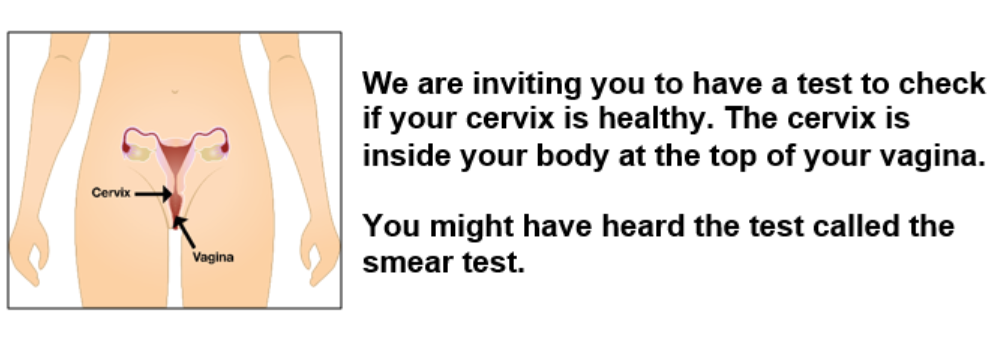
The invitation letters for cancer screening use terminology such as ‘cervical’, ‘cervix’ and ‘Human papillomavirus’ and assume that people will know what these words mean. What impact could using jargon and medical terminology have on the women receiving the letter? One problem is that women could misunderstand the procedure. Whereas, in an easy read document, the anatomically correct terms could be used, alongside an image, or further description. As the below image depicts:
PHE cervical screening: easy read invitation letter template
Ultimately, should there be standard information provided to all, which is written in a way that everyone can understand? Would more people be able to understand the information? Would this have an impact on uptake of services such as screening, and would this result in a more inclusive healthcare system?


Images:

1. Capture taken from the BBC News website, 18 April 2019, HEALTHWATCH/NHS ENGLAND The template for the letters is drawn up by Public Health England (https://www.bbc.co.uk/news/uk-england-tyne-47946395).

Tuesday, 28 July 2015

Would you accept money to be healthier?

Guest post by Emma Giles, Senior Research Lecturer in Public Health, Teesside University

As newspaper headlines have shown, the issue of encouraging individuals to adopt healthier lifestyle behaviours by paying them is controversial. Whilst many of us know that we should do a bit more physical activity, eat our five-a-day fruit and vegetables and even attend our vaccination and screening appointments, we don’t always do this. Many barriers prevent us from fully engaging with these healthy behaviours, and these barriers are often complex, individual, and are not always easily surmountable. These barriers range from living away from green spaces which would allow outdoor exercising, to deep-seated social norms that stop individuals from engaging in healthy behaviours because they are not well accepted by family, friends or the wider community.

In recent years there has been a growing body of research looking at paying people to be healthier. This essentially means providing individuals or groups with cash, shopping vouchers or gifts in return for the adoption of healthier behaviours. Such schemes include the Pound for Pound weight loss incentive scheme, the Give it Up for Baby scheme, and offering incentives for breastfeeding.


In order to hear recent research evidence, and to provide a forum for friendly debate, I organised the recent Fuse Quarterly Research Meeting, which focused on payment for health behaviours. Last Wednesday (22 July), policymakers, practitioners, and academics came together to hear presentations from four academics and practitioners working in the broad field of incentives. As Claire Sullivan, a Consultant in Public Health from Public Health England mentioned in her opening address as Chair of the meeting, often incentives can take various forms – including paper pants for Chlamydia screening!


In terms of specific incentives, Professor Pat Hoddinott, Chair in Primary Care, Nursing Midwifery and Allied Health Professions Research Unit at the University of Stirling, presented research which focused on incentives for breastfeeding and to quit smoking in pregnancy – the BIBS study. Key findings suggest that tailoring of incentives is important to meet local needs, but that they show promise to encourage these behaviours.

Professor David Tappin, Professor for Clinical Trials in Children within the School of Medicine at the University of Glasgow, followed Pat by showcasing data from the CPIT trial – a smoking cessation in pregnancy trial in its second phase. Results showed that there was a 14% increase in quit rate and further analysis showed that there was a 150g increase in birth weight of babies born to mothers who quit smoking. Findings suggest that financial incentives were found to be acceptable by the women involved, and may double the quit rate when used with existing smoking cessation services.

A practitioner perspective was provided by Mr Andrew Radley, Consultant in Public Health Pharmacy, NHS Tayside, who talked about operationalising the use of financial incentives in a stop smoking programme within a community pharmacy setting. In particular, 393 women in Tayside engaged with the smoking cessation services, and incentives were found to be effective. Of note was the finding that mothers preferred receiving their incentives on a weekly basis.

I spoke last and presented qualitative data exploring the acceptability of incentives. The findings suggest that incentives are more likely to be accepted if they are provided to certain population groups including pregnant women and those on a low income, but not for those who may have alcohol or drug problems. The ‘perfect’ incentive has yet to be identified, but it will need to be shown to be cost-effective for it to be accepted on a wider scale.

The presenters were then joined by Peter Kelly, Director of Public Health Stockton Borough Council, Jim Beall, Health and Wellbeing Board Chairman, and Dr Jean Adams NIHR Research Fellow at CEDAR for a panel discussion. The audience raised many questions and comments around the use of incentives, with particular concerns around incentives increasing health inequalities, aggressively placing the blame of poor health on individuals, and that incentives may result in moral implications when individuals are rewarded for their behaviour. The debate suggested that more research evidence is needed to discover what type of incentive works for whom, and in what setting, and to better explore group (rather than individual) incentives.


What is obvious is that paying people to be healthier is an emotive topic, a highly contested intervention approach, but at the same time, it also shows promise to encourage individuals to adopt healthier lifestyle behaviours. It certainly provides food for thought…how many of us would accept money to be healthier?

Follow this link to find out more about the Fuse Quarterly Research Meeting ‘Payment for health behaviours: the case of health promoting financial incentives’ on the Fuse website.


Did you enjoy reading this post? If so, please vote for Fuse in the UK Blog Awards 2016 by clicking here

Thursday, 18 April 2013

A second slice of the cake

Posted by Annette Payne and Emma Giles

As Emma mentioned in her blog post last week, we have endeavoured to write two joint posts and I guess that these are in fact testament of the Fuse Sandpit event for early career researchers that we both were lucky enough to attend in February 2013 at Linden Hall.

Previous to this sandpit, Emma and I did not know each other and the fact we got along, had a lot of research interests in common and the same pragmatic perspective led us to keep in touch, have coffee (no cake though….oh has Emma already mentioned that??!!) and to write these posts.

It's all about the cake
So was this part of the Sandpit process? Well Emma and I were not members of the winning team but maybe there was more than one prize and we did win in our own way?

We might have received some strong criticism about our bid of blood, sweat and almost tears (I know there were loud whispers that the feedback was disproportionate to the task in hand and in reality all the teams would have spent more than a few hours writing a bid for submission), we still may not have seen what a successful bid does actually look like and what it would have taken for our bids to make it through to successful funding. Yet both Emma and I fully acknowledge that it was still worth attending and that this was the first event of this type, and that lessons will be learnt, and processes improved upon, but we are both very proud to have been selected to attend and to just have been a part of the sandpit process!

Over our coffee (and NO cake) we discussed the sandpit as a whole process and although we came away without the financial prize we did come away with little personal prizes of our own. We both realised that we were able to work with a research team where there were at times challenging dynamics but that both Emma and myself possessed a degree of self-awareness to manage and blend where required into that team dynamic, enough to allow the process to move forward. I personally came away reassured that I do have academic, research and clinical knowledge that I often don’t give myself enough credit for. I know Emma surprised herself at times how she stepped up and took the lead and was able to get her point across despite a couple of resistant audience members. We both witnessed how the different philosophies of universities both old and new don’t have to clash and compete, but can complement and enhance outcomes.

I think the best prize however is that we have made contact with someone who we would work with, have coffee (and cake??) with to discuss work and any professional issues, and perhaps a fledgling friendship within the research world.

Tuesday, 9 April 2013

Networking

Posted by Emma Giles and Annette Payne

So, firstly we should maybe point out that this blog post was inspired by the Fuse conference on the 25-27th February 2013 at Linden Hall. This sandpit event aimed to inspire post-docs and post-grads (like our good selves) to write an inspiring, appropriate and sure-to-be funded research bid. Whilst this conference was held a few weeks ago, what we really found useful – and which inspired this post – was the opportunity to network. Being researchers in different North East Universities (Emma is based in the Institute for Health & Society at Newcastle University, and Annette works full time for the NHS Health Improvement while studying part time at Sunderland University) we don’t often get the opportunity to meet for a prolonged period of time with researchers from other universities. 

Cookies by Paolo Marco - an important ingredient of effective networking
On arriving at the Fuse event, both myself and Annette were placed in the same group, in which we were to spend many waking hours together working on a hypothetical (but a potentially very real) research bid. Together with an additional four researchers, Annette and I set to thinking about how we would write a research bid that would shed some light on how reticent Hep C carriers would come forward for testing. Whilst admittedly Annette and I were ‘forced’ to network in the first instance, in that we were allocated to the same working group, we soon realised over coffee (and dare we say it biscuits and other sweet goodies) that we got on rather well and that we were both interested in very similar research fields. Annette is currently starting her 3rd year of her part-time PhD (and aiming to finish in 12 months!) looking into the views and patterns of alcohol use in older adults living in sheltered housing, whilst I completed a PhD (in 2010) into the food, alcohol and physical activity behaviours of young adults, together with a first post-doc which looked at the dietary behaviours of older people.  Sharing similar research interests and skills (such as a firm interest in the value of qualitative research) was an interesting finding from meeting each other.

Since meeting up for coffee recently (minus the cake unfortunately!), we decided that we should thank Fuse for giving us the opportunity to network. The Fuse conference allowed us to meet with researchers from all of the five North East Universities (Newcastle University, Sunderland University, Teeside University, Durham University and Northumbria University). It gave us the opportunity to identify potential collaborations with other researchers and universities, to establish new friendships with people who share similar personal and professional interests, but crucially, by listening to other people’s research interests and skills, it helped us to fully appreciate what we have to offer as junior/early career research and the skills that we could bring to any budding cross-university collaborations. 

Whilst usually the dreaded ‘N’ word brings a tear to the eye, and a lump to the throat akin to that of ice breakers; the networking opportunity provided by Fuse was (fairly) enjoyable. The informal atmosphere, the always-ready-to-help mentors, and the open-attitude of all those involved, meant that we learned quite a bit about ourselves, but also about others who attended the event. In future, should we ever have to network again, we can tell ourselves that not always do we need to break into a cold sweat when made to network, that it can be fun (okay maybe a stretch too far), useful, and also result in a new friendship/collaboration being made. In this instance the networking between Annette and I paid off…shame it couldn’t have helped us write the winning bid though!

Thursday, 25 October 2012

My first blog post

Posted by Emma L Giles

Okay, so I’d better come clean and own up straight away…this is my very first blog. Now, it’s not like I didn’t know what a blog was before now, but I had never been that interested. I have a Facebook account and log on occasionally. I even tried twitter once, but I failed to ‘see the point’ of it. So when I thought I might venture into this blog business I wasn’t quite sure what the purpose was. However, since reading the Fuse blogs in particular, I think I may have seen the light.

The little book of anxiety, by Kerri Sackville
I am a post-doc, which basically means that since handing in my thesis (aka a large door stop that I have since looked at about ten times) in 2009, I have been working at Newcastle University as a Research Associate. My first post-docs were largely teaching-based, and so I would never have even contemplated writing a blog at that time. My topics would largely have been around such thoughts as: oh heck, what do I do when 300 students pile into the lecture theatre?? Oh my goodness, I was caught in the headlights today when I couldn’t answer a student’s questions, what to do, what to do??? I…honestly…cannot…mark…one…more…assignment…that…reads…the…same…

Gladly, such issues are no longer the reasons why I lie awake at night. Mainly because I have moved to the Institute of Health and Society at Newcastle and now I actually do research as a research associate, but also because after six years of teaching groups of 50-300 students I am no longer scared by large groups. I can think of a semi-professional and intelligent answer to most student questions, and I have learnt that every student contributes something different in their assignments (most of the time).

So why then am I writing this blog? Well, I was actually going to write about my experience of publishing academic papers as a new career researcher. However, this thought abruptly ended when I started to type. I realised that my first blog might actually be somewhat lacking: would it be entertaining? Would I need to be funny (I’m not naturally a comedian)? What happens if the editor rejects my blog? What DO I WRITE? 

I think, funnily enough, this blog has actually taught me something. It’s taught me that I’m a born worrier and that there will always be something that I am anxious about. However, this is where I can see some advantages of this blog business (I may even have started to like them as well). Blogs allow you to air your thoughts, to share concerns with others, and to (sometimes) receive helpful comments and advice.
I think I’m going to write that second blog soon, surprisingly about my worries around publishing. That is, if the editor doesn’t reject this first blog.

However, don’t ask me to go on twitter again.