Showing posts with label MLhussier. Show all posts

Friday, 22 March 2024

"We need happy memories"

How people who have experienced homelessness are redesigning support

Professor Monique Lhussier & Dr Christina Cooper from Northumbria University, and an Experts by Experience panel

Fuse researchers at Northumbria University were recently awarded £1.4m for a project looking to understand connections between trauma, health and homelessness in the North East. Here the research leads share how they have previously worked to embed community voices to improve health and reduce disparities for people with experience of homelessness.

The link between trauma and homelessness has been well documented, with recent evidence showing that 94% of people experiencing homelessness have experienced trauma. In the majority of cases the trauma was complex and reoccurring, with 65% having experienced four or more traumatic experiences.


In 2023 we received funding from the Arts and Humanities Research Council to develop a network to better support people who had experienced homelessness. We were fortunate to work with eight Experts by Experience (EbEs), or Experts by ‘Disaster’ as Barnie (one of our EbEs) suggested; people who had experienced homelessness, and the complex multiple needs and exclusions that frequently co-occur. The nine months project aimed to develop integrated ways of working, embedding community voices into the system to improve health and reduce disparities for People with Experience of Homelessness (PEH).

Discussions, which were led by EbE throughout the project, reiterated that trauma was common and often started in childhood, and followed by further re-traumatising events. Karl commented that while he remembered in vivid detail what had happened to him as a child, he often could not recall what he had been doing last week, highlighting the lasting impacts of trauma. Further discussions highlighted negative impacts throughout life, from relationships, education, employment to mental illness, suicide and addiction.

We reflected as a group that PEH are often viewed through a lens that considers only their immediate needs; shelter, clothing, food, and healthcare. Drawing on Maslow’s hierarchy of needs we considered that only the bottom two tiers are the most consistently met, but belonging and esteem much less so. The Experts by Experience felt that people need to be given a chance to grow in more holistic ways across all tiers of the hierarchy in order to become healthier and happier.

Tonkin’s model of grief proposes a way to see a happy and meaningful future focusing on growth around the grief. From these discussions, we collaboratively designed the graph below, which superimposes Maslow’s hierarchy of needs with and adapted version of Tonkin’s, in a model to inform ongoing and future work.
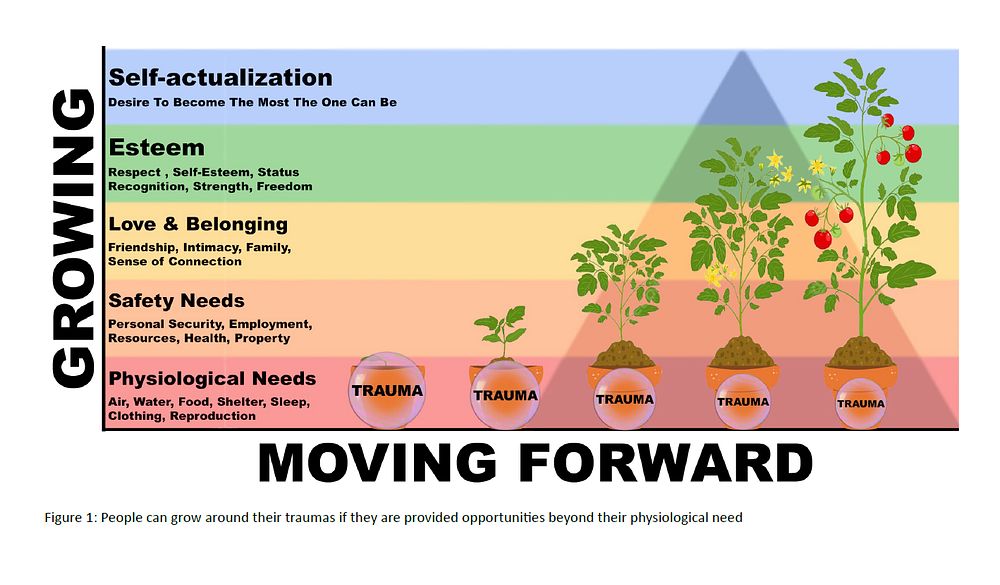
We have begun to explore this model through three core project strands:
  1. an innovation fund for which EbE were responsible;
  2. participation in an accredited Northumbria University module, and
  3. through understanding the impacts of involvement with the project.
The innovation fund pilot involved the development and implementation of five creative projects providing sustainable and varied opportunities for self-care, learning, and physical activity for People with Experience of Homelessness. One of those, the Hope Project, gave opportunities for 189 PEH to take part in new creative, social, or physical activities. Steven designed the Hope Project on the premise that ‘people need happy memories’, which those who have experienced trauma do not always have, to draw on when the going gets tough. Barnie explained that often people lose the motivation and ability to cook for themselves when they have lived on the streets. He designed cookery classes with a train the trainer model, meaning that many people have since benefitted from eating healthier food that they had cooked themselves. Lee set up a bike repair workshop so people can take part in physical activity and be more self-sufficient.


Being given the opportunity to manage a budget, help others and having the status of university student (“I have been called many things; it was nice being called a student!”), stood out as having had a positive impact for many of the Experts by Experience. Lee and Porl said that opportunities to shape the project and develop their skills as researchers led to them feeling trusted and valued as equal members of the project team. Further to this, involvement in the project gave a sense of purpose and belonging, and increased confidence for many EbE.

This supported the notion that it is possible to grow around trauma when we attend to people’s experiences, hopes, talents, potentials and ambitions, as well as their basic needs. It also challenged us, as researchers, to think of research not solely as a detached enterprise, but as an inherent part of a system that can support people to grow and have more positive and valuing experiences.

*This blog has been written in memory of Ben


References:
Image:
  1. Photo by Matt Collamer on Unsplash

Friday, 21 September 2018

Collaborating, meandering and consolidating to identify research priorities on welfare advice and health

Posted by Natalie Forster, Senior Research Assistant and Monique Lhussier, Associate Professor in Public Health and Wellbeing, Northumbria University and Fuse

As the judges of the Man Booker prize for fiction whittle down their long list and decide on the shortlist of books in the running for best novel of the year, we’ve been making a few (more research focused) lists of our own.

Setting aside our individual research plans and ambitions to focus on welfare and health
Funded by the NIHR School for Public Health Research, we are currently working collaboratively (from across Fuse, University College London, The University of Sheffield, and London School of Hygiene and Tropical Medicine) to set the future research agenda in the area of welfare advice and health. Working across this number of institutions, we have managed to set aside our individual research plans and ambitions and combine our expertise in a series of workshops to focus on the issues of welfare and health. Colleagues from the welfare advice sector have agreed to join us and are keeping the discussions grounded in the realities of practice, over the course of four workshops (this blog marks our half way point).

The first workshop saw us (tentatively at first) present our research to each other; with both our detailed topics and methodologies varying significantly, as one might expect. Deciding which research questions to pursue is a daunting task. Shortlisting questions was a delicate juggling act of managing our respective interests and expertise, while keeping practice perspective up front and centre, to ensure the usefulness of our future findings. This process also opened up fundamental discussions about the role of welfare advice in society, and how this should be studied.

One key area of debate concerns whether we should study the health impact of welfare advice, welfare itself, and/or systems of welfare provision in their broadest sense. At present, the UK boasts a welfare system that, in its complexity and inaccessibility, needs the intervention of advice services for users to access their entitlements. As researchers, should we therefore focus our attention on this hostile welfare environment, thought to perpetuate or deepen health inequalities, as opposed to advice services themselves? For example, a research emphasis on the health outcomes of advice might have been interesting but could play into wider failings to make benefits accessible if the advice-health relationship is proved any less than definitive. The group also considered whether advice services should be studied as an intervention or in terms of their function within society.

Further discussions centred around which outcomes, and particular user groups to focus on, and whether to study universal or means tested benefits, continuously swerving between the pragmatic and the theoretical, the national and the local. These fruitful meanderings were captured in a long list of possible research questions which we then worked to weigh up against agreed criteria. The result? A consolidated and (slightly!) shortened list of research questions, focused on five priority areas:
  1. Are there inequalities in the impact and reach of advice services across social groups? How/ does advice delivery mode matter?
  2. What are the individual and system level impacts of the de-implementation of advice services?
  3. What are the impacts of changes to welfare provision on children, inter-generationally and throughout the life course? 
  4. How do experiences of social welfare vary by social group, geographically and across generations? How do different identities combine to influence how social welfare is understood? 
  5. What is the impact of the rise in precarious employment and low wages on advice seeking and provision?
So quite a research agenda to fulfil! Throughout the remainder of the project, we’ll be engaging with advice sector representatives and recipients of advice to hear their views on the directions research in the area should take before developing concrete plans for how we could actually carry out this research. After that it’s time to commit pen to paper and draft those grant applications!

Thursday, 30 October 2014

52 weeks in public health research, part 43

Posted by Amelia Lake, Emily Henderson, Lorraine McSweeney and Peter Van Der Graaf


From Lorraine McSweeney: It was a proud and surreal moment to see my PhD thesis join eminent academics’ work on the Fuse Director's bookshelf of fame at Newcastle University!


From Amelia Lake and Emily Henderson: Emily has fashioned a temporary standing desk so we, at Durham University's centre for public policy & health, can introduce a bit more activity into our working life!


From Amelia Lake: Halloween a time of... excessive sugar intake? What happened to carving turnips, eating satsumas and the best treat (well in the Lake household circa 1985) a big box of pomegranates!


From Peter Van Der Graaf: Poster presentations at the 1st International Conference on Realist Approaches to Evaluation and Synthesis with two posters from Fuse's Monique Lhussier (see below). A surprising amount of papers and presentations on public health including a keynote address by Professor Mike Kelly from NICE.  Is Fuse missing a trick?


------------------
A reminder from the Fuse blog group:

Each Thursday of 2014 we’ll try and post around four pictures on the Fuse blog that capture our weeks in public health research, from the awe-inspiring to the everyday and mundane. Given that more of the latter than the former exists in most of our lives, we foresee problems compiling 208 images worth posting on our own. So this is going to have to be a group project. Send an image (or images) with a sentence or two describing what aspect of your week in public health research they sum up and we’ll post them as soon as we can. You don’t have to send four together – we can mix and match images from different people in the same week.

Normal rules apply: images you made yourself are best; if you use someone else’s image please check you’re allowed to first; if anyone’s identifiable in an image, make sure they’re happy for it to be posted; nothing rude; nothing that breaks research confidentiality etc.

Email your posts to m.welford@tees.ac.uk or contact any member of the Fuse blog group.