Showing posts with label learning disability. Show all posts

Friday, 10 February 2023

Treats: a helpful reward, or to be approached with care?

Posted by Anita Attala, Lead Adult Weight Management Dietitian from Northumbria Healthcare NHS Foundation Trust, and research team from Teesside University

We all like to have a ‘treat’ and to give ‘treats’ to others. Indeed, the use of food, and in particular what we in public health call ‘high fat, sugar, and salt’ containing foods or ‘HFSS’, are often chosen as rewards. The notion of food cultures is certainly a social anthropological (study of humans) concept, with an example being the use of food in positive reinforcement; using ‘treat’/HFSS foods to reward children in particular. Taken at ‘face-value’ such treats may appear harmless, however repeated use of HFSS in this way has been shown to physiologically influence the human food reward system, and impact on our ability to regulate how much food we eat. This, together with other detrimental impacts, has led to advice not to regularly use food as a reward. Research has also shown that using food rewards in adults can hinder healthy weight management, especially from a psychological perspective.

But what exactly is a ‘treat’? Why do we feel the need to ‘treat’ someone? Are ‘treats’ always a positive experience or can they be used in a detrimental or harmful way?

While working in a forensic service I saw patients gain weight, and often gain this weight very rapidly. I also noted that some staff seemed frustrated and concerned about the weight gain some patients experienced. However, I also noticed that HFSS food was frequently used as part of patient care. This sparked my interest in wanting to understand this apparent conflict.

Forensic services provide care for people with a severe mental illness or learning disability, who have committed a crime but are too vulnerable to be in prison. For example, they are high risk either to themselves or the public, and therefore are unable to live in the community. People in these environments are often here for a long time and are reported to die 15-20 years prematurely, often from avoidable diseases. There are often restrictions imposed on the person and their environment. These restrictions will depend on the level of security required and the risk posed by the patient, and can be directed by the Ministry of Justice. An example of a restriction might be the person is not able to leave the ward.

Limited research seems to have been undertaken around the use of HFSS food ‘treats’ for adults, let alone adults who are in hospital. Yet, it is something many of us seem primed to do – bring (HFSS) food to someone when they’re ill.

The word ‘treat’ conjures up a particular thought of food – which is often high in calories, high fat and high in sugar. What you view as a ‘treat’ and how to ‘treat’ can often have been learnt in childhood and can differ from person to person. But, while it is entirely possible to have a non-food ‘treat’, it’s often harder to think of one and can be more difficult to provide while in hospital (particularly one with restrictions such as forensic wards).

You could argue that ‘treats’, by definition, can only be a ‘treat’ if you don’t consume them on a regular basis. As research shows, regular behaviours of any kind, can soon develop into habits.

Wanting to learn more about the use of ‘treats’ to show care and kindness, particularly in a hospital setting, I applied for research funding from my Trust (Cumbria, Northumberland, Tyne and Wear NHS Foundation Trust). Also, in 2020, I was successful in obtaining a clinical academic internship with Health Education England (HEE) and the National Institute for Health and Care Research (NIHR). Both awards enabled me to research the use of treats in forensic inpatient care settings.

Using this funding, I decided to focus on whether ‘treats’ were being used to prompt a particular behaviour from a person, while in inpatient care settings; whether these ‘treats’ impacted on a person’s weight and physical health; and why treats were chosen and if it was related to ideas of care and kindness. Certainly, from my observations this is what seemed to be happening - often perhaps unconsciously – but this research allowed us to evidence what may be happening.

What we found

Our research into treats in the health care sector has now been published. It found that treats were used for a number of reasons including:
  • Being an affordable way to reward someone
  • An incentive to encourage patients to participate in activities, and
  • A way to express love/care for someone.
Of course, food as a bonding mechanism is not a new phenomenon, and the idea of certain foods providing comfort is well-established.

It’s entirely possible to have ‘treats’ as part of a healthy balanced diet, and that the origin of using HFSS as treats may be from a place of nurture, but the advice is that food treats should be infrequent and limited in quantity. While it would appear ‘easy’ to say that those working in institutions, like in NHS care services, need to be mindful of how food is being used, our research findings suggest that it may take a much bigger system/cultural change to reduce the use of HFSS as treats in services. I think the idea of a ‘positive food culture’ is useful here. One where the focus is on preserving and nurturing good health and wellbeing through the use of healthy, positive, food behaviours, attitudes and values.

Authors:

Anita Attala, Lead Adult Weight Management Dietitian from Cumbria, Northumberland, Tyne & Wear NHS Foundation Trust, and postgraduate student from Teesside University.

Jo Smith, Consultant Dietitian (Clinical Academic) from Tees, Esk and Wear Valleys NHS Foundation Trust, and PhD student from Teesside University

Amelia Lake, Fuse Associate Director and Professor of Public Health Nutrition from Teesside University

Dr Emma Giles, co deputy-lead of the Fuse Behaviour Change Theme and Associate Professor Public Health from Teessside University


References:
  1. Alonso-Alonso M, Woods SC, Pelchat M, Grigson PS, Stice E, Farooqi S, Khoo CS, Mattes RD, Beauchamp GK. Food reward system: current perspectives and future research needs. . Nutr Rev 2015;73(5):296-307. https://www.ncbi.nlm.nih.gov/pmc/articles/PMC4477694/
  2. Roberts L, Marx JM, Musher-Eizenman DR. Using food as a reward: An examination of parental reward practices. Appetite 2018;120:318-326. https://doi.org/10.1016/j.appet.2017.09.024
  3. Hsu A BA. Designing for Psychological Change: Individuals’ Reward and Cost Valuations in Weight Management. J Med Internet Res 2014;16(6). https://www.jmir.org/2014/6/e138
  4. Attala A, Smith J, Lake AA, Giles E. Investigating ‘treat culture’ in a secure care service: a study of inpatient NHS staff on their views and opinions on weight gain and treat giving for patients in a forensic secure care service. J Hum Nutr Diet 2023; 1-13. http://doi.org/10.1111/jhn.13129
  5. Human Relations Area File. Craving comfort: bonding with food across cultures. 2023; Available at: https://hraf.yale.edu/craving-comfort-bonding-with-food-across-cultures/
  6. Mingay E, Hart M, Yoong S, Hure A. Why We Eat the Way We Do: A Call to Consider Food Culture in Public Health Initiatives. International journal of environmental research and public health 2021; 18(22) https://www.ncbi.nlm.nih.gov/pmc/articles/PMC8623951/

Friday, 3 July 2020

Would easy-read documents for all mean a more inclusive healthcare system?

Posted by Kate Byrnes, Graduate Tutor & PhD Student, and Emma Giles, Reader in Public Health Behaviour Change, Teesside University

When you receive letters from the hospital or the doctors, what do they look like? Text heavy, with no pictures, and in a small font size? That is how the letter looked when I received my invitation to cervical screening.

Traditional appointment letter
Now imagine that instead of getting that letter, you received a letter which was written in a large font, used shorter sentences and included pictures. How would you react? Would you feel like the information was simple and clear to understand? Would you feel like you were being patronised and treated like a child? Or, would you even care?

Public Health England, have developed a cancer screening invitation letter in an ‘easy read’ format along with an easy read booklet. Both of which can be provided to support women with learning disabilities to access cervical screening. 
 
PHE cervical screening: easy read invitation letter template
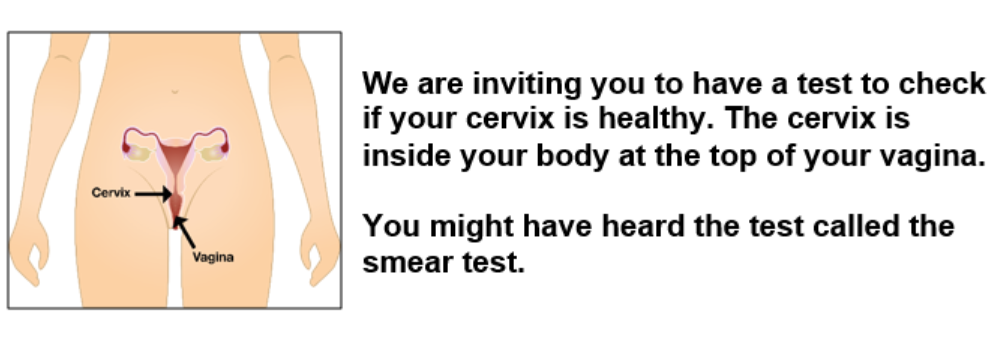
Within an easy read document, the images are left-aligned on the page, with text for each image on the right side. This helps the reader gain an understanding of what the written text says.

However, women with a learning disability, do not receive these easy read versions as standard. Every women invited to screening is given a booklet along with the invite letter which goes some way to explain both what happens during the appointment and the content of the letter. However, would it not be better for everyone to receive an easy-read version in the first instance?

Someone may only receive additional information in an easy read format, if they are identified by their GP surgery as having a learning disability, or because they receive support from healthcare services for people with a learning disability.

What about women who have a mild learning disability and do not receive any support? Or people who struggle to understand written information? It is possible these groups of people will be less likely to attend cancer screening simply because they do not understand the invitation letter.

Four in 10 adults in the UK struggle to understand and use typical medical information designed for the public (NHS, 2020). This is called ‘health literacy’. Having low health literacy has been linked to a range of problems, including poor general health, inappropriate use of health services and reduced life expectancy (NHS, 2020). One mechanism to limit the effects of poor health literacy, is having information in plain English, with simple and short sentences, without jargon.

Therefore, if the NHS is to use standardised letters, should they all be in a simplified, easy read format? This could help services meet the requirements of the Equality Act (2010) which stated that services need to make “reasonable adjustments” to their provision including to the information they provide.

The need for reasonable adjustments within the cervical and breast cancer screening programmes has been highlighted in my PhD research. The research is exploring the attitudes and opinions of women with a learning disability, family carers, and paid care workers towards cervical and breast cancer screening. Within the interviews each participant completes a Q sort (a card sorting task) to identify whether participants agree, disagree, or are neutral towards 28 statements. Each statement is placed on an individual card. The card is then placed onto a grid, to reflect how much they agree or disagree with the statement. Upon completion, it represents a picture of a participant’s range of attitudes and opinions towards cervical and breast cancer screening. The below figure shows a completed Q sort by a women with a learning disability.

Q sort by a women with a learning disability
When designing my PhD research, woman with a learning disability where involved in Patient and Public Involvement (PPI). PPI is defined as “research being carried out ‘with’ or ‘by’ members of the public rather than ‘to’, ‘about’ or ‘for’ them” (INVOLVE, 2020). The Health Research Authority (HRA) has acknowledged that public involvement can positively impact upon the design of research, especially in the design stage (Health Research Authority, 2017). By including Experts-by-Experience it is possible to find out what matters most to the public, especially when the research is controversial or on a sensitive topic. This is the primary reason that I wanted to use PPI during the research. Additionally, there has been very limited research conducted in England on this topic, and involving people with a learning disability in the design of the research.

The PPI in my research was split into three consecutive phases; identifying women’s preferences for how they would like written information to be presented to them; checking the easy-read documentation developed for the research, and obtaining the women’s preferences on the design of the Q grid. The importance of removing jargon and medical terms was highlighted in the results of the PPI, when the phrase ‘lady bits’ was used, women with a learning disability understood the location and some of the problems they might face going for screening, but didn’t always understand the word ‘cervix’. This is an important consideration for the invitation letters to cancer screening.

The invitation letters for cancer screening use terminology such as ‘cervical’, ‘cervix’ and ‘Human papillomavirus’ and assume that people will know what these words mean. What impact could using jargon and medical terminology have on the women receiving the letter? One problem is that women could misunderstand the procedure. Whereas, in an easy read document, the anatomically correct terms could be used, alongside an image, or further description. As the below image depicts:
PHE cervical screening: easy read invitation letter template
Ultimately, should there be standard information provided to all, which is written in a way that everyone can understand? Would more people be able to understand the information? Would this have an impact on uptake of services such as screening, and would this result in a more inclusive healthcare system?


Images:

1. Capture taken from the BBC News website, 18 April 2019, HEALTHWATCH/NHS ENGLAND The template for the letters is drawn up by Public Health England (https://www.bbc.co.uk/news/uk-england-tyne-47946395).