Showing posts with label animation. Show all posts

Friday, 11 September 2026

Strengthening partnerships to improve primary care in the Deep End

Posted by Dr Angela Wearn, Associate Member of Fuse and Advocacy and Engagement Lead for the Deep End Network North East and North Cumbria

In this blog, Angela reflects on what people living in some of the region’s most disadvantaged communities have told the Deep End Network about challenges they face when it comes to accessing primary care, including attending appointments, and what we can do to improve this.

The Deep End Network is a growing GP-led international movement that began in Glasgow in 2009 as a response to the ‘inverse care law’, which is that those who need care the most often struggle the most to access it.

The North East and North Cumbria Deep End Network was established in 2020, with support from Fuse, the Centre for Translational Research in Public Health, and the NIHR Applied Research Collaboration North East and North Cumbria, creating a space for practitioners working in areas of severe socioeconomic disadvantage to share experience, shape solutions, and influence how primary care can better meet the needs of the people it serves.

Funded by the North East and North Cumbria Integrated Care Board, the Deep End Network focuses on four core priorities:
  • Workforce: Building and retaining a well‑supported workforce in high‑need communities.
  • Education: Strengthening training at all levels so current and future health professionals understand health inequalities and access to opportunities
  • Advocacy: Ensuring Deep End practices and communities shape local and regional decisions on funding, access and service design.
  • Research: Evaluating Deep End initiatives to understand what works, why it works, and how effective approaches can be scaled to improve outcomes.
Since 2023, I’ve been working as Advocacy and Engagement Lead to build and strengthen partnerships between Deep End communities, practitioners and researchers, ensuring the experiences and perspectives of underserved patients and communities inform both our research portfolio and the wider support and initiatives we offer practices.

Over this time, additional funding and support from across NIHR infrastructure, including the NIHR Applied Research Collaboration North East and North Cumbria, NIHR Three Schools and NIHR Research Delivery Network, has further supported targeted involvement and engagement work with those living in Deep End neighbourhoods, the majority of whom have had no previous experience of involvement in research or service development.

Support through the NIHR Three Schools collaboration was made possible through membership of Fuse, which is part of the NIHR School for Public Health Research, one of the three NIHR schools within the collaboration.

What we’re hearing from Deep End communities

Many Deep End patients face multiple, overlapping challenges including low income, insecure housing, poor mental or physical health, caring responsibilities, trauma, or homelessness. These pressures make it harder to engage with primary care, even when people want to.

Through conversations, workshops, and community-led sessions, people have shared why engagement can feel difficult:
  • Personal pressures: the emotional and practical effort of attending can feel overwhelming and ‘too much’ on the day of the appointment.
  • Feeling unheard or stigmatised: which makes reaching out feel pointless.
  • Time and capacity: life can be busy, chaotic, and demanding, with health often taking a backseat.
  • Overwhelming contact routes: getting through to the practice or accessing a suitable appointment can feel impossible.
  • Negative past experiences: GP practices don’t always feel welcoming or safe.
Overall, I regularly hear that disengagement is rarely about disinterest, it’s about the collective barriers that build up and make staying connected to care difficult.

What communities say needs to change

Improving patient engagement in Deep End areas is complex. There is no single fix, and practices are working under significant resource constraints. But through our involvement work, communities have highlighted three priorities for investment and change that they feel would make a meaningful difference:
  • Improve connection and communication
  • Strengthen co‑design approaches
  • Build sustainable, community‑based partnerships
These priorities align strongly with national ambitions around personalised care, prevention, and reducing inequalities, and they reflect what people say would help them feel more able to engage with primary care as the wider system shifts towards more integrated neighbourhood-level working.

Moving forward together

The NHS encourages practices to work closely with Patient Participation Groups (PPGs), but Deep End practices face additional challenges: limited resources, diverse patient needs, and complex barriers to involvement. From the community perspective, awareness of PPGs is low, confidence is often limited, and many people are unsure whether their voice will genuinely matter. To support better partnership working, the Deep End Public Advisory Group identified three simple involvement principles that are easy to remember and act upon, and clear enough to come back to when things get busy or complex:
  • Make it easy
  • Make it worthwhile
  • Value patient experience
These principles are practical, community-informed and can be applied across a range of contexts to guide diverse involvement.

New one‑page resources for practices

To help bring these messages to life, we’ve co‑developed two infographics with Deep End patients, communities, and Nifty Fox. They distil community insights into quick, usable one-page resources that GP practices and other decision-makers can draw on to strengthen engagement and build more inclusive partnerships.

Supporting Patient Engagement in the Deep End: insights from the community
Working Better Together in the Deep End: patients and GP practices as partners

These resources will sit alongside a wider collection of materials, including a public‑facing animation and an illustrated impact report, which will be shared over the coming months. A celebration event is planned for early next year.


Why this matters

The Deep End Network exists because tackling health inequalities requires more than goodwill, it requires meaningful partnerships and system‑level commitment. These new resources are an important step in supporting practices and others to work alongside communities in ways that feel respectful, realistic, and rooted in the experiences of people who face the greatest barriers to accessing and influencing the care they receive.

We hope they support teams across the North East and North Cumbria and beyond to strengthen relationships, reduce barriers, and create primary care environments that are more responsive to the needs of communities most affected by health inequalities.

If you would like to know more about partnership working, co-production or our involvement work in the Deep End please contact Dr Angela Wearn (angela.wearn@newcastle.ac.uk)

Find out more about the Deep End Network

About the author
Dr Angela Wearn is Advocacy and Engagement Lead for the Deep End Network North East and North Cumbria and a Research Fellow with the NIHR Applied Research Collaboration North East and North Cumbria. She is also an Associate Member of Fuse, the Centre for Translational Research in Public Health.

Friday, 19 December 2025

Spark ideas, inspire change and fuel innovation - sharing research creatively

Posted by Ella Anderson, Fuse Public Involvement and Engagement Manager, Newcastle University

Have you ever wondered how to share your research in a way that engages with new and diverse audiences? Are there ways to share your work in a way that reaches the people it was designed to serve? If the answer is yes, then read on!

Research can spark ideas, inspire change and fuel innovation but all too often it gets buried in academic journals and dense reports that few people read, particularly the communities the research intends to serve. So what if there were more engaging, creative and accessible ways to share your findings? From interactive infographics and animations, to events, theatre and podcasts, Fuse researchers are re-imagining how to communicate their work with wider audiences.

Whether you are looking to captivate the public, influence policy makers or engage fellow experts, this post explores some creative ideas to make your research truly resonate.
  • In the first instance, reach out to any people who you have worked with as part of your research including public partners, young people, charities and voluntary organisations. What would they like to see? Actively liaise with and listen to the communities your research is intending to serve - how do they want findings presented?
  • Infographics and visual summaries can be a useful way to transform your findings into a simplified visual. Infographics are a graphic representation of information, data or knowledge to present complex content quickly and clearly. Emma Adams has worked with More than Minutes to summarise research about co-located services in a visual and accessible way. Steph Scott worked with Nifty Fox - specialists in visual storytelling - to produce a flipbook drawing on content from the ‘Divided Households’ report relating to children and parental imprisonment. Fuse Deputy Director Amelia Lake, Shelia Visram and team co-produced the Hyper Energy drink leaflet with young people to communicate key findings. Or what about a zine (DIY-style booklet or magazine) like this, ‘Moving Spaces’, co-produced by Caroline Dodd-Reynolds with LGBTQIA+ young people, exploring how physical activity spaces could be more joyful and safe.
    • Theatre and performance is an exciting way of communicating research. For example, Cap-A-Pie and researchers including Mandy Cheetham were involved in developing an emotive theatre production called Credit, based on stories and experiences of people living on Universal Credit.
       
    • Creative and engaging community events and workshops (with catering if you have budget!) are always a popular option. The more interactive, accessible and collaborative the better. Use the opportunity to close any feedback loops with people, charities, organisations who you have engaged with throughout the research. Show how you listened, what you found out, how findings are applicable to people's lives and work, and what happens next... keeping people in the loop is so important. Be sure to include opportunities for plain language Q&As and conversations, both informal (through breaks) and formal (via panel discussions). At one of Fuse’s International Women’s Day events, there was an optional gong bath for people attending the event. Although a sound bath may not have been directly linked to the research, the event was about creating a welcoming, inclusive and ‘safe space’ for people to come together.
    • If you have the budget, consider having an event doodled in real-time. We have had colleagues who have worked with Camille Aubry, Josie Brookes and Nifty Fox who offer this skill. Get in touch with us if you would like any other recommendations when sourcing quotes.
    • Have you thought about gamification of research findings or using interactive digital tools? You can create interactive quizzes or clickable maps to allow people to explore findings in an engaging way, applying insights to local contexts. Simulation tools allow public partners and individuals to visualise the impact of different public health interventions based on research findings. Take a look at Joanne McGrath's online Maze, which provided an interactive resource portraying women’s narratives of multiple exclusion, homelessness and accessing support.
    • Storytelling has long been a way to share information. Case studies lend themselves well to this, as human-centric narratives show the research in action. It can demonstrate how a specific person or community has benefitted or will benefit from the findings. Stories are a different way to 'humanise' data or translate findings in a way that is appropriate for the intended audience. For example, Cassey Muir and Ruth McGovern’s co-produced Twinkle Twinkle Arti children’s story book communicated messages about parental substance use in a gentle, age-appropriate manner. The book is available as a physical copy, an electronic copy and also has been made into a CBeebies style story time video.
    • Are there any opportunities for the use of creative methods throughout the project that you could bring together as part of an exhibition in a public space e.g. library, community centre, schools? Documenting the research and experience through photography, crafts or art can be a creative way of capturing interest and making research more understandable. Sarah Martin-Denham’s crochet blanket made up of 2,999 squares representing the number of children excluded every day from schools in England (2021/22 academic year) is a great example of this, and has been on a national tour engaging with 24 organisations - including the Children’s Commissioner Office and multiple councils.
    • You can share bite-sized research or findings through social media channels using visuals, animations, short videos - or even livestreaming to provide information and engage with people in real-time. Have a hashtag at the ready to encourage people to join the conversation and share perspectives. In a similar vein, there are opportunities to share research and knowledge via 'Ask Me Anything' style forums, for example as seen on Reddit. Yes, this is low cost but it comes with risks as questions are unpredictable! However, it is worth flagging as an option and is a creative, ‘non-traditional’ way to share research and answer questions.
    • Blogs, like the award-winning one you are reading right now, are a great way to share your research. Posts can make complex information more accessible to a wider audience. It allows you to present findings in a clear, engaging and informal style, reaching readers outside of academic circles, including policy makers, practitioners and the wider public. For guidance and support in writing your own blog post, contact Fuse Communications Manager, Mark Welford: m.welford@tees.ac.uk.
    • Could you take your research findings to places in the local community? Fuse colleagues Balbir Singh (Artistic Director of the Balbir Singh Dance Company) and Paul Chazot displayed art works from their Unmasking Pain project in pop-up displays in GP surgeries and a repurposed shop in a shopping centre. There is now a dedicated space at the Grainger Market, Newcastle-upon-Tyne called the Being Well Place, which is a place to connect and engage with the local community.
    • Do you have the option of translating materials/outputs for different audiences, and communities with diverse language needs? Translated summaries and visuals e.g. in multiple languages, work well and ensure inclusivity in dissemination. For example, Nicola Heslehurst worked with local designer, Twentyseven Design to develop English and Welsh infographics relating to pregnancy outcomes.
    • And finally what kind of Fuse Public Involvement and Engagement Manager would I be if I wasn’t promoting the wonderful and award-winning public partner-led podcast Public Health Research and Me?! Accessible, informative, flexible and friendly - this is a great way to share quality research with a diverse and international audience. 

    There are many more creative ways to share research and remember - there is a no ‘one-size-fits-all’ approach to sharing your findings. Always take into account your research topic, your findings and above all your target audience.

    Why not send us a message today if you have used a creative or innovative way to share your research or findings? We would love to hear from you and find out more ways to promote and share high quality research.


    Following strong interest from Fuse members, we have launched a Community of Practice (CoP) focused on creative research, involvement and dissemination.

    The first meeting will take place in the New Year. Places are limited for the first event but please register or get in touch (info@fuse.ac.uk), as there will be plenty more opportunities in future!

    A CoP is a network of people who share common interests and goals, creating a space for knowledge exchange, learning, and mutual support.

    Friday, 17 May 2024

    Animating practitioners to take action on stigma

    Matty Starforth, Public Health Practitioner-Harm Reduction and Social Inclusion Portfolio, Newcastle City Council

    “Stigma, stated simply, is a set of negative and often unfair beliefs. Stigma can be experienced on a societal, structural and personal level. It is employed largely unconsciously but at times also consciously”. 
    Anti Stigma Network


    Stigma is often a word that is associated with harm but it is important to recognise that stigma can have a huge impact on individuals and groups in society. From my own professional experiences, I am aware, like many of my colleagues and partner services are, that the harms of stigma can include and are associated with inequality, disadvantage, discrimination. Stigma increases stress, shame, depression, isolation, and can lead to the avoidance of healthcare and decreases treatment engagement and retention for individuals and groups.


    It’s clear that there is a need to address stigma and embed an ‘anti stigma approach’ as part of the work we do to tackle inequalities, but doing so can be challenging. While people tend to be generally aware of the term stigma and how this can affect individuals, there is often less understanding of the depths that people go through to avoid and overcome the stigma they experience, such as not attending appointments or seeking the help or support they deserve. There is also less awareness of the steps that we can all take as individuals to not only avoid stigmatising people through our language and practices, but also actively speak out and promote an anti-stigma approach more widely.

    What we are doing about it

    To address this, we have had several areas of work in Newcastle upon Tyne looking to raise awareness and address some of the harms of stigma on others. This started with the publication of Drugs, Identity and Stigma and ongoing discussions about changing how we focus on people who use drugs or alcohol and the language we use for those facing multiple disadvantage and exploitation. Academics, policy makers, public health and key stakeholders, from working together on various research, came together to deliver a practitioner conference, improve practitioner training, development and networking and production of a practice briefing, stigma animation and a planned education package. All of this has been informed by lived experience.

    In May 2023 we worked with partners to hold a conference to over 320 practitioners, service providers and community members from across the region. The Stigma, Trauma, Substance Use and Domestic Violence Conference involved a range of international, national and regional researchers and academics including a keynote talk from international anti-stigma lead, Professor Carla Treloar. The Conference was designed to promote knowledge exchange and good practice of Anti-Stigma work from across the region. A practice briefing that was developed from the event can be found here. A key theme in the discussions has been around vulnerability and exploitation, and partners have worked together, from research developed by the University, to produce animations around exploitation and home takeover. Research into practice improvement. Two artists were employed to capture the key themes and discussions of the conference as a visual (see below) which could then be shared with services.

    Visual capturing the key themes and discussions of the conference

    Developing the stigma animation

    From this work, we explored how we can explain the ongoing theme of stigma and its impact. A recent project that I have coordinated, in collaboration with university colleagues, is the production of a stigma animation which you can see above. Aimed at practitioners and volunteers, this will help raise awareness and become a key resource to support the work and objectives we have within Newcastle Public health, and also the wider local authority. The animation has involved consultation and input from a range practitioners, service users and individuals with lived experience of stigma. At each stage of the animation production, I have attended the Newcastle Service User and Carer forum. Inclusion of those with lived experience of stigma was essential in these discussions and has been key in helping to shape the direction and design of the animation, particularly in relation to service needs and solutions.

    A key challenge during this work has been ensuring we produce an animation which doesn’t unintentionally stereotype or stigmatise individuals through the imagery used. There has been a lot of thought-provoking conversations and discussions which have led to both personal and professional reflections. For example, figures in early storyboard drafts of the animation which were uniformly male and able bodied were subsequently changed to be more inclusive and represent a diverse range of bodies. Throughout the process there have also been a lot of discussion in relation to the language that we use to support the imagery. Some key insight was gained from the Newcastle Service User and Carer forum where participants identified examples of where they had felt stigmatised through language and how potential changes could have changed outcomes. These examples have been included within the animation to highlight the impact of language.

    We plan to share the animation across a range of practitioners working within fields such as drug and alcohol, mental health and wider health and social care roles. This will support the drive to encourage sign up to the Anti-stigma network and prompt organisations to develop an anti-stigma strategy for their workplace. Alongside this we wish to support practice improvement by developing a stigma education package, which the academics are leading on, and which we hope to eventually deliver through an educators by experience model.

    Addressing stigma will require individual and collective action from all of us, and so we urge you to please watch and share the animation, use the resources available, sign up to the Anti-Stigma Network and help us to spread an anti-stigma approach.

    Background and context

    Addressing stigma is a key priority in Newcastle upon Tyne. In 2022 the Director of Public Health report stipulated that policy and practice should ensure health improvement is free from stigma. This issue is also gaining National traction, with the Office for Health Improvement and Disparities (OHID) recently announcing the project ADDER stigma indicator programme and currently adapting Professor Carla Treloar’s (University of New South Wales) Australian stigma indicator and monitoring model for the UK. The NHS Alliance Stigma Kills campaign has recently been rolled out, with the North East and North Cumbria Integrated Care System (ICS) backing this campaign for our region. The Anti Stigma Network has also recently formed to raise the profile and awareness of stigma, especially the impact on people who use or have issues with drugs and/alcohol.

    Friday, 16 June 2023

    The Power of Partnership

    Our Top Tips for co-production with inclusive and meaningful Public and Patient Involvement and Engagement 


    Posted by Rosemary Nicholls, Patient and Public Involvement and Engagement (PPIE) member, and Charlotte Parbery-Clark, Fuse researcher at Newcastle University and Public Health Registrar

    This image was co-produced with members of the public, researchers and film production company Kaleidoscope CFA as part of the UNFAIR research programme. You are welcome to use and share the animation or images whilst acknowledging the source (https://bit.ly/UNFAIRstudy) when doing so. 


    Earlier this year, members of the public with researchers at Newcastle University launched an animation that explores public views of health inequalities. The animation was created as part of the UNFAIR project, which is funded by the National Institute for Health and Care Research (NIHR).

    Here Rosemary and Charlotte share their experiences as co-applicants on the project and give some top tips for members of the public and researchers.


    Rosemary

    "A key factor in the success of this project was the leadership style of the professional UNFAIR researchers. Their excitement and commitment to the study and to us as members of the Patient and Public Involvement (PPI) advisory team was infectious. The timely exchange of emails kept us all informed of progress and involved in deciding next steps. There was ongoing respect for what we had to offer.

    "I was confident in my views and sometimes doubtful about the practicalities of what was being proposed, thinking: “This isn’t going to work.” But I found various methods much more successful than I expected and I learned through my surprise that I’d been wrong!

    "A risk of consulting people in disadvantaged settings is that they may assume that the researchers will be able to effect immediate improvement in their circumstances, so it’s important to be clear from the outset about the aims and likely outcomes of a project and I feel we succeeded in this. The people we met in community groups emphasised how vital it is for them to be treated with respect and I’m confident that we put their needs at the top of our agenda when we asked them questions.

    "There were occasions when we had to reassess our approach and resilience became a useful quality. The excellent teamwork that Charlotte and I had developed over previous months enabled us to undertake a successful review of our methods and move forward."

    Charlotte

    "When the opportunity came up to co-lead the project, I was excited but also a bit apprehensive as I was new to this type of work and was unsure about how to 'get it right'. One thing I was sure of was that I wanted to involve members of the public throughout the project in a meaningful way and avoid it being 'tokenistic'. So, the start of my PPIE journey involved lots of reading and reflecting about how to approach it!

    "Co-leading with Rosemary and working with the UNFAIR PPIE contributors was invaluable as we could bounce ideas off each other and consider a variety of perspectives. They kept me right with the 'academic speak' I would sometimes slip into. I learnt so much with so many firsts, such as applying for funding for this type of work (and being successful!), creating flyers, navigating remuneration, as well as being involved in creating an animation."


    Top tips for members of the public (especially if considering a co-applicant role)
    • Be confident about taking up the role, if you would like to do it. The researchers have asked you because they’re confident you can contribute relevant skills and experience.
    • Check that you have the time to commit to being a co-applicant. In terms of hours, the commitment may not be very great, but being able to respond to emails quickly (within 48 hours) and to attend online and in person meetings at arranged times can be important. It’s likely that you will be consulted about suitable times, perhaps by doodle poll, but there may be occasions when you need to prioritise the project to ensure continuity and re-arrange your diary. Ongoing dialogue between you and the researchers to figure out the best approach together works well.
    • Each stage of the project will be well-planned and costed in advance by the researchers and the lay co-applicant is paid by the hour in my experience, depending on the nature of the work. However, there may be occasions when lay co-applicants feel that they can offer further insights and they should feel freely encouraged to check that comments outside the box will be welcome and if so, volunteer their thoughts to the researchers by email.
    • Be willing to ask questions of the researchers and put your point of view across with confidence, but be prepared to find that your assumptions may be proved wrong as the project progresses. Remember that it’s a learning process for us all. Be resilient when necessary and work together to keep the project on track.

    Top tips for researchers

    Ways of working:

    • Decide how you will involve public contributors at each stage of the project in line with your budget.
    • If working with a specific group of PPIE contributors on a project, decide together how you would like to work. There are tools to help you with this, such as Working Together.
    Diversity and inclusion:
    • Remove barriers for involvement as much as you can. For example, provide options such as different online and/or in-person sessions on different days/times, go to community groups and be flexible about timings to ensure it suits public contributors (not expecting people to come to you), or use online platforms, such as Padlet, for people who want to be involved but can't attend the session.
    • Language is really important, be as clear and as simple as possible.
    • To increase diversity of public contributors, networks can help promote the opportunities particularly in public health research compared to disease related research as public health research typically has a wider remit.
    Time:
    • Building relationships is key and takes time. It is good practice to keep people updated and adapt according to need where you can.
    • Make sure you know how to remunerate public contributors in your organisation before any PPIE sessions to reduce delays.
    • Build in extra project time for unforeseen events.
    Challenges:
    • Any challenges that may come about with PPIE work or co-production are opportunities to make the project even better, see them as gifts.
    • Sometimes, what is feasible in the time/resources available may not align with the feedback so be clear that you may not be able to act on all suggestions at the outset. Compromise as well as sharing why you have not been able to act on certain suggestions is useful. Have a way of deciding what you will do if the feedback conflicts with others' feedback is important.

    Involving members of the public is incredibly worthwhile strengthening the project in so many ways. Also, undertaking PPIE and/or co-leading provides opportunities for rich learning and skill development for both researchers and public contributors. There is lots of support especially if this is your first time doing this type of work, as either a member of the public or researcher. To find out more about PPIE or public co-applicants, the following resources may be useful:

    Guidance:
    Opportunities for public involvement:
     

    -----------------------------------------------------------------------------------------------------------------------------------------------------------------------------------------------------

    Rosemary Nicholls is a Patient and Public Involvement and Engagement (PPIE) Representative and Consumer Panel Member, National Institute for Health and Care Research (NIHR) Research Design Service (RDS) North East North Cumbria (NENC) and one of the UNFAIR PPI members.

    We would like to thank the UNFAIR PPIE and research team, members of staff who helped facilitate the online workshop as well as everyone who took part in the workshops.

    This project was funded by the Tilly Hale Award from Newcastle University and the National Institute for Health and Care Research (NIHR) (ref CA-CL-2018-04-ST2-010).The views expressed in this blog are of the authors and not necessarily those of the NIHR, the Department of Health and Social Care or Newcastle University.

    Friday, 30 September 2022

    Going beyond research to empower involvement and smash stereotypes

    Posted by Sheena Ramsay, Professor of Public Health & Epidemiology, (and team: Emma Joyes, Emma Adams, Laura McGowan) in collaboration with Fulfilling Lives Newcastle Gateshead Experts by Experience

    The way researchers approach some groups is often not sensitive to or inclusive of their needs. For example, the information can use technical language (such as ‘licit substances’ or ‘quasi-experimental’) which can be difficult to understand and off-putting. This can lead to people not wanting to take part in studies. Which means that new research insights, including changes to practice, can exclude those who are often most impacted.

    Over the last two years, we have been working with Fulfilling Lives Newcastle Gateshead and their Experts by Experience Network of individuals with lived experience of multiple disadvantage. We have explored perceptions of services and programmes relating to oral health and related health behaviours - such as substance use, smoking, and diet - for people who experience severe and multiple disadvantage (a combination of homelessness, substance misuse, and offending). From the beginning, the Experts by Experience Network has shaped our work and helped us ensure it is accessible to those we want to speak to the most.

    One of the ways that the Network has shaped our research is by helping us to create a video to help reach out to potential participants for our research - particularly people who are often excluded in research studies, such as people experiencing homeless.


    Our team worked with the Experts by Experience Network to look at ways to get people involved in the research. We wanted to work with those who had insights into the issues we hoped to study, so that we could communicate the research in a way that would resonate with people. Together, we co-created an animated video as a means of reaching out to people, so they could find out about the research and how to take part.

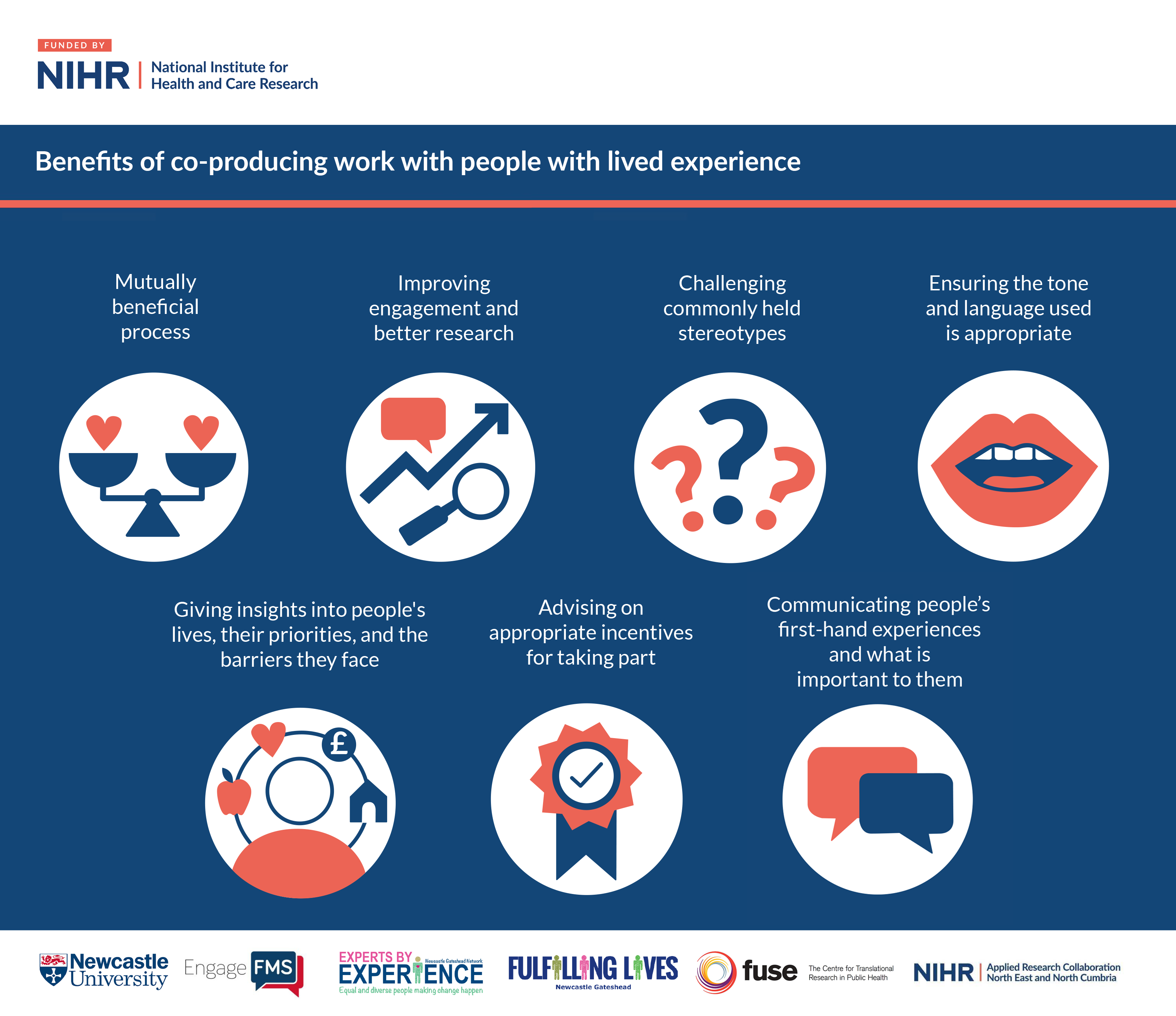
    The infographics in this blog show what we have learnt from this process of co-creating the video and the value of co-production.


    Creating a video provided an easy way in which organisations (such as Crisis, Fulfilling Lives, and other providers) and local Expert by Experience networks could share information about the study.

    Those involved in creating the video were able to draw upon their experiences to help shape the content. One of the members of the group shared their experience of the process:
    “Some of us in the Network feel really strongly about this issue and have personal experience of it ourselves so we were keen to be involved and share our ideas and opinions.”
    Another member said:
    “I joined this project because my own oral health has been something I've been embarrassed about in the past so I thought I could add something useful to this work.”
    We have tried to map out how we designed our video in the image below.


    The video has also been shared nationally with a wide range of organisations that support severe and multiple disadvantage groups in Newcastle and Gateshead, London, and Plymouth to promote engagement with policy and commissioners, local authority, criminal justice system, primary care, and third sector organisations. Producing a video was no easy feat, but it was a simple way of sharing our research with people who are pressed for time. You can check out the video below.


    A clear benefit of engaging with people with lived experience was having their input on how best to communicate our research widely. They provided real-life stories and examples, which helped create the narrative for the video. They helped challenge stereotypes of ways in which people can be portrayed in research studies - this resulted in modifying the images and language used in the video which were much more realistic and sensitive to the people we were wanting to engage. This has helped our research team become more aware of and appreciate the importance of stereotyping and how it can result in putting people off taking part in research.

    The benefits reached beyond the research team and the video (the below infographic highlights some of these), as many of the Experts by Experience echoed how involvement has led to them feeling empowered and one member wrote a blog about their experience.


    We plan to build on this collaboration as we continue our research and gain further input on findings from our study and next steps.


    This study ‘Improving the oral health and related health behaviours of adults experiencing severe and multiple disadvantage: evidence synthesis and qualitative stakeholder research’ is funded by the NIHR Policy Research Programme (grant reference NIHR200415). The video was supported by Newcastle University Engage FMS. The views expressed are those of the author(s) and not necessarily those of the NIHR or the Department of Health and Social Care.

    Friday, 10 May 2019

    Why do some women continue to smoke when they are pregnant?

    Guest post by Susan Jones, Research Associate, Teesside University
    "I was 12 years old when I started to smoke. I wasn’t thinking long-term, about my future, about the adult world I would one day join … I just wanted to look cool among my peers, be accepted and act grown up. Then I really did grow up and I was still smoking. Then I became pregnant … and I was still smoking. I didn’t exactly choose to be a smoker when I was pregnant but here I am ... addicted and not really wanting to give it up, or even if I wanted to, I don’t think I could – even for my baby.
    "My mam smoked when she was pregnant with me, and I’ve turned out all right; all my family smokes, all my friends smoke, my partner smokes too; in fact smoking is a part of all my close relationships, especially with my partner, we smoke together, it is part of how our relationship works."

    "I feel guilty, oh so guilty, but I can’t, I really can’t give up – I simply do not have the confidence to do it. I know that ‘smoking is bad for my baby’; I care for my baby and don’t want to do anything that would cause harm, and I’m really looking after myself, eating well, not drinking any more. I’ve cut down but I hardly dare think about quitting smoking, how on earth would I cope? And my partner, he’s not willing to change his smoking habits, or at least he’s agreed he’ll just not breathe over me when he’s been smoking, but he’s not even prepared to cut down – all he does is tell me, you must quit for the sake of the baby."
     
    A composite from interviews with pregnant smokers and maternity staff.


    Smoking is highly addictive and habit forming; many people enjoy the feeling it brings too[1]. Nevertheless the damage from smoking to the developing baby is well documented and the high level of smoking in pregnancy is still a major public health concern[2]. The National Institute for Health and Care Excellence (NICE) Public Health Guidance 26 (2010)[3] sets out all the trial-based evidence relating to the activities health professionals should take to support pregnant women to quit smoking. BabyClear© is a programme that supports health professionals to implement NICE guidance and provides standard training for them in order to carry out the activities in the most effective ways[4].

    When we evaluated the implementation of the babyClear© package during its roll-out across North East England, we found that, for healthcare practitioners to challenge smoking behaviour amongst pregnant women, there needs to be a whole support system in place for both the professionals and the women whose behaviour they seek to change[5].

    We recently developed an animation, based on our findings, which you can watch here:


    South Tees Hospitals NHS Foundation Trust took part in the evaluation of the implementation of the babyClear© package and works closely with its local stop smoking service. As Joanna Feeney, the Smokefree NHS Strategic Manager, says:
    "South Tees is a great example of how Stop Smoking Services and Maternity Services can work together to help support Pregnant women to have Smokefree Pregnancies. 
    "Most women who smoke during their pregnancy may know that smoking is bad but they are not aware of all the risks to them or to baby, they are also not aware of the help and support that is available to quit, including treatments such as Nicotine Replacement Therapy. 
    "Implementing advice and treatment as part of routine Maternal care that is continued outside of hospital with the Stop Smoking Service helps ensure that babies are given the best start in life. 
    "Last year in South Tees there were 334 more babies born Smokefree compared to 2012, and this year following the great work done on the wards at James Cook University Hospital the numbers are continuing to reduce but we recognise that there is still more to be done to ensure that every baby is born smokefree."
    The Maternity and Stop Smoking Services reviewed the referral pathway and developed an online referral system that not only makes it easier for midwives but increases the speed with which women are contacted and given an appointment with the Stop Smoking Service.

    Image courtesy of South Tees Hospitals NHS Foundation Trust
    The Stop Smoking Service provides regular feedback to Maternity on the outcomes of women referred, enabling Maternity to offer bespoke interventions to those women who do not engage with treatment.

    A further example of how South Tees Hospitals NHS Foundation Trust has moved towards a whole support system and worked in close partnership with stop smoking services is an initiative they undertook last year to redecorate the entrance to their maternity unit using eye-catching posters with a strong, stop smoking message.

    And now, a year on, Kay Branch, Consultant Public Health midwife, South Tees Hospitals NHS Foundation Trust says:
    "We are still really proud to have led the way towards a smokefree Trust. Our staff have noticed a reduction in the presence of anyone smoking outside entrances. 
    "We continue to work collaboratively with the local stop smoking service to ensure a streamlined service for women and their partners. Nicotine replacement therapy is available to all of our patients and is widely used across maternity. 
    "Our smoking at time of delivery reflects our hard work and passion for smokefree families."
    Maternity’s lead has inspired the whole Trust to implement a systematic approach to treating tobacco dependency with Maternity being the model ward.


    I would encourage you to take a look at the animation above and publications relating to the roll-out of the babyClear© intervention package across the North East region. Please do share them with commissioners and providers of services, but also your colleagues, family and friends and any pregnant smokers you know.

    More information on our evaluation work can be found here on the Fuse website.


    References:
    1. Chamberlain, C., O'Mara-Eves, A., Porter, J., Coleman, T., Perlen, S. M. et al. (2017) Psychosocial interventions for supporting women to stop smoking in pregnancy. Cochrane Database of Systematic Reviews. Accessed on 18/03/19 at: https://www.cochranelibrary.com/cdsr/doi/10.1002/14651858.CD001055.pub5/epdf/full
    2. Bauld, L., Graham, H., Sinclair, L., Flemming, K., Naughton, F. et al. (2017) Barriers to and facilitators of smoking cessation in pregnancy and following childbirth: literature review and qualitative study. Health Technology Assessment, 21(36). https://www.journalslibrary.nihr.ac.uk/hta/hta21360#/abstract
    3. National Institute for Health and Care Excellence (2010) Quitting smoking in pregnancy and following childbirth: public health guidance 26. NICE: London https://www.nice.org.uk/guidance/ph26/resources/smoking-stopping-in-pregnancy-and-after-childbirth-pdf-1996240366789
    4. Bell, R., Glinianaia, S. V., Van der Waal, Z., Close, A., Moloney, E., Jones, S., Araujo-Soares, V., Hamilton, S., Milne, E., Shucksmith, J., Vale, L., Willmore, M., White, M., Rushton, S. (2018) Evaluation of a complex healthcare intervention to increase smoking cessation in pregnant women: interrupted time series analysis with economic evaluation. Tobacco Control, 27: 1. Accessed on 18/03/19 at: http://tobaccocontrol.bmj.com/cgi/content/full/tobaccocontrol-2016-053476
    5. Jones, S.E., Hamilton, S., Bell, R. Araújo-Soares, V., Glinianaia, S.V., Milne, E.M.G., White, M., Willmore, M., Shucksmith, J. What helped and hindered implementation of an enhanced package of measures to reduce smoking in pregnancy: process evaluation guided by Normalization Process Theory. BMC Health Services Research [In press]

    Thursday, 11 February 2016

    Animation designers... a day in the life of a researcher (part 2)

    Guest post by Dr Victoria McGowan, Research Associate, Alcohol and Public Health, Teesside University, @teamalphatees

    Team Alpha recently spent a few days with Arcus Animation Studios and we were joined again by our two young people, Megan and Glen, from local schools who have been helping us develop the animation which introduces our SIPS JR HIGH study to participants. Arcus designed and produced our 2D cartoon animation and kindly let us into their studios for a behind the scenes peek at how they work. Here are some reflections on how it went:

    The team at Arcus were so welcoming and introduced us all into their creative world. Megan and Glen were shown how animations are developed and given tutorials on using various different graphic design software and tools, such as the graphic tablet. Team Alpha spent time admiring their work environment (an Aladdin’s cave of toys, games consoles and a miniature Star Wars AT-AT Walker) and were eager to join in the weekly Street Fighter competition held in their fantastic common room.
    The animation team at Arcus
    While Team Alpha were reliving their youth, Megan (centre above) and Glen were hard at work developing animation characters and storyboards. On day two Megan was interviewed by Arcus and described how her passion for graphic design influenced her decision to assist us in the development of our SIPS JR HIGH animation.

    She said: “I have been helping Teesside University in terms of creativity and research for the animation. The reason for this is because I am interested in graphic design myself and would love to get involved in some experience and voluntary work with animation and design companies”

    The experiences of Megan highlights the benefits of participant involvement in the development of research, not only to the study, but also to the individuals. Megan and Glen were able to gain experience of working in an animation studio and see first-hand what a career in this area would be like.

    “I like how the job will include drawing, animation and creativity. It also inspires me to be myself and not to follow instructions of what to do as part of designing something. I also like how you can design your office to what you like and enjoy, I think that it’s good for people to express their likes of designing and working with people that have the same interests as you”

    Megan was very grateful for the opportunity to spend time with Arcus, this gave her insight into the life of an animation designer and gave her confidence to continue pursuing this career.

    “I think Arcus has been very useful and they have given me ideas for further experiences and other work that I will be doing. They have given me a warm welcome into their company and also took me through tutorials of how their programs work and what they do to build up an animation. I have enjoyed my time at Arcus and the people here are very nice and outgoing! They each have their own personality which I like and they all have a story behind how they have achieved what they have done to become an animation designer.

    Thank you Arcus!”

    Thursday, 8 October 2015

    Animation designers…'the day in the life of a researcher'

    Guest post by Megan and Glen (TeamAlpha)

    TeamAlpha (The alcohol team at Teesside University: Professor Dorothy Newbury-Birch, Dr Emma Giles, Dr Grant McGeechan, Dr Victoria McGowan, Gillian Waller, Lisa Anderson, Robert Sayer) were joined by two young people from local schools - Megan and Glen – who helped the team to develop the groundwork for an animation video. This video is part of the SIPS JR-HIGH trial, a multi-centre individual-randomised controlled trial of the effectiveness of brief alcohol intervention for 14-15 year olds in a school setting. This animation video is currently being developed to show to young people in the school setting, and will be used to provide advice on how to complete the questionnaire component of the trial. This animation replaces the need for individual researchers to enter all the schools in the trial to inform the young people about the study process.

    In order to develop the animation Megan and Glen spent two days drawing storyboards, drafting scripts, searching for background music, and even thinking of examples of voices for the characters. This blog was drafted by Megan and Glen to highlight their thoughts on being a researcher and graphic designer for two days.


    Day one

    Brainstorming and initial storyboards were created as we worked hard all morning. We had a jolly start to the day and thought it was quite interesting and fast going, however more tiring than anticipated!

    Individual tasks were completed as we both researched ideas for the animation, even though we had to overcome difficulties associated with having to think of our own ideas for the initial designs for the animation. We definitely thought it was more hands on than we thought it would be, given the number of tasks planned throughout the day. We developed character images and screen shots for the video and really liked the process of doing this.

    Storyboards

    We felt that we worked hard during the first day at the University but we really enjoyed ourselves. This is partly due to the fact that we’d both like graphic design careers, and so a ‘taster’ of the process was really helpful. We were busy most of the time throughout the day; this was tiring, but also stopped the boredom setting in. This project showcased our skills in graphic design and our use of technology that we have learnt from school. Our experience of drawing, researching pictures and mood board designs really impressed TeamAlpha. As the day went by we described our visit to TeamAlpha as interesting but “full on” given that we did a 9-4 job!

    TeamAlpha was very welcoming and Dot (the Professor!) helped us with our ideas and team work. Emma also mentored us throughout the two days, helped guide our ideas, and helped us to showcase our skills as designers. Initially it was hard to build a rapport with each other, since we came from different schools, but by the end of the first day we worked as a duo much better.

    Day two

    The second day was more relaxing since we knew who we were working with in terms of TeamAlpha, and we were also getting used to each other. Additionally, the environment felt more relaxing since we had been there before; this helped us to interact better with each other and helped us to work on our tasks much more quickly. The day was very interesting, particularly when we found out what the animation script was – basically what each character says during each scene. We enjoyed editing this script to make it relevant for the target audience, which will be Year 10 students. It was good to see all of the different components coming together to become the animation.

    Overall reflections

    The two days were interesting for us both and I think our experience with TeamAlpha was brilliant. We thought the team were really cooperative and they communicated very well with each other – particularly during our ‘picnic’ lunches. We feel that the work that we created and produced on these two days will enhance our CVs and help inform the work that we will be doing in school and college next year. We were really surprised by the range of tasks that researchers undertake, and the amount of thought and research that has to go into making such a short (2 minute!) animation. We really feel that we have learnt the basics of research, working independently and as part of a team, and overall we really enjoyed being in such a creative environment. We’re really excited to see the finished animation later in the year, to see how our thoughts and work have helped shape the final video.

    TeamAlpha