Showing posts with label fuseduck. Show all posts

Tuesday, 6 January 2015

Fuse Duck and Rachel’s Day Of (health policy related) Fun

Posted by Rachel Stocker

During the final year of my PhD (2014) I was very lucky to gain funding for a three month fellowship at the Houses of Parliament, Parliamentary Office of Science and Technology (POST). POST is an office of both Houses of Parliament, providing independent and balanced analysis of public policy issues that have a basis in science and technology. POST recruits around 20 fellows per year, funded by a range of funding bodies including the Economic & Social Research Council (ESRC), the British Psychological Society (BPS), etc, to research and write a four page briefing ‘POSTnote’ on a science/technology related subject. The POSTnote itself gives a concise, unbiased overview of information, highlighting key areas for parliamentarians to consider when policy is being made. It’s (genuinely) a great opportunity to see how health policy actually works within parliament and the angle which parliamentarians take on health subjects rather than the angle researchers might take. Plus you get to wander round the parliamentary estate (as it’s called), eat in the subsidised restaurants, chill out next to Churchill… and… yeah!

I applied to work on the topic of end of life care, and as it happens, end of life care is high on the policy agenda at the moment. I wrote my POSTnote – which can be found here – between April and July 2014. Most POST fellows actually live in London for the three month period – which is fabulous – but as I’m pretty much set up here in the North East, with a husband, mortgage, and four babies cats, I couldn’t really swan off down to London. Luckily I could conduct nearly all of the required research and interviews from home, with a little bit of travel to London every so often to conduct interviews – most of the ‘big names’ live in London or nearby (sad but true) – and catch up with my supervisor at the POST offices.

Rachel and Fuse Duck at Queen's Campus, Durham University
So what does this have to do with Fuse Duck, I hear a chorus of voices ask? ……… well, Fuse Duck and I recently had a fabulous research policy day out (is this a thing?). He accompanied me to an event held at Portcullis House, run by POST, on my POSTnote. The event itself was titled ‘Palliative and End of Life Care’ and was a seminar, with several peers, MPs, researchers, and other interested individuals.

However when I say accompanied… Fuse Duck did not actually accompany me into the event. Despite having lugged him on a train from Darlington to London King’s Cross, then on two tubes across London to Westminster (he’s a bit portly and was shoved into my little suitcase on wheels), the security staff at Parliament deemed poor Fuse Duck to pose too much of a security risk in a parliamentary building. He had to sit in his bag at the security desk, next to the x-ray machine, and wait for me.

Who knew a lovingly hand knitted duck would pose such a threat to the inner workings of our parliamentary system? He didn’t seem too fussed luckily – although I could swear I saw an evil twinkle in his eye before we set off…

POST fellowships are open to those in the second or third year of their PhD (and some are open to post-docs), more information can be found here.

Thursday, 25 December 2014

Tuesday, 15 July 2014

Fuse duck flies into the University of Northumbria

Posted by Barbara Harrington

Fuse Duck arrived at Northumbria University on 30th May for a few weeks with me, Barbara Harrington, a researcher and lecturer in public health and patient safety. He quickly settled in having a cup of tea with his new friend, Stress Penguin from Redcar. Stress Penguin was liberated from Redcar whilst doing some interviews around Healthwatch, looking at the role of the new patient and public involvement organisations in the North East.


By Tuesday 3rd June and a lot of switching between PDFs, Excel Files, SPSS and SurveyMonkey for a Delphi project, something stronger than tea was called for. Fortunately Lesley Geddes (in the background), a principal lecturer with a particular interest in health promotion, behaviour change, and social marketing for health, was on hand to provide corrective public health messages about responsible drinking.


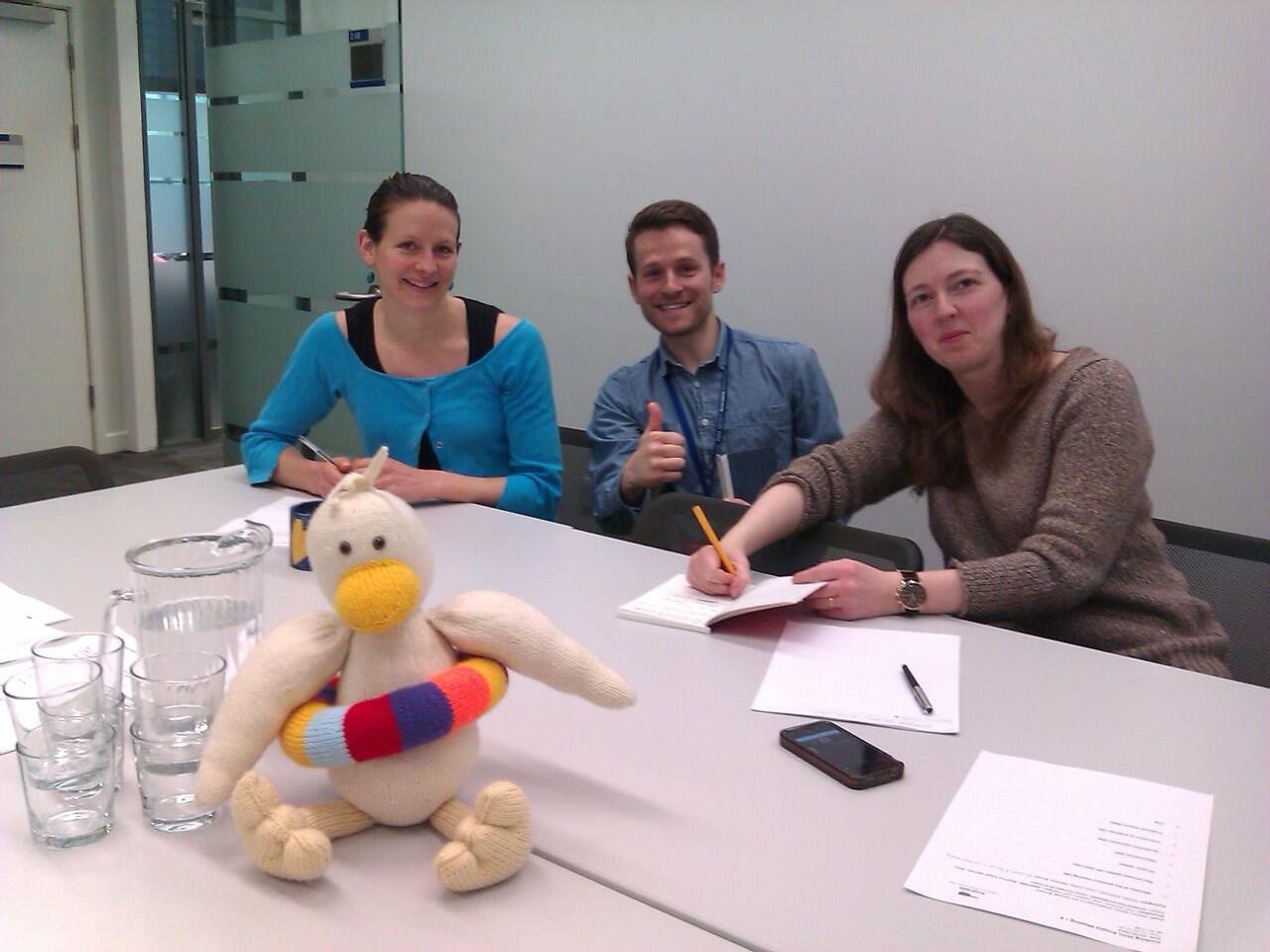
On Wednesday, 4th June, Fuse Duck joined in the celebrations when copies of Reforming Healthcare appeared written by Profs Ian Greener, David J Hunter, Russell Mannion, Martin Powell - and me! This is a major critical overview of the research published on healthcare reform in England from 1990 onwards. As you can see, Fuse Duck is riveted, considering the implications of this research for current debates about healthcare reorganisation in England.


Also on Wednesday, Fuse Duck attended our theory discussion seminar - the highlight of the month for many research staff, PhD students and other academics months. Here, staff from different disciplines within the faculty read and discuss some of the key theoretical texts from the social sciences. The seminars are led by Mick Hill, Robbie Duschinky, and Ian Robson. So far we have looked at chapters from Foucault’s Psychiatric Power lecture series, and Bourdieu’s Misrecognition and Symbolic Violence. These are always well led and interesting, discussing theory in relation to the times they were written and how relevant they continue to be. 

In June, we discussed Goffman’s Presentation of Self – Chapter 1. As usual the discussion was wide ranging including references to Hamlet, as well as presentation of self in relation to higher education teaching and health, social work, and education practice. With Fuse Duck attending, there was also a discussion about whether he had inadvertently disrupted the expected setting and consequently the personal fronts people displayed in this seminar. It was in fact a very apt seminar for Fuse Duck to attend. Here he is Ian Watson and me getting to grips with some of the finer points of Goffman.


Tuesday, 3 June 2014

The day Fuse duck came to town

Posted by Jean Adams

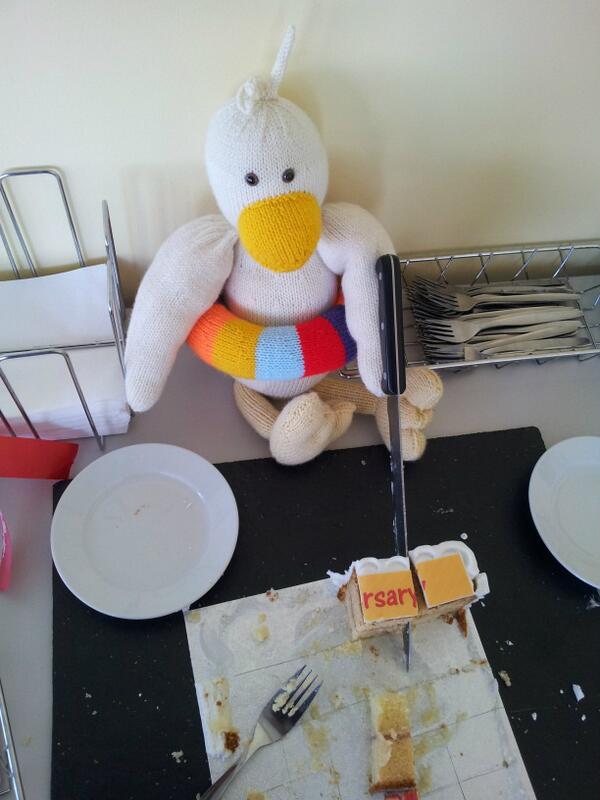
So you might remember that Fuse duck is going on a road trip around the North East region trying to find out what it is that Fuse researchers do all day. He is not, as some might have you believe, the new ‘marketing intern’ at Fuse. And he is certainly not an unpaid intern. No, you can rest assured that Fuse duck is very well recompensed for his labour. Mostly in cake, only rarely in stale bread.


It was right at the start of May that Fuse duck came to Newcastle to visit the Institute of Health & Society. I looked after him. I quite enjoyed having him. He dragged me around the place desperate to meet everyone and I ended up saying hi to a bunch of people I hadn’t met, or had only half met, before.

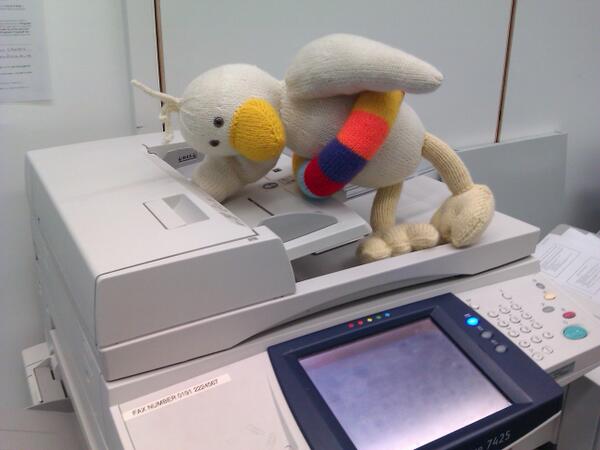
After a brief argument with the photocopier preparing for the ‘big meeting’ later in the day, we started out with a brainstorming/planning meeting for the 2015 CREATE workshop that I’ve been asked to co-ordinate. I have got myself a reputation for teaching writing skills. I’m not sure this is in any way justified. Sure, I’ve done a lot of writing and sure, bad writing sometimes annoys me. That doesn’t mean I’m any good at teaching people how to do it well. See Twitter during any football match/episode of Question Time/Strictly for more on this. But, when you’re offered a trip to Cyprus, the 2.5 days of workshop you need to prepare and deliver in exchange sometimes doesn’t feel too much of a drag. It’s more than a year away. It’ll be fine. In the course of an hour my co-facilitators and I worked through three or four different ideas for the workshop, before settling on an outline programme that we hope will be acceptable to the organising committee. We’ll find out in June. 


Next up was a project meeting for the YouCook project. This is a pilot evaluation of Jamie Oliver’s Ministry of Food cooking classes. Very exciting in principle, but harder than it looks in practice. Mostly, surprise, surprise, because recruitment is not that easy. And before you ask, Fuse duck didn’t get to meet Jamie on this occasion. But the main researcher on the project has done. 


Ten minutes to nip to the toilet and swap one pile of papers for another, and before we knew it the ‘big meeting’ was upon us. This was the second of three meetings of the steering group for our project on using parental incentives to encourage uptake of pre-school immunisations. Which astute readers might remember is where this whole blog thing began. The meeting was ‘big’ in that there were at least 10 people around the table. But also ‘big’ in that it involved people from London, Glasgow and Aberdeen - both in person, and on the phone - and clinicians as well as academics and researchers. One of those meetings where you are very aware how much of an effort people have made to come and take part, and how much you’d better make sure that you don’t waste their time.

The ‘big meeting’ went well. The project is going well and generating interesting findings. The discussion was engaging and lively. There were some good suggestions made for future directions. But chairing a two and a half hour meeting that you have been subconsciously worrying about for the last week is exhausting. So after that was done, Fuse duck and I went up to our coffee room and just hung out for half an hour to get stuff back in perspective. But somehow the conversation drifted into food porn and how naïve I was to think that food porn=Nigella Lawson and it felt time to leave.


The last meeting of the afternoon was a one-to-one with a researcher to chat R, data, and Foodscape. Although we do have lots of meeting rooms in IHS, we also have three ‘informal’ tables where both planned and impromptu meetings take place. Contrary to expectations, an informal table is not a post-modern representation of a table that only very loosely resembles the typical structure of a formal table. No, the informal tables are distinctively table-like, with grey rectangular tops and at least four sturdy legs. Their informality comes from the fact that there are not bookable, and not restricted within their own rooms. In fact they are placed in what is essentially an aneurytic corridor - a place that is as important for getting from A to B as it is for housing meeting spaces.

As it turns out, holding a meeting attended by a stuffed duck at the informal tables attracts a little more attention than some other meetings. Before we knew it, students, researchers and even the institute director were chatting to Fuse duck and not about Foodscape work package 4. So we called it a day, packed up and headed for home.

That was the end of the work day, but not the end of the whole day. We still had our 30 minutes of moderate to vigorous physical activity to get in. Fuse duck is sadly lacking in bones, ligaments, tendons and muscles, making his running style fairly floppy. I didn’t mind carrying him and we went for a little plod around the park, stopping to see if there were any ducks around to say hello to in the pond. But all we could find was a prissy swan who just hissed at us and swam off. 


Thursday, 24 April 2014

52 weeks in public health research, part 16


Posted by Dorothy Newbury-Birch and Jean Adams

From Dorothy Newbury-Birch: I've been working at home for the week going through lots of reviewers comments for a report. The report is larger than my PhD was - 55,000 vs 36,000 words! I have everything I need - coffee, my little bit of India hanging from the window, flowers (got to have for writing) and the little pot is my pot of motivation - this is the pot where the pink paper tabs go when I've finished that point - there is only six in the pot at the moment and 37 left to go but seeing the pot get fuller will be fantastic.

From Jean Adams: I spoke at a lunchtime seminar at ScHARR, Sheffield University a few weeks ago. It was pouring rain when I left Newcastle and I got soaked on the way to the station. By the time I reached Sheffield it was a beautiful day made a little happier by finding some interesting things on the walk from the station up to the university. This poem on the side of a Sheffield Hallam University building is by Andrew Motion. I couldn't read without hearing his voice in my head.

From Jean Adams: this fountain is just outside Sheffield station. I took lots of pictures of it, but my favourite was this selfie. #ego

Hang on...is that the #fuseduck doing some active commuting?


-------------------


Just to remind you:

Each Thursday of 2014 we’ll try and post around four pictures on the Fuse blog that capture our weeks in public health research, from the awe-inspiring to the everyday and mundane. Given that more of the latter than the former exists in my life, I foresee problems compiling 208 images worth posting on my own. So this is going to have to be a group project. Send me an image (or images) with a sentence or two describing what aspect of your week in public health research they sum up and I’ll post them as soon as I can. You don’t have to send four together – we can mix and match images from different people in the same week.

Normal rules apply: images you made yourself are best; if you use someone else’s image please check you’re allowed to first; if anyone’s identifiable in an image, make sure they’re happy for it to be posted; nothing rude; nothing that breaks research confidentiality etc.

Also, this doesn’t mean we wont also be posting words. You word-based posts are, as always, much appreciated.

Tuesday, 22 April 2014

Introducing Fuse duck: coming to a university near you to save Albert Park’s pond

Posted by Avril Rhodes and Peter van der Graaf

Remember when there was a brief outbreak of blog posts on knitting? Remember branded goods and the debut of the Fuse gloves? The gloves flopped spectacularly, strangely no one wanted them, at all. I have the world’s only pair. That was not terribly good news as I still had a wool mountain at home and a one pair of Fuse gloves didn’t make so much as a small dent in the mountain.

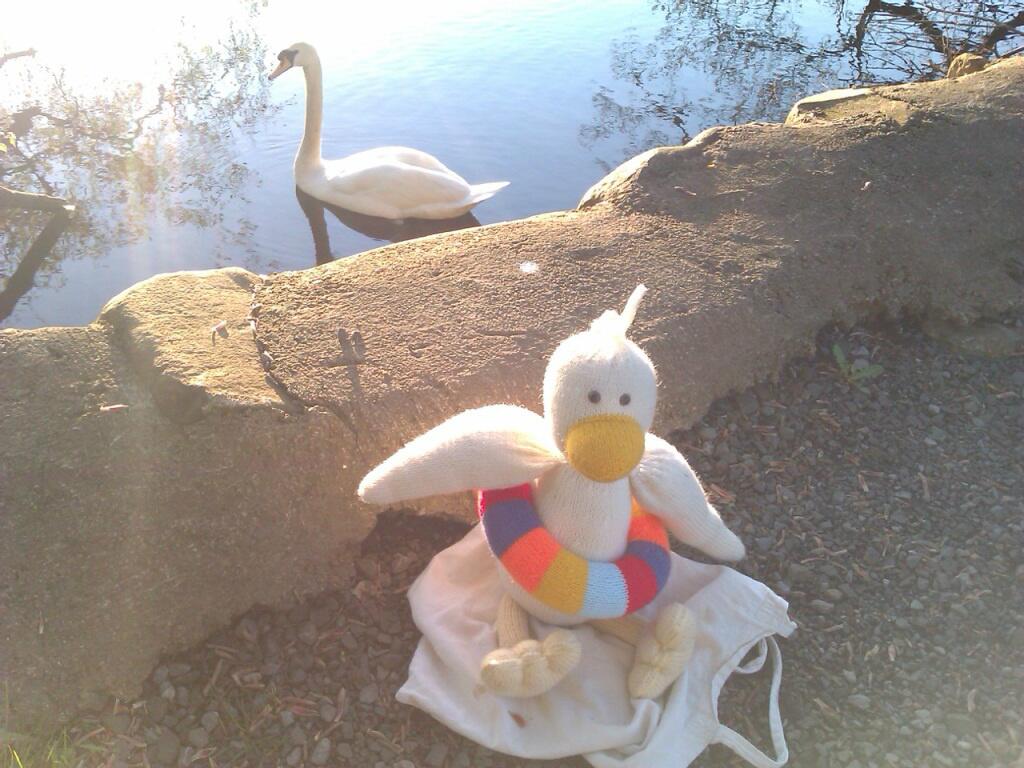
Undeterred and still working my way through the mountain, three years on, the latest product is the Easter Fuse duck. Easter Fuse duck is inspired by the brave ducks of Albert Park, who live just across the road from AskFuse HQ, Parkside, Teesside University.  These outstanding ducks co-exist with a number of environmental challenges. These include, without any trace of exaggeration, fishermen with their trailing lines (and a nice line in swearing), large quantities of unsuitable food thrown at them by passers-by, rubbish of all kinds floating around (humans are behind this too), unruly groups on outsize fowl shaped pedalos, and noise pollution from many sources including a café, play park, a roller skating track, and seasonally, a full size funfair. Otherwise it’s a rural idyll.

Albert Park duck pond, Middlesbrough
It’s a tribute to the persistence of nature that despite everything so-called sophisticated humans do to disrupt duck life they continue, and even flourish. Pollution might be one thing somewhat out of our hands (although  not entirely), but why do we keep dropping litter, paying others to tidy it all up, and making it difficult for wildlife? It’s such a commonplace public health hazard (especially in urban areas) spoiling everyone’s enjoyment and consuming resources in the clean-up.

Fuse duck decided it was high tide (boom-tish!) for action; luckily, Fuse duck recognises the value of collaboration wearing the life-belt featuring our combined University colours. He is appealing to all Fuse researchers for help in finding a new home for him after all the public health dangers he faced and to learn more about how to combat these dangers for his fellow feathery friends in Albert Park. With all the expertise in Fuse on tangled-up fishing lines (complex systems), unruly groups (behaviour change), healthy eating in the face of austerity (health inequalities), play parks and roller skating tracks (early life and adolescence), hearing aids (healthy ageing) and knowledge of duck language (translational research), Fuse duck is keen to meet the researchers that can save his pond!

Fuse duck hard at work
So our environmental warrior would like to go on a road trip to visit all the Fuse Universities and public health researchers within them: to sit in on their fascinating meetings, experience their randomised controlled trials (RCTs) first hand, join their physical activities, share coffee mornings and indulge in the latest evidence review with long and incomprehensible titles. If you would like Fuse duck to visit you for a week, please let us know and he could be winging his way in your direction. All we ask is that you let us know how he is getting on in your public health wonderland by writing about his adventures and posting photos on the blog.

After his tour de force, Fuse duck has plans to fly further afield to see our friends in practice and policy land, so watch this space!

Can you give Fuse duck a good home?  If so then email Avril Rhodes on Avril.Rhodes@tees.ac.uk