Showing posts with label lshtm. Show all posts

Friday, 7 May 2021

Children’s exposure to junk food advertising: can the UK hold firm in the face of industry resistance?

Posted by Chris Baker, primary school teacher and distance learning tutor at the London School of Hygiene and Tropical Medicine

Growing up in a sweet shop was, as you can imagine, an absolute dream. Who wouldn’t want an entire store of confectionery under their own roof? It was the 1990s and I didn’t realise how lucky I was - living above a newsagent run by my parents. I’d get home from school, give a cursory wave to my mum behind the counter and immediately grab a chocolate bar, or an ice cream. It was the best.

Clearly, it wasn’t a recipe for good health. I was continuously surrounded by the bold and colourful logos, the marketing strategies and the special offers - all designed to hook me into habitual consumption. I paid little attention to the nutritional contents of the things I was snaffling (this was long before front-of-package labelling came along). My physical health (particularly my teeth) paid the price.

Cut to 2020 and I find myself thinking back to that era - before the internet, before screen-time, before social media. I am now a primary school teacher (with experience in public health) committed to promoting children’s health and well-being. I see that the relationship between children and junk food today has not changed all that much. There are still products high in fat, sugar and/or salt that kids crave. And what’s helping them to connect with these products? Digital marketing.

I teach ten and eleven-year-olds in an international school, so the demographic group I am most familiar with is not representative of the UK. However, I believe there are important similarities. Many children of this age now have smartphones and use apps intended for older audiences. Through these apps, they are exposed to new and sophisticated marketing strategies, unheard of by older generations.

Fortunately, there are plans to address this. Last year the UK government proposed a total ban of online marketing for foods high in fat, salt and sugar. Not a restriction, or a tightening of rules: a total ban. The preamble to this consultation suggests that completely reducing exposure to ‘endless prompts’ to eat offers the best way forward. The government’s response to the consultation, with an accompanying plan of action, is due to be published this Spring.

The scope and scale of this proposal are noteworthy. To date, no countries have successfully implemented a complete ban (there are strong restrictions in Chile and French-speaking Canada). Implementation of the government’s proposal would place the UK firmly at the front of the pack, delivering strong policy action with the potential for significant public health benefit.

Unsurprisingly, industries affected by such a ban have been critical of the proposals. In an open letter, a consortium of food companies and advertising agencies called for a rethink. Their arguments are predictable and are representative of a cross-industry playbook, seen repeatedly in recent years across several other industries interested in unhealthy commodities. They claim the proposal is disproportionate. They claim the evidence is lacking in detail. They distance themselves from the issue and play down their role. They demand a meeting with the government to discuss ‘alternative’ (but unspecified) approaches.

A total ban would be an entirely appropriate response in the face of an industry that has altered considerably in recent years. An earlier attempt to merely limit adverts for unhealthy foods in and around children’s tv programming (as well as other non-broadcast media) was found to expose children to no less advertising. Artificial separation of children’s media and adult media is a fallacy, and doesn’t reflect the reality of tv consumption nowadays.

More importantly, this proposal addresses the issue of children’s developing ability to distinguish an advert (and its provenance). Research suggests that over a third of 12-15 year olds are not aware of the financial arrangements behind promotional posts. Astroturfing - the artificially-created “buzz” around a product, designed to look authentic and spontaneous - can be difficult to identify, especially when delivered by a relatable vlogger or influencer, who may not have disclosed endorsement arrangements.

Most schools nowadays (mine included) encourage “digital citizenship”. As a teacher, I am responsible for helping my students navigate the risks and benefits of the internet. Often, I hear children referring to spurious news stories, and am reminded of the sophisticated ways even adults can be tricked into believing something.

Age restrictions for social media platforms, often put forward as a robust mechanism to shield children from inappropriate content, are weak and inconsistently controlled. Parental control settings on popular sites are not widely understood or implemented and the rapid changes in children’s media habits is named as a key driver in the government’s desire to strengthen legislation.

I believe that young people should have the freedom to use television and the internet for enjoyment and education. Exposure to insidious marketing that promotes and profits from the development of unhealthy eating habits should not be a price to pay for this. The UK government has proposed a bold course of action. In the face of strong opposition from industry, they should stay firm with their intentions; the health of future generations stands to benefit.

Friday, 6 March 2020

Out of the shadows: Corporate activity and our health

Posted by Nason Maani, Harkness Fellow, Boston University School of Public Health

When considering the impact of commercial actors on health, our minds in public health turn immediately to tobacco. However, while the tobacco industry has earned its reputation and associated exclusion from policymaking, what is unique about those actors misleading policymakers and the public for commercial advantage? Arguably, nothing at all. Asbestos, leaded paint, fossil fuel, sugar-sweetened-beverage and alcohol companies and their proxies have been found to pursue similar tactics.

This is not to say that large commercial actors cannot in many cases benefit society while making a profit. Rather, it is to say that such commercial actors have a track record of focusing on maintaining profit while avoiding litigation, negative PR, and regulatory burdens. When these goals conflict with population health, such actors have the power and scale to negatively influence health, the evidence base, policy options, and even public discourse. The commercial determinants of health, in their broadest sense, are defined as activities of the private sector that affect the health of the population.

As we discussed in a recent commentary, there is a need to progress our understanding in this area because all these areas of influence matter to societal progress, and there are commonalities across many different industries in terms of their motivations, strategies, networks, tactics and interventions that merit the attention of public health researchers.

There is also currently a lack of conceptual focus on these powerful actors by policy-makers and non-governmental organisations, and some gaps in our thinking about these issues. We know that it is largely the conditions in which we are born, grow, live, work and age that determine our health, sometimes called “the social determinants of health”. However, in a recent review, we showed that commercial determinants were often absent from conceptual frameworks of the social determinants of health. This is problematic because such actors have the incentives, resources and strategic ability to influence everything from individual behaviours, attitudes and preferences, to the pollution of the environment, and the funding of politicians who are unwilling to consider the weight of evidence on a particular issue.

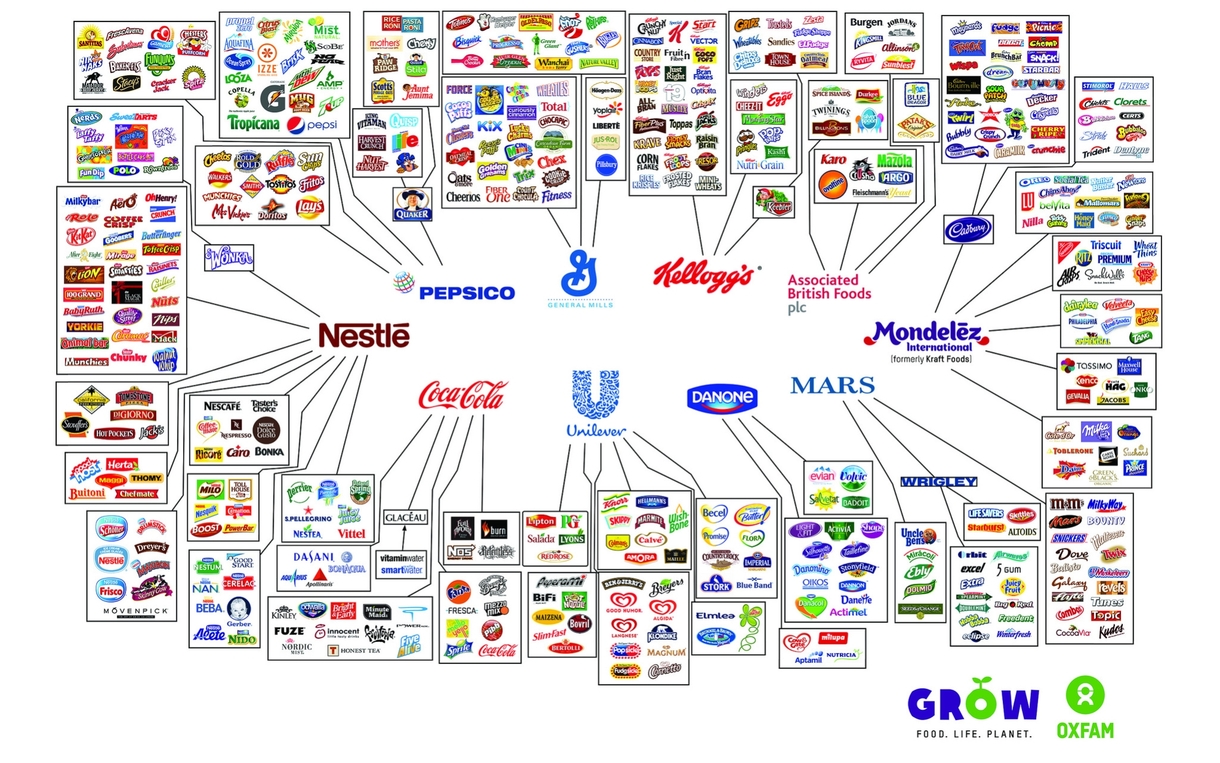
Oxfam’s infographic making the connections between big companies and some very familiar brands.


There is a large space for study in this area, but many challenges to doing so, not least because there is relatively little research funding or political will to tackle these issues directly. Many researchers and advocates remain “silo-ed”, focusing on a particular product, or discipline. This “zoomed-in” view stands in contrast to the intersectional ways in which a single large company might act, never mind an industry sector as a whole, or different industry sectors with overlapping interests, acting, for example, to diminish employment rights or environmental standards. We argue that there must be much greater scope for the convening of interdisciplinary research to explore these issues and offer potential solutions.

What about practice?

Aside from research, what about practice? There is also a need for the evidence that does exist to translate more effectively into policy. The challenge public health practitioners often face is that there is a strong political will for partnership and collaboration with the private sector at the local, national and global level, both through direct partnerships, and multilateral engagements. Such arrangements are, on the face of it, appealing. Access to the resources of the private sector is an obvious solution to the problem of increasingly restricted budgets for public health departments, particularly as these private resource pools are so large. Voluntary commitments between the public and private sectors are also conceptually appealing, echoing the type of multi-stakeholder engagement that public health advocates strive for.

However, in the UK, the evidence suggests such activities are often characterised by an abundance of words (in the form of voluntary pledges) and a paucity of deeds (in the form of meaningful changes to how harmful products are produced and marketed). Without regulatory safeguards, it appears unlikely that harmful product manufacturers will voluntarily act in ways that could reduce their own profit margins or lead to “stranded assets”. Instead, such actors will go to great lengths in framing themselves as part of the solution to a “complex” problem, while attempting to diminish the role they play in creating that problem, and rejecting what they termed “one size fits all” approaches such as policy best buys.

There is, however, progress on the research front. Research on specific harmful products and the industries that produce and market them continue apace, and commonalities in corporate strategies are being increasingly discussed. Networks of interested researchers in related topics are beginning to emerge. Perhaps most promisingly, it is becoming clear that commercial determinants are an important component of the broader determinants of health. As the “elephants in the room” become more widely perceived in issues such as alcohol harm, climate change and the opioid crisis, let us hope that, informed by a growing evidence base, the tools to properly address them will follow.


Photo attribution:
  1. "140/365 - Coke Shadow" by Adam Wyles via Flickr.com, copyright © 2011: https://www.flickr.com/photos/the-travelling-bum/5418900013 (CC BY-ND 2.0).
  2. Oxfam infographic courtesy of Oxfam, copyright © 2013: https://firstperson.oxfamamerica.org/2013/03/10-everyday-food-brands-and-the-few-giant-companies-that-own-them

Friday, 9 March 2018

How industry-funded organisations mislead the public on alcohol & cancer

Guest post by Dr Nason Maani Hessari, Research Fellow, London School of Hygiene and Tropical Medicine

When it comes to the risk of cancer associated with alcohol consumption, there is a significant disconnect between scientific evidence and public opinion.

The evidence of the independent link between alcohol consumption and cancer is clear, as emphasised by recent comprehensive reviews by the UK Committee on Carcinogenicity* (Committee on Carcinogenicity of chemicals in food, 2015), and the International Agency for Research on Cancer (IARC, 2012). Drinking alcohol can cause a range of cancers, including oral cavity, pharynx (cavity behind the nose and mouth), larynx (voice box), oesophagus (gullet), colorectal (bowel and colon), breast and liver cancer. Furthermore, the risk of developing cancers of the mouth, throat and breast increases with any amount consumed on a regular basis (Department of Health, 2016). However, public awareness of this link remains low, with a 2016 survey reporting only 12.9% of respondents identifying cancer as a potential consequence of drinking too much alcohol (Buykx et al., 2016).

What does this have to do with the alcohol industry? Well, in the UK and many other countries, alcohol-industry funded organisations, called Social Aspects Public Relations Organisations (SAPROs), present themselves as sources of health information to the public, particularly around ‘responsible drinking’, underage drinking and drink driving (Maani Hessari and Petticrew, 2017). These organisations have been criticised for their inherent conflict of interest, as they are linked to large multinational alcohol producers, for whom a large proportion of profits come from harmful drinking (Casswell et al., 2016). The industry has a track record of focusing on education and individual responsibility, while lobbying against population-level measures to reduce alcohol-related harm (Babor and Robaina, 2013), even though these are evidence-based (Burton et al., 2017), and form the basis of the WHO Global Alcohol Strategy, in which alcohol producers participated (World Health Organisation, 2010).

Considering the role of the alcohol industry in providing information to consumers, we decided to examine the extent to which the industry fully and accurately communicated the scientific evidence on alcohol and cancer. To do this, we systematically examined the content of 27 industry-funded organisations or websites. In each case, we analysed how information regarding alcohol and cancer was presented, and whether the statements they made about cancer risk were in agreement with the scientific evidence, as presented in the Committee on Carcinogenicity (COC) and IARC reviews.

We found that most alcohol industry SAPROs appeared to misrepresent evidence by denying, distorting or distracting from links to cancer, particularly breast cancer (Petticrew et al., 2017, Petticrew et al., 2018). A full list of examples can be found in our paper and the supplementary information, but as an example of denial, consider this:
“Moderate wine intake may actually reduce the risk of oesophagus, thyroid, lung, kidney and colorectal cancers as well as Non-Hodgkin’s Lymphoma…Concerning breast cancer, there may also be a protective role for wine.” [Wine Information Council].
When some risk was acknowledged, it was often presented alongside a range of other confounders, thus undermining the evidence that there is an independent relationship. For example:
“Alcohol has been identified as a known human carcinogen by IARC, along with over 1,000 others, including solvents and chemical compounds, certain drugs, viral infection, solar radiation from exposure to sunlight, and processed meat.” [International Alliance for Responsible Drinking]
Or in another instance:
“Not all heavy drinkers get cancer, as multiple risk factors are involved in the development of cancers including genetics and family history of cancer, age, environmental factors, and behavioural variables, as well as social determinants of health.” [Australia: Drinkwise].
It is not clear how the consumer is meant to interpret this information. The use of such descriptions to describe risk of cancer from smoking would in essence be both equally correct, and equally misleading. In fact, this type of language is highly reminiscent of arguments used by the tobacco industry, which emphasise the complex causes of lung cancer and coronary heart disease, in order to help deny the scientific evidence and identify other independent risk factors for smoking-related diseases to deflect focus from their products (Petticrew and Lee, 2011).

Since the publication of our findings (Petticrew et al., 2017, Petticrew et al., 2018), additional examples of alcohol industry representatives openly disputing the link between alcohol and cancer continue to emerge. For example, a recent study in the Yukon, Canada, examining the effects of adding a cancer warning label to alcohol (as one of three potential labelling options) has been suspended due to industry pressure.

Perhaps even more striking: as part of the ongoing debate in Ireland regarding the Public Health Alcohol Bill (PHAB), when a physician noted on live TV that alcohol was a carcinogen, a leading alcohol industry spokesperson countered inaccurately that alcohol was in fact, not a carcinogen, and that there were “…as many studies, medical studies, as there are on the ‘pro’ side…” (clip below).


It has been argued that greater public awareness, particularly of the risk of breast cancer, poses a significant threat to the alcohol industry (Connor, 2017). In response to other threats to profits, there is evidence that the industry has attempted to engage in “denialism” (Katikireddi and Hilton, 2015), and it appears this may also be the case for cancer, particularly breast cancer.

Currently, the alcohol industry remains involved in developing alcohol policy in many countries, and in disseminating health information to the public, including school children. Our research findings, which build on existing evidence regarding the activities of SAPROs (Babor and Robaina, 2013, McCambridge et al., 2014, Moodie et al., 2013), should be cause for a re-evaluation of such arrangements. The World Health Organisation has previously stated that ‘In the view of the WHO, the alcohol industry has no role in the formulation of alcohol policies, which must be protected from distortion by commercial or vested interests.’(Chan, 2013). The clear and obvious similarities to tobacco industry tactics that we report, which reflect the inherent conflict of interest, serve as a reminder that policies are but one aspect at risk of industry distortion.


All views expressed are those of the author.


References

BABOR, T. F. & ROBAINA, K. 2013. Public health, academic medicine, and the alcohol industry's corporate social responsibility activities. Am J Public Health, 103, 206-14.

BURTON, R., HENN, C., LAVOIE, D., O'CONNOR, R., PERKINS, C., SWEENEY, K., GREAVES, F., FERGUSON, B., BEYNON, C., BELLONI, A., MUSTO, V., MARSDEN, J. & SHERON, N. 2017. A rapid evidence review of the effectiveness and cost-effectiveness of alcohol control policies: an English perspective. Lancet, 389, 1558-1580.

BUYKX, P., LI, J., GAVENS, L., HOOPER, L., LOVATT, M., GOMES DE MATOS, E., MEIER, P. & HOLMES, J. 2016. Public awareness of the link between alcohol and cancer in England in 2015: a population-based survey. BMC Public Health, 16, 1194.

CASSWELL, S., CALLINAN, S., CHAIYASONG, S., CUONG, P. V., KAZANTSEVA, E., BAYANDORJ, T., HUCKLE, T., PARKER, K., RAILTON, R. & WALL, M. 2016. How the alcohol industry relies on harmful use of alcohol and works to protect its profits. Drug Alcohol Rev, 35, 661-664.

CHAN, M. 2013. WHO's response to article on doctors and the alcohol industry. Bmj, 346, f2647.

COMMITTEE ON CARCINOGENICITY OF CHEMICALS IN FOOD, C. P. A. T. E. C. 2015. Statement 2015/S2.

CONNOR, J. 2017. Alcohol consumption as a cause of cancer. Addiction, 112, 222-228.

DEPARTMENT OF HEALTH 2016. UK Chief Medical Officers' Alcohol Guidelines Review - Summary of the proposed new guidelines.

IARC 2012. Personal habits and indoor combustions. IARC monographs on the evaluation of carcinogenic risks to humans.

KATIKIREDDI, S. V. & HILTON, S. 2015. How did policy actors use mass media to influence the Scottish alcohol minimum unit pricing debate? Comparative analysis of newspapers, evidence submissions and interviews. Drugs (Abingdon Engl), 22, 125-134.

MAANI HESSARI, N. & PETTICREW, M. 2017. What does the alcohol industry mean by 'Responsible drinking'? A comparative analysis. J Public Health (Oxf), 1-8.

MCCAMBRIDGE, J., KYPRI, K., MILLER, P., HAWKINS, B. & HASTINGS, G. 2014. Be aware of Drinkaware. Addiction, 109, 519-24.

MOODIE, R., STUCKLER, D., MONTEIRO, C., SHERON, N., NEAL, B., THAMARANGSI, T., LINCOLN, P. & CASSWELL, S. 2013. Profits and pandemics: prevention of harmful effects of tobacco, alcohol, and ultra-processed food and drink industries. Lancet, 381, 670-9.

PETTICREW, M., MAANI HESSARI, N., KNAI, C. & WEIDERPASS, E. 2017. How alcohol industry organisations mislead the public about alcohol and cancer. Drug Alcohol Rev.

PETTICREW, M., MAANI HESSARI, N., KNAI, C. & WEIDERPASS, E. 2018. The strategies of alcohol industry SAPROs: Inaccurate information, misleading language and the use of confounders to downplay and misrepresent the risk of cancer. Drug Alcohol Rev.

PETTICREW, M. P. & LEE, K. 2011. The "father of stress" meets "big tobacco": Hans Selye and the tobacco industry. Am J Public Health, 101, 411-8.

WORLD HEALTH ORGANISATION 2010. Global Strategy to Reduce the Harmful Use of Alcohol.

*Carcinogen is any substance or agent that promotes the formation of cancer


Image: ‘Spilling wine’ (3375802661_fc4ff615ba_z) by Gunnar Grimnes via Flickr.com, copyright © 2009: https://www.flickr.com/photos/gromgull/3375802661