Showing posts with label employment. Show all posts

Friday, 29 July 2022

Part-time work can be a game changer for families and a smart strategy for organisations

Posted by Belinda Morgan, flexible work expert & author; Amelia Lake and Helen Moore, researchers from Fuse at Teesside University

Part-time work has the potential to change lives. Done well, it can drive hugely positive outcomes for individuals, families and society. But its potential isn’t widely understood, so part-time work still sits largely on the sidelines of organisational strategy – under-rated and under-utilised.

And even organisations who are leading the way with the accessibility and implementation of part-time work, are rarely doing it well at all levels. It’s still very uncommon to see senior leaders working part-time.

Amelia Lake, Fuse Associate Director, and Helen Moore, Fuse Associate, at Teesside University are bucking this trend. Both work in senior level roles in public health research, leading teams and both work part-time.

Amelia and Helen were two of the senior leaders I interviewed when writing my book Solving the Part-Time Puzzle: How to decrease your hours, increase your impact, and thrive in your part-time role. They shared their stories about how they make their part-time arrangements work, and the benefits they experience from working in this way.

Helen Moore (left) and Amelia Lake (right) both work part-time in public health research
Amelia said, “When I first started working at Teesside University, I would frequently get asked what was my ‘side hustle’ when I wasn’t at work and people were surprised to hear that I was doing family activities with my (then) young children. While I appreciate working part-time is a privilege, it allows me a better work-life balance and time with my children.

“During the pandemic, and post-pandemic, childcare has been difficult to access, and being part-time means some days of the week can be less stressful in terms of childcare. Working part-time means I work even more collaboratively with colleagues as their support when I am not at work is important. It can be hard to switch off emails and alerts on non-working days, and I don’t always do it, but I know it is important.”

Helen said, “It was, and is, important for me, as the primary carer of young children (I have two sets of twins) with a husband who works away in the Merchant Navy, to be able to have some flexibility around when and how I work. This supports me in being able to take them to, and pick them up from, school several days of the week, and to not have to rely all of the time on either family help (which can feel like an imposition) or paid childcare (which is both expensive and difficult to find when you have four children).”

So why is it so rare to see senior leaders working part-time? Largely because there’s an embedded belief that senior leadership roles are the most challenging to do part-time. Many people will tell you it’s impossible – and that it’s not even worth attempting.

Stories of leaders like Amelia and Helen are hugely important, because we badly need more senior leaders leading the way and working part-time. When senior leaders do so it demonstrates to others that part-time work is acceptable and encouraged, and that it’s possible to keep growing a career while working part-time.

The individual and family wellbeing benefits are quite clear, and should be reason enough for organisations to start creating more part-time work opportunities. But the reality is that more encouragement may be required.

The good news is that there are some other big reasons for organisations to get on board with this.

A clear and highly relevant advantage for employers is talent attraction and retention. In the context of the ‘great resignation’ of 2022 this is a critical consideration for organisations looking to find creative ways to solve the talent shortage.

Firstly, it allows employers to retain their talented people who reach a point where they want or need to work part-time.

In Amelia’s words, “We need to see more people in leadership roles working part-time. I was promoted to Professor in my part-time working pattern which illustrates that it is possible to do high quality impactful work building capacity and also doing research, while working part-time. Teesside University has both promoted me and supported me in my part-time role.”

It also enables employers to tap into a hidden talent pool of highly qualified people who either can’t or choose not to work full-time. They include people with caring responsibilities, people with health issues, and people at retirement age who would stay in the workforce longer if given the opportunity to work part-time.

Helen said, “I strongly believe that working part-time doesn’t equate to a reduction in performance, and that it is demonstrated by my promotion to Associate Professor and being one of two Teesside University Star Award Research Excellence finalists in 2021.

“Being supported by Teesside University to work part-time in a senior role enables me to both lead the work of the University’s successful Evaluation and Impact Team, and to be able to be present and care for my four children.

“Having managers who were willing to try something new, even take a risk, and recruit a person to work part-time hours to establish and lead a new team has paid off and worked well – it has enabled me to grow significantly as both a researcher and a research leader.

“Roles similar to mine which I have previously considered, have been strictly full-time hours only, and did not feel open to someone with other commitments like me. There are a lot of talented people who for various reasons would like to work less than full-time hours, and I’m hopeful that my experience shows it is possible.”

This is also, of course, about inclusion. The consulting firm Timewise warns that if a company’s diversity, equity and inclusion (DEI) programmes aren’t underpinned by a commitment to flexible working that includes part-time, they will struggle to be fully inclusive. 'This will not only have a negative impact on their gender pay gap, but is also likely to impact their employer brand'

As well as the talent related benefits, there are also productivity benefits to be reaped by organisations who are willing to introduce more part-time roles. Organisation for Economic Co-operation and Development (OECD) data confirms that productivity (defined as output per working hour) improves with shorter hours. Across the world’s richest countries, higher productivity correlates with lower working hours.

The power and potential of part-time work really is huge. It can be a game changer for families and a smart people strategy for organisations.


Friday, 1 April 2022

Breaking down barriers in End of Life care

Posted by Colette Hawkins, Consultant in Palliative Medicine, South Tees NHS Foundation Trust

Health research achieves extraordinary things. There are countless examples of life-changing, disease preventing or curative treatments. These are rightly celebrated and have shaped our society, as well as our expectations, around health and illness.
Break Through 1995 "Walls break hearts, hearts break walls" by 
Pierre Marcel via Flickr © 2011 (CC BY-NC-ND 2.0)


But what about people living with a life-limiting illness and those approaching end of life? Health professionals often struggle to move away from an interventional, disease-focussed approach to a more holistic, person-centred approach. This risks unwanted intervention and missed opportunities for choice. This is mirrored by health research. In the UK, just 0.21% of health research is focussed on palliative and end of life care.

The reality is that people living towards end of life really struggle and whilst this may be directly related to ill-health, it is often issues of daily life which incapacitate them. These are generally overlooked by health professionals.

Since 2017, I have been involved in running research on legal needs in life-limiting illness. One element of this is social welfare legal needs (SWL): matters of daily life for which the law defines rights, entitlements and protections. In the context of life-limiting illness, the ‘big three’ are issues relating to money, employment and housing. These are prevalent, impacting most people in some way. However, their greatest impact is on people who are already disadvantaged, for example those experiencing homelessness, financial insecurity or debt, socially excluded or marginalised groups and people with multiple physical and/or mental illness. These people experience the most SWL needs, are most affected by them and are least likely to access support successfully.

Social welfare legal needs will often be presented to health professionals, wrapped up in a person’s physical complaints, but missed in favour of a focus on disease. So where else could they go? Our foundation research scoped the system of support for these issues. A wide range of services beyond health and social care provide advice and support for SWL needs, including charities, community groups, advice sector, legal services, social services, Jobcentre, housing groups, social prescribing, statutory organisations and more.

But if we took months to map the system (and it’s still growing), can we expect people in vulnerable and difficult situations to find their way?

Funded by the NIHR Applied Research Collaboration (ARC) North East and North Cumbria (NENC), our research has engaged members of the public with lived experience, as well as service providers in Gateshead, to find an effective system response to social welfare legal needs. We used Human Learning Systems, an approach which accepts the complexity of a system and supports co-produced responses to need founded on continuous learning.

Engagement of people with lived experience of life-limiting illness and SWL needs proved critical to the value of this project. Focus group discussions revealed the scale of the challenge to manage SWL needs. The walls they faced included not feeling heard, not knowing where to go for help, lack of information to help themselves, lack of responsibility from professionals or services, poor communication between services and long delays to resolution (or non-resolution). These insights, along with those of service providers, told us that the ideal system response should be founded on relationships and offering information, problem solving and a joined up approach. This seems quite obvious and appropriate, so why are there so many walls?

Attitudes and structures 

The walls come from two main sources: professional attitudes and structures. Attitudes obstruct when they use labels, stereotypes or assumptions, treat illness, not people, miss opportunities for honest discussion, restrict choice through failing to listen to priorities and wishes, overlook responsibility for holistic needs and forget to work in partnership. Structures maintain silos and fragmentation of care with the lack of clear routes to advice and support, boundaries to access through geography, referral criteria or social context, expectations that patients and carers will self-advocate and navigate themselves and missed opportunities to capitalise on the expertise of others. These walls obstruct identification and management of social welfare legal needs and amplify inequalities in care towards end of life.

We believe interprofessional learning is a route to breaking down these walls. We use short stories of experience instead of ‘sterile’ clinical cases, and facilitate discussion to explore what matters most, and the approaches to meeting needs in an inclusive, respectful and effective way. Initial pilots have shown that this is a route to closer integration of services, although the latest pilot, within the ARC project, also highlighted the challenge of engagement with online learning, accentuated by the pressure and workplace fatigue linked to COVID-19. Feedback showed that people felt too busy to attend or just didn’t turn up on the day.

We have secured a NIHR End of Life Partnership grant which we are using to co-design a research strategy for evaluation of system-wide learning around SWL needs in life-limiting illness. We are re-evaluating what we mean by ‘end of life’, pushing beyond traditional views and including people at risk of premature death. We are broadening our insight into the inequalities and prejudices embedded within care of people who may be living towards end of life. We can see the walls; our task is to break them down.


This project ‘Integrating care to meet social welfare legal needs in life-limiting illness. Qualitative investigation of a multi-agency, complexity-informed intervention’ has been funded by by the National Institute for Health Research (NIHR) [Applied Research Collaboration North East and North Cumbria (NIHR200173)]. The views expressed are those of the author(s) and not necessarily those of the NIHR or the Department of Health and Social Care.


Image: Break Through 1995 "Walls break hearts, hearts break walls" by Pierre Marcel via Flickr © 2011: https://www.flickr.com/photos/21063155@N06/5409729627 (CC BY-NC-ND 2.0)

Thursday, 19 November 2020

Surely men should have their day too...

Posted by Shelina Visram, Senior lecturer in public health, Newcastle University (on behalf of the BoroManCan research team)

*Trigger warning: mental health and suicide

Unless you’re a fan of the comedian and writer Richard Herring, you may not have given much thought to International Men’s Day. For almost a decade Herring has raised huge sums of money for the domestic violence charity Refuge by spending International Women's Day (8 March) answering each person who asks on Twitter 'But when is International Men's Day?' He then follows up the enquiries on International Men’s Day (19 November) to raise money for CALM, the Campaign Against Living Miserably. 


Presumably, these people are under the illusion that there is no dedicated day to celebrate men, yet International Men’s Day was founded in 1999 to do just that. The theme for 2020 is ‘Better health for men and boys’ with the strapline ‘Laugh stronger, live longer’, but many have struggled to find reasons to be cheerful this year. Although women are more likely to suffer the social and economic consequences of the pandemic, being a man greatly increases the risk of death from COVID-19.(1,2) Men tend to have many underlying health conditions that worsen coronavirus and generally contribute towards lower life expectancy. Our region (North East England) is likely to see high numbers of COVID-related deaths but also significant impacts in terms of poverty and unemployment, given that the North of England’s economy has been hit hardest by the pandemic.(3)

We don’t yet know what long-term impact the lockdowns will have on mental health and wellbeing, but early reports suggest an increase in suicide. Globally, men were almost twice as likely to die by suicide as women were before the pandemic.(4) Harmful masculine norms – in other words, what it means to be a man – are a key driver of suicidal tendencies and encourage risk-taking behaviours like drinking and smoking. These norms often stop men from seeking medical help and have a knock-on effect on women’s lives, placing increased responsibilities on them to care for men’s wellbeing.(5) They also affect women in other ways, for example, there have been reports of a dramatic increase in domestic violence during the pandemic.


So, not much to celebrate this year then? Well, actually, there is some cause for optimism. Men’s health is starting to move up the agenda in policy and practice. I was involved in an evidence review and expert meeting to inform the first World Health Organization strategy on men’s health and wellbeing in Europe, which was published in 2018. World Health Statistics were separated by sex from 2019 so that we can better understand gender differences that affect health outcomes. There are also a number of initiatives that have adopted gender-sensitive approaches to actively address masculine norms, for example, through rugby or football.(6,7) In the North East, the BoroManCan campaign aims to inspire positive behavioural, health and culture change in Middlesbrough, where four out of five suicides involve men and the rate of male suicide is the second highest in the country. Various activities have been developed in partnership with community groups, including Barbers for Health, young men’s workshops in schools, and a one-day training course to develop Men’s Health Champions. Many of these activities are on hold because of the pandemic but the BoroManCan website, podcast and social media pages continue to share stories from local men and services, as well as providing advice and links to further support.

To infinity... and beyond!
I’m working with a team from Newcastle, Durham and Teesside Universities to develop a programme of research around men’s health and wellbeing. We were recently awarded funding from the NIHR Applied Research Collaboration (ARC) North East & North Cumbria to conduct research that will help practice partners begin to understand what has worked so far in relation to BoroManCan and where improvements can be made. Findings and outputs will be shared widely so they can be used to inform the development of similar initiatives aimed at addressing gender equality. I’m looking forward to being part of efforts to change the conversation around men’s health and wellbeing, not least because my own little man celebrates his birthday the day after International Men’s Day. Hopefully by the time he’s older the phrase ‘man up’ will mean something quite different, like being comfortable with your emotions and having the confidence to ask for help when you need it. 


References

1. Burki T (2020). The indirect impact of COVID-19 on women. The Lancet Infectious Diseases, 20(8): 904-905.

2. Williamson EJ, Walker AJ, Bhaskaran K et al (2020). Factors associated with COVID-19-related death using OpenSAFELY. Nature, 584: 430–436.

3. Bambra C, Munford L et al (2020). COVID-19 and the Northern Powerhouse, Newcastle-upon-Tyne: Northern Health Science Alliance. https://www.thenhsa.co.uk/app/uploads/2020/11/NP-COVID-REPORT-101120-.pdf.

4. Dearden L (2020). Coronavirus: Mental health incidents rising during UK lockdown, police say. The Independent, 6 April 2020. https://www.independent.co.uk/news/uk/home-news/coronavirus-suicide-rates-ukmental-health-support-a9451086.html.

4. WHO (2014). Preventing suicide: A global imperative. Geneva: World Health Organization.

5. Marcos-Marcos J, Mateos JT, Gasch-Gallén À, Álvarez-Dardet C (2019). Men’s health across the life course: A gender relational (critical) overview. Journal of Gender Studies, epub ahead of print 18 December 2019.

6. Witty K, White A (2011) Tackling men's health: Implementation of a male health service in a rugby stadium setting. Community Practitioner, 84(4): 29-32.

7. Gray CM, Wyke S, Zhang R, et al. (2018) Long-term weight loss following a randomised controlled trial of a weight management programme for men delivered through professional football clubs: The Football Fans in Training follow-up study. Public Health Research, 6(9): 1-14.

Friday, 6 March 2020

Out of the shadows: Corporate activity and our health

Posted by Nason Maani, Harkness Fellow, Boston University School of Public Health

When considering the impact of commercial actors on health, our minds in public health turn immediately to tobacco. However, while the tobacco industry has earned its reputation and associated exclusion from policymaking, what is unique about those actors misleading policymakers and the public for commercial advantage? Arguably, nothing at all. Asbestos, leaded paint, fossil fuel, sugar-sweetened-beverage and alcohol companies and their proxies have been found to pursue similar tactics.

This is not to say that large commercial actors cannot in many cases benefit society while making a profit. Rather, it is to say that such commercial actors have a track record of focusing on maintaining profit while avoiding litigation, negative PR, and regulatory burdens. When these goals conflict with population health, such actors have the power and scale to negatively influence health, the evidence base, policy options, and even public discourse. The commercial determinants of health, in their broadest sense, are defined as activities of the private sector that affect the health of the population.

As we discussed in a recent commentary, there is a need to progress our understanding in this area because all these areas of influence matter to societal progress, and there are commonalities across many different industries in terms of their motivations, strategies, networks, tactics and interventions that merit the attention of public health researchers.

There is also currently a lack of conceptual focus on these powerful actors by policy-makers and non-governmental organisations, and some gaps in our thinking about these issues. We know that it is largely the conditions in which we are born, grow, live, work and age that determine our health, sometimes called “the social determinants of health”. However, in a recent review, we showed that commercial determinants were often absent from conceptual frameworks of the social determinants of health. This is problematic because such actors have the incentives, resources and strategic ability to influence everything from individual behaviours, attitudes and preferences, to the pollution of the environment, and the funding of politicians who are unwilling to consider the weight of evidence on a particular issue.

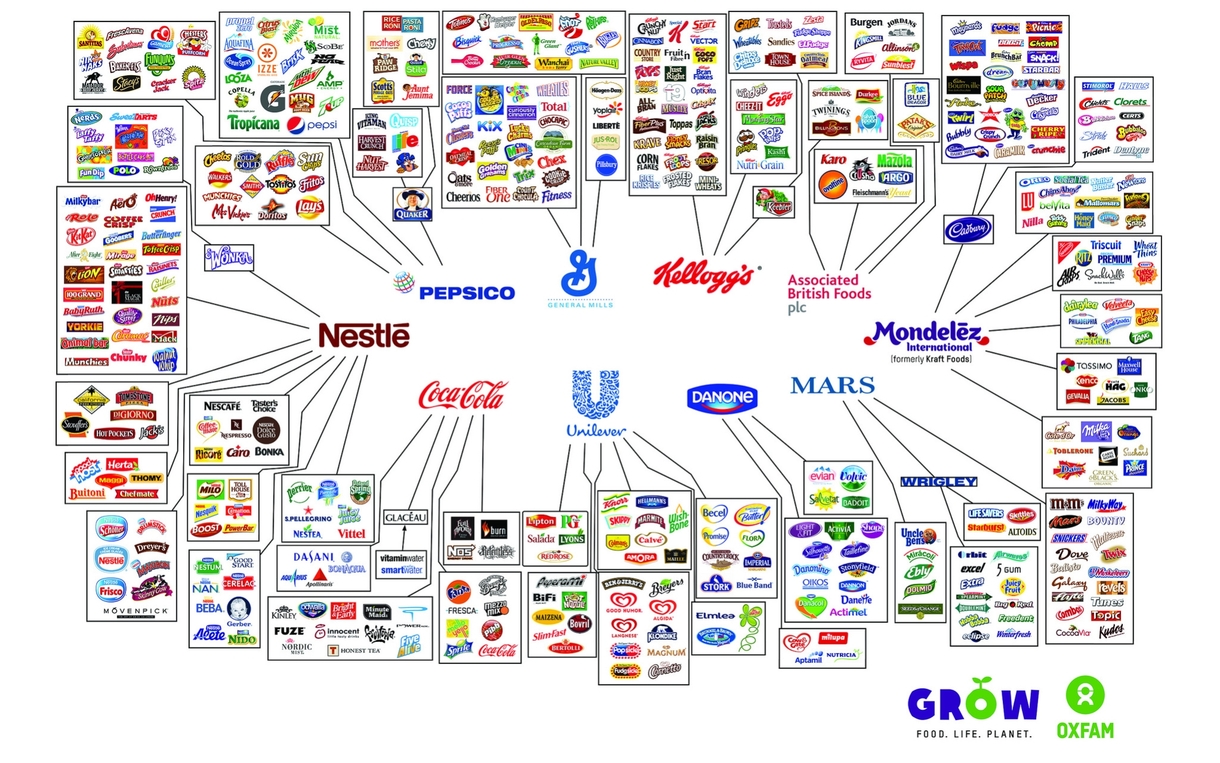
Oxfam’s infographic making the connections between big companies and some very familiar brands.


There is a large space for study in this area, but many challenges to doing so, not least because there is relatively little research funding or political will to tackle these issues directly. Many researchers and advocates remain “silo-ed”, focusing on a particular product, or discipline. This “zoomed-in” view stands in contrast to the intersectional ways in which a single large company might act, never mind an industry sector as a whole, or different industry sectors with overlapping interests, acting, for example, to diminish employment rights or environmental standards. We argue that there must be much greater scope for the convening of interdisciplinary research to explore these issues and offer potential solutions.

What about practice?

Aside from research, what about practice? There is also a need for the evidence that does exist to translate more effectively into policy. The challenge public health practitioners often face is that there is a strong political will for partnership and collaboration with the private sector at the local, national and global level, both through direct partnerships, and multilateral engagements. Such arrangements are, on the face of it, appealing. Access to the resources of the private sector is an obvious solution to the problem of increasingly restricted budgets for public health departments, particularly as these private resource pools are so large. Voluntary commitments between the public and private sectors are also conceptually appealing, echoing the type of multi-stakeholder engagement that public health advocates strive for.

However, in the UK, the evidence suggests such activities are often characterised by an abundance of words (in the form of voluntary pledges) and a paucity of deeds (in the form of meaningful changes to how harmful products are produced and marketed). Without regulatory safeguards, it appears unlikely that harmful product manufacturers will voluntarily act in ways that could reduce their own profit margins or lead to “stranded assets”. Instead, such actors will go to great lengths in framing themselves as part of the solution to a “complex” problem, while attempting to diminish the role they play in creating that problem, and rejecting what they termed “one size fits all” approaches such as policy best buys.

There is, however, progress on the research front. Research on specific harmful products and the industries that produce and market them continue apace, and commonalities in corporate strategies are being increasingly discussed. Networks of interested researchers in related topics are beginning to emerge. Perhaps most promisingly, it is becoming clear that commercial determinants are an important component of the broader determinants of health. As the “elephants in the room” become more widely perceived in issues such as alcohol harm, climate change and the opioid crisis, let us hope that, informed by a growing evidence base, the tools to properly address them will follow.


Photo attribution:
  1. "140/365 - Coke Shadow" by Adam Wyles via Flickr.com, copyright © 2011: https://www.flickr.com/photos/the-travelling-bum/5418900013 (CC BY-ND 2.0).
  2. Oxfam infographic courtesy of Oxfam, copyright © 2013: https://firstperson.oxfamamerica.org/2013/03/10-everyday-food-brands-and-the-few-giant-companies-that-own-them

Friday, 21 February 2020

Workplace Health and the Cauldron of Evidence

Scott Lloyd and Sarah Slater, Advanced Public Health Practitioners, Public Health South Tees 

Systematic reviews are brilliant. They take all the available evidence for a particular topic, do something special (stick the results into a big cauldron) and churn out a finding that informs us mere mortals in policy and practice where we should and shouldn’t be investing our money and capacity.

Double, double toil and trouble...
In these austere times, such evidence about what works and what doesn’t is so important – especially when combined with the how and why. This recent review by Jenna Panter and colleagues is an excellent example of what works and how.

However, there is one sphere of public health where we feel that systematic reviews may not paint a full and fair picture.

Let us explain.

Workplace Health


Most public health colleagues have a speciality or five. This might be a topic (e.g. nutrition or addiction) or part of the life-course (e.g. children and young people or older adults).

We are Workplace Health Specialists with 28 years of combined experience. We’ve supported employers of all descriptions, including businesses of different sizes and in different sectors. We’ve worked on national workplace health programmes, such as the Well@Work programme led by the British Heart Foundation between 2005 and 2007, and have been involved in the North East Better Health at Work Award since its launch in 2009 (arguably the biggest and most successful workplace health programme in England). We’ve a lot of experience of supporting NHS organisations who are trying to improve the health of staff – sometimes successfully, sometimes less so.

Working with such a variety of employers to improve staff health is a challenge of both knowledge and skill because they are looking to you, as the expert, to come up with evidence-based suggestions. Consider how you might support the below employers (real examples for us) to encourage physical activity in their workforce:
  • A tea factory which operates 24 hours a day with mixed shifts and a predominantly female, part-time workforce
  • A call centre for a bank employing 1,200 mostly young staff, in a mainly sedentary occupation
  • A call centre for a public sector organisation employing workers typically aged 40 plus, in a mainly sedentary occupation
  • A mining company at which the majority of the workforce arrive, take a lift down a shaft for 20 minutes, work a shift underground in 40 degree heat, resurface in the lift and get straight in the car to head home
  • A category B prison. 
How would you support an employer to encourage physical activity in a call centre?
What you might suggest to each of the above five employers (and what might work) could be completely different (and probably would be). At least in each of those scenarios, the workforce is likely to be pretty homogenous. Consider working with a huge employer such as a Local Authority or NHS Trust which arguably have massive internal differences in staffing groups in terms of age, gender, hours, and roles (e.g. office staff vs refuse collectors).

We believe that these differences make workplace health a different kettle of fish compared to other settings, such as schools, colleges, universities, and prisons, which could be comparatively homogeneous. They aren’t of course – there are massive differences between schools for example, but our suggestion is that they have the potential to be very similar if all variable things (e.g. culture, policies etc.) were the same. 

What’s our point?

Firstly, that lumping trials of workplace health interventions and programmes into a systematic review masks these potentially huge differences. We’re not sure how we get around this issue but we are raising it as an issue.

Secondly, to suggest that there is a lot more research to be done. There are some workplaces that should be considered a priority. For example, the majority of the working population in the private sector (60%) are employed by small-to-medium sized enterprises (less than 250 employees) and this is an area that no-one has cracked in terms of health and wellbeing via the workplace. Another example is call centres: given the sedentary, pressured nature of the work. One feasibility trial has recently been completed (Morris et al. 2019)[1] and another is underway (involving Scott). We can’t do individual studies for every type of workplace but some should be considered a priority.

Thirdly, to highlight the skills possessed by our peers who lead on workplace health. Employers and employees can throw all sorts of issues at you from bread and [low fat] butter stuff like physical activity and mental wellbeing to stuff like menopause awareness and sleep. Not only does a workplace health specialist need to maintain a base knowledge of all these topics, but they also need to understand how it might be tackled in the various types of workplace highlighted above.

It would be remiss of us not to plug the North East Better Health at Work Award. It needs a stronger evaluation building on previous work (Braun et al. 2014)[2], but we’re talking about a programme that was launched in 2009 and has actively engaged hundreds of employers every single year since (456 currently engaged at January 2020), supporting them to promote the health and wellbeing of their staff (potential combined reach of 202,962 working adults as of January 2020) and the wider community. We’re always recruiting more businesses so if you would like to know more visit www.betterhealthatworkne.org.


References
  1. Morris, A.S., Murphy, R.C., Shepherd, S.O., Healy, G.N., Edwardson, C.L. & Graves, L.E.F. (2019). A multi-component intervention to sit less and move more in a contact centre setting: a feasibility study. BMC Public Health, 19 (1), 292                                    https://bmcpublichealth.biomedcentral.com/articles/10.1186/s12889-019-6615-6
  2. Braun, T., Bambra, C., Booth, M., Adetayo, K. & Milne, E. (2014). Better health at work? An evaluation of the effects and cost–benefits of a structured workplace health improvement programme in reducing sickness absence. Journal of Public Health, 37 (1), 138 –142  https://academic.oup.com/jpubhealth/article/37/1/138/1559494


Image 2: Photo by Arlington Research on Unsplash

Friday, 8 November 2019

The hardest thing was admitting that I was stressed at work...

To coincide with International Stress Awareness Week Annabel Gipp writes about workplace stress and shares her personal experience of working in the NHS.


Stress is something we all experience at some point in our working life, academic studies and at home. It’s almost become a standard for measuring how our day has been. I can recall many a time when I have exclaimed ‘That day was pretty unstressful!’, where this has really been code for ‘I’ve had a really great day’.

Being in employment has been found to have a beneficial impact on the health and wellbeing of a person, and helps to reduce workplace inequalities. Sadly however, being in low paid, insecure employment can actually contribute more to stress than being unemployed according to the National Institute for Health & Care Excellence. In non-manual workers, the most common cause of workplace absence was stress.

Workplace stress in defined as a harmful reaction people have to undue pressures and demands placed on them at work. Stress can manifest in a variety of mental and physical symptoms. Mentally, this includes:

  • Trouble concentrating
  • Negative feelings towards yourself, others and situation 
  • Difficulty processing information or thinking logically 
  • Constantly worrying something awful might happen 
  • Forgetfulness 
This can also manifest in physical symptoms:
  • Dizziness/ hyperventilating
  • Trouble sleeping 
  • High blood pressure 
  • Chest pains 
  • Tension and muscle pains 
  • Fatigue 
  • Digestive problems 

All of these can make it very difficult to focus on work or study, or even just keeping your home and socialising. This can result in a vicious circle which can worsen stress: 

A paper written by the Health and Safety Executive in October 2019 estimated that there were 602,000 workers across the UK suffering from work related stress, depression and anxiety. This resulted in 12.8 million working days lost and 54% of all working days lost to ill health were as a result of stress, anxiety and depression. The biggest cause of a build-up of stress was due to increasing workload, tight deadlines, too much responsibility and lack of managerial support.

It is also acknowledged that stress, depression and anxiety are more prevalent in public sector industries such as education, health and social care and public administration. Sadly, trends of reported workplace stress seem to be increasing slowly year-on-year, with 1,800 per 100,000 workers reporting work place stress in 2018/2019.

Stress has been linked with increased risk of many chronic health conditions, including heart disease, high blood pressure and depression. It has also shown to have links with immune system suppression, including in the progression of cancers, gastrointestinal disorders such as irritable bowel syndrome, skin conditions, neurological and emotional disorders.

So, stress is a very serious condition that needs to be reduced wherever possible, and organisations have a part to play to help manage it as much as possible.

Sadly it is not always possible to remove stress completely. I work in the NHS, and the nature of working in this organisation can potentially increase stress. Using this as one example, workers within the NHS are often faced with increasingly large workloads, stretched budgets, emotionally distressing situations or challenging patients - which can all increase stress.

I have had to take some time off work due to workplace stress. For me this was caused by a number of factors but what helped me return was a very supportive manager and team, and adjustments at work to help manage my caseload.

For me, the hardest thing was admitting that I was stressed at work. I felt guilty for letting the team down and that I should be able to manage. However, reducing the stigma around workplace stress is essential, as seeking support allowed me to return more quickly and stay in work.

So what can we do? The NHS Employers Website has a great tool to assess how you are feeling today, and it’s essential to check in on yourself. Having space to reflect and allowing yourself to voice worries or anxieties can help and give you time away from the stressful environment.

Trying to connect with people around you and with meaningful activities can all be helpful as well. But the key message is to seek support when you need it, from whoever you feel able to seek this from. Be it a colleague, friend, GP or charitable service, talking is essential and no-one is an island.


Annabel is a Floating Dietetic Clinical Specialist at Tees, Esk and Wear Valleys NHS Foundation Trust (TEWV). Practitioner of Public Health, Faculty of Public Health, Trade Union Representative for the BDA (Association of UK Dietitians) and Staff and Dietetic Wellness Champion.


Good sources of information:

Image:
  1. "According to HR you haven't had any stress-related illnesses yet." by Grizelda Grizlingham via University of Kent, British Cartoon Archive (Reference number: GGD1406, Published by: Prospect, Sep 2017, with thanks to Copyright holder: Grizelda Grizlingham): https://archive.cartoons.ac.uk/Record.aspx?src=CalmView.Catalog&id=GGD1406&pos=11

Thursday, 10 October 2019

Policy, procedure, practice and plate-spinning - how to achieve a work-life balance

Posted by Susanne Nichol, Better Health at Work Award Programme Coordinator, Northern TUC

I regularly wish for an extra hour in the day, or a day in the week and I even more regularly feel like my frenetic movement from place to place whilst grabbing various coats, bags, children, laptops, papers and other extraneous articles is accompanied by the Benny Hill theme tune. And I know that I am absolutely not alone in this daily plate-spinning, multi-tasking blur that is reality for the vast majority of parents, carers – and well, everyone else!

However, I am fortunate to work for an employer that has a raft of measures in place to help me restore some balance. For example, having flexi-time means I can get a much needed hit of endorphins by going to the gym or out for a power-walk on my lunch hour, or before I have to sprint through the school gates lest my youngest child becomes an accidental boarder.

The Better Health At Work Award (BHAWA) is a regional flagship public health programme that is the result of a long-standing (currently celebrating a decade of making workplaces healthier), progressive partnership between 11 of the regional local authorities. This was evaluated in 2012 by Durham University, received a RAND Europe award in 2018 for its impact on health and wellbeing, and due to cross-organisational working between Local Authority specialist public health practitioners, academics and Fuse, was a featured element in the Prevention stream of the recently awarded regional NIHR Applied Research Collaboration (ARC) funding.

As BHAWA Coordinator I have contact with literally hundreds (currently over 400) workplaces across North East England and Cumbria, who cumulatively employ nearly a quarter of a million workers. One of the mandates of the BHAWA is that participants survey their staff biennially (at a minimum) and ask them what topics/ issues they’d like to see addressed or get more information/ support on and more often than not, work-life balance is ubiquitous in the top 5.

To me, this presents more of a challenge for both employer and employee than some of the other regular top 5 entries such as healthy eating, physical activity and mental health. Work-life balance encompasses all of those things and more, and whilst the application of all health topics is subjective, this even more so, as we all have our fulcrum in a different place – with a large measure of economics thrown in. Most of us would like to work less time for the same pay, but currently business demands and finances often make this unviable; conversely, whilst going to 3 days instead of 5 might give you perfect work-life balance, most of us wouldn’t be able to sustain a 40% reduction in salary.

Unfortunately, there is no quick fix or magic wand. However, there are multiple ways and means to mitigate work-life imbalance and to actively facilitate a redress in the right direction. The BHAWA takes a holistic approach to workplace health that emphasises making positive changes to all aspects of the workplace, from the infrastructure and logistics, to the pervading culture of staff and management engagement and interaction – and everything in between.

So, how do they do it and what does ‘good’ look like? Well, based on my six years of experience I can safely say that the best employers take a wholesale approach and embed health and wellbeing into the holy workplace triumvirate of policy, procedure and practice.

It all starts with having fit for purpose policies in place, specifically such as Flexible Working; one of our workplaces operates a best practice ‘Adult Working’ policy, which is uber-flexible, employee-led and based around a mutually trusting relationship, so if Costa is a conducive place for them to deliver their work in between school-runs or meetings, then so be it. More and more participants are also introducing ‘stuck not sick’ policies that allocate a bank of ‘reserve’ hours that people can use to deal with unexpected issues, such as an ill child or a flooded kitchen.

Then there are underpinning procedures like regular and supportive line management, meetings/1-2-1s that start with the question ‘How are you?’ which allows for an open dialogue and an easier conversation around any issues and hopefully a subsequent resolution. But, what is of paramount importance is the active implementation of policy and procedure. If an employer has the best policy in the world, yet nobody actually knows about it, then it’s not worth the paper it’s written on. Awareness, buy-in, good communication/training and a practical approach is imperative here.

Having managers who are properly supported to understand and apply the policy in practice is fundamental. They can do this in various ways; by advertising jobs as flexible from day one, supporting a range of flexible working options such as home-working, flexi-time, or compressed hours; reminding colleagues that they can (and should) take their lunch break/leave and can attend medical appointments or workplace campaigns or activities like on-site flu jabs, or a lunch-time yoga class, without it being detrimental to pay.

One thing is for certain - work-life balance is for life and not just for a week


Image:

  1.  'plate spinning' by Clancy Mason via Flickr. Attribution-NonCommercial 2.0 Generic (CC BY-NC 2.0): https://www.flickr.com/photos/clancy123/1805082629
  2. 'I'm working through my lunch hour. Work - life balance survey' by David Austin via University of Kent, British Cartoon Archive (Reference number: 84983, Published by: The Guardian, with thanks to Copyright holder: Janet Slee): https://archive.cartoons.ac.uk/Record.aspx?src=CalmView.Catalog&id=84983

Friday, 12 April 2019

Making the rural a bit more idyllic

Guest post by Christina Dobson, Research Associate, Institute of Health and Society, Newcastle University

Ah, the countryside. The home of all that is natural and healthy, the epitome of the ‘good life’. Where you can stroll down the lane to collect fresh eggs or veggies from your neighbour, simply dropping your money in the honesty box left at the end of their drive. I grew up in a rural area, and still live in one now. I love that I only have to walk (more like dawdle - I have a very curious and distractible three year old!) for 10 minutes (five minutes without said three year old) from my front door and I am in the North Yorkshire Moors National Park.

And it seems that living in a rural area could actually be good for you in a number of ways. You are likely to be more satisfied with your life, experience better health overall, and live an average of two years longer than people in urban areas. Maybe it’s the un-polluted air, the connection between land and food, the sense of belonging and community? Or maybe that is just a myth, sold to us all through Postman Pat?


Because, actually, living amidst the beautiful rolling hills may not be so good for you if you develop cancer. In fact, it may even put you at greater risk of developing certain cancers and make you less likely to survive your cancer. With roughly 20% of the population of England living in a rural area, this poses a serious public health problem.

However, we don’t really know why rural patients are facing poorer survival rates than urban patients. One of the strongest factors is that cancer is often diagnosed at a more advanced stage in rural patients, limiting the treatment options available to them. We know that delays in diagnosis are strongly linked to advanced stage cancers, and, as such, encouraging early diagnosis has been central to UK cancer policy for over a decade.

When we begin to think about where diagnostic delays may be occurring for rural patients, it seems that they are investigated and diagnosed just as quickly as urban patients, after referral to hospital for specialist assessment. It follows then that there may be problems prior to referral to hospital that are slowing down rural cancer patients’ diagnoses, either in the way patients respond to symptoms, or the way they are managed in primary care.

Thanks to funding from Yorkshire Cancer Research, and alongside colleagues from Aberdeen and Glasgow, we are starting to look for answers to some of these questions. This study will involve interviewing people in rural Yorkshire to understand their experiences of bowel cancer symptoms and decisions around if, how, and when to seek help about them. The findings from these interviews will be used to work with local communities to think about what interventions we may be able to design to encourage people in rural areas to present to their GP and, hopefully, increase the likelihood that their cancer is diagnosed at an earlier stage and that they will survive.

It is an exciting study, as there is so little known about symptom experiences in rural populations, with lots of issues to explore. For instance, availability and regularity of public transport, provision of health care services in rural areas, hidden poverty, cultural beliefs and experiences of ill health and employment, to name but a few. And then there’s the messy complexity of defining the ‘rural’, or maybe we should be looking to instead describe the multitudes of ‘rurals’? Plenty to keep me busy!

With the arrival of National Bowel Cancer Awareness Month it’s been valuable to reflect on the importance of this study and the opportunities and challenges that lie ahead. Understanding some of the barriers to timely presentation that exist for rural populations, and devising ways to overcome them is our challenge for the next two years, and beyond. Maybe, longer term, we can help to make the ‘rural’ a bit more idyllic.