Showing posts with label psychological. Show all posts

Friday, 6 November 2020

Changing the habit(s) of a lifetime: an intense body and mind affair

Posted by Fiona Ling, Senior Lecturer in Sport & Exercise Psychology, and Gavin Tempest, Senior Lecturer in Exercise Neuropsychology, Northumbria University

Many of us will be soon be thinking about making New Year’s resolutions, whether it’s to do with eating more healthily or doing more exercise. However, how many of us have actually managed to stick to our resolutions even though we know they are good for us? The question is – why is it so difficult to change our health habits?

While it’s well recognised that our environment does not help in encouraging a healthy lifestyle - from food and drink marketing to electronic devices promoting inactivity - could there be other reasons why we find it hard to change behaviour?
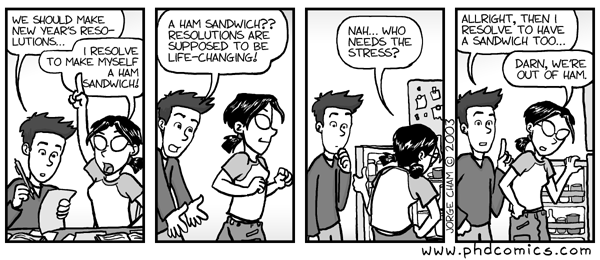
"Piled Higher and Deeper" by Jorge Cham www.phdcomics.com

What actually drives our behaviour?

Currently there exists many theories that try to explain why we do what we do, however, explanations are still lacking in regards to how our body and brain works together to directly drive our behaviour. When it comes to changing our habits, a key point to remember is that this involves stopping ourselves from doing things we consider pleasurable. For example, if you’re on a diet, every time you see an unhealthy snack, you have to tell yourself to STOP. Or, if you’re not a fan of exercising, why would you get off the sofa and slip on your running shoes? Making ourselves do things that don’t provide us with an instant reward can be stressful. These examples suggest that changing our habits can be stressful, that is, (the thought of) diet or exercise can become a source of stress (a stressor), and this makes our brain’s impulse control system work harder in order to adopt a new habit. Researchers have found that some of us can become stressed when seeing images of food, and are also not as good at controlling our impulses.1 Food craving, especially from seeing foods that we like, is a known stressor and the stress experienced from having to control our cravings is likely to tire out the impulse control system that can lead us to give in to temptations.

We might be able to change our habits for a short time as we become vigilant towards our goals, that is, the need to stick to our diet or exercise. However, we all have our limits and if stress from restricting our behaviour continues it will sap our ability to control our impulses, and our behaviour will return to what we are used to (or our ‘normal’). We saw another example of short-term success in behaviour change during our research. When monitoring children’s physical activity, some showed a burst of activity level at the start, but before long, it quickly dropped.2 These children were characterised by being hyper-vigilant towards stressors and they were generally more inactive than other children. We speculated that it was our monitoring of the activity that increased stress as the children felt that they had to show us they were more active which might spur on the initial activity spike, but as the children’s impulses for inactivity built up, it resulted in a considerable drop later on.

What’s next - how can we possibly take up, and keep up with, good health habits?

To influence health behaviour, it is crucial to understand the stress-impulse control mechanisms that DIRECTLY drive the behaviour. To use an analogy, if a person has a fractured arm, a direct treatment would be fixing the bone, rather than taking painkillers which would help to relieve the pain but not fix the problem. Similarly, if it is the stress from behaviour change and its influence on impulse control that directly causes us to succumb to temptations, we ought to target psychological interventions that reduce stress, or the brain’s impulse control system. Being able to manage our stress-impulse control system is particularly vital in the current environment where we are constantly exposed to temptations that lead to an unhealthy lifestyle. It is important to note that other factors, such as motivation and intentions, are also influential in changing our behaviour, however, this stress-impulse control process may more directly dictate the way we behave within split seconds and without our conscious awareness.

A possible psychological intervention is mindfulness training which can increase awareness of the stress cues, so that self-control can be executed before the brain’s impulse mechanism takes over. So next time we have a craving for an unhealthy snack or we are getting worked up about going for a run, we can potentially cope by containing and managing stress and impulses.

We believe that more research needs to be invested in the stress-impulse control mechanisms as it can potentially enhance the effectiveness of future individual health behaviour interventions and public health messages in getting us live a healthier lifestyle, and crucially, it can revolutionise the way we think about health behaviour change.


References
  1. Spitoni, G.F., Ottaviani, C., Petta, A.M., Zingaretti, P., Aragona, M., Sarnicola, A.,. & Antonucci, G. (2017). Obesity is associated with lack of inhibitory control and impaired heart rate variability reactivity and recovery in response to food stimuli. International Journal of Psychophysiology, 116, 77-84. https://www.sciencedirect.com/science/article/abs/pii/S0167876016307310?via%3Dihub
  2. Ling, F.C.M., Masters, R.S.W., & McManus, A.M. (2011). Rehearsal and pedometer reactivity in children. Journal of Clinical Psychology, 67, 261-266. https://onlinelibrary.wiley.com/doi/abs/10.1002/jclp.20745

The views expressed here are those of the authors and do not necessarily reflect those of Fuse (the Centre for Translational Research in Public Health) or the author's employer or organisation.

Friday, 15 December 2017

Not addicted but still having an impact: children living with parents who misuse drugs and alcohol

Guest post by Dr Ruth McGovern, Institute of Health & Society, Newcastle University

There is growing political interest in the misuse of alcohol and drugs by parents and its impact upon children. The newly published Drug Strategy 2017 highlights drug and alcohol dependent parents as a priority group with an estimated 360,000 children living with parents who are dependent upon alcohol or heroin.

As a registered social worker, I have often identified ‘dependent parental substance misuse’ as a risk factor in many ‘child in need’ assessments conducted by Children’s Services. Around half of all child protection cases, recurring care proceedings (repeat children removed and placed into local authority care) and serious case reviews (enquiries following child death or serious injury where neglect or abuse is known or suspected) involve parents who misuse substances. However, the impact of parental substance misuse is not limited to addicts. The number of children living with parents who misuse but aren’t dependent upon alcohol and drugs is likely to be substantially more than the number of children living with those who are addicts. As such, greater harm in the population as a whole is likely to be experienced by these children.

I have been part of a group of academics and clinicians who have recently concluded a rapid evidence review funded by Public Health England (PHE). The review found evidence that parents who misuse, but aren’t dependent on substances, can have a significant impact on the physical, psychological and social health of their child. For instance, in early childhood we found that children of mothers misusing alcohol [1] were twice as likely to suffer a long bone fracture and five times as likely to be accidentally poisoned, than children whose mothers do not drink heavily. Children of mothers misusing alcohol or drugs are also more likely to require outpatient care or to be hospitalised due to injury or illness, and for longer. The impact of substance misuse by parents continues into adolescence, with our review showing an increased likelihood of antisocial, defiant and violent behaviour in late adolescence as well as substance misuse by the child. However, many of these children and families are not identified as being affected by the substance misuse of a parent and subsequently do not receive the help they need in the form of an intervention.

Therefore, our review also examined the evidence for effective interventions to help reduce the numbers of parents misusing alcohol and drugs. Family-level interventions, particularly those that offer intensive case management, or those which provide parents with a clear motivation (such as those linked to care proceedings) show promise in reducing the problem. Unfortunately, there was little research examining the effectiveness of interventions for parents misusing but not dependent on alcohol and drugs.

PAReNTS study logo
To respond to this evidence gap, we designed the PAReNTS study (Promoting Alcohol Reduction in Non Treatment Seeking parents). Within this study we are examining the feasibility and acceptability of alcohol screening (using the AUDIT-C questionnaire [2]) and brief interventions with parents involved in early help and statutory children’s social care services. The brief intervention is an adapted version of the ‘How much is too much?’ programme for parents [3] which combines advice and behaviour change activities and is delivered by both social care practitioners and the local alcohol service. Whilst alcohol brief interventions have been found to be effective in adults who misuse alcohol, little is known about the effectiveness of such interventions for parents with additional and complex needs. This presents unique challenges, for instance, parents may be concerned about the stigma of being labelled as having an alcohol problem, particularly if this could be used as a reason to remove their child from their care. There is clearly a need for a sensitive approach. In future blog posts, I hope to update you on the progress we make with the PAReNTS study and whether it is feasible to deliver early interventions with alcohol misusing parents to improve the wellbeing of children, who are often overlooked in public health.

References:
  1. Below the age of 10 years, much of the evidence focuses on mothers with alcohol misuse problems as most caregiving is carried out by mothers during early years. 
  2. The AUDIT-C is a 3-item alcohol screen that can help identify persons who are hazardous drinkers or have active alcohol use disorders (including alcohol abuse or dependence): https://www.integration.samhsa.gov/images/res/tool_auditc.pdf
  3. This programme was highlighted by the National Institute for Health and Clinical Excellence alcohol prevention guidance (PH24): https://www.nice.org.uk/guidance/ph24.
Image credits:

Friday, 20 October 2017

Monopoly money, pitching to the converted, and sending Mr Grumpy away happy: doing home and healthy ageing research differently

Dr Philip Hodgson, Senior Research Assistant, Northumbria University


Endings are rubbish, right?  Whether it be a great novel, play, film, TV series – there’s always that feeling that no matter how things are pulled together, it will never be as good as you have pictured in your imagination.  And then, you know, it just ends…

It was perhaps with this in mind that we decided to take a different approach in the last of our four workshops on home and healthy ageing.  Rather than guest speakers being invited to share their knowledge and prompt discussion, the project team attempted to summarise and pitch their ideas for future research back to the group (think Dragons’ Den).  This proved to be challenging, as the previous sessions had been so rich that even synthesising them into brief slides was difficult, never mind placing them in a strategic context for the participants to critique and reflect upon.  Yet, three key themes were identified.  These were in addition to the concept of a ‘home’ being more than just bricks and mortar but personal/psychological, physical and social/environment space(s) – an idea that we used as a starting block in week one and illustrated below.

More than just bricks and mortar
'Home' illustration used in the seminars 
The key themes were:
  • Policies and contexts: not only a tension between housing and health policies, but also the need to consider market and narrative factors influencing housing and health decisions;
  • The life course approach: the need to think about housing as an individual pathway, in which preventative measures and services are considered before crisis point;
  • Transitions and soft services: the need for support to be available as and when people experience key housing and life changes, such as reduced physical health, retirement, or the loss of support networks and being able to navigate different services on offer.
However, this is where we’d like to leave you with a cliff hanger: rather than going through each of themes in-depth (fans of this series will have to wait for our spin off…  er, research papers for that!), we’d instead like to reflect on our process at this stage.  These sessions took a slightly different approach as, rather than being a series of open seminars with presentations that people could dip in and out of, we invited several key individuals to attend each session in turn.  The reasons for this were many, but primarily we wanted to ensure that a diverse range of backgrounds were represented throughout (housing providers, architects, academics, local authority workers, homelessness workers, etc.) to go on a learning journey with us as a research team.  This meant that by the time we reached the final session, there was enough of a shared understanding that we could make the most of the group’s commitment to the project – we would be actually able to start to pin down quite complex concepts, practical issues and, hopefully, future projects.

We tried out different formats to structure the discussions: from world cafés, to games (with Monopoly money!) with researchers pitching ideas to mock panels, which worked to various degrees but always ensured a lively debate.

Do not pass Go. Do not collect £200
Pitching ideas with Monopoly money 
There were, of course, some difficulties.  As I’m sure everyone reading this will know, it is a lot to ask of a practitioner to take one morning out of their schedule, let alone for four seminars.  As a result, engagement had to remain a constant focus and I spent much time nervously lingering by the registration desk hoping for just a few more name badges to disappear before we started!  It was also a challenge in terms of managing the conversations during the sessions: you want all voices to be heard in such a diverse group but we all needed to be pulling in the same direction by the end.

Yet, by the final session, the rewards were immense.  Not only were we able to pitch ideas to a group who had already undergone some of the same learning as us, but this gave everybody the confidence to relate the complex theoretical issues to their own practice (allowing us to capture the breadth of what was possible).  It allowed us to discuss concrete projects, and leave the session with a sense of trust that networks were in place to actually deliver on them.  Perhaps most importantly we found that, what started as a broad idea, was something of relevance across the housing and health sectors.  Even the grumpiest of the project group (naming no names) left the day with a spring in their step.  For that alone, everyone who attended deserves some massive thanks…

So, who needs endings, when we can all just sign up to the sequel?

To be continued…


Photo 2: By James Petts from London, England (Monopoly) [CC BY-SA 2.0 (https://creativecommons.org/licenses/by-sa/2.0)], via Wikimedia Commons

Friday, 21 April 2017

Sleepless in the slammer

Charlotte Randall, Higher Assistant Psychologist and MSc student, Northumbria University

The current prison population is 85,641 and around 50% of this population suffers from symptoms of insomnia. While this is similar to the general population there are a limited amount of resources to help treat this disorder in prisons.

Having worked in prisons for seven years, I am all too familiar with the problems that a lack of sleep can have on an offender's ability to engage with the prison regime, and the impact this has on their mental health. Due to the high prevalence of mental health problems, substance misuse and personality disorders in the prison population, the issue of sleep is often side-stepped and the importance of obtaining and having a healthy sleep practice can be forgotten about.

I am part of the Mental Health In-reach team in a prison in the North East, and have witnessed first-hand the effect poor sleep can have on an offender’s mental health. As this is an under-researched area, I decided it would be interesting and beneficial to conduct research on insomnia in the custodial setting. The aim of the study was to see whether a 60-70 minute session of Cognitive-Behavioural-Therapy for Insomnia (CBT-I) with an accompanying self-help pamphlet was an effective treatment in reducing the symptoms of insomnia in male prisoners.

As I work in the prison Mental Health Team full time, I thought this would be a simple project to undertake, however there were several hurdles along the way. Firstly I was required to gain ethical approval from several different organisations; NHS; National Offender Management (NOMS); and the University. Offenders are classed as a vulnerable population for research purposes, and therefore there is heightened scrutiny from ethic boards as a result of this. This process was lengthy; I had to complete three separate documents explaining the project’s benefits for each organisation. Once submitted, I was required to attend a full Research Ethics Committee (REC) where the research protocol and IRAS (Integrated Research Application System) form were discussed and additional questions were asked. It was then a waiting game to see whether the study had been granted ethical approval. As with any research project there was a deadline of September 2016, in which my dissertation needed to be submitted. Ethical approval was granted in June 2016, after recommendations had been made by the NHS and NOMS ethic boards and an amendment report was submitted.

On the other hand, recruitment for the study was relatively easy, which surprised me! Although it also identified the need for insomnia interventions in the custodial setting and confirmed that this research was important. The offenders were keen to engage, due to the lack of pharmacological (drug related) and psychological interventions for insomnia they were eager to find something that helped them sleep.

Results from this research were positive and highlighted that there was a significant reduction in insomnia related symptoms after completing the 60-70 minute session of CBT-I, with the accompanying self-help pamphlet with category C adult male prisoners. This research is the first of its kind to assess whether an adapted versions of CBT-I is effective in the prison population, where there are limited interventions and resources to help aid sleep disturbances. Although the results were positive, they have to be taken with caution as the prison where this research was undertaken has a unique regime and all prisoners are in single-cells which allowed them to complete certain aspects of CBT-I e.g. sleep restriction.

My experience of completing this research was positive; I enjoyed the prospect of analysing an undiscovered area and hopefully informing academia and practice within a public health setting. I did however find it hard in the early stages of this project, specifically going through the ethics process and length of time this took. A written report has been disseminated to NOMS highlighting the findings of this research. It also identifies how this research could be taken forward and inform future research opportunities. The single session of CBT-I is being delivered in the prison where the research was completed, more data is being gathered and will hopefully be published in 2017.


Photo attribution:
  1. “sans horizon” by poirpom via Flickr.com, copyright © 2015: https://www.flickr.com/photos/poirpom/16479845789/
  2. “prison” by erin via Flickr.com, copyright © 2007: https://www.flickr.com/photos/insunlight/1037277952
  3. “Insomnia” by Ben Harrison via Flickr.com, copyright © 2011: https://www.flickr.com/photos/48755144@N02/5564362009