Showing posts with label FLNG. Show all posts

Friday, 30 September 2022

Going beyond research to empower involvement and smash stereotypes

Posted by Sheena Ramsay, Professor of Public Health & Epidemiology, (and team: Emma Joyes, Emma Adams, Laura McGowan) in collaboration with Fulfilling Lives Newcastle Gateshead Experts by Experience

The way researchers approach some groups is often not sensitive to or inclusive of their needs. For example, the information can use technical language (such as ‘licit substances’ or ‘quasi-experimental’) which can be difficult to understand and off-putting. This can lead to people not wanting to take part in studies. Which means that new research insights, including changes to practice, can exclude those who are often most impacted.

Over the last two years, we have been working with Fulfilling Lives Newcastle Gateshead and their Experts by Experience Network of individuals with lived experience of multiple disadvantage. We have explored perceptions of services and programmes relating to oral health and related health behaviours - such as substance use, smoking, and diet - for people who experience severe and multiple disadvantage (a combination of homelessness, substance misuse, and offending). From the beginning, the Experts by Experience Network has shaped our work and helped us ensure it is accessible to those we want to speak to the most.

One of the ways that the Network has shaped our research is by helping us to create a video to help reach out to potential participants for our research - particularly people who are often excluded in research studies, such as people experiencing homeless.


Our team worked with the Experts by Experience Network to look at ways to get people involved in the research. We wanted to work with those who had insights into the issues we hoped to study, so that we could communicate the research in a way that would resonate with people. Together, we co-created an animated video as a means of reaching out to people, so they could find out about the research and how to take part.

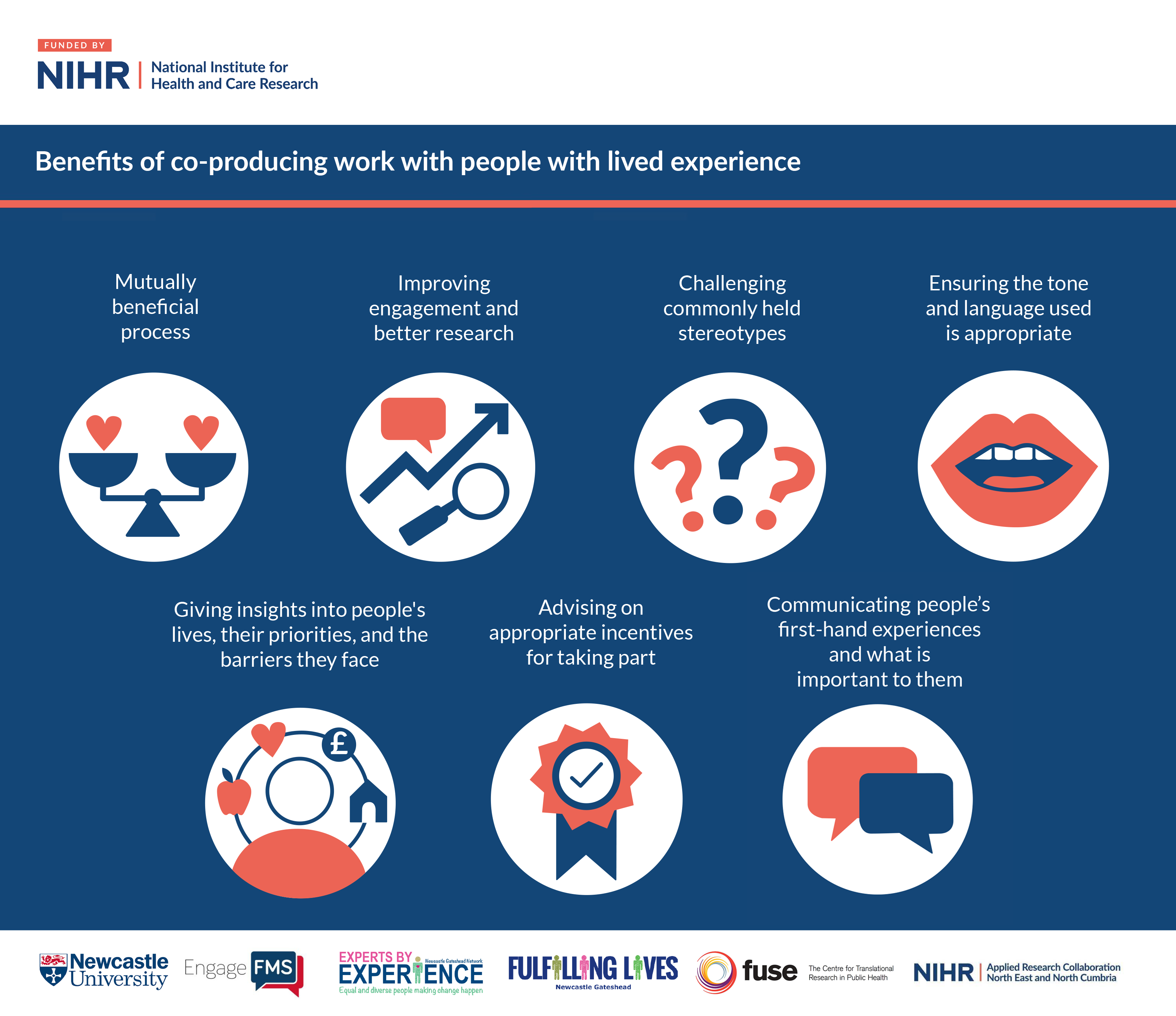
The infographics in this blog show what we have learnt from this process of co-creating the video and the value of co-production.


Creating a video provided an easy way in which organisations (such as Crisis, Fulfilling Lives, and other providers) and local Expert by Experience networks could share information about the study.

Those involved in creating the video were able to draw upon their experiences to help shape the content. One of the members of the group shared their experience of the process:
“Some of us in the Network feel really strongly about this issue and have personal experience of it ourselves so we were keen to be involved and share our ideas and opinions.”
Another member said:
“I joined this project because my own oral health has been something I've been embarrassed about in the past so I thought I could add something useful to this work.”
We have tried to map out how we designed our video in the image below.


The video has also been shared nationally with a wide range of organisations that support severe and multiple disadvantage groups in Newcastle and Gateshead, London, and Plymouth to promote engagement with policy and commissioners, local authority, criminal justice system, primary care, and third sector organisations. Producing a video was no easy feat, but it was a simple way of sharing our research with people who are pressed for time. You can check out the video below.


A clear benefit of engaging with people with lived experience was having their input on how best to communicate our research widely. They provided real-life stories and examples, which helped create the narrative for the video. They helped challenge stereotypes of ways in which people can be portrayed in research studies - this resulted in modifying the images and language used in the video which were much more realistic and sensitive to the people we were wanting to engage. This has helped our research team become more aware of and appreciate the importance of stereotyping and how it can result in putting people off taking part in research.

The benefits reached beyond the research team and the video (the below infographic highlights some of these), as many of the Experts by Experience echoed how involvement has led to them feeling empowered and one member wrote a blog about their experience.

We plan to build on this collaboration as we continue our research and gain further input on findings from our study and next steps.


This study ‘Improving the oral health and related health behaviours of adults experiencing severe and multiple disadvantage: evidence synthesis and qualitative stakeholder research’ is funded by the NIHR Policy Research Programme (grant reference NIHR200415). The video was supported by Newcastle University Engage FMS. The views expressed are those of the author(s) and not necessarily those of the NIHR or the Department of Health and Social Care.

Friday, 25 March 2022

Is a picture truly worth a thousand words?

Posted by Emma Adams, NIHR ARC NENC Mental Health Fellow at Newcastle University, and Experts by Experience from Fulfilling Lives Newcastle Gateshead & #HealthNow Newcastle

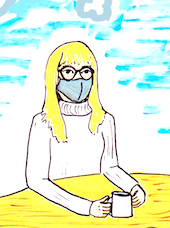
An illustration of me! Taken from one of the images
below created by Siân from More than Minutes
We have all heard some variation on the saying “a picture is worth a thousand words”, and yet often information is shared through large reports with thousands of words and few images. A 2019 paper published in Nature Communications highlighted that with all the information people can read, gaining people’s attention is increasingly difficult.

Take the image of me (right), it tells you about my hair colour, glasses, outfit, that I'm partial to a tea or coffee and that I am sitting at a table. If I had written a description of everything that you can get from the picture, it would have likely taken up far more space. If it were me, I would probably only have skimmed the text. As a public health researcher, part of my job is finding ways to share research findings in a way that will engage people to want to learn more and have a conversation (something we in Fuse like to call knowledge translation).

Alongside my Experts by Experience (individuals with lived experience of homelessness, mental ill-health, and/or substance use) we began to ponder how to share what we learned from our NIHR School for Public Health Research (SPHR) funded study exploring access to community based mental health and substance use support during the COVID-19 pandemic for individuals experiencing homelessness and those providing support. We had finally reached a point where there was a light at the end of the tunnel, as we moved away from understanding to sharing the findings. Yes, we figured we would write a couple of papers, attend some conferences, and likely write a report, but the bigger question was would the people in policy and practice and individuals experiencing homelessness read those documents? While trying to be nice, one person levelled with me and said Emma, “I’m probably not going to share a PowerPoint with a friend” and another said, “I don’t even know what that journal is”. Quickly the realisation sunk in that we were going to have to come up with a better solution for sharing our findings.

I began to think about visuals but realised my failed attempts at drawing stick people meant I probably would not be able to do this on my own. Two of the Experts by Experience spoke about a visual they had seen designed by More than Minutes for a peer research study around barriers to accessing care and treatment for people experiencing homelessness (#HealthNowManchester). I realised in that moment we had found our answer. Suddenly the Zoom call was abuzz with energy as everyone got excited about what story our visual might tell. As one person said, “it’s aimed at people who can’t read or write, or have a disability - someone like my brother”. Perhaps even more insightful was the comment that, “it [a visual] could have a different meaning for each person depending on their own experience”. 

We met with Siân (an illustrator from More than Minutes) and began planning the image and figuring out how to depict our endless pages of ideas into a visual that was engaging without being overwhelming. Over the next few months, we had a bit of back and forth on what we were envisioning. When the initial pencil sketch arrived, we were shocked at how the images captured so much of what we wanted to share without being a visual overload. Like kids at Christmas, we sat in suspense waiting to see what the final colour version would look like. We knew it captured exactly what we wanted when we saw the coloured versions. It was the physical depiction of everything we had learned and would proudly adorn our homes and offices! Through working with Experts by Experience and having input from colleagues in practice, we believe we have created a poster that depicts the experiences without some of the stigma we often see. Each of us saw something a little bit different in the poster, and we could not wait to share it with friends, colleagues, and providers. 

Created by Siân from More than Minutes; See the full images on the NIHR School for Public Health Research website.

Having had the experience of seeing words and quotes come to life, I cannot wait to do it again. Although we will continue to write papers and reports, the ability to share the images from our phones or by email with anyone has made us think about other creative ways to communicate research in the future.

So, I end this post with a question for you, do these pictures tell a better story of the findings than a one-page summary would have? Between you, me, and our Experts by Experience, we will be returning to this visual time-and-time again whereas the paper and report might not have the same reach and engagement. 

-----------------------------------------------------------------------------------------------------------------------------------------------------------------------------------------------------

To make this visual freely accessible, we would welcome organisations printing their own copies. If you are printing the poster, please print it in its entirety and email Emma Adams emma.adams@newcastle.ac.uk so we can see all the places sharing our findings. A limited number of printed posters are available directly from Emma for pick up from Newcastle University.

Initial findings from Emma’s study have now been published in the International Journal of Environmental Research and Public Health.

Fuse Research Programme Meeting is planned to share more information about Emma’s study. Stay tuned for the save the date and further information. 

-----------------------------------------------------------------------------------------------------------------------------------------------------------------------------------------------------


Emma is a Mental Health Fellow for the NIHR Applied Research Collaboration (ARC) North East and North Cumbria (NENC) and a previous NIHR School for Public Health Research (SPHR) Pre-Doctoral Fellow.  Her study 'Exploring and understanding access to community-based mental health and addiction services in Newcastle and Gateshead' is NIHR SPHR ResNet funded.

This project is funded by/supported by the National Institute for Health Research (NIHR) School for Public Health Research (SPHR) (Grant Reference Number PD-SPH-2015-10025). Emma was supported by the NIHR SPHR Pre-doctoral Fellowship Funding Scheme (Grant Reference Number PD-SPH-2015). Emma is now supported by the NIHR Applied Research Collaboration (ARC) North East and North Cumbria (NENC) (NIHR200173). The views expressed are those of the author(s) and not necessarily those of the NIHR or the Department of Health and Social Care.

Friday, 5 November 2021

Cookies, coffee and co-production during Covid

Posted by Emma Adams, Fuse/NIHR School for Public Health Research (SPHR) Pre-doctoral Fellow at Newcastle University, in collaboration with Experts by Experience from Fulfilling Lives Newcastle Gateshead and #HealthNow Newcastle

Photo taken by Jeff Parker (one of the individuals with lived experience involved in our
co-production) of the masks he made for each of us at our first face-to-face meeting. 
COVID-19, has forced all researchers to re-think engagement and how we work with people with lived experience. I like many, have been navigating how best to do this within my study that aims to explore and understand access to community-based mental health and substance use support in Newcastle and Gateshead for those experiencing homelessness during the pandemic.

Since March 2020 I have been collaborating with five people with personal experience of homelessness, mental health, and/or substance use to co-produce the analysis for this study. During that time we have discovered a very helpful approach (albeit with an imposing name) - Interpretative Phenomenological Analysis.

Here comes the science…


This approach was very reflective and recognised that we were trying to understand how our participants made sense of what had happened to them. We wrote exploratory comments to reflect on the word-for-word text from interviews and then used both to develop themes. This approach lent itself really well to our analysis, as we found it was less rigid than other coding-based approaches (such as thematic analysis) and had more opportunity for reflection. 

The saying ‘no two things are alike’ describes how we ran our co-production meetings given COVID-19 restrictions. We sent out printed packages with anonymised transcripts for comments, held Zoom meetings to discuss our comments and thoughts, hosted in-person meetings with sticky notes and marker pens to develop themes and unpick key ideas, and used physical and virtual highlighters to identify our top quotes. Accompanied with a healthy amount of coffee, baked treats, and fruit, we set our sights on trying to understand our data. We broke down each analysis into three sessions, with the first session focussed on reviewing the transcripts and writing comments, the second focussed on developing some initial themes, and the third focussed on identifying and refining all the themes and key quotes.

Friendship, findings and reflections


We are now starting to share initial findings and determine creative ways to present the information. Having built a strong friendship, we reflected on how much we enjoyed the collaborative co-production experience, despite the circumstances created by COVID. We also reflected that not all co-production is positive. Here we share a few thoughts from the experience.

Why did you become involved in the study?
Everyone in our group felt motivated by the opportunity to have their voices heard and make a difference.
"Because I am interested in how the pandemic has affected people and am a member of the Experts by Experience and would like to change things for the better" – Joanne
"I wanted to do a different sort of user health research having done some last year in Newcastle for Crisis and Groundswell. Getting involved in analysing the anonymised data was a fantastic opportunity for myself" – Tony

What did you enjoy and learn?
Everyone enjoyed being involved as the research continued to grow and their continuous involvement meant we could develop friendships.

"Actually being involved from start to finish, Emma baking" – Jeff

"Analysing some of the data and the group! I feel new friendships have been made" – Fiona

 Although different learnings were shared, it was clear that everyone enjoyed working in a team to try out new things and have a ‘behind the scenes’ peak into doing research.

"One day I would really like to do more of this work in a permanent position as part of my continuing personal development. So it was very nice to get the opportunity to find out what this sort of work entailed and whether or not I would enjoy doing it too" – Tony

"Co-production can really work if it's formulated with an organic and lived experience perspective at the heart of the study, the information gathered was not lost in translation and the language from participants' interview was not tampered with" – Des

What did you find challenging and wish researchers knew?
Forcing ourselves to think about some of the things we all found challenging, we realised it is important to touch base with people involved in co-production to understand what they are struggling with and how they can be better supported.

"Biggest problem I have is getting to a venue, I have anxiety issues travelling by bus" – Jeff

"Emma would send me a gentle reminder a few days before work was due and it would spur me to either start, or finish off and get the work sent in. This really helped me" – Fiona
What would you say to a friend about getting involved in research?
Across the board, everyone said they want to continue to be involved in research projects and would encourage friends to do so.
"At first it might fly over the top of your head, but give it time and you will learn things you never knew you were capable of" – Joanne

"Go for it, maybe you can help affect change that will help others who have been through what you have. Plus, you’ll make some new friends and may enjoy yourself too" – Jeff

What are you most excited about?
When asked about what they were most looking forward to and anything else they wanted to share, responses ranged from gaining specific experience, to celebrating successes.

"It made a nice change to be more involved and now I’m doing more research with Crisis its helped me to help them shape how it can be done and how sense making is carried out" – Jeff

"The biggest rush of the project was to receive an email from the Lancet after we submitted a piece on the work. If it gets published, I’m throwing a party" – Fiona

"Emma has kept us updated throughout and involvement moving forward looks bright … and on the back of this there is confidence to come back to the university and vice versa in other research projects" – Des

Lessons learned from a researcher perspective


The depth and richness gained through co-producing my analysis is something I could have never done on my own. I learned that it is okay to admit when you are feeling a bit lost about the best approach, as that allows for an open dialogue to determine what can be done to make things better. Through our co-production, I realised how to make findings more accessible and engaging for everyone. The pandemic has meant that we have all missed out on in-person contact. Listening to our group I was shocked and humbled by how much the little touches mattered; well-timed cookies or an invite for a coffee chat can make a big difference. These small touches allowed me to develop relationships with everyone and have frank and honest conversations. From this experience, I have learned that you do not need to wait until you have findings to make a difference, rather you have a chance through co-production to make lasting impacts across the span of your research project.


Emma's study 'Exploring and understanding access to community-based mental health and addiction services in Newcastle and Gateshead' is NIHR School for Public Health Research (SPHR) ResNet funded.

This project is funded by/ supported by the National Institute for Health Research (NIHR) School for Public Health Research (Grant Reference Number PD-SPH-2015-10025). The views expressed are those of the author(s) and not necessarily those of the NIHR or the Department of Health and Social Care.

Friday, 29 January 2021

Bringing the voice of lived experience and community learning into research

Posted by Angela Broadbridge, Peer Research Lead, The Young Foundation (former Research and Evaluation Lead, Fulfilling Lives Newcastle Gateshead)

“There’s something really interesting in our data here, we don’t quite have the full picture, let’s talk to some people to puzzle it over more.”
This is something I hear myself or the team at Fulfilling Lives Newcastle Gateshead (FLNG) say really regularly. We’re an 8 year National Lottery Community Fund learning programme working to improve the lives of people facing multiple disadvantage and build a trauma-informed approach within the services that supports them. We have a wealth of data from supporting over 250 people locally, and we work with a team of Experts by Experience, people with lived experience working to bring about change across the systems they have been through, using their voices to be heard across different platforms.
Fulfilling Lives Newcastle Gateshead Experts by Experience Network co-design session

As the programme has developed our relationship with Fuse has changed and connections have grown, we now do much of our ‘puzzling over’ with Fuse colleagues! I joined Fuse as an associate member back in 2017 when I took up my post as research and evaluation lead for FLNG. I attended Fuse Quarterly Research Meetings to build up my contact base and learn from others operating in this interesting space between frontline practice and research and learning. As I began to see frontline practitioners come into those sessions, I invited some of our own frontline staff to join me to share their experience of working with people who have experienced complicated and challenging circumstances and struggled navigating systems.

I want to highlight some of our learning from building collaborative relationships through and with Fuse researchers, as this has proved to offer new platforms for the voice of lived experience not just to be heard in research, but to set research agendas and co-produce work alongside academics.

In 2018, Dr Sheena Ramsey (co-lead of the Fuse Healthy Ageing Research Programme) invited me to attend a Research Hub Initiative event with Public Health England and I pitched a seed grant funding idea with support from Fuse researchers. Our recently published work on deaths in the multiple complex needs community, an issue our Experts by Experience network encouraged us to explore, was borne out of this funding. We have since joined up with Sheena again in a new study identifying effective and sustainable interventions to improve the oral health of adults with severe and multiple disadvantage. This collaboration works because Sheena and other researchers associated with the study took the time to really get to know our programme, and our Experts by Experience network. Sheena visited us at the men’s accommodation project where we were based a few years ago, met some of our frontline staff and also built trusting relationships with the network, introducing us to academic and practice colleagues to further situate our programme learning within Fuse.

Brainstorm - what makes a good collaboration?
While this was happening, Prof Susan Carr (Fuse Associate Director), set up a meeting with her team at Northumbria University and FLNG peer researchers to talk about projects we were both working on and to explore collaborations. She also arranged for our peer researchers to present early findings from their work to Prof Kevin Fenton, Public Health Regional Director for London, and it was at this point that we started to see how people with lived experience could be involved in local research and practice beyond being participants. There were opportunities for genuine collaboration and learning together.

Fast forward to early in the pandemic and we were involved in two applications to the NIHR Applied Research Collaboration (ARC) for the North East and North Cumbria. One of these applications was exploring food insecurity with Fuse Associate Dr Steph Scott, and Kevin Dobson and Keith Gibson from FLNG’s research team set about exploring our own programme data around foodbank use. Our Lottery funded programme is quite unique in that we have a personal budget fund to use to support people on the programme with anything from their basic needs, including food and accommodation, to more creative uses like buying art materials or enjoying an afternoon at the cinema. Once again we had a ‘there’s something interesting here’ moment.

I sent Steph an email saying:
“we’ve worked with 259 people in Newcastle Gateshead over 6 years and of these 127 individual client records contained a reference to food insecurity or food poverty. We had 14 unique cases, interestingly all female, whose notes had 10 or more references to food poverty and we can see from the notes frequent references to benefits being suspended, people not eating, or missing the foodbank opening times.”
Working with partners to surface system barriers and solutions
The conversation that followed led to us talking to the Experts by Experience about food insecurity, they were similarly enthused by the topic and together we made a successful joint application to the Catherine Cookson Foundation within Newcastle University for a project exploring mutual aid during Covid-19. Using our Lottery funded programme learning and building on our experience co-producing research in other projects with Fuse researchers we are working with a group of Experts by Experience who have developed research questions to start a listening exercise with their peers around their experiences of food insecurity, mutual aid and Covid-19.

This relationship with Fuse is evolving and changing, and it now feels like a relationship truly rooted in the principles of co-production. Our team report that they feel their frontline experience is listened to and helps shape research projects, and our peer researchers are involved in numerous projects and have the confidence to approach Fuse researchers to develop new pieces of work building on the issues that are important to them and their communities. As our programme comes to an end in March 2022, the Experts by Experience network is now thinking about its legacy, we very much hope to continue to build on this strong foundation for collaboration and learning.

Friday, 15 May 2020

Experts by Experience challenge us to create opportunities for them to take the lead in research

Posted by Ang Broadbridge (Research and Evaluation Lead) and Ged Hazlehurst (Expert by Experience) Fulfilling Lives Newcastle Gateshead

Earlier this year Fuse and Fulfilling Lives Newcastle Gateshead co-chaired a Quarterly Research Meeting sharing initial findings from a joint research project that explored the reasons underlying high death rates among people with multiple and complex needs (MCN). There we asked attendees to consider the findings and help shape recommendations.

Now as we write up the findings during the height of the Covid-19 pandemic, we are reminded that drug related deaths and MCN issues have been a public health crisis long before the pandemic, though it has drawn an even sharper focus on health inequalities at this time.

The findings from the study will be available in a forthcoming end of project report but in this blog we wanted to go behind the scenes with Experts by Experience to share our experiences of co-production in public health research.

Some background

So what is Fulfilling Lives Newcastle Gateshead (FLNG), and what are Experts by Experience? FLNG is an eight-year learning programme looking to improve the lives of people with complex needs and build a trauma-informed approach within the services that support people across Newcastle and Gateshead. Experts by Experience are people with lived experience of multiple and complex needs, and have vital things to say that can help shape the future of how systems and services work for their peers.

Co-producing research

Co-production is bringing together the people using services and the people providing those services to share power and work collectively to design, develop or deliver improvements to them. This also involves seeing services and staff as agents for change and seeing people who use services as assets with skills, who in turn, gain from their contributions and move towards positive change. For example, Experts by Experience on the FLNG programme have developed training resources for Department for Work & Pensions staff raising awareness of MCN issues, which were rolled out across JobCentre Plus.

FLNG wants research to be genuinely co-produced and has invested in creating a National Vocational Qualification accredited peer research skills training package and local Peer Research Network. This is to support a shift from involvement led by professionals to an approach in which peers define the remit and research questions, leading on all aspects of the research design, delivery and dissemination.

Experts by Experience defining research problems

The beauty of the Fulfilling Lives programme has been our small team and the small caseloads; with at the most eight frontline practitioners each working full time with just 10-12 people. We work intimately with these people, building strong trusting relationships, getting to know their families, and being by their side through crisis.

Between 2014 and 2020 we worked with 267 people, during which time we experienced 27 deaths on programme. That is around 10% of the client cohort, so you can perhaps imagine the impact of that 10% on a small team who have been deeply involved in the lives of the people they have navigated through services.

We talked to our Experts by Experience Network about this and as the programme research lead I (Ang) was really wary about the sensitive subject matter and its potential for re-traumatising. My thinking was challenged when the Experts Network were really passionate about deaths in their community and told us they were already talking about it, often without much support, so not to shy away. Then they challenged us to think about how our co-production and peer research offer could dig deeper to explore this issue. We asked Experts by Experience to help us explore what it would look like for them to take a peer-led approach to this work. They really helped shape the ethics process, for example they told us to look within their Network for participants, as we could guarantee good support for people to discuss any issues that emerged out of participation. In doing so they, the Experts by Experience, identified the topic for this project.

What was the feedback from our co-produced research event? 

When we met for the Fuse QRM the purpose of the session was to study the initial findings gathered from the series of focus groups we ran exploring MCN deaths. It was interesting then that the feedback we received from the event, asking people’s views on what we found and what was surprising, clustered around co-production in research. This suggests that this research has the potential to challenge beliefs about the involvement of people with lived experience in public health research:
  • People were surprised by the extent to which Experts by Experience were able to take on such a difficult subject, and;
  • People were surprised by the normalisation of death within our Expert by Experience community. 
It is our hope that this acts as a springboard for more and better involvement of people with lived experience of multiple and complex needs in public health research. We have explored a sensitive and challenging subject with Experts by Experience who challenged us to create opportunities for them to take the lead. We hope that as our Peer Research Network grows, other researchers can build on the peer research model we utilised in this study to shape their own research projects.

FLNG is one of twelve programmes linked across England funded by the National Lottery Community Fund, looking to influence the system nationally. A Core Partnership of Changing Lives (lead partner), Mental Health Concern and Oasis Community Housing lead the programme’s activity, for more information visit http://www.fulfillinglives-ng.org.uk/


Images courtesy of http://www.fulfillinglives-ng.org.uk