Showing posts with label sedentary behaviour. Show all posts

Friday, 6 November 2020

Changing the habit(s) of a lifetime: an intense body and mind affair

Posted by Fiona Ling, Senior Lecturer in Sport & Exercise Psychology, and Gavin Tempest, Senior Lecturer in Exercise Neuropsychology, Northumbria University

Many of us will be soon be thinking about making New Year’s resolutions, whether it’s to do with eating more healthily or doing more exercise. However, how many of us have actually managed to stick to our resolutions even though we know they are good for us? The question is – why is it so difficult to change our health habits?

While it’s well recognised that our environment does not help in encouraging a healthy lifestyle - from food and drink marketing to electronic devices promoting inactivity - could there be other reasons why we find it hard to change behaviour?
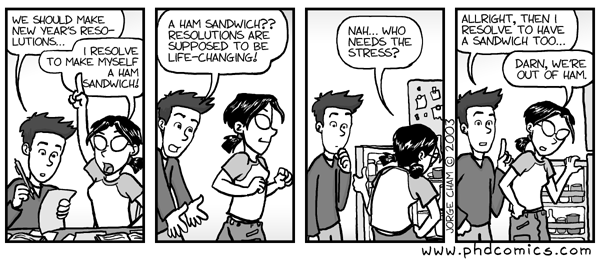
"Piled Higher and Deeper" by Jorge Cham www.phdcomics.com

What actually drives our behaviour?

Currently there exists many theories that try to explain why we do what we do, however, explanations are still lacking in regards to how our body and brain works together to directly drive our behaviour. When it comes to changing our habits, a key point to remember is that this involves stopping ourselves from doing things we consider pleasurable. For example, if you’re on a diet, every time you see an unhealthy snack, you have to tell yourself to STOP. Or, if you’re not a fan of exercising, why would you get off the sofa and slip on your running shoes? Making ourselves do things that don’t provide us with an instant reward can be stressful. These examples suggest that changing our habits can be stressful, that is, (the thought of) diet or exercise can become a source of stress (a stressor), and this makes our brain’s impulse control system work harder in order to adopt a new habit. Researchers have found that some of us can become stressed when seeing images of food, and are also not as good at controlling our impulses.1 Food craving, especially from seeing foods that we like, is a known stressor and the stress experienced from having to control our cravings is likely to tire out the impulse control system that can lead us to give in to temptations.

We might be able to change our habits for a short time as we become vigilant towards our goals, that is, the need to stick to our diet or exercise. However, we all have our limits and if stress from restricting our behaviour continues it will sap our ability to control our impulses, and our behaviour will return to what we are used to (or our ‘normal’). We saw another example of short-term success in behaviour change during our research. When monitoring children’s physical activity, some showed a burst of activity level at the start, but before long, it quickly dropped.2 These children were characterised by being hyper-vigilant towards stressors and they were generally more inactive than other children. We speculated that it was our monitoring of the activity that increased stress as the children felt that they had to show us they were more active which might spur on the initial activity spike, but as the children’s impulses for inactivity built up, it resulted in a considerable drop later on.

What’s next - how can we possibly take up, and keep up with, good health habits?

To influence health behaviour, it is crucial to understand the stress-impulse control mechanisms that DIRECTLY drive the behaviour. To use an analogy, if a person has a fractured arm, a direct treatment would be fixing the bone, rather than taking painkillers which would help to relieve the pain but not fix the problem. Similarly, if it is the stress from behaviour change and its influence on impulse control that directly causes us to succumb to temptations, we ought to target psychological interventions that reduce stress, or the brain’s impulse control system. Being able to manage our stress-impulse control system is particularly vital in the current environment where we are constantly exposed to temptations that lead to an unhealthy lifestyle. It is important to note that other factors, such as motivation and intentions, are also influential in changing our behaviour, however, this stress-impulse control process may more directly dictate the way we behave within split seconds and without our conscious awareness.

A possible psychological intervention is mindfulness training which can increase awareness of the stress cues, so that self-control can be executed before the brain’s impulse mechanism takes over. So next time we have a craving for an unhealthy snack or we are getting worked up about going for a run, we can potentially cope by containing and managing stress and impulses.

We believe that more research needs to be invested in the stress-impulse control mechanisms as it can potentially enhance the effectiveness of future individual health behaviour interventions and public health messages in getting us live a healthier lifestyle, and crucially, it can revolutionise the way we think about health behaviour change.


References
  1. Spitoni, G.F., Ottaviani, C., Petta, A.M., Zingaretti, P., Aragona, M., Sarnicola, A.,. & Antonucci, G. (2017). Obesity is associated with lack of inhibitory control and impaired heart rate variability reactivity and recovery in response to food stimuli. International Journal of Psychophysiology, 116, 77-84. https://www.sciencedirect.com/science/article/abs/pii/S0167876016307310?via%3Dihub
  2. Ling, F.C.M., Masters, R.S.W., & McManus, A.M. (2011). Rehearsal and pedometer reactivity in children. Journal of Clinical Psychology, 67, 261-266. https://onlinelibrary.wiley.com/doi/abs/10.1002/jclp.20745

The views expressed here are those of the authors and do not necessarily reflect those of Fuse (the Centre for Translational Research in Public Health) or the author's employer or organisation.

Friday, 21 February 2020

Workplace Health and the Cauldron of Evidence

Scott Lloyd and Sarah Slater, Advanced Public Health Practitioners, Public Health South Tees 

Systematic reviews are brilliant. They take all the available evidence for a particular topic, do something special (stick the results into a big cauldron) and churn out a finding that informs us mere mortals in policy and practice where we should and shouldn’t be investing our money and capacity.

Double, double toil and trouble...
In these austere times, such evidence about what works and what doesn’t is so important – especially when combined with the how and why. This recent review by Jenna Panter and colleagues is an excellent example of what works and how.

However, there is one sphere of public health where we feel that systematic reviews may not paint a full and fair picture.

Let us explain.

Workplace Health


Most public health colleagues have a speciality or five. This might be a topic (e.g. nutrition or addiction) or part of the life-course (e.g. children and young people or older adults).

We are Workplace Health Specialists with 28 years of combined experience. We’ve supported employers of all descriptions, including businesses of different sizes and in different sectors. We’ve worked on national workplace health programmes, such as the Well@Work programme led by the British Heart Foundation between 2005 and 2007, and have been involved in the North East Better Health at Work Award since its launch in 2009 (arguably the biggest and most successful workplace health programme in England). We’ve a lot of experience of supporting NHS organisations who are trying to improve the health of staff – sometimes successfully, sometimes less so.

Working with such a variety of employers to improve staff health is a challenge of both knowledge and skill because they are looking to you, as the expert, to come up with evidence-based suggestions. Consider how you might support the below employers (real examples for us) to encourage physical activity in their workforce:
  • A tea factory which operates 24 hours a day with mixed shifts and a predominantly female, part-time workforce
  • A call centre for a bank employing 1,200 mostly young staff, in a mainly sedentary occupation
  • A call centre for a public sector organisation employing workers typically aged 40 plus, in a mainly sedentary occupation
  • A mining company at which the majority of the workforce arrive, take a lift down a shaft for 20 minutes, work a shift underground in 40 degree heat, resurface in the lift and get straight in the car to head home
  • A category B prison. 
How would you support an employer to encourage physical activity in a call centre?
What you might suggest to each of the above five employers (and what might work) could be completely different (and probably would be). At least in each of those scenarios, the workforce is likely to be pretty homogenous. Consider working with a huge employer such as a Local Authority or NHS Trust which arguably have massive internal differences in staffing groups in terms of age, gender, hours, and roles (e.g. office staff vs refuse collectors).

We believe that these differences make workplace health a different kettle of fish compared to other settings, such as schools, colleges, universities, and prisons, which could be comparatively homogeneous. They aren’t of course – there are massive differences between schools for example, but our suggestion is that they have the potential to be very similar if all variable things (e.g. culture, policies etc.) were the same. 

What’s our point?

Firstly, that lumping trials of workplace health interventions and programmes into a systematic review masks these potentially huge differences. We’re not sure how we get around this issue but we are raising it as an issue.

Secondly, to suggest that there is a lot more research to be done. There are some workplaces that should be considered a priority. For example, the majority of the working population in the private sector (60%) are employed by small-to-medium sized enterprises (less than 250 employees) and this is an area that no-one has cracked in terms of health and wellbeing via the workplace. Another example is call centres: given the sedentary, pressured nature of the work. One feasibility trial has recently been completed (Morris et al. 2019)[1] and another is underway (involving Scott). We can’t do individual studies for every type of workplace but some should be considered a priority.

Thirdly, to highlight the skills possessed by our peers who lead on workplace health. Employers and employees can throw all sorts of issues at you from bread and [low fat] butter stuff like physical activity and mental wellbeing to stuff like menopause awareness and sleep. Not only does a workplace health specialist need to maintain a base knowledge of all these topics, but they also need to understand how it might be tackled in the various types of workplace highlighted above.

It would be remiss of us not to plug the North East Better Health at Work Award. It needs a stronger evaluation building on previous work (Braun et al. 2014)[2], but we’re talking about a programme that was launched in 2009 and has actively engaged hundreds of employers every single year since (456 currently engaged at January 2020), supporting them to promote the health and wellbeing of their staff (potential combined reach of 202,962 working adults as of January 2020) and the wider community. We’re always recruiting more businesses so if you would like to know more visit www.betterhealthatworkne.org.


References
  1. Morris, A.S., Murphy, R.C., Shepherd, S.O., Healy, G.N., Edwardson, C.L. & Graves, L.E.F. (2019). A multi-component intervention to sit less and move more in a contact centre setting: a feasibility study. BMC Public Health, 19 (1), 292                                    https://bmcpublichealth.biomedcentral.com/articles/10.1186/s12889-019-6615-6
  2. Braun, T., Bambra, C., Booth, M., Adetayo, K. & Milne, E. (2014). Better health at work? An evaluation of the effects and cost–benefits of a structured workplace health improvement programme in reducing sickness absence. Journal of Public Health, 37 (1), 138 –142  https://academic.oup.com/jpubhealth/article/37/1/138/1559494


Image 2: Photo by Arlington Research on Unsplash

Thursday, 20 October 2016

Who wins: the tortoise or the hare in the race for health benefits?

Posted by Liane Azevedo, Fuse staff member and Senior Lecturer in Physical Activity and Public Health, Teesside University

At the 63rd American College of Sports Medicine Annual Meeting in Boston, USA this year, an interesting debate took place which was titled ‘Who Wins: the Tortoise or the Hare?'. The debate discussed the latest research findings on a hot topic in physical activity research: what is better for your health; high intensity exercise or reducing sedentary behaviour in favour of light to moderate exercise? I was expecting a heated debate; however, the session was quite balanced with both sides presenting the pros and cons of their approach, followed by a talk on the middle ground by Tim Church suggesting that the best is exercise in moderation (the benefits of regular moderate-intensity exercise).


Let’s start with the arguments for reducing sedentary behaviour. The sedentary behaviour ‘defence’ was presented by Genevieve Healy from the University of Queensland. She talked about a study which showed that a reduction in sitting, in favour of more standing or stepping, could both promote cardio-metabolic benefits (concerning heart disease and metabolic disorders such as diabetes) to improvements in glucose and lipid metabolism (the synthesis and breakdown of glucose and fatty acids). Similar results were shown in other presentations at the conference with a number of studies also showing that interrupted sitting with walking (rather than just standing) can improve insulin response, resting blood pressure and lipid concentration. Moreover, Genevieve provided a number of examples of interventions for the workplace and for older populations, such as Small Steps, Stand Up For Health and Stand Up Australia, which have all shown to be effective

I presented evidence of this argument myself at the conference in a poster about a systematic review which we conducted on sedentary behaviour interventions for children. We found that sedentary interventions are mostly ineffective to reduce BMI (body mass index) in a mixed-weight population but can be effective for treatment of an overweight or obese population.

In the case of sedentary behaviour major questions still remain, for instance, are the risks of sedentary behaviour for cardiovascular diseases independent of physical activity? In other words, if you have a job like mine that requires you to sit for long hours and you try to compensate for this behaviour at the end of the day by doing 30-40 mins of moderate to vigorous physical activity, does this mean that you still have the same cardiovascular disease risks as, for instance, someone who does not exercise? The answer appears to be no; the risk seems lower (phew … ). However, the data in the literature is still contradictory. But it was interesting to see well known scientists in the field like Charles Matthews recognising that these behaviours might not be as independent of each other as it was originally thought when it relates to health risks.

The case for the opposite argument - that high intensity exercise is more important for your health - was made by Professor Ulrik Wisløff from the Norwegian University of Science and Technology. He presented a number of studies which showed the additional benefits of vigorous activity compared to moderate or total physical activity on a number of health indicators, such as all-cause mortality, improvement of maximum aerobic capacity and in endothelial (the inner lining of blood vessels) function, and as an effective treatment of arterial fibrillation (abnormal heart rhythm) in unhealthy patients.

The audience questioned Professor Wisløff about the risk of injury when doing high intensity exercise, how to translate these findings into physical activity guidelines, and the long term sustainability of this type of exercise. Wisløff said that in their studies there were no report of injuries, but admitted that long term sustainability still needs to be investigated. A starting point for demonstrating the feasibility of high intensity exercise in a real-life setting can be found in the study completed by Dr Kathryn Weston at Teesside University. In the study she investigated the effect of a school-based high-intensity interval training on cardio-metabolic health. She found that the high intensity exercise did not only improve some cardio-metabolic parameters but was also delivered as intended.

Therefore, I would say that the answer to the question ‘who wins the tortoise or the hare?’ is that both are winners. For some people high intensity exercise can be the most exciting way to exercise, while for others just the substitution of sedentary to light and moderate is the suitable (also it doesn’t need to be one or the other). The most important point is to choose something that will encourage you to do physical activity, because the health benefit is there for both.

Acknowledgment: Liane Azevedo would like to thank Fuse and Teesside University for the support to attend this Conference.


Photo attribution: “Image from page 216 of "St. Nicholas [serial]" (1873)” by Internet Archive Book Images via Flickr.com: https://www.flickr.com/photos/internetarchivebookimages/14781657201

Thursday, 9 June 2016

Aspiring to new lows in North West waistlines

Guest post by Naoimh McMahon, Postgraduate student, NIHR CLAHRC NWC

In theory weight management is a ‘simple’ balance between consuming enough energy to adequately fuel ourselves and moving enough to ensure that extra energy is used up. However, in reality there is a complex web of influences that determine our eating and activity habits. We are becoming increasingly more sedentary and are prone to consuming more energy-dense foods. This combination is making the energy balance harder to achieve. When it comes to weight management interventions, what works for one individual is rarely guaranteed to work for the next and so there are real challenges to understand what the right mix of actions are to enable people to achieve and maintain a healthy weight.

Last summer, when preparing a doctoral fellowship application I met with providers and service users from a range of local health improvement initiatives in the North West of England. I was really intrigued by one initiative in particular called Aspire. Aspire is a weight loss programme delivered by a local charity. The design of the programme was unlike any other weight loss programme I had encountered and there was a real sense of personal investment in the programme from both the providers and participants. The thinking behind Aspire is that for individuals who have a lot of weight to lose, intensive and ongoing support is needed to make a positive and sustainable change. The programme runs for 26 weeks and each group has 12 participants. Aspire includes all the traditional elements that you would expect to find in a weight loss programme such as advice and education on food and healthy eating. It also supports participants, many of whom have a body mass index (BMI) of over 35, to engage in graded physical activity.

I think what I found most intriguing about this programme was the emphasis it placed on the person, trying to build confidence and esteem to really convince people that they could achieve their weight loss goals. For example one of the activities that participants spoke about with most feeling was a step climb in a local park at the beginning of the programme. The Aspire providers discussed how this activity served two purposes: (i) to act as a ‘shock to the system’ by allowing the participants to really reflect on their current fitness levels and (ii) to provide a goal to work towards and make a commitment that it will never be that hard again. The group returned to this step climb at the end of the 26 weeks with smart phones in tow and there is some really fantastic footage that captures the excitement and pride at the progress they had made along with the disbelief at how it had once taken hours to complete.

There is never a ‘one size fits all’ and any programme will work for some but not for others. It certainly seems like now it is less about finding a single ‘effective’ or ‘perfect’ programme and more about trying to understand what it is about programmes that enable different people to make positive and sustainable changes. I think we will all know people personally who have taken control over their weight by stumbling upon park runs and ‘getting the bug’ or by using commercial weight loss programmes such as Weight Watchers or Slimming World - finding a system that really works for them. Like other weight loss programmes, there were Aspire participants who did not achieve their goal weight and there were participants who regained the weight that they had worked so hard to lose. What is important is not to write-off such efforts as ‘ineffective’ but to get a better understanding of how and why these outcomes came about. Aspire is only one example of a novel approach to enable people to lose weight but there are certainly elements that have been particularly effective for some participants.


Find out more about the programme and how participants felt about what worked for them.

Thursday, 17 March 2016

Obesity: many perspectives, no magic solution

Lorraine McSweeney, Research Associate, Newcastle University

To coincide with Nutrition and Hydration week Lorraine reports back from the Westminster Food and Nutrition Forum.

On the 9 March I attended a Westminster Food and Nutrition Forum titled: ‘Next Steps on Policy for Obesity - Prevention, Sugar Consumption and Priorities for Children’s Health’. The original purpose of the forum was to discuss the Government’s childhood obesity strategy. However, as publicised in the Guardian on the 26 February, this has been delayed; with the Department of Health calling it a ‘complicated issue’ that they want to ensure is a ‘game changing moment’. Despite the strategy delay the forum went ahead to allow ‘experts’ in the field to share ideas and possible approaches for the strategy.

Speakers and panel members were a diverse group ranging from Public Health England (PHE); School Food Plan; Southampton Health and Wellbeing Board; Children’s Food Trust; ukactive kids; Family Lives; primary care; Advertising Standard’s Authority; British Retail Consortium; Kantar World Panel; Food and Drink Federation; and London Food Board… the list goes on...

The McLympics - advertising and sponsorship
PHE stated that the average diet in the UK is poor with too much saturated fat and sugar and too little fibre, fruit and vegetables. This is having a knock-on effect on our children, with one in five primary school kids overweight or obese, by the time children leave primary school, this figure rises to one in three. Contrary to popular belief, this is not just an issue of poverty; obesity is happening in both the most and least affluent areas. We are bombarded with opportunities to eat 24 hours a day and there are many drivers to buy and eat. Advertising and sponsorship, which some people don’t associate with advertising, can have a negative impact on child health.

The Chief Executive Officer from the Children’s Food Trust argued that good food should be a part of a child’s life from day one, right through their life. Food should not be tailored to be ‘child-friendly’. Children should be encouraged to eat smaller portions of adult food and should not be targeted by the food industries. Parents need to be listened to and families should be helped to cook more.

The need to get children moving more was discussed and included comments about modern life not encouraging children to be active; and schools too scared to work with parents and tell them how to keep their children active. It was stated that only a third of children enjoy sports and other solutions need to be encouraged. The primary care representative felt that too many patients are being treated with the consequences of obesity. She believes that primary care professionals are missing opportunities to discuss weight with parents; however, GPs reported not wanting to cause offence and felt they did not have the time to deal with the issues.

An overarching theme from the ‘health’ representatives was that prevention is key and that the food industry was part of the problem and should be involved in solving the problem. We were informed that in an average supermarket consumers have 30,000 products to choose from and consumer change is very hard to drive.

The impact of volume of sales of products such as sugar and bread, which have no immediate substitute, are shown not to be affected by price rise. The introduction of a sugar tax was highly debated; some felt it would not change consumer behaviour, whilst others argued it would offer one solution. However, following the success of the reformulation of products to reduce salt and saturated fat, it was agreed that the reformulation of products containing sugar could be a way forward. However, representatives from the food and drink industries stated that sugars would be more difficult as it has a structural function in food.

In addition, if a product was made ‘healthier’ consumers may be inclined to eat more of the product but it was agreed that alongside reformulation, portion size control could be beneficial. There was much discussion of whether legislation should be enforced on food and drink companies – the representatives believed that due to diversity of companies, a voluntary approach was better. However, it was argued that ‘if consumers continued to make incorrect choices – legislation was all that was left’.

As you can see from this very brief summary, obesity continues to be a very complex issue; it was thought-provoking to hear the different perspectives from health, policy, practice and industry. However, the discussions emphasised the point that there is no magic solution; the publication of the Government’s childhood obesity strategy is eagerly awaited.

Photo attribution: flickr.com, Santo Chino, "McLympics": https://www.flickr.com/photos/santochino/2797034750

Thursday, 16 July 2015

Who needs nudging, shoving, and shaming? Individuals or government?

Guest post by Victoria McGowan, Post-Doctoral Research Associate at Teesside Uni, Alcohol & Public Health Research Team

I recently attended International Society for Behavioural Nutrition and Physical Activity (ISBNPA) conference in Edinburgh (see #ISBNPA2015 on twitter). The conference was a great event and I’m very grateful to Teesside University for supporting my attendance.

Conferences have a tendency to be sedentary affairs and can often have limited opportunities for physical activity or even just standing during sessions. However, I was delighted to see that the conference organisers had marked out significant space for standing during sessions. Not only that, but there was the opportunity for yoga and health walks early every morning as well as lessons in ceilidh dancing at lunch time and a walk to Arthur’s Seat as part of the social programme. It was quite a physically active, physical activity conference.

Lunch time ceilidh dancing
However, there were some interesting discussions about whether us delegates were being socially shamed or nudged into partaking in physical activity during the conference. The conference opened with Professor Nanette Mutrie describing how she’d spotted one of her own researchers using the escalator as opposed to the stairs and encouraged delegates to give standing ovations to all speakers in an attempt to get us on our feet more. Although I found the level of physical activity on offer a refreshing change from being largely sedentary, I was slightly unnerved about the underlying social shaming.

I’m a strong advocate for informed choice, I love posters on stairs telling me how many calories I’ll burn by walking up them but I also love having the option of taking the escalator. There were stories of academics taking photos of people using the escalator to shame them for not using the stairs. It was interesting to watch the Mexican wave of delegates standing to applaud, a few individuals would stand and then row after row behind them followed suit… until it came to me and I would sit in defiance. Why did I stay seated? Because I have a choice and honestly, I don’t like being socially shamed into doing something. Yes, I agree obesity, nutrition, and physical activity researchers should not be hypocritical and practice what they preach. However, we also need to be mindful that we’re working with people who are more concerned about paying their rent, whether their children need new school shoes, zero hours contracts, whether they can get an appointment with their GP, the list goes on. Yes, taking the stairs may improve our health if we use them regularly but we have to understand that some individuals choose the unhealthier option due to a whole host of external pressures. Lecturing these individuals about taking the stairs may fall on deaf ears or, as in my case, may lead to defiance. I used the escalator on occasion because it was quicker for me to walk up/down the escalator to dash between sessions and avoid the crammed stairs.

There are other reasons why individuals choose the less healthy option and we need to understand these external pressures rather than shaming people into taking the stairs. As Professor Alan Batterham rightly pointed out in his debate with Professor Stuart Biddle we’re evolutionary predisposed to conserve energy whenever possible so sometimes we may choose the escalator. However, we may choose the stairs if we’re provided with information on why it’s good for our health, or if we alter the environment to make healthy choices easier. But please don’t shame us into choosing one option or the other as this could lead to unintentional detrimental consequences of purposeful rebellion. Yes, I’m aware of the obesity ‘epidemic’, but I’m also aware this is caused by factors which are outside of individual control. Professors Ted Schrecker and Clare Bambra’s book How Politics Makes Us Sick shows how the rise in neoliberal policies in the UK and US are associated with rises in obesity and health inequalities.

Inequalities are having the greatest impact on health
Kylie Ball highlighted this point at the end of her keynote speech, yes we need to help improve nutrition and physical activity BUT we also need to help reduce inequalities in nutrition and physical activity. Inequalities are having the greatest impact on the nation’s health, not occasionally taking the escalator.

It’s time to nudge, shove, and shame our government, not individuals, into reducing health inequalities and improving overall public health.

Did you enjoy reading this post? If so, please vote for Fuse in the UK Blog Awards 2016 by clicking here