Showing posts with label Christmas. Show all posts

Friday, 5 January 2024

Using board games to increase inclusion in research - a trivial pursuit?

Posted by Lesley Haley, AskFuse Research Associate, Teesside University 

Did you play any board games over the holidays? As we scrabble into 2024, have you ever thought about how they could be used as a way to engage people in your research?

I hadn’t, until I went to a recent Creative Methods in Research conference, where Kath Maguire (University of Exeter/NIHR School for Public Health Research) showcased how using board games in research was anything but trivial! Kath demonstrated the concept of using board games in public involvement and engagement can increase participation by reaching people less comfortable with standard formats of engagement or data collection, such as interviews or questionnaires.

Kath brought examples, like a “pairs” game used with public partners to break down barriers of understanding around the jargon used in research. Pairing research jargon, concepts or acronyms (‘randomised control’, ‘double blinded’, ‘SPHR’, ‘NIHR’ for example) with their plain English explanations allowed all participants to probe the underlying assumptions and constructs, and perhaps to reduce the power imbalance between the knowledge giver (usually researchers) with the knowledge receiver (usually public partners). And of course this game can be used to redress that balance by public partners sharing their knowledge with researchers.

However, the most surprising game that Kath has used in increasing involvement was the repurposing of that classic multicultural game, Snakes and Ladders.

While AskFuse (the responsive research and evaluation service run by Fuse) created the pictured Snakes and Ladders game as an interactive way to explore successes (Ladders) and setbacks (Snakes) of getting research knowledge used in practice, Kath has taken the game to a whole new level.

Kath has a wealth of experience in using board games as a creative method of inclusion to reach people less comfortable with more literacy-based research methods. They bring a blank paper board and a variety of stick-on snakes and ladders as a visual prompt to generate discussion and reflection using the metaphor of the game to explore a range of experiences. The aim is not necessarily to play the game, but to use the building of a bespoke “game” to reflect and “illustrate” narratives and experiences.

Participating in Kath’s interactive workshop was, for me, a real game changer. We explored how using snakes and ladders enabled discussion, reflection and inclusion. We could design our own individual game to tell our story, or do it collaboratively. We used the game layout as a metaphor for exploring changes through time or to illustrate a “journey” (for example, exploring access or barriers to health services). It allowed us to describe and reflect on different pathways or starting points. Being a physical representation of our narrative meant that, at times, “gaps” emerged which led to questions around “what was happening here?” and “what are we missing?” The grid could also used to reflect emotional journeys in response to a given (research) question or situation. We explored how focussing on a game allowed for different viewpoints to emerge and for less vocally confident people to engage without having to “carry” a conversation or justify their experience. The game squares could be filled with comments, contributing factors, and ideas. We reflected that the snakes and ladders could be reconfigured for creative re-imagining of time/place/situations - “what would happen if we did this”? And of course the complexities of the research process can be illustrated through the metaphor of Snakes and Ladders.

At the end of the session, there was a tangible product and graphic representation of the research question, the process and the outcomes of the exploration. We reflected that over several sessions, the game would perhaps change and this progress could be captured in photos. The “game” could also then be used creatively to disseminate the research (Coon et al 2022).

We also explored the risk that a gaming method for engagement or data collection, especially in the “Snakes & Ladders” format, could be seen by some people as trivialising the serious business of research, as in the UK it is perceived as a child’s game. However the game is not all it appears. Originally known in “Moksha Patamu”, it was a philosophical game of actions and consequences for adults developed in ancient India (Museum of Gaming 2015). Over time and locality, the game has evolved into other versions, with snakes transformed into “drainpipes” or “chutes (Start the Week 2023). So the game has a tradition of being adapted and re-purposed and perhaps we should not be shy of re-purposing it to make research more accessible?

Since Kath’s workshop, I’ve had a quick look around to see if there are other researchers using gaming. While there is literature on using board games in health education and promotion (Nakao 2019) and public health policy (Spitters 2018) there seems less on the use of board games in public involvement and engagement in health.

Of course, snakes and ladders doesn’t have the monopoly on being the only board game that can be used. So, do you use board games in your research to engage with people and communities? What's been your experience of what works for who? How do you pitch it? What have you found the setbacks and successes of using board games as a creative way of engaging people and communities?

As you scrabble to fit all the board games back into the cupboard after Christmas, maybe it’s time to reflect that participatory board games in research could be for the rest of the year too, not just for Christmas.

With thanks to Kath Maguire for the interactive workshop and to SPHR for funding attendance at the conference.


References:

Coon, J.T., Orr, N., Shaw, L. et al. (2022) Bursting out of our bubble: using creative techniques to communicate within the systematic review process and beyond. Syst Rev 11, 56 https://systematicreviewsjournal.biomedcentral.com/articles/10.1186/s13643-022-01935-2

Kath’s work:

Museum of Gaming Newsletter (2015) Issue 2 Snakes and Ladders History. Accessed 2 Jan 2024 Available at: https://www.museumofgaming.org.uk/documents/Newsletter2.pdf https://www.museumofgaming.org.uk/index.cfm

Nakao M (2019) Effects of board games on health education and promotion” board games as a promising tool for health promotion: a review of recent literature BioPsychoSocial Medicine (2019) 13:5 https://doi.org/10.1186/s13030-019-0146-3

Spitters H.P.E.M , van de Goor L.A.M, Juel Lau C, Sandu P , Eklund Karlsson L , Jansen J, van Oers J.A.M (2018) Learning from games: stakeholders’ experiences involved in local health policy Journal of Public Health | Vol. 40, Supplement 1, pp. i39–i49 | doi:10.1093/pubmed/fdx149 https://academic.oup.com/jpubhealth/article/40/suppl_1/i39/4925598

Start the Week: Playing Games (2023) BBC Radio 4 Monday 4th December 2023 09.00 Available at: https://www.bbc.co.uk/sounds/play/m001t2xq?partner=uk.co.bbc&origin=share-mobile (Accessed 8 Dec 2023)


Friday, 10 December 2021

Once upon a time in research... the power of storytelling for scientific communication

Posted by Peter van der Graaf, Associate Professor, AskFuse Research Manager & NIHR Knowledge Mobilisation Research (KMR) Fellow, Teesside University

A Christmas story about gifting knowledge (featuring Evidence Man)


It was the week before Christmas. After a long day in the office at her university, Ana Lyst rushed out to do some last-minute Christmas shopping. She had been too busy writing grant applications and journal papers to even think about presents for family and friends. It was already dark, with a stiff, cold breeze and snow started falling around her.

As she approached the high street, Ana noticed a bookshop she hadn’t seen before. It looked rather grand, a bit like an ivory tower, but with more doors. Through large windows at the front, she could spot frantic people in white lab coats running between the shelves, carrying big loads of paper and folders. ‘Bingo!’, she thought: books make great Christmas presents and I can sort out all my gifts in this one shop. She merrily stepped inside and was greeted by a large, vaulted ceiling underneath which stood endless rows of books in all shapes and sizes, reaching all the way to the ceiling. On first impression, the books looked rather dull and colourless, many of them gathering dust, with long, incomprehensible titles edged on their spines in gold.


Undaunted by the ambush of knowledge and people, Ana walked over to the applied research section (which sported a large swirly sign, fusing five different colours) and spotted several books that looked like decent presents for friends. Taking them to the till, she was met by a stern looking clerk, named Pierre View, who inspected the books carefully and with an authoritative tone explained that many of the selected books were not yet ready to leave the bookshop, as they needed more work and review. Could she please come back in 17 years to collect them? The 14% of books that were ready to leave, were neatly packaged in shiny, glossy covers with pictures and key phrases all over them that Ana Lyst was sure would really impress her friends.

However, when she tried to leave, Ana noticed that there were many doors to exit the shop (the entrance was no longer visible) and when she tried the first door in front of her, it wouldn’t open. She went to the next five doors with the same result: all of them were firmly locked, or the ones that did open led to a dead-end. Ana started to panic and her earlier optimism
 quickly melt away, replaced with visions of being stuck in the bookshop over Christmas with not a mince pie in sight.

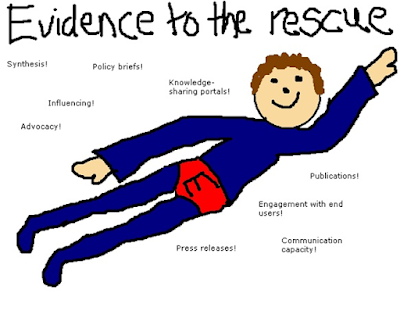
At that moment, a small backstage door hidden in a corner of the shop opened and a bold bespeckled man stepped out, fully dressed in a superhero outfit with bright blue tights and top (that looked a bit too tight), over which she wore red underpants featuring a large letter ‘E’. Ana Lyst didn’t know what to make of this man, but he looked friendly enough and was walking over to her to offer his services. As the man came closer, he produced a large set of antique brass keys from beneath his cape and began opening several doors. “Are you a bit lost?”, asked Evidence Man (for that is who he was) in an accent with a Dutch lilt. “Stuck between here and the outside world? Not to worry! I know the way out to some safe spaces with a friendly audience who would love to hear all about the books you just bought. They would even be interested in the ones that are not ready yet, and they might have a few books of their own to share with you. Shall we go?”

True to his word, when Ana stepped through the first door unlocked by Evidence Man, she emerged back in the now snow-covered high street, where a group of her friends were waiting and, even better, one of them was carrying a large plate of mince pies! Ana Lyst’s spirits lifted immediately, and she vowed to tell her friends all about the helpful Evidence Man in the bookshop. But when she turned around, the nice man had disappeared and through the windows of the bookshop could be seen flying to assist another confused customer.

The End.


The power of storytelling for scientific communication


I was inspired to write this Christmas tale (and blog) after attending a storytelling workshop at the Fuse end-of- year social event on 3 December, which was led by Duncan Yellowlees. Duncan is a Communications Trainer who works with researchers to improve their communications, confidence, and impact. Take a look at his online COMMunity website (Research Comms … but better) to find out more. 

In an engaging and entertaining way, he took us through the key elements of storytelling: from key principles (putting pictures in people’s heads; construct a narrative of causes and effects), to different types of stories (metaphorical, motivational or monster stories, stories as hooks, and point-of-view stories), their structures (problem, solution and results) and what to include in stories (the point, examples, people, heroes & villains, magical helpers, and tensions & conflicts). Did you spot any of these elements in my story? Scroll down to the bottom of this post for spoilers.

Overall, Duncan provided plenty of tips and tricks on how we can use storytelling as academic researchers to communicate our research findings to wider audiences. And this relates directly to the first point (and story) that he made during the workshop: researchers spend too much time throwing the ball (their research findings) but not nearly enough time on making sure there is someone there to catch it (knowledge users). Find your audience first and make them pay attention before you start talking about your research.

His second point was that all this might seem daunting: so many different techniques, plot lines and structures to think about, how can we ever get any good at this? But when comparing it to learning to drive a car, the same principles apply: keep practicing and it gradually (and sometimes quite quickly) becomes second nature. This is because storytelling is already embedded in everything we do in our daily lives: from telling our family and friends about our everyday experiences, to reading books or ‘binging’ on Netflix series.

Finally, Duncan suggested some simple techniques for storytelling in science communication: making stories relatable and relevant (e.g. stress before Christmas) by including named people and adding details (e.g. dark, snowy high streets and describing the interior of the bookshop), which start to paint a picture in people’s heads. Most importantly, start with a hook: a story to draw in your audience, so they want to hear more, or use a question or bold statement as bait (e.g. only 14 percent of research makes it into practice and policy after 17 years).

My story might not have been all you hoped for this Christmas, but the Fuse social event brought some useful gifts for the Fuse Communications toolkit and much needed festive cheer at the end of another challenging academic year. 

Merry Christmas everyone and happy storytelling!


Spoiler alert:
  • The point: knowledge mobilisation between academia and practice is facilitated by a knowledge exchange broker. Plus some points about the time it takes and difficulties faced by researchers when trying to get research into practice and policy.
  • Heroes: academics producing research and papers, while running between bookshelves.
  • Villain: Bookshop clerk (Reviewer 2).
  • Magic helper: Evidence Man (Knowledge Exchange Broker)
  • Tensions & conflicts: research dusting away on bookshelves or not being ready to leave the building, while access to knowledge users is restricted or confusing.
  • Type of story: metaphorical story, overlapping with stories as hooks (to introduce this blog and talk about the storytelling workshop).

Thursday, 17 December 2020

Let’s kick Coca-Cola out of Christmas for good

Posted by Robin Ireland, Director of Research, Food Active, PhD Candidate, University of Glasgow @robinHEG

You may have thought Coca-Cola invented Christmas. In a sort of way, they did of course. Arguably, modern Santa was designed by an advertising campaign for Coca-Cola in 1933 (Forsyth 2016). And, Santa, whether in the twentieth or twenty-first century, is all about encouraging us to consume. In Coca-Cola’s case, a sweet brown liquid that should logically have absolutely nothing to do with a winter celebration in, originally at least, the Northern Hemisphere.


Coca-Cola has been creative at making up traditions as part of their marketing campaigns since the soft drink was invented in Atlanta, USA, in the late nineteenth century. They have been muscling in on our favourite cultural practices pretty much ever since, in their growth to become a hugely successful and profitable transnational corporation. They have been involved with the Olympics since 1928 when vendors set up branded kiosks in Amsterdam (Keys 2004). A similar relationship with the FIFA World Cup from 1975 was seen as critical at expanding Coca-Cola’s influence into China and the Arab countries (Sugden and Tomlinson 1998).

Coca-Cola expert at manipulating our deepest wishes and our emotions whether they are talking Christmas or football. The pandemic may have prevented their Christmas Truck tour in the UK, but, never fear, their international marketing department is on the case. A two and a half minute commercial on YouTube featuring a little girl and her Dad’s attempts to deliver her letter to Santa at the North Pole had already received over 37 million views at the time of writing, whilst pulling at our heart strings.

Professor Dame Sally Davies, the previous Chief Medical Officer in England, wrote, “Commercial companies use a range of strategies and other approaches to promote products and choices that affect human and environmental health, defined as the commercial determinants of health” (Davies 2019 Annex D, p.4). And Coca-Cola are the masters. Luke Allen (Allen 2020) described the corporation as “virtually a cartoon villain in many public health circles” (p.29). Commercial determinants of health can be divided into four channels in which transnational corporations influence health (Kickbusch et al. 2016). Let’s consider how Coca-Cola use these channels.

The marketing is the most obvious. The red and white Coca-Cola brand is ubiquitous. This year the Christmas Truck Tour will not be visiting Liverpool or Glasgow and other major British cities. But the corporation’s partnership with the Premier League enabled it to tour those city centres in 2019.

This year the Christmas Truck Tour will not be visiting major British cities but the corporation’s 
partnership with the Premier League enabled it to tour those city centres in 2019

How about lobbying then? Marion Nestle (2015) has done a great job in describing how the ‘soda industry’ has learned from the tactics of the tobacco industry in funding dubious research. In funding campaigns and legal challenges to taxes on sugary drinks for example.

As many transnational corporations are criticised for the damage that consumption of their products can cause to human health, so, many try to position themselves as good corporate citizens. Coca-Cola adopt the same tactics and support a number of charities such as FareShare, Street Games, the World Wildlife Fund and Special Olympics GB. It’s sad that in a tough world, it’s often left to corporations to fund good causes rather than government. I thought that had been left in the Victorian age rather than reappearing in the twenty-first century. Coca-Cola also support the Department of Transport’s THINK road safety campaign. In this a volunteer is encouraged to be a Designated Driver to bring intoxicated friends home safely from their Christmas parties. The language of a “responsible drinking culture” is all part of the transnational corporations’ tactics of blaming all of us for believing their marketing and over-consuming their products. That’s right, the soaring levels of overweight and obesity and distressing images of tooth decay amongst youngsters in the UK, are all down to us, the irresponsible parents.

Finally, transnational corporations are experts at developing extensive supply chains to amplify their global ambitions. According to Nestle (2015), Coca-Cola claims to sell its products in two hundred countries with only Cuba and North Korea escaping its clutches. And that’s down to US trade embargoes not to Coca-Cola’s marketing executives.

It’s very hard to argue against Coca-Cola’s Christmas truck tour. Food Active and public health advocates have done so for many years being called the fun police along the way and advocates of the nanny state. We can only speculate the reasons why the tour has been scaled back in the North West in recent years (where Food Active largely operates), but we would take some comfort in the idea that our lobbying played a role in steering the truck off course.

Allen (2020), referenced Coca-Cola’s 2018 annual report, to show the corporation spends approximately US$4 billion per year on advertising. And they wouldn’t be spending that kind of money if the advertising didn’t work. The marketing has persuaded some that Christmas isn’t Christmas without the Coca-Cola Truck Tour. Well, you know the Holidays ARE Coming this year. Because this dreadful pandemic has at least kept some of Coca-Cola’s marketing out of our towns. Let’s just hope that the growing link between obesity and Covid-19 (Alberca et al. 2020) may encourage more to consider how we can limit the advertising of Coca-Cola and other transnational corporations that promote their high in fat, sugar and/or salt products to children. And let’s start to kick Coca-Cola out of Christmas.


References:

Alberca, R.W., Oliveira, L.d.M., Branco, A.C.C.C., Pereira, N.Z. and Sato, M.N. (2020) 'Obesity as a risk factor for COVID-19: an overview', Critical Reviews in Food Science and Nutrition, 1-15, available: http://dx.doi.org/10.1080/10408398.2020.1775546.

Allen, L.N. (2020) 'Commercial Determinants of Global Health' in Kickbusch, I., Ganten, D. and Moeti, M., eds., Handbook of Global Health, Geneva: Springer International.

Davies, S.C. (2019) Time to Solve Childhood Obesity, London, available: https://assets.publishing.service.gov.uk/government/uploads/system/uploads/attachment_data/file/837907/cmo-special-report-childhood-obesity-october-2019.pdf [accessed 27 November 2020].

Forsyth, M. (2016) 'Coca-Cola didn’t invent Santa ... the 10 biggest Christmas myths debunked', The Guardian, 21 December 2016, available: https://www.theguardian.com/lifeandstyle/2016/dec/21/coca-cola-didnt-invent-santa-the-10-biggest-christmas-myths-debunked [accessed 27 November 2020].

Keys, B. (2004) 'Spreading Peace, Democracy , and Coca-Cola®: Sport and American Cultural Expansion in the 1930s', Diplomatic History, 28(2), 165-196.

Kickbusch, I., Allen, L. and Franz, C. (2016) 'The commercial determinants of health', The Lancet, 4, 895-896.

Nestle, M. (2015) Soda Politics. Taking On Big Soda (And Winning). Oxford: Oxford University Press.

Sugden, J. and Tomlinson, A. (1998) FIFA and the Contest for World Football. Who rules the peoples' game? , Cambridge: Polity Press.


Image 2: Coca-Cola Tour Bus. Liverpool, March 2019. Photo courtesy of E.Boyland.


The views expressed in posts are those of the authors and do not necessarily reflect those of Fuse (the Centre for Translational Research in Public Health) or the author's employer or organisation.

Friday, 20 December 2019

Happy New Year from everyone at Fuse

We would like to wish all our readers and contributors a very Happy New Year - why not make a resolution to blog in 2020 and send us your posts?


Image (adapted with thanks):
The original uploader was Rsabbatini at English Wikipedia. [CC BY 4.0], via Wikimedia Commons.

Friday, 21 December 2018

The power of cookies

Posted by Peter van der Graaf, AskFuse Research Manager / Fuse Knowledge Exchange Broker, Teesside University

With the festive season upon us, many are looking forward to indulging in a mince pie or two and getting stuck in some extra helpings of turkey or brandy-soaked Christmas pudding. This often sparks some well-intentioned health warnings from public health folk about the risks of overindulging, binge drinking and the increasing obesity epidemic. Not wanting to dismiss these important messages, I would like to focus on a different message in this blog: food as a great tool for knowledge mobilisation (making information useable and accessible through working collaboratively).

If there is one thing that I have learned in my time as AskFuse Research Manager, it is that nothing is as useful as biscuits for bringing people together and contributing to a positive meeting between researchers and health professionals. 

This insight started from my own weakness: I have an incurable sweet tooth and my colleagues and students have quickly learned to exploit this asset for plying me with Dutch liquorice and other delicacies into supporting their requests and theses. So, I decided to turn their own weapons on them, with surprising results.

Stuck in a challenging debate about the usefulness of research evidence for commissioning local health services? Bring some cookies and fruit (to balance; I am a public health researcher after all!) and you will find that conversations all of sudden move in more fruitful directions.

Although my experience told me that cookies are a great conversation starter when brokering knowledge, I did not realise until recently that this was an area of serious academic study. In a recent paper published in Medical Education[1], Michael Hessler and colleagues from the University Hospital of Münster in Germany decided to put the power of cookies to the test and conducted their own Randomised Controlled Trial while delivering an emergency medicine course.

They were worried about the evaluations at the end of their course and suspected that these were not the measures of quality that the University was hoping for. Therefore, they were looking for a ‘content-unrelated’ intervention that would alter their evaluation results significantly and prove that their evaluations were seriously under-baked.

Third‐year medical students (n=118) were randomly allocated into 20 groups, 10 of which had free access to 500g of chocolate cookies during the course sessions (cookie group!) and 10 of which did not (control group). The groups had the same teachers and were taught the same content. After the course, all students were asked to complete a 38‐question evaluation form.

The results were very appetising: the cookie group evaluated teachers significantly better than the control group, they rated the course material as considerably better and overall satisfaction scores for the course were significantly higher. In summary: the provision of chocolate cookies had a significant effect on course evaluation.

One might conclude that course evaluations are seriously flawed but I prefer the ‘cookie-jar-is-always-half-full’ interpretation: providing cookies to participants is a great way to boost results! The German research adds baking powder to my own observations in UK knowledge brokering: cookies are a great way to boost exchange of knowledge and relationship building in conversations and meetings.

The ingredients of each meeting and conversation might be different but they all need a baking agent to rise to the occasion. So, whatever you do this Christmas, if you would like to avoid awkward questions during social and family gatherings about ‘what it is that you do as a researcher’ or ‘when are you finally going to finish your PhD?’, just bring a plate of cookies and subtly but swiftly change the conversation to a sweeter topic.

Happy Christmas!


Reference:
  1. Hessler M, Pöpping DM, Hollstein H, Ohlenburg H, Arnemann PH, Massoth C, Seidel LM, Zarbock A, Wenk M. Availability of cookies during an academic course session affects evaluation of teaching. Medical education. 2018 Oct;52(10):1064-72, https://onlinelibrary.wiley.com/doi/pdf/10.1111/medu.13627

Friday, 7 December 2018

Steering the Coca-Cola Christmas trucks off course in 2018

Guest post by Beth Bradshaw, Alex Holt and Robin Ireland, Food Active

You may remember our guest blog for Fuse from last year, which discussed the media frenzy that goes into overdrive when the Coca-Cola Christmas Truck Tour sets off on its journey across various locations in the UK. We also noted our own campaigns and the efforts of others such as SUGAR SMART to make the case against welcoming the truck into towns and cities already grappling with a childhood obesity and oral health crisis.
 
Every year, we are met with growing support from the public health community and the public including GPs, dentists, teachers and parents. Last year Public Health England issued guidance to local authorities about hosting the Coca-Cola truck. However, there was also some criticism of our position, especially where we were seen as ‘spoiling’ Christmas in some way.

However, this year, things seem to be different. We feel a change in the air this festive period with a scaling back of the Coca-Cola tour, both in terms of numbers of locations and less prominent venues.

There are a number of important changes that have happened both in the build-up and the start of the Coca-Cola Christmas Truck Tour for 2018. While these might appear small, together they demonstrate quite a significant shift by the soft drinks corporate giant.

This year, the Coke Truck allowed just three days between the announcement of the tour and its start, compared to 11 days last year. Within this time frame, SUGAR SMART coordinated an open letter to Coca-Cola bosses with over 40 signatories from local authorities, Clinical Commissioning Groups, and national campaign groups to oppose the truck visiting their areas [1]. This meant there was time to coordinate responses both nationally and locally, including a series of Tooth Fairy stunts, and for noise to be made to create negative publicity before the truck had even arrived.

The Coke Truck vs the Tooth Fairies
Another important shift is the size of the tour – downsizing by over a third (37% to be exact), from 38 stops last year to just 24 this year. The 2018 tour is also visiting some much smaller locations - the media has called it ‘snubbing’ cities such as Milton Keynes and Liverpool - and there are just four visits on council-owned land. We are pleased to see so few local authorities allowing the truck on council-owned land but would urge those that are welcoming the truck to seriously consider whether this is in the best interest of their local population.

There are also more stops hosted on supermarket car parks this year, with as many as ten of the stops to Asda and Tesco. The same Tesco that announced a five-year ‘strategic partnership’ with national health charities including the British Heart Foundation, Cancer Research UK and Diabetes UK to help ‘remove barriers to healthy habits’ earlier this year. A Coca-Cola truck pitching up in their car park is certainly a barrier to healthier habits, both literally and figuratively speaking. This move has also been met with criticism and Sustain and SUGAR SMART are calling on the public to write to Asda and Tesco to ask them to reconsider hosting the truck next year. On taking this action ourselves, we received a response from Asda customer relations which said:
“We have been in conversation with Coca-Cola prior to this tour and we are happy that they will be encouraging customers to sample their sugar-free brands. They will only provide Red Coke on request and they estimate that at least 90% of their drinks sampled will be sugar free.”
As of yet and unsurprisingly, we have had no response from Tesco.

Asda’s response is consistent with the quote provided by Coca-Cola’s press release, which also appears to have satisfied Public Health England’s concerns, as they have decided not to respond to the truck this year.

Finally, in the North West of England (where Food Active is based), the truck is visiting just one city in the region compared to six visits in 2016 and four in 2017. Over the past four years, Food Active has been lobbying against the arrival of the truck in the North West, including publishing an article in the British Medical Journal [2], writing an open letter to local and national press (with over 100 signatories) and supporting SUGAR SMART’s open letters to Coca-Cola bosses. We hope that this continued pressure, even in the face of significant criticism, has helped to steer the Coke truck away from the North West.

However, we know the battle is by no means over - 14 of the 19 stops in England have above average prevalence of excess weight amongst 10-11 years old, and in some locations including Manchester, over 30% of the children have experienced tooth decay.

Last year, our blog concluded that “our experience shows us that public health has to be persistent in ensuring our messages are heard in the current victim-blaming culture”. This statement is perhaps even more validated following this year’s experiences.

In the spirit of good will this Christmas, we thank Coca-Cola for helping more of our local authorities in the North West to help tackle issues of childhood obesity and dental decay in their areas - many of which are already disproportionately burdened with deprivation and health inequalities.

www.foodactive.org.uk

@food_active


References:
  1. Ireland, R and Ashton, J.R. (2017) “Happy corporate holidays from Coca-Cola” i8633. Available at: https://www.bmj.com/content/356/bmj.i6833
  2. SUGAR SMART (2017) Spending holidays in good health. Available at: http://www.foodactive.org.uk/wp-content/uploads/2017/11/Open-Letter-to-Coca-Cola.pdf
Images:
  1. Courtesy of Beth Bradshaw
  2. With thanks to Sustain and Sugar Smart UK: https://www.sustainweb.org/blogs/nov17_coke_truck 

Friday, 22 December 2017

Merry Christmas from Fuse

We would like to wish all of our readers and contributors a very happy festive season. We will return in the New Year - why not make a resolution to blog in 2018 and send us your posts?


Friday, 1 December 2017

When the Coca-Cola truck comes to your town

Guest post by Robin Ireland, Director of Research at Food Active and Beth Bradshaw, Project Officer at Food Active.

When Coca-Cola announced their 'Holidays Are Coming' truck tour (ironically coinciding with Sugar Awareness Week), our local media in the North West covered the story like it was the first sign of Christmas, the first cuckoo to be spotted in spring.

And in the run up to the big red shiny sugar-laden truck’s arrival to our towns and cities, from Bolton to Liverpool, Manchester to St Helens, the local newspapers will cover the story in page after page of advertorials, telling you where to get your picture taken posing with Coca-Cola's sugary products and even live blogs in some cases.

In previous years, at no time did the reporters consider that not everyone welcomed the truck in their neighbourhood. Many people are concerned that the truck was marketing Coke to children despite the company's protestations that they do not promote their products to the under twelves. Furthermore, in some locations in the North West the truck was allowed to promote their unhealthy drinks to children and families on Council owned landed. 

To demonstrate our concern, last year Food Active drafted a letter objecting to Coca-Cola's tour coming to the North West which was sent to the national and regional media. No less than 108 people signed in support including the current and past Presidents of the Faculty of Public Health, five Directors of Public Health, Professors, Doctors, educationalists and of course parents. If we are honest, we were shocked that the letter was almost entirely ignored. It would appear that Coca-Cola's commercial clout and public relations campaign counted more than the collective voice of those who are having to address the results of diets regularly fuelled by liquid sugar.

Just before Christmas 2016, Professor John Ashton and I (Robin) were in contact with the British Medical Journal concerning these issues and were invited to submit an editorial which was published in January [1]. In contrast to their previous experience the media attention was huge including coverage in over 60 regional and national newspapers and interviews on various channels including Sky News and Wales Today.

This year, the media attention and discussions around the Coca Cola Christmas Tour has continued. Before the tour was even announced, a news story hit the local press in the North West from Liverpool councillor Richard Kemp CBE (also Deputy Chair of the Community Wellbeing Board at the Local Government Association of England and Wales), who raised concerns about its arrival in Liverpool given the city is ‘in the grip of an obesity epidemic’ – although we know this is not an issue only in Liverpool – the whole country is in the grip on an obesity epidemic. Once the tour was announced, including six visits to the North West, we were pleased to see none were on council-owned land (in 2016 the truck visited Williamson Square in Liverpool which is owned by the Council)

Following this came a cascade of news stories from local and national newspapers and radio stations. This year, Food Active joined up with Sugar Smart to encourage Directors of Public Health, Council Leads and Clinical Commissioning Group Chairs across the country to sign an open letter to Coca-Cola opposing its arrival, given the health harms associated with the consumption of their products and calling for more responsible marketing during the festive period. The North West represented one quarter of the 29 areas, cities and towns who signed the letter. This advocacy may have helped to prompt a response from Public Health England and Public Health Wales – there is a sense that the argument against the Coca-Cola truck are now being taken seriously and media coverage of the 2017 Coca Cola Christmas Tour is not just about when and where you can get your photo taken - but also the health concerns. 
Coca-Cola says that it does not promote its products to the under twelves

Following excellent work by Public Health England, by national organisations including Action on Sugar, the Children's Food Campaign and many others, and of course by Food Active in the North West, we know that we must target sugary drinks as part of a strategy to address the tsunami of obesity, type 2 diabetes and dental disease we face in our poorest and most deprived communities. Moreover, as highlighted in a blog by Dr. Alison Tedstone, Director of Diet and Obesity at Public Health England, the truck will be visiting some of our poorest areas which are often disproportionately burdened with higher levels of obesity [2]. As such, a symbol of ill health should not be welcomed nor celebrated within our communities during a season of good will and cheer. 

However, this is not only about high sugar drinks. Protecting children from junk food marketing has been outlined as the number one priority in tackling obesity by the Obesity Health Alliance (a coalition of over 40 organisations committed to reducing obesity – of whom Food Active is a member). We must not mistake the Coca-Cola truck for anything but a very high profile marketing stunt. We do not allow products high in fat, sugar and salt to be advertised to children on children’s TV programmes, so why is the Coca-Cola truck welcomed into our communities year on year with such open arms? Speaking at the Socialist Health Alliance Public Health Conference, we called for junk food marketing controls to be extended to cover family attractions such as the Coca-Cola truck, as well as sports sponsorship and marketing communications in schools. By allowing the truck into our towns and cities, we are allowing Coca-Cola to exploit the festive period to market their products to the community – and to children in particular.

Our experience shows us that public health has to be persistent in ensuring our messages are heard in the current victim-blaming culture. There is little point in local authorities spending their ever restricted funds on promoting healthier eating and drinking if each Christmas we allow Coca-Cola and others to highjack our messages. There is certainly no excuse for local authorities at to allow this truck on their land and it is the responsibility of public health advocates to continue to make the case to Give Up Loving Pop in 2018. 
  
References:
  1. Ireland, Robin, and John R. Ashton. "Happy corporate holidays from Coca-Cola." (2017): i6833. Available at: http://www.bmj.com/content/356/bmj.i6833
  2. Tedstone, Alison. “An update on sugar reduction”. (2017). Available at: https://publichealthmatters.blog.gov.uk/2017/11/14/sugar-reduction-an-update/


Photo © Oast House Archive (cc-by-sa/2.0)


All views expressed in a post are exclusively those of the author or authors.

Friday, 17 February 2017

How big food and drink are using sport

Guest post by Robin Ireland, Director of Research, Food Active and Healthy Stadia

You don't have to do much travelling to realise that the unhealthy alliance between sport and the Food and Drink Industry isn't only an issue in the UK.

I am lucky enough to be visiting New Zealand and Australia at the moment and it's easy to see all the same signs - and very similar marketing campaigns and messaging. Whether it's the All Blacks rugby team being pictured with the product of their "Official Hydration Partner", Gatorade, or the recent Australian Tennis Open full of alcohol advertisements (and I haven't even mentioned cricket), it's clear that the Food and Drink Industry have an international agenda.

Advertising featuring the All Blacks rugby team photographed in New Zealand

In January, the British Medical Journal published an editorial (Ireland and Ashton 2017)1 that I wrote (with Professor John Ashton CBE) about how Coca-Cola's publicity machine was subverting the Christmas message.

If anything, it's even more blatant in sport and we have been aware of it for some time from London's "Obesity Games" (Garde and Rigby 2012)2 to Rio's promotion of ultra-processed foods (Loughborough University)3. Even when spectators want healthier food, this choice is rarely made available to them.

George Monbiot recently referred to "Dark Money" (Monbiot 2017)4 which describes the funding of organisations involved in political advocacy that are not obliged to disclose where the money comes from. In public health terms, we may describe this as Commercial Determinants of Health where industry interests impact on our health. It is often linked to the increasingly sophisticated Corporate Social Responsibility policies being adopted by big corporations.

The latest of these is of course the deal just announced by the English Premier League and Cadburys criticised by the Obesity Health Alliance in a letter to The Times (Obesity Health Alliance 2017)5. Cadburys no doubt will argue that they are taking an ethical position to help educate people. But can we really take a chocolate company seriously that wishes to advise schoolchildren on nutrition, healthy eating and exercise?


FC Bayern München's branded energy drink
It is no coincidence that the mantra parroted by food and drink sponsors is that our diets are down to individual choice and that if we simply took more exercise we wouldn't be having the obesity epidemic now prevalent worldwide. This is rubbish. So called energy and sports drinks should have no part to play in the diet of the average member of the public. Kids do not need more sugar (or more protein for that matter) if they are eating a balanced diet with lots of fruit and veg. But of course the food and drink industry do not make their enormous profits in this way.

It is these concerns - amongst many others - that encouraged myself and colleagues to establish Healthy Stadia in 2005, of which I am a Director. Healthy Stadia takes a holistic and integrated approach to developing sports stadia and clubs as "health promoting settings":
"Healthy Stadia are those which promote the health of visitors, fans, players, employees and the surrounding community" (from Healthy Stadia website)6.

Healthy Stadia's Conference which will be held at the Emirates Stadium, London, in April will be discussing food and drink sponsorship in professional sport among other issues. I anticipate that these topics will come under increasing public scrutiny in years to come, as we develop more awareness of the impact that marketing has on our food and drink choices. (Cairns et al., 2013)7.

Sports fans and public health professionals alike should be questioning how 'Our Beautiful Games' are being manipulated by the Food and Drink Industry to promote ultra-processed food and drink - including alcohol - to audiences, often well populated by impressionable youngsters. Let's see if we can link up the campaigns in different countries to make a louder voice demanding change from the governing bodies of sport.
References:
  1. Ireland R and Ashton John R. (2017). Happy corporate holidays from Coca-Cola. BMJ 2017;356:i6833. http://www.bmj.com/content/356/bmj.i6833. 10 January 2017.
  2. Garde A and Rigby N. (2012). Going for gold – should responsible governments raise the bar on sponsorship of the Olympic games and other sporting events by food and beverage companies? Commun Law. 2012:356:42-9.
  3. Loughborough University Press Release (2016). Loughborough research calls for change in spectator food and drink provision at sports mega events such as Rio 2016. PR/16/158. http://www.lboro.ac.uk/media-centre/press-releases/2016/december/loughborough-research-calls-for-change-in-spectator-food-and-drink-provision-at-.html. 05 December 2016.
  4. Monbiot G. How corporate dark money is taking power on both sides of the Atlantic. The Guardian. https://www.theguardian.com/commentisfree/2017/feb/02/corporate-dark-money-power-atlantic-lobbyists-brexit. 02 February 2017.
  5. Obesity Health Alliance (2017). Letter to The Times – Cadbury and Premier League Sponsorship. Accessed online at: http://obesityhealthalliance.org.uk/2017/02/06/letter-times-cadbury-premier-league-sponsorship/?utm_campaign=Cadbury%20letter. 06 February 2017.
  6. European Healthy Stadia Network. http://www.healthystadia.eu/about.html
  7. Cairns G, Angus K, Hastings, G and Caraher M (2013). Systematic reviews of the evidence on the nature, extent and effects of food marketing to children. A retrospective summary. Appetite 2013: 356:209-15. http://www.sciencedirect.com/science/article/pii/S0195666312001511. 03 March 2013.
All views expressed are exclusively those of the author.

Thursday, 14 January 2016

Christmas dinner: a pleasure not to be underestimated

Posted by Duika Burges Watson, Fuse staff member and Lecturer in Evaluation and Policy Interventions, Centre for Public Policy & Health, Durham University

The final event for our research project exploring the potential of progressive cuisine to improve quality of life for head and neck cancer survivors was a Babette’s feast of sorts. Babette’s feast, the novella by Isak Dinesen (Karen Blixen), centres on the story of a most remarkable and transformative meal. In a remote and austere community in Northern Denmark, Babette cooks up a storm for the abstemious community. A religious cult denying all pleasure, the community is reluctant to eat anything that might be ‘wickedly’ enjoyable. Finally convinced of Babette’s desire to thank them for their support at the time of her father’s death, the French trained chef is permitted to use some new found wealth to prepare a sumptuous feast. During the multiple courses, the community is existentially transformed. Their enjoyment and love of life and feelings of well-being become undeniable as each delicious course is presented, despite their efforts to pretend otherwise...

Courtesy of amazon.co.uk
With our Christmas dinner, we didn’t set out to do anything other than thank the participants for their involvement in the research. We knew from our qualitative food play workshops (25 in all) that participant survivors missed the opportunity to socialise around food; their difficulties with food and eating (including swallowing, speed of eating, limited food choices, and fear of choking) made a ‘normal’ eating out experience unlikely[i]. So we invited the project’s Research Chef to prepare a Christmas meal that we hoped they would enjoy.

The tasting menu, or menu degustation (below) was designed as an adventure in dining, in which multiple very small courses make it easier to undertake - when you know that if you don’t like one, there are plenty more before and after to select from. The delightful setting at Irvin’s brassiere on the North Shields Fish Quay provided an opportunity for survivors to dine out, at their pace; to select from a range of dishes, and to enjoy some of the foods we now knew would be acceptable (with a diversity of eating difficulties, increasing options would ensure there was something on the menu for everyone). What we hadn’t anticipated was how much they’d enjoy the leisurely three hour lunch. Unlike the diners at Babette’s feast, survivors of head and neck cancer do not deny the pleasure of food, it simply may not be an option.

The menu that was offered to participants
Our Resources for Living research has centred on the potential of using some of the progressive cuisine techniques derived from the new ‘science of deliciousness’, an interdisciplinary approach to understanding our sensory perception of food with input from physics, chemistry, neurology and psychology[ii]. Chefs around the world are gaining insights into food in ways never before explored, and we developed the interdisciplinary research project on the assumption that some of these new understandings might improve quality of life for those living with the long term altered eating side effects of cancer and its treatment.

Our research, and the research of others, has showed that the loss of pleasure associated with food can be ‘almost unbearable’. Recent research in neurology suggests that there is one ‘pleasure centre’ in the human brain. In other words, “the pleasure evoked by food is remarkably similar to that of other rewards, suggesting a unitary pleasure system, whether engaging with food, sex, social or higher-order rewards”[iii]. In our research, finding ways to improve quality of life is intimately connected with the loss of pleasure. While we uncovered some ‘compensatory pathways’ such as participants finding pleasure in cooking for loved ones or engaging in exercise, the ability to eat a nine course meal appeared to do much more than just provide satisfaction. Participants reported feelings of well-being and happiness that they’d truly missed, some for years.

For our Christmas meal insights, thanks must go to Sam Storey, our brilliant chef on the project, and to the team of researchers and survivors involved who together have worked to understand, and find ways to manage, the challenge of living with altered eating difficulties.

Resources for Living (R4L) Pilot: Exploring the Potential of Progressive Cuisine for Quality of Life Improvement for Head and Neck Cancer Survivors is funded by the National Institute for Health Research (NIHR) Research for Public Benefit (RfPB) programme.

--------------------------------------------------------------------------------------------------------------------------
[i] Wells, M., 1998. The hidden experience of radiotherapy to the head and neck: a qualitative study of patients after completion of treatment. Journal of Advanced Nursing, 28(4), pp.840-848; Cousins, N., MacAulay, F., Lang, H., MacGillivray, S. and Wells, M., 2013. A systematic review of interventions for eating and drinking problems following treatment for head and neck cancer suggests a need to look beyond swallowing and trismus. Oral Oncology, 49(5), pp.387-400. 

[ii] Mouritsen, Ole G. "The science of taste." Flavour 4.1 (2015): 18.

[iii] Kringelbach, M.L., 2015. The pleasure of food: underlying brain mechanisms of eating and other pleasures. Flavour, 4(1), p.20.

Thursday, 1 January 2015

52 weeks in public health research, part 52

Posted by Emma Foster, Amelia Lake, Lorraine McSweeney and Mark Welford

So this is it, we have reached the final week of our 52 week public health picture project. But what insights has it provided into the everyday lives of public health researchers? Find out in a blog post coming soon. A big thank you to all those who contributed their images.

Happy New Year!


Posted by Emma Foster: Not a New Year resolution as a) it seems silly to start the day after a big party and b) now is when I have a bit more time to exercise... So starting tomorrow this cross trainer is going to be getting much more use....and not just for drying clothes!


Posted by Amelia Lake: Less of a resolution more of an ambition! No more trainers on the bike - it's time to look like a pro... and possibly get a few knocks and bruises in the process!


Posted by Lorraine McSweeney: I recently attended a graduation ceremony at Newcastle University to receive my doctorate award. For the first time in the congregation history the PhD titles were announced during the ceremony; mine being 'Prevention of obesity: exploring strategies for intervention in preschool'. The ceremony was attended by my supervisor and Fuse Director Ashley Adamson. Also in attendance that day was television journalist and newsreader Angela Rippon who received an honorary degree for her charity work in dementia.


Posted by Mark Welford: Fundraisers braving the North Sea to earn money for their favourite charity in the Annual Boxing Day dip. A bit of physical activity after the Christmas day indulgence and the beginning of a New Year's resolution?

Thursday, 25 December 2014

Tuesday, 23 December 2014

52 weeks in public health research, part 51


Posted by Mark Welford: I imagine this is what every academic's Christmas tree looks like. This fine specimen can be found in the Learning Resource Centre of Stockton Sixth Form College. As far as Christmas decorations go, we really should be taking a leaf out of their book!   
 

Posted by Caroline Dodd-Reynolds: Finishing my Christmas shopping this week, all seemed fairly quiet at the MetroCentre 'gym'...

Posted by Dorothy Newbury-Birch: This is my last Christmas working at the Institute of Health & Society at Newcastle University. From 5th January 2015 I will be Professor of Alcohol and Public Health Research at the Health and Social Care Institute at Teesside University. Very exciting times. I promise to write a blog in January letting everyone know what it's like to be a new professor!


Posted by Mark Welford: Can you guess the theme of this book display at Stockton Sixth Form College? Answers in the comments section below.


------------------
A reminder from the Fuse blog group:

Each week of 2014 we’ll try and post around four pictures on the Fuse blog that capture our weeks in public health research, from the awe-inspiring to the everyday and mundane. Given that more of the latter than the former exists in most of our lives, we foresee problems compiling 208 images worth posting on our own. So this is going to have to be a group project. Send an image (or images) with a sentence or two describing what aspect of your week in public health research they sum up and we’ll post them as soon as we can. You don’t have to send four together – we can mix and match images from different people in the same week.

Normal rules apply: images you made yourself are best; if you use someone else’s image please check you’re allowed to first; if anyone’s identifiable in an image, make sure they’re happy for it to be posted; nothing rude; nothing that breaks research confidentiality etc.

Email your posts to m.welford@tees.ac.uk or contact any member of the Fuse blog group.

Thursday, 18 December 2014

52 weeks in public health research, part 50

Posted by Mandy Cheetham, Amelia Lake and Mark Welford

It's all food, parties and away days in this week's Fuse blog picture post.  You'd think it was Christmas!


Posted by Amelia Lake: A balance? T'is the season to introduce your offspring to more sugary delights... Or is it a season for some balance! I like the balance option, some treats - both fruity and sugary!


Posted by Mandy Cheetham: A little (delicious) Christmas indulgence at the Health and Social Care Institute away day in Great Ayton, North Yorkshire. Reward for a morning's work including workgroups on software and apps (details below) designed to make our research life richer and easier!

Evernote & OneNote (information management), Inspiration & Prezi (visual mapping and presentational software), handling long documents in Word, and Twitter.


Posted by Mark Welford: Professor Graham Henderson giving a quick speech at his last staff Christmas party before he retires as Vice-Chancellor of Teesside University.  He resisted the urge to play a solo on the double bass temptingly placed behind him!

 
Posted by Amelia Lake: More food photos for the blog. Our traditional in canteen Christmas meal at Durham Queen's Campus in Stockton. With the obligatory whizzing balloons!
 
------------------
A reminder from the Fuse blog group:

Each Thursday of 2014 we’ll try and post around four pictures on the Fuse blog that capture our weeks in public health research, from the awe-inspiring to the everyday and mundane. Given that more of the latter than the former exists in most of our lives, we foresee problems compiling 208 images worth posting on our own. So this is going to have to be a group project. Send an image (or images) with a sentence or two describing what aspect of your week in public health research they sum up and we’ll post them as soon as we can. You don’t have to send four together – we can mix and match images from different people in the same week.

Normal rules apply: images you made yourself are best; if you use someone else’s image please check you’re allowed to first; if anyone’s identifiable in an image, make sure they’re happy for it to be posted; nothing rude; nothing that breaks research confidentiality etc.

Email your posts to m.welford@tees.ac.uk or contact any member of the Fuse blog group.