Showing posts with label BMJ. Show all posts

Friday, 10 July 2020

Not an equal opportunity disease: Covid-19 and health inequalities

Posted by Clare Bambra, Professor of Public Health, Newcastle University and Ryan Riordan, 5th Year Medical Student, University of Cambridge

Spanish Flu of 1918 was experienced unequally, with higher rates
  of infection and mortality among the most disadvantaged
As Covid-19 began to spread rapidly across the UK in early March, politicians and the media were keen to tell us that we were ‘all in it together’ and that the virus ‘does not discriminate’. As time passed, it became apparent that this wasn’t the case.

We now know that Covid-19 is far from a socially neutral disease, with clear clusters of more severe impact amongst our most deprived and marginalised communities.

We now know that people living in more socio-economically disadvantaged neighbourhoods and minority ethnic groups have suffered more with higher infections and death rates.

Historically, this has also been the case - evidence has shown that previous pandemics including the Spanish Flu of 1918 and the H1N1 pandemic of 2009 have also been experienced unequally, with higher rates of infection and mortality among the most disadvantaged parts of the country – both in the UK and internationally. 

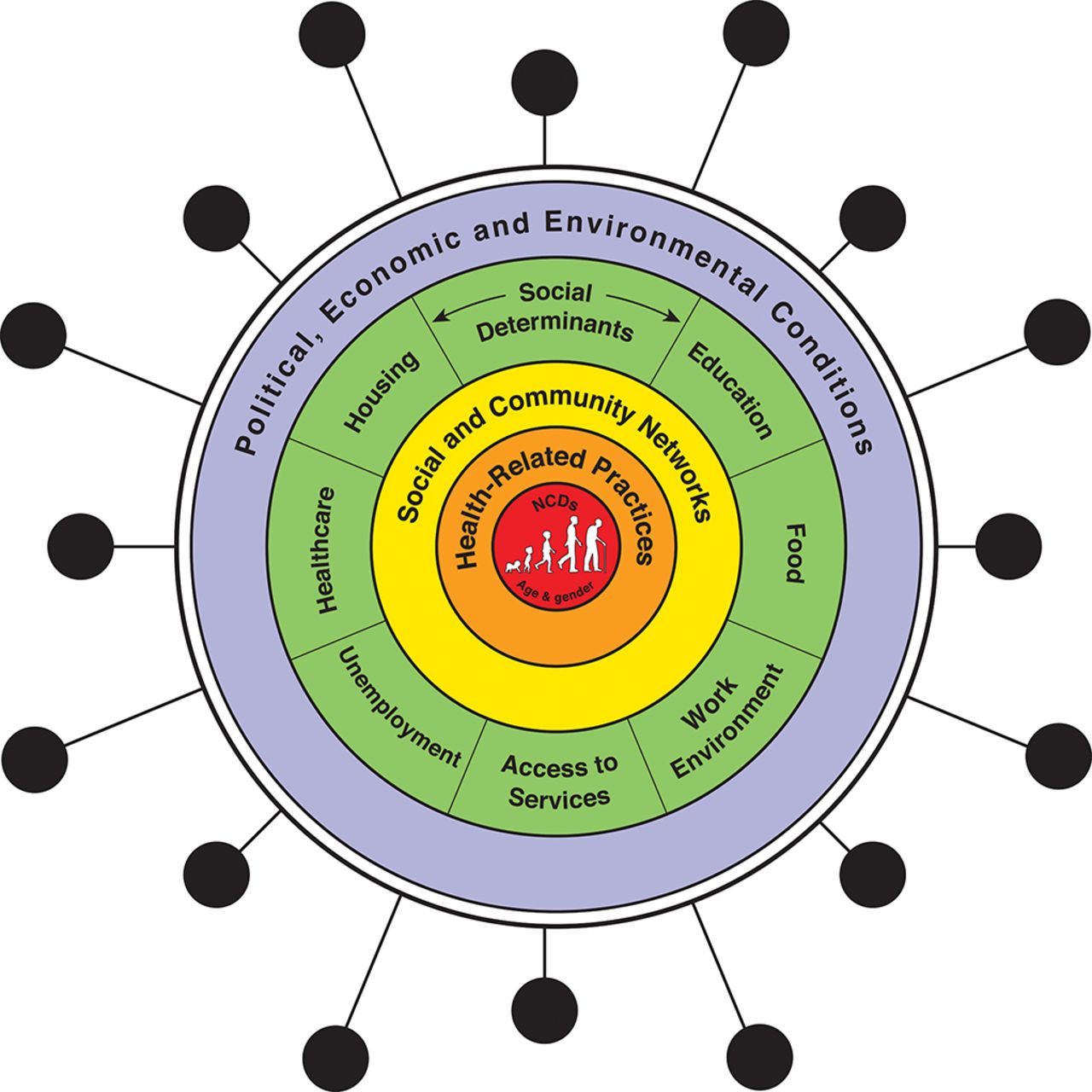
Emerging evidence from a variety of countries suggests that these inequalities are being mirrored today in the Covid-19 pandemic. Both then and now, these inequalities have emerged through the syndemic nature of Covid-19, as it interacts with and exacerbates existing social inequalities in chronic disease and the social determinants of health.

The syndemic of COVID-19, non-communicable diseases (NCDs)
 and the social determinants of health
This is down to a number of factors – not least unequal exposures to the social determinants of health (the conditions in which we are born, grow, live, work and age) leading to higher rates of almost all of the known underlying clinical risk factors that increase the severity and mortality of Covid-19 (e.g. high blood pressure, diabetes, cardiovascular disease).

We may have been living under the same regulations, but across the country, our experiences of ‘lockdown’ were widely different. We knew this. We weren’t ‘all in the same boat’ - we were in the same ocean in the middle of the same storm - but some were on luxury liners and others on rapidly-deflating dinghies.

We saw lower-paid care workers, shop workers, transport workers, factory workers continuing to work face-to-face with the public, while others worked from home on full pay or were furloughed with some semblance of job security.

There were families trying to stay sane in small flats without outdoor space and with empty cupboards, whilst others in more fortunate circumstances trebled their flower delivery order to ensure their homes looked good during Zoom meetings.

The divide in our society is stark on many levels, and as we go forward, who will pay the price of the multi-billion pound interventions that the government has put in place to see us through this period, and bear the brunt of the post-Covid-19 global economic slump? 

Covid-19 has laid bare our longstanding social, economic and political inequalities. Even before the pandemic, life expectancy amongst the poorest groups was already declining in the UK and the USA and health inequalities in some European countries have been increasing over the last decade.

I know that this all makes for grim reading for researchers, practitioners and policymakers concerned with health inequalities. So what can we do?

It is vital that this time, the right public policy responses, such as expanding social protection and public services and pursuing green inclusive growth strategies, are undertaken so that the Covid-19 pandemic does not increase health inequalities for future generations. Public health must ‘win the peace’ as well as the ‘war’. It is our job to make that case.

As we start to shape our ‘new normal’ and as the government unveils its post-Covid-19 recovery plans for the UK, public health policy must be a priority.

We need to act now if we want to avoid deepening the health inequality divide even further for generations to come.

Read the full essay: The Covid-19 pandemic and health inequalities


With thanks to the NIHR Applied Research Collaboration North East & North Cumbria 


Image attribution:
  1. Otis Historical Archives, National Museum of Health and Medicine / Public domain. https://commons.wikimedia.org/wiki/File:Emergency_hospital_during_Influenza_epidemic,_Camp_Funston,_Kansas_-_NCP_1603.jpg
  2. The syndemic of COVID-19, non-communicable diseases (NCDs) and the social determinants of health (adapted from Singer and Dahlgren and Whitehead). With acknowledgement to Chris Orton from the Cartographic Unit, Department of Geography, Durham University, for his assistance with the graphics. https://jech.bmj.com/content/early/2020/06/13/jech-2020-214401.full?ijkey=haFkUOyJurtabHz&keytype=ref#F1
  3. Screenshot taken from the Financial Times website: https://www.ft.com/content/8ea1c992-89f8-11ea-a109-483c62d17528 09/07/2020

Friday, 17 May 2019

The toxic mix of Universal Credit, austerity and widening inequalities

Concerns about the mental health impact of government reforms under austerity are growing and emerged in Universal Credit research commissioned by Gateshead Council which is soon to be published in BMJ Open[1].


Mandy Cheetham, Research Associate at Teesside University, posts on Mental Health Awareness Week.

The invitation to present the findings at Newcastle University’s recent conference on human rights, health and welfare made me reflect on the multiple ways in which Universal Credit drives inequalities and undermines claimants’ rights.

Panel members (Mandy, pictured furthest right)
Want, Disease, Ignorance, Squalor & Idleness: Beveridge’s 5 giants


As part of a panel discussion, I was struck by the powerful comments of my fellow panel members who framed the rising need for food banks as a failure of social security. They described the “uncomfortable truth” of food poverty, the “violence of austerity” and the need to start from a position of love and care, offering people dignified, not demeaning responses to crises.

The sense of exclusion, shame, embarrassment and stigma surrounding food insecurity and the use of foodbanks was clearly articulated by the Universal Credit claimants in the study we did in Gateshead and Newcastle. One participant with a long term health condition commented:
"I think the most degrading thing about Universal Credit was that I had to go to foodbanks. I couldn’t afford to eat" (Claimant interview)
Universal Credit claimants and staff supporting them recognised the political choices which undermine people’s basic rights to food and social security, which are fundamental to health and wellbeing.
"It seems to be government policy at the moment to punish people for being poor" (Staff interview)
It is hard to see these choices as accidental when Amber Rudd, the Secretary of State for Work and Pensions, acknowledges that the rise in food banks is at least in part due to the roll out of Universal Credit. It is brutal and unrelenting in its effects.

Last week, I attended a thought provoking seminar by Guy Standing (co-founder of the Basic Income Earth Network), who reflected on the benefits of securing a basic income for all and described his view of the modern giants blocking transformative progress, including precarity: creating ‘supplicants’ with no rights, asking for favours from friends, family and bureaucrats, reliant on charity with no sense of agency or freedom. 

Digital exclusion, delays, deductions, intensified work related requirements, arbitrary risk of sanctions and maladministration by the Department for Work and Pensions associated with Universal Credit, all combine to maintain the precarious existence of claimants, undermining their rights to financial and material security, and social inclusion required for health and wellbeing.

This is not new. In a paper entitled ‘First do no harm’, Barr et al (2016)[2], found the programme of reassessing people on disability benefits using the Work Capability Assessment was independently associated with an increase in suicides, self-reported mental health problems and antidepressant prescribing. The authors suggest that the policy may have had serious adverse consequences for mental health in England, which could outweigh any benefits that arise from moving people off disability benefits.

The four year welfare benefits freeze, austerity and implementation of Universal Credit is a toxic combination that has truly terrible consequences for those reliant on the state leaving people without enough money to fund the basics essential to participate in society. 


Piecemeal changes announced by government to phase out “unnecessarily long” three year sanctions under Universal Credit, for example, are welcome but do little to address the wider concerns raised about the continuing hardship which people experience on Universal Credit (Dwyer P. 2019)[3]

There are increasing calls for public health to respond in the face of mounting evidence of the harm to people’s physical and mental health which Universal Credit is causing. If government Ministers and policy makers were guided by the principles of “First Do No Harm”, it would be hard to see how the continued roll out of Universal Credit could be justified in the name of ‘welfare reform’. Public health needs to be at the forefront of efforts to address concerns about rising inequalities in different dimensions – income, work, mental and physical health, families and relationships, which were highlighted this week by the Institute for Fiscal Studies (Joyce and Xu 2019).


References:
  1. Cheetham M, Wiseman A, Moffatt S, Addison M. (2019) The impact of Universal Credit in North East England: a qualitative study of claimants and support staff BMJ Open (in press).
  2. Barr B, Taylor-Robinson D, Stuckler D, Loopstra R, Reeves A, Whitehead M. ‘First, do no harm’: are disability assessments associated with adverse trends in mental health? A longitudinal ecological study Journal of Epidemiology and Community Health, 70:339–345 http://dx.doi.org/10.1136/jech-2015-206209.
  3. Dwyer P. [editor] (2019) Dealing with welfare conditionality, Bristol, The Policy Press. 
  4. Joyce R. and Xu X. (2019) Inequalities in the twenty-first century: Introducing the Deaton Review, Institute for Fiscal Studies and Nuffield Foundation, London, UK https://www.ifs.org.uk/inequality/wp-content/uploads/2019/05/The-IFS-Deaton-Review-launch.pdf
Images:
  1. Courtesy of Newcastle University Law School: https://twitter.com/NCLLawSchool/status/1121333821121671169
  2. Courtesy of Ruth Norris (@ruthpnorris): https://twitter.com/ruthpnorris/status/1121512102437453830 
  3. Courtesy of the Institute For Fiscal Studies: https://www.ifs.org.uk/inequality/chapter/briefing-note/

Friday, 1 December 2017

When the Coca-Cola truck comes to your town

Guest post by Robin Ireland, Director of Research at Food Active and Beth Bradshaw, Project Officer at Food Active.

When Coca-Cola announced their 'Holidays Are Coming' truck tour (ironically coinciding with Sugar Awareness Week), our local media in the North West covered the story like it was the first sign of Christmas, the first cuckoo to be spotted in spring.

And in the run up to the big red shiny sugar-laden truck’s arrival to our towns and cities, from Bolton to Liverpool, Manchester to St Helens, the local newspapers will cover the story in page after page of advertorials, telling you where to get your picture taken posing with Coca-Cola's sugary products and even live blogs in some cases.

In previous years, at no time did the reporters consider that not everyone welcomed the truck in their neighbourhood. Many people are concerned that the truck was marketing Coke to children despite the company's protestations that they do not promote their products to the under twelves. Furthermore, in some locations in the North West the truck was allowed to promote their unhealthy drinks to children and families on Council owned landed. 

To demonstrate our concern, last year Food Active drafted a letter objecting to Coca-Cola's tour coming to the North West which was sent to the national and regional media. No less than 108 people signed in support including the current and past Presidents of the Faculty of Public Health, five Directors of Public Health, Professors, Doctors, educationalists and of course parents. If we are honest, we were shocked that the letter was almost entirely ignored. It would appear that Coca-Cola's commercial clout and public relations campaign counted more than the collective voice of those who are having to address the results of diets regularly fuelled by liquid sugar.

Just before Christmas 2016, Professor John Ashton and I (Robin) were in contact with the British Medical Journal concerning these issues and were invited to submit an editorial which was published in January [1]. In contrast to their previous experience the media attention was huge including coverage in over 60 regional and national newspapers and interviews on various channels including Sky News and Wales Today.

This year, the media attention and discussions around the Coca Cola Christmas Tour has continued. Before the tour was even announced, a news story hit the local press in the North West from Liverpool councillor Richard Kemp CBE (also Deputy Chair of the Community Wellbeing Board at the Local Government Association of England and Wales), who raised concerns about its arrival in Liverpool given the city is ‘in the grip of an obesity epidemic’ – although we know this is not an issue only in Liverpool – the whole country is in the grip on an obesity epidemic. Once the tour was announced, including six visits to the North West, we were pleased to see none were on council-owned land (in 2016 the truck visited Williamson Square in Liverpool which is owned by the Council)

Following this came a cascade of news stories from local and national newspapers and radio stations. This year, Food Active joined up with Sugar Smart to encourage Directors of Public Health, Council Leads and Clinical Commissioning Group Chairs across the country to sign an open letter to Coca-Cola opposing its arrival, given the health harms associated with the consumption of their products and calling for more responsible marketing during the festive period. The North West represented one quarter of the 29 areas, cities and towns who signed the letter. This advocacy may have helped to prompt a response from Public Health England and Public Health Wales – there is a sense that the argument against the Coca-Cola truck are now being taken seriously and media coverage of the 2017 Coca Cola Christmas Tour is not just about when and where you can get your photo taken - but also the health concerns. 
Coca-Cola says that it does not promote its products to the under twelves

Following excellent work by Public Health England, by national organisations including Action on Sugar, the Children's Food Campaign and many others, and of course by Food Active in the North West, we know that we must target sugary drinks as part of a strategy to address the tsunami of obesity, type 2 diabetes and dental disease we face in our poorest and most deprived communities. Moreover, as highlighted in a blog by Dr. Alison Tedstone, Director of Diet and Obesity at Public Health England, the truck will be visiting some of our poorest areas which are often disproportionately burdened with higher levels of obesity [2]. As such, a symbol of ill health should not be welcomed nor celebrated within our communities during a season of good will and cheer. 

However, this is not only about high sugar drinks. Protecting children from junk food marketing has been outlined as the number one priority in tackling obesity by the Obesity Health Alliance (a coalition of over 40 organisations committed to reducing obesity – of whom Food Active is a member). We must not mistake the Coca-Cola truck for anything but a very high profile marketing stunt. We do not allow products high in fat, sugar and salt to be advertised to children on children’s TV programmes, so why is the Coca-Cola truck welcomed into our communities year on year with such open arms? Speaking at the Socialist Health Alliance Public Health Conference, we called for junk food marketing controls to be extended to cover family attractions such as the Coca-Cola truck, as well as sports sponsorship and marketing communications in schools. By allowing the truck into our towns and cities, we are allowing Coca-Cola to exploit the festive period to market their products to the community – and to children in particular.

Our experience shows us that public health has to be persistent in ensuring our messages are heard in the current victim-blaming culture. There is little point in local authorities spending their ever restricted funds on promoting healthier eating and drinking if each Christmas we allow Coca-Cola and others to highjack our messages. There is certainly no excuse for local authorities at to allow this truck on their land and it is the responsibility of public health advocates to continue to make the case to Give Up Loving Pop in 2018. 
  
References:
  1. Ireland, Robin, and John R. Ashton. "Happy corporate holidays from Coca-Cola." (2017): i6833. Available at: http://www.bmj.com/content/356/bmj.i6833
  2. Tedstone, Alison. “An update on sugar reduction”. (2017). Available at: https://publichealthmatters.blog.gov.uk/2017/11/14/sugar-reduction-an-update/


Photo © Oast House Archive (cc-by-sa/2.0)


All views expressed in a post are exclusively those of the author or authors.