Showing posts with label success. Show all posts

Friday, 4 June 2021

Things I wish I’d known when I started my PhD… (part 1)

Posted by members of the Population Health Interventions Programme at the MRC Epidemiology Unit
“By three methods we might learn wisdom: first by reflection, which is noblest; second by imitation, which is easiest; third by experience, which is the bitterest.” 
Confucius
Like most research groups, ours comprises an ever-changing cast of early, mid and senior career researchers. Our training is in a variety of academic disciplines and we all have different short, medium and long term life and career aspirations. While our experiences of public health research are naturally individual, we have noticed some commonalities. We share these here to provide reassurance to those new to the game that whatever they’re feeling is almost certainly ‘normal’. Challenging experiences are often interpreted negatively, particularly when they are first met. We propose that they can often be reassessed and reframed in ways that make them positive parts of a continuous learning and career development journey. Other people might have different experiences, this is ours…

1. Research is challenging but you’ve got this

"Piled Higher and Deeper" by Jorge Cham www.phdcomics.com
Research is certainly challenging. One of the first hurdles of the PhD will be trying to figure out how your research will contribute new knowledge to the area - this is one of the toughest challenges! Stick with it, because thankfully it does get a bit easier over time as you immerse yourself in the research and build your specialist knowledge. But even the most accomplished still find research hard. All the papers you read are from months (often years) of thinking, hard work, and negotiating multiple barriers - it doesn’t happen overnight. As a PhD student, you have the additional challenge of trying to do this in a short time frame, and it doesn’t always go to plan (which is usually out of your control). But, if good research was easy, anyone could do it.

An obvious interpretation of experiencing something as being difficult is to think that we, as individuals, are not up to it. The cycle of creativity suggests, rather glibly, that all projects are associated with a thought cycle that goes something like: this is awesome, this is difficult, this is terrible, I am terrible, this might be okay, this is awesome. We are not sure that we routinely experience the second ‘this is awesome’ stage. But push through because the ‘this might be okay’ stage always comes.

If you have been selected to pursue the PhD, your supervisors think that you are capable. You wouldn’t be on this journey if there were any real doubts about your ability. Encountering difficulties and making mistakes is normal and expected. Even those researchers you admire the most have moments of self-doubt, numerous journal and grant rejections and bad days when nothing goes right.

2. Comparison can be the thief of joy

Academic research is often experienced as highly competitive. In many ways it is. There is competition for limited research, studentship and fellowship funding; limited space in ‘prestigious’ journals; and limited podium time at conferences. This leads to the tendency to continuously compare your own work, and yourself, to others - and to experience a feeling of falling short.

It’s worth pointing out the selection bias present in the successes others share, and how most of the time we’re not seeing the full picture. Despite knowing this, we understand it is sometimes hard to see everyone else seemingly thriving, while you feel you’re just about surviving! Keep in mind that everyone’s PhD is different, and our successes will run to different timelines. And remember, you bring to your PhD your own unique skills and experiences. We’re confident that others are comparing themselves to you, too…

However, rather than continuously comparing yourself to others, we recommend trying to learn from them. If others appear to be succeeding where we are not, what, if anything, can we learn from their approach? Sometimes this will lead to the conclusion that there are better ways of doing things. Other times it might lead to the conclusion that the sacrifices required to achieve a particular outcome are not something we as individuals are willing to make. Or, indeed, that the outcome is not something we want.

We suggest being clear about what our own success criteria are and trying to stick to judging ourselves by those alone. These criteria can be set alone or with others in the context of formal or informal regular appraisals and personal review. At the risk of getting too SMART*-arsed, they should, at a minimum, be realistic.

Rather than interpreting others’ achievements as indicators of our own lack of success, we propose embracing and celebrating them. Informal and formal research group meetings achieve many things, but we see the sense of community that they build amongst ourselves as one of the most important. By embracing each other’s achievements we can support and build each other up, rather than letting comparison get us down.
 
Channel your inner Arsène - "Le Professeur"
3. Research is a team sport and you’re the boss


Completing a PhD might be seen as a lonely, individual pursuit. But while the end result is your own, you aren’t alone on the journey. In fact, research is a team sport.

Your home team is the one you share with your supervisor(s), and you’ll revel in the highs (and lows) of your PhD experience together. In this team you’re the captain. Lead from the front and manage your supervisors by communicating clearly with them, arranging supervision meetings and keeping them up to speed with your progress. As the captain, you make the final decisions related to your research and you are responsible for defending them. If you don’t agree with your supervisor then you should say so, and explain why. Your supervisor doesn’t want you to nod along, as the idea is to learn from each other and make better research (i.e. win) as a team. This can often feel really hard, especially early on while they’re still the experts, but they expect you to take the lead.

In other teams to which you’ll belong, you might play a different role but still make an impact. For example, you might run a writing group, attend group meetings or present in a seminar series; these are all important aspects of teamwork and becoming a valued member of the research community. You are also a member of teams that are less obvious. You probably aren’t sure now how the Facilities or IT department are going to help you achieve your PhD, but when you need a new chair or an obscure software package installed, be glad that you have them as teammates.

In part 2 next week: learning how not to take things personally, life isn't all about the PhD, bad things may happen that are not okay, and enjoying every step of the journey.


Authors: Catrin Penn-Jones, David Ogilvie, David Pell, Dolly Theis, Emma Lawlor, Hannah Forde, Jean Adams, Jenna Panter, John Rahilly, Kate Ellis, Martin White, Matt Keeble, Nina Rogers, Rich Patterson, Roxanne Armstrong-Moore, Tom Burgoine, Yuru Huang


*SMART Goals: Specific, Measurable, Assignable, Realistic, and Time-related

Images:
1. "Piled Higher and Deeper" by Jorge Cham www.phdcomics.com
2. Mr. Alexander Ottesen, CC BY-SA 2.5 <https://creativecommons.org/licenses/by-sa/2.5>, via Wikimedia Commons

Friday, 15 February 2019

If at first you don’t succeed, try, try, try and try again…

Posted by Suzanne Moffatt, Reader in Social Gerontology, Institute of Health & Society, Newcastle University

Ways to Wellness Link Workers provide support to people with
 long-term health conditions who are referred by their GP
Publishing a study protocol is always gratifying (even though it counts for nothing in the Research Excellence Framework!). Publication of this particular protocol evaluating the impact of social prescribing on health and wellbeing caused me to reflect on the 58 months that had elapsed between that initial invitation to develop an evaluation and getting the study protocol into print. Why on earth had it taken so long and what had we done in those months? Well, we weren’t twiddling our research thumbs, but we did get quite a few knock backs in our efforts to secure “the big grant”, and I thought it worth sharing with the research community as multiple failures before success is often untold.

We started with an outline bid to the National Institute of Health Research (NIHR) Public Health Research Programme in 2015 which was shortlisted, but not successful at the full proposal stage. Fortunately an application to the Cabinet Office was successful that same year, which enabled us to complete a qualitative study exploring the impact of social prescribing for service users and perspectives of ‘link workers’ delivering the intervention (work currently accepted for publication). In 2015 (busy year!) applications to the School for Public Health Research (SPHR) Public Health Practice Evaluation Scheme (PHPES) and School for Primary Care were both unsuccessful. But in 2016 we achieved success with a ‘cut down’ version of our SPHR PHPES application (capitalising on end of year finances, I believe) that allowed us to pilot questionnaire data collection (paper rejected and currently being prepared for re-submission). 2017 also saw us obtain a relatively small grant from Newcastle University’s Institutes for Ageing and Social Renewal, allowing us to follow up 24 out of our original qualitative sample of 30 service users, findings of which have recently been published.

Ukulele group, Throckley Community Centre, Newcastle upon Tyne
Despite our lack of success so far in obtaining the “big” grant, we had contributed a valuable body of work on the impact of social prescribing and into the bargain employed some excellent researchers – Mel Steer, Kirsty Laing and Jo Wildman. Yet, in spite of the apparently unstoppable popularity of social prescribing as a way of addressing long term health problems and tackling inequalities, a systematic review demonstrated that a robust evidence base about impact and cost effectiveness is lacking. When the 2017 NIHR Public Health Programme call for research on Community Groups and Health Promotion[1] (16/122) hit my inbox, it dawned on me that another application (our seventh in case you had lost count) fitted the bill. I felt a mixture of dread and exhilaration. Definitely the last chance saloon.

So, why was this bid successful? In essence, because it was more clearly focused on a specific condition (type 2 diabetes), our substantial body of underpinning research, the mixing of quasi-experimental and ethnographic methods and a really excellent team of researchers. So now all we have to do is deliver. But remember, if at first you don’t succeed, sometimes persistence pays off.

For more information about our evaluation of Ways to Wellness Social Prescribing, visit the project website.

Applications to the SPHR Public Health Practice Evaluation Scheme (PHPES) are now being accepted with funded projects expected to start from January 2020.


After 10 years’ success, as of 18 July 2025, this initial project by Ways to Wellness is closed following a withdrawal in funding. However, the learning from it provided the foundation upon which Ways to Wellness was able to build its varied current prototypes. Find out more about the work it continues to do at www.waystowellness.org.uk/projects


Reference:
  1. This work is funded by the National Institute of Health Research, Public Health Research Programme, Community Groups and Health Promotion (grant no. 16/122/33). The research was informed by a NIHR School for Public Health Research (SPHR) funded project (project reference: SPHR-FUS-PES-WTW).

The views expressed are those of the author and not necessarily those of the NHS, the NIHR or the Department of Health and Social Care.

Tuesday, 13 January 2015

Feeling welcome, getting lost and being my own woman: My first week as a Professor

Posted by Dorothy Newbury-Birch

On Monday last week I was asked to introduce myself to a room full of fellow new starters at Teesside University. For the first time, officially I said: ‘I’m Dorothy Newbury-Birch, Professor of Alcohol and Public Health Research’. WOW!!
Making the news
I remember when I started my last post as a Senior Research Associate at Newcastle University, seven and a half years ago and I was asked to do a presentation to introduce myself to the department and my very clever (I thought anyway) title was ‘I’m a criminologist let me into here’. I’ve been thinking about that presentation a lot over the last few days – not least because I am going to give a professorial inaugural lecture on the 26th January (have you booked yet?). What it has made me realise is that unlike when I have started jobs in the past this one is different.

You know that feeling you have in the first week you start a new job? The feeling of not fitting in; being afraid that people are going to realise you don’t know what you are doing? That feeling of wondering what you are supposed to be doing? That feeling you have that says, please let me in, please accept me which I think is what I was asking in my presentation all those years ago.
 
My new office
Well I’ve been in post for a week and for the first time in my career I feel that I have fit in from day one; that I do know what I’m doing (well mostly!) and that I am in the perfect place in my career, my institute and my life. I’ve been wondering why that is? Of course it’s because I have been made to feel so included and welcome in my new department. It's also because I was lucky enough to have a colleague come with me at the same time so we were able to share the asking of questions, and spend an hour driving around Middlesbrough looking for a car-park that we had been assigned and laughing so much about not being able to find it. But it's more than all this, it's about knowing that the time is right for me to lead the work I want to lead, to develop my own team to lead work that makes a difference to society. I’m also lucky to have told by my line manager that ‘I am my own woman’ in this job. What does that mean? Well for me, it means that I can spend some time working out a plan for my research and developing a team of likeminded people. I want to be moving forward, to interact with the people who can help me do this and I know that I will be supported to do this.

I can only see good things ahead. I will let you know in a couple of months how it is going and remember if you are at Teesside come and say hello – I’d tell you where I’m based but I keep getting lost!

Thursday, 5 July 2012

How to improve your productivity: don’t read this blog

Posted by Jonathan Ling

One of my first office mates was Roger.

He was an older academic who had just been recruited by my department. As I helped him carry boxes of books into our room, I noticed that at the top of one of them was a book with his name on the cover. I was impressed – I was sharing my office with an author! I told him how great it must be when someone said to him: “I’ve read your book”. He agreed that it was a nice feeling, but what felt even better was when, having written a couple more books, he was able to say: “Which one?”

I’d never really thought about writing a book myself, until I was asked a couple of years ago to co-author a short textbook. It was on a topic I knew a bit about, but I’d never met the co-author who came from a university at the other end of the country. The editor suggested that the process would be reasonably straightforward and fairly speedy. As he had written several books himself I thought he obviously knew what he was talking about.

With hindsight I now realise he must be significantly more methodical in his approach to writing than I am.

I eventually finished my part of the book and it was published last year. Mostly by trial and error, I learnt a few things as I went along:

1. Have a writing routine. Take time out of every day to write. If you don’t block out a specific time each day to write (and stick to it), you won’t get anything written. It doesn’t matter when it is (I work better in the afternoons), just hang a “Do not disturb” sign on your door, or around your neck, and get going.

2. Don’t get side-tracked. See point 1. Your writing time is for writing – it’s not time for admin, catching up with emails, fitting in meetings or reading engaging and erudite blogs.

3. Seek feedback from your target audience. Unless it’s your diary, everything you write is for an audience. Think about who the audience is, and make sure they get a look at it. For a textbook, this was undergraduate students and other lecturers. For a journal article, most likely it would be fellow academics, as well as practitioners or policy makers.

Egg timer, by Martin Lopatka

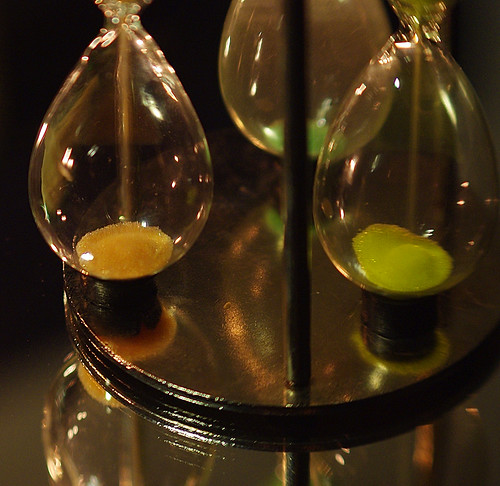
4. When all else fails, get an egg timer. There were some parts of the book where I really struggled – topics I was unfamiliar with, that required lots of reading and which I wasn’t particularly interested in. But I just had to grind these sections out. In one of my more (possibly only) fruitful side-tracks, (see point 2), I came across the Pomodoro technique. In essence, this is just working on your chosen task for 20 minutes (no email, no looking out of the window – just work!) and then having a 5 minute break before another 20 minute session. Try it sometime – it did the trick for me.

Eventually, with the help and support of my co-author, editor and publishers, the book was finished, proofread and published. It is nice to have a book on the shelf with my name down the spine. But it was a huge amount of work, on something that’s not REF-able. So it’s not something I can see myself doing again.
Although, in my weaker moments I can’t help but think that one day it might be quite nice to say “Which one?” when someone tells me that they’ve read my book….

Wednesday, 4 July 2012

Turning the corner

Posted by Jean Adams

In university research there are two sorts of jobs: research jobs and academic jobs.

Research jobs are all about getting a particular research project done. Contracts are time-limited and you do research – collect data, analyse results, write reports. Academic jobs tend to be permanent and involve the classic triad of research, teaching and administration. The research bit is more about leadership than in research jobs – submitting grant applications, and supervising researchers employed on your projects. But there is also classroom teaching and student supervision. And let’s just not talk about the admin.

You can see why many people might aspire to an academic position - for the job security if nothing else.
Turning the academic corner
I wouldn’t be an academic if I didn’t now say “well, that’s actually a bit of an oversimplification, really – but it gives you an idea, doesn’t it?”.

Even before I finished my PhD I wanted an academic position. I wanted to ‘lead’. I wanted to teach. And after all those years as a full-time student (n=9), you betcha I wanted a nice, healthy pay-check every month forever.

I spent four years as a post-doctoral researcher before getting my first academic position. Less time than many, and for this I am very grateful. Now, a further four years on, it occurred to me recently that only now am I actually doing the job.

Although I knew all that stuff about the difference between research and academic jobs, when I first made the transition myself it seemed like nothing changed. Yes it was nice to stop getting those letters telling me that my contract was due to expire in three months. Yes it was nice to get a little bump in my salary with promises of more in due course. Yes it was nice to put “Lecturer in Public Health” in my email footer. But that was about it. My day-to-day job was pretty much the same. I analysed data, wrote papers, suggested ideas for projects to senior colleagues, shied away from any real responsibility.

And then I got scared. I wouldn’t be the “new lecturer” able to hang on the coat-tails of more senior colleagues forever.

And then I got more scared. I knew I had to get some grant funding, make sure my post-grad students flourished, and deliver good teaching. I tried to do all these things. But I didn’t seem very good at any of them. My grant applications were rejected. My post-grads seemed unable to tie down their research questions, let alone do some research. The big lecture theatre petrified me.

But, you know, it does seem true what they say. Once you’ve started, it gets easier; you just have to start. I got a little grant funded. Then I got another, bigger one. Then I got another. My post-grads are making their own, individual, journeys towards completion. I look forward to teaching seminars (although not preparing them) and whilst the big lecture theatre still scares me, I don't think it shows so much anymore.

So here I am just starting to think that I have finally turned the corner and might truly be doing the job I’m paid to do. And guess what? From August, they've promoted me.

Monday, 11 June 2012

Older and wiser? Musings from a ‘mature’ PhD student

Posted by Amy O'Donnell

Recent posts from Martin White and Dorothy Newbury-Birch have sent me musing (and no, before you ask, this isn’t yet another PhD distraction, I promise!).

On the one hand Martin’s first tip in his "From PhD to PI in ten easy steps" is to do your PhD young; on the other, Dorothy writes convincingly about how you might juggle 'mature' study with the domestic stuff that grown-ups tend to have to manage.

So where does this leave me I wondered? I've just turned forty, have two school age children, five pets (do they count?) and to throw into the mix, am currently facing a somewhat challenging time due to my partner's (lack of) employment situation.

Times are indeed tough. And believe me I often look at my younger, child-free peers rather enviously, imagining all the amazing progress I’d achieve if I didn't have after school activities to organise four nights out of five, weekends packed with football matches and Stagecoach, and general mortgage related-stress.

But when I seriously ask myself - “Should I have done this sooner? Could I have done this sooner?” - the answer to both questions is a resounding "No".

For starters, I think that the long and confused path I've taken to get this far has provided me with an invaluable skillset and bundles of what they call ‘life’ experience. I've worked in public affairs so I have a keen sense of the need to stay policy-relevant; I used to manage the BBC corporate diary (yes really) so bureaucracy and seniority doesn't faze me (mostly); and I spent most of my thirties at the rough end of the contract research wedge: bid-writing and mega-quick project turnarounds were my bread-and-butter.


Along the way, I think I've become a better and more seasoned writer and I've developed a deep-rooted passion for tackling social and economic inequalities. In particular, as a mother, I feel a sense of urgency to see things change for the better before my boys have to go out and face the big bad world. Personally, I really don't think I was ready before now. And I also think that with the current focus on translational research, those of us who have actually worked outside academia might have a valuable role to play in bridging the cultural divide.

Of course I understand this will undoubtedly limit my long term opportunities (unless I plan on working to 80…which is possibly not too ridiculous a prospect under the current government). Things haven't always gone quite to plan with the PhD either, so I haven't (yet) rattled off those all-essential publications. But, future academic employers, I do think I've still got lots to offer. Come January 2013, let's hope someone else does too.

Wednesday, 6 June 2012

What do you get if you mix a scientist and a mother?

Posted by Bronia Arnott

I came across a headline on the way to work a few weeks ago “The data confirms: If you want to stay in science and see your children grow up, don’t have children before you have tenure”. As a post-doctoral science researcher, who doesn’t yet have tenure, and is already a mother of one did I dare read on?

The headline was the title of a post on the LSE Impact Blog. It referred to the findings of a study which found that childless women are “paid, promoted and rewarded equivalently to their male peers” but mothers are “far more likely to move out of the research-professor pipeline…”.


So for those just starting out who want a career and kids, they just have to wait until they have tenure to have kids. Right? But what if you get tenure and then find out that you’ve missed your biological window of opportunity? I can’t imagine many people regretting not getting tenure on their deathbed, but I can imagine the years of heartache that come with not being able to have the children you wanted.

And I’m not convinced that once you have tenure you can sit back and relax. All the professors I know are always talking about how busy they are! REF papers and successful grant applications don’t write themselves.

So what about me? Should I just give up and go home?

I wasn’t convinced so I thought I would do what I do best and do some further research… I found a piece in the Guardian suggesting that the proportion of women in science is much lower in the UK low compared with the United States. The article suggested that the problem wasn’t getting women into science, but getting them to stay. Apparently they often drop out to start families. This was beginning to sound familiar.

I got my coat.

But wait…on my way out of the door I remembered I had attended my first full institute meeting of the Institute of Health and Society, at Newcastle University. There was the usual IT updates and grant successes, but then they started talking about the Institute being awarded the Athena SWAN Silver Award, and suddenly the meeting got a whole lot more interesting. Some of the staff even put down their knitting needles.

This award scheme recognises good employment practices for women working in science and related fields in higher education and research. The Silver award recognises efforts, above and beyond university-wide policies, to identify challenges faced by women and implement effective solutions.

Professor Judith Rankin, who led the application, said that the Institute “has always strived to introduce good working practices to ensure that those women who wish to combine a family with a career can”. Professor Eileen Kaner, Institute Director, said: "Success in achieving this award acknowledges the considerable work to make working in science an attractive career option for women."

Did you notice that? Two quotes from two women, both Professors, one the director of the Institute! In fact the Institute is full of examples of successful women, including those who have children, some who even had their children before they got tenure!

On my way to pick up my daughter later that day the whole issue was still playing on my mind. While I was boosted by the news that there was such great work going on in the UK to support women in science, I realised that is was a sad reflection of the existing inequalities. Surely we should be better at supporting men AND women in their careers AND in their family life?

Thursday, 31 May 2012

From PhD to PI in ten 'easy' steps

Posted by Martin White

Recently I’ve been reflecting on what it takes to make it in academia. In part, this was prompted by an invitation to take part in an event at the UK Society for Behavioural Medicine conference last year. ‘Senior’ academics from a range of disciplines formed a panel to take questions informally over lunch from a baying mob of PhD students and post-doc researchers.

The baying mob: El dos de Mayo de 1808, by Fancisco de Goya y Lucientes
The questions primarily focused on career development and how to achieve rapid and effective progression. The members of the panel were readily able to identify ways in which their careers had been atypical. But despite our idiosyncrasies, we agreed on many pieces of advice.

Here's my top ten tips for success:

1. Get a doctorate early on in your academic career – preferably while you are young and need less sleep, and while you can tolerate a student stipend for 3-4 years.

2. Learn to work independently, demonstrating that you have an enquiring mind and are able to define original research questions. This is the foundation of academia and one of the X-factors which will set you apart as PI material.

3. Learn how to write well, for both scientific and non-academic audiences. Get advice or training on how to do this. Practice every day (e.g. by writing blog posts - Ed.).

4. Publish your work. Start while you are doing your PhD - leaving these papers until later creates a backlog which you may never be able to tackle. Writing papers before the relevant thesis chapters will help you develop a concise, clear style for your thesis and prove it is of a 'publishable standard'.

5. Get a mentor. Identify an academic ‘hero’, or at least a good role model. Look outside your institution and don’t be afraid to ask very senior  people. They will be flattered and pleased to help shape someone else’s career. Meet with them at least once a year.

6. Be genuinely interested in your subject area; choose carefully! A lack of enthusiasm shows through any veneer you put on for project meetings or interviews.

7. Sell yourself. Think carefully about how you can make a case for your future employment. Make yourself indispensible and demonstrate how you can add value to any team. Take every opportunity to present at conferences, workshops, select committees, etc.

8. Get personal funding. While post-doc research posts, working on other people’s projects, will earn your crust and keep you busy, they provide limited opportunities to hone your skills as a PI. Fellowships are available at every level and will give you incredible freedom to develop and shine as an independent researcher.

9. Collaborate. Spread your wings and make new relationships with the most interesting and brightest people you can find. Involve policy and practice partners in your research whenever possible to help bring relevance and impact to your research.

10. Learn to love criticism – she's your best mate. You will not get anywhere unless you welcome objective peer review and understand how to give and receive it. The best way to learn this is to become a peer reviewer for journals and grant funding bodies. This also carries esteem and will open up doors for you through the contacts you make.

Lastly, enjoy yourself and don’t be afraid to break the rules!