Wednesday, 27 June 2012

Can banking help fight health inequalities?

Guest post by Cam Donaldson

In 2010, Glasgow Caledonian University established the Yunus Centre for Social Business and Health. Muhammad Yunus is the 2006 Nobel Peace Laureate, awarded jointly with Grameen Bank for their efforts to relieve poverty, largely through promulgating microcredit. Grameen - 97% owned by its borrowers - issues small collateral-free loans, often for enterprise, to millions of the poorest people in Bangladesh and in several other countries.

Yunus does not fund our Centre. Why, then, is a UK University working with him, and what has microcredit got to do with health? Let me try to explain by bringing together three strands of thought.

Cam, with Muhammad Yunus and GCU Principal Pamela Gillies
First, on health, a more explicit strategy of inclusion combined with fair loan provision - essentially what Grameen promote - could facilitate health improvement. Gaps in life expectancy between the richest and poorest areas of Glasgow have grown to 28 years. We already have a world class NHS, so solutions do not lie there. Even public health policy seems more like “products chasing diseases”. We identify ‘risk factors’ and then target products (mainly drugs) at them. Either that or we tell people to exercise more, eat less fatty foods, give up smoking and drink less. But, can health be ‘compartmentalised’ like this? Further away from diseases and risk factors are the root causes - it is low income, societal exclusion and hopelessness that kill people. Without working on the ‘causes of the causes’ more-conventional attempts at public health improvement will have limited impact.

Second, on banking, the sector has been bolstered by national bailouts and quantitative easing. The bonus culture continues. Banks pander to middle class ‘trendies’ with more flexible opening hours (a 1980s phenomenon on which they had cut back!) and the entry of flash providers like Metro and Virgin. As we argue whether regulation goes far enough, the poorest are largely ignored – many trapped on benefits, which, despite being squeezed, people still cannot get off because, whilst raking in billions from QE, banks will not go near such people or their business ideas.

Government matches this lack of support, not allowing the welfare system to become a facilitator. They could do this by permitting schemes allowing income from welfare to taper off gradually whilst that from private sources grows - providing a minimum income overall and a guarantee of a return to welfare if such businesses fail. No less a guarantee than the banks have had, and one with much less risk – if a business is a success, one more person is off welfare and likely creating jobs for others. If it fails, then, at worst, we are merely back where we started, although it is thought that having tried and failed still enhances future job prospects. Money is placed more directly in the hands of those more likely to spend, contributing in a small way to getting the economy moving.

Third, on the ‘Big Society’, implementing some of the above would mean society could truly claim to be big, ensuring enhancement of well-being amongst the worst off. So far, many examples of the Big Society merely show it being captured by the middle class to their own advantage – with many more schemes in affluent as opposed to more-deprived areas, despite notable exceptions.

So here it is. To create a truly Big Society, and enhance the health and well-being of the poor, there is a role for banking. Examples are now spreading to the West – Fair Finance in London, started up by the son of Bangladeshi immigrants, is an excellent case. But we need more and they need more strategic support. Hence, the attempt to bring Yunus’ ideas to the most deprived areas of Scotland and the creation of our research centre to assess its impact. 

If it can be done in Bangladesh, why not here?

Monday, 25 June 2012

How can I help you help me?

Posted by Dorothy Newbury-Birch

I’ve never failed to get practitioners on board for a research project.

I’m not bragging (oh okay I am a bit). Some of the projects have been really difficult environments to do research: Accident and Emergency Departments, prisons, probation, magistrates courts, crown courts, youth offending teams, police stations, schools, GP surgeries. But I see people struggling with engaging practitioners and I wonder why. It’s by no means easy – actually getting someone to answer the phone or respond to your email can be really difficult but there are ways around that. Don’t believe what people say about it being more difficult elsewhere in England either – we’re often told that its much harder in London to engage but I don't agree: it is harder to get around London for meetings, but not harder to engage. I’ve done it – I know!

So what are my tips for success in engaging practitioners?

1. Send an email followed up by a telephone call about a week later where you tell them you’re following up on your email will probably get you somewhere. If you are a Dr. or working with a Dr. saying this helps.

2. Use current contacts to help you – however remember if you say that ‘Dorothy’ suggested I call you that you are using my reputation, so use it wisely.

3. When arranging to meet, ask what suits them best. Making it clear that you will come to them,  out of hours if necessary, usually works.

4. NEVER say you want to arrange a meeting (even though you do). Always say something like, ‘have you got time for a coffee and a chat about some research I’m working on which I think you would be really interested in’.

5. When you do meet (for a coffee!) find out very quickly if they are the right person to talk to about the research – they may be the PI but it may be someone else that you will be liaising with. Get the first person to introduce you to the next person.

6. Don’t go the meeting (coffee) with a huge list of things you need them to do. Tell them about the research and go through the main things – the list should come later (although you should never have too long a list).

7. When you get to meet the team (there is usually a team) my years of research experience tell me that ONLY providing blueberry muffins works. For some reason, chocolate ones don’t work the same.

8. Offer solutions to problems. In one trial I worked on with probation where I wanted them to fax me something each day, they said that they didn’t have time. So I offered to set the fax up to send me the list at the same time that they HAD to send it to someone else.

9. Listen to their solutions. They know their systems much better than you.

10. Keep them updated with what is going on throughout the research. THIS IS REALLY IMPORTANT not just for your research project, but for others that may come after.

11. Ok, I know I have 11 tips and 10 sounds better but this one is important. Involve the people you’re working with in the design, carrying out and the dissemination of the work (if they want to) it really makes for much better research.

Thursday, 21 June 2012

On realist approaches

Posted by Monique Lhussier

Whilst I was originally educated as a scientist (an engineer in biological processes), many years later, I wrote a PhD thesis in… Nomadology.

This is not only about the kind of nomadism that describes the life of Bedouins in North Africa. It’s also about a flexibility of the mind, which allows us to accept that all research paradigms have a point, but rejects the fact that any single one of them could provide answers for everything at all times. The approach is postmodern and offers perspectives that most, at best, consider iconoclastic. It is as far from science as one can go, but I found it liberating. My PhD journey was one of discovery and intellectual indulgence that we rarely have the opportunity to engage in. This, for me, is what working in academia is all about. In fact, my ambition in life is to reach a stage where I am paid to think and do little else…that unlikely dream is what keeps me interested. 

The hampter wheel career stage
After my PhD, I went through a hamster-on-the-wheel stage. Work needed to be done to attract funding, deliver, attract more funding and deliver some more, with little time to build some kind of cumulative knowledge. 

Then, in the past few years I discovered realist approaches (evaluation, synthesis), which are about building theories of understanding. Understanding of how things work, for whom and in what circumstances. The kind of theory that isn’t a million miles away from the realities of life, but explains it in a way we might not have thought about before. It talks about the way in which contexts interact with underlying mechanisms to produce favourable outcomes. 

I recently attended a seminar on realist approaches, where the presenter illustrated this beautifully. Imagine a tennis ball in a hand. On earth, if the hand releases its grip, the ball falls. The action of the opening hand is only the visible part of what made the ball fall, though, as it is gravity that attracts the ball to the floor. Take that hand in outer space and, when it opens, the ball floats. The same visible thing happened (hand opening), but gravity has ceased to work. Take that hand under water and the ball goes upwards, towards the water surface. Gravity still applies, but is outweighed by buoyancy. Take the same action in three different contexts, and it leads to three different outcomes. 

How relevant is this in public health? Unless we can understand what really happens as a result of a public health intervention, we have no chance of replicating its successes and avoiding its pitfalls. I am currently undertaking a realist synthesis. Existing theories provide me with potential ‘menu’ of forces that may, in isolation or combination, explain published outcomes in any given circumstances. We constantly operate a toing and froing from theories to published data, until we feel we have developed a comprehensive enough explanatory framework. This process forces us to step out of our normal modus operandus of understanding (engaging in some kind of nomadism), to develop a new area of knowledge that can readily be translated. 

That knowledge is also beginning to instil conceptual sense in many other things I have done – whilst unfortunately not all I do, I at last am being paid to think my way out of the wheel.

Wednesday, 20 June 2012

Happy birthday health economics, from public health!

Guest post from Cam Donaldson, Kenny Lawson, Helen Mason and Emma McIntosh

UK Health economics is 40 years old this year. Well, more accurately, the Health Economists’ Study Group is 40 years old. This is to be celebrated in itself – few areas of applied economics have been as successful in terms of sustainability and influence, as well as contributing significantly to our parent discipline of economics.

Ironically, health economics concepts can be traced back to Adam Smith’s pronouncements on public health:

“In some parts of Lancashire it is pretended, I have been told, that bread of oatmeal is a heartier food for labouring people than wheaten bread, and I have frequently heard the same doctrine held in Scotland. I am, however, somewhat doubtful of the truth of it. The common people of Scotland, who are fed with oatmeal, are in general neither so strong nor so handsome as the same rank of people in England, who are fed with wheaten bread. They neither work so well, nor look so well; and as there is not the same difference between people of fashion in the two countries, experience would seem to show that the food of the common people of Scotland is not so suitable to the human constitution as that of their neighbours of the same rank in England.”

We say ‘ironically’ because, despite the claimed successes of health economics and public health, growing health inequalities within nations remains an outstanding societal challenge, and one with significant health economic consequences. The main challenge, of course, is in devising effective and efficient interventions to reduce such inequalities. For health economics, the question then becomes one of whether our tools, which have been so successful to date, are up to the task of economic appraisal of public health interventions.

Indeed the dominant rubric of ‘cost per quality adjusted life year’ seems to present something of a moral dilemma for health economics when it comes to assessing public health interventions. The cost-per-QALY metric has served well the assessment of health technologies, but, amongst others, has the following limitation: all that is measured (and hence valued) are health gains for health care resources expended.

Public health economics: more than just cost-per-QALY?
On the cost side this is limiting, given that many public health interventions will, by their nature, be multi-sectoral, thus requiring more of a ‘societal approach’. Likewise, on the benefit side: although one may wish to assess the output of public health interventions in QALYs, what about other outcomes such as ‘improving life chances’ as well as enhancements in quality of housing and built environment, dignity, esteem and capabilities? Many community-based public health interventions also have spill over effects on their communities which need to be captured. The reductionism of the now-dominant health economics evaluation approach does not match what needs to be measured in evaluating public health. A broader and longer time horizon is required to fully capture all impacts.

This becomes a moral dilemma because, given that so many interventions previously evaluated by bodies such as NICE have been assessed using cost-per-QALY, should we permit others to be appraised via a broader societal approach which now takes these ‘other broader attributes’ into account?

There are two answers to this question. First, if the general scientific principle of working from ‘broad to specific’ were adhered to in health economics, no such moral dilemma would exist. We could start off our evaluations by thinking broadly and then either remain so or work to something more specific (e.g. cost per QALY) depending on the issue at hand. Just because health economics has come at this principle the wrong way round - specific to general - should that be allowed to limit our evaluations by leaving out the measurement of important potential impacts?

Secondly, and following on from this, a broader societal approach actually takes us back to the origins of economic evaluation, which was designed to:

“...identify relevant options for consideration; enumerate all costs and benefits to various relevant social groups; quantify as many as can be sensibly quantified; not assume the unquantified is unimportant; use discounting where relevant to derive present values; use sensitivity analysis to test the response of net benefits to changes in assumptions; and look at the distributive impact of the options”

So, public health has given health economics a birthday present - the opportunity to return to a societal perspective, which many, even in health economics itself, have been advocating for some time.

Hopefully, we can take advantage of this coming together of health economics and public health in measuring and valuing what is relevant and so implementing effective and efficient public health solutions to reduce health inequalities in the communities we all seek to serve.


Cam, Kenny, Helen and Emma run the Economics of Public Health blog, hosted by the Glasgow Centre for Population Health

Monday, 18 June 2012

Communicating science

Posted by Jean Adams

Not so long ago, I promised never to do another degree again. This came after finally completing an MSc in Psychology and Health in London. For 20 long weeks I caught the early flight to London each Thursday morning, attended lectures for two days, and then struggled to make it back to Newcastle before midnight on Friday evening. I learnt some stuff. I did an interesting dissertation that I’m still pretty pleased with. But overall, the effort was not worth the gain.

But another fellowship application, and another blank ‘training plan’ section, and I found myself thinking that the only thing I needed to do to become an ‘independent researcher’ was a Postgraduate Certificate in Science Communication – at the University of the West of England, in Bristol. A PGCert isn’t a degree anyway. So it’s not like I was breaking a promise.

Love the box hedge logo at UWE Frenchay campus
So let’s be clear: Bristol is further from Newcastle than London is. The travelling was longer, more expensive and more arduous this time; each trip was three days, rather than two. But, I only had to make six trips. And, most importantly, I learnt so much more during those six trips than I did from the 20 I made to London.

In a nutshell, I learnt that it’s all about story. Communicating stuff is about narrative. Communicating difficult science to people who aren’t necessarily that interested in it, is about telling a good story. You catch people’s attention with a compelling tale, then once you’ve got them hooked, you can slip in whatever you want – complex methods, difficult concepts, mashed swede, whatever.

Which is not exactly rocket science. But, you know, the science communication field is full of used-to-be scientists – if they were rocket scientists, they might have stayed in science.

I also got to do some pretty cool other stuff. I edited a (pretend) travel magazine, I set up a blog, I recorded and edited a podcast, I got totally over-excited in the Knit-a-Neuron workshop, I bought a copy of The Sunday Telegraph – for research purposes (which wasn’t that cool, but it’s certainly something I’ve never done before). In order to complete my writing portfolio, I attended a conference and pretended I was journalist, not a researcher. At the end of each day I wrote a 500 word news article on something I had heard. It made the whole experience a whole lot more immediate and exciting.

Which is all well and good, Dr. Adams, and we are certainly trying to encourage our staff to do more in the way of 'public engagement', but not at the expense of research excellence and impact.

I think this stuff is important for research excellence and impact too. Good research papers also tell good stories. Not necessarily in the same way that a newspaper or novel does, but without narrative your paper is just a series of facts (or, if you’re a social scientist, just a series of 'facts'). That's why you remember some research papers so much better than others. Ditto good grant applications, teaching sessions, and conference presentations.

So, I’m thinking about doing a degree in creative writing.

Only joking.

Thursday, 14 June 2012

Nothing personal

Posted by Peter Tennant

When I was four feet tall, and each year felt like a Chinese dynasty, certain annual events used to really standout. The first hot day of summer. That strange day when there were flying ants everywhere. And the day when young adults would cry in the streets.

Apparently they had 'A-levels'. Or more accurately, they didn't.

These days, I find it harder to notice anything among the blur. Christmas is a long lunch. Summer a short weekend. But every now and again, grown men and women can still be found crying. The tears are usually less visible. But there’s no doubt about it, Fellowship applications are the A-levels of the early career researcher.
Vladimir Putin, after hearing he didn't get his fellowship

In a recent post, Fuse director Martin White listed personal funding (in particular getting a Fellowship) as one of 10 "easy" steps to achieve "rapid and effective progression" in a research career. It reminded me of one of those weird logic puzzles. If Andrea is lazier than Beth, and Catherine is greedier than Delia, how many cakes will Delia eat before Andrea has woken up? In short, getting a Fellowship may make career progression easier, but it's certainly not easy to get one. At least not in my experience.

At this point, my academic enemy would probably volunteer a simple explanation. Like the overly-blunt PE teacher to the short fat boy (sorry, boy of below average height and above average weight) who doesn't understand why he's so rubbish at the high-jump. But as much as we might blame my own academic physique, the statistics tell a bruising story. For every 5-10 applications, only one will be successful.

On the surface of it, this doesn't sound too bad. At least not in a world where there are hundreds of applications for any one academic position. But firing off a job application and applying for a Fellowship are like chalk and cheese. Occasionally cheese may have a chalky texture. But I guarantee, the chalk and pickle sandwich will never catch on.

To start with, Fellowship applications belong to that special category of things that completely take over your life. Partly because they take up so much time – I reckon I did about 200 hours on my NIHR Fellowship application, not to mention the countless time staring into space 'thinking' about it. And whenever I did stop thinking about it, a friend would usually ask: "Have you heard about your Fellowship yet?".

But it's the personal focus that makes a Fellowship application so uniquely challenging. Yes, the project needs to appear excellent. But so do you. And, sadly, not just in the eyes of your Mum (sorry Mum, but I'm afraid 'having good A-levels' isn't quite enough any more). Which means there's lots to write about how great you are and why you deserve the money more than anyone else. There's no place for modesty. So if I ever come across like a egotistical jerk, I'm just practising for my next application. Honest.

Before finishing, I would like to offer some advice. Some magic formula that boosts those slim chances of acceptance. But as a twice-reject, you might as well ask McDonald's to help solve the obesity epidemic. All I can advise, is you try to keep your emotional distance. They might call it personal funding, but (believe it or not) rejection is nothing personal.

Wednesday, 13 June 2012

If it ain’t fixed, broker it

Guest post from Oliver Francis, Centre for Diet and Activity Research

Before I applied for my current job, I’d never heard of a Knowledge Broker. I’d always described what I did as ‘communications’. But a year in, this role has confirmed that the word 'communication' doesn’t really cover the challenges of linking public health evidence with policy and practice. In this time I’ve also met a couple of other ‘Brokers’ so I’m now a little less embarrassed about telling people my job title at parties.

As the recent Geek Manifesto reminds us, there are plenty of voices clamouring for more evidence-based policy making, so why does all this knowledge need brokering at all? Surely academics just need to publish their findings and they’ll be automatically taken up by policymakers and practitioners who want to do a good job.

Well, put simply, the world isn’t built like that. There are many barriers within the complex world of public health research translation. To take just one, there are often big gaps between the evidence that individual studies generate and the broader information that policymakers use to make their decisions. There are the practicalities of implementation, there’s money, ideology, politics, public opinion, the media. Or to put it another way: how many purely evidence-based decisions do you make in a day? Thought so.
Research translation: not so simples
One thing academics can do to help is make our research more available and easier to digest. So at CEDAR we’re producing short summaries of our research findings. Hopefully these Evidence Briefings are a step in the right direction. Indeed, these sorts of documents are increasingly common outputs from research groups, in addition to the wider syntheses of evidence coming from organisations such as NICE and (soon) Public Health England.

So, writing engaging and straightforward summaries of emerging, nuanced and complex evidence in no more than two pages… Simples! Well, actually, not so simples. For instance, how do we deal with expressing uncertainty for those who need to make clear cut decisions? How do we produce something that’s short enough to hold attention, but long enough to convey all the important information without a hundred web links? How do we convince a local authority in Newcastle to pay attention to findings generated in Cambridgeshire? People love case studies, but as we know, the plural of anecdote is not data. How can we make sure we tell only ‘true stories’?

Or should we just face up to the fact that there is a limit to what researchers can contribute to this process? Is the job of academic institutions just to produce summaries of the evidence in plain English, and then leave it to others to interpret them in the light of the demands of the so called ‘real world’?

I’d love to hear your thoughts. Have a look at the first Briefing in the series about physical activity and schools, and take our quick survey to tell us what you think of it. Or post here, or contact me directly if you’ve something to share. Even if you don’t work in this particular area, your views can help us improve future Briefings on other topics, and hopefully make sure that as little as possible gets lots in translation.

Monday, 11 June 2012

Older and wiser? Musings from a ‘mature’ PhD student

Posted by Amy O'Donnell

Recent posts from Martin White and Dorothy Newbury-Birch have sent me musing (and no, before you ask, this isn’t yet another PhD distraction, I promise!).

On the one hand Martin’s first tip in his "From PhD to PI in ten easy steps" is to do your PhD young; on the other, Dorothy writes convincingly about how you might juggle 'mature' study with the domestic stuff that grown-ups tend to have to manage.

So where does this leave me I wondered? I've just turned forty, have two school age children, five pets (do they count?) and to throw into the mix, am currently facing a somewhat challenging time due to my partner's (lack of) employment situation.

Times are indeed tough. And believe me I often look at my younger, child-free peers rather enviously, imagining all the amazing progress I’d achieve if I didn't have after school activities to organise four nights out of five, weekends packed with football matches and Stagecoach, and general mortgage related-stress.

But when I seriously ask myself - “Should I have done this sooner? Could I have done this sooner?” - the answer to both questions is a resounding "No".

For starters, I think that the long and confused path I've taken to get this far has provided me with an invaluable skillset and bundles of what they call ‘life’ experience. I've worked in public affairs so I have a keen sense of the need to stay policy-relevant; I used to manage the BBC corporate diary (yes really) so bureaucracy and seniority doesn't faze me (mostly); and I spent most of my thirties at the rough end of the contract research wedge: bid-writing and mega-quick project turnarounds were my bread-and-butter.


Along the way, I think I've become a better and more seasoned writer and I've developed a deep-rooted passion for tackling social and economic inequalities. In particular, as a mother, I feel a sense of urgency to see things change for the better before my boys have to go out and face the big bad world. Personally, I really don't think I was ready before now. And I also think that with the current focus on translational research, those of us who have actually worked outside academia might have a valuable role to play in bridging the cultural divide.

Of course I understand this will undoubtedly limit my long term opportunities (unless I plan on working to 80…which is possibly not too ridiculous a prospect under the current government). Things haven't always gone quite to plan with the PhD either, so I haven't (yet) rattled off those all-essential publications. But, future academic employers, I do think I've still got lots to offer. Come January 2013, let's hope someone else does too.

Friday, 8 June 2012

Coral Triangle Day

Posted by Duika Burges Watson

June 9th is Coral Triangle Day. The Coral Triangle is a region in South East Asia that covers just 1% of the world’s surface but contains 30% of its coral reefs, 76% of coral reef-building fish species, 9 of the 10 species of giant clam and is home to 100 million people. Celebrating Coral Triangle Day might not sound like an important public health issue for people in the UK, but my reading tells me it is fundamental. I am fortunate to have the opportunity to demonstrate how, as recipient of the 2012 Neville Schulman Challenge Award (with Dr Johanna Wadsley), through our Indonesian research exchange and expedition, Hugging the Coast.


Sometimes topics in public health leap out at you because you are motivated by an issue or concern that really grabs you. Hugging the Coast is a title that resonates on so many levels, and it is one that clearly touched not just us but the many supporters and sponsors that have provided gear, money, expertise, and time to help make the expedition possible.

In August 2012, our international team of six women sea-kayakers and social scientists will traverse the 250km length of the volcanic islands that reach from the northern tip of Sulawesi, Indonesia, to Sangihe in the Celebes Sea - at the edge of the Coral Triangle. We will be documenting and engaging with life in one of the world’s ‘liminal zones’, confronting key contemporary public health issues in relation to climate change and sea level rise, food security and ecology, and how what we ‘do’ at home is not isolated from what happens in other parts of the world.

Our project resonates with the major challenge to public health that is presented in Lang and Raynor’s recent publication Ecological Public Health: Reshaping the Conditions for Good Health. At its core, they argue that public health needs a major overhaul, we need to transform relationships between people, circumstances and the biological world of nature and bodies. They stress that we need better ways to understand and account for major transitions – be they demographic, epidemiological, urban, energy related, economic, nutritional, biological, cultural or political; any conditions involving interactions between human eco-systems and health.

Scenarios developed for the Coral Triangle suggest that in the next century the biological diversity of this ‘Amazon of the seas’ may be destroyed, the resilience of coastal environments will deteriorate and food security – already an issue with climate change and El Nino events – will force migration, urbanisation and even greater depletion of environmental resources. In Hugging the Coast we will confront the lived experience of transitions related to climate change.

But part of the Coral Triangle Initiative, and what Coral Triangle day is there to celebrate, is that there are opportunities to avoid this worst-case scenario – reducing greenhouse gas emissions and building resilience back in with new approaches to agriculture and aquaculture; international investment to ensure that economic growth, food security and natural environments are maintained. On this, a key focus for our expedition and research is the role that seaweed farming might play as an exemplar of ‘climate smart’ agriculture: as an alternative livelihood, reducing fisheries pressures and for carbon sequestration.

The seaweed farmed in the Coral Triangle, is not used there. The product ‘carrageenan’ is extracted from the seaweed and, amongst other uses, is employed in processed foods and fat-reduced products, in toothpaste, as an active ingredient in HIV/AIDs prevention technologies, as an anti-viral agent to protect against HPV and swine flu, and to encapsulate important drugs (for example for novel diabetes drugs). In many applications, public health is a driver of use. In Hugging the Coast we will be exploring a ‘liminal’ zone between land and sea, but also one between the global East and West.

Hugging the Coast offers us an opportunity to map out interactions between human eco-systems and health; to ‘test drive’ an ecological public health approach. It will inevitably be a complex picture, and one that you can follow and contribute to on our blog or on twitter @hugindo

Wednesday, 6 June 2012

What do you get if you mix a scientist and a mother?

Posted by Bronia Arnott

I came across a headline on the way to work a few weeks ago “The data confirms: If you want to stay in science and see your children grow up, don’t have children before you have tenure”. As a post-doctoral science researcher, who doesn’t yet have tenure, and is already a mother of one did I dare read on?

The headline was the title of a post on the LSE Impact Blog. It referred to the findings of a study which found that childless women are “paid, promoted and rewarded equivalently to their male peers” but mothers are “far more likely to move out of the research-professor pipeline…”.


So for those just starting out who want a career and kids, they just have to wait until they have tenure to have kids. Right? But what if you get tenure and then find out that you’ve missed your biological window of opportunity? I can’t imagine many people regretting not getting tenure on their deathbed, but I can imagine the years of heartache that come with not being able to have the children you wanted.

And I’m not convinced that once you have tenure you can sit back and relax. All the professors I know are always talking about how busy they are! REF papers and successful grant applications don’t write themselves.

So what about me? Should I just give up and go home?

I wasn’t convinced so I thought I would do what I do best and do some further research… I found a piece in the Guardian suggesting that the proportion of women in science is much lower in the UK low compared with the United States. The article suggested that the problem wasn’t getting women into science, but getting them to stay. Apparently they often drop out to start families. This was beginning to sound familiar.

I got my coat.

But wait…on my way out of the door I remembered I had attended my first full institute meeting of the Institute of Health and Society, at Newcastle University. There was the usual IT updates and grant successes, but then they started talking about the Institute being awarded the Athena SWAN Silver Award, and suddenly the meeting got a whole lot more interesting. Some of the staff even put down their knitting needles.

This award scheme recognises good employment practices for women working in science and related fields in higher education and research. The Silver award recognises efforts, above and beyond university-wide policies, to identify challenges faced by women and implement effective solutions.

Professor Judith Rankin, who led the application, said that the Institute “has always strived to introduce good working practices to ensure that those women who wish to combine a family with a career can”. Professor Eileen Kaner, Institute Director, said: "Success in achieving this award acknowledges the considerable work to make working in science an attractive career option for women."

Did you notice that? Two quotes from two women, both Professors, one the director of the Institute! In fact the Institute is full of examples of successful women, including those who have children, some who even had their children before they got tenure!

On my way to pick up my daughter later that day the whole issue was still playing on my mind. While I was boosted by the news that there was such great work going on in the UK to support women in science, I realised that is was a sad reflection of the existing inequalities. Surely we should be better at supporting men AND women in their careers AND in their family life?

Thursday, 31 May 2012

From PhD to PI in ten 'easy' steps

Posted by Martin White

Recently I’ve been reflecting on what it takes to make it in academia. In part, this was prompted by an invitation to take part in an event at the UK Society for Behavioural Medicine conference last year. ‘Senior’ academics from a range of disciplines formed a panel to take questions informally over lunch from a baying mob of PhD students and post-doc researchers.

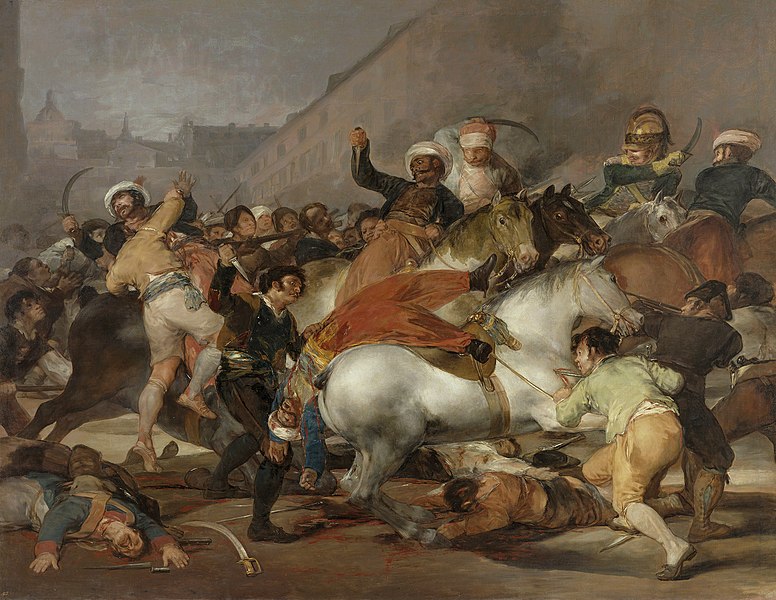
The baying mob: El dos de Mayo de 1808, by Fancisco de Goya y Lucientes
The questions primarily focused on career development and how to achieve rapid and effective progression. The members of the panel were readily able to identify ways in which their careers had been atypical. But despite our idiosyncrasies, we agreed on many pieces of advice.

Here's my top ten tips for success:

1. Get a doctorate early on in your academic career – preferably while you are young and need less sleep, and while you can tolerate a student stipend for 3-4 years.

2. Learn to work independently, demonstrating that you have an enquiring mind and are able to define original research questions. This is the foundation of academia and one of the X-factors which will set you apart as PI material.

3. Learn how to write well, for both scientific and non-academic audiences. Get advice or training on how to do this. Practice every day (e.g. by writing blog posts - Ed.).

4. Publish your work. Start while you are doing your PhD - leaving these papers until later creates a backlog which you may never be able to tackle. Writing papers before the relevant thesis chapters will help you develop a concise, clear style for your thesis and prove it is of a 'publishable standard'.

5. Get a mentor. Identify an academic ‘hero’, or at least a good role model. Look outside your institution and don’t be afraid to ask very senior  people. They will be flattered and pleased to help shape someone else’s career. Meet with them at least once a year.

6. Be genuinely interested in your subject area; choose carefully! A lack of enthusiasm shows through any veneer you put on for project meetings or interviews.

7. Sell yourself. Think carefully about how you can make a case for your future employment. Make yourself indispensible and demonstrate how you can add value to any team. Take every opportunity to present at conferences, workshops, select committees, etc.

8. Get personal funding. While post-doc research posts, working on other people’s projects, will earn your crust and keep you busy, they provide limited opportunities to hone your skills as a PI. Fellowships are available at every level and will give you incredible freedom to develop and shine as an independent researcher.

9. Collaborate. Spread your wings and make new relationships with the most interesting and brightest people you can find. Involve policy and practice partners in your research whenever possible to help bring relevance and impact to your research.

10. Learn to love criticism – she's your best mate. You will not get anywhere unless you welcome objective peer review and understand how to give and receive it. The best way to learn this is to become a peer reviewer for journals and grant funding bodies. This also carries esteem and will open up doors for you through the contacts you make.

Lastly, enjoy yourself and don’t be afraid to break the rules!

Wednesday, 30 May 2012

Let’s get out of the office and see what’s really happening

Posted by Dorothy Newbury-Birch

When putting bids together for research we have to think carefully about how a project can happen ‘in the field’. We look at the evidence to date and often ask people who are working in said 'field' for advice on how things can work. But is this enough?

I would argue not always – for us to really understand what we are asking people who take part in research to do, we need to get out there and look for ourselves how things could work in practice. For example if I am working on a project where I would like ambulance staff to screen patients for alcohol use disorders how can I really know what normal practice is like without observing it for myself?

Hanging out with an ambulance crew - good fun, good research
I have, to date, carried out observational work for these very reasons, in an Accident and Emergency Department (AED) on black Friday - the Friday before Christmas. I quickly realised that asking AED staff to ask lots of questions about alcohol wasn’t really a good idea. In fact, just getting a cup of coffee that night was barely feasible. However, using a shorter questionnaire, perhaps at the triage stage, might be.

I also spent two weekends with an ambulance crew and learned that paramedics make small talk in the back of the ambulance with a lot of patients whilst they are being transferred to the AED. This makes it an ideal opportunity for research to take place. I also realised that quite a few people who paramedics are called to see, are not transferred to hospital. The paramedics were frustrated about not being able to do anything with these people (another opportunity for research).

I spent a night with the maxillofacial team in AED where I learned that they are slightly separate to the core AED staff and in the main do have more time (yet another opportunity for research). Finally I spent a couple of nights on a project with police and paramedics where I’m not sure what I learned, but it was fun.

Of course, there are loopholes to get through in order to do observational work like this, forms to be filled in (including risk assessments). I am always honest about my reasons for doing the work with the people I’m working with and this is important for good relationships. I always, always take goodies for the team (blueberry muffins, cherry bakewells).

Ultimately I think this observational work means we end up with better research. And it's really, really, really good fun. So give it a try.

Monday, 28 May 2012

Routine Secondary Data

Posted by Lynne Forrest

We all know what a nightmare it is trying to recruit participants for research studies. So if you only have to get hold of some routine data that’s just sitting there, well, that’s going to be much simpler, isn’t it? You’d think....

The plan for my PhD was to look at inequalities in cancer care by linking cancer registry and Hospital Episode Statistics data for lung cancer, and also linking to audit data. This is routine data that has already been collected and so I naively assumed it was just a case of getting ethical approval to access the data, finding someone to cobble the data together and off we go. I wrote an optimistic project timetable where I would get my hands on the data about seven months into the PhD. Eighteen months in I’ve finally got hold of some unlinked data and I’m still waiting for the rest.

I don't work for News International, so what's the problem? Photo: Christian Sinibaldi
So, what went wrong?

I think my first mistake was assuming that just because the data was there it would be easy to get hold of. There are a lot of hoops you have to jump through first.

I thought that what I wanted to do was simple but it turns out that it’s not. This is apparently the most complicated linkage that the cancer registry has undertaken and the bottom line was, nobody wanted to do it. I spend a lot of time begging people to speak to me and basically being fobbed off, in the nicest possible way. Luckily I eventually found a newly-joined analyst who was willing to give it a go. I’m not sure that she’s thanking me now...

Issues then arose of whether the data I wanted might be identifiable. Variables such as date of birth and death are classed as identifiable and individual records are ‘potentially-identifiable’, even if they don’t include identifiable information (which is an excellent catch 22 – they are identifiable even though they are not identifiable...)!

Finally it seemed like it was all coming together. I’d agreed with the registry that they would supply me with anonymised data containing ages rather than dates, I’d made it through ethics, and I’d got some data. But, on checking, not exactly the data I wanted. So, currently I am discussing with the registry how it will be possible for me to calculate survival time if they won’t allow me to have data on the number of days from diagnosis to death. Survival from lung cancer is short and rounding to the nearest year isn’t going to identify survival differences with any degree of accuracy.

The sticking point is that although they are not supplying me with date of death I could theoretically work it out from this information and that makes the data (aaagh!) ‘identifiable’. However, as I don’t have an NHS number, date of birth, or place of death, I don’t know how I would identify anyone from the 140,000 records I have. Plus I’m a researcher, not a News International journalist, and I’m not interested in anyone individually, so I’m not going to attempt to do this.

Can’t I just sign something to that effect and have the data I need please?

Friday, 25 May 2012

Should I do a PhD mum?


I’m about to have a grandchild and am so unbelievably excited about it! My daughter is thinking that she might like to do some postgraduate studies after her baby is born and is starting to worry about how she will manage to be able to do this and have a child. This made me think about what advice I should give her.

I began my PhD in 1997 (not that long ago!) when my youngest was four and the eldest (the now pregnant daughter) was eight. My husband and I made a decision from day one to treat my PhD as a job. I also learnt that the only thing that was going to get me through it all was good, changeable, project management.

At least once a week, the diary would be put on the kitchen table and decisions made about who would do the drop offs (mainly me), who would do the pick ups (mainly me) and who would look after the girls at weekends so I could do some work (mainly him).

Dot's girls. Some time ago.
We didn’t have family locally so negotiations would happen in the school yard about me looking after friends' kids after school one day if they could look after mine another. School holidays were negotiated with friends the same way: I would have their kids for a couple of days (or from 3pm onwards) and they would have mine opposite times. These summer holiday days were fab: I would have three or four kids, we would go off for the day early and be back by about 3pm, then I would go up to the university for a few hours work.

I also wrote five papers during my PhD and attended a few conferences. I can honestly say, that from day one I worked at least 8 hours a day on my PhD - mostly in the office, sometimes at home. In the last year, of course this wasn’t enough and I did have to work at nights and every weekend.

Of course there were sacrifices: I didn’t spend nearly enough time with the kids when they were young. But this was a decision I made and if I hadn’t done a PhD, I would have needed to work anyhow. The money was terrible and there were at least three conversations in the three years about whether I should continue because of money worries. In the end I got a pub job for a few months at nights.

So my advice to my lovely daughter who is contemplating this? Pick a subject and topic that you really believe in, that you are going to be interested in for the time needed. Make a commitment to it and treat it like a job. Remember that your child (my precious grandchild) is a fact and not an excuse for working. You have support on your doorstep from family that a lot of people (including me) didn’t have. Go for it....

Monday, 21 May 2012

On Busyness

Posted by Martin White

Finally, I have committed pen to paper for my first blog post. Why has it taken me so long? The truth is, I just can’t find the time. Sounds like a lame excuse and one that is often interpreted as ‘I just can’t be bothered’. So, just in case you need convincing, here is a snapshot from a recent week.

Monday was a bank holiday. I helped organise and spoke at a two-day multi-disciplinary workshop in Glasgow, the previous Thursday and Friday. Spending the weekend Munro-bagging was a no brainer. Going to the hills is a great way to forget about the pressures of work, but by Monday afternoon, my in-box beckoned and deadlines loomed.

Stob Dearg from Ben Cruachan, Munro no. 79, 5 May 2012 (Photo: Martin White)
Sharing the five hour drive home meant I had time to read a PhD chapter in the car. Stopping for food in a pub allowed the first wi-fi access for three days and the chance to delete a mound of spam and identify priorities. Inevitably, this led to a couple of hours work back at home, responding to emails and assessing key tasks for the next week. I knew there was going to be no time to get all this done when I got back in the office on Tuesday.

On Tuesday I woke at 0555, an hour before the alarm. My brain was already in overdrive so I got up, made tea and tracked the changes on the PhD chapter from the previous evening. My diary was stuffed: seven hours of meetings with two 30 minute breaks.

Everyone wants a slice of my time. Sometimes for my scientific expertise, but more often these days because I can make things happen. I don’t resent this, it’s the nature of the job, but it’s frustrating not to be able to do more thinking, reading and writing.

The meat of my day was two one-hour research project meetings, one face-to-face; the other a teleconference with colleagues in Finland, Holland and the US. The rest of the day was taken up by individuals: helping a post-doc think through a fellowship application, a PDR, helping a senior lecturer work out how get the curriculum time we need for undergraduate teaching. 'The 'fillers' were unscheduled meetings relating to the day-to-day assortment of human and political (small p) complications a director comes across when dealing with staff on a personal level. No actual research, but all essential to keep the research going.

I usually go for a run after work, but having been in the hills all weekend, I ached. So I hung back and ground through the 50+ emails that had accumulated through the day. Then I had to go find my car, which I had left at the garage for an MOT when I went to London en route to Glasgow. Having been away for a week, the fridge also needed replenishing. After the supermarket, I eventually arrived home after 8pm.

Given the choice I would prefer not to work this many hours in a day or a week or a lifetime. But, everyone I know in positions of significant responsibility has a similar workload as far as I can tell. However, there are benefits. The job is incredibly stimulating – I learn loads from the interesting and talented people I meet at every research funding board, conference, research network, centre, school, consortium or project meeting I attend.

More importantly, for the first time in my career, I feel I am beginning to make a difference – in public health policy circles, with research funders, and, most importantly, supporting the career development of my daily ‘fillers’.

Friday, 18 May 2012

A case of mistaken identity?

Posted by Janet Shucksmith

Towards the end of my undergraduate days I was directed to the notoriously duff University Careers Service. With no inclination to follow traditional Cambridge careers – think Burgess, Philby and MacLean spy ring or Cleese, Cook, Fry, Frost showbiz alumni – I told the careers officer that I wanted to make a difference to the world. Lacking information on entry level schemes to Supergirldom, he gave me a leaflet on the UN. Luckily for the world’s population, I grew up shortly thereafter.

Traditional Cambridge career: Footlights, 1981
My grown up understanding is more modest: as public health researchers we should perhaps be content to make small contributions. It is also morally unacceptable to claim more power for one’s work than is sensible when recruiting participants. I remember community education workers telling me how difficult it made life when youngsters naively believed things would change as a consequence of their research contribution – that they would get a dedicated playground with skateboard ramp or a sexual health service. The workers were the ones who had to cope with the let down kids when commissioners shelved our research report in the drawer marked ‘Pie in the Sky’.

Now our participant information letters are tediously correct in pointing out to people that they will get nothing personally from contributing to our research and nothing may change as a consequence. The best we can promise is that they will suffer no harm or detriment to the service they receive. Given this rather depressingly realistic estimate of how unimportant and inglorious research is, it still takes me by surprise that the general public occasionally invests the researcher with power beyond anything I currently dream of.

Lawrence, my PhD researcher, was castigated frequently by the citizenry of Gateshead last year for having singlehandedly introduced the National Child Measurement Programme. Whilst trying to explore the impact of the policy, a number believed him to be the original perpetrator of a rather unpopular regime, and called him to account for not having thought through the impact on children and parents.

Recently, invited to present research evidence to a local health scrutiny committee, my colleague and I spoke about a specific project on the impact of Human Resources leave policies on carers of those at end of life. At the conclusion, a councillor drew herself up to her full height and demanded to know why I had decided to close their local palliative care hospital? What on earth had convinced her that I had the responsibility and power to do any such thing? Me? I’m only a researcher, madam. You mistake me for someone with power and authority.

My worst case of mistaken identity came when we undertook research prior to the implementation of HPV immunisation. Despite ethically approved invitation letters and information sheets, it became evident that many parents thought we had come not to ask their views, but actually deliver the ‘jag’: despite our lack of medical qualifications or kit. We were more alarmed when it became apparent that many parents believed the vaccination was a precautionary small dose of cancer, and delivered straight into the cervix! The very limited permission we had to explore perceptions was construed by some as being sufficient to allow us to lay their children out and perform an intimate intervention. So much for informed consent?

As a researcher, one often feels relatively distant from the intervention that is being evaluated. But Joe Public sometimes has a great deal of difficulty working out our researcher role and distinguishing us from the rest of the cohort of powerful but unnamed and unspecified authorities who ‘do things’ to them.

Tuesday, 15 May 2012

Academic rivalry

Posted by Peter Tennant

Last month I discovered I have a joke mortal enemy. Less Holmes and Moriarty, more Sylvester and Tweety. I'm a bit sketchy on the details, but according to my (evil?) spies he likens me to Dick Dastardly, chief antagonist of Wacky Races.

Sharing a joke with a fellow early career researcher
Jolly as this example may be (or so I hope), the issue of 'academic enemies' is an unfortunate reality.

Occasionally, two people, or even two research groups, become so attached to their methodologies, hypotheses, or paradigms, that they develop a sort of 'unfriendly competition'. It's actually quite like Wacky Races. Only with fewer flying cars.

I think it usually starts pretty innocently. A slightly nasty conference question. An overly harsh review. Sometimes, both camps are just so attached to their own way of thinking, and so disdainful of the opposite, that the idea of a polite exchange seems somehow inappropriate.

I guess the quest for the truth can sometimes be a very passionate one, despite the stereotype of Scientists as dull and emotionless. I myself can recall several moments when I've called a distinguished researcher an ignorant fool. Admittedly, they've usually just rejected one of my papers. And I would never insult them to their face. That would be immature. Far better to throw a tantrum in the safety of your own office.

Anyway, whatever the reasons, the effect of these rivalries can be startlingly plain to see. [Cue custard pie]. Last year I went to a bizarre talk that provides a convenient example. In it, the presenter discussed a debate between himself and his academic enemy Dr Weedypants*. Although dressed in intellectual fluff, the message was simple: Dr Weedypants is a fool.

It could be true. Dr Weedypants may be a fool (sadly, he was not available to defend himself). But I'm afraid I simply could not listen to the argument. I was too put off by the presenter's pantomine-villain act. This probably makes me a fickle-minded researcher who still needs to learn how to suppress my emotions. After all, despite his pathological tendency towards evil, Dick Dasterdly was also innovator-in-chief. And the MRC don't give out grants for being nice.

*I may have been a little creative with the name here.

Monday, 14 May 2012

Just trying to make the world a better place

Posted by Jean Adams

People who work in public health research seem to have a universal desire to make the world a better place.

Mostly they also have that innate finding-out-new-stuff-is-cool streak that unites scientists of every flavour. But in public health research, getting out of bed seems more about working out how (health) things could be better.
We just want to make the world a better place....


Which is what Fuse is all about: not just finding out how we could, under ideal circumstances, improve people’s health; but also working out how we can ‘translate’ public health research evidence into public health policy and practice to make it more ‘evidence-based’. To use the jargon.

I am grateful to Fuse. Not just because they have paid my salary for the last few years, but also for getting me to think more about the problem of evidence-based policy.

I was also really pleased to be invited to a workshop on Economic Evaluation of Population Health Interventions in Glasgow last week. Admittedly, I was pretty apprehensive before-hand: all I know about health economics, I learnt during an MSc module led by one of the guys who organised the workshop. What could I usefully contribute?

Perhaps I didn’t contribute anything useful. But I did enjoy the workshop – which was very trendily multidisciplinary (maybe I was just a token public health rep?). I particularly enjoyed chatting to an ex-academic, now working for the Scottish Government, who gave me a very candid window into how government works.

Way back when, before I had really thought about it much, I thought evidence-based public health policy was all about educating the policy makers – about what scientific evidence is, how us scientists generate it, and how the policy makers should use it. If we just shouted louder, maybe they would hear us.

This is not an unreasonable approach. So much so, that an eminent science writer has just written a, much-praised, book about it. But it only takes a minute reflecting on the minimal effectiveness of health education in changing behaviour, to work out why it might not work.

Of course policy makers, and politicians in particular, take more into account than just scientific evidence of what ‘works’ when they make decisions about what they should spend our money on. Which is where the health economists come in. If we can’t convince them with straight-up ‘what works’ arguments, perhaps we can appeal to their mercenary instincts and convince them with arguments about what might save money. But this is just more-better education.

So what can we do? My first suggestion is that instead of trying to get policy-makers to think more like scientists, us scientists need to start thinking a bit more like policy-makers. And what my loose tongued academic-turned-civil-servant-health-economist reminded me of last week, was that we don’t elect our politicians on the basis of whether or not they are the sort that might be ‘evidence-based’. We elect them on the basis of ideology.

Perhaps, the only way to change policy is to appeal to ideology. Blitz the broccoli-evidence, mix it up with some yummy-ideology, and slip it down the hatch airplane style.

Wednesday, 9 May 2012

Waiting and hoping

Posted by Jean Adams

So many things seem to take so long in research that I often find myself just waiting. Just waiting and hoping.

Obviously, I don’t just sit and wait and do nothing. I manage to find important and useful (I hope) things to fill my time whilst I wait. But at some deeper level I really am just waiting and trying not to be too distracted by the waiting.
 
Ian McKellan & Patrick Stewart in Beckett's 'Waiting for Godot', by Tristram Kenton

At the moment the waits that are preoccupying me most are decisions on a grant application and a paper.

The decision on the grant application has been made. I know this because the administrators were good enough to let me know that the funding board would meet to make a decision on 18th April. But then the decision would have to be ratified by the Department of Health, which would take about four or five weeks.

I know this all makes sense to somebody. And I know I can’t do anything about it. But come on! Five weeks to tell me about a decision that has already been made? After three months to make the decision. Is this supposed to be death by waiting? The researcher who can wait the longest without complaining gets the grant. I lose.

The paper is bothering me much more. Which is odd. If I don’t get the grant, there are no other options for funding the research. It just wont happen and that will be a couple of months of work down the drain. But if the paper isn’t accepted, I can try another journal. It’ll get published somewhere eventually (I hope). But I really want it to get published where I have sent it right now.

It isn’t even a research paper. It’s one of those 2000 word ‘analysis’ papers (AKA rants) saying something we’ve all thought for a while, but which only I had the patience to write down. Which makes it a bit like modern art – yes, anyone could have done it, but they didn’t.

The electronic submission system at the journal has flags to tell you what’s happened to your paper so far. They are pretty sparse, but informative enough to piece together a little story of my paper’s journey. It seems that my paper was initially considered by an editor who wasn’t quite sure about it and so sent it to another editor for a second opinion. But the second editor wasn’t sure either and so sent it to a further editor for a third opinion.

So far, not too promising.

But then the third editor (who maybe was a bit more senior than the other two and so found the decision easier to make?) agreed that the paper should be sent for peer review. Right now, the system tells me, the editors are looking for appropriate peer reviewers.

Which is nice. I have my fingers crossed for my little paper rant. I shall go on waiting. And hoping.

Tuesday, 8 May 2012

Another good yarn

Posted by Avril Rhodes

What a relief! After fretting that I would never be able to contribute to the Fuse blog (I mean what research have I ever done?) but feeling vaguely under pressure to produce something, along comes “Knitty Problems” focussing on knitting and meetings, two things that I definitely have a PhD in by virtue of longevity.

Until I joined Fuse I thought I was a member of an almost extinct breed, knitters, which would go down the evolutionary cul-de-sac of many a humanoid predecessor, known only for leaving strange artefacts behind (like circular needles) which archaeologists of the next millennium would think were instruments of torture. 

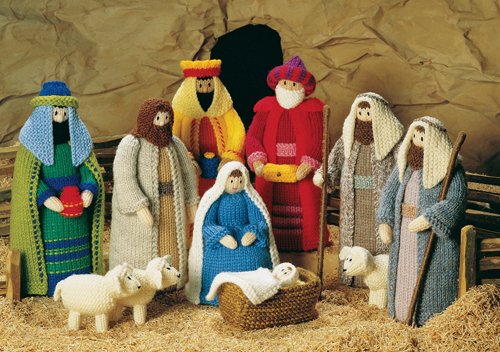
Believe you me there were no knitters in my old job(s) in the NHS – the last refuge for knitters was older ladies making action man clothing for premature baby units. No-one respectable knitted and certainly not if you had a real job. I kept my secret well hidden for years. In fact when I once lapsed and admitted to having knitted a Christmas crib, a colleague I still manage to call a friend was paralyzed with laughter at the thought of the knitted baby Jesus. What’s funny said I? Haven’t you done the diversity course?

Natty knitted nativity
However after decades I can now come out, because Fuse, and Parkside in particular, is full of academic knitters. My first inkling of this was when someone I didn’t know too well, asked me if I knew a good wool shop in Middlesbrough. These knitters knit in front of TV, on public transport, they even have to remove balls of wool to retrieve mobile phones, and they are happy to discuss patterns and stockists without batting an eyelid. 

But would they knit in meetings??? I’m not sure. I have seen people knitting before a carol service (well actually one person on one occasion) but knitting doesn’t seem to chime with the need to appear fully professionally engaged, or in the case of a carol service respectfully attentive. I personally harbour a desire to knit in conferences and seminars (following the rules, of course as I’d just get frustrated if I got stuck in the middle of a pattern) not because I’m not listening, but to do three things - to take up the spare brain power not focusing on the subject being spoken of, secondly, knitting really helps you not to go to sleep at the wrong times, and, thirdly, it ensures you don’t reach for the sweets or biscuits that still creep in when the public health police are engaged elsewhere. I challenge the reader which is worse – the gentle rhythmical clicking of needles, the embarrassment of snoring in the post-lunch presentation or someone trying to eat a hard biscuit noiselessly? The latter two are insufferable and will do much more reputational damage than being able to show off your latest scarf in the real break time as you virtuously sip water.

So, thank you Jean for helping me join the open-science blog!

Wednesday, 2 May 2012

Writer's block

Posted by Helen Wareham

Writer’s block is something I think everyone can relate to.

I had hit a point in my PhD where I really needed words down on paper. I’d neglected my introductory literature and systematic review chapters for too long and I had to do something about it. So at the end of March, refreshed after a week’s holiday, I made myself a cup of tea, cleared some space on my desk and sat down ready for the words to flow...

There were moments of sheer elation where it all seemed to be coming together and words would flow onto the screen.


Writing god
These were unfortunately followed by moments where I was sat staring at a screen for hours wanting to cry or set it all on fire in despair.

So here’s the big question: how do you get over writers block?

My partner completed her PhD last year and impressively seemed to have days where words just flowed, churning out 5,000 in a day at one point! But, I remember these days well. Entering her PhD shed (yes we had to build an outdoor office so she could work without distractions in isolation) I would be faced with empty bags of Haribo, bourbon biscuits wrappers, empty boxes of pro-plus, the odd glass which had contained a large measure of alcohol and Kirsty hunched over her laptop with a look on her face something akin to a squirrel on crack.

So whilst I was desperate, I thought it might be best to leave the avenues of excess sugar, caffeine and alcohol for my final months (I don’t want to peak too early).

"You’ve just got to get on with it Helen. Just keep going and if something helps go with it", were Kirsty’s words of wisdom.

What transpired for the last month was me working in different locations (including other peoples offices), succumbing to drinking masses of coffee, writing some despairing facebook statuses and various other little things to try and get through that mental wall.

Am I over my writers’ block? Have I found a magical fountain of inspiration? No, is the simple answer. But every day the word count went up a bit and eventually I hit the word target I’d set myself. What I’ve written isn’t amazing but I have words on a page and that’s what I need right now.

It’s seems a bit stupid to be so at the mercy of a simple brain freeze and it’s frustrating to not have any idea why and how these things happen or when they are going to pass. But I’ve come to think that the key attribute needed for success in completing a PhD is shear bull-headed unwavering persistence that you’re going to get through it. If along the way simply grasping desperately to anything that remotely helps, however silly and destructive, is what works then I’m just going to have to go with it and get on. My closing confession as to what helped the most over the last month...this picture and Britney Spears greatest hits on repeat.


Tuesday, 1 May 2012

Knitty problems

Posted by Jean Adams

My name’s Jean and I’m a knitter.

I am also a crocheter, sewer and quilter. I’ve tried my hand at upholstery and if anyone ever bought me a spinning wheel, I imagine I could get quite into that too.

I do these things because I like making stuff. I don’t always like the things I make. But I really like the process of making. Sometimes I like making things that require all my concentration and attention. Other times I’m happy just to mindlessly plod through a simple pair of socks or ripple blanket.

One of my many crochet blankets
I can totally mindlessly knit a sock and, at the same time, leave substantial brain space free for conversation, watching TV, listening to the radio, or doing the crossword. Obviously I would have to put my knitting down to fill in the crossword, but that’s not impossible. Me and my knitting aren’t absolutely inseparable, you know.

So here’s the question: would it be appropriate for me to knit in meetings?

Obviously, I’m not suggesting that I knit during a meeting that I’m chairing, taking notes for, or being asked to make some other types of substantial contribution to. But those sorts of meetings make up only about half of the things I go to.

Think of all those meetings which you just have to go to, but you learn almost nothing and almost contribute nothing. Knitting in these feels like a sensible option – at least I’ve used the time efficiently. Unlike the next best alternative of playing on my phone, at least when I’m knitting I can also listen, keep track of what’s going on, and contribute if I need to.

Then there are the things like seminars where I often learn something really interesting or useful, but again I don’t really need to contribute anything. Surely it would be okay to knit in those too?

It’s not like there aren’t other people who do crafty things in meetings – with very productive results. There are even other academics who knit in meetings in a very public way. And rules for how to do it right.

Sounds like I’ve almost talked myself into it, doesn’t it?

But the problem is, I’m worried about what other people would think. I guess there might be all sorts of responses to meeting knitting, but the one I’m most worried about is that people might think it’s unprofessional. Somehow playing on your phone can indicate that you’re a very busy person with important other stuff to be doing. Which just reinforces how very professional you are. Whilst knitting indicates that if you weren’t here you might be baking fairy cakes. Which is not what us serious academics should be doing at all.