Monday, 17 September 2012

This is what evidence is made of

Posted by Jean Adams

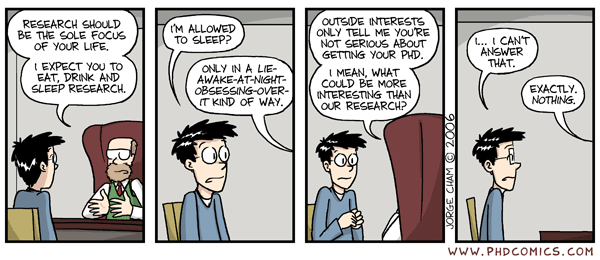
I recently re-joined the systematic review club. I did a systematic review once. It was fine. I learnt how to do it, I did it, I published it. It was a good learning experience. Certainly good enough to learn that I didn’t need to do another one in a hurry. Or at least I didn’t need to do the nitty-gritty reviewing myself. But things happen and before you know it you’re second reviewer on a systematic review that you just can’t pass on to anyone else.
I love a good (and sometimes not so good) radio drama
There are some jobs that were designed to be Friday afternoon jobs. Jobs that clearly need to be done, but that you don’t need to think too hard about. Jobs that you can do whilst catching up on BBC Radio 4 drama serials on the iPlayer. Reformatting the tables in your latest rejected manuscript to meet the exact, esoteric, requirements for the next journal in your list. Adding references from Endnote into Word.

I love a little pile of Friday afternoon jobs. As they don’t require much brain input, I find them easy to churn through and they make me feel unusually productive. Productive, unthinking, with added radio stories. Just what I need to end the week.

In contrast, other jobs are very clearly Tuesday morning jobs. Jobs that need sustained, un-interrupted thought. Jobs where even Radio 3 is intrusive. Drafting the justification section of grant applications. Deciding what exactly is the key message in your latest paper. Working out the analysis plan for the 3MB of data you’ve just received.

I don’t mind Tuesday morning jobs. If I have the time, the space, the right environment and am making progress, I really like the satisfaction of biting off big chunks of Tuesday morning jobs. In fact, high quality Tuesday mornings jobs are what keep me in the job.

I know some people don’t mind systematic reviewing. I know some people even positively enjoy systematic reviewing. These are wonderful people. We need systematic reviews and we need systematic reviewers. I am pleased to count systematic reviewers among my friends. But, really, I am not a systematic reviewer. I’m always happy to come up with the idea and justification for a systematic review on a quiet Tuesday morning. But the real-life screening and data extraction, bread and butter of systematic reviewing are not my bag at all.

The problem, I have decided, with systematic reviewing, is that it is neither a Friday afternoon job, nor a Tuesday morning job. You need to concentrate to decide if the paper you’re reading meets all of the inclusion criteria you’ve set. You can’t possibly listen to radio stories whilst you’re systematic reviewing. But you don’t really have to come up with any great new ideas. The ideas happened way back on a Tuesday morning in November when you drafted the protocol.

I procrastinate outrageously when I am systematic reviewing. I check Twitter. I make a cup of tea. I decide I’m procrastinating too much and that I must not do anything but review until I have reviewed 10 more papers. I wonder what’s happening in the tennis and convince myself that I’ll review much better if I just check the scores and get it out of my system. I think of blog posts I could write.

But, as I am slogging my way through and slowly passing papers from the ‘to screen’ to the ‘screened’ pile, I try and remember that it is systematic reviews that we hope might guide decisions; that this pain is what evidence is made of.

Thursday, 13 September 2012

On evidence

Posted by Simon Howard

In my first week at medical school, one of the professors warned that most of what we were to be taught was factually wrong. It was an arresting statement, but it may have been true: Studies have shown that textbooks and experts frequently lag behind evidence, sometimes recommending “treatments” that are actually known to be harmful.

Do Primary Care Trusts do the same? PCTs, like the one I work in, currently commission the majority of NHS services provided to patients in their catchment areas (though not for much longer). Sometimes, academics get frustrated with PCTs for seemingly doing things that either have little evidence, or appear to contradict it altogether. Given that evidence is the bedrock of public health, and given the potential for decisions to affect whole populations, this might seem worrying.


In defence of PCTs, a lot of evidence based work does happen. Most major pieces of work include a review of academic literature at an early stage, and follow the findings. The annual Joint Strategic Needs Assessment and regular detailed Health Needs Assessments also take into account published literature and local and national data in a fairly systematic way.

But there are lots of barriers to following the evidence. Books and books could be written on this topic, from the applicability of evidence in the real-world to deciding if research is really relevant to a particular population. But I’m no expert, and I’m not going to try and describe anything technical, complicated, or even remotely clever. These are just a few examples of practical barriers to following the letter of the academic evidence in public health.

One huge barrier is – as with most things in life – money. In a world of ever-tightening budgets, an academic’s seemingly reasonable intervention can be unaffordable. As an extreme example, research by the FAA and CAA suggests that three or four lives would be saved in an average aircraft fire if all passengers were provided with smoke hoods. However, the vanishing rarity of in-flight fires, the enormous cost of supplying and maintaining smoke hoods, and the cost of the fuel required to propel them around the world, all make this proposal financially unjustifiable.

Not all examples are quite so clear-cut. Sometimes, instead of choosing not to do something, PCTs try to cherry-pick the best bits of interventions in a way that is almost certainly infuriating to the academics who pioneered them, and possibly less effective in practice. But, sometimes, doing something is better than doing nothing.

Often, there can be a big lag between publication of evidence and its implementation. One reason is the complex contractual nature of commissioning: it’s often difficult to make small changes to services that have already been commissioned. The constant pressure to reduce costs incentivises longer contracts which spread the financial risk, but which also increase the evidence-practice lag. I’m sure it’s deeply frustrating to be an academic shouting “there’s a better way to do this” while services continue unchanged.

There’s also a political element to public health. Decisions to cut services that are no longer supported by evidence are particularly tricky. In England and Northern Ireland, the evidence that cervical screening in women under the age of 25 causes more harm than good has led to a withdrawal of the service in this age group. The clear evidence, combined with clear recommendations from the World Health Organisation and National Screening Committee hasn’t stopped this becoming a topic for political debate and petition, and hasn’t (yet) changed policy in Wales or Scotland. It seems likely that this political element will play a bigger part in decision making as public health moves to the overtly politicised world of local authorities.

To me personally, the most frustrating barrier to following the evidence is an inability to access it. It continues to baffle me that the NHS doesn’t have anything like the level of straightforward desktop access to literature that university colleagues have. In the 21st century, it seems crazy that I sometimes have to ask the BMA to take a paper journal off a physical shelf, scan it in, and email it to me as the only practical cost-effective way to access a paper that’s of general interest, rather than something specific to any individual project.

I think a latent awareness of what’s going on in academia is important in public health. It might not matter so much when someone’s doing a big literature review prior to introducing a new service, but it can help with horizon-scanning, and with those little every day decisions that aren’t worthy of a trawl though the literature, and with planning for the future. This is something we can all play a part in: public health professionals probably need to broaden their awareness of the academic things going on around them, and academics probably need to shout louder about the latest developments in their fields. As an associate member, I’m probably biased, but I think FUSE is great at helping both groups.

Wednesday, 12 September 2012

Research, personal information, information governance etc.

Posted by Rose Watson

So, we all know about the Data Protection Act.

We all know that if we want personal information about people (e.g. research participants) then we have to get ethical approval to obtain that information and that this  requires us to state how and where that information will be stored; who will have access to it; and what we will do with it. We have to promise to keep it confidential. We also have to inform our participants of the same details. This is particularly true if we require access to NHS patients or staff for our research. 

Firstly a favourable ethical opinion must be sought and there is a national system for this: the Integrated Research Application System. Secondly, each NHS Trust who will be involved in the research must validate something called a Research Passport, another national system (invented by Mr Bureaucracy, as written about by Bronia Arnott a short while ago). It basically boils down to this – if you are employed by a Higher Education Institute (HEI) you fill in some forms about yourself, you get a criminal records bureau (CRB) check to check that it is OK for you to work with children and/or vulnerable adults and you undertake an occupational health assessment. This is all signed off by the HEI human resources department and then sent off to the lead NHS Trust Research and Development Department to be validated. 

This protection of people is all good. I hope my personal details held by others are well guarded too. Nobody wants to think that the people and organisations we have trusted with our personal details will just go around giving them to anyone willy nilly.

However, as researchers, we are expected to hand out our personal details on a regular basis, often in duplicate, without any information given to us about how it will be stored, who will have access, what it will be used for (although, it is implied that it will only be used to check you are suitable to work with children and/or vulnerable adults). This is all fine, I expect to give a certain amount of information about myself, I understand the need to safeguard people (and of course to not bring research into disrepute). 

It does worry me though. These are my personal details after all. Of course there are the issues with the system not being entirely followed and NHS Trusts obviously feel the need to cover their backs in case anything should go wrong, hence all of the duplication. Risk averse society and all that jazz. 


However, in the spirit of being risk averse, I would ask that my personal details are also treated carefully. With the same due respect I give to my research participants’ personal details. Unfortunately my details have now twice been lost in the post in this system. I would ask that people let me know why they are collecting information (especially details which are extra to the national Research Passport system); where they will store it (and please, a bit more information than ‘electronically’: what on earth does that mean?); and who will have access to it. These are simply the same questions that researchers must answer (and rightly so) when they ask people for personal details.

In short, it is perhaps time we were all a bit more conscious of the personal details that people are collecting about us as researchers. Do they really need ALL of that information? Why? What about how it is transported?

Monday, 10 September 2012

Rules for the perfect supervisor

Posted by Lynne Forrest

We’ve previously had two blog posts explaining what makes a perfect research student. It was hard to disagree with any of it really, but, it’s a two-way relationship and in the interests of fairness, we students now get to respond and say what we require in the perfect supervisor.

Disclaimer: these traits are desirable in a generic ideal supervisor and any resemblance to any actual Fuse/IHS supervisor should not be implied. The views and experiences reported here reflect a consensus of opinion derived from the student body and are not necessarily mine (I’d really like a reference and a job at the end of my PhD…)

So, assuming that we’ve now all become the perfect research student, what can be done to further improve the research experience? Although comments ranged from ‘my supervisors are brilliant’ to ‘my supervisors constantly have me in tears!’ some common themes did emerge.

These are the things we think you should do to become the perfect supervisor:

1. Set ground rules at the first supervision meeting so that everyone knows what is expected of them.

2. Don’t spread yourself too thinly. Although having a ‘big name’ supervisor can be useful to students in terms of being able to utilise your experience, knowledge and connections, if you are always too busy to deal with us then this is somewhat negated. Possibly appoint a more junior colleague as the main supervisor.

3. Prepare for meetings and actually read the documents that the student sends you. If we follow the rules and send a document well in advance but you still don’t read it then this is a hugely frustrating issue. There is a power imbalance in the PhD/supervisor relationship that needs to be acknowledged, but not exploited. If we keep to our side of the agreement, then please can you do the same?

4. Be supportive, approachable and understanding.

5. Be constructive and remind the student that your comments shouldn’t be taken personally.
Criticism is fine as long as it is directed at the work rather than the person. A supervisory meeting is not an episode of ‘The Sweeney’ and you need never adopt the ‘bad cop’ role…(unless, of course, this has been agreed in 1.)

6. Promote a healthy work/life balance. 

Promote a healthy work/life balance

7. Forward any opportunities that you think might be relevant to the student. Please don’t just assume that we’ll know what is possible. For example, it was suggested that students should offer to supervise an undergraduate dissertation but I don’t think anyone knew that was even an option for PhDs. It’s hard to be proactive with things you know nothing about. Similarly with teaching opportunities.

8. Deal with each student as an individual. As one student eloquently put it ‘we’re like unique little snowflakes’! A one-size-fits-all approach just doesn’t work here. A mature student may need different handling to a younger one. However, on saying that you also need to…

9. Ensure equality of opportunities. Make sure that ALL students know what is available.

10. If you are not the main supervisor you still need to turn up for meetings occasionally. It’s very embarrassing when a student says hello to you in passing and you have no idea who they are. If you really aren’t interested in doing it then please hand the role to someone else.

11. Give lots of clear feedback. And if possible always try to end a supervisory meeting on a positive note. If your student constantly exits in tears then something has gone very wrong somewhere…

12. Sort out any supervisory disagreements outside the meeting. And don’t talk about other stuff over your student’s head. We only get an hour a month so let’s talk about us and our lovely project…

And I could go on and on….there was lots more! Do you agree? Please feel free to comment.

Thursday, 6 September 2012

The value of being an imperfect research student

Posted by Heather Yoeli

In their posts of July 23 and 30, White and Adams provide a rigorously evidence-based summary of how to be the excellent research student. I found it a beautiful, if slightly disconcerting, read: carefully structured, convincingly argued, mindful of its chances of being published in the BMJ and (I assume) flawlessly citation-managed and submitted conveniently in advance of its deadline. In their two-part analysis, however, White and Adams neglect either to verify or to justify the imperative of their paradigmatic implication. Or, in less pretentious-sounding academic twaddle... they don’t really tell us what’s so brilliant about being the perfect research student.

And therefore, I would like to respond by proposing that the archetypal Perfect Research Student may not be doing any favours to him or herself or to his or her participants.

To begin with, I will critically evaluate the semiotics of the use made of their Lisa Simpson image. Lisa, as all fans of The Simpsons will know, is a perfect student; bright, attentive and thorough. Her brother Bart is, by contrast, somewhat imperfect; whilst no less intelligent and creative than his sister, he has a tendency to be impetuous, slapdash and prone to sending his supervisors things he is still working on.* And yet, outside of the classroom sphere, it is Bart rather than Lisa who displays the more competent social skills and interpersonal confidence; he has a relaxed, confident and slightly zany manner of engaging and communicating with others. He would make an excellent ethnographer or qualitative interviewer. Lisa, by contrast, has spent too much time at too tender an age seated with her laptop precariously balanced upon a pile of textbooks to know how to talk to anyone other than her laptop. 

And moving The Simpsons to the personal, I have learned through my ethnographically qualitative fieldwork that participants often respond more readily to imperfect than to perfect researchers. Ethnography is about regarding participants as real people, and about building relationships with real people, and real people are inherently imperfect.** I have been carrying out fieldwork on the Cowgate estate in Newcastle (glances distractedly up from laptop to wave to everyone she’s been chatting to) which is a community in which most thirty-something women possess more useful aspirations than to join the hierarchy of public health academia, and therefore a community which regards with confusion and cynicism the archetypal Perfect Research Student.*** I have therefore learned that participants find it easier to relate to me when I am imperfect; when, for example, I arrive at a meeting with half a bowl of my daughter’s porridge (or even half a tummy-full of my son’s puke) adhered to my leggings, or when I get halfway home with a participant’s gloves in my bag. Whereas most of my participants have had no personal experience of sitting in a postgraduate supervision session, many of them have experienced a stroppy toddler refusing her breakfast or a cheerfully regurgitant baby projecting his breakfast back towards the floor, and all of them will have done something as brainless and daft as walking off with someone else’s gloves because all people everywhere have done something similarly brainless and daft. 
 
Imperfection, therefore, is what connects us to our humanity. And our humanity as researchers is what connects us to other people. And being connected to others is a vital component of all qualitative research.


*Admittedly, the last bit isn’t true. It’s merely what I do on an almost monthly basis, and White and Adams tell me I shouldn’t.
**All of the clauses in this sentence should have been evidenced and referenced. I have neglected to do so merely to exemplify my own imperfection.
***Again, this statement should have been verified. It isn’t. As Bart Simpson might say, don’t have a cow about it, dude.

Wednesday, 5 September 2012

Good CoP, bad CoP

Posted by Janet Shucksmith and colleagues

A few dogged staff members in Fuse had been talking for a while about the need to share experience of Knowledge Exchange (KE) in public health across the UKCRC Centres of Excellence. “After all we are the Centre for Translational Research in Public Health” they would say.

And so with all the Centres descending on Durham for conference and summer school fun this was an opportunity not to miss.

We were going to attempt to form a super-group, well not quite, more what is known as a Community of Practice (CoP); inviting anyone (not drawn away by one of the other workshops) with an interest in KE.


Communities of practice are groups of people who share a concern or a passion for something they do and learn how to do it better as they interact regularly.
Excitement grew. What could we share? What could we learn from one another? These questions were newly critical with the second phase renewal bids for centre funding being drafted. Here was the chance to see what crept out of the woodwork when the invitation was issued.

A dozen or so good souls heeded the call. Introductions first, and the meeting immediately assumed the air of an Alcoholics Anonymous gathering..."I'm Stephanie and I am a health statistician.."..this in a very apologetic tone. Never mind, Stephanie. We can see past this failing and will be able to glimpse your inner beauty. The group thus reassured, it turned out that several participants were similarly (dis)abled. What was going on? Was this some crazy research version of the Mystery Shopper schtick? Anyway, it looked like there were enough fuzzy qualitative people to make the group viable, so on we sailed.

CoPs come in all shapes and forms but have the same essential characteristics. They bring together like-minded individuals keen to share thoughts and ideas on a specified theme, often to share resources, news and updates, as well as to argue and reason together to learn more about the chosen theme. So you can have a CoP on almost anything. Try Google if you don't believe us. Best of all the community of practice acronym opens up a whole new range of possibilities. Taxocop is, disappointingly, not a virtual community dedicated to improving the ability of its members to swindle the Inland Revenue, but rather a group of people who like putting things in taxonomies. Hmmm, I think I know where I'd put them in my taxonomy of strange colleagues…

Discussion swirled around, producing some new vocabulary for a few of us...'hive thinking' and 'hackathons' as a way of brainstorming practical problems in the field of computer software (not just for the geeks then).

We emerged with an agreement to continue and develop the CoP. First steps after a note of the meeting involved setting up a virtual community. Kevin Balanda from the Northern Ireland group volunteered. ‘We need to talk about Kevin’* was the comment on the following Monday morning after the first attempt at this went somewhat awry, but we quickly recovered and are now locked into the Health Well website and starting to explore how to use it. We will meet in the too, too solid flesh at least once a year at Centres of Excellence conferences, and may meet for events in between when we have specific issues to ‘hack’ over. It has in the first instance set us off exploring the importance of policy and practice partners being able to access the sorts of journal and report resources in which public health evidence is embedded ... Watch this space!

If you are interested in joining the Community of Practice please contact Kevin.Balanda@publichealth.ie 

*It is thanks to the hard work of Kevin that we now have a forum for discussion

Monday, 3 September 2012

Achieving impact

Posted by Jean Adams 

There are two things that research is judged on in the UK at the moment – the quality of ’outputs’, which means journal papers in my neck of the woods; and ‘impact’. The official definition of impact is “any social, economic or cultural impact or benefit beyond academia”. In public health, the sorts of things that might count are a change in local or national policy or practice that followed from your research findings. 

It all sounds so sensible, doesn’t it? Of course we should specifically value research that has a positive impact on the everyday lives of the people who, by and large, pay for it through their taxes. Aside from the obvious implication that just to know something we didn’t know before is somehow a less valuable than ‘impact’, my experience is that achieving impact is a serendipitous thing. Something that seems to be as reliant on being in the right place at the right time, as on doing high quality research. 

Research impact
I spent two hours last month defending a piece of work that we published earlier this year. It was some of the most intensive questioning I’ve experienced on my research. A bit like my PhD viva, but without the suit and focusing on just one 3,000 word paper, rather than three full years of work and a 50,000 word thesis.

The paper was about TV food advertising to children. It had come to the attention of Ofcom. Our findings were at odds with one of Ofcom’s own reports and so they were keen to discuss differences between our respective methodologies and how we might reconcile our conflicting findings.

It was an interesting experience and the people from Ofcom had obviously done their homework – they’d read our paper in great depth and wanted to talk through every sentence, and every cell of every table. As I say, it was a pretty intense couple of hours. I think we came out okay – sure our research had some limitations, but so does all research – compromises have to be made. But that doesn’t mean we don’t stand by our findings. They were kind enough to leave off pointing out how rude we’d been about their research until the last 10 minutes or so.

As the meeting was winding up, I took the chance to ask: “so what happens next?” Because when you get a chance to speak with people who work for national policy organisations, you kind of think you should take the opportunity to try and somehow make a contribution; to achieve impact.

My polite enquiry was met with a shrug and: “well, this is not something that’s on the policy agenda at the moment.”

Our research findings reflect the final recommendations of NICE public health guidance on prevention of cardiovascular disease, as well as the position of the British Heart Foundation, the World Cancer Research Fund, and the Scottish Public Health Minister. But it’s not on the policy agenda.

And that, I fear, may be that. We did some work that certainly could achieve impact. We even got the chance to speak to some people who might have been able to help us enact that impact. But it’s not on the policy agenda.

Serious question: what else can we do to achieve impact?

Wednesday, 1 August 2012

Holidays

The Fuse open science blog left for its summer holidays at early o'clock on the 1st of August. The plan is to fly to Delhi with a rucksack, some rupees and a sense of adventure and take it from there. Last year it had a blast in Ibiza. But, you know, you've got to grow up some time. Gastroenteritis permitting, the blog will be back, refreshed and raring to go, on the 3rd of September 2012.

To be the first to hear about new posts in the autumn, follow @fuse_online or @jeanmadams.

Just because the blog is on holiday, doesn't mean you should be too. The blog always needs your posts. Please continue to send them to j.m.adams@ncl.ac.uk or m.welford@tees.ac.uk and they will be published just as soon as the blog is back in the office.

Monday, 30 July 2012

How to be the perfect research student, part 2: content matters

Posted by Martin White and Jean Adams
In our first post on what research students can do to make their, and their supervisor’s, lives easier we focused on process. In this second, and final, instalment we address the product(s) of your endeavours.

1. Pay attention to grammar and style. Well written documents are easier to read and increase the reader’s confidence in your abilities. Grammar and style are not just window dressing; they are an essential part of good communication. You may find the BMJ’s house style guide useful.
Pay attention to grammar and style
2. Use sub-headings. They help you structure your text and keep related pieces of information together. They also help the reader understand where your argument is leading.

3. Be critical in your literature review. Try to go beyond just describing the literature, to critically interpreting it. This doesn’t necessarily mean providing a detailed critique of every paper you read. It means identifying the major knowledge gaps in the literature, identifying common methodological limitations, identifying limitations of existing theories, and suggesting reasons for all of these things. This requires you to think for yourself and put your own, personal stamp on your interpretation of the reading you’ve done.

4. Frame research questions, not aims and objectives. Try to state clearly the scientific rationale for your research, identifying the gaps in knowledge that you aim to fill, and then specify the question that needs to be answered to fill each gap. In public health, research questions tend to be preferred to null and alternative hypotheses.

5. Separate your methods, results and discussion. Methods say what you did. Write them like a recipe book, which others can follow. Reference established techniques. Don’t muse about which methods might have been better (reserve that for the discussion). Results say what you found. Don’t repeat what is in tables, figures or boxes in the text. Don’t veer off into discussion of the results. The discussion interprets your findings, sets them in the context of existing knowledge and discusses their strengths, limitations and implications.

6. Don’t confuse association with causation. Finding a statistically significant association between two variables does not necessarily mean that one causes the other. Be careful when you are writing not to imply causation unless you have good evidence of it.

7. Structure your discussion. Many people find the discussion the hardest section of their thesis, dissertation or paper to write. One way of easing the pain is to use the sub-headings suggested by Docherty and Smith (1999).

8. Don’t repeat yourself. Repetition is boring, insults the reader by assuming they didn’t read it the first time you said it, and is a waste of words. Read and reread your drafts to eliminate repetition.

9. Proof read. Once you have a first draft that includes the key points you need to cover, re-read and revise to hone your message. Consider each sentence individuallly and ask yourself if there is a clearer way to convey the idea. Think particularly about if you could use fewer words and less jargon.

10. Try to write your thesis with publication(s) in mind. In a PhD you can nest each distinct piece of work in a separate chapter, each of which will lead to a paper. If you structure these chapters like a paper, then your publishing challenge is made easier. For an MSc or undergraduate research project, try to structure your whole dissertation like a paper if appropriate.

Thursday, 26 July 2012

This post would have been about bureaucracy, but it got caught up in red tape

Posted by Bronia Arnott

When your research is funded it is such a great feeling. You have spent hours toiling over your budget spreadsheet, having it rejected by the Institute finance officer, reclassifying your directly incurred and indirectly incurred costs. You have carefully crafted your theoretical argument and honed your methodological choices. You have even agreed to do another systematic review. And all that hard work has paid off; your research grant has been funded. Now that the money is finally in your hands you can do what you wanted. Right? You clearly haven’t worked in a University before, have you? 


If you had, you would have met the Director of the Institute of Red Tape: Mr Bureaucracy*. Mr Bureaucracy doesn’t care what your research project is, how much money you got, or who it was funded by; all that he cares about are rules and regulations. Before his promotion to Direction of Red Tape, he was Head of Health & Safety. The most impressive thing on his CV to date is his design of the Research Passport System.

I wouldn’t mind but I’m not asking to go out and buy a designer handbag with the money, I’m not asking to inflict torture on participants, I’m not even suggesting that my colleagues and I go on a round the world cruise; I’m asking to do what I said I would do and what I was funded to do. If I carefully researched the cost of an iPhone, made sure I put it into the right costings column on my grant application, and then the funding body agreed that we needed it so that we could develop a smartphone app to investigate mHealth then please, PLEASE, don’t tell me that a Nokia is just as good AND significantly cheaper.

Thankfully, all of the staff within my research institute who deal with finance and research governance are absolute stars and are not like Mr Bureaucracy at all. But if you do come across him please let me know; I need to speak to him about an iPhone.

*This character is entirely fictional, and any resemblance to any individual dead or alive is coincidental.

Wednesday, 25 July 2012

Working effectively with patients and public in research

Posted by Dorothy Newbury-Birch

I’m chair of the Engagement Strategy Group in my research institute. I’m not sure, like most things, how that came about, but I’m here and I’m on a steep learning curve. You see, like most of us, for a long time I thought that patient and public involvement meant that we should have a couple of lay people on our steering groups. And I was wrong, so wrong. It is so much more than that and if done properly can make your research much better in so many ways. I can only talk for myself but I’ve really started thinking about this differently, in particular, in relation to one of the trials I am the Principal Investigator (PI) for.
How not to do patient and public involvement in research
SIPS JR-HIGH is a pilot feasibility trial of alcohol screening and brief interventions in schools with 14-15 year olds. On the program management group we have a representative from the education department at the local council. He has expertise in alcohol and drug education in schools and we’ve met with him a number of times both at the project management group and separately to discuss the intricacies of the work. He’s a co-PI on the project and his input was invaluable to its success in being funded. He was also our link to getting the schools on board.

We have the Young Mayor (yes, North Tyneside has a Young Cabinet) on our Trial Steering Group, who we have met and spoken to a number of times. The Young Cabinet also looked over all our paperwork prior to submitting our application for university ethics approval. We also have a young person and their mum on the steering group. They were interested in the research, trialled our intervention and gave us valuable feedback. We've been to a couple of the schools a few times to trial the questionnaires and to ask them what they think of the information leaflets we’re using.

So what are my tips from my new found knowledge? Firstly, don’t just expect people to rock up to a meeting after sending them piles of paperwork and expect them to engage. Meet with them prior to the meeting; explain what is going to happen at the meeting. Talk through some of the issues and the paperwork and get their views. Explain to them that their input is important. Check to see if they need any help in coming to the meeting i.e car parking or childcare. Make sure you have spoken to them about financial reimbursement for their time. A great resource is available from INVOLVE which can help.

Secondly, have someone in the group meet with the person a few minutes before a meeting and have a coffee and introduce people as they turn up for the meeting. Have this person sit next to the lay member and explain things if necessary and encourage them to have their say if they want to. Don’t rush them away after the meeting; ask them what they thought and if they have any questions. Make arrangements to give them a call in a couple of weeks to chat through things if necessary. Work at their pace, don’t assume they can or can’t do things.

If you take these things on board, your research, I promise you, will be better and more fulfilling for yourself and the people we are doing the research with and for.

Monday, 23 July 2012

How to be the perfect research student, part 1: process matters

Posted by Jean Adams & Martin White

Being a research student isn’t always easy. But nor is supervising research students. We have spent many unproductive hours ranting about the things that research students should, but don’t always, do to make their, and our, lives easier. Here they are in one easy list (in two parts…).

1. Prepare for meetings. Send an agenda of things you would like to cover in advance of supervisory meetings. Ask your supervisors if there are items they wish to cover too. If you don’t have anything you need to discuss, ask if the meeting should be cancelled. But remember, sometimes it’s good to touch base even if there's nothing specific to discuss.

Lisa Simpson: the perfect student?
2. Send documents in good time. If you've written something that you would like to discuss during a meeting, send it in advance – it’s hard to discuss your work without having had time to read, think about and comment on it. If possible, agree in advance when you will send documents so that reading can be timetabled into busy schedules.

3. Don’t send things you’re still working on. When you send documents for comment it should be on the understanding that you’ve done your best with them. They might not be the finished article and part of a supervisor’s job is to offer advice on how your best effort can be made better. If you ask for comments on something that you are still actively working on, chances are you will just get suggestions for things you were planning to do anyway – a waste of everyone’s time. An exception to this is getting comments on outlines, which can be useful to check you are on the right track.

4. Negotiate realistic deadlines. One way to avoid sending things that you are still working on is to be sensible when negotiating interim deadlines. If you find that you’re nearing the deadline but are not going to be finished in time, request an extension.

5. Say if your supervisor has got it wrong. Everyone makes mistakes – in designing studies, understanding the literature, interpreting data, and lots of other things. One of the joys of supervising is the new insights that students bring.

6. Use a citation manager (e.g. Endnote, Zotero, Mendeley). These help you store details on things you have read and automatically insert citations into your text. Some are free, others available via your university. On-line tutorials are available for whatever programme you choose.

7. Learn to use your software. A little pain getting to know your software will almost always pay off in the long run. As well as learning how to use your citation manager optimally, you should also learn how to get the best out of your word processor (in particular, the formatting options) and your data management package.

8. If you’re a PhD student, offer to supervise an undergraduate research project. This will help you to appreciate the art of good supervision and the frustrations of a student who fails to do any of the above!

9. Be proactive about the possibility of publication. Lots of our undergraduate, masters and PhD students have published papers based on the work they did with us. The main point of most student projects is to achieve the relevant educational objectives, but many are also worth publishing. This lets you share your findings with the world and gives you something extra to put on your CV. And who doesn't get a buzz out of seeing their name in print?

Thursday, 19 July 2012

Seeing is believing: exploring qualitative methods beyond text and talk

Posted by Shelina Visram (with Ann Crossland)

In the run up to the recent UKCRC Public Health Research Centres of Excellence meeting, I received an email asking for volunteers to help organise and deliver workshops. One of the suggested topics – ‘The use of novel qualitative methods in evaluation research’ – immediately caught my eye. I’ve been involved in a number of evaluations and most have relied on qualitative methods. So I put myself forward and was glad to hear Professor Ann Crosland had volunteered too. We decided Ann should do the bits on using commonplace methods in novel ways and I’d do the bits on visual methods. Then we went our separate ways to work on the content.

That’s when I stopped and thought: how much do I really know about visual methods? Yes, I’ve used them in a number of projects but I’m certainly no expert. I wondered who would attend this workshop. Would they be expecting to explore the philosophy of creative methods? Should I be using words like epistemology and ontology? Or could I get away with showing cute pictures drawn by small children? I decided the most sensible approach would be to hedge my bets and do a bit of both (without getting bogged down by philosophy).

Picture drawn by a 7-year-old when asked “What things affect your health?” during the evaluation of a weight management programme 
Here comes the science… Qualitative research relies heavily on the things people write or say. If you’re a positivist, you might ask how we know whether this information is ‘true’, i.e. does it accurately reflect the ‘real world’? We interpretivists tend not to worry about those things and instead accept the existence of multiple realities and therefore multiple versions of the ‘truth’. However, we still assume that what people write or say is a reliable account of their truth. Yet we know that people have different capacities and motives for sharing information. During interviews or focus groups, participants are telling particular stories in a particular social context. To what extent can we use these stories to draw interpretations about their lives outside of that context?*

This is part of the rationale for using visual methods. We acknowledge that the information people provide verbally or in writing is only ever partial and cannot be taken at face value. Visual methods give us an alternative means to examine their beliefs, attitudes, experiences and ideas about themselves. These methods are particularly useful in exploring the routine of daily life that tends to go unnoticed. For example, how many of us could describe our journey to work in any great detail? Yet if we were asked to draw, map, photograph or film our travels, we would undoubtedly provide a far richer picture of the same journey. Other examples of creative methods include spider diagrams, clay modelling, body mapping, and something called Lego Serious Play which I am desperate to try (but maybe with Fuzzy Felts – remember them?).

Advantages of using visual methods include the fact that they are interactive, encourage free expression, and often generate unexpected findings. They are also inclusive, in that they don’t require participants to be especially articulate in speaking or writing in English. I’ve used drawing in a project involving children from 4-years-old and this helped to give them a ‘voice’ in evaluating a service. Challenges include the potential to generate vast amounts of data that can be difficult to interpret, although visual methods are generally used alongside interviews and focus groups. This helps to engage participants in the process of interpretation. There are also ethical issues to consider; for example, consent is required if others appear in photos or videos.

It can take a lot of time, energy and resources to use creative methods in any research or evaluation activity. But I would argue that they represent one way of overcoming some of the criticisms about the validity and anecdotal nature of qualitative research. And they’re fun too.


*For an in-depth discussion of this argument, read this book.

Wednesday, 18 July 2012

From middle-class to world-class

Posted by Peter Tennant

I enjoy watching tennis, use words like 'loo' and 'supper', and open my Christmas presents after lunch. In the UK, this makes me firmly middle-class. But much as I might protest (usually by wittering about my 'deprived' schooling), I know it's the truth. Why else would I feel so at home in academic research, a profession dominated by the middle classes?

Strawberries and cream at Wimbledon
On the plus side, this makes for some delicious bring-and-share lunches, what with all the Marks & Spencer nibbles, and home-made cakes (made, of course, with organic locally-sourced ingredients). But much as I enjoy free-range cupcakes, is it good for research, especially in a subject called 'public' health?

Former British Prime Minister Tony Blair might have once declared that 'we're all middle class now', but the gap between the UK's rich and poor is arguably wider than any time since the Second World War. And where there are income differences, there are also differences in health status and health-behaviour. Which has left me wondering, are a largely middle-class community best placed to understand and empathise with the UK's most deprived, so often the 'public' we are trying to target in 'public health'?

Don't get me wrong - I'm not saying that great work isn't being done by great people. And I'm not saying any researcher is actively biased. Anyone who's ever met a Scientist will agree; we are generally quite objective. After years of being drilled to act like a robot, some of us have even converted to running on petrol and oil, rather than continuing to rely on the inefficiency of food and water.* But even the most robotic researcher will find it harder to accept something, or even think to ask about something, that doesn't fit with their own experiences or world-view.

ERROR! ERROR! DOES NOT COMPUTE

Could this narrow demographic also (partly) explain why researchers find certain groups so hard to recruit? Or, to put it more bluntly, are UK public health researchers sometimes talking a different language? As an unhealthy person working in an Institute with the word ‘health’ in its name, I know how patronising it can feel:

“Post-exercise endorphins you say? I’m afraid all I get is wheezing, cramp, and a sensation of impending death”

I doubt it’s a coincidence that successful commercial organisations like Weight Watchers employ members of the local community, who have previously lost weight and maintained a healthy weight thereafter, to run their meetings. In other words, people who speak the same language. Could you imagine the same meetings being run by an average public health researcher?

1) LOADING WEIGHT LOSS PROGRAMME LESSON 001
2) INSTRUCT AUDIENCE TO “DO 30 MINUTES OF MVPA**”.
3) LESSON END


OK. Slight over-exaggeration. In fact, the best public-health interventions draw on detailed qualitative research (i.e. where brave researchers have ventured outside the ivory tower to speak to real members of the public) to ensure it addresses the needs and barriers of the target population. But I still think a bit more demographic diversity wouldn’t do the profession any harm.


*This sentence may contain factual errors
**MVPA, by the way, is public health research speak for 'Moderate or Vigorous Physical Activity'

Monday, 16 July 2012

NICE work

Posted by Linda Penn

Just being in that auspicious oak panelled room, breathing history, made me feel delightfully important, although I had done absolutely nothing to warrant the illusion. Then a nice NICE person suggested I might apply. ‘Well’, thought I, ‘no harm in applying, shy bairns etc.’ So I did. And I was eventually enrolled as a member of the NICE Programme Development Group (PDG) for: “Preventing type 2 diabetes: risk identification and interventions for individuals at high risk.” This NICE guidance was published last week, accompanied by a summary in the BMJ.

The National Institute of Health & Clinical Excellence
There is good evidence for prevention of type 2 diabetes, but evidence is not NICE guidance. Guidance may be based on evidence, but there is a huge chasm of reviews, discussion, expert testimony, drafting, comments, more reviews, debate, more comments, economics, considerations, redrafting, more redrafting, consensus and hard work; between literature and guidance. I am full of admiration for the patience and professional endeavour of the NICE team. I do not think I have ever listened so closely, or thought so carefully. ‘Do I have something to say? Is it really worth saying? Am I sure of the point and if so how can I comment in a clear, concise and constructive manner?’ The feeling that ‘This is important, it matters’ never really goes away. The guidance is published. So how did we do?

However good or otherwise, the guidance is one thing. The real importance is in implementation, but that’s a whole different story.

Thursday, 12 July 2012

From aged PhD to aged Intern

Posted by Lynne Forrest

I’ve previously blogged on why I’m doing a PhD in my forties and how I regard it as a career ‘second chance’, having not really quite got it together, career-wise, for the first 20 years of working life. As part of that spirit of positive thinking, when I started my PhD I decided I would embrace all the opportunities that came along. One of these was the chance to do a three month Internship, via my PhD funder the ESRC.

Now Internships don’t generally get a very good press, being pretty much regarded as a way for businesses to avoid paying someone a salary whilst offering ‘job experience’ that mostly consists of filing and making the tea.

However, I’d recently read that doing an internship was a good PhD career move. Also, as these were paid internships that were being offered by a range of high profile Government and charity organisations which required specific skills (of which tea-making wasn’t one), it seemed like a good idea. As a mature student, I didn’t need an internship to gain general work experience. I was looking for an opportunity to develop my skills base and gain experience in an area that wasn’t covered by my PhD.


The internship that I was interested in involved working in the Strategic Research Team at the Scottish Government conducting health research and translating the research into policy and practice. They were looking for someone with systematic reviewing experience, advanced quantitative skills and who had worked with large datasets, all of which applied to me. It seemed a perfect fit. And it was – they’ve offered it to me!

Although I’m very excited at this opportunity, the same age and status-related worries apply to doing an internship as to doing a PhD. However, for the most part, PhD students are treated similarly to staff in my department* and so I’m sure I will cope just as well as an aged Intern as I do being an aged PhD student. Unlike young interns I also have children, who are not best pleased that I will be away for 3 months. I’m hoping to negotiate flexible working hours and will be home every weekend, so I’m ignoring the emotional blackmail and guilt and am going anyway. It’s just too good an opportunity to turn down.

I think it’s going to be very interesting to be able to observe the reality of how the translation of evidence to policy actually works in a political environment and, indeed, to see how much policy is, in fact, evidence-based.

As well as the amazing career opportunity, the other positive for me is that I will be spending three months in Edinburgh, my home town. Having spent the past 15 years in Newcastle, I’ve latterly become terribly nostalgic for Scotland (getting all misty eyed over VisitScotland adverts and watching tartan and bagpipe-style programmes at New Year. I know. I need help). The reality of a few months in dreich Edinburgh over the winter may be just what I need to get over this.

Anyway, I’ll let you know how I get on….

*except that PhD students are required to ‘hot desk’. When I complained and got a proper desk it was on the understanding that I gave it up if someone ‘more important’ required it…

Wednesday, 11 July 2012

How to get the evidence message across

Guest post by Katie Cole

The mantra of “but there’s no evidence for it!” is one I’ve said or thought many times, both in my work, discussions with family and friends, or when shouting at the BBC Today programme.


But as an early-career academic, I’m increasingly aware there is a complex web of considerations when trying to translate evidence into policy, and that there are times when chanting our mantra may do more harm than good.

I recently attended a Royal College of Physicians/Alma Mata seminar on alcohol advocacy. At one point, a panel member suggested that social norms interventions to address excessive alcohol consumption on university campuses “sounded very promising” and policy-makers were considering it. I’ve looked into US research into these interventions: a national evaluation concluded that they are ineffective in reducing alcohol consumption. Whilst I could have made this point, I felt it was more complex than that. Don’t we need to test the policy in the UK drinking context to make a more robust contribution to the debate? Shouldn’t we seek to support policy-makers to integrate evaluations into pilots, or to finance full-scale trials?

Another challenge I’ve had was during a placement at a Primary Care Trust. I was involved in the Individual Funding Request process, where the PCT considers funding treatments and procedures not normally available on the NHS. I worked up a number of cases, looked at the evidence base and presented the case to a panel of clinicians and non-clinicians. In most cases, the evidence base was of poor quality: finding a case series for the exact condition and treatment in question represented a minor professional achievement. Usually, the case series found that, lo and behold, most cases improved, which often sparked disproportionate optimism that we had a justification for funding the treatment. In contrast, when I found a randomised controlled trial with only modest results, the panel were more inclined to propose not funding the treatment. Here I was challenged to explain the difference between the strength of the evidence base, and the strength of the effect size; whilst at the same time, acknowledging the difficulty of decision-making against a poor evidence base.

A final challenge has been in developing The Lancet UK Policy Matters website, which includes short summaries of the evidence underpinning a range of UK health-related policy changes. In developing the format of the summaries, we had to be very clear to authors that statements purporting the intended benefit of the policy should not be included in the ‘evidence’ sections of the summary – this was reserved for peer-reviewed research or evaluations. Our experience in guiding authors highlighted to us how meticulous we as professionals need to be in the choice of language we use when drawing on our scientific expertise.

Above all other lessons, these experiences have taught me that advocating for evidence in policy making is challenging, complicated and requires skill. It demands an understanding of the evidence itself – its strengths and limitations – but also of the policy making process. Whilst these issues can be difficult to reconcile, the above experiences have only strengthened my drive to communicate effectively with all actors in the policy making process.

Katie Cole co-founded The Lancet UK Policy Matters website with Rob Aldridge and Louise Hurst.

Monday, 9 July 2012

The joys of systematic reviewing

Posted by Dorothy Newbury-Birth

I’m often asked what my methodological expertise is. Hmmmm, expertise aye…..

Well, I love a randomised controlled trial – the more complex and difficult the better. But I have grown to love systematic reviewing aswell. As funding becomes harder to get, funders are looking more at systematic reviews and meta-analyses (and modelling) to get to grips with what research is already out there.

As with most things I fell into my first systematic review (which was actually a rapid review so not quite as difficult) on alcohol and liver disease. My role was to manage the team and I found the process fascinating. It was all about preparation and organisation.

I am the module leader on a 10 credit MSc module in Systematic Reviewing. The first thing I tell anyone who asks about how to do a systematic review is that it’s important to do get your team around you. You wouldn't do a trial without a statistician and a methodologist, so we shouldn’t do a systematic review without the necessary expertise. I’m sure I could come up with a half-decent search strategy but I know that our Information Specialists can do it much better than me. I could make a half-decent attempt at meta-analysis (I’ve been on a course you know!) but there are statisticians who can do it far better.

First thing's first: get your team together
So the first thing to do is get your team around you, and then work out what you want to know and how you’re going to do it. Write a protocol like you would for any research work. Importantly, scope the literature, find out what’s been done before. You really don’t want to get half way through and realise someone else has done the work that you are doing or, even worse, not find anything because your question is so obscure. Have regular team meetings to discuss progress. Divide the work into sections – writing the protocol; designing the search strategy; first sift of the data; second sift of the data etc. Draw a gantt chart and be realistic with it – ask other people for their advice on time frames.

Stay positive, lots of people will tell you horror stories of the process of carrying out a systematic review but that is really not the case. It’s like anything, if you go in negatively you will hate it, but if you are positive you will enjoy it.

Finally, be organised, use Endnote as your management tool and make it your friend, make it work for you.

Enjoy.

Thursday, 5 July 2012

How to improve your productivity: don’t read this blog

Posted by Jonathan Ling

One of my first office mates was Roger.

He was an older academic who had just been recruited by my department. As I helped him carry boxes of books into our room, I noticed that at the top of one of them was a book with his name on the cover. I was impressed – I was sharing my office with an author! I told him how great it must be when someone said to him: “I’ve read your book”. He agreed that it was a nice feeling, but what felt even better was when, having written a couple more books, he was able to say: “Which one?”

I’d never really thought about writing a book myself, until I was asked a couple of years ago to co-author a short textbook. It was on a topic I knew a bit about, but I’d never met the co-author who came from a university at the other end of the country. The editor suggested that the process would be reasonably straightforward and fairly speedy. As he had written several books himself I thought he obviously knew what he was talking about.

With hindsight I now realise he must be significantly more methodical in his approach to writing than I am.

I eventually finished my part of the book and it was published last year. Mostly by trial and error, I learnt a few things as I went along:

1. Have a writing routine. Take time out of every day to write. If you don’t block out a specific time each day to write (and stick to it), you won’t get anything written. It doesn’t matter when it is (I work better in the afternoons), just hang a “Do not disturb” sign on your door, or around your neck, and get going.

2. Don’t get side-tracked. See point 1. Your writing time is for writing – it’s not time for admin, catching up with emails, fitting in meetings or reading engaging and erudite blogs.

3. Seek feedback from your target audience. Unless it’s your diary, everything you write is for an audience. Think about who the audience is, and make sure they get a look at it. For a textbook, this was undergraduate students and other lecturers. For a journal article, most likely it would be fellow academics, as well as practitioners or policy makers.

Egg timer, by Martin Lopatka

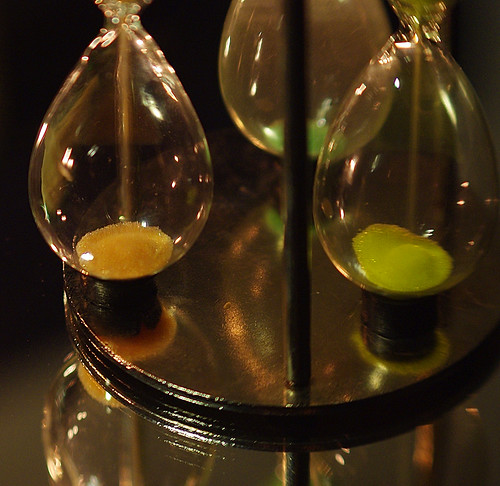
4. When all else fails, get an egg timer. There were some parts of the book where I really struggled – topics I was unfamiliar with, that required lots of reading and which I wasn’t particularly interested in. But I just had to grind these sections out. In one of my more (possibly only) fruitful side-tracks, (see point 2), I came across the Pomodoro technique. In essence, this is just working on your chosen task for 20 minutes (no email, no looking out of the window – just work!) and then having a 5 minute break before another 20 minute session. Try it sometime – it did the trick for me.

Eventually, with the help and support of my co-author, editor and publishers, the book was finished, proofread and published. It is nice to have a book on the shelf with my name down the spine. But it was a huge amount of work, on something that’s not REF-able. So it’s not something I can see myself doing again.
Although, in my weaker moments I can’t help but think that one day it might be quite nice to say “Which one?” when someone tells me that they’ve read my book….

Wednesday, 4 July 2012

Turning the corner

Posted by Jean Adams

In university research there are two sorts of jobs: research jobs and academic jobs.

Research jobs are all about getting a particular research project done. Contracts are time-limited and you do research – collect data, analyse results, write reports. Academic jobs tend to be permanent and involve the classic triad of research, teaching and administration. The research bit is more about leadership than in research jobs – submitting grant applications, and supervising researchers employed on your projects. But there is also classroom teaching and student supervision. And let’s just not talk about the admin.

You can see why many people might aspire to an academic position - for the job security if nothing else.
Turning the academic corner
I wouldn’t be an academic if I didn’t now say “well, that’s actually a bit of an oversimplification, really – but it gives you an idea, doesn’t it?”.

Even before I finished my PhD I wanted an academic position. I wanted to ‘lead’. I wanted to teach. And after all those years as a full-time student (n=9), you betcha I wanted a nice, healthy pay-check every month forever.

I spent four years as a post-doctoral researcher before getting my first academic position. Less time than many, and for this I am very grateful. Now, a further four years on, it occurred to me recently that only now am I actually doing the job.

Although I knew all that stuff about the difference between research and academic jobs, when I first made the transition myself it seemed like nothing changed. Yes it was nice to stop getting those letters telling me that my contract was due to expire in three months. Yes it was nice to get a little bump in my salary with promises of more in due course. Yes it was nice to put “Lecturer in Public Health” in my email footer. But that was about it. My day-to-day job was pretty much the same. I analysed data, wrote papers, suggested ideas for projects to senior colleagues, shied away from any real responsibility.

And then I got scared. I wouldn’t be the “new lecturer” able to hang on the coat-tails of more senior colleagues forever.

And then I got more scared. I knew I had to get some grant funding, make sure my post-grad students flourished, and deliver good teaching. I tried to do all these things. But I didn’t seem very good at any of them. My grant applications were rejected. My post-grads seemed unable to tie down their research questions, let alone do some research. The big lecture theatre petrified me.

But, you know, it does seem true what they say. Once you’ve started, it gets easier; you just have to start. I got a little grant funded. Then I got another, bigger one. Then I got another. My post-grads are making their own, individual, journeys towards completion. I look forward to teaching seminars (although not preparing them) and whilst the big lecture theatre still scares me, I don't think it shows so much anymore.

So here I am just starting to think that I have finally turned the corner and might truly be doing the job I’m paid to do. And guess what? From August, they've promoted me.

Monday, 2 July 2012

Venice

Posted by Dorothy Newbury-Birch

I’m at a conference in Venice and I think it's the most beautiful place I've ever been to. But, with a bit of time on my hands (there’s no English TV in the apartment I’m staying in), I'm wondering why we come to conferences. I've probably been to about 50 conferences, heard around 300 speakers and seen hundreds of posters. I can only remember a handful of any of them.


We’re told that its important for us to attend conferences and disseminate our work. But as I stood in front of my carefully crafted poster today for an hour and a half in the baking heat and spoke to a grand total of three people I wondered just how much dissemination was happening. I once gave an oral presentation in America to three members of my research team and someone who I think was in the wrong room but felt too bad to leave. I have, of course, also given presentations in front of hundreds of people.

So why is it so important and why do I keep coming to conferences? Well the reason is that by coming to these conferences I ‘connect’ with other like-minded people from around the world. I chat with people about their research and my research and we talk about how we can perhaps collaborate on future work.

I sat on the boat to the conference venue today (yes in Venice it's a boat not a bus!) and talked with an academic from Kansas about research in schools - a really useful conversation for a project I'm currently working on. During lunch, I chatted with some colleagues from Barcelona about a European project we are involved in. Over coffee yesterday I talked with someone from Cardiff about complex methodologies and had a chat with a member of the steering group for a recent UK trial we worked on. On the boat back from the venue, I chatted with a researcher from the USA about the differences in obtaining ethical approval in America and the UK.

These are just a few of the many conversations I have had in the last two days. I have also been introduced to some important people in the field who I didn't know before.

I know others find this whole networking thing really difficult. Anyone who knows me will know that my two greatest loves are talking and biscuits, so for me it's fantastic. But it's more than just chatting. These events give me time to think about past, present and future research and to explore ideas with others who are giving themselves the time to do the same.

They give me time to ponder and that's a good thing and that's why I come to conferences.

Thursday, 28 June 2012

What happens when you put fresh fruit & veg in local corner shops?

Posted by Jean Adams

This post is about a research paper that is published on-line today. Writing about research findings is a new venture for the Fuse Blog. Let us know if you want to see more results write-ups like this by leaving a comment below, or tweeting me @jeanmadams

In 2008, the Department of Health in England decided that one way to get people to eat more fruit and veg was to make it more readily available in local, corner shops.

The rationale was fairly simple – corner shops are less likely to sell fruit and veg; people who live in poorer neighbourhoods are less likely to have cars; thus they probably shop more at local corner shops and so probably have less opportunities for buying fruit and veg than people who have a car and use it to shop at a big supermarket.

Simple, but perhaps flawed. But let’s not talk about that for now. 

The corner store initiative was part of the all-singing-all-dancing Change4Life campaign. In our region, the North East, 17 stores were selected for an intensive intervention that involved part funding for a brand new chiller cabinet, a partial store re-fit to allow fruit and veg to be displayed more prominently, a funky little fruit and veg stand on wheels, and lots of Change4Life branded ‘merch’ – posters, stickers, shelf strips, you name it. A further 70 stores got just the stand and the merch. All stores were given various written materials to help them make more of fruit and veg.

Launch of a new Change4Life store in Portsmouth
There was a lot of publicity around the intervention and lots of shops got in their local papers. Which was great. But the point was to encourage people to eat more fruit and veg. Did it?

We spent a lot of time and effort trying to get funding to do a full-on outcome evaluation of this intervention. Sadly, although we did initially get awarded funding, it was withdrawn at the last moment (a story for a different post). Instead we did a small, process evaluation. Around two years after initial implementation, we looked at whether the stores were still using the intervention materials. We also asked 10 people who had been involved in the intervention in different capacities how it had gone.

What we found was that less than half of the stores were still using the campaign materials – apart from the funded chillers, which were all still in place. Shopkeepers told us that the merch just didn’t last very long and they didn’t know how to get replacements. They also thought that the campaign had been intended as a short-term initiative and were a bit surprised that we were still interested two years on.

Lots of shopkeepers and managers complained about a lack of communication with the intervention team. They didn’t have a clear idea what the intervention was aiming to do, or how to keep it going after the initial fanfare of its launch. DH was aware of this, and they tried to maintain the momentum by linking shops to local health workers and primary schools in the hope that schools and other community organisations might choose to buy their fruit and veg from Change4Life stores. Unfortunately, this never really worked and there were some tensions between the ultimate commercial aims of shops and health promotion aims of health workers.

As we weren’t able to collect any information on the impact of the intervention on consumption of fruit and veg amongst local people, we can’t ever say for sure whether or not the campaign was effective. But our results do suggest that it was unlikely to have had any sustained impact.

Sadly, lots of enthusiasm and funding seems to have got bogged down by poor communication and a focus on style over substance. The lessons are wide reaching, but perhaps not new.

You can read the full results here.