Thursday, 10 April 2014

52 weeks of public health research, part 14

Posted by Michael Heasman, Martin White and Lynne Forrest

From Martin White: The MRC has this jigsaw-like object in its 13th floor stair lobby. I think it celebrates 100 years of the MRC (Centenary last year). I attended two meetings: the Population Health Sciences Research Network board, which has overseen ‘methodological knowledge exchange’, including the hugely cited MRC Guidance on the development and evaluation of complex interventions; and the Public Health Interventions Development panel, which funds competitive, small scale research.

From Martin White: At the Public Health intervention Development research funding panel we reviewed 29 applications in less than 3 hours. Two panel members per application. You do the maths. The applications are short (a couple of pages) and the stakes not high (maximum of £150k over 18 months). But, only few will get funded. The MRC assessment criteria demand a high level of rigour and innovation. Only an agreed score of 8 or more can be considered for funding. There is no room for error as an applicant.

From Michael Heasman: no description required.

From Lynne Forrest: This poster appeared in the 3rd floor coffee room at IHS recently, urging us all to take the stairs for health and fitness reasons and also to ‘avoid awkward silences’ in the lift! I do wonder if it might be more useful if the notice were stuck beside the lift on the ground floor? And, as public health evidence is what we’re all about, is anyone evaluating its effectiveness?
-------------------

Just to remind you:

Each Thursday of 2014 we’ll try and post around four pictures on the Fuse blog that capture our weeks in public health research, from the awe-inspiring to the everyday and mundane. Given that more of the latter than the former exists in my life, I foresee problems compiling 208 images worth posting on my own. So this is going to have to be a group project. Send me an image (or images) with a sentence or two describing what aspect of your week in public health research they sum up and I’ll post them as soon as I can. You don’t have to send four together – we can mix and match images from different people in the same week.

Normal rules apply: images you made yourself are best; if you use someone else’s image please check you’re allowed to first; if anyone’s identifiable in an image, make sure they’re happy for it to be posted; nothing rude; nothing that breaks research confidentiality etc.

Also, this doesn’t mean we wont also be posting words. You word-based posts are, as always, much appreciated.

Tuesday, 8 April 2014

10 top tips for getting publishing (tips 1-5)

Posted by Jean Adams

The Institute of Health & Society at Newcastle University has recently set up an Early Career Researchers group. I was invited to speak at their inaugural meeting on ‘publishing’. The brief was to speak for about 20 minutes and cover 10 top tips. I think I was an ECR just on the edge of the time when the phrase started being used, and the research community started to recognise ECRs as a group worthy of attention and nurturing. Sometimes the younger researchers at conferences were invited to pub crawls (not really my thing), but I don’t remember much in the way of encouragement to organise and support each other. The attendance at the IHS ECR meeting was huge and there was a definite buzz in the room. I felt quite excited, and flattered, to be there.

‘Publishing’ is a big topic and so much of how to do it seems to be about experience, working out what works in what situations, and a mixture of good luck and persistence. But I managed to come up with 10 things that felt worth saying – maybe not the toppest tips of all, but some things worth thinking about. The first five are here. I’ll cover the next five sometime in the next few weeks.

1. Know what your paper did (aims) and what it adds (message)


I think there are two sentences that almost all peer-reviewed papers hang on – the aims and the message. The introduction justifies the aims, the methods describe how the aims were achieved, and the results describe what the ‘answer’ to the aims were. You probably know what the aims were (perhaps you shouldn’t have started the research if were clear what you were trying to achieve?). The message might be harder. This is the one thing you want people to remember from your paper. The ‘what this study adds’ box; the ‘citable sentence’. The message is what drives much of the discussion and in some cases may be open to interpretation. So you might have to discuss it with your team to get it clear.

Knowing your aims and message are about knowing where your paper's come from and where it's going; map by Max Roberts

2. Write a detailed plan as a team


I think I have only written a paper plan as a team once in my career. So I can’t promise that this works. But I get the feeling that much drafting and re-drafting could be avoided if a detailed plan for each paper was agreed within the team before the real business of writing got underway. If we all agreed the general argument put forward in the introduction, the sub-headings required in the methods, the crucial tables/quotes/figures to include in the results, and the three or four main points under each sub-heading of the discussion, then perhaps there would be little more than re-wording required at the comments stage. Perhaps?

3. Pay attention to your laziness


We are all lazy. Different people just express it in different ways, and hit the point of can’t be bothered at different points. I’m sure we all do that thing of arguing there is a good scientific reason not to do something, when the truth is we just really cannot find the will to do it. There is a lot of self-discipline required in lots of areas of research, and sometimes you run out. This is okay, understandable, and expected. But it feels to me worth noticing and being truthful – at least to yourself – about when the real issue is laziness and when there is good scientific justification for stopping. Then at least you know what the problem is and how you should address or justify it.

4. Know when good enough is good enough


Which brings me to knowing when to stop. Because hardly any (no?) piece of research is perfect and there does come a point where you have to agree that what you have is good enough for what you are trying to achieve. This point might be different for different things. But you do have to be able to draw a line and move on or else you'll never get to the next project - which is always more exciting/interesting/likely to change the world than the current one.

5. Review, review, review


Papers in peer-reviewed journals are remarkably formulaic. I think the best way to learn to write them, is to read others. And the best way to make yourself pay attention to how other papers are written as you read them is to do so as a peer-reviewer. If you aren’t routinely asked to peer-review for journals (and generally you need a publication record for this to happen), the more senior people you work with probably are. It’s fairly normal either to pass reviews officially on to a colleague via the journal office, or to do a review together with a less experienced colleague. So ask if you want more experience of this. Informal peer-review can also be very valuable – to reviewer and reviewed. We all know that feeling of being too close to a piece of work and needing someone with fresh eyes to notice the glaring mistakes.


OK. That’s it for today. I promise to get around to writing up tips 6-10 in the next few weeks. In the meantime, what are your top tips for getting published?

Thursday, 3 April 2014

52 weeks of public health research, part 13

Posted by Melanie Rimmer, Emily Henderson & Martin White

From Melanie Rimmer: Reminds me of the old days of searching journals by hand, card index files, the smell of old books, dusty shelves festooned with dead flies, and the volume you needed was always the one missing from the shelf. Without doubt computer searching is better, but somehow sterile. I miss the romance (but not the dead flies).


From Emily Henderson: Celebrating our new status as a WHO Collaborating Centre! The Centre for Public Policy and Health at Durham University is now a WHO CC on Complex Health Systems Research, Knowledge and Action, which links with Fuse’s new Complex Systems Research Programme.


From Martin White: It never ceases to amaze me how the irony of juxtaposing public health stories (this one courtesy of our very own Blog Editor) with junk food promotions entirely escapes newspaper editors. Nowhere more than in the free dailies that litter our public transport. This piece about a systematic review on financial incentives is rather good, which makes me think it may even have been written by Dr Adams.


From MartinWhite: When a small glass of coke contains 9 teaspoons of sugar, it is hardly surprising that the Coca Cola Corporation is investing heavily in ‘changing the conversation’. Coca Cola wants us to forget about the sugar and do exercise instead to burn it off. Their marketing is widespread in the Alps, as well as in professional sport, leisure and educational settings. Someone tell them why this isn’t the answer please…

-------------------

Just to remind you:
Each Thursday of 2014 we’ll try and post around four pictures on the Fuse blog that capture our weeks in public health research, from the awe-inspiring to the everyday and mundane. Given that more of the latter than the former exists in my life, I foresee problems compiling 208 images worth posting on my own. So this is going to have to be a group project. Send me an image (or images) with a sentence or two describing what aspect of your week in public health research they sum up and I’ll post them as soon as I can. You don’t have to send four together – we can mix and match images from different people in the same week.

Normal rules apply: images you made yourself are best; if you use someone else’s image please check you’re allowed to first; if anyone’s identifiable in an image, make sure they’re happy for it to be posted; nothing rude; nothing that breaks research confidentiality etc.

Also, this doesn’t mean we wont also be posting words. You word-based posts are, as always, much appreciated.

Tuesday, 1 April 2014

Today the ‘c’ word is – choice.

Posted by Libby Morrison & Jennifer Remnant

Choice is a buzz word, much favoured by politicians. We are continually being offered ‘real choices’! In learning disabilities, choice can be a difficult and complex thing, often linked to other ‘c’ words like ‘capacity’ and ‘consent’ These other ‘choices’ will be examined in further blog posts. But today I will be considering every day, common or garden choice.

When I first began working in the Health and Social Care sector 16 years ago, I very quickly became aware that many service users chose the same things. Of the nine residents in the first care home for adults with a learning disability that I worked in, ALL watched Coronation Street AND Emmerdale. In the next care home with three adults with a learning disability, again all watched Coronation Street and Emmerdale. In fact by the fourth and fifth place I worked in I had realised that it wasn’t just soap operas that all the service users watched, it was specifically ITV – unless it was Strictly on BBC1,  obviously! So despite the ‘choice’ word being used all the time – it was a key area in the 2001 Valuing People white paper – I began to suspect that television viewing might have been more to do with the carers' choice, rather than the service users.

Call me a cynic if you will.

It was the same with music, cinema, theatre and shows. If I look through my local theatre’s programme of events, I can tell you exactly which shows all the people in my area with a learning disabilities will be at. Because it is a FACT that adults with learning disabilities ALL love Elvis Presley and Abba tribute bands! Yes they do. Also all people with Down syndrome are very happy and smile all the time – especially when they are taken to see Abba tribute bands!

Call me a cynic if you like.

I worked for 10 years with a remarkable woman, who had a mild learning disability. I thought that I knew her quite well – her likes and dislikes etc. By chance one day in my car I put on a classical music programme. Almost immediately she began humming along to a Beethoven piece. I asked her how she knew it, and she said ‘oh my Dad used to play it on the piano. I love that sort of music’. I had had no idea. I began to take her to see some classical concerts – which she loved, especially pianists. She recognised a piece of music one time as coming from Swan Lake – I asked her if she had ever seen a ballet. She hadn’t, so we went – she loved that too. I asked another carer if she would like to accompany this service user to the ballet – ‘Ballet? – bally awful more like’ she said. 

Call me a cynic if you must.
I was guilty myself of limiting this service user’s choice. Not knowing a great deal about classical music myself, I generally suggested well known pieces of music, thinking that she would not enjoy more modern and perhaps challenging composers. In fact it was me that struggled with modern classical music. When at one concert there was some Benjamin Britten and Peter Maxwell Davies, she turned to me with shining eyes and said ‘I could have listened to that all night’.

Real Choice.

Thursday, 27 March 2014

52 weeks of public health research, part 12

Posted by Lynne Forrest and Jean Adams


From Lynne Forrest: Whilst buying a coffee for taking on the train, I noticed that Costa now list the calories in each cup. My flat white had 145 calories, which meant that two cups contain the calorie-equivalent of a Mars bar. This seemed shockingly high to me and I’m sure I can’t be the only person who had no idea of the large ‘hidden’ calorie count in drinks. Apparently most of the big coffee retailers use full-fat milk as standard. Perhaps we need a public health campaign (similar to those that aim to reduce hidden salt and sugar in food) to get them to switch to semi-skimmed as default.


From Lynne Forrest: As very much a fair-weather cyclist, now that the weather has improved I’ve started cycling in to work again. I’m trying to embrace the idea of active transport and cycling has the added advantage of being quicker than the bus. Most of my cycle is across Newcastle town moor, which isn’t the most scenic of routes but is traffic-free. Later in the year there are usually lots of cows blocking the path (which scare me!) but it’s currently blissfully cow-free.


From Jean Adams: I love a bit of retro-branding-as-art, but was particularly struck by this image in a hotel room I stayed in recently. How did a soft drink brand manage to become part of popular culture? When will we work out how to do that for apples?


From Jean Adams: Last week was my last visit to Ashridge for NIHR Leadership Training. Despite my initial reservations, I've really enjoyed the experience and hope I've learnt some useful things. I will particularly miss the splendid early 19th century country house setting. And the fabulous food.


-------------------

Just to remind you:

Each Thursday of 2014 we’ll try and post around four pictures on the Fuse blog that capture our weeks in public health research, from the awe-inspiring to the everyday and mundane. Given that more of the latter than the former exists in my life, I foresee problems compiling 208 images worth posting on my own. So this is going to have to be a group project. Send me an image (or images) with a sentence or two describing what aspect of your week in public health research they sum up and I’ll post them as soon as I can. You don’t have to send four together – we can mix and match images from different people in the same week.

Normal rules apply: images you made yourself are best; if you use someone else’s image please check you’re allowed to first; if anyone’s identifiable in an image, make sure they’re happy for it to be posted; nothing rude; nothing that breaks research confidentiality etc.

Also, this doesn’t mean we wont also be posting words. You word-based posts are, as always, much appreciated.

Tuesday, 25 March 2014

Sometimes you know what the answer will be, sometimes you don’t

Posted by Jean Adams

Quite often, I’m pretty sure I know what the results of a piece of research will be before we start it. I’ve never written my pre-thoughts down, so who knows how good I am at predicting the results, and how good I am at gradually changing my mind as the results become available and convincing myself, post-hoc, that I knew that all along.

We have just finished a systematic review of the effectiveness of financial incentives for changing health-related behaviours. Before we started, the general chit-chat on incentives was that they work for short-term, simple behaviours, but not for long-term, complex ones; that the effects don’t last much beyond the period that you give the reward for; and that you probably need to give people quite a lot of money to have an effect. It wasn’t absolutely clear to me why people thought this, but some prominent people, who I respect a lot, said at least some of it in some high profile journals. So I assumed I was missing something.

Our review was justified because no-one had ever tried to bring evidence on financial incentives on all health-related behaviours together in one systematic review. But I was pretty sure it was going to be one of those worthy-but-not-earth-shattering bits of work that would just confirm what everyone says already.

Like all good (or maybe bad) systematic reviews, this one seemed to go on and on. And on. The whole ‘rule book’, register your protocol, approach to systematic reviewing makes me think that it should be a nice, clean, linear, no decisions made on the hoof, sort of research method. Maybe that’s how it is for you. But it never seems to be for me. I think I’ve been entirely explicit with my inclusion criteria, but then they don’t seem to be any use for screening the articles the search found. I think we’ve finally identified all the included articles. Then some inter-library loan we’d forgotten about turns up and the reference list identifies another five papers to screen.

I find all of this unexpected messiness a little unsettling. Obviously, the number of times I’ve experienced it means it shouldn’t really be that unexpected anymore. But it is. The messiness makes me think I’ve somehow done it wrong. At which point I start to enter the bad part of the creative cycle and it is way too easy to get stuck there. Especially when it takes a year and about 30 rejections to get your review published.

The creative process
I don’t know why it took so long to get our review published. I don’t think (by which I mean please tell me this wasn’t the reason, it took so long) it was that it was badly done. It seemed to be more that everyone thought that a systematic review on the effectiveness of financial incentives was not news. We know about them - they work for short-term, simple behaviours, but not for….see above.

But it turns out that that wasn’t what we found at all. Most of the evidence we found that met our criteria in terms of study design was on smoking - a long-term, complex behaviour. We found financial incentives to be more than twice effective as usual care or no intervention for helping people to quit smoking. Effect size for smoking cessation dropped off in those studies following up for more than six months after incentives had been withdrawn, but not entirely. The effects for short-term, simple behaviours, like coming for screening or vaccinations, was similar - about twice as effective as usual care. Effect didn’t seem to be vary massively with incentive size.

I still haven’t managed to convince myself I knew this all along.

Thursday, 20 March 2014

52 weeks of public health research, part 11

From Amelia Lake: Recorder and earpiece at the ready for my first telephone interview after a relaxing week off. Next job: to tackle too many emails!

From Beki Langford: After a very busy week and far too many hours spent in the office working to a deadline, it was wonderful to get out into the sunshine at the weekend and see that spring had finally sprung.


From Jean Adams: preparing teaching materials on the office floor early one morning, I had a sudden flash back to the days when every grant application involved sending 22 hard copies, organising great piles of print outs on the floor, and a final sprint to the post office to catch the last post before the deadline.

From Jean Adams: some of this year's students on our MSc in Public Health and Health Services Research. I'm always taken by surprise when MSc teaching starts in September and then can't quite believe it can all be over so soon come March. Actually it isn't - there are still more classes, assignments, exams and dissertations to get out of the way. Just no more of me standing up in front of the class. This year's students were lots of fun and VERY opinionated - a great combination that makes a teacher's life so much easier.

-------------------

Just to remind you:

Each Thursday of 2014 we’ll try and post around four pictures on the Fuse blog that capture our weeks in public health research, from the awe-inspiring to the everyday and mundane. Given that more of the latter than the former exists in my life, I foresee problems compiling 208 images worth posting on my own. So this is going to have to be a group project. Send me an image (or images) with a sentence or two describing what aspect of your week in public health research they sum up and I’ll post them as soon as I can. You don’t have to send four together – we can mix and match images from different people in the same week.

Normal rules apply: images you made yourself are best; if you use someone else’s image please check you’re allowed to first; if anyone’s identifiable in an image, make sure they’re happy for it to be posted; nothing rude; nothing that breaks research confidentiality etc.

Also, this doesn’t mean we wont also be posting words. You word-based posts are, as always, much appreciated.

Thursday, 13 March 2014

52 weeks of public health research, part 10

Posted by Bronia Arnott and Jean Adams

From Bronia Arnott: In a meeting with a policy-practice partner and I was given this funky glass which tells you about alcohol guidelines and also provides unit measures for different drinks. I was only drinking water out of it though!

From Jean Adams: when we moved into our purpose-built new offices a few years ago they were, understandably, a little stark and bare. This year a whole series of plants have mysteriously appeared in public parts of the building. They are very welcome new occupants.

From Jean Adams: the small cafe in our building sells a good range of food. But it makes me a bit sad that the cheapest hot option is a bowl of chips.

From Jean Adams: I tend to work on trains when I travel for work purposes. I feel a bit guilty if I don't and it's good, uninterrupted time for getting reading and thinking done. But at 8.45pm on a Friday evening it's okay to knit and read, isn't it?


-------------------

Just to remind you:

Each Thursday of 2014 we’ll try and post around four pictures on the Fuse blog that capture our weeks in public health research, from the awe-inspiring to the everyday and mundane. Given that more of the latter than the former exists in my life, I foresee problems compiling 208 images worth posting on my own. So this is going to have to be a group project. Send me an image (or images) with a sentence or two describing what aspect of your week in public health research they sum up and I’ll post them as soon as I can. You don’t have to send four together – we can mix and match images from different people in the same week.

Normal rules apply: images you made yourself are best; if you use someone else’s image please check you’re allowed to first; if anyone’s identifiable in an image, make sure they’re happy for it to be posted; nothing rude; nothing that breaks research confidentiality etc.

Also, this doesn’t mean we wont also be posting words. You word-based posts are, as always, much appreciated.

Tuesday, 11 March 2014

The C word: care

Posted by Jennifer Remnant & Libby Morrison

I am a carer. I currently work on a ‘casual’ (another ‘c’ word!) basis for a mental health company. Prior to that, I worked chiefly with people with learning disabilities, and also spent some time as a PA to teenage twins with a physical impairment. Being a carer is hard work. Hard, underpaid, undervalued work. It reflects the emptiness of the rhetoric that society (and academia?) uses for service users, and the workforce that supports them. Being a support worker/care assistant/health assistant/personal assistant/care worker can be emotionally and physically draining. It involves the basics; knowledge of food preparation, hygiene and cleanliness and personal care in predominantly tiring shift patterns. If you’re going to attempt to work through Maslow’s hierarchy of needs (which I try my best to do – though it’s a mostly ideological attempt) you need to know how to keep another human being safe, how to feed them and how to keep them clean, whilst also offering service users opportunities to make real choices and where possible maintain personal autonomy, eg; ‘Would you like a piece of cake or an apple?’; ‘Would you like to be obese?’. Carers earning as little as the minimum wage are expected to make difficult and often quick decisions to support service users (often with complex needs) – when trying to balance health and safety considerations against individual choice and autonomy. 


One service user that I used to work with many years ago in a mental health service particularly tested the team I worked in; a typical exchange would be something like this:

Me - ‘Can you go to the toilet please?’

SU - ‘the toilet?’

Me - ‘yep, the toilet’

SU - ‘what for?

Me - ‘to see if you need to go’ (this person is regularly doubly incontinent )

SU - ‘what happens next?’

Me - ‘lets just take this one step at a time’

SU - ‘will I get stuck?

Me - ‘no you won’t get stuck, you didn’t get stuck last time, or the time before’

SU - ‘where do I need to go?’

Me - ‘the bathroom’,

SU - ‘the bathroom?’ (like that is the strangest thing he’s ever heard)...etc.

About 45 mins to an hour after first asking him, he might be on the toilet, he might not. He might go he might not. He might say he can’t, and then when you explained that you had other residents you needed to see and returned to the office, he might follow you there and urinate and defecate there in front of you. Or in the kitchen. Or in the corridor. Which despite not knowing either way, felt like a dirty protest – though in his defence, from macro to micro levels, there was a lot to protest about. 

He moved very slowly a lot of the time, but could also be impressively speedy. His level of understanding was very good, and so was his memory. He liked to talk about sexual violence, especially if it was a locally publicised crime, because then he could discuss with female workers the safety of their chosen route home. He worried about whether staff liked him, and asked them directly. He asked staff if they were his friends. He sometimes called the emergency services in the middle of the night because he woke up terrified that he was going to die. He has been exploited financially throughout his adult life. He was unique. He was witty, funny and thoughtful.

It was harder still to work with this service user when I found out that he regularly found the energy and time to hop into a taxi, travel down to a local brothel and pay for the company of young women. He had a preference for eastern European women. In a painful irony, many of the women service users I work with, especially with the current welfare reforms, have, or do, prostitute themselves.

This man was only one of ten residents in the mental health service he lived in. He started with 24 hour support, but as the money drip-dripped away, so did his support. The team that work with him have not had a pay rise in 4 years because they are not NHS staff.

I think for this example in particular the welfare state and its provisions are an interesting fit. I don’t even know how the staff that work with him now are going to begin to approach the ESA50 form when it comes, or the distress it will cause. In the last 6 months (in a different support role) I have supported various people to fill out ESA50 forms, and despite being as sure as I could be that all would go straight into the support group, the wait was unbearable. All of them smoked, and all of them increased their cigarette intake at this time. A number had to go to the doctors and have their anti-anxiety medication increased and those that drank reported drinking more.

Doing this job highlights the stark difference between the rhetoric at the top and the reality at the bottom. Nothing is packaged up smartly and neatly like some legislation would suggest that it is.

It also forces me to ask big ideological questions about what I’m even doing in a university – and what I want ‘impact’ to mean in terms of research.

Crumbs.

Thursday, 6 March 2014

52 weeks of public health research, part 9

Posted by Bronia Arnott, Amelia Lake and Jean Adams

From Amelia Lake: years of hard work condensed into a succinct & excellent presentation. Ashley Adamson introduces Rachel Tyrrell's PhD presentation just before her viva. As one of her supervisors I'm still excited by the research Rachel conducted!

From Jean Adams: a welcome splash of colour on our desk/kitchen table at home reminding us that winter never lasts forever, and that mental well-being is as important as physical health.

From Bronia Arnott: at the train station again on the way to another meeting. Only to Durham for an askfuse meeting this time.

From Bronia Arnott: this is what my commute to work looks like - why not share a picture of yours?

-------------------

Just to remind you:

Each Thursday of 2014 we’ll try and post around four pictures on the Fuse blog that capture our weeks in public health research, from the awe-inspiring to the everyday and mundane. Given that more of the latter than the former exists in my life, I foresee problems compiling 208 images worth posting on my own. So this is going to have to be a group project. Send me an image (or images) with a sentence or two describing what aspect of your week in public health research they sum up and I’ll post them as soon as I can. You don’t have to send four together – we can mix and match images from different people in the same week.

Normal rules apply: images you made yourself are best; if you use someone else’s image please check you’re allowed to first; if anyone’s identifiable in an image, make sure they’re happy for it to be posted; nothing rude; nothing that breaks research confidentiality etc.

Also, this doesn’t mean we wont also be posting words. You word-based posts are, as always, much appreciated.


Tuesday, 4 March 2014

The New Public Health System at Nearly One

Posted by David J Hunter

With the public health system changes in England approaching their first anniversary it’s a good time to take stock and reflect. Much remains to be done as new relationships are forged and structures bed down but already some matters are becoming clearer. They pose a mix of threats and opportunities.
The new English public health system has nearly reached its first birthday
It’s in the nature of local government that some local authorities will rise to the challenge presented by public health more readily than others. But to assume that Whitehall, in the shape of the Department of Health or Public Health England, can step in and sort things out is both simplistic and naïve.

As a new report from the Institute for Public Policy Research on the relational state concludes, complex problems defy solution by central government and require all stakeholders, notably local government, to work in new ways to reshape public services. A reliance on bureaucratic and market-based tools is no longer ‘fit for purpose’ if it ever was.

So what are some of the key issues with which the new system is grappling and which will set the future direction in the run-up to the general election in May 2015 and beyond? I briefly explore four here.

Place-based budgeting


The prize in having public health return to local government is the opportunity afforded to adopt a place-based approach to harnessing resources to improve population health across whole communities and neighbourhoods.

Forget the ring-fenced public health budget. This is an often unhelpful distraction and is certainly likely to be time-limited. The real agenda is about pooling local resources from a range of bodies and determining how best to allocate them to meet identified needs.

Already community budgets are being developed in some local areas and there is scope to take this approach much further perhaps picking up from where the Total Place Pilots left off under the last government in 2010.

Role of Health and Wellbeing Boards (HWBs) and managing unrealistic expectations


A paradox of the public health changes is that Health and Wellbeing Boards (HWBs) have acquired huge prominence and expectations are high. They are seen as the system leaders locally charged with the task of promoting integrated health and social care, public health and overseeing the reconfiguration of health services in local areas. Yet they have virtually no powers.

These are significant and complex responsibilities and there must be doubts about HWBs’ abilities to deliver what is needed across all of them. The risk otherwise is that HWBs are being set up to fail. The wiser HWBs will not allow themselves to be stretched beyond their limits and will identify their key priorities and stick to them. Nevertheless, the temptation to take on responsibility for the entire health system will be hard to resist.

Role of Public Health England (PHE)


The new kid on the block is Public Health England and considerable uncertainty surrounds its place in the new architecture, both nationally and locally. Concerns exist over its independence from the Department of Health and this has yet to be thoroughly tested although the omens are not promising.

On minimum unit pricing for alcohol, PHE rested its case on the evidence which ultimately the government chose to ignore. And this is the problem – the evidence rarely speaks for itself. But for a body whose existence is predicated on presenting the evidence what options are open to it should those to whom it reports choose to ignore its advice? ‘Speaking truth to power’ is much more complex and political than simply marshalling and presenting the evidence in the hope that good sense will prevail.

In a new report on PHE, the House of Commons Health Committee is critical of what it sees as an ‘insufficient separation between PHE and the Department of Health’. It concludes that although PHE was created ‘to provide a fearless and independent national voice for public health in England’ it does not believe that ‘this voice has yet been sufficiently clearly heard’.

Local authorities remain wary and puzzled by PHE and the new centres appearing in their midst. They instinctively feel they do not want a central presence overshadowing their work. Conceivably, PHE can offer valuable support and resources but building effective, high trust relationships is proving tricky. It also takes time which is at a premium.

With an election looming in just over a year’s time, PHE will be under growing pressure to prove itself and demonstrate impact. Few cherish ‘quangos’ or arm’s length bodies, especially new ones.

Changing nature of workforce in terms of skills and capacities


Perhaps the most threatening challenge to the public health system, or possibly the one that offers most hope for real progress depending on where you sit in the new landscape, is the public health workforce and the changes which beckon. The issue divides opinion sharply and is intensely political since it confronts long-standing and fiercely held professional views.

There is no doubting that many moving into local government from the NHS are struggling to find their place in the new system. For the most part this comes down to a lack of understanding or appreciation of local government and its political dimension.

The leaders in local government are not the officers but the elected members. Many bring to public health issues considerable extant knowledge and experience of their communities and while this may not represent evidence in the conventional sense, it remains a key factor in decision-making.

I predict that the public health workforce in a few years’ time will look and feel very different. There will be casualties and not all local authorities will get it right but if local government is to serve public health better than the NHS, with exceptions, managed to do, then it’s time for a change in the workforce and its skills base.

The new public health leaders need to be politically astute, able to communicate well with different audiences, form relationships that enable things to get done, and assemble the business case for investing and disinvesting in public health. There are some Directors of Public Health who get it but many still don’t or have no wish to. They live in hope that what has happened to them will, like the floods affecting large parts of England, magically disappear so that life can return to normal.

Looking ahead, the challenges facing public health are hugely complex and require careful assessment and reflection as they unfold. None offers easy answers. While there are risks that the system will be unable to cope and fail to deliver, there is also renewed hope that what is being put in place offers an opportunity to promote health and wellbeing in a way that was only rhetorically advanced prior to April 2013.

Thursday, 27 February 2014

52 weeks of public health research, part 8

Posted by Bronia Arnott and Simon Howard

From Bronia Arnott: Healthy snacks for a meeting at the Human Nutrition Research Centre.

From Bronia Arnott: not so healthy snacks when it is my turn to cater a meeting.

From Simon Howard: the newly opened Beautiful Science exhibition at the British Library which charts the history of data visualisation, including a whole (brilliant) section on public health. 

From Simon Howard: this cartogram is from the Chief Medical Officer's forthcoming annual report, which I'm editing. It represents the number of fast food outlets per person at local authority level (darker = more), with the area of local authorities distorted to be proportional to the population. It raises really interesting questions about association with obesity, and shows the complexity of public health - we know there's an association between population density of fast food outlets and deprivation, but there are also weird outliers like Westminster, which is likely related to tourism, and coastal towns, which is likely related to fish and chip shops.


------------------

Just to remind you:

Each Thursday of 2014 we’ll try and post around four pictures on the Fuse blog that capture our weeks in public health research, from the awe-inspiring to the everyday and mundane. Given that more of the latter than the former exists in my life, I foresee problems compiling 208 images worth posting on my own. So this is going to have to be a group project. Send me an image (or images) with a sentence or two describing what aspect of your week in public health research they sum up and I’ll post them as soon as I can. You don’t have to send four together – we can mix and match images from different people in the same week.

Normal rules apply: images you made yourself are best; if you use someone else’s image please check you’re allowed to first; if anyone’s identifiable in an image, make sure they’re happy for it to be posted; nothing rude; nothing that breaks research confidentiality etc.

Also, this doesn’t mean we wont also be posting words. You word-based posts are, as always, much appreciated.

Tuesday, 25 February 2014

A blow for translational research – you eat what you (l)earn

Posted by Avril Rhodes and Mark Welford

Congratulations to CEDAR for making the National Diet and Nutrition Survey interesting and fully translated for ordinary people (muggles) like us. Take a look at the February CEDAR bulletin and the infographic illustrating what people eat proportionately more of by income and education, and we guarantee happy hours of wondering who fits into each box, whether the dietary stereotypes you held are correct or not, and dreaming up the ideal meal (culturally) for each sub-group. This is a wonderful case of the picture holding your attention so much more effectively than a written report would do on the same subject, and yet, the picture itself bringing together all kinds of data in one place. A challenge to academics – this is intellectually respectable enough for CEDAR, so what of your Fuse work would lend itself to the same treatment?

Food, income and education: who eats more of what? Foods appear only if they are consumed in quantities significantly greater than that of the UK population as a whole. 
And then you get to the fun part…..

• Fetch my gun, Jeeves. Clearly with all those game birds and smoothies being downed by the high income high education group there must be a new marketing opportunity for pheasant smoothies. Heston, move over!

• And what about the high income, medium education group, tucking into a hazelnut coated prawn or maybe fish rolled in sesame seeds? The boat certainly came in there.

• Having dinner with a professional footballer or Lord Alan Sugar? For the high income, lower education group save all your energies in the menu planning for the pudding – I’d recommend the most wine drenched trifle recipe you can find, or if it’s Christmas a boozy Christmas pudding would be just right.

• The middle of the chart – middle income and mid-range level of education are a real puzzle – average apparently for so much apart from the consumption of spirits and liqueurs, can anyone explain that?

• More tea vicar? The clergy must be in the low paid high educated square given the consumption of buns, cakes and pastries there, the staples of pastoral visits.

• And the Great British aversion to salad looks right.

And the more serious part…..

Some of our pre-conceived ideas are all too obviously supported from looking at the diagrams about consumption of processed meat products on lower incomes, and a greater variety and higher quality foods at the higher income end. As if we needed it another illustration of inequality in diet income related as much as anything else. Bring on the affordable healthy meal!
CEDAR has demonstrated that research findings don’t have to be hidden away in academic journals gathering dust. Research can be communicated in an interesting, engaging, innovative and exciting way. Along with the traditional methods of dissemination through papers, the media, research briefs, case studies, posters and presentations; how about making an impact using animation, podcasts, comics or even comedy?

Thursday, 20 February 2014

52 weeks of public health research, part 7

Posted by Bronia Arnott, Martin White, Sarah Morgan-Trimmer and Heather Yoeli
From Bronia Arnott: On my way to a meeting to discuss with public transport providers ways to increase more sustainable travel, but my train was delayed and I was late. Isn't it ironic?

From Martin White: Having been President of the Society for Social Medicine for the last two years and overseen the most radical revamp in its history, it was with some pleasure that I saw its new image revealed on Wednesday 5th February 2014. Please explore the site, look at the new newsletter and submit an abstract for this year's ASM in Oxford.

From Sarah Morgan-Trimmer: This is the new healthy snack table in the office that I share with Annie and Catt at DECIPHer, Cardiff. Public health represented in still life!

From Heather Yoeli: I’ve been doing much of my thinking and writing at the Cowgate Centre, which on Mondays is the main ‘fieldwork site’ for my PhD project. I use the desk beside the main CCTV monitors, and sometimes groups of local kids come over to watch one another making faces at the cameras. This is the scene I returned to after I’d asked one of them to 'look after my things for just a minute’…

From Heather Yoeli: My supervision team have not been excessively impressed with my first attempt at a ‘findings’ chapter for my PhD. And so, on my Thursday day off, I took my children to see the fantastic Judith Kerr exhibition at Seven Stories, hoping to inspire us all with some absolutely brilliant writing. As we shared a hot chocolate afterwards, I saw this stripy gift-wrapped shoebox inviting ‘feedback’ on their café. Giving and receiving an honest and constructive critique of one another’s work is an everyday part of academic life. I do prefer getting my feedback directly…


-------------------

Just to remind you:

Each Thursday of 2014 we’ll try and post around four pictures on the Fuse blog that capture our weeks in public health research, from the awe-inspiring to the everyday and mundane. Given that more of the latter than the former exists in my life, I foresee problems compiling 208 images worth posting on my own. So this is going to have to be a group project. Send me an image (or images) with a sentence or two describing what aspect of your week in public health research they sum up and I’ll post them as soon as I can. You don’t have to send four together – we can mix and match images from different people in the same week.

Normal rules apply: images you made yourself are best; if you use someone else’s image please check you’re allowed to first; if anyone’s identifiable in an image, make sure they’re happy for it to be posted; nothing rude; nothing that breaks research confidentiality etc.

Also, this doesn’t mean we wont also be posting words. You word-based posts are, as always, much appreciated.

Tuesday, 18 February 2014

Protected time

Posted by Jean Adams
When I was medical student, lunchtime training events were held in most hospitals I passed through. The presence of a free lunch made these high priorities for student attendance. However, I think there was only one hospital that put such a high priority on staff attendance that the time was protected – as signalled by a bleep collection at the door. The sessions were specifically for newly qualified doctors in their first year of practice. Staff deposited their bleeps in a basket outside the training room. If any went off during the session, a secretary would respond saying when the session was due to finish and asking that urgent issues were referred elsewhere. At other hospitals, training was something you went to if you had the time and left early if something more urgent occurred on the ward.

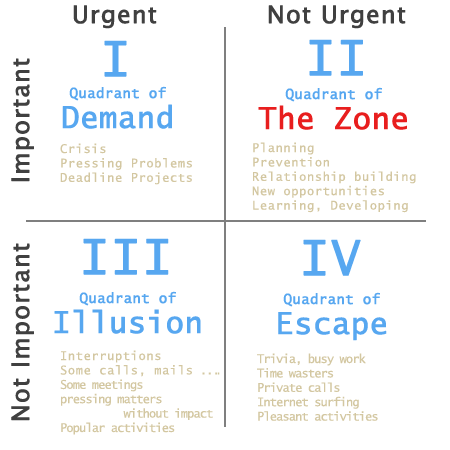
When you go to time management training, they always tell you about the important vs urgent matrix. Some things are important but not urgent, others are urgent but not important etc. The idea is that you identify the not important or urgent tasks and get rid of them. Then you allocate your time to the three other groups of tasks ensuring that the important gets done and you don’t end up focusing solely on the urgent. 

Surely there must be some 'pleasant activities' in The Zone?
Emergencies hardly ever happen in research. Which, for me, is part of the attraction. Lots of important deadlines exist – grant applications, conference submissions. But fair warning is generally given, meaning that it is theoretically possible to stop these becoming too urgent. Many, many other things that need attention crop up all the time. Quite often I find these are of the urgent and certainly important to someone else, but not massively important to me variety.

My – not entirely effective – approach to this is to routinely work at home on a Friday. The idea is that this provides me with one full day per week to focus on extended important but not urgent tasks that matter to me – writing papers, reading and commenting on large documents, catching up with the literature. The reality is that I mostly spend Fridays catching up on urgent and some-what important tasks that have accumulated through the week - nudging my me-tasks to next Friday at the earliest.

Sometimes, when my to-do list gets overwhelming (which is admittedly more often than not), I protect other time too. I schedule in a few hours to do a peer review for a journal, half a day to prepare teaching, 30 minutes to make a phone call that absolutely must happen. At the very least this makes me feel slightly calmer that there is definitely time available to do everything. It might also make me slightly more efficient by reducing the number of times I get to my desk with a few free hours ahead of me and have to work out which of the tasks on my list to do next.

But, like making the most of Fridays, the problem with protected time is the self-discipline required to actually do the scheduled task at the scheduled time, and not get distracted by apparently more urgent things. I find this is massively facilitated by having a secretary deal with meeting arrangements and I know that I am exceptionally lucky to have the luxury of even part-time secretarial support. Every time someone asks me directly for some of my protected time I feel I have to weigh up the pros and cons, wonder if their thing is more important than my scheduled thing, make a decision about when the scheduled thing is going to be re-scheduled, feel bad if I ‘choose’ to say no. A secretary, on the other hand, is slightly more remote. Obviously they want to be helpful and will try and fit people in as soon as they can. But they genuinely seem to be consummate experts in just saying no – without explanation or guilt.

This leads me to those pesky people who have worked out that if they ask me, instead of the secretary, they’re more likely to get a yes than a no.

What are your time management solutions?

Thursday, 13 February 2014

52 weeks of public health research, part 6

Posted by Lorraine McSweeney and Bronia Arnott

From Lorraine McSweeney: submission!

From Lorraine McSweeney: boxing up left over study materials from a study about nutrition in pre-school children.

From Bronia Arnott: When the going gets tough...the tough make colourful reminders of their recruitment totals to date!

From Bronia Arnott: Getting some physical activity at work - to counteract all of that sedentary behaviour due to sitting around in meetings.


------------------

Just to remind you:

Each Thursday of 2014 we’ll try and post around four pictures on the Fuse blog that capture our weeks in public health research, from the awe-inspiring to the everyday and mundane. Given that more of the latter than the former exists in my life, I foresee problems compiling 208 images worth posting on my own. So this is going to have to be a group project. Send me an image (or images) with a sentence or two describing what aspect of your week in public health research they sum up and I’ll post them as soon as I can. You don’t have to send four together – we can mix and match images from different people in the same week.

Normal rules apply: images you made yourself are best; if you use someone else’s image please check you’re allowed to first; if anyone’s identifiable in an image, make sure they’re happy for it to be posted; nothing rude; nothing that breaks research confidentiality etc.

Also, this doesn’t mean we wont also be posting words. You word-based posts are, as always, much appreciated.

Thursday, 6 February 2014

52 weeks of public health research, part 5

Posted by Bronia Arnott, Beki Langford and Sarah Sowden


From Bronia Arnott: The scale of the problem. As part of some research projects that I have been involved in I weigh and measure children, as part of the development of interventions to reduce overweight and obesity in young people. This is an abstract photo of a set of scales! Today I got a letter at home from the National Child Measurement Programme saying that my daughter will be measured soon. It feels strange to be on the other side of public health data collection!

From Beki Langford: On a night out in Stokes Croft (Bristol) I stopped my friends so I could take a photo of this sign. I'd just given a lecture about health inequities and obesogenic environments and this photo seemed to illustrate it perfectly.

From Sarah Sowden: I’m currently scoping a project around evaluating the use of outdoor gyms.  During a weekend trip to London I stumbled across another one…my three year old enjoyed trying out the treadmill but no other takers on a rainy January Saturday in Eltham.

From Sarah Sowden: Dashing home from work the other night, I saw this pinned up on the railings outside the medical school.  How about a free makeover as an incentive to exercise?

-------------------

Just to remind you:

Each Thursday of 2014 we’ll try and post around four pictures on the Fuse blog that capture our weeks in public health research, from the awe-inspiring to the everyday and mundane. Given that more of the latter than the former exists in my life, I foresee problems compiling 208 images worth posting on my own. So this is going to have to be a group project. Send me an image (or images) with a sentence or two describing what aspect of your week in public health research they sum up and I’ll post them as soon as I can. You don’t have to send four together – we can mix and match images from different people in the same week.

Normal rules apply: images you made yourself are best; if you use someone else’s image please check you’re allowed to first; if anyone’s identifiable in an image, make sure they’re happy for it to be posted; nothing rude; nothing that breaks research confidentiality etc.

Also, this doesn’t mean we wont also be posting words. You word-based posts are, as always, much appreciated.

Tuesday, 4 February 2014

Better together?

Posted by Jean Adams

As I think I might have pointed out before, I am a fairly (very) introverted person. Mingling and networking and parties are not my default setting at all. In fact, it is possible that these are the things most likely to trigger all sorts of odd avoidant behaviour in me.

My introversion, and the general advice to focus on small grants at the start of one’s career, means that I have mostly been involved in projects with a few close collaborators that I know how to work with and who I know I work well with. But it seems that you can’t hide under your desk your whole life and I now find myself taking part in quite a few big projects, involving collaborations across and beyond Fuse.

Surprisingly, these collaborations don’t fill me with too much horror. It turns out that I’m fine with the sort of structured interaction you get at project meetings. But as I get involved with more and more big collaborations, it’s interesting to observe how they all work differently – and inevitably some work better than others.

Learning to work with people you haven’t worked with before sometimes feels like an odd little dance. You understand where you need to get to. But you’re not absolutely sure you’re managing to convey that to everyone else. The ways of working that seem natural to you, turn out to be a little too anal, or a little too flying-by-the-seat-of-your-pants, to everyone else.

To make a tricky situation just a little bit more awkward, there is the added complication of the teleconference.

Part of my introversion is a strong dislike of the telephone. I resisted a mobile phone for quite a lot longer than was absolutely sensible (“I don’t want people to be able to contact me anywhere”); and the task that I always put off longer than anything else is cold calling people – even when it’s become patently clear to everyone that a telephone call is the only way to achieve what I need to do (“what if they don’t want to be interrupted?”).

I’m not totally against teleconferences. In fact, I’d much rather a teleconference than an hour on the road, or three hours on the train, there and back. And teleconferences, like project meetings, tend to be a bit more structured than the cold calling that I struggle with. But still they can be odd, can’t they? Especially when you haven’t ever met the people you’re collaborating with IRL. In fact, despite the wonders of speaking live to countless people who are widely geographically dispersed, I am not absolutely sure that the teleconference is a phenomenon that we should definitely encourage.

Like many (most? all?) researchers I suffer from persistent insecurity about my intellectual abilities. But there’s nothing like a teleconference to bring out my imposter syndrome. And at the same time as worrying that I’m coming across as a numpty, I often find myself wondering if perhaps the people on the other end of the line are numpties themselves. Sure I might be talking nonsense, but I’m starting to get the feeling that you might be too. Or maybe only someone as daft as me would reckon that what you’re saying is daft? Look, let’s make a pact – I wont think you’re a numpty, if you don’t think I am; the problem here is the telephone, not anyone’s numpti-ness.


Happily there are a number of upsides to all of this. When things go well I get to meet interesting people, and take part in interesting conversations, and be involved in good research. And sometimes I even think I might be starting to get some control over my introversion.