
A Christmas story about gifting knowledge (featuring Evidence Man)
It was the week before Christmas. After a long day in the office at her university, Ana Lyst rushed out to do some last-minute Christmas shopping. She had been too busy writing grant applications and journal papers to even think about presents for family and friends. It was already dark, with a stiff, cold breeze and snow started falling around her.

Undaunted by the ambush of knowledge and people, Ana walked over to the applied research section (which sported a large swirly sign, fusing five different colours) and spotted several books that looked like decent presents for friends. Taking them to the till, she was met by a stern looking clerk, named Pierre View, who inspected the books carefully and with an authoritative tone explained that many of the selected books were not yet ready to leave the bookshop, as they needed more work and review. Could she please come back in 17 years to collect them? The 14% of books that were ready to leave, were neatly packaged in shiny, glossy covers with pictures and key phrases all over them that Ana Lyst was sure would really impress her friends.
However, when she tried to leave, Ana noticed that there were many doors to exit the shop (the entrance was no longer visible) and when she tried the first door in front of her, it wouldn’t open. She went to the next five doors with the same result: all of them were firmly locked, or the ones that did open led to a dead-end. Ana started to panic and her earlier optimism quickly melt away, replaced with visions of being stuck in the bookshop over Christmas with not a mince pie in sight.
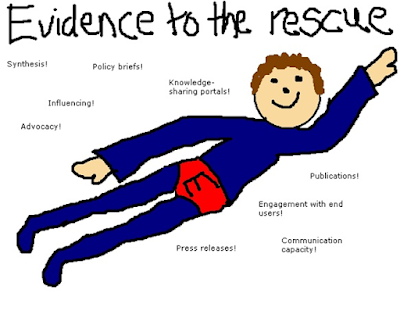
True to his word, when Ana stepped through the first door unlocked by Evidence Man, she emerged back in the now snow-covered high street, where a group of her friends were waiting and, even better, one of them was carrying a large plate of mince pies! Ana Lyst’s spirits lifted immediately, and she vowed to tell her friends all about the helpful Evidence Man in the bookshop. But when she turned around, the nice man had disappeared and through the windows of the bookshop could be seen flying to assist another confused customer.
The End.
The power of storytelling for scientific communication
I was inspired to write this Christmas tale (and blog) after attending a storytelling workshop at the Fuse end-of- year social event on 3 December, which was led by Duncan Yellowlees. Duncan is a Communications Trainer who works with researchers to improve their communications, confidence, and impact. Take a look at his online COMMunity website (Research Comms … but better) to find out more.
In an engaging and entertaining way, he took us through the key elements of storytelling: from key principles (putting pictures in people’s heads; construct a narrative of causes and effects), to different types of stories (metaphorical, motivational or monster stories, stories as hooks, and point-of-view stories), their structures (problem, solution and results) and what to include in stories (the point, examples, people, heroes & villains, magical helpers, and tensions & conflicts). Did you spot any of these elements in my story? Scroll down to the bottom of this post for spoilers.
Overall, Duncan provided plenty of tips and tricks on how we can use storytelling as academic researchers to communicate our research findings to wider audiences. And this relates directly to the first point (and story) that he made during the workshop: researchers spend too much time throwing the ball (their research findings) but not nearly enough time on making sure there is someone there to catch it (knowledge users). Find your audience first and make them pay attention before you start talking about your research.
His second point was that all this might seem daunting: so many different techniques, plot lines and structures to think about, how can we ever get any good at this? But when comparing it to learning to drive a car, the same principles apply: keep practicing and it gradually (and sometimes quite quickly) becomes second nature. This is because storytelling is already embedded in everything we do in our daily lives: from telling our family and friends about our everyday experiences, to reading books or ‘binging’ on Netflix series.
Finally, Duncan suggested some simple techniques for storytelling in science communication: making stories relatable and relevant (e.g. stress before Christmas) by including named people and adding details (e.g. dark, snowy high streets and describing the interior of the bookshop), which start to paint a picture in people’s heads. Most importantly, start with a hook: a story to draw in your audience, so they want to hear more, or use a question or bold statement as bait (e.g. only 14 percent of research makes it into practice and policy after 17 years).
My story might not have been all you hoped for this Christmas, but the Fuse social event brought some useful gifts for the Fuse Communications toolkit and much needed festive cheer at the end of another challenging academic year.
Merry Christmas everyone and happy storytelling!
Spoiler alert:
Spoiler alert:
- The point: knowledge mobilisation between academia and practice is facilitated by a knowledge exchange broker. Plus some points about the time it takes and difficulties faced by researchers when trying to get research into practice and policy.
- Heroes: academics producing research and papers, while running between bookshelves.
- Villain: Bookshop clerk (Reviewer 2).
- Magic helper: Evidence Man (Knowledge Exchange Broker)
- Tensions & conflicts: research dusting away on bookshelves or not being ready to leave the building, while access to knowledge users is restricted or confusing.
- Type of story: metaphorical story, overlapping with stories as hooks (to introduce this blog and talk about the storytelling workshop).


.jpg)
