Showing posts with label Canada. Show all posts

Friday, 25 May 2018

Public health isn’t good politics

Knowledge exchange lessons from the 4th Fuse international conference (part 1)

Posted by Peter van der Graaf, AskFuse Research Manager, Teesside University

When I attended the Fuse knowledge exchange conference in Vancouver, B.C. earlier this month, I did not know that some Canadian squirrels are black.

I also did not know how much knowledge exchange was embedded in Canadian research. In the UK we are struggling to get researchers involved in knowledge exchange while working in an academic system that does not reward these activities. For Canadian researchers this is a fundamental part of their job and firmly embedded in the CIHR (the Canadian equivalent of NIHR) mission statement: "… excel the creation of new knowledge and its translation into improved health for Canadians" (Canadian Institutes of Health Research Act).

As surprised as I was to see black squirrels skirting the trees in Stanley Park in Vancouver, I was also surprised by the number of Canadian presenters at the Fuse conference who pointed to the impossibility of translating research evidence into practice.

For instance, Steven Hoffman, made a convincing case about public health being not good politics and therefore difficult to translate into policy. He argued that everything that public health does makes it invisible to policy makers. For example, we focus on prevention instead of treatment, which is much more difficult to observe and showcase.

An image from Steven Hoffman's presentation
Moreover, the more successful we are (when we prevent population diseases from spreading), the greater our invisibility becomes (there is no longer a disease to worry about) and, consequently, the more difficult it is to ask for more resources to keep prevention efforts up.

We also focus on supporting long-term chronic conditions instead of delivering acute services that can provide an instant solution to health problems. Furthermore, our data, as a population science, is based on statistical lives instead of individuals with a face and story. This all makes public health a hard-sell to politicians.

But it is not only our modus operandi that causes this hard sell: the system in which policy makers operate makes the use of research evidence unlikely. Paul Cairney from the University of Stirling explained in his talk that policy makers must ignore almost all the evidence that they are presented with to make decisions. They do this, not by weighing up the evidence carefully as we as researchers would like them to do, but by taking shortcuts, which Paul described as ‘bounded rationality’.

Policy makers either select evidence that helps them to reduce uncertainty about how to achieve their goals or, (and this is the more popular option) they apply their gut-level, emotional, belief-driven knowledge to reduce ambiguity about policy options. Moreover, policy makers are often not in control of the policy process and therefore they cannot tell us what evidence is useful, when and how it will influence the decision-making process.

If public health policy is not good politics and research evidence is a hard sell to policy makers, what can we do to make a better investment case for public health? Luckily both speakers provided their own shortcuts for making it more likely that public health and our evidence would be heard and used by policy makers:

1.) Recraft the narrative. Smoking was banned in public places not because smoking was harmful to smokers but because the campaigns focused on the dangers of second-hand smoke to the wider public, particularly children. By reframing the story from an individual blame game to an emotive public issue, public interest could be galvanised and used to put pressure on national Government to take action, building on local interventions already in place with a proven evidence-base.

2.) Take account of how democracy works: politicians need votes. As public health researchers we need to give them glory in the eyes of their voters and provide them with opportunities to leave a visible legacy. We could this by advertising our successes more clearly and by making it personal. Eugene Milne, Director of Public Health at Newcastle City Council, summed this up in a simple statement: "...‘it could happen to me’, mobilises people".

3.) However, to do this effectively, we need to be aware of hierarchy in politics and different policy contexts and networks. Most importantly, we need to be able to navigate diffused decision-making processes. As Paul emphasised in his presentation, policy makers have different ideas about what counts as good evidence, and there are many ‘policymakers’ across many levels and types of government. In other words, there are many sources of policy relevant knowledge that public health research evidence has to compete with.

It will take time and long-term relationship building to understand and navigate the different policy contexts, networks and types of evidence used in both. Unfortunately, public health students are generally poorly equipped to navigate these networks. Steven Hoffman remarked that we are not equipping our PhD students with knowledge of political systems and, in not doing so, set ourselves up for continued failure to make public health and our evidence visible to policy makers.

This does not mean that each student should become a political expert and advocate fiercely for her/his research findings. But it does entail a student being able to recognise their role in the wider system that they are part of, including various political networks and contexts. How can we teach our students to act from their position in a political system in a way that will make public health more visible?

This brings me back to squirrels. The squirrels that I encountered in the park stood out because they were black; a different colour to the common British grey and (less common) red squirrels that I’m used to seeing. In a similar vein, we could make our PhD students stand out by teaching them how to take evidence shortcuts in the political system.

Sharon Hodgson, Shadow Minister for Public Health, speaking
at an event in Sunderland
When I returned to the UK, with more appreciation for squirrels, I attended a spotlight event at the University of Sunderland the next day, which aimed to increase the visibility of public health research at the university. Although heavily jet-lagged, what sparked my interest at the event was a debate that took place between Sharon Hodgson, the Shadow Minister for Public Health and various researchers in the room. They sparred about the evidence for introducing a minimum unit price for alcohol in England and whether 40p made more ‘sense’ (and to who) than 50p. The ensuing debate demonstrated many of the arguments made in this blog and therefore will be the focus of my next blog (part 2) with John Mooney, Senior Lecturer at the University of Sunderland.

We will use this example to demonstrate how Canadian experiences might inform local practice in the UK by recrafting the narrative, taking account of Labour as an opposition party, and making it personal for voters.


Image: "Black Squirrel" (11997818194_8f66516b30_z) by DaPuglet via Flickr.com, copyright © 2018: https://www.flickr.com/photos/dapuglet/11997818194

Friday, 26 May 2017

Postcards from a public health tourist #1: Montréal, Québec, Canada

Posted by Clare Bambra, Fuse Associate Director and Professor of Public Health, Newcastle University

A few of our academics are lucky enough to have the opportunity to travel around the world to speak at conferences or explore collaborations - all in the line of work and the translation, exchange and expansion of knowledge of course.

The least we could expect is a postcard, to hear all about the fun that they're having while we’re stuck in the office watching droplets of rain compete to reach the windowsill…

So here’s the first from Professor Bambra.


Dear Fuse Open Science Blog,

I spent late April and May 2017 as a visiting Professor at the Institute of Research in Public Health, part of the University of Montréal. I was the guest of Professor Louise Potvin who is a leading international researcher in health promotion and the editor-in-chief of the Canadian Journal of Public Health. She was an amazing and generous host.

Me (bottom right) with Louise Potvin (centre) - an amazing and generous host
I had a really enjoyable and fruitful time both intellectually and socially at the Institute. It is an exciting place to be as a health equity researcher. They are leading the field in health equity research in Canada and alongside the other Montréal universities and the municipal public health agency, they have set up the joint Lea Roback Centre which examines health equity. There I was honoured to deliver the annual Paul Bernard lecture on social determinants of health – you can watch a video of the talk here.

I was also an invited speaker at the World Health Summit speaking alongside Ilona Kickbush (World Health Organization Europe) and Connie Clements (Canadian National Collaborating Centre on the Determinants of Health - NCCDH) about the legacies of the Ottawa charter. The NCCDH is tasked with integrating health equity and the social determinants of health into Canadian public health practice. Jane Philpott, the Minister of Health for the Federal Canadian government also gave an inspiring speech at the summit about the importance of the social determinants of health and her journey from being a family doctor to a leading politician.

Montréal experienced unprecedented rain and flooding while I was there
Montréal is an amazing place to visit, an extremely vibrant multicultural bilingual city with great restaurants and a very welcoming feel to it. It was very exciting to be there in 2017 as Canada celebrates 150 years and Montréal celebrates its 375th year. However, weather wise Montréal experienced unprecedented rain and flooding while I was there with many homes and businesses evacuated and the army required to provide emergency support.


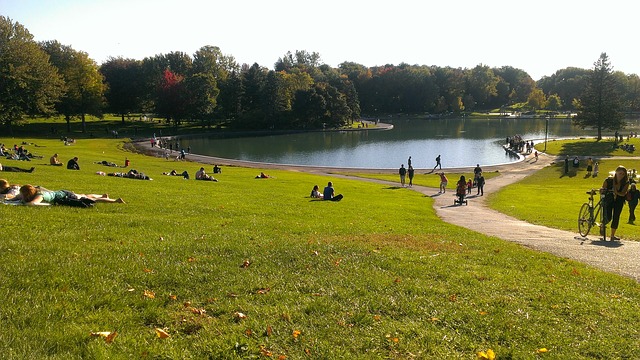
Montréal is also an interesting place from a public health perspective, it’s a city with a lot of green spaces and a variety of parks and recreation areas. It’s a very safe place to be, and very walkable - unlike other areas of North America. Public transport costs are low with a flat rate on the Metro and the buses of around $3. They also have a shared bicycle scheme called Bixi - which is free for a cycle ride of up to 30 minutes.

However, Montréal and Canada are of course not without their own public health problems. There was very visible homelessness. The Montréal health gap is 11 years between the most and least affluent neighbourhoods and most significantly, the Inuit and indigenous populations have average life expectancies of only 70 years - 10 years less than the average Canadian. Inuit health is understandably a key focus for health equity researchers in Montréal - including former Fuse associate Mylene Riva. She is now researching the effects of housing conditions and food security on the health of Inuit people in Arctic Quebec.

So a very useful visit for me and I was able to make good future connections for the Fuse Health Inequalities research theme.


Photo attribution: