Showing posts with label dissemination. Show all posts

Friday, 19 December 2025

Spark ideas, inspire change and fuel innovation - sharing research creatively

Posted by Ella Anderson, Fuse Public Involvement and Engagement Manager, Newcastle University

Have you ever wondered how to share your research in a way that engages with new and diverse audiences? Are there ways to share your work in a way that reaches the people it was designed to serve? If the answer is yes, then read on!

Research can spark ideas, inspire change and fuel innovation but all too often it gets buried in academic journals and dense reports that few people read, particularly the communities the research intends to serve. So what if there were more engaging, creative and accessible ways to share your findings? From interactive infographics and animations, to events, theatre and podcasts, Fuse researchers are re-imagining how to communicate their work with wider audiences.

Whether you are looking to captivate the public, influence policy makers or engage fellow experts, this post explores some creative ideas to make your research truly resonate.
  • In the first instance, reach out to any people who you have worked with as part of your research including public partners, young people, charities and voluntary organisations. What would they like to see? Actively liaise with and listen to the communities your research is intending to serve - how do they want findings presented?
  • Infographics and visual summaries can be a useful way to transform your findings into a simplified visual. Infographics are a graphic representation of information, data or knowledge to present complex content quickly and clearly. Emma Adams has worked with More than Minutes to summarise research about co-located services in a visual and accessible way. Steph Scott worked with Nifty Fox - specialists in visual storytelling - to produce a flipbook drawing on content from the ‘Divided Households’ report relating to children and parental imprisonment. Fuse Deputy Director Amelia Lake, Shelia Visram and team co-produced the Hyper Energy drink leaflet with young people to communicate key findings. Or what about a zine (DIY-style booklet or magazine) like this, ‘Moving Spaces’, co-produced by Caroline Dodd-Reynolds with LGBTQIA+ young people, exploring how physical activity spaces could be more joyful and safe.
    • Theatre and performance is an exciting way of communicating research. For example, Cap-A-Pie and researchers including Mandy Cheetham were involved in developing an emotive theatre production called Credit, based on stories and experiences of people living on Universal Credit.
       
    • Creative and engaging community events and workshops (with catering if you have budget!) are always a popular option. The more interactive, accessible and collaborative the better. Use the opportunity to close any feedback loops with people, charities, organisations who you have engaged with throughout the research. Show how you listened, what you found out, how findings are applicable to people's lives and work, and what happens next... keeping people in the loop is so important. Be sure to include opportunities for plain language Q&As and conversations, both informal (through breaks) and formal (via panel discussions). At one of Fuse’s International Women’s Day events, there was an optional gong bath for people attending the event. Although a sound bath may not have been directly linked to the research, the event was about creating a welcoming, inclusive and ‘safe space’ for people to come together.
    • If you have the budget, consider having an event doodled in real-time. We have had colleagues who have worked with Camille Aubry, Josie Brookes and Nifty Fox who offer this skill. Get in touch with us if you would like any other recommendations when sourcing quotes.
    • Have you thought about gamification of research findings or using interactive digital tools? You can create interactive quizzes or clickable maps to allow people to explore findings in an engaging way, applying insights to local contexts. Simulation tools allow public partners and individuals to visualise the impact of different public health interventions based on research findings. Take a look at Joanne McGrath's online Maze, which provided an interactive resource portraying women’s narratives of multiple exclusion, homelessness and accessing support.
    • Storytelling has long been a way to share information. Case studies lend themselves well to this, as human-centric narratives show the research in action. It can demonstrate how a specific person or community has benefitted or will benefit from the findings. Stories are a different way to 'humanise' data or translate findings in a way that is appropriate for the intended audience. For example, Cassey Muir and Ruth McGovern’s co-produced Twinkle Twinkle Arti children’s story book communicated messages about parental substance use in a gentle, age-appropriate manner. The book is available as a physical copy, an electronic copy and also has been made into a CBeebies style story time video.
    • Are there any opportunities for the use of creative methods throughout the project that you could bring together as part of an exhibition in a public space e.g. library, community centre, schools? Documenting the research and experience through photography, crafts or art can be a creative way of capturing interest and making research more understandable. Sarah Martin-Denham’s crochet blanket made up of 2,999 squares representing the number of children excluded every day from schools in England (2021/22 academic year) is a great example of this, and has been on a national tour engaging with 24 organisations - including the Children’s Commissioner Office and multiple councils.
    • You can share bite-sized research or findings through social media channels using visuals, animations, short videos - or even livestreaming to provide information and engage with people in real-time. Have a hashtag at the ready to encourage people to join the conversation and share perspectives. In a similar vein, there are opportunities to share research and knowledge via 'Ask Me Anything' style forums, for example as seen on Reddit. Yes, this is low cost but it comes with risks as questions are unpredictable! However, it is worth flagging as an option and is a creative, ‘non-traditional’ way to share research and answer questions.
    • Blogs, like the award-winning one you are reading right now, are a great way to share your research. Posts can make complex information more accessible to a wider audience. It allows you to present findings in a clear, engaging and informal style, reaching readers outside of academic circles, including policy makers, practitioners and the wider public. For guidance and support in writing your own blog post, contact Fuse Communications Manager, Mark Welford: m.welford@tees.ac.uk.
    • Could you take your research findings to places in the local community? Fuse colleagues Balbir Singh (Artistic Director of the Balbir Singh Dance Company) and Paul Chazot displayed art works from their Unmasking Pain project in pop-up displays in GP surgeries and a repurposed shop in a shopping centre. There is now a dedicated space at the Grainger Market, Newcastle-upon-Tyne called the Being Well Place, which is a place to connect and engage with the local community.
    • Do you have the option of translating materials/outputs for different audiences, and communities with diverse language needs? Translated summaries and visuals e.g. in multiple languages, work well and ensure inclusivity in dissemination. For example, Nicola Heslehurst worked with local designer, Twentyseven Design to develop English and Welsh infographics relating to pregnancy outcomes.
    • And finally what kind of Fuse Public Involvement and Engagement Manager would I be if I wasn’t promoting the wonderful and award-winning public partner-led podcast Public Health Research and Me?! Accessible, informative, flexible and friendly - this is a great way to share quality research with a diverse and international audience. 

    There are many more creative ways to share research and remember - there is a no ‘one-size-fits-all’ approach to sharing your findings. Always take into account your research topic, your findings and above all your target audience.

    Why not send us a message today if you have used a creative or innovative way to share your research or findings? We would love to hear from you and find out more ways to promote and share high quality research.


    Following strong interest from Fuse members, we have launched a Community of Practice (CoP) focused on creative research, involvement and dissemination.

    The first meeting will take place in the New Year. Places are limited for the first event but please register or get in touch (info@fuse.ac.uk), as there will be plenty more opportunities in future!

    A CoP is a network of people who share common interests and goals, creating a space for knowledge exchange, learning, and mutual support.

    Thursday, 7 March 2024

    Creating an out of this world children’s book to help families affected by substance use

    Cassey Muir, Research Associate from Newcastle University


    To celebrate #WorldBookDay, Cassey tells us about going beyond the research to co-produce a children's story book to help families affected by substance use which is now freely available.

    “To take the findings from our lived experience and create something real for families and people beyond the world of research has been brilliant” 
    Young person involved in the project


    Creating something real: How we produced a children’s story book

    When I had the opportunity to create a children’s story book based on some of my PhD research that could help families affected by substance use, I was really excited to get started with the project. Ever since I was little, I wanted to write a children’s storybook and I had even mentioned this at my PhD interview panel, so being part of this project was a dream come true in many ways. 

    To be able to create a book that has such meaning for the children and families involved has been incredibly rewarding, if not emotionally challenging at times. To help shape the plot and character development based on the stories of the young people that I had talked to during my PhD, felt like an enormous privilege but also a weight to get right. I wanted to make sure the story reflected the different experiences of children, while other members of the team were making sure the story reflected parents and caregivers’ experiences. Working with the talented Danielle Slade (author) and Josie Brookes (illustrator) helped make this process go as smoothly as possible. They were empathetic to the stories of families and wanted to keep to the integrity of family’s experiences and impacts, while making a story that was engaging.

    With the creative minds of Danielle and Josie, we worked with 15 family members who were affected by parental alcohol or drug use, three teachers, Coram Life Education, and Coram Beanstalk to co-produce this storybook. Using techniques like free writing to music, drawing different characters, and storyboarding ideas, we involved children and parents in the creative process from the start. Families were also able to see early mock-ups of the book and feedback their ideas on improvements to the story and share their preferences on illustrations. Josie and Danielle were really receptive to the ideas from children and parents and valued their input.


    We met with teachers from local primary schools and practitioners from Coram to think about who the target age range of the book would be, how the book could be used within schools and practice, and how to help adults have conversations with children. Through these discussions we developed conversation prompts for adults that are at the back of the book. These prompts (for example, what do you think of the Yozzle?) can help with discussing the characters and themes within the book with children in one to ones, in groups, or within a whole class setting. Anyone can follow along with this story of Arti, a wishing star. We have received positive feedback from practitioners where this book has been used with younger children (5-8 years), older children as a discussion point for reflecting on childhood (14-16 years) as well as with children who have special educational needs and disabilities.

    We have also recently collaborated with Newcastle Film Club to produce a ‘story time’ video of the book being read by the author. This video allows the book to be accessed more widely and can be used alongside the book. Being able to produce this video, with Amy Mains (Director and Editor) and Scott Anderson (Director of Photography), who are also both teachers, was a fun and unique experience. We set up the equipment and reshuffled the backdrop in Fenham Library and managed to shoot the film in under two hours, just in time for the library opening to the public. I think this video adds an extra bit of magic to the story, with soft music and twinkling sounds!


    Beyond the world of research: Creatively disseminating research findings

    For context on the book, Twinkle, Twinkle Arti is a free story book co-produced with and for children who experience parental alcohol and drug use. This book helps start conversations between trusted adults and affected children. The messages within the book are based on two linked studies around the needs of affected families, led by Fuse Researchers.

    The Safe Space project, led by Ruth McGovern, found that many parents and caregivers find it difficult to talk to their child about substance use and the impact upon the child and family. Parents and caregivers spoke about wanting resources to help with these conversations. Alongside this, research led by me, explored the experiences and support needs of children and young people. Children and young people told me that they valued the importance of confiding in a trusted adult such as a teacher, social worker, or family support worker but often did not know who they could trust or talk to, and prioritised approaches within schools which promoted conversations about parental substance use.

    The story book captures the emotional and social impacts of living in a difficult family situation, from the perspective of the child and the parent or caregiver, and highlights helpful strategies to support the child’s wellbeing, for example talking about your feelings.

    Using out of this world storytelling and fictional characters, the findings from these two studies are told in a way that makes them accessible to families and practitioners and offers positive messages and validation not only to children but to parents/caregivers and practitioners who find it challenging to know how to broach this sensitive topic.


    We are freely sharing this book with families, schools, and practitioners across the country. To help understand the usability and impact of the storybook, we are gathering feedback from practitioners with a short online survey. This feedback will contribute to informing further development of the book and additional resources that are needed. I hope the book can be used across many different settings (schools, social care, and voluntary organisations) and can be shared with families who want to have those conversations. Within schools, we hope it is used in whole class situations, to reduce the stigma and show children they are not alone. It’s a fun story with fictional characters, and I hope families feel the book is engaging and non-stigmatising.

    Here is some of the feedback that we have received so far about the book.

    A practitioner told us: “It is so meaningful for children to know about the Yozzle [fictional character depicting alcohol or drugs in the book] and how it makes them feel. What a very complex idea to get across to children and yet it has been achieved with such skill!”

    A child who reviewed the book shared: “It [the story] shows you’re not on your own and that there are other stars [fictional character depicting trusted adults] to support you.”

    A primary school teacher shared the following: “There were no problems at all using Twinkle, Twinkle Arti in a whole class situation. In fact, I think it worked well as an introduction because it wasn't only alcohol use that the children discussed it was mental health, feelings, and how to overcome problems.”

    A parent who helped co-produce the book reflected: “I am proud of the book because other children won't have to go through what my children have."

    I think it is really important for researchers to work collaboratively with public, practice, and policy partners and to engage in creative processes that open their research to wider audiences. Through this process, you might learn something new and have fun doing it. But don’t just take my word for it, here are the perspectives of the illustrator and young person involved in the project:

    Josie, the story’s illustrator, says: “This has been a really inspirational project, and a joy to work with Danielle, the research team, and all the families involved. We collectively believed in the power of storytelling to get these important issues across, and the resulting book is something I am so proud to have been a part of making. I think children will connect with Arti, her colourful world, and her story. I am excited for it to be used as a positive resource with children and families, in opening up those very crucial conversations, whilst simultaneously being so enjoyable to read!”

    A young person reflected: “This book is something I would have loved to have been able to give to ‘little’ me, having something that related to my home situation when I was a child. I feel rewarded to be able to do this for ‘me’ now, for little me going through all those hard times and for all the children who will read this book, who are going through something, have a hard home life, have parents who are struggling, anything.

    I hope through the book, we are able to show them that they are not alone and that there are people around them who are there to give them love and support. Hopefully, the book can help reach them earlier than I was reached out to. To create a book that would educate and support whomever read it, no matter their age or background, to be more than a storybook and to be able to help them, even in a small subtle way. It is a chance to reach the children that need it through a storybook that they come across all the time in life. It is incredibly rewarding to have a book that exists, that will last and be passed on to different children who are in a variety of situations for years to come. I am very proud of it.

    I sincerely hope the book not only entertains children at bedtime, but that it can in some ways soothe a child's worries. It was an honour to hear the brave accounts from families and even more so, that they have trusted us to put their feelings and stories into this book.”

    Fuse researchers and lived experience expert at book launch event. From left to right: Ruth McGovern, Kira Terry, Cassey Muir and Debbie Smart 

    If you would like to learn more about this research, then please go to the links at the bottom of this page. And if you would like to join Arti on her journey of bravery, self-discovery, and learning about the important of talking about your feelings then take a look at the story book or watch the video.

    Find out more
    • Download the book free.
    • Listen to this Fuse podcast to hear Cassey discussing her research on social and emotional resilience in children and young people affected by parental substance use.
    • Read this Fuse news article about Twinkle, Twinkle Arti.
    • Read this Alcohol Action Ireland blog and listen to the podcast.


    All illustrations by Josie Brookes

    Friday, 1 December 2023

    Getting creative to make research more accessible and inclusive

    Posted by Victoria Bartle, Fuse Public Partner

    We were throwing balls of wool around, picking picture cards to describe ourselves and having a thoroughly inspiring time. This was not your typical research conference!

    It was day one and keynote speaker Pam Burnard was encouraging us to challenge the system using creative methods to subvert common assumptions.

    Many of the researchers at the International Creative Research Methods Conference in Manchester are independent, not linked to a specific university or funder and this allows them to approach research from a variety of unusual and unfamiliar angles.

    The conference is the brainchild of Dr Helen Kara: independent researcher, author, teacher, speaker and creative research methods (CRM) expert. Helen’s vision was to bring together the global CRM community to share knowledge, promote understanding, enable networking and have fun!

    After the first day's keynote, I went to see Nicole Brown, a researcher looking at fibromyalgia, a condition that I also have. She had asked people living with fibromyalgia to collect objects to describe how the condition made them feel. One person had taken a photo of her chair - a really comfortable armchair, with a blanket, a table beside it holding drinks, snacks and distractions. This could have been a picture of my own living room! Due to chronic pain and fatigue I have what I call my 'nest'. I have reclining sofas with a side table with all of my remotes, chargers, creams, spare meds, thermostat, drinks, snacks, book, switch, lip balm (etc.) just so that everything I need is within reach and I don’t have to move too much or cause myself too much pain. I found the picture really impactful and saw the potential for objects, artwork and abstract thinking to be able to describe conditions like fibromyalgia which is extremely difficult to explain to someone who doesn’t have it. Using objects as data to assess and evaluate was really interesting and a methodology that I wasn’t previously aware of.

    We were then given the task of picking some cards to describe ourselves as researchers.

    These are the lego cards I chose to describe me during the sessions by Nicole Brown, who works with objects as data in research.

    The skydiver because I feel like I just ask to do things and hope for the best, the singer because I like to present and talk about PPI (Patient and Public Involvement) in research. 

    Black widow because she’s a superhero and fights for people who can’t and Rocket because he’s been made up with tech and I felt like he’s a disabled superhero :)


    Jargon buzzing

    On day 2 the Lawnmowers Theatre Company, run by and for people with learning difficulties, brought out jargon buzzers which were amazing! The characters pressed the buzzers every time someone used a term or word that they didn’t understand. I really want to use these in PPI meetings in the future, but we might not get anything done having to explain all the acronyms and research language that is often used!

    Making a 'zine'

    I didn’t know anything about zines and wasn’t aware of the Madzine project to help people with mental health conditions to explain how they feel, get things out and be creative. The session was really interesting giving us some history on zines before we were able to create our own. I made one about a project that I have been working on using some paper with stars on to represent the PPI Group members. A black page for accessibility as we all had different barriers to involvement and some of them were difficult to address, hidden or unknown. Some of the zines that they showed us were amazing: creative, visual, unusual, thought provoking and touching. They plan to create a mobile Madzine library that tours around the country so that people can read the zines and share in the experiences of the creators to increase awareness and understanding of living with mental health conditions.

    Board games, rockpools and podcasts  

    Kath McGuire (University of Exeter/NIHR School for Public Health Research), led our session talking about working with creative methods, public involvement and research dissemination. I briefly introduced the Fuse podcast and explained the collaborative approach to creating it. People were then able to take a look around the room at the variety of creative outputs that we had brought with us, and a video about how we have creatively communicated research in Fuse (see below). We had a snakes and ladders game to be used with PPI groups, or groups of researchers to evaluate their projects: snakes were barriers and challenges and ladders were successes and wins. We also took posters created by Fuse researchers showing their project results (Emma Adams) and Kath had a Blue Health Rockpool from another project. We took questions and explained how we created the podcast, what its impact had been and answered lots of technical questions about equipment, hosting and distribution. Hopefully accurately!


    Attending the conference really broadened my view of research and public involvement. Lots of researchers at the conference felt that by making their work more creative it made it more inclusive. By reducing or removing established barriers to involvement such as language, terminology, education level and academic preconceptions they were able to engage with a wider, more diverse group of people. They could still be academically rigorous and produce research that stands up to peer review and meets publication standards whilst including more people, accessing people with appropriate lived experience of their topic of study and making involvement engaging, interesting and fun!

    I have come away from the conference wanting to make Patient and Public Involvement meetings more creative, use games and objects to describe feelings and opinions, implement the jargon buzzer and design engaging dissemination methods that are relevant to the target audience of the study, drawing on the skills of the researchers and PPI teams.

    A special thanks to Kath Maguire, Daniel Mutanda and Heather Boult (University of Exeter/NIHR School for Public Health Research), and the Fuse colleagues: Lesley Haley, who helped me with the podcast aspect of the workshop 'market place'; Ella Anderson for preparing the workshop activity; and Mark Welford for producing the Creatively communicating research video that we used in the session.

    Friday, 21 April 2023

    A public partner’s guide to podcasting

    Posted by Victoria Bartle, Fuse Public Partner, with tips for guests from Cassey Muir, Fuse & NIHR School for Public health Research (SPHR) funded PhD Researcher from Newcastle University


    Everyone seems to have a podcast these days and there are lots discussing research, but how many can say that they are totally led by the public? I have been participating in public involvement in research since 2016 and believe that it is a vital part of improving everybody’s health, but find that getting other people involved and informing the public about research projects is really difficult.

    I was excited to be involved with the Fuse podcast Public Health Research and Me as I’ve wanted to start my own for a while now, and felt as if this would be a perfect opportunity to learn about podcasting and give it a try, as well as being part of creating a platform to help engage the public in research and hopefully increase awareness and involvement. I joined the podcast team made up mainly of other public partners and took part in some excellent training which went through equipment, hints and tips for selecting guests, how to phrase and deliver questions, different podcast formats, as well as recording and editing. I was buzzing after the training and keen to get started.


    I was lucky enough to be selected to be the first host for the podcast and was matched with Cassey Muir, one of the Fuse researchers who is working with children and young people who have been affected by parental substance use. Her work is fascinating and I was soon enthralled reading everything I could to prep for the interview and come up with a very long list of questions. As brevity is not my forte the rest of the team helped to cut these down to around five or six questions which is about all that you need to create a 30 minute podcast.

    We then had a pre-record meeting with Cassey, where we discussed the questions. Talking to her about her work helped me to edit and refine the questions for the interview. Once the questions had been finalised and approved by the podcast team and Cassey, we set a recording date.

    I was quite nervous before the record. I’d been a panel member on a podcast before and had so many technical issues that I was really stressed and anxious by the time I managed to get everything sorted. So for this recording I made sure I had tried all of the equipment and was all set up with my notes, drinks, tissues and cough medicine…because of course I had a cold! Recording when one of the presenters keeps coughing is really difficult for the editor, but Cassey was a pro and kept pausing whenever I coughed so that we would have a second or two to edit it out. We talked for ages and the record went really well. I was able to bring in some of my own lived experience of the topic and this helped to make the conversation more natural and less like me firing questions at Cassey, although I did say “wow” and “that’s amazing” a lot which I was determined not to do as much the next time.

    Now to the technical part! Although we had had some training on editing podcasts, the team decided to use an external editor as we wanted it to sound as professional as possible, and none of us were confident in using the software just yet. Listening to the edited version we were able to make requests for changes, but I felt that it generally sounded great, and asking to cut out all of my embarrassing “wows” was my own issue and not necessary. We had to write our bios to go with the podcast, an overview of what it was about, and make sure that the projects and references that we discussed were all available for the listeners to link to directly from the podcast page.

    Going live was exciting, I sent the link to all of my friends and family, it was tweeted on the Fuse twitter feed and is also on the Fuse website so everyone can access it. We’ve had over 100 listens and the bonus video has had nearly 300 views so far. I’ve had lovely feedback from my friends and family who said they found it really interesting. My Mum was especially impressed as she now has something that she understands to tell people when she’s trying to explain what public involvement in research is and what I do.

    Round two  


    The second recording went a bit differently. I had loads of background information to read about Eugene Milne, his career history, his involvement in establishing Fuse, his role in public health and his recent MBE which was all very exciting. I had lots of questions about all of the different projects that he had been involved in, their impact on public health in the North East, as well as his plans for retirement, but during the pre-record chat I decided to take a more focused direction as his responses to some of the topics were just so interesting. We narrowed it down to his involvement in establishing Fuse, what his initial expectations were and how he feels it has developed over the past 15 years; the impressive results from the public health initiatives that he oversaw (including North East tobacco and alcohol control programmes Fresh and Balance); as well as responding to Covid-19 during his time as the Director of Public Health for Newcastle.

    Again the public partner team reviewed the questions and the theme of the podcast and we went ahead with the recording. This time I didn’t have a cough which made recording much easier, but I still responded with lots of “wow’s” and “that’s amazing” as I found Eugene very engaging and his career so interesting. I then got myself a bit confused towards the end of the record. I’d skipped a question as it didn’t fit with how the conversation was flowing, but I wanted to come back to it at the end. I’d already said the outro lines so I had to pause for a second or two, ask the missed question, and then remind the editor to swap the order of the last two sections around. I was a bit embarrassed about this, but it was absolutely fine and you can’t tell in the final version.

    Things don’t always go to plan


    The third recording with PhD student Joanne McGrath has been different again. We had already decided to focus on one of Joanne’s current projects looking at women experiencing homelessness as it fitted in with International Women’s Day and an event that Fuse was hosting for the occasion. This meant that I had a bit less reading to do while prepping the questions this time. They were approved by the podcast team and Joanne, and she steered the direction of the podcast from the outset as she knows her research best and which areas are being focused on currently. The recording has been beset with challenges, technical issues, diary clashes and unavoidable life events that have meant that we have had to postpone the recording three times. Is it cursed!?

    These challenges actually led us to writing this blog, as well as the hints and tips below. We have all learnt so much from the first three podcasts and as I pass the hosting responsibilities to the next public partner we wanted to make sure that we were learning from our experiences. At the point of writing this blog, we have now managed to record Joanne’s episode, so keep an eye out for it. Her work with women experiencing homelessness is so important and will benefit an often overlooked group of people by supporting positive changes in their lives.

    Our top tips for podcasting


    For hosts


    Preparing for the podcast:

    • Give yourself enough time to read through all of the guest’s work and discuss with them and the team the possible theme of the interview.
    • Write down all the questions you can think of; you can always edit and rearrange the order later.
    • Have a pre-record meeting with the guest; this helps you and your guest to feel comfortable, and to try out the microphone and recording platform. This can also help to define the questions and theme of the podcast.
    • After the guest and the team have reviewed the questions and decided on five or six to use, arrange them in an order that should flow like a conversation.
    • Write your own intro, a couple of sentences about yourself to introduce you to the listeners and practice this a few times so that you are familiar and comfortable saying it.
    • Also practice the intro and outro sections that have already been created, changing some of the words if it fits better with how you speak.
    The podcast recording:
    • Login to the meeting for the record early, have everything you need set up around you, and make sure you have all devices on silent so you won’t be disturbed.
    • Check the mic in advance, you may need a USB port to attach to your computer and headphones with a connector jack. If you use an Apple Mac (or similar) you may have to use a USB adapter.
    • Place the mic approximately 15cm (6”) in front of you.
    • Find a small quiet room that is preferably well furnished to absorb any echo.
    • Have a little chat with the guest, try to make them feel comfortable and start when you’re both ready.
    • Mute yourself if you need to cough, sneeze or drink etc.
    • Avoid rustling any paper or notes that you may have prepared.
    • Turn off non-essential devices using wifi and reduce the tabs/windows on your device. This will reduce the likelihood of buffering during the Zoom/Teams call.
    • If you do cough, sneeze or make a mistake then pause for a second or two and start again (or mark by saying “edit point”), this gives the editor a space to remove the noise.
    After the recording:
    • Re-record any sections you feel necessary, or let the team know if you think a section will need to be moved, cut or edited and they can pass this on to the editor.
    • Once the edited version comes back, with the “umms”, “aaahhhhs”, coughs (etc.) removed, you will be able to listen through and request any further edits that you’d like.
    • Write a bio and provide a photo to go on the podcast platform.
    • Help with any promotion through your own networks, and enjoy listening!

    For guests


    Preparing for the podcast:
    • Identify and share your relevant publications, resources, and information with the host and podcast team, which allows them to focus the conversation and questions (e.g., do you want to provide a wide variety of resources or only those on a specific topic?).
    • Help clarify any specific points of interest or themes you would like to get across about your work as this will help with determining relevant questions.
    • Pre-record meetings and/or emails are helpful, which can take away some of the nerves by building a relationship with the host or testing out the equipment.
    • Ask for a copy of the questions if you would like to make notes and think about your answers ahead of time.
    The podcast recording:
    • This should be/is a fun experience where you get to talk about your work with someone who is keen to listen and explore different topics with you. It is a great chance to discuss your research in a way that you might not normally and possibly from a different viewpoint, so try to ease into it and enjoy it. If you lose your train of thought or stumble over your words it is okay, that is the benefit of editing and not being live.
    • If you have made them, have your notes to hand, either printed (but not rustling) or on the screen to help you remember important points that you want to make during the podcast.
    • As this is meant to be somewhat conversational, remember to go with the flow of questioning as some of your answers may spark interesting follow-up questions that you are unprepared for.
    After recording:
    • Ensure you have provided links to the important items you discussed during the podcast, which can then be shared alongside the podcast.
    • You get to listen/watch through the edited podcast before it goes live, which is your chance to highlight any changes you would like to be made (although the editing team do a fab job, so there may be no necessary changes at this stage).
    • Once the podcast is live, this is a great opportunity to share your work and the podcast with relevant networks and/or on your social media.
    • Enjoy listening or watching the podcast!

    Friday, 30 September 2022

    Going beyond research to empower involvement and smash stereotypes

    Posted by Sheena Ramsay, Professor of Public Health & Epidemiology, (and team: Emma Joyes, Emma Adams, Laura McGowan) in collaboration with Fulfilling Lives Newcastle Gateshead Experts by Experience

    The way researchers approach some groups is often not sensitive to or inclusive of their needs. For example, the information can use technical language (such as ‘licit substances’ or ‘quasi-experimental’) which can be difficult to understand and off-putting. This can lead to people not wanting to take part in studies. Which means that new research insights, including changes to practice, can exclude those who are often most impacted.

    Over the last two years, we have been working with Fulfilling Lives Newcastle Gateshead and their Experts by Experience Network of individuals with lived experience of multiple disadvantage. We have explored perceptions of services and programmes relating to oral health and related health behaviours - such as substance use, smoking, and diet - for people who experience severe and multiple disadvantage (a combination of homelessness, substance misuse, and offending). From the beginning, the Experts by Experience Network has shaped our work and helped us ensure it is accessible to those we want to speak to the most.

    One of the ways that the Network has shaped our research is by helping us to create a video to help reach out to potential participants for our research - particularly people who are often excluded in research studies, such as people experiencing homeless.


    Our team worked with the Experts by Experience Network to look at ways to get people involved in the research. We wanted to work with those who had insights into the issues we hoped to study, so that we could communicate the research in a way that would resonate with people. Together, we co-created an animated video as a means of reaching out to people, so they could find out about the research and how to take part.

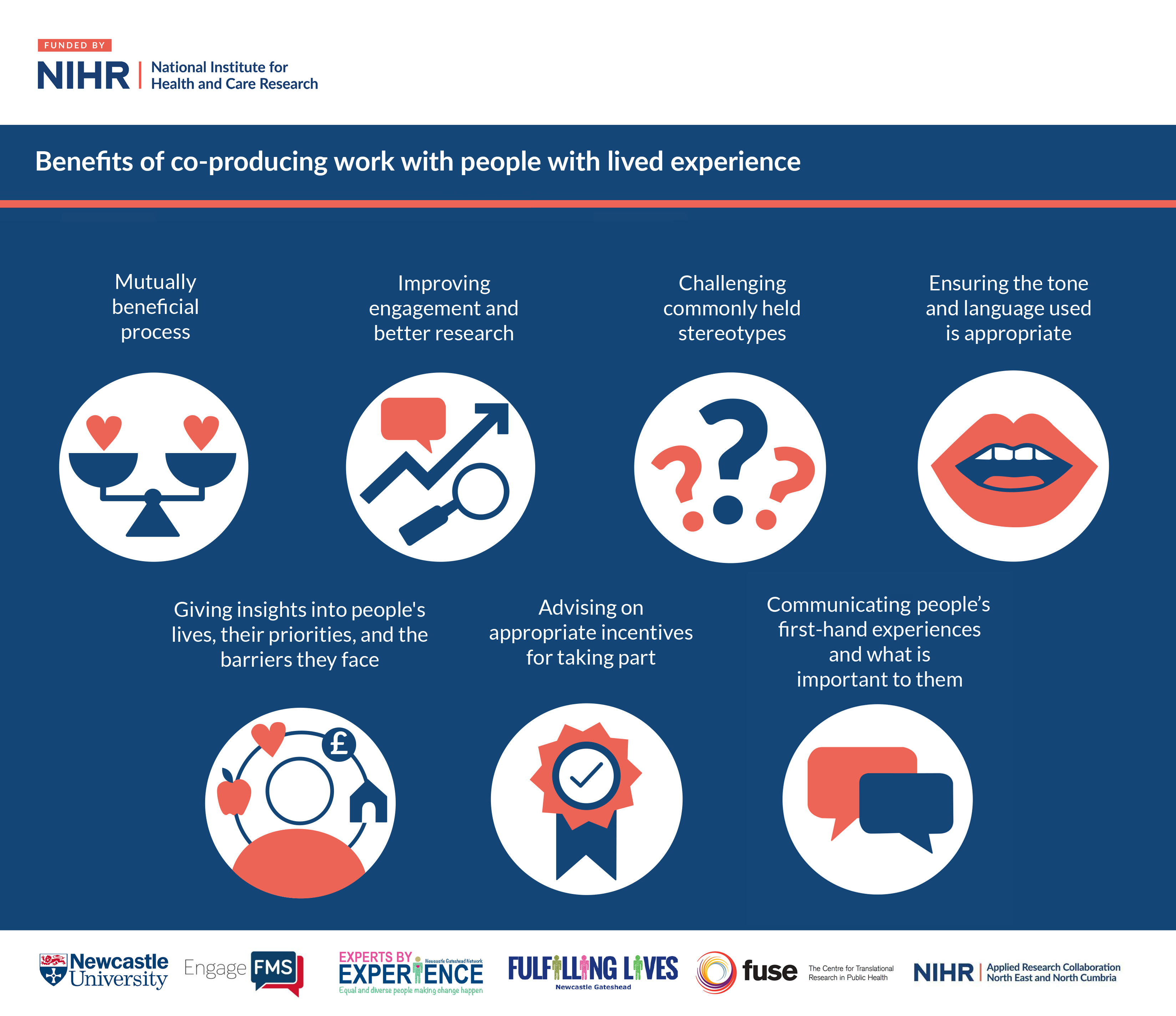
    The infographics in this blog show what we have learnt from this process of co-creating the video and the value of co-production.


    Creating a video provided an easy way in which organisations (such as Crisis, Fulfilling Lives, and other providers) and local Expert by Experience networks could share information about the study.

    Those involved in creating the video were able to draw upon their experiences to help shape the content. One of the members of the group shared their experience of the process:
    “Some of us in the Network feel really strongly about this issue and have personal experience of it ourselves so we were keen to be involved and share our ideas and opinions.”
    Another member said:
    “I joined this project because my own oral health has been something I've been embarrassed about in the past so I thought I could add something useful to this work.”
    We have tried to map out how we designed our video in the image below.


    The video has also been shared nationally with a wide range of organisations that support severe and multiple disadvantage groups in Newcastle and Gateshead, London, and Plymouth to promote engagement with policy and commissioners, local authority, criminal justice system, primary care, and third sector organisations. Producing a video was no easy feat, but it was a simple way of sharing our research with people who are pressed for time. You can check out the video below.


    A clear benefit of engaging with people with lived experience was having their input on how best to communicate our research widely. They provided real-life stories and examples, which helped create the narrative for the video. They helped challenge stereotypes of ways in which people can be portrayed in research studies - this resulted in modifying the images and language used in the video which were much more realistic and sensitive to the people we were wanting to engage. This has helped our research team become more aware of and appreciate the importance of stereotyping and how it can result in putting people off taking part in research.

    The benefits reached beyond the research team and the video (the below infographic highlights some of these), as many of the Experts by Experience echoed how involvement has led to them feeling empowered and one member wrote a blog about their experience.


    We plan to build on this collaboration as we continue our research and gain further input on findings from our study and next steps.


    This study ‘Improving the oral health and related health behaviours of adults experiencing severe and multiple disadvantage: evidence synthesis and qualitative stakeholder research’ is funded by the NIHR Policy Research Programme (grant reference NIHR200415). The video was supported by Newcastle University Engage FMS. The views expressed are those of the author(s) and not necessarily those of the NIHR or the Department of Health and Social Care.

    Friday, 25 March 2022

    Is a picture truly worth a thousand words?

    Posted by Emma Adams, NIHR ARC NENC Mental Health Fellow at Newcastle University, and Experts by Experience from Fulfilling Lives Newcastle Gateshead & #HealthNow Newcastle

    An illustration of me! Taken from one of the images
    below created by Siân from More than Minutes
    We have all heard some variation on the saying “a picture is worth a thousand words”, and yet often information is shared through large reports with thousands of words and few images. A 2019 paper published in Nature Communications highlighted that with all the information people can read, gaining people’s attention is increasingly difficult.

    Take the image of me (right), it tells you about my hair colour, glasses, outfit, that I'm partial to a tea or coffee and that I am sitting at a table. If I had written a description of everything that you can get from the picture, it would have likely taken up far more space. If it were me, I would probably only have skimmed the text. As a public health researcher, part of my job is finding ways to share research findings in a way that will engage people to want to learn more and have a conversation (something we in Fuse like to call knowledge translation).

    Alongside my Experts by Experience (individuals with lived experience of homelessness, mental ill-health, and/or substance use) we began to ponder how to share what we learned from our NIHR School for Public Health Research (SPHR) funded study exploring access to community based mental health and substance use support during the COVID-19 pandemic for individuals experiencing homelessness and those providing support. We had finally reached a point where there was a light at the end of the tunnel, as we moved away from understanding to sharing the findings. Yes, we figured we would write a couple of papers, attend some conferences, and likely write a report, but the bigger question was would the people in policy and practice and individuals experiencing homelessness read those documents? While trying to be nice, one person levelled with me and said Emma, “I’m probably not going to share a PowerPoint with a friend” and another said, “I don’t even know what that journal is”. Quickly the realisation sunk in that we were going to have to come up with a better solution for sharing our findings.

    I began to think about visuals but realised my failed attempts at drawing stick people meant I probably would not be able to do this on my own. Two of the Experts by Experience spoke about a visual they had seen designed by More than Minutes for a peer research study around barriers to accessing care and treatment for people experiencing homelessness (#HealthNowManchester). I realised in that moment we had found our answer. Suddenly the Zoom call was abuzz with energy as everyone got excited about what story our visual might tell. As one person said, “it’s aimed at people who can’t read or write, or have a disability - someone like my brother”. Perhaps even more insightful was the comment that, “it [a visual] could have a different meaning for each person depending on their own experience”. 

    We met with Siân (an illustrator from More than Minutes) and began planning the image and figuring out how to depict our endless pages of ideas into a visual that was engaging without being overwhelming. Over the next few months, we had a bit of back and forth on what we were envisioning. When the initial pencil sketch arrived, we were shocked at how the images captured so much of what we wanted to share without being a visual overload. Like kids at Christmas, we sat in suspense waiting to see what the final colour version would look like. We knew it captured exactly what we wanted when we saw the coloured versions. It was the physical depiction of everything we had learned and would proudly adorn our homes and offices! Through working with Experts by Experience and having input from colleagues in practice, we believe we have created a poster that depicts the experiences without some of the stigma we often see. Each of us saw something a little bit different in the poster, and we could not wait to share it with friends, colleagues, and providers. 

    Created by Siân from More than Minutes; See the full images on the NIHR School for Public Health Research website.

    Having had the experience of seeing words and quotes come to life, I cannot wait to do it again. Although we will continue to write papers and reports, the ability to share the images from our phones or by email with anyone has made us think about other creative ways to communicate research in the future.

    So, I end this post with a question for you, do these pictures tell a better story of the findings than a one-page summary would have? Between you, me, and our Experts by Experience, we will be returning to this visual time-and-time again whereas the paper and report might not have the same reach and engagement. 

    -----------------------------------------------------------------------------------------------------------------------------------------------------------------------------------------------------

    To make this visual freely accessible, we would welcome organisations printing their own copies. If you are printing the poster, please print it in its entirety and email Emma Adams emma.adams@newcastle.ac.uk so we can see all the places sharing our findings. A limited number of printed posters are available directly from Emma for pick up from Newcastle University.

    Initial findings from Emma’s study have now been published in the International Journal of Environmental Research and Public Health.

    A Fuse Research Programme Meeting is planned to share more information about Emma’s study. Stay tuned for the save the date and further information. 

    -----------------------------------------------------------------------------------------------------------------------------------------------------------------------------------------------------


    Emma is a Mental Health Fellow for the NIHR Applied Research Collaboration (ARC) North East and North Cumbria (NENC) and a previous NIHR School for Public Health Research (SPHR) Pre-Doctoral Fellow.  Her study 'Exploring and understanding access to community-based mental health and addiction services in Newcastle and Gateshead' is NIHR SPHR ResNet funded.

    This project is funded by/supported by the National Institute for Health Research (NIHR) School for Public Health Research (SPHR) (Grant Reference Number PD-SPH-2015-10025). Emma was supported by the NIHR SPHR Pre-doctoral Fellowship Funding Scheme (Grant Reference Number PD-SPH-2015). Emma is now supported by the NIHR Applied Research Collaboration (ARC) North East and North Cumbria (NENC) (NIHR200173). The views expressed are those of the author(s) and not necessarily those of the NIHR or the Department of Health and Social Care.

    Friday, 18 June 2021

    When, what and how to engage and disseminate research evidence during a pandemic?

    Posted by Peter van der Graaf, Teesside University, Jenni Lynch, University of Hertfordshire, and Liz Such, University of Sheffield, three NIHR Knowledge Mobilisation Research Fellows

    In this blog, we share lessons from working with local authorities on the development of action learning sets (bringing people together to reflect on research evidence) when they are faced with the many challenges of COVID-19.

    Why do we need action learning? 
    (Best-laid plans)

    We know that local authorities value research evidence to improve their decision-making about public services in times of austerity; however, making evidence fit for purpose and getting it actively used in local government remains challenging.

    So, we decided to test a potential new approach to knowledge mobilisation by convening and supporting action learning sets (ALS) across three local authorities (Hertfordshire, Gateshead and Doncaster Councils). This was supported by the NIHR Centre for Engagement and Dissemination (NCED), which not only aims to share knowledge and outputs from NIHR-funded research, but to develop the evidence base about “what works” in knowledge mobilisation.

    The ALS would bring together a group of approximately 15 stakeholders in each local authority, including public health and social care commissioners, front-line practitioners, third-sector representatives, service users and local academics to reflect on research related to a priority topic of their choice. Using deliberative dialogue, including structured questioning and reflection, participants explored different types of knowledge and relationships between knowledge producers, users and mobilisers. By applying this approach, the ALS aimed to help mobilise research and other forms of knowledge on wellbeing and equity in local government into collectively agreed action plans.

    As we started discussions with our local authority partners in Spring 2020, the full implications of the COVID-19 pandemic hit. Despite various attempts to start the ALS we regrettably had to decide to abandon the project in its current form. In this blog, we share our lessons from working with the local authorities on the development of ALS during a pandemic and what this means for future knowledge mobilisation activities from NCED when engaging with public health and social care. Our reflections focus on the when, what and how of knowledge mobilisation with local authorities.

    Research capacity during a pandemic: unethical conversations? (When)

    What the pandemic taught us is that when public health and social care research is most needed (e.g. to inform the response to COVID-19), capacity for using this research is very limited. With local authority staff being spread thin and reassigned to other parts of their councils, it was not feasible and even borderline unethical to ask them to join and prepare for action learning set (ALS) meetings. In particular senior staff within local government, who are key participants for the ALS, were in some cases absent from our early conversations. A serious question was posed: 
    "How could we mobilise research evidence to help local government in their response to COVID-19, when they hadn’t got the time or mind space to even look at a one-page summary brief?"
    We tried to make the process more accessible by moving the ALS meetings online, involving smaller groups to optimise interaction (five instead of 15 participants) and shorter sessions, with individual activities and reflection time between sessions. This helped to some extent to engage with local authority partners, but the capacity problem remained and even short online meetings where often not feasible for senior staff. However, it illustrated the value of a blended approach to ALS with a potential combination of online and face-to-face sessions to allow stakeholders to engage differently at various times in the process. We also urged them to consider topics that were immediately relevant to their current situation, e.g. working virtually through the pandemic.

    The need for relevant evidence (What)


    The Hertfordshire County Council Social Work team chose to reflect on how to interpret the Mental Capacity Act and apply strengths-based approaches when discharging patients from hospitals into the care of local authorities (discharge to assess pathways). Strengths-based approaches are a collaborative process between service users and providers to determine an outcome that draws on the person’s strengths and assets. We found a small number of NIHR funded studies but also identified useful knowledge from other sources, such as a Health Services and Delivery Research (HS&DR) Evidence Synthesis Centre Topic Report, which provided a systematic review of evidence on different strengths-based approaches within adult social work, and guidance documents produced by a law firm.

    Knowledge Mobilisers Assemble!
    Similarly, Gateshead Council selected the topic of community-based approaches to public health, focusing on how to implement these approaches with staff within the Council across different departments by applying a whole system approach. We were able to identify relevant work through our network of NIHR-funded Knowledge Mobilisation Research Fellows. For example, researchers at the University of Hertfordshire had teamed up with Hertfordshire County Council to set up a whole systems programme team and developed a joint masterclass on the topic that summarised the latest evidence.

    This illustrated a need to tap into a wide range of databases that included studies and evidence from sectors beyond health and links to a network of knowledge mobilisers to access ongoing work and publications that were not routinely published on scientific databases. We plan to support this in the development of our own website as Knowledge Mobilisation Research Fellows united in the Knowledge Mobilisation Alliance.

    Localising and tailoring of evidence: the value of dialogue (How)

    Thirdly, our conversations with partners about the planning of the action learning sets (ALS) demonstrated that local authority staff value conversations with academic researchers about the meaning of research and how-to tailor evidence to their local needs. Evidence is made fit for local commissioning and planning purposes by localising it (relating evidence to local context and needs) and tailoring it (presenting actionable messages). ALS provide a mechanism for this translational activity and a collaborative space for local authority staff to take time out from their busy jobs and reflect on research evidence (and other types of knowledge).

    Constructive dialogue was seen as most useful in supporting decision
     making, instead of researchers parachuting in with findings   
    Various staff members in local government who we talked to were already research active, engaging with research through conferences and some by undertaking PhD studies themselves. They were already mobilising local intelligence, national data and tacit knowledge in their decision making. Instead of academic researchers parachuting in with their research findings, constructive dialogue about the meaning of different types of knowledge - and where researchers and practitioners worked together as equal partners - was seen as most useful for supporting local government decision making. Facilitated conversations over a series of meetings would enable them to effectively blend different types of knowledge together to inform the commissioning of health and social care services.

    Being humble and open to challenge and dialogue are key components of any knowledge mobilisation strategy for engaging with local authorities and dissemination of health research findings.


    More commentary on action learning sets and engaging with local authorities in knowledge mobilisation below:
    • Van der Graaf P, Cheetham M, Redgate S, Clare H, Adamson A. Co-production in local government: process, codification and capacity building of new knowledge in collective reflection spaces. Workshops findings from a UK mixed methods study. Health Research Policy and Systems. 2021 Jan;19(12). https://rdcu.be/cesKm
    • Van der Graaf P, Blank L, Holding E, Goyder E. What makes a ‘successful’ collaborative research project between public health practitioners and academics? A mixed-methods review of funding applications submitted to a local intervention evaluation scheme. Health Research Policy and Systems. 2021 Jan;19(1):1-3. https://rdcu.be/cdWGC

    Images:
    1. "… of Mice And Men …" by Kristian Bjornard via Flickr.com, copyright © 2010: https://www.flickr.com/photos/bjornmeansbear/4294131461 (CC BY-SA 2.0)
    2. Pat Loika, CC BY 2.0, via Wikimedia Commons