Showing posts with label influences. Show all posts

Friday, 6 March 2020

Out of the shadows: Corporate activity and our health

Posted by Nason Maani, Harkness Fellow, Boston University School of Public Health

When considering the impact of commercial actors on health, our minds in public health turn immediately to tobacco. However, while the tobacco industry has earned its reputation and associated exclusion from policymaking, what is unique about those actors misleading policymakers and the public for commercial advantage? Arguably, nothing at all. Asbestos, leaded paint, fossil fuel, sugar-sweetened-beverage and alcohol companies and their proxies have been found to pursue similar tactics.

This is not to say that large commercial actors cannot in many cases benefit society while making a profit. Rather, it is to say that such commercial actors have a track record of focusing on maintaining profit while avoiding litigation, negative PR, and regulatory burdens. When these goals conflict with population health, such actors have the power and scale to negatively influence health, the evidence base, policy options, and even public discourse. The commercial determinants of health, in their broadest sense, are defined as activities of the private sector that affect the health of the population.

As we discussed in a recent commentary, there is a need to progress our understanding in this area because all these areas of influence matter to societal progress, and there are commonalities across many different industries in terms of their motivations, strategies, networks, tactics and interventions that merit the attention of public health researchers.
There is also currently a lack of conceptual focus on these powerful actors by policy-makers and non-governmental organisations, and some gaps in our thinking about these issues. We know that it is largely the conditions in which we are born, grow, live, work and age that determine our health, sometimes called “the social determinants of health”. However, in a recent review, we showed that commercial determinants were often absent from conceptual frameworks of the social determinants of health. This is problematic because such actors have the incentives, resources and strategic ability to influence everything from individual behaviours, attitudes and preferences, to the pollution of the environment, and the funding of politicians who are unwilling to consider the weight of evidence on a particular issue.

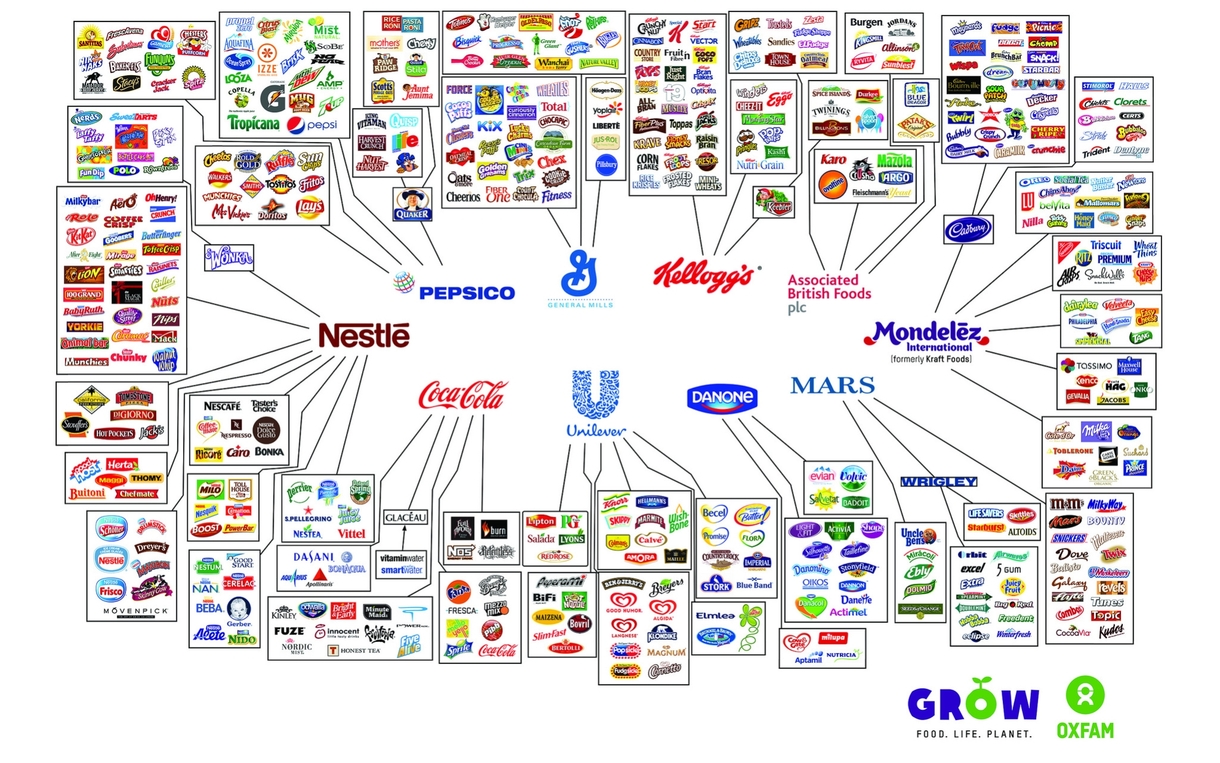
Oxfam’s infographic making the connections between big companies and some very familiar brands.


There is a large space for study in this area, but many challenges to doing so, not least because there is relatively little research funding or political will to tackle these issues directly. Many researchers and advocates remain “silo-ed”, focusing on a particular product, or discipline. This “zoomed-in” view stands in contrast to the intersectional ways in which a single large company might act, never mind an industry sector as a whole, or different industry sectors with overlapping interests, acting, for example, to diminish employment rights or environmental standards. We argue that there must be much greater scope for the convening of interdisciplinary research to explore these issues and offer potential solutions.

What about practice?

Aside from research, what about practice? There is also a need for the evidence that does exist to translate more effectively into policy. The challenge public health practitioners often face is that there is a strong political will for partnership and collaboration with the private sector at the local, national and global level, both through direct partnerships, and multilateral engagements. Such arrangements are, on the face of it, appealing. Access to the resources of the private sector is an obvious solution to the problem of increasingly restricted budgets for public health departments, particularly as these private resource pools are so large. Voluntary commitments between the public and private sectors are also conceptually appealing, echoing the type of multi-stakeholder engagement that public health advocates strive for.

However, in the UK, the evidence suggests such activities are often characterised by an abundance of words (in the form of voluntary pledges) and a paucity of deeds (in the form of meaningful changes to how harmful products are produced and marketed). Without regulatory safeguards, it appears unlikely that harmful product manufacturers will voluntarily act in ways that could reduce their own profit margins or lead to “stranded assets”. Instead, such actors will go to great lengths in framing themselves as part of the solution to a “complex” problem, while attempting to diminish the role they play in creating that problem, and rejecting what they termed “one size fits all” approaches such as policy best buys.

There is, however, progress on the research front. Research on specific harmful products and the industries that produce and market them continue apace, and commonalities in corporate strategies are being increasingly discussed. Networks of interested researchers in related topics are beginning to emerge. Perhaps most promisingly, it is becoming clear that commercial determinants are an important component of the broader determinants of health. As the “elephants in the room” become more widely perceived in issues such as alcohol harm, climate change and the opioid crisis, let us hope that, informed by a growing evidence base, the tools to properly address them will follow.


Photo attribution:
  1. "140/365 - Coke Shadow" by Adam Wyles via Flickr.com, copyright © 2011: https://www.flickr.com/photos/the-travelling-bum/5418900013 (CC BY-ND 2.0).
  2. Oxfam infographic courtesy of Oxfam, copyright © 2013: https://firstperson.oxfamamerica.org/2013/03/10-everyday-food-brands-and-the-few-giant-companies-that-own-them

Friday, 19 October 2018

What’s a night out without a takeaway?

Ingrained & intertwined risky drinking & eating habits

Posted by Stephanie Scott, Senior Lecturer in Criminology & Sociology, Teesside University

A recent Fuse blog post reflected on the ways in which alcohol and food come together in the lives of young adults (Cassey Muir and Alice Graye ‘the booze, the binge and the bulge’). For example, some young adults may eat a takeaway after a night of drinking and a fry-up the next day, some may choose not to eat prior to drinking and some may drink alcohol alongside a meal. Such reflections are based on findings from the recently completed FOrwaRD project, a study that I have had heavy involvement in as a project applicant and lead researcher.

Yet, whilst the reflections of those on the cusp of adulthood are extremely important, one of the key messages from this project and an abundance of public health research evidence is that behaviours such as risky drinking and associated eating patterns become ingrained and intertwined in our lives long before we turn 18. In other words, health behaviours cluster in adolescence and track to adulthood. Think back. How long have you associated a beer with a curry or white wine with fish or, more bluntly, that going for a takeaway at the end of a night of heavy drinking is the norm? And, are these messages instilled in us during adolescence or perhaps even earlier in childhood? We also know that an unhealthy approach towards food and alcohol is more likely for some young people than others, particularly for alcohol, where we have seen a steady decline in the overall percentages of those who drink alcohol juxtaposed against those who do drink doing so at extremely high levels.

My point here is that, not only do eating and drinking behaviours interact, but the influences on these behaviours, such as parents, peers, marketing, urban space, also overlap, and overlap from an early age. Frankly, we eat and drink certain products for pleasure, for popularity or to socialise. One way in which to tackle a growth in obesogenic and alcohol-related harm is to explore overlapping and distinct influences on these behaviours at the point in which they accelerate i.e. late childhood / early adolescence and use this knowledge in the design of interventions which link rather than separate out such behaviours.

With this in mind, we set out (using Fuse pump prime funding) to identify and synthesise qualitative research evidence into common underlying factors which influence alcohol use and unhealthy eating behaviours amongst young people aged 10–17. This involved bringing together two separate bodies of literature to enable analysis and comparison across two associated fields of study. Thus, our synthesis involves the interpretation of individual studies by identification of second-order constructs (interpretations offered by the original researchers) and third-order constructs (development of new interpretations beyond those offered in individual studies) by way of the development of a ‘model structure’ of shared influences upon both unhealthy eating behaviours and alcohol use amongst young people aged 10–17.

Of the 63 studies included in the review, 27 studies focused on alcohol whereas 36 focused on eating behaviours. Initial analysis of the data identified 16 themes, 14 of which demonstrate shared or overlapping influences on young people’s alcohol use and eating behaviours. For example, we found that both alcohol and food were used by adolescents to overcome personal problems such as to relieve stress, to push away negative feelings or emotions and in some cases to replace human interaction: “…it’s a way like any other to forget or to let off steam, it depends on the person.” (Petrilli et al., 2014).

Whilst these findings are at an exceptionally early stage, one thing is clear – there remains very little research linking young people’s eating behaviours and alcohol use together. Hopefully, emerging publications from this review and the FOrwaRD project will help to lead this change.

With thanks to the core project team Louisa Ells, Emma Giles, Frances Hillier-Brown and Wafa Elamin.


Reference:
  1. Enrico Petrilli, Franca Beccaria, Franco Prina & Sara Rolando (2014) Images of alcohol among Italian adolescents. Understanding their point of view, Drugs: Education, Prevention and Policy, 21:3, 211-220, DOI: 10.3109/09687637.2013.875128