Showing posts with label Covid-19. Show all posts

Friday, 26 September 2025

This time the hare might win: dark kitchens and the regulatory race

Posted by Helen Moore, Associate Professor (Research) & Fuse Associate, Teesside University 

Do you remember the fable of the tortoise and the hare? The one where the overconfident hare sprints ahead, but takes a nap, and lets the slow but steady tortoise win the race? Well, in today’s digital economy, that story’s getting a reboot, but this time, the hare isn’t napping.

In the world of food delivery and online ordering, the hare (the digital entrepreneurs) is wide awake and developing food purchasing opportunities at an incredible speed. Online delivery outlets, often functioning as dark kitchens, are agile, tech-savvy, and unburdened by the red tape of traditional business models. They’re using popular, well-known apps to reach huge numbers of people, launching new brands overnight, flooding menus with similar, but subtly different options and delivering meals faster than regulators can say “planning permission.” Low overheads, high levels of flexibility and choice have meant that rates of online food ordering are increasing, with the covid-19 pandemic accelerating this phenomenon.

Meanwhile, the tortoise (well-meaning but less agile local and national government) is still trying to understand the race in which it has been entered. Regulators are struggling to keep pace with a food industry that’s evolving in real time while the professionals working in local authorities hit ‘speed bumps’ which include outdated planning laws and limited evidence. For example, there is no clear use classification for dark kitchens, and some councils treat them as “industrial”, others as “sui generis” (unique), and there is inconsistent enforcement between local authorities. While some local authorities have implemented restrictions on takeaways opening close to schools, online food ordering apps mean that food can be delivered from places outside of the restricted areas. In addition, due to limitations with the recording of food outlet data, policymakers also find it hard to track spread or assess impact of dark kitchens which contribute significantly to this industry.

While innovation races ahead, regulation is not keeping pace, raising questions about public health, urban planning, and fairness. This isn’t just a story of speed, it’s also a story of systems, and unless the tortoise finds ways to modernise the traditional policy cycles to become proactive rather than reactive, and to reduce potential loopholes, the hare might just win this one, particularly as consumers like convenience and variety, which online ordering offers in abundance.

So, what can be done?

National and local authorities need to rethink how they engage with fast-moving digital industries - not to stifle innovation, but to ensure it serves the public good. We need clear national guidance on planning classifications, and health-focused planning laws that include digital-only food outlets. It isn’t all bad news though, there are some signs of progress with local authorities beginning to enforce planning permission requirements and with funded research projects examining various aspects of dark kitchens.

Free online training

To support local authorities and communities in using the planning system to promote healthier diets and reduce obesity, we have launched a new, free e-learning course called Planning for a Healthier Food Environment. The course was developed through a collaborative effort between Fuse (the Centre for Translational Research in Public Health), academic experts from Teesside University and Newcastle University, and the Office for Health Improvement and Disparities (OHID).

This one-hour online Fuse Research Event, held on 23 September, introduced the wider policy and planning context for the course, provided insights into its cross-disciplinary development, and outlined how the resource can be applied in practice to support healthier, more equitable environments.


Photo by Roman on Unsplash

Wednesday, 11 September 2024

Food insecurity in pregnancy is putting women’s health at risk and babies at a health disadvantage. That is unfair and unjust

Posted by Zoë Bell, Postdoctoral Research Fellow, King’s College London

In the three years since we started this project a lot has changed, and nothing has changed at the same time. Just as the pandemic was leaving a shadow behind us, we entered a new chapter of social and economic challenge; notably, the Russian invasion of Ukraine and Brexit fuelling a cost-of-living crisis with huge impacts on our food system and food prices. These events, in their own unique ways, have left households more vulnerable to experiencing poverty, and the topic of this blog, food insecurity.

During this time, we’ve witnessed food insecurity become a more prominent feature in the news with the help of celebrity advocates and mutual aid groups which brought communities together to support one another. Headline examples are Marcus Rashford’s campaign supporting the extension of free school meals over the summer holidays, and most recently, Taylor Swift’s donation to food banks in cities across the UK as part of her tour. Within the context of a decade long erosion of the social security safety net, the charitable sector has stepped in to provide food relief; but it’s clear this is just a sticking plaster.


While temporary economic, social and nutrition policies were put in place during the pandemic to support vulnerable families, long-term commitment has been lacking.

Time is ticking and it is the most vulnerable who are paying the price. Indeed, pregnancy is a time when the consequences of inadequate support come at a premium cost.

We know how important it is for pregnant women to eat a nutritious and well-balanced diet for their own health and for their developing baby. This is where our research fits in. We set out to pull together all the available evidence to explore whether there are differences in pregnancy risks for women and babies when they experience food insecurity.

Our two new reviews of the evidence around food insecurity in pregnancy and the links with maternal weight, diet, and pregnancy health show worrying results, including both physical and mental health risks. While we were expecting to see some health implications, the extent of the risk for poorer health was shocking. Pregnant women experiencing food insecurity were significantly more likely to have poor mental health, obesity, poor quality diets, develop Gestational Diabetes and dental problems.

Infographic to translate the review findings co-designed with experts by experience during an engagement workshop in Newcastle
Upon Tyne, North East England. Funded by Tilly Hale a Newcastle University Faculty Medical Sciences Engagement fund.


Noticeably, these reviews lacked studies from the UK with studies mainly from the USA. You might ask does this matter? Yes. Why? Because the USA has long-standing nutritional support for pregnant women, with evidence of having beneficial impacts on women's diet and health. This embedded support might have reduced or completely masked some of the associations that food insecurity has with pregnancy risks reported in these studies. Whereas in the UK nutritional programs are not as extensive and women lack support. This means we might find that the risks are worse and the need for support is greater than we currently think it is in the UK.

We acknowledge these reviews are based on observational data, exploring association rather than causation. Women experiencing food insecurity are likely living with multiple other causes of stress that could be contributing to food insecurity and pregnancy risks. Nevertheless, we see from the evidence to date that these women are at risk and need more support. Our ongoing work exploring experiences of food insecurity during pregnancy also suggests that current support initiatives are not doing enough, and further policy-related intervention is required, further emphasising the need for action now.

Our new reviews show that food insecurity during pregnancy contributes to health inequalities, putting women’s health at risk, and babies at a health disadvantage from before a they are born. For example, when babies are exposed to gestational diabetes or maternal obesity, they are more likely to develop type 2 diabetes or obesity themselves later in life. That is unfair. That is unjust. So, we ask, how much more evidence is needed before urgent policy action is taken to mitigate food insecurity?

Much more support from government is needed to make sure that women and babies are protected from food insecurity during pregnancy. Only time will tell if tides will turn under this new Labour government.

So, what do we suggest?

First, an uplift in the value of the Healthy Start scheme, a policy directly related to nutrition during pregnancy and early years. Second, greater integrated care across multiple sectors for women during the pregnancy period. Thirdly, considering the wider interlinked, structural barriers for families living in poverty (and based on our broader research program) removal of the two-child benefit cap, continued expansion of childcare support and of free school meals. These policies would relieve financial pressures on households with young families.

In the meantime, watch this space as our research team has two ongoing reviews exploring pregnant women and people's experiences of food insecurity and its relationship with breastfeeding and infant feeding. Some of our other ongoing studies are exploring the experiences, risks and support needs of women during pregnancy and in the postnatal period after birth, and their families across a diverse UK population in Gateshead, Coventry, Middlesbrough, Lambeth and Bradford.

If you are inspired to help add evidence and advocate for food security amongst mothers and children, then please consider becoming a member of our Nourishing Futures Network. This was established by Fuse members working with international colleagues. The network’s mission is to lead knowledge exchange and generate knowledge in this emerging field around food insecurity before and during pregnancy and in the first 2001 days of life.


Find out more

This research has been summarised in the following:

Friday, 26 January 2024

A new social contract for Public Health

By David Hunter, Newcastle University; Peter Littlejohns, King’s College London; Albert Weale, University College London; Jacqueline Johnson, public health and management consultant; and Toslima Khatun, King’s College London

Air pollution is widely recognised as a serious health hazard while Covid-19 shone a spotlight on the weaknesses of the UK’s public health system

The UK is in the grip of a public health crisis. With depressing regularity, new research shows the growing deterioration of the public’s health. Improvements in life expectancy have stalled, health inequalities have widened, obesity and alcohol misuse are placing an increasing strain on health services, and air pollution is now widely recognised as a serious health hazard. While Covid-19 shone a spotlight on the weaknesses of the UK’s public health system, they had existed for some time. Indeed, as Michael Marmot has argued, most of the deterioration in health stems from 2010 and the Coalition government’s austerity policy. This resulted in cuts to public spending with local government, which is responsible for public health, suffering some of the deepest.

Despite the wealth of evidence testifying to the parlous state of public health and with many studies offering solutions that are both cost-effective and for which there is robust evidence, there remain significant political and organisational barriers to the realisation of an effective public health system. Unless these are confronted, the chances of progress are slim.

A new social contract for public health

We support the case for a new social contract in which health policy is truly public. Public health policies are often criticised by those of a neoliberal persuasion for restricting individual choice and for ‘nanny statism’. We refer to this form of liberalism as ‘vulgar individualism’. Big government and state overreach are viewed as problems which stifle personal freedom and hinder private sector growth on which the economy depends.

In fact, a much bigger problem is state underreach and a failure to take up and apply policies and policy instruments that are known to be effective in order to improve health. But as long as governments continue to subscribe to the view that the health of individuals is a matter of personal responsibility then action of the kind needed will not be forthcoming. Over the past 13 years or so, successive governments have subscribed to this view ignoring all the evidence which demonstrates the flaw at the heart of such thinking, namely, a belief that that government is best which governs least.

In place of such a stunted political ideology we propose a new social contract for public health incorporating the principles of what might be termed ‘social individualism’, that is, a commitment to using the instruments of collective political authority to create the conditions for individual choice and fulfilment.

What are the elements of the new social contract for public health?

First, and importantly, a social contract for public health would focus on prevention, reflecting the significant body of evidence demonstrating how a wide range of public health measures would prevent more serious conditions developing. But while it is easy to state all this, as indeed numerous academics and analysts have done over many years, unless political leadership is in place to confront the challenges the prospect of change happening is slim.

A particular challenge is the tension arising from the urgent driving out the important. With an NHS under extreme pressure in respect of growing waiting lists and staff shortages, for electoral and other reasons, politicians are most likely to prioritise addressing these to the exclusion of longer-term public health measures. Yet, as the Hewitt Review of Integrated Care Systems points out, ‘we have mistaken NHS policy for healthcare policy’.

Second, a new social contract requires a precautionary state, paying attention not only to known hazards but also to remote and uncertain ones. If the pandemic taught us anything, it was the need to be prepared and have sufficient resources in place to enable swift and effective action to be taken. Sadly, for a government emerging from the debacle over Brexit and trapped in a mindset of short-termism with a focus on campaigning rather than governing, adopting a policy of precaution does not come naturally.

Third, social solidarity is required in the face of health inequalities. Social individualism recognises that policies for the most vulnerable are not policies for a particular group in society, but policies for all of us when in need. What is required from public policy is the support to resilience over the life cycle.

Fourth, a new social contract requires a different approach to government and governance. In particular, addressing the short-termism that pervades our politics has to be challenged and replaced by a more sober acknowledgement of how governments need to function. A populist politics that wishes away the need for planning and relies on easy, facile slogans to attain and retain office – ‘the unbearable lightness of politics’ as the historian, Tony Judt, put it – undercuts the seriousness that is needed for effective government.

Above all, a new social contract sees a central role for an active state. To this end, we set out a manifesto to frame the approach to public health that is needed in the hope that it might inform the political debate as preparations get underway for a general election due over the next year.

A manifesto

Much that needs to be done already exists and is supported by a sound evidence base as well as by the main UK public health bodies. The Hewitt Review’s plea for priority to be given to population health matched by new investment is also worth acting on. Some measures could be swiftly adopted by a new government if it so chose. Others will take longer but making a start by implementing what be done quickly would make most sense in tackling the crisis facing public health.

Above all, regardless of the particular topic demanding attention, at the heart of public health policy is the need to work in a cross-organisational and cross-sectoral way. This will not happen without strong political leadership, but to embed a cross-government commitment to public health requires new legislation to place a duty on all government departments to respect in their policies the claims of public health. To monitor how policy is taken forward and implemented, there is a strong case for making the publication of health impact statements obligatory.

If the winds of change blowing through the country offer a turning point in the public’s health, then the incoming government has no time to lose in seizing the opportunity.


For an extended discussion of the issues raised go to our new book: Littlejohns P, Hunter DJ, Weale A, Johnson J and Khatun T (2024) Making Health Public: A Manifesto for a New Social Contract. Bristol: Policy Press

Bristol University Press | Making Health Public - A Manifesto for a New Social Contract, By Peter Littlejohns, David J. Hunter, Albert Weale, Jacqueline Johnson and Toslima Khatun


Authors

David J Hunter, Emeritus Professor of Health Policy and Management, Population Health Sciences Institute, Newcastle University

Peter Littlejohns, Emeritus Professor of Public Health, Centre for Implementation Sciences, Institute for Psychiatry, Psychology and Neurosciences, King’s College London

Albert Weale, Emeritus Professor of Political Theory and Public Policy, University College London

Jacqueline Johnson, pubic health and management consultant

Toslima Khatun, teaching fellow, King’s College London


References

The answer starts with austerity, The Guardian, 10 August

Hewitt P (2023) The Hewitt Review: An independent review of integrated care systems, GOV.UK https://assets.publishing.service.gov.uk/government/uploads/system/uploads/attachment_data/file/1148568/the-hewitt-review.pdf

Judt T (2010) Ill Fares the Land. Harmondsworth: Penguin Books 


The views and opinions expressed by the authors are those of the authors and do not necessarily reflect those of Fuse, the Centre for Translational Research in Public Health.


Image:
Image by Jacques GAIMARD from Pixabay.

Friday, 27 January 2023

Public Health at a crossroads again: meeting the challenge of a reformed system in England

Posted by David Hunter, Newcastle University, Peter Littlejohns, King’s College London, and Albert Weale, University College London


With health policy understandably preoccupied with the pressures on, and changes occurring in, the NHS arising from the impact of COVID-19, implementation of the Health and Care Act 2022, and various strikes among the workforce, it is imperative not to overlook the public health system reforms in England.

Public Health England’s (PHE) sudden demise in August 2020 followed mounting criticisms of its performance during the early stages of the pandemic and general unpreparedness.1 Rather than consider how PHE might be reformed, the government rushed to replace it with two new bodies: UK Health Security Agency (UKHSA), and Office for Health Improvement and Disparities (OHID). Like PHE, the UKHSA is an executive agency with close ministerial oversight while still permitting ‘independence in the delivery of policy advice’. It will act as a ‘system leader’ for health security with responsibility for pandemic preparedness and external threats across the UK while bearing in mind that health is a devolved responsibility.

PHE’s remaining functions in respect of the wider public health, including health improvement and population health, lie with OHID. Located within the Department of Health and Social Care (DHSC) and jointly accountable to the Secretary of State for Health and Social Care and the Chief Medical Officer for England, it enjoys even less independence than the UKHSA. Building on the work of PHE, OHID’s priorities include tackling obesity, improving mental health, promoting physical activity and other population health issues, notably inequalities.

There is merit in taking stock to identify any lessons which might be gleaned from the mixed life of PHE and whether the new bodies offer hope to do things better.2

Learning the lessons

The findings from a research project to explore the circumstances surrounding the rise and fall of PHE may assist with the learning process.3 Five broad underlying issues were identified in the research which contributed to PHE’s demise.
  • PHE did not possess the capacity to undertake a testing regime
     of the size and complexity required by the pandemic
    Severe funding cuts in public health spending, nationally and locally, since 2010 meant that PHE functioned with reduced capacity when the pandemic struck
  • PHE did not possess the capacity to undertake a testing regime of the size and complexity required by the pandemic, the absence of which was the basis of the case against the organisation
  • The governance of PHE as an executive agency meant it lacked independence
  • While decisions made by PHE at the start of the pandemic were later considered mistakes (and judged outside the law by a judicial review) at the time there was little information about the nature and possible effects of the virus and limited capacity in the health system which required tough prioritisation decision to be made
  • The sudden closure of PHE without any consultation was widely reported to be due to blame-avoidance behaviour on the part of key actors, principally Dominic Cummins (as former Chief Advisor to the Prime Minister, Boris Johnson) and Matt Hancock (as former Secretary of State for Health and Social Care). There was also a view that the decision was based on policy favouring use of the private sector and contracting out functions like test and trace.
Key lessons from these findings centre on two major areas of concern: the respective remits of the new bodies, and their governance.

Remits


The respective remits of UKHSA and OHID need to be clearer and more transparent if the risk of fragmentation is to be avoided. A welcome feature of PHE was its attempt to bring together the key public health functions that had previously operated in separate silos. As things now stand, separating communicable diseases (CDs) from non-communicable diseases (NCDs) is a retrograde move since, as the pandemic highlighted in stark terms, close links exist between them when it comes to those groups and communities which suffered most in terms of illness and death. A syndemic understanding of diseases and their underlying social factors is pivotal in preventing disease in the future and avoiding fragmentation.4

Governance


Governance of the new public health bodies requires careful attention. As an executive agency, PHE was criticised for its lack of independence from government which restricted its ability to ‘speak truth to power’. Given UKHSA enjoys the same status, it remains unclear how it intends to avoid a similar fate. The problem is a deep-seated and pervasive one within government. The idea that OHID being housed in the DHSC will allow it to exercise greater influence and have a closer collaboration with ministers could be a good move, or, more likely if history is any guide, it may be overly optimistic. There is a risk that OHID may disappear into Whitehall and become invisible, lacking even the limited degree of independence PHE had. To succeed, OHID has to be visible and have allies inside government.

A further issue concerning the governance and working style of both agencies, especially OHID, centres on their ability to operate effectively across government. Public health comprises numerous ‘wicked issues’, that is, multi-faceted problems that are complex and for which there are no simple or single solutions. Confronting them will be especially challenging for a government which, for all its rhetoric about ‘levelling up‘, remains topic- and department-focused, operating in silos rather than concerned with cross-government issues.5

OHID has a steep hill to climb if it wants to lead a transformational agenda across the wider determinants of health which demands a whole-of-government approach. The hill just got steeper following government delays in tackling child obesity and its failure to implement a national food strategy. In keeping with the prevailing political ethos, there is a renewed focus on individual behaviour change and lifestyle choices rather than tackling the influence on health of commercial interests via taxation and regulation.6,7 If significant inroads into the population health agenda are to be made, then confronting powerful vested interests in, and lobbying from, the food and drinks industry and their ’friends’ in government engaged in what has been termed ’institutional corruption’ cannot be avoided.8 Whether OHID has either the backing from government or competences for such a struggle remains doubtful in the extreme.

Conclusion

Public health once again finds itself at a crossroads. It can either continue to ‘muddle through’ with a broken political and public policy system that is not fit for purpose.9 Or there is an opportunity to construct a strong and confident public health system that is well-placed to confront the challenges facing it. The aftermath of COVID-19 should make the choice of options self-evident. However, as things stand, it is unlikely that the UK’s broken political system with its focus on short-term fixes is up to the challenge. Without major systemic change aimed at overhauling the UK’s political system, a risk of further deterioration in the state of the public’s health may be unavoidable.


References:
  1. Calvert J, Arbuthnott G. Failures of state: the inside story of Britain’s battle with coronavirus. London: Mudlark, 2021. https://harpercollins.co.uk/products/failures-of-state-the-inside-story-of-britains-battle-with-coronavirus-jonathan-calvertgeorge-arbuthnott?variant=39528280391758
  2. Vize R. Controversial from creation to disbanding, via e-cigarettes and alcohol: an obituary of Public Health England. British Medical Journal 2020; 371:m4476 http://dx.doi.org/10.1136/bmj.m4476
  3. Littlejohns P, Khatun T, Knight A, Hunter DJ, Markham S, Coultas C, Kelly MP, Ahuja S. (2022) Lessons from the demise of Public Health England: where next for UK public health? London: NIHR ARC South London. https://arc-sl.nihr.ac.uk/sites/default/files/uploads/files/public-health-report-sept-2022-final.pdf
  4. Horton R. Offline: COVID-19 is not a pandemic. The Lancet 2020; 396: 874. https://doi.org/10.1016/S0140-6736(20)32000-6
  5. Pope T, Shearer E, Hourston P. What levelling up policies will drive economic change? The need for a long-term focus on skills and cities. London: Institute for Government, 2022. https://www.instituteforgovernment.org.uk/publications/levelling-up-policies?
  6. British Broadcasting Corporation (BBC). Junk food: obesity strategy falling apart, Jamie Oliver says. 15 May 2022 https://www.bbc.co.uk/news/uk-61449921
  7. Ralston R, Smith K, O’Connor CH, Brown A. Levelling up the UK: is the government serious about reducing regional inequalities in health? British Medical Journal 2022; 377:e070589 https://doi.org/10.1136/bmj-2022-070589
  8. Draca M. Institutional corruption? The revolving door in American and British politics. SMF-CAGE global perspectives series: 1. 2014. http://www.smf.co.uk/wp-content/uploads/2014/10/Social-Market-FoundationInstitutional-Corruption-the-revolving-door-in-American-and-British-politics.pdf
  9. Ricketts P. Hard choices: the making and unmaking of global Britain. London: Atlantic Books, 2022. https://atlantic-books.co.uk/book/hard-choices

David J Hunter, Emeritus Professor of Health Policy and Management, Population Health Sciences Institute, Newcastle University

Peter Littlejohns, Emeritus Professor of Public Health, Centre for Implementation Science, Institute for Psychiatry, Psychology and Neurosciences, King’s College London

Albert Weale, Emeritus Professor of Political Theory and Pubic Policy, University College 
London


The views and opinions expressed by the authors are those of the authors and do not necessarily reflect those of Newcastle University, King’s College London, University College London, or Fuse, the Centre for Translational Research in Public Health.

Friday, 16 December 2022

Walking football for people with chronic breathlessness – has it got legs?

Posted by Callum Bradford, Research Associate, Teesside University

Following on from the recent success of the England Women’s football team, and with the Men’s World Cup final just around the corner, now seems like a good opportunity to talk about our walking football project, designed exclusively for people with chronic breathlessness. What is walking football you ask? Well it's football, without running (you don’t say?!), and the physical contact is a bit more restricted. Thankfully, FIFA hasn't got its hands on walking football just yet, with the World Cup being an example of why we perhaps should avoid such a thing.


Chronic Breathlessness is predominantly caused by pulmonary conditions, such as chronic obstructive pulmonary disease (COPD), impacting 75 million people globally. With Covid-19 and an ageing population this number is expected to rise, increasing the burden on families, carers, and health and social care services. For individuals, breathlessness is associated with a lower quality of life, decreased capacity to do exercise, and higher levels of anxiety and depression

Pulmonary rehabilitation is recommended for everyone with breathlessness. Consisting of both exercise and education, its benefits on health are unequivocal, however, any benefits gained by patients are often reduced three months after completion. This is primarily because patients go back to doing less physical activity once the programme has finished and support from healthcare professionals is removed. With this in mind, we wanted to develop an intervention that could step-in when patients finish their rehabilitation, offering a form of exercise maintenance and continued social support. Given the nation's love of football (most of the time), we believed walking football might have potential.

To develop the intervention, we initially consulted pulmonary physiotherapists, and a local walking football team. The physios were initially very sceptical, raising concerns that the pace would be too fast, and highlighting the number of people with breathlessness who required oxygen or walking-aids. Walking-aids?! Oxygen?! I hadn't even considered that. I was starting to worry that this idea might be a complete non-starter.

So next stop was to see some walking football for myself at Middlesbrough’s Herlingshaw Centre. I left the session with mixed feelings. They played three-touch, meaning everyone got the opportunity to play, forcing that one player who thinks they're Allan Saint-Maximin to pass the ball. It was also proactively refereed to the benefit of everyone, with players encouraged to talk to the ref if they felt the pace of the game was too fast. However, after giving it a go myself, the pace was still surprisingly quick, despite what Father Ted might have you believe, bringing back concerns as to whether it would be too high an intensity. What I really needed to know was what patients themselves thought of walking football.

So we linked up with Breathe Easy Darlington, a local support group for people with lung conditions. Describing the input from Breathe Easy members as invaluable to our research over the last few years would be a massive understatement. So much so that, as a small thank you, we held a fundraiser for them last month on World COPD Day, raising £1120.76.

Their opinions would be vital to walking football’s success... however, they were also dubious of the idea. Again, concerns were raised about the speed, the walking-aids, and the balance required to play. So I asked, under what circumstances – if any – would they consider giving walking football a go? They stated that if the football was exclusive to people with breathlessness like themselves, they would give it a try, as they would be able to dictate the pace of the game and not feel too self-conscious of their footballing abilities. Our original plan involved asking patients to join onto sessions at the Herlingshaw. Luckily, by consulting with Breathe Easy members, I now understand how that plan – to mix people with and without breathlessness - would have likely ended in disaster, demonstrating the importance of including end-users when designing research studies.

Twelve Breathe Easy members agreed to play and the stage was set for our walking football taster sessions, and as you can see from our video, I don't think it could have gone much better.

The players embraced the competitive aspect of football, stating that “On the pitch you forget about breathlessness”; and the concern for walking-aids was turned on its head after we agreed that hitting the ball with a walking-stick is a perfectly fine way to score a goal. Our coach, Monty Towers, was key to its success, mixing up the session with fun games, while allowing everyone to play football at their own pace. In our follow-up conversations, members also suggested implementing a buddy system, where more experienced participants take responsibility for introducing new patients to the group so they feel more welcome – a brilliant idea that we intend to implement in the future.

Throughout 2023 we will be assessing the feasibility of walking football following pulmonary rehabilitation in collaboration with both North Tees & Hartlepool and South Tees NHS Foundation Trusts, plus the North Riding FA; and I’m confident if it’s anything like our sessions with Breathe Easy members, it will be a great success.

And if you’re still upset about the World Cup, don’t worry, I’m sure our walking football team will bring it home next year.


The views and opinions expressed by the author are those of the author and do not necessarily reflect those of Teesside University or Fuse, the Centre for Translational Research in Public Health.

Friday, 25 November 2022

How can we give our communities the Best Start in Life?

Posted by Liam Spencer, ARC North East & North Cumbria Mental Health Fellow, Newcastle University

Having had a background in youth and community work within a local authority, the question contained in the title of this blog is one close to my heart.

It is also the name that South Tyneside Council gave to one of their projects - the Best Start in Life (BSIL) Alliance - which really struck a chord with me, especially as my research interests focus on children and young people’s mental health.

I first learned about the project back in May 2019, when I attended an AskFuse brokering event for the Public Health Practice Evaluation Scheme (PHPES) of the NIHR School for Public Health Research. At this event Anna Christie, the Public Health Knowledge and Intelligence Lead for South Tyneside Council, presented on the BSIL Alliance, focussing on three initiatives: Locality Hubs; Mental Health Champions; and Young Health Ambassadors.

This was the beginning of a partnership between Fuse researchers and South Tyneside Council, and after successfully being shortlisted and then submitting a full-length application, in October 2019 we were delighted to learn that our proposal had been accepted – out of 91 registrations of interest for the 2019 PHPES funding call, ours was one of only 10 proposals that were successfully funded!

Best-laid plans

By the time the project started in April 2020, we were living in very different times to when we planned the evaluation, due to the Covid-19 pandemic.

We had hoped as researchers to be embedded within South Tyneside Council; this was not possible.

We had planned to include the Locality Hubs within our evaluation; these were not able to be launched.

Routine data we had planned to include in a cost consequence analysis (a form of economic evaluation where separate costs and a range of outcomes are presented to allow readers to form their own opinion on the relevance and relative importance of interventions) were either not collected or were severely impacted.

Moving from Plan A, to Plan B, to Plan C is commonplace in research, however, throw a global pandemic into the mix and you can find yourself quickly wheeling through all the letters of the alphabet whilst trying to stick to the original plan for your research! Despite the hurdles we had to overcome – the dedication and commitment from our colleagues at South Tyneside Council, and the Fuse team endured, and we were all determined to deliver on the project.

Insightful discussions at the Fuse Research Event in South Tyneside
Fast-forward to the present day and we have completed our evaluation. Thankfully, only being able to meet virtually is a thing of the past and on Wednesday 12 October we were joined by practitioners from local authority and third sector organisations, researchers, and students from across the region, for a Fuse Research Event at The Customs House in South Shields, to finally share learning from our evaluation! The event included academic contributions from myself, Ruth McGovern (study lead), and Sam Redgate, along with Anna Christie, Tom Hall (Director of Public Health), and Chrissy Hardy (Public Health Practitioner, Children & Young People) from South Tyneside Council.

Supporting young people’s mental health

Our findings showed that the successful implementation of Alliances in public health and social care related services within Local Government is dependent upon achieving a system level approach, whereby thinking, methods, and practice are applied to better understand public health challenges and identify collective actions across services. Placing local people at the heart of the system, and creating a cultural shift is also key to a successful Alliancing approach. Mental Health Champions and Young Health Ambassadors were found to influence system change by generating mental health awareness and facilitating more inclusive and supportive environments for children and young people.

As well as sharing findings from the evaluation, we wanted this in-person event to be interactive and collaborative, and asked those who attended to think about the similarities and differences between the Mental Health Champion and Young Health Ambassador initiatives. I thought it was really interesting that people recognised that these initiatives share a similar ethos, with commonality of goals and outcomes – to support young people’s mental health, in both proactive and reactive ways. Attendees felt it was important that both approaches are organic, with ideas emerging ‘from the bottom-up’. Volunteers can utilise the Alliance in a productive way, by accessing training and events, and securing buy-in from senior stakeholders, with support from Chrissy, the facilitator of both initiatives. I was so grateful for all the meaningful and insightful contributions provided, which are proving to be very useful in guiding the write-up of our findings – ensuring that they are as relevant to practice as possible.

We are very thankful to our colleagues at South Tyneside Council for collaborating with us on this project (despite the barriers we faced along the way!) – and we really hope that the findings from this work will help shape their future policies and practices. Personally, this evaluation provided me with an opportunity to learn more about current local initiatives, engage with passionate practitioners and young people, and build some really fantastic relationships with colleagues at South Tyneside Council. I thought that the event was a wonderful way to bring people together from across the region, to share our findings, and to draw the project to the close. A big thanks to the Fuse team for making it happen!

Find out more:


Friday, 14 October 2022

Media representations of disabled people

Posted by Laura Navin, Health and Social Care student, Northumbria University

Picture by Laura Navin
Negative media representations of disabled people still exist in society and this needs to be addressed. I have dyspraxia which is a learning difficulty, and I sometimes struggle with my co-ordination, communication, processing and speed but it has not stopped me from achieving my goals!

In the media, disability tends to be portrayed through a medical or deficit model, with disabled people often treated as pathetic.1,2,3 TV charity shows such as Children in Need encourage pity for disabled people2 and people with disabilities are still seen as “the heavy burden of care”; “the helpless victim”.3 Yet even when well-meaning, encouraging pity is discriminatory as it creates stereotypical and negative assumptions about disabled people2. These negative representations can decrease a disabled person’s self-esteem and make them feel like they are not part of society.1,4

The issue is heightened by the absence of disabled people and their voices within mainstream media which might help to reclaim the narrative and counter negative stereotypes. As Caroline Casey, founder of The Valuable 500, a global movement putting disability on the business leadership agenda, has suggested “from daytime TV to adverts on social media, to the articles which publications run, representation and visibility of persons with disabilities simply does not reflect our society”. This was brought to light recently for example, when Sia’s decision to cast a neurotypical actress in the role of an autistic female protagonist in her upcoming film was widely criticised.

There are more positive portrayals of disability in the media however. Harry Potter star, Daniel Radcliffe has dyspraxia and acted as an inspiration to many when saying, “do not let it stop you. It has never held me back.”. In 2018, Lee Ridley from the North East won Britain’s Got Talent and in 2021, EastEnders star Rose Ayling-Ellis became the first deaf contestant on Strictly Come Dancing. Even these more positive representations are emblematic of the failure to represent disabled people as everyday, ordinary citizens however. As Lee Ridley claims, “Our government has a very weird relationship with disabled people. We are either seen as superhuman or as some sort of burden”.

Portrayals of disabled people as a burden on society have been shown throughout both austerity and the Coronavirus pandemic. Disabled people have been mocked as ‘scroungers’ in television shows and newspapers, with arguments that incapacity benefit had become a ‘lifestyle choice’ for the lazy, and that a disability benefit crisis was responsible for the UK economic crash resulting in the disproportionate targeting of disabled people within austerity measures.5,6 Covid has been argued to be one of the biggest media outbreaks medicalising disabled people.1,7 During the pandemic, disabled people were seen as ‘vulnerable’ and had to isolate from society.5,8 ‘Vulnerable’ is a label that is often rejected by people with disabilities and its adoption does not portray the importance of disabled people’s rights and viewpoints.9 Labels such as ‘vulnerable’ or ‘immunocompromised’ when used to explain differential susceptibility to illness have also been argued to result in an unreasonable, unpleasant message about the value of disabled people’s lives. The sunflower lanyard which could be worn by disabled people to show they were exempt from wearing face masks helped in some ways to increase disability awareness and create more understanding, support and respect towards disabled people. However, this is another form of labelling, and not all disabled people want to identify their disability to the world. Greater understanding and training on disability ethics is urgently needed to avoid this sort of discrimination and support disabled rights more systemically.9,10


It is also important that disabled voices are heard in society and that the media represents disabled people in a more positive light. Sometimes when I tell people about my dyspraxia they feel pity for me, but this is not what I want. I am telling my story to inspire others, not create sympathy, so please do not feel sad for me, feel happy for me! I have succeeded in my academic studies and graduated from university with second-class honours as a student with dyspraxia. I have been involved in podcasts and dissertation writing to raise my voice as a disabled person and in doing so I hope to give others the confidence to do the same. I am now studying for a postgraduate certificate in education (PGCE) to teach health and social care. I hope to continue to raise my voice and to inspire others.


Part of our Fuse blog Student Series
The Fuse blog Student Series showcases posts by students who have been challenged to write a blog as part of their studies at one of the universities in the Fuse collaboration, the NIHR School for Public Health Research, or perhaps further afield. The authors may be new to blogging and we hope to provide a 'safe space' for the students to explore their subject and find their voice in the world of public health research.

The views and opinions expressed by the author are those of the author and do not necessarily reflect those of Northumbria University or Fuse, the Centre for Translational Research in Public Health.


References

1) Cameron, C. (2014) Disability Studies: A student’s guide. London: SAGE Publications Ltd.

2) Barnes, C. (1992) Disabling imagery and the media: an exploration of the principles for media representations of disabled people. Halifax, England: The British Council of Organisations and Disabled People and Ryburn Publishing Limited.

3) Goethals, T. et al. (2020) ‘I am not your metaphor: frames and counter-frames in the representation of disability’, Disability & Society, 12 (1), pp.1-19. DOI: https://doi.org/10.1080/09687599.2020.1836478.

4) Casey, C. (2020) ‘Where all the disabled people on screen? We must increase representation or risk reinforcing damaging stereotypes’, Independent, 1 December. Available at: Where are all the disabled people on screen? We must increase representation or risk reinforcing damaging stereotypes | The Independent (Accessed: 22 March 2022).

5) Ryan, F. (2019) Crippled: austerity and the demonization of disabled people. London: Verso.

6) Briant, E. et al. (2013) ‘Reporting disability in the age of austerity: the changing face of media representation of disability and disabled people in the United Kingdom and the creation of new ‘folk devils’, Disability & Society, 28 (6), pp.874-889. DOI: 10.1080/09687599.2013.813837.

7) Shakespeare, T. et al. (2021) ‘Triple jeopardy: disabled people and the COVID-19 pandemic’, The Lancet, 397(10282), pp.1331-1333. DOI: https://doi.org/10.1016/S0140-6736(21)00625-5.

8) Courtenay, K. and Perera, B. (2020) ‘COVID-19 and people with intellectual disability: impacts of a pandemic’, Irish Journal of Psychological Medicine, 37, pp.231-236. DOI: 10.1017/ipm.2020.45.

9) Singh, S. (2020) ‘Disability ethics in the coronavirus crisis’, Journal of Family Medicine and Primary Care, 9 (5), pp.2167-2171. DOI: 10.4103/jfmpc.jfmpc_588_20.

10) McLean, S. and Williamson, L. (2007) Impairment and disability: Law and ethics at the beginning and end of life. Oxon: Routledge-Cavendish.

Friday, 12 August 2022

What impact did a blanket ban on new takeaways have in Gateshead?

Posted by Heather Brown, Professor of Health Inequalities at Lancaster University

At the end of a road I used to live on, there was a wonderful curry house that always smelled amazing every time you walked by, even if it was 8am in the morning and they were just starting to prepare the food for the day. Whilst I lived there, I ate more takeaway curries then I have in any of my other many houses which were not so conveniently located to delicious smelling food.

The food available to us in our environment is likely to influence what we eat and subsequently our health. The use of planning policy can be one way for both local and national government to help shape a healthy environment by limiting or restricting where certain types of food outlets can be located. About half of all local authorities in England have some type of planning guidelines to restrict new fast-food outlets. In England there are three main types of planning policy used to promote a healthy food environment:

1. restricting new fast-food outlets near schools.

2. restricting new fast-food outlets if the density of existing outlets has surpassed a certain threshold of all retail outlets (e.g. no more than 20% of all outlets can be fast-food).

3. restricting new fast-food outlets if childhood obesity rates are above a certain threshold (e.g. above 20% based upon data from National Childhood Measurement Programme for children aged 4-5 and 10-11).

What Gateshead did


Gateshead Council, like many local authorities in North East England, has childhood overweight and obesity rates that are higher than the national average. To try and reduce childhood overweight and obesity to less than 10% by 2025, Gateshead implemented all three types of planning guidance (a school exclusion zone, restricting new outlets by retail density, and restricting new outlets by childhood obesity rates). This is effectively a blanket ban on establishing a new premise for use as a fast-food outlet if the building was not already being used for that purpose. Buildings that were being used for fast-food could change ownership and continue to sell fast-food. This guidance was implemented in June 2015.

As part of an NIHR Applied Research Collaboration (ARC) North East and North Cumbria (NENC) funded project, we evaluated if Gateshead Council’s approach to planning had any significant impact on the density and proportion of fast-food outlets in Gateshead compared to other local authorities in the North East which did not have any type of planning guidance. Data on food outlets came from the Food Standards Agency Food Hygiene Rating Scheme Data. Our analysis covered 2012-2019 (we did not include data during the Covid-19 pandemic because planning guidance on what type of food outlets could provide takeaways was relaxed) - a subject covered earlier this week in the Fuse blog post How Covid-19 changed the takeaway landscape by Callum Bradford from Teesside University.

What we found


We found that compared to other local authorities in the North East, Gateshead’s planning policy reduced the density of fast-food outlets by around 13 per 100,000 people and the proportion of fast-food outlets by around 14%.

Next, we are going to look at if this change in the density and proportion of fast-food outlets has had any impact on childhood overweight and obesity between 2015 to 2019 and if this did anything to reduce inequalities in childhood weight.

If you would like to read our paper in Social Science and Medicine on the impact of Gateshead’s planning policy on the food environment you can find it here.

Tuesday, 9 August 2022

How Covid-19 changed the takeaway landscape

Posted by Callum Bradford, Research Associate, Teesside University

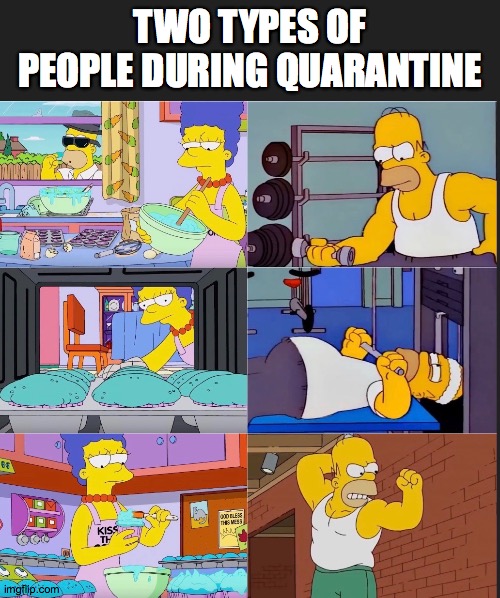
During the Covid pandemic, you may have seen the memes for how there are two types of people during lockdown. First there were those who used lockdown as an excuse to exercise more, eat well, and generally take care of themselves in a manner of which they had never had the time for previously. Then there were those who out of sheer boredom, decided to drink and order takeaway on more days than not as it was ‘something to do’.

As you can probably guess, I very much fell into the second category.

To my detriment, takeaways typically sell food which is relatively cheap, high in calories, low in nutritional value, and (annoyingly) very appetising; all delivered to your front door in a matter of minutes. Now I don’t want to come across as anti-takeaway, or anti-business, there is a place in our society for unhealthy food, nor do I blame anyone else for my questionable dietary choices. However, I’m sure most of us agree that we can have too much of a good thing at the impairment of not only our own health, but also the health of the high-street.

Apparently I’m not the only one who is too easily tempted by takeaways, with local governments implementing planning regulations to further prevent this takeover-of-takeaways, in the knowledge that our willpower is often lacking. You’re likely familiar with some of the rules already in place, such as no takeaways within 200m of a school, or that most restaurants and pubs can only provide takeaway food on an ‘ancillary’ basis.

However, with the Covid-19 lockdowns pubs and restaurants lost their ability to trade. In an attempt to combat the potential loss of business, the government introduced new temporary measures allowing these businesses to trade as takeaways, without needing to apply for planning permission. In other words, my options for takeaway just increased threefold, and by ordering-in I was ‘doing my bit’ to keep businesses open.

As we were now stuck indoors, every occasion was now an excuse for a takeaway; Birthday? Takeaway. Passed Uni? Takeaway. Anniversary? Slightly fancier takeaway with cocktails (highly recommend).

With these temporary regulations in mind, we consulted with various planners, public health leads, and environmental health officers from across the North East, to better understand how these regulations were impacting their roles, alongside any public health trepidations they may have (if my diet alone wasn’t enough cause for concern).

The main theme throughout our conversations was an overwhelming sense of uncertainty. Covid had an unprecedented impact on the priorities of local authorities. Because of this, they could not organise the infrastructure needed to identify how many businesses were choosing to trade as takeaways. Even today as we slowly return to a sense of normality, the role of collecting this data appears to be unassigned as authorities play catch-up on work lost to Covid. Therefore, as you can imagine, gauging the impact of these regulations became very challenging and speculative. There was also uncertainty around how and when these regulations would end, or what elected members planned to do (if anything) about the potential long-term consequences to health.

Surprisingly, the main finding from our research had little to do with the regulations themselves, but rather how Covid has accelerated change in the takeaway landscape. During Covid, we all developed new habits (for better or worse); one of which was the use of online delivery services such as Deliveroo and Uber Eats.

Despite the temp Covid regulations now ending, with these delivery services, many businesses that could not originally offer takeaway now can, and local authorities have limited ability to prevent them from doing so since they aren’t technically providing the deliveries themselves. A quick search on Deliveroo in Middlesbrough for example offers me delivery for Burger King, Starbucks, and Creams Cafe. None of these options are well-known as takeaways, but all now provide the delivery of unhealthy food. And although these services were technically available pre-Covid, the pandemic has led to a huge increase in their popularity, allowing for more unhealthy-food options and the changing of shopping habits. There are also traffic implications. Have you ever tried to walk through Liverpool city centre during lunch hour? Attempting to dodge Deliveroo riders on their bikes as you stroll through town is quite the experience.

To summarise, the Covid pandemic had an unparalleled impact on public health professionals, to the extent that the government implementing new regulations regarding takeaways was considered low priority. Ambiguity surrounding the impact of these regulations remains, with the ending of the regulations becoming somewhat nullified given the rise of online delivery.

In conclusion I offer some advice. if you’re trying to eat healthier, writing a blog post on takeaways whilst doing ‘research’ on Deliveroo, might not be the wisest of ideas – speaking from experience.

Friday, 22 July 2022

Going hybrid: The best of both worlds?

Posted by Helen Moore, Associate Professor (Research), Teesside University

Since 2012 my ability to attend in-person and participate in seminars, conferences and workshops has been significantly reduced. This was partially due to a change in my mobility while I was pregnant with twins twice (!) (2012, 2015), and then after my pregnancies, due to the challenges of arranging childcare for four small children. It has become easier as they have got older, but after my second maternity leave, I returned to work but remained the primary carer for four children under the age of four as their father (my husband), was (and still is) a Merchant Navy captain, which involves working away for half of every year.

Make an enquiry about getting professional technical help as soon as you conceive the idea
 – don’t assume it will be prohibitively expensive
During this time, I had always felt very grateful to any event organiser who took the time to release the slides after their events or, as time progressed and technology moved on, to run an additional online version as this enabled me to participate, albeit in a less than perfect fashion, but I viewed it as certainly being better than nothing. I hadn’t really appreciated how many other people were also often unable to attend events in-person, due to other factors in their lives, but this was brought into sharper focus for me with the Covid-19 pandemic when I started reading, and joining in with, conversations on social media around event accessibility that had never been on my radar.

I’m sure everyone remembers that when lockdowns were imposed, initially events were completely cancelled but as time progressed and it became clear this was not going to be a ‘flash in the pan’, the planning stages of events began to include considerations of how best to run them entirely online, with many people having to rapidly learn and develop skills around using technology to engage with the maximum number of participants possible.

Between January-April 2021, I was part of a team that worked on a project commissioned by the Office for Health Improvement and Disparities (OHID) which looked at the impact of Covid-19 on the hot food takeaway planning regulatory environment in North East England. As the project drew to a close the team thought that this, alongside other work we had been involved in, or were aware of, would make an excellent Fuse Research Event, and my colleague Professor Amelia Lake and I decided we would work together to make it happen.

I was keen to explore the possibilities of having a, in my view, truly hybrid event, where participants could choose to attend in person or via a real time remote video stream, and where presenters could choose to be in the room or present via a MS Teams link. I had previously worked with the team from Teesside University’s Aurora House on other projects, and Amelia had worked with them to create the live stream of her inaugural professorial lecture, so we were confident that they possessed the skills, the technology and the will to ensure this could happen.

It took a lot of organisation to get this to work, and having organised many events pre-Covid, it was definitely more work than if we had decided to run a traditional event with in-person attendance only. I spent significant amounts of time thinking about how we could include the remote audience and presenters in the discussion in the most effective way. The entire event was live streamed on the Fuse YouTube channel, with a technician ensuring that the virtual audience saw a mix of angles and information during the session. We used sli.do to allow the remote audience to submit questions during each presentation, and then one of the organising team asked the questions using the same microphone that was used for questions from the room so everyone could hear.


We only had one minor hiccup, in that we used my personal Teams account to allow the external speakers to present, and I forgot to decline meetings that were scheduled to run at the same time – and, of course, the other meeting used the chat function, which meant everyone could read their messages! We managed to get a message to the other meeting and they quickly stopped using the chat function!

As usual, we asked for feedback on the event, and the comments were extremely positive, including the fact it was hybrid, with “Ability to attend online”, mentioned in more than one response.

I would absolutely encourage people to think about making the effort to run hybrid events. it widens your audience and opens up different avenues for discussion – posing a question via an online function is, for most people, less scary than standing up and speaking into a microphone! 

My top tips for running a hybrid event

While I was writing this blog, I thought about what my top five tips would be for anyone considering running a hybrid event in the future:
  1. Make an enquiry about getting professional technical help as soon as you conceive the idea – don’t assume it will be prohibitively expensive;
  2. Ensure you communicate with the presenters and attendees, before and during the event, about how they can interact and engage during the event;
  3. Use interactive apps such as sli.do.
  4. Avoid using personal accounts for external events, such as Teams or Zoom (or make sure to decline any other meetings scheduled at the same time!)
  5. Always ask for feedback to improve future events.

Friday, 25 March 2022

Is a picture truly worth a thousand words?

Posted by Emma Adams, NIHR ARC NENC Mental Health Fellow at Newcastle University, and Experts by Experience from Fulfilling Lives Newcastle Gateshead & #HealthNow Newcastle

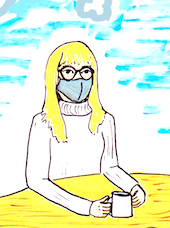
An illustration of me! Taken from one of the images
below created by Siân from More than Minutes
We have all heard some variation on the saying “a picture is worth a thousand words”, and yet often information is shared through large reports with thousands of words and few images. A 2019 paper published in Nature Communications highlighted that with all the information people can read, gaining people’s attention is increasingly difficult.

Take the image of me (right), it tells you about my hair colour, glasses, outfit, that I'm partial to a tea or coffee and that I am sitting at a table. If I had written a description of everything that you can get from the picture, it would have likely taken up far more space. If it were me, I would probably only have skimmed the text. As a public health researcher, part of my job is finding ways to share research findings in a way that will engage people to want to learn more and have a conversation (something we in Fuse like to call knowledge translation).

Alongside my Experts by Experience (individuals with lived experience of homelessness, mental ill-health, and/or substance use) we began to ponder how to share what we learned from our NIHR School for Public Health Research (SPHR) funded study exploring access to community based mental health and substance use support during the COVID-19 pandemic for individuals experiencing homelessness and those providing support. We had finally reached a point where there was a light at the end of the tunnel, as we moved away from understanding to sharing the findings. Yes, we figured we would write a couple of papers, attend some conferences, and likely write a report, but the bigger question was would the people in policy and practice and individuals experiencing homelessness read those documents? While trying to be nice, one person levelled with me and said Emma, “I’m probably not going to share a PowerPoint with a friend” and another said, “I don’t even know what that journal is”. Quickly the realisation sunk in that we were going to have to come up with a better solution for sharing our findings.

I began to think about visuals but realised my failed attempts at drawing stick people meant I probably would not be able to do this on my own. Two of the Experts by Experience spoke about a visual they had seen designed by More than Minutes for a peer research study around barriers to accessing care and treatment for people experiencing homelessness (#HealthNowManchester). I realised in that moment we had found our answer. Suddenly the Zoom call was abuzz with energy as everyone got excited about what story our visual might tell. As one person said, “it’s aimed at people who can’t read or write, or have a disability - someone like my brother”. Perhaps even more insightful was the comment that, “it [a visual] could have a different meaning for each person depending on their own experience”. 

We met with Siân (an illustrator from More than Minutes) and began planning the image and figuring out how to depict our endless pages of ideas into a visual that was engaging without being overwhelming. Over the next few months, we had a bit of back and forth on what we were envisioning. When the initial pencil sketch arrived, we were shocked at how the images captured so much of what we wanted to share without being a visual overload. Like kids at Christmas, we sat in suspense waiting to see what the final colour version would look like. We knew it captured exactly what we wanted when we saw the coloured versions. It was the physical depiction of everything we had learned and would proudly adorn our homes and offices! Through working with Experts by Experience and having input from colleagues in practice, we believe we have created a poster that depicts the experiences without some of the stigma we often see. Each of us saw something a little bit different in the poster, and we could not wait to share it with friends, colleagues, and providers. 

Created by Siân from More than Minutes; See the full images on the NIHR School for Public Health Research website.

Having had the experience of seeing words and quotes come to life, I cannot wait to do it again. Although we will continue to write papers and reports, the ability to share the images from our phones or by email with anyone has made us think about other creative ways to communicate research in the future.

So, I end this post with a question for you, do these pictures tell a better story of the findings than a one-page summary would have? Between you, me, and our Experts by Experience, we will be returning to this visual time-and-time again whereas the paper and report might not have the same reach and engagement. 

-----------------------------------------------------------------------------------------------------------------------------------------------------------------------------------------------------

To make this visual freely accessible, we would welcome organisations printing their own copies. If you are printing the poster, please print it in its entirety and email Emma Adams emma.adams@newcastle.ac.uk so we can see all the places sharing our findings. A limited number of printed posters are available directly from Emma for pick up from Newcastle University.

Initial findings from Emma’s study have now been published in the International Journal of Environmental Research and Public Health.

A Fuse Research Programme Meeting is planned to share more information about Emma’s study. Stay tuned for the save the date and further information. 

-----------------------------------------------------------------------------------------------------------------------------------------------------------------------------------------------------


Emma is a Mental Health Fellow for the NIHR Applied Research Collaboration (ARC) North East and North Cumbria (NENC) and a previous NIHR School for Public Health Research (SPHR) Pre-Doctoral Fellow.  Her study 'Exploring and understanding access to community-based mental health and addiction services in Newcastle and Gateshead' is NIHR SPHR ResNet funded.

This project is funded by/supported by the National Institute for Health Research (NIHR) School for Public Health Research (SPHR) (Grant Reference Number PD-SPH-2015-10025). Emma was supported by the NIHR SPHR Pre-doctoral Fellowship Funding Scheme (Grant Reference Number PD-SPH-2015). Emma is now supported by the NIHR Applied Research Collaboration (ARC) North East and North Cumbria (NENC) (NIHR200173). The views expressed are those of the author(s) and not necessarily those of the NIHR or the Department of Health and Social Care.