Showing posts with label students. Show all posts

Friday, 22 March 2024

"We need happy memories"

How people who have experienced homelessness are redesigning support

Professor Monique Lhussier & Dr Christina Cooper from Northumbria University, and an Experts by Experience panel

Fuse researchers at Northumbria University were recently awarded £1.4m for a project looking to understand connections between trauma, health and homelessness in the North East. Here the research leads share how they have previously worked to embed community voices to improve health and reduce disparities for people with experience of homelessness.

The link between trauma and homelessness has been well documented, with recent evidence showing that 94% of people experiencing homelessness have experienced trauma. In the majority of cases the trauma was complex and reoccurring, with 65% having experienced four or more traumatic experiences.


In 2023 we received funding from the Arts and Humanities Research Council to develop a network to better support people who had experienced homelessness. We were fortunate to work with eight Experts by Experience (EbEs), or Experts by ‘Disaster’ as Barnie (one of our EbEs) suggested; people who had experienced homelessness, and the complex multiple needs and exclusions that frequently co-occur. The nine months project aimed to develop integrated ways of working, embedding community voices into the system to improve health and reduce disparities for People with Experience of Homelessness (PEH).

Discussions, which were led by EbE throughout the project, reiterated that trauma was common and often started in childhood, and followed by further re-traumatising events. Karl commented that while he remembered in vivid detail what had happened to him as a child, he often could not recall what he had been doing last week, highlighting the lasting impacts of trauma. Further discussions highlighted negative impacts throughout life, from relationships, education, employment to mental illness, suicide and addiction.

We reflected as a group that PEH are often viewed through a lens that considers only their immediate needs; shelter, clothing, food, and healthcare. Drawing on Maslow’s hierarchy of needs we considered that only the bottom two tiers are the most consistently met, but belonging and esteem much less so. The Experts by Experience felt that people need to be given a chance to grow in more holistic ways across all tiers of the hierarchy in order to become healthier and happier.

Tonkin’s model of grief proposes a way to see a happy and meaningful future focusing on growth around the grief. From these discussions, we collaboratively designed the graph below, which superimposes Maslow’s hierarchy of needs with and adapted version of Tonkin’s, in a model to inform ongoing and future work.
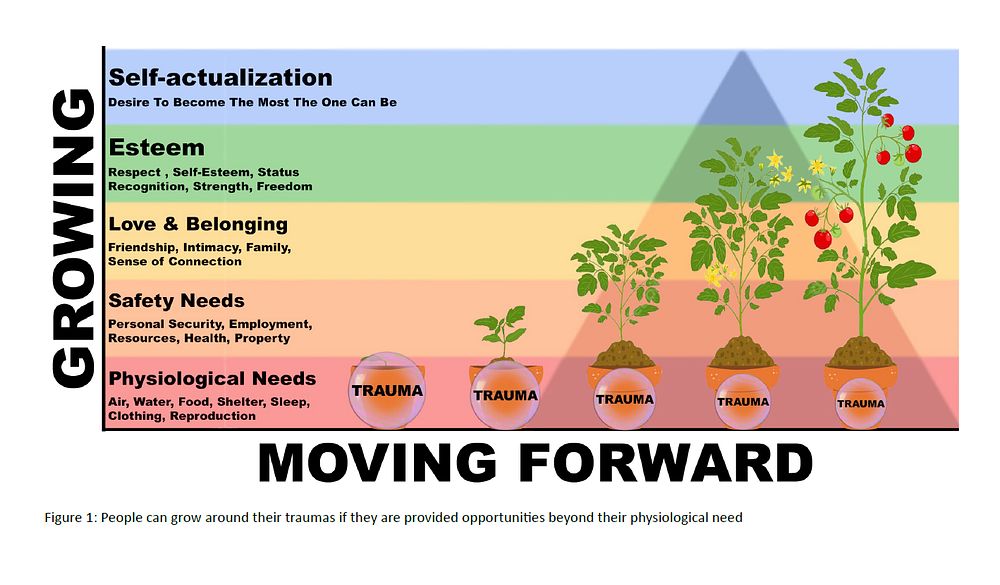
We have begun to explore this model through three core project strands:
  1. an innovation fund for which EbE were responsible;
  2. participation in an accredited Northumbria University module, and
  3. through understanding the impacts of involvement with the project.
The innovation fund pilot involved the development and implementation of five creative projects providing sustainable and varied opportunities for self-care, learning, and physical activity for People with Experience of Homelessness. One of those, the Hope Project, gave opportunities for 189 PEH to take part in new creative, social, or physical activities. Steven designed the Hope Project on the premise that ‘people need happy memories’, which those who have experienced trauma do not always have, to draw on when the going gets tough. Barnie explained that often people lose the motivation and ability to cook for themselves when they have lived on the streets. He designed cookery classes with a train the trainer model, meaning that many people have since benefitted from eating healthier food that they had cooked themselves. Lee set up a bike repair workshop so people can take part in physical activity and be more self-sufficient.


Being given the opportunity to manage a budget, help others and having the status of university student (“I have been called many things; it was nice being called a student!”), stood out as having had a positive impact for many of the Experts by Experience. Lee and Porl said that opportunities to shape the project and develop their skills as researchers led to them feeling trusted and valued as equal members of the project team. Further to this, involvement in the project gave a sense of purpose and belonging, and increased confidence for many EbE.

This supported the notion that it is possible to grow around trauma when we attend to people’s experiences, hopes, talents, potentials and ambitions, as well as their basic needs. It also challenged us, as researchers, to think of research not solely as a detached enterprise, but as an inherent part of a system that can support people to grow and have more positive and valuing experiences.

*This blog has been written in memory of Ben


References:
Image:
  1. Photo by Matt Collamer on Unsplash

Friday, 21 December 2018

The power of cookies

Posted by Peter van der Graaf, AskFuse Research Manager / Fuse Knowledge Exchange Broker, Teesside University

With the festive season upon us, many are looking forward to indulging in a mince pie or two and getting stuck in some extra helpings of turkey or brandy-soaked Christmas pudding. This often sparks some well-intentioned health warnings from public health folk about the risks of overindulging, binge drinking and the increasing obesity epidemic. Not wanting to dismiss these important messages, I would like to focus on a different message in this blog: food as a great tool for knowledge mobilisation (making information useable and accessible through working collaboratively).

If there is one thing that I have learned in my time as AskFuse Research Manager, it is that nothing is as useful as biscuits for bringing people together and contributing to a positive meeting between researchers and health professionals. 

This insight started from my own weakness: I have an incurable sweet tooth and my colleagues and students have quickly learned to exploit this asset for plying me with Dutch liquorice and other delicacies into supporting their requests and theses. So, I decided to turn their own weapons on them, with surprising results.

Stuck in a challenging debate about the usefulness of research evidence for commissioning local health services? Bring some cookies and fruit (to balance; I am a public health researcher after all!) and you will find that conversations all of sudden move in more fruitful directions.

Although my experience told me that cookies are a great conversation starter when brokering knowledge, I did not realise until recently that this was an area of serious academic study. In a recent paper published in Medical Education[1], Michael Hessler and colleagues from the University Hospital of Münster in Germany decided to put the power of cookies to the test and conducted their own Randomised Controlled Trial while delivering an emergency medicine course.

They were worried about the evaluations at the end of their course and suspected that these were not the measures of quality that the University was hoping for. Therefore, they were looking for a ‘content-unrelated’ intervention that would alter their evaluation results significantly and prove that their evaluations were seriously under-baked.

Third‐year medical students (n=118) were randomly allocated into 20 groups, 10 of which had free access to 500g of chocolate cookies during the course sessions (cookie group!) and 10 of which did not (control group). The groups had the same teachers and were taught the same content. After the course, all students were asked to complete a 38‐question evaluation form.

The results were very appetising: the cookie group evaluated teachers significantly better than the control group, they rated the course material as considerably better and overall satisfaction scores for the course were significantly higher. In summary: the provision of chocolate cookies had a significant effect on course evaluation.

One might conclude that course evaluations are seriously flawed but I prefer the ‘cookie-jar-is-always-half-full’ interpretation: providing cookies to participants is a great way to boost results! The German research adds baking powder to my own observations in UK knowledge brokering: cookies are a great way to boost exchange of knowledge and relationship building in conversations and meetings.

The ingredients of each meeting and conversation might be different but they all need a baking agent to rise to the occasion. So, whatever you do this Christmas, if you would like to avoid awkward questions during social and family gatherings about ‘what it is that you do as a researcher’ or ‘when are you finally going to finish your PhD?’, just bring a plate of cookies and subtly but swiftly change the conversation to a sweeter topic.

Happy Christmas!


Reference:
  1. Hessler M, Pöpping DM, Hollstein H, Ohlenburg H, Arnemann PH, Massoth C, Seidel LM, Zarbock A, Wenk M. Availability of cookies during an academic course session affects evaluation of teaching. Medical education. 2018 Oct;52(10):1064-72, https://onlinelibrary.wiley.com/doi/pdf/10.1111/medu.13627

Friday, 3 August 2018

The booze, the binge and the bulge

Guest post by Cassey Muir, Research Assistant, and Alice Graye, MRes Student, Newcastle University.

Drinking behaviours and eating behaviours in young adults have been widely studied separately, but our research - FOrwaRD; exploring FOod and Risky Drinking behaviours in young adults aged 18-25 - takes a novel perspective to try and understand how drinking and eating behaviours interact and the implications for interventions.

We hope that intervening in early adulthood, when these linked unhealthy patterns emerge and are prominent, may prove beneficial in reducing the risks associated with obesity and heavy drinking. From our formative research, there seems to be an unquestioned norm that drinking alcohol and eating unhealthy food link together in the lives of young adults. There are a number of ways in which drinking and eating behaviours may interact, for example, some young adults may eat a takeaway after a night of drinking and a fry-up the next day, some may choose not to eat prior to drinking and some may drink alcohol alongside a meal (look out for research on this soon to be published by Dr Stephanie Scott and colleagues). 

While the answer to how these behaviours link together may vary, it is clear that young adults are provided with a social benefit from their linked eating and drinking patterns. A benefit that seems to be the biggest barrier for intervening with these linked behaviours.

Alice and I recently organised a Fuse Quarterly Research Meeting. The event kicked off with three inspiring talks. Firstly, Sharon Hodgson the Shadow Minister for Public Health, gave her thoughts on young adult alcohol use and eating patterns from a policy perspective. This was followed by Fuse Associate Director Dr Amelia Lake, a Reader in Public Health Nutrition who delved into the obesogenic environments that today’s young people live in, with particular emphasis on the high rates of energy drink consumption in the UK. The current research findings of the FOrwaRD project were presented by Dr Stephanie Scott and the team. These findings led into the workshop activities for the day, with attendees giving their views on young adult associated eating and drinking habits and intervention strategies. The meeting was attended by over 50 delegates responsible for policy or service delivery for young adults; this included people from Local Authorities, voluntary sector organisations and Higher Education Institutions from across the North East, as well as three young adults involved in patient and public involvement. 
Sharon Hodgson, Shadow Minister for Public Health, at the
Fuse Quarterly Research Meeting
For the workshop activities, attendees visited ‘FOrwaRD’s Food and Alcohol Big Market’ in which there were tables representing ‘venues’ and everyone had time to socialise in two venues, one bar and one takeaway shop. At each venue there was a topic to be discussed, which were:
  1. Young adult eating and drinking patterns
  2. Current support for young adults
  3. Developing an intervention
  4. Recruiting young adults at risk
There was lots of energy and positive discussions throughout the workshop activities and a clear opinion voiced that young adults should be better supported when it comes to safer drinking and healthier eating and the link between the two. Ideas to support this focused on both individual and population based approaches. Firstly, young adults may benefit from a change in policy around the food and alcohol environment. This could include; reducing the amount of alcohol and food promotional offers, restricting development of fast food and alcohol venues (for example, on and around student campuses), or setting up activities that do not revolve around food or alcohol. While these discussions mainly focused on the environment in and around Higher Education campuses, this approach may be beneficial more widely.
“We need to have a shift in the way that we approach planning and licensing around universities or colleges. Obviously, it’s harder to do because there are a lot of people who don’t go to university and college who you wouldn’t reach with that.” Group 1
Indeed, in earlier interviews with young adults, it was also found that linked food and alcohol pricing, and the night-time environment could be target areas for change.

In addition, attendees also discussed the importance of targeting a young adult’s social network, tailoring the motivational hook and goals to the individual, whether that be to lose weight, save money, to improve their appearance or mental health awareness, and that we offer healthier - and just as social - alternative behaviours.
“Perhaps finding more avenues for socialising as well that don’t involve eating and drinking. There are plenty of other things to be doing.” Group 5
“The important thing is your hook and what motivates them, because if you don’t get that then you’re not going to.” Group 3
While student eating and drinking behaviours were seen as problematic, there was a view throughout discussions that these behaviours may change or improve upon graduating, and that going into employment may act as a buffer against these behaviours escalating. Whereas, young adults who do not go to university may benefit from an intervention in the long-term. One way of accessing young adults may be to start within the community setting and approach services that support them.

At the event we made fantastic connections to discuss our findings with other young adults within community settings such as the YMCA, Balance North East, Matrix, and the Young Health Commissioners.

Do you know of any organisations who work with and support young adults and who would like to find out more information or get involved with our research project? If so, then please contact me, Cassey Muir (cassey.muir@newcastle.ac.uk). We are aiming to run workshops over the summer with young adults to get their views on how we can support them to drink safe, eat well and be social.

#DrinkSafeEatWellBeSocial

Cassey and Alice are part of a multidisciplinary research team working on the FOrwaRD project. Cassey is an early career researcher running the day-to-day activities of the project and Alice is an MRes student working on the project, exploring students’ experiences.