Showing posts with label Resolution. Show all posts

Friday, 6 November 2020

Changing the habit(s) of a lifetime: an intense body and mind affair

Posted by Fiona Ling, Senior Lecturer in Sport & Exercise Psychology, and Gavin Tempest, Senior Lecturer in Exercise Neuropsychology, Northumbria University

Many of us will be soon be thinking about making New Year’s resolutions, whether it’s to do with eating more healthily or doing more exercise. However, how many of us have actually managed to stick to our resolutions even though we know they are good for us? The question is – why is it so difficult to change our health habits?

While it’s well recognised that our environment does not help in encouraging a healthy lifestyle - from food and drink marketing to electronic devices promoting inactivity - could there be other reasons why we find it hard to change behaviour?
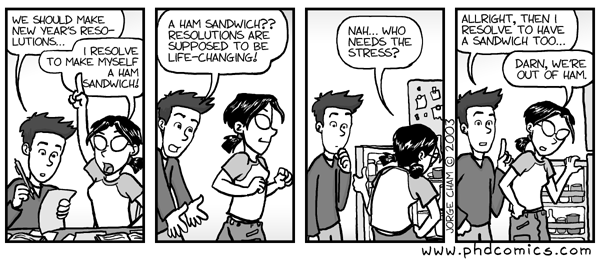
"Piled Higher and Deeper" by Jorge Cham www.phdcomics.com

What actually drives our behaviour?

Currently there exists many theories that try to explain why we do what we do, however, explanations are still lacking in regards to how our body and brain works together to directly drive our behaviour. When it comes to changing our habits, a key point to remember is that this involves stopping ourselves from doing things we consider pleasurable. For example, if you’re on a diet, every time you see an unhealthy snack, you have to tell yourself to STOP. Or, if you’re not a fan of exercising, why would you get off the sofa and slip on your running shoes? Making ourselves do things that don’t provide us with an instant reward can be stressful. These examples suggest that changing our habits can be stressful, that is, (the thought of) diet or exercise can become a source of stress (a stressor), and this makes our brain’s impulse control system work harder in order to adopt a new habit. Researchers have found that some of us can become stressed when seeing images of food, and are also not as good at controlling our impulses.1 Food craving, especially from seeing foods that we like, is a known stressor and the stress experienced from having to control our cravings is likely to tire out the impulse control system that can lead us to give in to temptations.

We might be able to change our habits for a short time as we become vigilant towards our goals, that is, the need to stick to our diet or exercise. However, we all have our limits and if stress from restricting our behaviour continues it will sap our ability to control our impulses, and our behaviour will return to what we are used to (or our ‘normal’). We saw another example of short-term success in behaviour change during our research. When monitoring children’s physical activity, some showed a burst of activity level at the start, but before long, it quickly dropped.2 These children were characterised by being hyper-vigilant towards stressors and they were generally more inactive than other children. We speculated that it was our monitoring of the activity that increased stress as the children felt that they had to show us they were more active which might spur on the initial activity spike, but as the children’s impulses for inactivity built up, it resulted in a considerable drop later on.

What’s next - how can we possibly take up, and keep up with, good health habits?

To influence health behaviour, it is crucial to understand the stress-impulse control mechanisms that DIRECTLY drive the behaviour. To use an analogy, if a person has a fractured arm, a direct treatment would be fixing the bone, rather than taking painkillers which would help to relieve the pain but not fix the problem. Similarly, if it is the stress from behaviour change and its influence on impulse control that directly causes us to succumb to temptations, we ought to target psychological interventions that reduce stress, or the brain’s impulse control system. Being able to manage our stress-impulse control system is particularly vital in the current environment where we are constantly exposed to temptations that lead to an unhealthy lifestyle. It is important to note that other factors, such as motivation and intentions, are also influential in changing our behaviour, however, this stress-impulse control process may more directly dictate the way we behave within split seconds and without our conscious awareness.

A possible psychological intervention is mindfulness training which can increase awareness of the stress cues, so that self-control can be executed before the brain’s impulse mechanism takes over. So next time we have a craving for an unhealthy snack or we are getting worked up about going for a run, we can potentially cope by containing and managing stress and impulses.

We believe that more research needs to be invested in the stress-impulse control mechanisms as it can potentially enhance the effectiveness of future individual health behaviour interventions and public health messages in getting us live a healthier lifestyle, and crucially, it can revolutionise the way we think about health behaviour change.


References
  1. Spitoni, G.F., Ottaviani, C., Petta, A.M., Zingaretti, P., Aragona, M., Sarnicola, A.,. & Antonucci, G. (2017). Obesity is associated with lack of inhibitory control and impaired heart rate variability reactivity and recovery in response to food stimuli. International Journal of Psychophysiology, 116, 77-84. https://www.sciencedirect.com/science/article/abs/pii/S0167876016307310?via%3Dihub
  2. Ling, F.C.M., Masters, R.S.W., & McManus, A.M. (2011). Rehearsal and pedometer reactivity in children. Journal of Clinical Psychology, 67, 261-266. https://onlinelibrary.wiley.com/doi/abs/10.1002/jclp.20745

The views expressed here are those of the authors and do not necessarily reflect those of Fuse (the Centre for Translational Research in Public Health) or the author's employer or organisation.

Friday, 20 December 2019

Happy New Year from everyone at Fuse

We would like to wish all our readers and contributors a very Happy New Year - why not make a resolution to blog in 2020 and send us your posts?


Image (adapted with thanks):
The original uploader was Rsabbatini at English Wikipedia. [CC BY 4.0], via Wikimedia Commons.

Friday, 12 January 2018

Kale and running shoes

Posted by Amelia Lake, Associate Director of Fuse, Dietitian and Reader in Public Health Nutrition at Teesside University

"January is our busiest month" said Hayley in the bustling fruit and vegetable shop in the small North Yorkshire market town where I live. This was on the first Saturday of January. She said their sales of kale had rocketed as people started juicing, eating better and generally trying to improve their diet. All this following the excesses of Christmas.

On Sunday morning, when I was out running (or trying to run on the icy pavements!), I was surprised at the number of runners pounding the streets in our small town. Then I remembered, it's the first weekend in January. Maybe, like me they have a shiny new gadget that they are somewhat obsessed with (how many steps have I done today?). There must be an exponential increase in the number of runners and kale consumers.

What is it about 'New Year, New You' that never fails to deliver and how long will these new behaviours be sustained? Why is it that our print and broadcast media don't grow tired of feeding us (excuse the pun) the same January story of …”you've eaten and drunk to excess in December now it's time to abstain from alcohol (Dry January) and go on an excessive unsustainable dietary regime”... Or the most recent health “craze” of ‘raw water’.

Our social media feeds are filled with so called 'nutrition and fitness experts'. The Instagram squares show us before and after pictures of success stories, quick fixes, rapid weight loss etc. etc... Not so many squares saying - look at your diets, your lifestyle, make sustainable changes as these are more likely to succeed in the long term (well apart from one of my professional organisations The British Dietetic Association).

What about the evidence? Does it advocate New Year's resolutions? Are we programmed to wait for the longer term goals or do we need to have instant results? A study published in 2016 suggests that while individuals may exercise for the long term goal of improved health, it is actually the immediate reward that predicts their persistence in that behaviour.

Ultimately these resolutions are about an individual's behaviour change. Much of our public health policy focuses on individuals changing their behaviours. Anyone who has tried to do this knows how difficult it is. Yet, we (professionals, the media, society) continue to focus on the individual who is generally living in an environment where kale isn't an everyday option and running shoes only go on at the weekend – or sit looking pristine in the cupboard.

What we need is a change in the system or what is called a 'whole systems approach' to health and lifestyle problems. The most obvious lifestyle related problem is that of obesity. There is a chronic problem of energy imbalance affecting our whole population young, middle-aged and old. We are encouraged to eat less and exercise more but really, the environment doesn't support those changes (for the majority of the population). Will our policy makers have any New Year's resolutions to focus less on the individual and more on the system in which we make our behaviours? With changes such as a sugar levy coming into play, we are seeing food manufacturers reformulate or change product size. But we also hear reports of people stockpiling sugary drinks that are about to be reformulated. Is this the start of a shift away from the individual and to systems thinking? I very much hope so.

Kale and running shoes are not the answer to addressing a health and lifestyle crisis but long term supported and sustainable changes are.


Image: 'Marinated Kale Salad-2' (23204695074_92c53db643_z) by 'jules' via Flickr.com, copyright © 2015: https://www.flickr.com/photos/stone-soup/23204695074

Thursday, 1 January 2015

52 weeks in public health research, part 52

Posted by Emma Foster, Amelia Lake, Lorraine McSweeney and Mark Welford

So this is it, we have reached the final week of our 52 week public health picture project. But what insights has it provided into the everyday lives of public health researchers? Find out in a blog post coming soon. A big thank you to all those who contributed their images.

Happy New Year!


Posted by Emma Foster: Not a New Year resolution as a) it seems silly to start the day after a big party and b) now is when I have a bit more time to exercise... So starting tomorrow this cross trainer is going to be getting much more use....and not just for drying clothes!


Posted by Amelia Lake: Less of a resolution more of an ambition! No more trainers on the bike - it's time to look like a pro... and possibly get a few knocks and bruises in the process!


Posted by Lorraine McSweeney: I recently attended a graduation ceremony at Newcastle University to receive my doctorate award. For the first time in the congregation history the PhD titles were announced during the ceremony; mine being 'Prevention of obesity: exploring strategies for intervention in preschool'. The ceremony was attended by my supervisor and Fuse Director Ashley Adamson. Also in attendance that day was television journalist and newsreader Angela Rippon who received an honorary degree for her charity work in dementia.


Posted by Mark Welford: Fundraisers braving the North Sea to earn money for their favourite charity in the Annual Boxing Day dip. A bit of physical activity after the Christmas day indulgence and the beginning of a New Year's resolution?