Showing posts with label CEDAR. Show all posts

Friday, 11 February 2022

Now that's what I call blogging 2021

Posted by Mark Welford, Fuse Communications Manager, Teesside University

Let’s all channel British novelist E.M. Forster and play a little game of Only Connect. What connects the things below?


“Yes of course, they can all be a type of list” (said in the friendly yet ever so slightly patronising manner of host Victoria Coren Mitchell)
I think it's fair to say that we all love a list. I mean, the premise of another very popular BBC gameshow is basically to list pointless stuff.

So here again (a little later than advertised) is our annual list of the most-viewed Fuse blog posts of 2021!

You'd be forgiven for thinking that this would be dominated by Covid and the pandemic as we saw in the 2020 list.

Obviously, we had our fair share of pandemic related posts. Blogs about misinformation, food insecurity, malnutrition, obesity and what children made of it all. How it impacted on work and engagement with public partners, parents, decisionmakers, practitioners, policy-makers and commissioners. How it affected our mental healthour liberties and even inspired a song and a cat-scale of wellbeing!

But as you can see from the list below it didn't dominate the top 5 chart-toppers of 2021. Perhaps a little escapism goes along way...

------------------------------------------------------------------------------------------------------------------------------------------------------------------------------------------------------

Katsushika Hokusai: The Great Wave off Kanagawa
5. The other third wave: a mass epidemic of very individual pain

Posted by Jack Nicholls, Lecturer in Social Work at Northumbria University

Lockdown restrictions were beginning to ease in the UK. But after the jubilation, what if you don't feel the way you think you should?

A very personal post by Jack Nicholls on the long-term mental health consequences of the pandemic, of lockdown and social restrictions, and of its easing. 

*Content/trigger warning: mental health, depression, suicidal feelings.

Page views: 938
Published: 16 April 2021.

------------------------------------------------------------------------------------------------------------------------------------------------------------------------------------------------------

4. Patient and Public involvement with Parents during a Pandemic: the four ‘P’ challenge


Posted by Hannah Batten, Food and Human Nutrition undergraduate student at Newcastle University. Hannah was on a placement year with the Population Health Sciences Institute, as part of the MapMe study aiming to help parents assess child weight.
Body image scales on the MapMe website are being updated for MapMe2
"Most importantly, is to say to our participants that we are extremely grateful for their time and input, particularly during these uncertain times."
Hannah tells us how she and the MapMe study team met the challenges involved in recruiting and running an online Parent Involvement Panel (PIP) to help review documents and study materials, when parents were already dealing with a global pandemic. 

Page views: 1,029
Published: 5 March 2021.

------------------------------------------------------------------------------------------------------------------------------------------------------------------------------------------------------

3. Should pregnancy 'be incentive enough' to quit smoking?

Posted by Susan Jones, Research Associate at Teesside University

In this blog post on #NoSmokingDay, Dr Jones explored deprivation, guilt, shame, stigma and the complex web of reasons behind smoking behaviour.

Page views: 1,155
Published: 10 March 2021.

------------------------------------------------------------------------------------------------------------------------------------------------------------------------------------------------------


2. Things I wish I’d known when I started my PhD… (part 1)

Posted by members of the Population Health Interventions Programme at the MRC Epidemiology Unit


Research doesn't happen overnight, avoid comparison and channel your inner Arsène Wenger ("Le Professeur"). In our second most popular blog post, the early, mid and senior career researchers at University of Cambridge share their tips for PhD survival.

Here is part 2 which interestingly received only half as many views despite including a High School Musical reference.


Page views: 1,347
Published: 4 June 2021.

------------------------------------------------------------------------------------------------------------------------------------------------------------------------------------------------------

1. Can Forest School inspire the next generation to be happy & healthy?

Posted by Katie Beresford, undergraduate student at Durham University

With more than 2,700 views this is our most read post of 2021 by some distance!

In it Katie explores growing up in the Lake District, embracing nature, finding school restrictive and struggling academically in her early years.

Nearly two decades later she is completing a Fuse summer internship with the NIHR School for Public Health Research and is tasked to review literature discussing the effectiveness of Forest School as a public health intervention.

Why not grab a coffee and take a walk with Katie into the woods to find out what she discovered...

Page views: 2,746
Published: 8 October 2021.

------------------------------------------------------------------------------------------------------------------------------------------------------------------------------------------------------

So there you have it, the top five Fuse blog posts of 2021. Congratulations to Katie who wins a rare and coveted Fuse paperweight!  

Fantastically both Katie and Hannah's blog posts were part of our Fuse blog Student Series which we launched last year! This showcases posts by students who have been challenged to write a blog as part of their studies. The authors may be new to blogging and we hope to provide a 'safe space' for the students to explore their subject and find their voice in the world of public health research. Hopefully this will encourage other students to take the plunge!

As always, many thanks to our loyal readers and fantastic contributors.

Can we do any better in 2022? If you fancy giving it a go, please find out what we are looking for and how to take part here. All contributors receive a much sought-after Fuse badge.


Images:
2. Image: Katsushika Hokusai, (CC0 1.0), via Wikimedia Commons
4. Mr. Alexander Ottesen, CC BY-SA 2.5, via Wikimedia Commons

Friday, 11 June 2021

Things I wish I’d known when I started my PhD… (part 2)

Posted by members of the Population Health Interventions Programme at the MRC Epidemiology Unit

This is Part 2 of our PhD SURVIVAL GUIDE. In Part 1 we found out that doing a PhD (or any research) is challenging but the ‘this might be okay’ stage always comes; continuously comparing your work, and yourself, to others is the thief of joy; and research is a team sport and you're the boss so start channelling your inner Arsène Wenger!

Like most research groups, ours comprises an ever-changing cast of early, mid and senior career researchers. Our training is in a variety of academic disciplines and we all have different short, medium and long term life and career aspirations. While our experiences of public health research are naturally individual, we have noticed some commonalities. We share these here to provide reassurance to those new to the game that whatever they’re feeling is almost certainly ‘normal’. Challenging experiences are often interpreted negatively, particularly when they are first met. We propose that they can often be reassessed and reframed in ways that make them positive parts of a continuous learning and career development journey. Other people might have different experiences, this is ours…


Licensed to YouTube by: UMG (on behalf of Walt Disney Records); UNIAO BRASILEIRA DE EDITORAS DE MUSICA - UBEM, ASCAP, AMRA, LatinAutorPerf, Walt Disney Music Company (Publishing), LatinAutor - SonyATV, LatinAutor - UMPG, CMRRA, UMPI, and 15 Music Rights Societies

4. We’re all in this together – don’t take it personally

It is impossible to overstate the importance of not taking feedback personally. Opening a document containing feedback from your supervisor or peers and seeing a page full of colourful tracked changes and comments can sometimes feel like personal criticism. It’s all too easy to see this as a setback but in reality, this is what teamwork looks like. Your supervisor is there to ask the difficult questions, and to stretch you intellectually. All feedback is intended to be helpful, so you can produce a stronger output.

Trust us, your supervisor doesn’t expect perfection. Think they don’t receive similar feedback from their colleagues? Think again. But they’ve learned from experience that falling short of perfection is okay. Few imperfect ideas are that imperfect!

Also, what does perfect look like? There’s rarely a ‘right’ answer to any question, and there are different but equally valid ways to approach most things. Different is not necessarily better. Although you’re bound to immediately presume what you’ve done is ‘wrong’, our advice is to take a breath, remind yourself why you did what you did, and be prepared to defend that. This will be an essential skill for your viva! But remember to respect the time it took for someone to really consider your work, by reciprocating and carefully considering their ideas.

Your supervisor wants to see you succeed because your success is also theirs. Seeing your student flourish is immensely gratifying. It rewards everyone’s intellectual contribution to the work, and validates that seedling of an idea, planted by your supervisor, which has since blossomed under your care. Lastly, don’t forget that as much as you’re learning from them, they’re learning from you, too. You wouldn’t be doing that systematic review if they knew the answer already. 

"Piled Higher and Deeper" by Jorge Cham www.phdcomics.com
5. A PhD is a job, not a way of life

For most of us, reaching the start of a PhD represents lots of hard work and effort. It is tempting to think that means you should pour your life into research, and nothing but research, for three or more years, to do justice to that opportunity.

But your PhD can benefit from some down time. Giving yourself a mental break from research means you can return to work with renewed enthusiasm. Time away can also offer clarity and sometimes inspiration! Setting boundaries between research and the rest of your life can make the entire PhD process more sustainable and ultimately, more enjoyable. It can be easier to work efficiently and effectively in distinct working hours (even if those aren’t 9-5), with the incentive of doing something else that you enjoy at the end of it.

However, intending to take time off work and actually doing it are two very different things. During busy periods, it is easy to prioritise your PhD over other areas of life. It also becomes harder to switch off thoughts like “should I read that extra paper?” or “maybe I should do that analysis?” while you are trying to relax.

There are simple ways you can give yourself a better chance of achieving the elusive ‘work-life’ balance. Scheduling time – and protecting that time – to do a particular hobby, sport or social activity can help. It is much easier to rearrange a “hope to do yoga at some point this week” than a class you have booked at 7pm on Wednesday. Similarly, committing to doing things with other people is a great way to cultivate new friendships with colleagues, enjoy their company, and follow through with a plan. At times of self-doubt, it is also a good reminder that there are many other things you are capable of, and that life isn’t all about the PhD! 

6. Some bad things may happen that are not okay

A healthy PhD experience should be challenging, yes, but if this starts to have a negative impact on your physical or mental health and affects how you would normally function, something could be wrong. There are fantastic resources on the Mind website which are a great starting point to help you be more aware of your feelings. Struggling with mental health is very common in life and you are not alone. Seeking help and support is important though. Don’t be afraid to tell your supervisor if you’re struggling.

Sometimes though, the cause of these struggles can be external, and in particular, your relationships with supervisors. Supervisors are responsible for challenging you but also encouraging and supporting you. If there is a problem with your relationship, it is always wise to talk to your supervisor if you can, as they may not realise there is a problem. People are not always immediately compatible in their working styles; this is okay and can be worked through.

If a dysfunctional relationship is caused by a supervisor who is behaving inappropriately, this is not okay. Harassment or bullying of any kind should be escalated through the proper channels in your university. Speak to fellow students you trust candidly about your experiences too; you may not be the only one suffering and they could help support you through it.

The student always becomes the master
7. Enjoy every step of the journey

The good things that come from doing a PhD are not necessarily what you might expect. For some, the highest high is indeed right at the end, the crescendo, when the thesis is submitted. But for many this can feel like an anti-climax. The more you can learn to embrace and enjoy the process, and the less you anticipate what you think will be the good things, the more good things will come your way. A breakthrough with your data collection, your first set of meaningful results, mastering a new skill, or even just a meeting with your supervisor that goes particularly well, are all cause for celebration. Each milestone is a block that forms the foundation of your PhD and each one is a vital move towards your end goal. There is nothing more rewarding than the sense you are on the right track.

As you progress, you will also start noticing that people begin treating you like the expert you are becoming. You might not feel like it, but the student always becomes the master. As strange as these moments feel, you should enjoy them. They are an external reminder that you know more than you think you do. 

Occasionally you will sit back and realise, "I'm doing a PhD! And that’s pretty cool". Stop thinking that you need to have all the answers, or even that you know where your research is going, and instead realise you are there to learn and there to explore, wherever that takes you.

That’s it!

We hope that these points have been helpful, and that you are able to look back at these blog posts when it feels like everything is going wrong. Trust us, it most probably isn’t. We have all been where you are and have lived to tell the tale. Most of us would love to be in the position you are right now again, even just to spend time reading those papers that we still can’t get around to. Try your best to enjoy this incredible experience. You’ve got this!

Authors: Catrin Penn-Jones, David Ogilvie, David Pell, Dolly Theis, Emma Lawlor, Hannah Forde, Jean Adams, Jenna Panter, John Rahilly, Kate Ellis, Martin White, Matt Keeble, Nina Rogers, Rich Patterson, Roxanne Armstrong-Moore, Tom Burgoine, Yuru Huang.


Video: 
Song: We're All In This Together (From "High School Musical"/Soundtrack Version)
Artist: High School Musical Cast
Writers: Robbie Nevil, Matthew Gerrard
Licensed to YouTube by: UMG (on behalf of Walt Disney Records); UNIAO BRASILEIRA DE EDITORAS DE MUSICA - UBEM, ASCAP, AMRA, LatinAutorPerf, Walt Disney Music Company (Publishing), LatinAutor - SonyATV, LatinAutor - UMPG, CMRRA, UMPI, and 15 Music Rights Societies

Images:
1. "Piled Higher and Deeper" by Jorge Cham www.phdcomics.com

Friday, 4 June 2021

Things I wish I’d known when I started my PhD… (part 1)

Posted by members of the Population Health Interventions Programme at the MRC Epidemiology Unit
“By three methods we might learn wisdom: first by reflection, which is noblest; second by imitation, which is easiest; third by experience, which is the bitterest.” 
Confucius
Like most research groups, ours comprises an ever-changing cast of early, mid and senior career researchers. Our training is in a variety of academic disciplines and we all have different short, medium and long term life and career aspirations. While our experiences of public health research are naturally individual, we have noticed some commonalities. We share these here to provide reassurance to those new to the game that whatever they’re feeling is almost certainly ‘normal’. Challenging experiences are often interpreted negatively, particularly when they are first met. We propose that they can often be reassessed and reframed in ways that make them positive parts of a continuous learning and career development journey. Other people might have different experiences, this is ours…

1. Research is challenging but you’ve got this

"Piled Higher and Deeper" by Jorge Cham www.phdcomics.com
Research is certainly challenging. One of the first hurdles of the PhD will be trying to figure out how your research will contribute new knowledge to the area - this is one of the toughest challenges! Stick with it, because thankfully it does get a bit easier over time as you immerse yourself in the research and build your specialist knowledge. But even the most accomplished still find research hard. All the papers you read are from months (often years) of thinking, hard work, and negotiating multiple barriers - it doesn’t happen overnight. As a PhD student, you have the additional challenge of trying to do this in a short time frame, and it doesn’t always go to plan (which is usually out of your control). But, if good research was easy, anyone could do it.

An obvious interpretation of experiencing something as being difficult is to think that we, as individuals, are not up to it. The cycle of creativity suggests, rather glibly, that all projects are associated with a thought cycle that goes something like: this is awesome, this is difficult, this is terrible, I am terrible, this might be okay, this is awesome. We are not sure that we routinely experience the second ‘this is awesome’ stage. But push through because the ‘this might be okay’ stage always comes.

If you have been selected to pursue the PhD, your supervisors think that you are capable. You wouldn’t be on this journey if there were any real doubts about your ability. Encountering difficulties and making mistakes is normal and expected. Even those researchers you admire the most have moments of self-doubt, numerous journal and grant rejections and bad days when nothing goes right.

2. Comparison can be the thief of joy

Academic research is often experienced as highly competitive. In many ways it is. There is competition for limited research, studentship and fellowship funding; limited space in ‘prestigious’ journals; and limited podium time at conferences. This leads to the tendency to continuously compare your own work, and yourself, to others - and to experience a feeling of falling short.

It’s worth pointing out the selection bias present in the successes others share, and how most of the time we’re not seeing the full picture. Despite knowing this, we understand it is sometimes hard to see everyone else seemingly thriving, while you feel you’re just about surviving! Keep in mind that everyone’s PhD is different, and our successes will run to different timelines. And remember, you bring to your PhD your own unique skills and experiences. We’re confident that others are comparing themselves to you, too…

However, rather than continuously comparing yourself to others, we recommend trying to learn from them. If others appear to be succeeding where we are not, what, if anything, can we learn from their approach? Sometimes this will lead to the conclusion that there are better ways of doing things. Other times it might lead to the conclusion that the sacrifices required to achieve a particular outcome are not something we as individuals are willing to make. Or, indeed, that the outcome is not something we want.

We suggest being clear about what our own success criteria are and trying to stick to judging ourselves by those alone. These criteria can be set alone or with others in the context of formal or informal regular appraisals and personal review. At the risk of getting too SMART*-arsed, they should, at a minimum, be realistic.

Rather than interpreting others’ achievements as indicators of our own lack of success, we propose embracing and celebrating them. Informal and formal research group meetings achieve many things, but we see the sense of community that they build amongst ourselves as one of the most important. By embracing each other’s achievements we can support and build each other up, rather than letting comparison get us down.
 
Channel your inner Arsène - "Le Professeur"
3. Research is a team sport and you’re the boss


Completing a PhD might be seen as a lonely, individual pursuit. But while the end result is your own, you aren’t alone on the journey. In fact, research is a team sport.

Your home team is the one you share with your supervisor(s), and you’ll revel in the highs (and lows) of your PhD experience together. In this team you’re the captain. Lead from the front and manage your supervisors by communicating clearly with them, arranging supervision meetings and keeping them up to speed with your progress. As the captain, you make the final decisions related to your research and you are responsible for defending them. If you don’t agree with your supervisor then you should say so, and explain why. Your supervisor doesn’t want you to nod along, as the idea is to learn from each other and make better research (i.e. win) as a team. This can often feel really hard, especially early on while they’re still the experts, but they expect you to take the lead.

In other teams to which you’ll belong, you might play a different role but still make an impact. For example, you might run a writing group, attend group meetings or present in a seminar series; these are all important aspects of teamwork and becoming a valued member of the research community. You are also a member of teams that are less obvious. You probably aren’t sure now how the Facilities or IT department are going to help you achieve your PhD, but when you need a new chair or an obscure software package installed, be glad that you have them as teammates.

In part 2 next week: learning how not to take things personally, life isn't all about the PhD, bad things may happen that are not okay, and enjoying every step of the journey.


Authors: Catrin Penn-Jones, David Ogilvie, David Pell, Dolly Theis, Emma Lawlor, Hannah Forde, Jean Adams, Jenna Panter, John Rahilly, Kate Ellis, Martin White, Matt Keeble, Nina Rogers, Rich Patterson, Roxanne Armstrong-Moore, Tom Burgoine, Yuru Huang


*SMART Goals: Specific, Measurable, Assignable, Realistic, and Time-related

Images:
1. "Piled Higher and Deeper" by Jorge Cham www.phdcomics.com
2. Mr. Alexander Ottesen, CC BY-SA 2.5 <https://creativecommons.org/licenses/by-sa/2.5>, via Wikimedia Commons

Friday, 13 October 2017

From shock to the system, to system map and beyond: evaluating the UK sugary drinks tax

Guest post by Jean Adams, Centre for Diet & Activity Research (CEDAR), University of Cambridge

Mostly you don’t get to watch TV at work. The day that George Osborne announced he would introduce a tax on sugary drinks in the UK, here at CEDAR HQ we all stood huddled around a computer monitor watching and re-watching the words coming out of his mouth. 

Oh. My. Goodness. I did not see that coming. 

The “soft drinks industry levy”, to give it it’s proper name.

A rather senior professor has since told me that he totally saw it coming.

After we’d got over the shock of the announcement, the conversation turned pretty quickly to research (well, this is a university, after all). We have got to evaluate this!

Colleagues at CEDAR had already written papers about how sugary drink taxes could be evaluated. We had talked with colleagues in other countries about evaluating their taxes – only for those taxes to fall through at the final political hurdle. I have more than one half-written application for research funds to evaluate sugary drink taxes stashed down the back of my computer.

And here it was, all systems go for designing an evaluation for a UK sugary drinks tax! In our back yard!

OK, so we have to work out whether it impacts on diet. But, what about jobs? Will people lose their jobs? Surely we need to know if it changes price and purchasing of sugary drinks. Right, but even if it does people might just shift to other foods – maybe they will just eat more cake instead? We are Public Health researchers, we need to focus on health: does the tax change how many people get diabetes? Or tooth decay? Or the number of obese children? And what about how this even happened? Did you see it coming? Why has this happened? Why now? Why don’t we do interviews with politicians and find out how it happened?

Woah, woah, woah! Ten seconds in and this is getting way more complicated than we (I) had ever thought it might. Before we did anything, we needed to work out what we thought might be going on here. Once we understood what the potential impacts might be, then we could start thinking about how we might evaluate them.

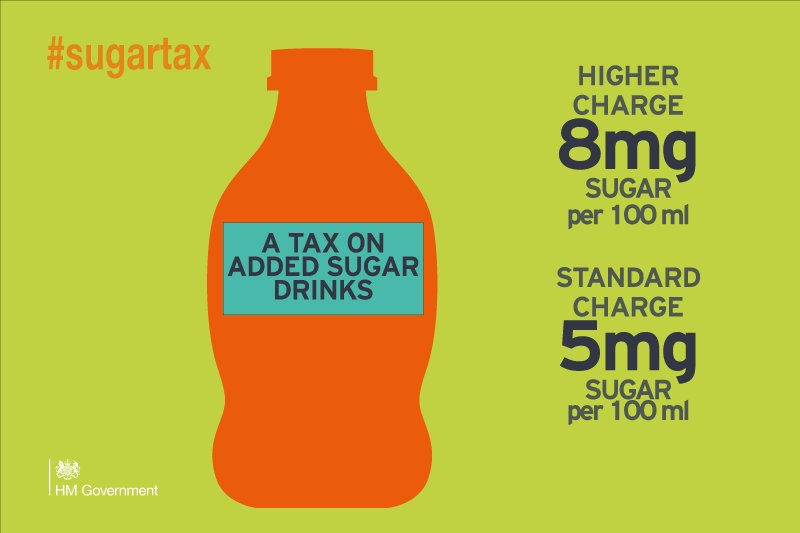
So that’s what we did. We spent 6 months developing a ‘systems map’ of the potential health-related impacts of the UK Soft Drinks Industry Levy (aka sugary drinks tax). The tax is explicitly designed to encourage soft drinks’ manufacturers to take sugar out of their drinks. There are two levels – a higher tax for drinks with the most sugar, a lower one for only moderately sugary drinks. So we started there (at ‘reformulation’) and worked out.

Then we sense-checked our map with people working in government, charities, and the soft drinks industry. They made lots of suggestions for things we’d missed, or needed to clarify. We changed our map and asked people to check it again. We changed it again. Only then did we decide what we should, and could, evaluate.

The current version of our systems map (we still think of it as a work in progress). Larger version here.


Yes, we are going to look at how the price of sugary drinks changes over the next few years. But we are also going to look at the amount of sugar in soft drinks in UK supermarkets, and the range of drinks available. We’re going to use commercial data to look at purchasing of soft drinks, as well as other sugary foods. We’ll use the National Diet & Nutrition Survey to explore whether there are any changes in how many sugary drinks, and other sweet foods, people in the UK eat. We’ll use hospital data to see if the number of children admitted with severe dental decay decreases. We’ll use statistical modelling to predict how changes in how many soft drinks people drink might translate into cases of diabetes and heart disease. We’ll look at the impact of the tax on jobs, and the economy. We’ll explore the ‘political processes’ of why and how this tax happened at this time. And we’ll conduct surveys to find out what people in the UK think of sugar, sugary drinks, and the tax itself – and whether this changes over time.

Obviously it’s going to be a lot of work. We’re going to need some excellent people to join the team to help us actually do this thing. Personally, I’m feeling a little overwhelmed/excited/overwhelmed/excited. It’s going to be brilliant!

Wanna be part of it?

Friday, 16 December 2016

Understanding the health benefits of the ‘sugar tax’: how will the soft drinks industry respond?

Guest post by Oliver Mytton, Centre for Diet and Activity Research (CEDAR) & MRC Epidemiology Unit, University of Cambridge
Today our paper, a health impact assessment of the government’s proposed ‘sugar tax’ was published in the Lancet Public Health. The government’s proposal, announced in April of this year, took health campaigners by surprise. Not only was it unexpected, but the government’s proposal was unusual.


Other countries, notably Mexico, have introduced a sales or excise tax on sugary drinks. However, the UK government proposed a levy on soft drinks manufacturers or importers based on the volume of sugary drinks sold. There will be two levels of tax, a higher level on drinks with more than 8g per 100ml, and a lower level on drinks with 5g to 8g per 100ml.

With others, I have previously modelled the potential health benefits of a ‘simple’ excise tax on sugary drinks, but the industry levy is more complicated.

Industry levy – how it might work  


The levy might lead to a reduction in sugary drinks consumption through a number of pathways, and from listening to industry experts and reviewing statements made by soft drinks manufacturers, it was apparent that nobody knew quite how the industry would respond.

The nature and magnitude of these responses might lead to very different health outcomes, which is what we describe in our paper. For our health impact assessment, we identified three broad responses that the industry might make:
  1. reformulation (reducing sugar content); 
  2. price rises that pass the cost on to consumers; and
  3. changes in marketing practices to ‘shift’ consumer preferences, e.g. away from high sugar drinks to diet drinks.
For each response, we then identified a ‘best case’ and ‘worst case’ scenario.

Modelled health benefits


From these six scenarios, we were able to estimate changes in consumption of sugary drinks. We then estimated changes in health, using data describing the relationship between sugary drinks consumption and three outcomes (dental caries, type 2 diabetes and obesity).

The most beneficial modelled scenario for health was reformulation (reduction of sugar content by 15% for ‘mid-sugar’ drinks and 30% for ‘high-sugar’ drinks), with an estimate of 140,000 fewer adults and children with obesity; 19,000 fewer incident cases of diabetes each year, and 270,000 fewer decayed, missing, or filled teeth annually in the UK. Important reductions in disease were also associated with the maximum expected price increase (equivalent to half the levy cost being passed onto consumers) and changes in marketing share.

The least beneficial modelled scenario for health was a change in market share that resulted in consumers switching not only from high-sugar drinks, but also from diet drinks, to low sugar drinks. This might result in an (small) increase in consumption of sugary drinks and consequent (small) increase in disease (using the measures we looked at). If the price is passed on to all soft drinks (rather than just sugary drinks) the health benefits were also substantially reduced.

Across the scenarios the most striking finding was the concentration of the health benefits in terms of obesity and dental caries amongst children and younger adults. They are the major consumers of sugary drinks. Diabetes follows a different pattern with many more cases likely to be prevented amongst adults than children, because there are relatively few incident cases of type 2 diabetes among children and young adults.

In doing this, we have not made an overall estimate of the health benefits of the new levy, rather we have identified the benefits attributable to different industry responses to the levy and put upper and lower bounds on those responses.

Policy implications

Consumers appear to be turning away from sugary drinks


Our assessment shows that the health benefits of the levy will be greatly affected by how the industry responds. We have identified scenarios where the health benefit is minimal (or conceivably negative). However, we think this is unlikely: there are strong signs from industry that there will be significant reformulation, consumers appear to be turning away from sugary drinks and most of the scenarios we modelled were beneficial for health.

While we are not as optimistic about reformulation as others, our work does further suggest that reformulation of sugary drinks has potential to mitigate some of the health risks associated with regular consumption of sugary drinks. Reformulation of soft drinks probably has more scope than I previously thought. The government levy may, particularly by using two tiers, be a relatively effective tool to incentivise reformulation.

It also suggests that the industry levy may not be a ‘simple’ intervention. Whilst we have described discrete responses, it is possible that the levy may stimulate several changes. Not just the changes described in our study but others, e.g. changes in consumer attitudes, reductions in portion sizes and introduction of new low sugar products. If it does do this, the government’s approach may be very effective, perhaps more effective than a ‘simple’ excise tax.

On the flipside, it may also be more uncertain or risky as its success depends on how industry responds. This creates a potential role for government and health organisations to apply pressure on industry to respond in ways that improve health. This uncertainty also underscores the need for a careful evaluation that can capture the important industry responses.

Finally, whilst there are reasons to be optimistic and the government should be applauded for this initiative, it does underscore the need for ‘brave and bold’ action across a variety of areas concerned with food and physical activity (which the recent Childhood Obesity Plan failed to deliver) to markedly reduce obesity. As I have written before, this measure alone will not ‘solve’ obesity, but it can be an important step towards improving population health.