Showing posts with label translation. Show all posts

Friday, 28 January 2022

Science, and the art of communication

Posted by Louis Goffe, Research Associate, NIHR Policy Research Unit in Behavioural Science

Brian Deer - Copyright cleared
“He’d found no cure for Crohn’s, or remedy for autism, no vaccine, no nothing in medicine. But now he was a man delivering fear, guilt, and disease to everywhere with an internet connection.”
Brian Deer, The Doctor Who Fooled the World


It wasn’t a scientist, not a medical doctor, nor an esteemed health institution, but Brian Deer, an investigative journalist, who researched, compiled, and detailed to the world ‘The fraud behind the MMR scare’. While the adjective to his profession alludes an expectation to the discovery of truth, it’s his journalistic craft that effectively communicates with passion and clarity how the now struck off doc and his associates formulated the non-existent relationship between MMR and autism.
Health promotion takes more than good science, there is
 an art to the delivery.  Photo by Jon Tyson on Unsplash

Deer lays out the complete narrative in his book The Doctor Who Fooled the World. It’s as gripping as your favourite thriller, though with the added heart-sinking poignancy that it is not a work of fiction. While I was keen to write a book review, others do this better, I considered what’s the take-home for those of us in translational research in public health.

I’m a researcher for the NIHR funded Policy Research Unit in Behavioural Science, where we ‘use behavioural science evidence, theory and methods to support decision-making’. Our approach is rigorous and grounded in scientific theory. However, the pandemic has brought into sharp focus that health promotion takes more than good science, there is an art to the delivery. I mean, how else have the sceptics convinced so many that wearing a face covering could be detrimental to health?

Prior to the Medicines and Healthcare products Regulatory Agency approval of the first COVID-19 vaccines, research institutions, health, and Government bodies had been virtually silent on the development process. Some were also critical of how the initial results were released to the world. This reservation to engage with a non-academic audience is partially understandable, we deal in uncertainty and it’s much more than simply crossing the i's and dotting the t's. No researcher worth their h-index wants to put something out into the world that they can’t back-up empirically. The sad fact is though, if we’re not on the front foot keeping the public informed of the vaccine trial process and approval milestones, then there’s a flock of 'quacks' more than happy to work their grift.

To their credit, they work with the religious zeal of a missionary, flooding every corner of the internet knowing our vulnerability to the illusory truth effect. While promotion is focused on social media, their word is also preached in podcasts and proliferated through e-commerce. Take a look at Amazon. Their charitable programme AmazonSmile has reportedly donated thousand of dollars to a vaccine misinformation soil pipe, and high ranking books on “vaccines” include: ‘Anyone who tells you vaccines are safe and effective is lying’, ‘The COVID vaccine: and the silencing of our doctors and scientists’, and ‘Vaccine-nation: poisoning the population, one shot at a time’. There is also the subtly titled: ‘******’s review of critical vaccine studies’, that gives the allusion of a systematic review (though don’t expect it to be listed in the Cochrane Library) but shares a publisher with the essential intergalactic phrasebook ‘Ambassador between worlds’ that provides answers to: What do extraterrestrials think about our religious beliefs, sexual attitudes, and goals in life? But most depressing of all, prominence is given to the book authored by the struck off doc, the man at the centre of Deer’s investigation.

Before the first COVID-19 shots were available, to understand vaccine attitudes my Unit delivered a survey using belief-based statements in adults living in England who did not want, were yet to consider, or were not sure whether to vaccinate against COVID-19. This included their agreement to some of the more 'out-there' theories, including our own fictionalised theory that “Mass coronavirus vaccination is a ploy by environmental lobbyists to sterilise billions of people to reduce population growth”, to which 117 (7%) of respondents agreed to. While my literary intention here is to shock, I suspect that the pandemic has made you immune to such statistics. The problem is that once such views have taken root the typical counter arguments using facts are insufficient, and potentially detrimental in combating misinformation.

The vaccine rollout has been the biggest, most ambitious immunisation programme ever in the UK. It’s a historic achievement by the NHS, ably supported by the Vaccine Taskforce. But as we now reflect, it’s my view that if the Government, healthcare providers and research institutions had provided a cohesive, timely, and responsive informative service that detailed and provided a status update on vaccine development, this would have gone a long way to allay many people's rightful concerns. Sadly this reticence to comment continues as speculation increases over approval of jabs for younger children.
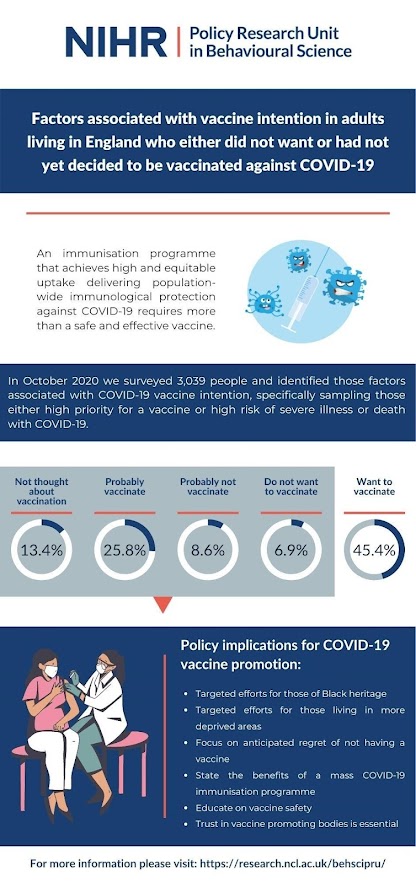
The public has shown an enthusiasm to learn a wealth of terminology during the course of the pandemic. My Unit’s work on the comprehension of antibody testing has shown that this isn’t easy, but it’s something that we shouldn’t shy away from. Patient and public involvement in research is vital to ensure that our lay outputs are fit for purpose and we should all consider how we can be better at science translation. Speaking on camera or on live radio is incredibly nerve-racking and not for all, but as I recently discovered following a two-hour training course, you don’t need a degree in design to produce a half decent infographic.

While I am advocating for your individual action, we also need to consider what systems, for example the new UK Health Security Agency, could put in place to fulfil the role that was missing during the pandemic. Most pressingly on our horizon is the delayed childhood vaccine strategy. The struck-off doc will be feeling emboldened. He understands and has mastered the artistic skill of communication, delivering his message with the gentle assured cadence of a BBC continuity announcer. In the absence of substantiated evidence, he expertly sows doubt and fear to the masses, and as the infodemic has shown, he is not alone. This is a huge challenge for us in public health research and the online vitriol is scary. But building the evidence-base isn’t enough, we all need to work on at least one aspect of the artistic craft of research promotion. Because if it’s not you, you can be assured that someone else most certainly is.


The views and opinions expressed by the author are those of the author and do not necessarily reflect those of the Policy Research Unit in Behavioural Science, the NIHR, the Department of Health and Social Care, Newcastle University or Fuse, the Centre for Translational Research in Public Health.

The Policy Research Unit is funded by the National Institute for Health Research (NIHR) [Policy Research Programme (Policy Research Unit in Behavioural Science PR-PRU1217-20501)]. The views expressed are those of the author(s) and not necessarily those of the NIHR or the Department of Health and Social Care.


Images: 

1) Lourenço Veado, CC BY-SA 4.0, via Wikimedia Commons
2) Photo by Jon Tyson on Unsplash

Friday, 19 March 2021

Simple, likeable, luck? How to get physical activity research into practice

Posted by Nicola McCullogh, Post-graduate Researcher, Northumbria University

Sometime last year – I can’t remember exactly when due to lockdown blur – I was asked by my mentor Caroline Dodd-Reynolds if I’d like to join the Fuse Physical Activity Network. I’d been to a number of workshops and I loved the focus on putting knowledge into practice, so I said yes and spent the rest of the year being in awe of the speakers we’ve had from across the world. And the discussion following the first workshop of 2021 (22nd January) was so rich that we wanted to do a bit of a follow-up to – as they say – ‘continue the conversation’.

                                     Watch a recording the 5th Fuse Physical Activity Workshop

This isn’t a report on the workshop itself, but it would be wrong to start on the discussion between the attendees without first acknowledging the speakers who inspired that discussion. First Professor Adrian Bauman (University of Sydney) spoke about how we can improve physical activity practices locally and nationally, and then Ben Rigby (Durham University) took us through 10 guiding principles for local physical activity practice which were developed by the Fuse Physical Activity Network. Some of the points that jumped out from the chat box during the presentations were around the topics of:
  • Inclusivity: How can we make sure that physical activity messages get to specific groups of people? (e.g. can we do this via carers?)
  • Scalability: Physical activity interventions tend to be less effective when scaled up; is this because they are often adapted in the scaling-up process?
  • ‘Business as usual’: Should we move away from thinking about physical activity programmes and towards encouraging physical activity by integrating it into people’s daily lives?
  • Making every contact count: How can we measure the effects of conversations between health professionals and patients about regular physical activity in a way that meets the definition of ‘evidence’ for all of the different groups interested in this sort of practice and research?
As you can see, there was so much going on that it’s no surprise there were a few things we didn’t get to explore on the day! So we pulled together the remaining key themes from the chat and these are considered below.


Are physical activity interventions long enough, as it can take years to become active/inactive? And when we’re researching interventions do we give enough thought to people staying active afterwards?

This seems to be one of those areas where there’s an unfortunate disconnect between research and practice. At the workshop we discussed the value of academic research in understanding the needs of communities but also acknowledged the potentially lengthy timeframes involved before research hits policy and practice. On the other hand, limitations on the practice side can include timescales over which practitioners need to deliver interventions due to funding requirements, meaning that interventions may be shorter than they would ideally be. When it comes to people staying active, although studies with follow-ups do exist, interventions tend to try to give their participants the skills to stay active on their own once the programme finishes, rather than being ‘maintenance interventions’. Maybe we need to try an approach a bit like weight loss groups for ongoing support?


Could we use financial incentives to increase people’s physical activity?


Anyone who knows me knows I love a bit of self-determination theory so I’m going to default to that for my answer, though of course other theories are available! Tying in with the above question, I think what we all want to see is interventions with long-term effects. Financial incentives might encourage physical activity while incentives are available, but we’re unfortunately not giving people the motivation to continue without these rewards and we know the rewards won’t last forever. On another level, those running the interventions have targets to reach to show the effects of their work, so they’re operating under short-term reward systems, too. Shifting our targets towards long-term effects may help.


How can we address the social factors that influence physical activity?


Social determinants of health (conditions in which people are born, grow, work, live, and age) are well recognised by physical activity researchers and practitioners. On a broad level, interventions try to reduce anything that would hinder participation for the groups they aim to help. But an interesting area of thought is how we can use people’s sense of belonging to a group, and their perception of what that group does, to encourage them to be active (e.g. encouraging new parents to be active together at parent and baby groups). We just need to explore the best ways to do this when people identify with groups to different degrees and their group identifications can change over time.


Our efforts can be supported by following the 10 guiding principles for local physical activity practice, which bring together some of the issues discussed above including social determinants of health, inclusivity, and harnessing things that are already happening to promote physical activity. Over the years there have been many different initiatives to encourage people to get active, and some of them have really stuck. The Daily Mile is a simple idea to get children moving in schools, and it seems to be something that works for pupils and staff because it’s been running for over five years now. And Park Run has been successful around the world for over a decade. So it might seem like it’s difficult to get something in place that has an effect, that is sustainable and that people actually like, but sometimes with a bit of luck we can put research into practice and it all comes together.

I think the overall conclusion – summarised very nicely by Professor Bauman – was "keep trying".

What do you think? Let us know in the comments below.


Thank you to everyone who attended the webinar and contributed to the discussion, and to everyone involved in the Fuse Physical Activity Network for their support.

Friday, 26 February 2021

Four practical steps to increase knowledge exchange between researchers and policymakers

Posted by Peter van der Graaf, NIHR Knowledge Mobilisation Research Fellow, Teesside University

Are you keen to have impact with your research but get lost in all the knowledge exchange frameworks and models that are out there? In this blog, Peter calls upon 10 years’ experience working in translational public health for Fuse to identify four practical steps to develop collaborative research and achieve meaningful change in policy and practice.


We know all about the challenges of using research to inform policy and practice, especially in public health where the evidence base for interventions or programmes is patchy or contested. In response to these challenges, countless models and frameworks have been developed that try to define the knowledge exchange process (how research evidence can be used, in combination with other types of knowledge, to change policy and practice). Practitioners and researchers venturing into the field of knowledge exchange can be bewildered by the options available which don’t go beyond concepts and fail to describe in practical terms what research translation looks like in reality.

Here I want to share practical guidance from our research on ‘how to do’ knowledge exchange by reflecting on a model that has been developed in Fuse over the last ten years. Our approach to achieving practice and policy change has been to engage with practitioners, policymakers and the public through communications and knowledge brokerage, to co-create relevant research, influence policy and practice debates and promote evidence uptake. Below I have broken this down into four practical steps:
  • Step 1. Awareness raising: Making evidence users, funders and support organisations aware of our existence, our research and engagement opportunities, including engaging our partners early in setting the agenda for future research.
  • Step 2. Sharing knowledge: Creating opportunities for research users and producers to come together to explore opportunities for mutual learning and knowledge exchange through collaborative events, our responsive research service (AskFuse), and patient and public involvement.
  • Step 3. Making evidence fit for purpose: Localising and tailoring evidence to context by offering a knowledge brokering service, embedded research, and increasing awareness of the different pressures faced by people in health policy, practice and academia.
  • Step 4. Supporting uptake and implementation of evidence: Developing long-term relationships with policy and practice partners to co-create evidence, build capacity for practice change, and change practice and policy.

It is important to link a range of knowledge exchange activities that engage policymakers and practitioners at different levels, intensities and points in their decision-making and development processes.

For example, before meeting with policy and practice partners, we develop tailored research briefs that summarise study findings in an accessible and visual way, and that emphasise recommendations and implications for policy and practice. Involving Fuse researchers in developing these briefs improves their knowledge exchange skills, while providing them with ‘calling cards’ to initiate relationships with policymakers for further collaborative work. These conversations are often followed by requests to AskFuse on how knowledge users can apply the research evidence in a specific context, invitations to engage in collaborative research, or to support capacity building and implementation.

Knowledge exchange between academia and public health practitioners and policymakers can be complicated and at times bewildering. Breaking the process down into practical steps illustrates that knowledge exchange is empirical and relational.

Friday, 18 January 2019

Sustainable diets must be a public health priority

Guest post by Tom Embury, Public Affairs Officer at the British Dietetic Association

The publication this week of the EAT-Lancet Commission report on healthy diets from sustainable food systems makes it clear that our health and the planets are inextricably linked. As such, improving the sustainability of our diets must be a public health priority. This is something that the British Dietetic Association (BDA) has recognised for some time, and we have recently launched our One Blue Dot toolkit to help dietitians, as key public health actors, deliver on that priority.
Pale Blue Dot - photograph of Earth taken by the Voyager 1 space probe

One Blue dot – the only home we have

The BDA chose to name our Environmentally Sustainable Diets Toolkit 'One Blue Dot' for the famous image taken by Voyager 1. It is of the Earth from a distance over 3.5 billion miles, and in it our planet appears as a pale blue speck, less than one pixel wide, in the vast darkness of space. The astronomer Carl Sagan said of the image:
"To my mind, there is perhaps no better demonstration of the folly of human conceits than this distant image of our tiny world. To me, it underscores our responsibility to deal more kindly and compassionately with one another and to preserve and cherish that pale blue dot, the only home we've ever known"
Our eating habits are having an adverse impact on the environment and we are endangering the future of the planet – up to 30% of greenhouse gas emissions (GHGe) come from the production of food – and it’s the only one we’ve got. We also know that our current food system is not providing for human health either. Over 800 million people worldwide still do not have enough to eat, while nearly two billion are now overweight or obese.

We believe that eating more sustainably can be a win-win – good for us and good for the planet. It’s also the responsible thing to do. As Ursula Arens, one of the dietetic experts who helped us write the toolkit put it: "Eat healthily for you, eat sustainably for your grandchildren".

Practical help

The BDA’s 2017 policy statement on sustainable diets emphasised the central role we believe dietitians need to play, translating the complex science of environmental sustainability as it relates to food into practical dietary advice for patients and the public at large. The statement was well received by our members but they also made it clear that we needed to do more to support them to make this policy a reality. This is a big topic and can be daunting, not just for the public but for healthcare professionals as well. That is why the idea for a toolkit was born, designed to provide a summary of the key evidence, some practical tools and links for more advice.

So far, we’ve developed a comprehensive reference guide which looks in detail at the key elements of a sustainable diet, outlines the evidence on the impact of certain foods on areas like GHGe, land use and water use. We’ve included practical meal swaps, which highlight the relatively easy ways in which common meals can be made both more nutritious and have less impact on the environment. We then include detailed information on specific nutritional considerations, in particular those nutrients that may be lacking if red meat is reduced and dairy intake moderated, such as calcium, iron and iodine.

Key recommendations

The main two recommendations within the toolkit are to reduce red and processed meat (RPM), and to moderate dairy intake. These two actions will lead to the biggest reduction in GHGe in particular, and we know that there are positive health benefits from reducing RPM and shifting away from certain dairy sources such as cheese which have high environmental impact and are also typically high in saturated fat and salt.

Other considerations, like sourcing sustainable fish, eating more fruit and veg, consuming locally produced food and reducing food waste will also make an important contribution to public health. No one action will be enough on its own. It becomes clear once you delve into the science and evidence on sustainable diets just how complex this issue is, and that even seemingly innocuous differences in the way (or indeed where) food is produced makes a big difference to its environmental impact.

What next

This toolkit is not finished; it remains a live document which we hope to add to and update over the coming months and years. While the first part is focused on dietitians themselves, we know that the next phase will be to make this a public health message. We’ve already got some more materials planned, and been delighted with all the questions and suggestions from dietitians and others about what we could look to include in future iterations. If you have any further suggestions, including on how this message can be translated for public health audiences, they’re very welcome!

We know that changing our diets alone will not save the planet - we also need to make big changes in transport, energy, waste and many more besides. However, as the experts in diet and health, it’s the area in which we have the expertise to make the biggest difference.

You can find out more about the One Blue Dot toolkit on the BDA website: www.bda.uk.com/onebluedot


Image: 'Carl-Sagan-Pale-Blue-Dot' by Owen Iverson via Flickr.com, copyright © 2006: https://www.flickr.com/photos/oweniverson/4671868416

Friday, 25 May 2018

Public health isn’t good politics

Knowledge exchange lessons from the 4th Fuse international conference (part 1)

Posted by Peter van der Graaf, AskFuse Research Manager, Teesside University

When I attended the Fuse knowledge exchange conference in Vancouver, B.C. earlier this month, I did not know that some Canadian squirrels are black.

I also did not know how much knowledge exchange was embedded in Canadian research. In the UK we are struggling to get researchers involved in knowledge exchange while working in an academic system that does not reward these activities. For Canadian researchers this is a fundamental part of their job and firmly embedded in the CIHR (the Canadian equivalent of NIHR) mission statement: "… excel the creation of new knowledge and its translation into improved health for Canadians" (Canadian Institutes of Health Research Act).

As surprised as I was to see black squirrels skirting the trees in Stanley Park in Vancouver, I was also surprised by the number of Canadian presenters at the Fuse conference who pointed to the impossibility of translating research evidence into practice.

For instance, Steven Hoffman, made a convincing case about public health being not good politics and therefore difficult to translate into policy. He argued that everything that public health does makes it invisible to policy makers. For example, we focus on prevention instead of treatment, which is much more difficult to observe and showcase.

An image from Steven Hoffman's presentation
Moreover, the more successful we are (when we prevent population diseases from spreading), the greater our invisibility becomes (there is no longer a disease to worry about) and, consequently, the more difficult it is to ask for more resources to keep prevention efforts up.

We also focus on supporting long-term chronic conditions instead of delivering acute services that can provide an instant solution to health problems. Furthermore, our data, as a population science, is based on statistical lives instead of individuals with a face and story. This all makes public health a hard-sell to politicians.

But it is not only our modus operandi that causes this hard sell: the system in which policy makers operate makes the use of research evidence unlikely. Paul Cairney from the University of Stirling explained in his talk that policy makers must ignore almost all the evidence that they are presented with to make decisions. They do this, not by weighing up the evidence carefully as we as researchers would like them to do, but by taking shortcuts, which Paul described as ‘bounded rationality’.

Policy makers either select evidence that helps them to reduce uncertainty about how to achieve their goals or, (and this is the more popular option) they apply their gut-level, emotional, belief-driven knowledge to reduce ambiguity about policy options. Moreover, policy makers are often not in control of the policy process and therefore they cannot tell us what evidence is useful, when and how it will influence the decision-making process.

If public health policy is not good politics and research evidence is a hard sell to policy makers, what can we do to make a better investment case for public health? Luckily both speakers provided their own shortcuts for making it more likely that public health and our evidence would be heard and used by policy makers:

1.) Recraft the narrative. Smoking was banned in public places not because smoking was harmful to smokers but because the campaigns focused on the dangers of second-hand smoke to the wider public, particularly children. By reframing the story from an individual blame game to an emotive public issue, public interest could be galvanised and used to put pressure on national Government to take action, building on local interventions already in place with a proven evidence-base.

2.) Take account of how democracy works: politicians need votes. As public health researchers we need to give them glory in the eyes of their voters and provide them with opportunities to leave a visible legacy. We could this by advertising our successes more clearly and by making it personal. Eugene Milne, Director of Public Health at Newcastle City Council, summed this up in a simple statement: "...‘it could happen to me’, mobilises people".

3.) However, to do this effectively, we need to be aware of hierarchy in politics and different policy contexts and networks. Most importantly, we need to be able to navigate diffused decision-making processes. As Paul emphasised in his presentation, policy makers have different ideas about what counts as good evidence, and there are many ‘policymakers’ across many levels and types of government. In other words, there are many sources of policy relevant knowledge that public health research evidence has to compete with.

It will take time and long-term relationship building to understand and navigate the different policy contexts, networks and types of evidence used in both. Unfortunately, public health students are generally poorly equipped to navigate these networks. Steven Hoffman remarked that we are not equipping our PhD students with knowledge of political systems and, in not doing so, set ourselves up for continued failure to make public health and our evidence visible to policy makers.

This does not mean that each student should become a political expert and advocate fiercely for her/his research findings. But it does entail a student being able to recognise their role in the wider system that they are part of, including various political networks and contexts. How can we teach our students to act from their position in a political system in a way that will make public health more visible?

This brings me back to squirrels. The squirrels that I encountered in the park stood out because they were black; a different colour to the common British grey and (less common) red squirrels that I’m used to seeing. In a similar vein, we could make our PhD students stand out by teaching them how to take evidence shortcuts in the political system.

Sharon Hodgson, Shadow Minister for Public Health, speaking
at an event in Sunderland
When I returned to the UK, with more appreciation for squirrels, I attended a spotlight event at the University of Sunderland the next day, which aimed to increase the visibility of public health research at the university. Although heavily jet-lagged, what sparked my interest at the event was a debate that took place between Sharon Hodgson, the Shadow Minister for Public Health and various researchers in the room. They sparred about the evidence for introducing a minimum unit price for alcohol in England and whether 40p made more ‘sense’ (and to who) than 50p. The ensuing debate demonstrated many of the arguments made in this blog and therefore will be the focus of my next blog (part 2) with John Mooney, Senior Lecturer at the University of Sunderland.

We will use this example to demonstrate how Canadian experiences might inform local practice in the UK by recrafting the narrative, taking account of Labour as an opposition party, and making it personal for voters.


Image: "Black Squirrel" (11997818194_8f66516b30_z) by DaPuglet via Flickr.com, copyright © 2018: https://www.flickr.com/photos/dapuglet/11997818194

Wednesday, 8 November 2017

Spice up your research life: match-making in public health

Posted by Peter van der Graaf, AskFuse Research Manager, Teesside University

Three years ago, we had a crazy idea: what if Fuse had its own dating service for academic researchers and health professionals? Instead of innovative research findings gathering dust on lonely bookshelves, we wanted to provide a stage for academics and health professionals to meet and discuss how that evidence could be used in practice. We were keen to facilitate early conversations on how to collaborate on research that is useful, timely, independent, and easily understood.

Instead of health practitioners wandering around University campuses, trying to find the right academic to work with, we envisioned an open door leading to a welcoming friendly-faced guide. Someone who could do the matchmaking and help them to find or create evidence for spicing up their policies or interventions.

After checking our idea with various health practitioners in the region to make sure that it would make their hearts beat faster, we launched AskFuse in June 2013: Fuse’s very own rapid responsive and evaluation service with a dedicated match-maker (research manager) in post – that’s me!

Coming from an applied research background in social sciences, this post was certainly a challenge but also an incredibility exiting opportunity to develop something new with the support of an enthusiastic group of people across Fuse. The job has been a steep learning curve, but also a great way to meet a lot of people working in public health across the region, getting to understand their passions and … what keeps them up at night.


I quickly learned that there were many great public health projects and programmes being developed and delivered locally that deserved more attention and research (e.g. My Sporting Chance, Ways to Wellness, Boilers on Prescription).  I was encouraged by a real appetite among academics to support this work but felt the frustrations of health professionals caused by budget cuts and the need to decommission services rather than to develop them. I also noticed the limited research evidence informing some of these decision-making processes and the lack of knowledge among academics about how to influence these processes and mobilise their research evidence effectively.

AskFuse has supported more than 270 enquiries from a wide range of sectors, organisations and on topics ranging from Laughter Ball Yoga to Whole Systems Approaches to obesity. We have helped to develop new interventions and evaluated existing ones, made research evidence accessible and understandable, organised events to explore new topics, and pioneered new methodologies; all in collaboration with our policy and practice partners. We have also made mistakes, misunderstood procurement procedures, were not able to help in time, could not find relevant expertise or did not always follow-up on conversations.

Despite these challenges - or perhaps because of them - we have been able to build a dating service that (I think/hope) is perceived as useful by our policy and practice partners, that has helped us to build relationships (even in times of considerable system upheaval with public health moving to local authorities), and has informed new research agendas for Fuse going forward over the next five years as a member of the national School for Public Health Research.

As the service is expanding and my role is changing (I recently became a NIHR Knowledge Mobilisation Research Fellow, which I will talk about in another blog), we are looking for a new AskFuse Research Associate to work with me on strengthening the service and taking it in new directions. If you are interested in mobilising knowledge, fancy a challenge and want to work with a fantastic team, why not be part of it?

Thursday, 6 October 2016

A nation stood still for 25 years: Can we find solutions for action in policy and practice?

Guest post by Ben Rigby (pictured), a postgraduate student in Durham University’s School of Applied Social Sciences and Associate Member of the Wolfson Institute of Health and Wellbeing Research

Fourteen – the number of pieces of legislation published since 1991 which specifically state ‘physical activity’ (PA) in the context in which Public Health England presents as a problem needing a long-term solution. That is, an unsustainable burden on the UK economy, resulting from diminished health and well-being, which may be alleviated by increasing population-level PA.
 
I want to help do something about this problem. For the next few years, I will be undertaking a North East Doctoral Training Centre ESRC-funded PhD to research how PA-related practice, evidence, and policy interact to benefit or disadvantage different population subgroups. This project will be supervised by both Dr Emily Oliver and Dr Caroline Dodd-Reynolds, co-directors of Durham University’s Wolfson Institute Physical Activity Special Interest Group. 

Although advances in public health policy and evidence have emerged, not least through the work of the Fuse’s Physical Activity Group on improving evaluation and translation, for example, there remains a clear disconnect between use of evidence, proper evaluation and the influence (and interference) of policy and politics in decision making and the provision of activity opportunities. Having worked for Hampshire’s County Sport Partnership for the past year, these are issues I have experienced first-hand.
 
As a practitioner, it was often difficult to translate available evidence into viable practice. Reasons for this were numerous, though included funding issues, difficulty in physically accessing research, as well as in understanding complex ideas of theory and evaluation, within the particularly vague policy context by which one was guided. Emerging literature also highlights issues in policy, such as failing to consider local implementation barriers, persistent participation inequalities or the intricacies of behaviour change.
 
The aim of my research will be to identify systems and opportunities that facilitate a more integrated relationship between PA evidence, policy and practice. In order to garner a holistic appreciation of these factors, it is vital to understand how policy makers receive, adapt and adopt evidence; how organisational factors constrain or facilitate its adoption and importantly, recognise values and interests of those influencing responses to the evidence or policy problem. A particularly neglected policy research topic has been individual or organisational capacity to act upon evidence.
 
Previous research has perhaps been somewhat one dimensional in these areas. Alternatively by employing a mixed-methods approach and my applied social sciences background, I will be able to generate a much-needed complex understanding of the extent that local, regional and national stakeholders use evidence in PA policy design and implementation, and review factors associated with successful policy implementation. Whilst building upon existing literature, it is intended that this will offer a unique interpretive perspective on people, practices and policy processes (both locally and nationally), enabling and supporting policy development and implementation.
 
Does sitting and talking, and a lack of progressive
 policy action, promote our sedentary society?
Specifically by investigating the following two core propositions initially, I propose that it may be possible to find equitable solutions for progress in increasing physical activity and provide an important contribution to the field of public health research:
  1. Weak evidence results in inherently conflicting and ambiguous PA policy, thus constraining implementation efforts
  2. Political entrepreneurs may offer more effective solutions for policy development and implementation 
Being a fledgling researcher
One of my relatives (a PhD recipient herself), once told me that doing a PhD will be the hardest thing I ever do. I am under no illusions about the task before me, the complexity of which may be compounded by investigating one of society’s most entrenched problems. However I welcome the challenge and cannot wait to get stuck in, even if a little part of me wonders if I have what it takes to make a difference in the world, as I am sure many new Social Policy researchers before me have. I hope that my research will land well and have impact in the academic sense, but also in tangible real life outcomes for local communities in time.
 
I am not alone in this quest, and hope over the coming years to work closely with Fuse and its focus on Translational Research; specifically, the Fuse Physical Activity group offers an important platform for me to engage with physical activity policy makers, practitioners and academics who I hope will engage with me in developing this programme of work. I believe research evidence should be free and accessible wherever possible, an issue I have already raised. I wish to experiment with how better to present evidence to make it attractive to both policy makers and practitioners. At the same time, I am conscious of having to develop my academic reputation and profile and balancing this with experimentation is something I am wary of at this stage. 
 
I wish to build networks within local institutions with like-minded students and academics to share ideas and findings. My aim is to disseminate throughout my project and beyond. I hope to be able to present to Fuse research fora, access advice and support from the group’s members, as well as contribute to this blog. I welcome any feedback on this post. In particular I would be delighted to hear from individuals, practitioners or groups who:
  • have shared research interests
  • are responsible for PA-policy production locally
  • research health inequalities
  • had difficulties implementing policy guidance and evidence
  • believe research in this area may benefit their line of work
Ben can be emailed at benjamin.p.rigby@durham.ac.uk. He is also on Twitter, LinkedIn and has a blog.

 
Notes and References:

  1. Figure taken 27 June 2016 – using the search term ‘physical activity’ at http://www.legislation.gov.uk. Between 1991 and this date 72,088 pieces of legislation were published. Results were manually screened and filtered for ‘physical activity’ as recognised by the World Health Organisation as benefitting health, well-being and personal and social development.
  2. Bowen and Zwi.2005. Pathways to evidence-informed policy and practice: a framework for action.
  3. http://www.mirror.co.uk/news/uk-news/john-prescott-battle-jeremy-corbyn-8720209.

Thursday, 4 June 2015

Complexity in health organisations: setting ourselves up for chaos or enjoying the simple things in life?

Posted by Peter van der Graaf

Can applying a complexity lens to health organisations be more than an academic exercise with practical applications for service delivery? This question was central to a two-day meeting last week in London at the Health Foundation between researchers, policy makers and health practitioners. The event was organised by The Knowledge to Action Group (KTAG), an international team of senior academics and coordinated by two leading members of Fuse’s Complex Systems research programme, Prof David Hunter and Dr Emily Henderson. The group brought together the crème de la crème of health research and knowledge mobilisation, with about 40 handpicked participants from across the UK to debate a green paper on the topic (which is a tentative government report and consultation document of policy proposals for debate and discussion).


The essence of this meeting was about getting to grips with the consequences of doing research and developing interventions in a world that is inherently complex (which is not to be confused with just being complicated!). The green paper (Knowledge-to-Action: Addressing Complex Problems in Health Systems, May 28/29 2015) described complex systems as non-linear; dynamic; and having no single point of control.  Because of these characteristics, outcomes in a complex system are unpredictable and resistant to interventions. So are health systems really complex? Anyone trying to get research evidence into practice will quickly discover that knowledge mobilisation is prone to all the characteristics outlined above for complex systems.

In one of the breakout sessions during the event the difference between complicated and complex was illustrated with the example of building a rocket versus raising a child.  Building a rocket is complicated but will lead to a predictable outcome (successful launch) if all the different pieces are correctly assembled according to the guidebook. However, raising a child is complex (as many parents will testify) and often leads to chaos in many academic households. This is bad news for academic parents and health service managers: you cannot steer the thing (but you are still accountable for it) and even if you find the solution to a problem in the system it is likely not to work when you try it again. The dynamic nature of systems means that what works in one context or at one point in time may not work the same as the system changes.

How do you work within such a system? Fortunately, the event provided four case studies of research projects where the academics had managed to work within a complex health system to produce change across different areas, often in co-production with policy makers and health practitioners. The authors of the green paper distilled four themes from these case studies to inform future research and interventions:

  1. the balance of central and distributed authority in organisations and systems; 
  2. the importance of emergence (continuous learning and adaptation); 
  3. the need for co-produced knowledge; and 
  4. a range of leadership positions and styles.
These four themes were discussed in more detail in various breakout sessions over the two days.

Participants embraced the spirit of the event and discussed a wide range of topics (from the need for a critical discourse department to finding positive deviants), whose relationships with the four themes were sometimes unclear and mostly unpredictable. Nevertheless, some key messages emerged from the event that will soothe the nerves of academics and service managers. By visualising complex organisations as “patterns of conversations between interdependent individuals” (as quoted in a presentation from Allan Best on the first day), working in complex systems becomes conversation management and engagement. According to the researchers involved in the successful case studies, this works all the better outside the normal context of everyday work by taking commissioners to the pub or baking a cake for a meeting with service managers to get the conversation really going. Isn’t it ironic that to work inside complex systems, one needs to go back to basics in a more simple system?

Thursday, 9 April 2015

How hard can it be? Flying over the gap between research and policy


Posted by Peter van der Graaf
A man in a hot air balloon realised he was lost. He reduced altitude and spotted a woman below. He came lower and shouted: “Excuse me, can you help? I promised a friend I would meet him, but I don’t know where I am”. The woman below replied: “You’re in a hot air balloon hovering approximately 30 feet above the ground. You’re between 40 and 41 degrees north latitude and between 59 and 60 degrees west longitude”.

“You must be a researcher,” said the balloonist. “I am,” replied the woman, “how did you know?” "Well,” answered the balloonist, “everything you told me is technically correct, but I’ve no idea what to make of your information, and the fact is I’m still lost. Frankly, you’ve not been much help at all. If anything, you’ve delayed my trip.”

The woman below responded: “You must be a policy maker”. “I am,” replied the balloonist, “but how did you know?” “Well,” said the woman, “you don’t know where you are or where you’re going. You made a promise, which you’ve no idea how to keep, and you expect people beneath you to solve your problems. The fact is you are in exactly the same position you were in before we met, but now, somehow, it’s my fault.”
This story was presented by Professor Roland Bal from Erasmus University in Rotterdam, the Netherlands in his recent Knowledge Exchange Seminar titled: ‘Hybrid management in science-policy practice relations’. You might have heard the story before, as it is adapted from an article by Locock & Boaz in 2004 in Social Policy and Society and also quoted in the PhD thesis of one his students, Rik Wehrens (2013), who studied the Dutch Academic Collaborative Centres for Public Health and how they shaped the co-production of research, policy and practice within this field in the low lands.


In his seminar Roland used the above story to explain that we often fall into the trap of thinking of two communities (ivory tower scientists on the one hand and policy makers at the coalface on the other) with completely different perspectives on the use of research and evidence. He did not deny there were differences between both professions, and gaps to bridge but suggested that we should use these gaps more strategically. By starting from a recognition that all science is a social practice quoting Jasanoff (2004) (“Scientific knowledge [..] both embeds and is embedded in social practices, identities, norms, conventions, discourses, instruments and institutions” (p. 2-3)) he showed how the Dutch Centres have been able to blur the boundaries between the two communities by distinguishing between a front and back stage for their partnerships and performing on these stages at different times in the collaboration process.

At front stage the academics took the limelight and made all the right noises about scientific rigour by presenting their advisory report to public and policy audiences, complete with imposing lecture theatres. They deliberately emphasised the difference between academics and health professionals to create the impression of ‘science speaking truth to power’. However, the content of the reports and the research behind were intensely debated behind the scenes on various back stages between academics, health professionals and policy makers to ensure that the research objectives and findings were embedded in the wider political context. In other words, collaboration and distinction were highlighted at different times in the process to enable each community to explain and sell their work to their peers: policy makers needed to account for their compromises and shared decisions, and academics needed to manage the expectation around their research.

Two key mechanisms provided crucial in this staging: firstly, dual appointments that enabled health practitioners to take up part-time roles in academia (but surprisingly not the other way round!) and, secondly, scenario approaches that clustered specific interventions into modelled scenarios connected to relevant policy programmes.

What lessons does this hold for Fuse? Are we still trying to bridge the two communities or should we spend more time developing different stages? AskFuse (our responsive research and evaluation service) might be a step in the right direction to create the back stage for initial conversations between policy makers, health professionals and academics but where is our front stage? Are we making enough noise? And how serious are we about dual appointments (researchers in residence?) and linking research on interventions to specific policy programmes?