Showing posts with label embedded research. Show all posts

Friday, 21 July 2023

How to choreograph a dance between policy makers and academic researchers?

Posted by Peter van der Graaf, Associate Professor in Public Health at Northumbria University and AskFuse Research Manager


Dancing is a key move in public health, particularly if you want to make an impact with your research. Knowledge exchange is not just a science or even an art, but very much a dance between researchers and policy makers about the use of research evidence. To complete this dance successfully and get evidence used in decision making, both partners need to follow certain steps. However, learning the steps (science) or performing them perfectly (art) is not sufficient: it requires instinct and feel for where you are in the dance and why you are doing it.

To develop a dance plan for your interactions between policy makers and academic researchers, Fuse hosted a special session (or dance class) at the European Implementation Event in Basel, Switzerland on 8 June. The EIE2023 brought together over 300 implementation scientists, practitioners and funders from across health, social welfare, education and other sectors in Europe. Over two days through fishbowls, science slams, workshops, inspiring keynotes and oral presentations, participants explored how to create a new normal for implementation science in society.

Our session explored dance challenges (e.g. moving too slow, bad timing, outfit malfunctions, and unsynchronised performances) and new routines in response (see: ‘What did we learn?’ below) that we have developed in Fuse over the last 15 years collaboratively with our partners. In the session, we highlighted examples of creative communication (the art of knowledge exchange), research performance both backstage and frontstage (AskFuse), and dancing together (embedded research) to set the scene for a discussion about what makes a successful dance between policy makers, health practitioners and academic researchers. We invited conference participants to share their own reflections of dance routines they have developed to support knowledge exchange and implementation of research evidence in practice and policy making.

What did we learn? 10 dance lessons


1. Academic researchers need to learn four basic steps for dancing with policy makers (see the Fuse knowledge exchange model):
  • Raising awareness, using creative communication.
  • Knowledge sharing through joint events.
  • Making evidence fit for purpose (localising and tailoring).
  • Supporting uptake and implementation (e.g., capacity, co-production, linking activities).
2. A deviant knowledge broker can help to facilitate backstage conversation and protect policy makers and academic researchers from missteps.

3. Go with the music: as the context and process in which evidence is useful changes constantly, it is an important skill for researchers to be able “to go with the music” based on ongoing relationships with policy and practice partners.

4. Emotional engagement between researchers and policy makers is essential to get a better feel for the music. A heart-to-heart or moaning about bad performances helps you to improve dance routines and hide missteps. Don’t forget the power of cookies!

5. Embedded research helps to develop an instinct for the dance, based on a better understanding of each other’s organisational contexts. Embedded research allows you to be part of solutions, developed with the communities affected, not just report on the effect on interventions and their implementations.

6. Public health is political; lobbying and advocacy are a core part of the embedded research roles.

Choreographing your own dance routine

We presented participants with the following questions to help develop their own dance routines: 


In response, conference participants started to develop their own dance metaphors for describing their experiences with collaborative research between academics and policymakers. Someone referred to their routines as a ‘silent disco’, where academics and policymakers were dancing to different pieces of music without knowing what the other where listening too. Other participants emphasised the need to spend time together first before you start picking music, to get a better understanding of each other’s musical tastes (classical meets punk?).

Overall, participants felt inspired to start to think more deeply about their own dance plans. How would you answer the above questions and what would your dance plan look like? 

Friday, 2 April 2021

Working together to tackle inequalities and inactivity

Posted by Sophie Phillips, Fuse & NIHR School for Public health Research (SPHR) funded PhD Researcher, Department of Sport and Exercise Sciences, Durham University, and Dr Rachel Mowbray, Insight Coordinator, County Durham Sport, Active Partnership.

In today's Fuse blog post, Sophie and Rachel tell us about collaborating during Sophie's secondment at County Durham Sport between January and March 2021.

It seems obvious that we would work together, right?

I conduct research in an academic institution and Rachel promotes evidence-based working in an Active Partnership which collaborates closely with Durham County Council. Our day-to-day roles are quite different. But, we have a shared goal: to tackle inequalities that stand in the way of physical activity engagement and support children and adults to be more active. By working together, combining knowledge, skills, and connections, we think we can make even greater progress towards improving people’s health and wellbeing.

How is academic research positioned within the physical activity landscape?

Physical activity policy and practice is a large and complex system made up of many different organisations, approaches, and settings. Academia is often positioned as external to the system, trying to create impact from the outside through activities referred to as ‘pathways to impact’. But in reality, academic research could be a crucially important element of the system in its own right (but often doesn’t have that position). Can positioning academic research as part of the system (as opposed to outside the system) make creating impact less of a hurdle and more of an opportunity?

Through my secondment to County Durham Sport, academic research has been embedded into the local Active Partnership. This gave me a huge opportunity to make an impact (on a daily basis!) by simply talking to others in different parts of the system. By sharing my knowledge and passion through conversations, I felt like I could make a real difference. Sharing information and ideas can challenge and influence thinking. This can (and does) influence the way things are done.

What are the benefits of an embedded researcher in policy or practice?

Rachel:
Non-academic audiences often cannot access academic publications in meaningful ways because of financial barriers and/or because of the academic format. Having Sophie embedded in our organisation brought academic research to life and into the conversations happening between practitioners, policy makers, and non-academic researchers. These conversations allowed us to access the most up-to-date and robust information about physical activity. In the same way, County Durham Sport were able to offer extensive knowledge of the local physical activity system and inequalities. Working together, we created a stronger evidence-base on which to tackle the challenge of inactivity.
Sophie: I was able to communicate knowledge from academic research papers on physical activity into meaningful insight for County Durham Sport. One of the pieces of work I conducted during the secondment was a report on early years physical activity and movement. This included translating evidence from academic research papers into meaningful and accessible outputs (including reports, overviews in tables, and presentations). I was also able to engage with different stakeholders and physical activity providers across multiple settings, who are involved with local early years provision. This helped to bring together both the research evidence and the current local landscape, to make evidence-based and actionable recommendations about future early years provision.

Take-home messages from our collaborative experience…

Our day-to-day roles are very different, as are the expectations and outcomes of our work. Although this presents some challenges (such as differing timescales and required outputs), ultimately, we share a goal - to tackle inequalities that stand in the way of physical activity engagement, support everyone to be more active, and help to improve people’s health and wellbeing. Finding this common ground can foster true collaborative thinking and drive connections between academic and non-academic players in the physical activity system. Integrating our different perspectives and approaches is beneficial and necessary to create meaningful system change.

Rachel: Tackling big issues (like inequalities in physical activity) requires a collaborative and evidence-based approach. I would encourage other third sector organisations to engage directly with academic researchers - both to learn from their expertise, and to share your own experience of practice or policy. We can achieve more working together than we can alone!

Sophie: My experience of collaboration with County Durham Sport has been invaluable. It has influenced the way I think about conducting and communicating research. I would encourage other public health research PhD students to explore the opportunities of engaging in a short time with policy and practice partners in their field, to help view their work from different angles.


Sophie’s academic research is about measuring the physical activity and movement behaviours of pre-school aged children. Her secondment at County Durham Sport was funded by UK Research and Innovation (UKRI) QR Strategic Priorities Fund awarded through Durham University.

Rachel promotes evidence-based partnership working to tackle inequalities in physical activity through her role with County Durham Sport, Active Partnership funded by Sport England.


Images:

2 & 3. Photo of Rachel (https://www.countydurhamsport.com/about-us/meet-the-team) and Sophie (https://www.countydurhamsport.com/homepage/news/) with thanks to County Durham Sport.

Friday, 12 February 2021

Placement, parcels and a pandemic: five weeks embedded in a public health team

Posted by Maisie Rowland, Research Assistant and Registered Nutritionist, Human Nutrition Research Centre (HNRC), Newcastle University

Newcastle Civic Centre
My research has taken me from primary schools in the West End of Newcastle to rural schools in the mountains of Moshi, Tanzania but I have always been curious about other job roles and what they involve. I have also been interested in how, as researchers, we can collaborate with those outside of academia to ensure that the research we do has the desired impact. So on seeing an advertisement for an embedded researcher placement in Newcastle City Council with the Public Health team, I put in an application. This felt like a great opportunity to expand my knowledge of other job sectors, while creating links outside the university and maintaining my work in the HNRC (working there one day a week). Before I knew it, I was walking to the city’s Civic Centre for the first day of my five-week placement.

I spent my first week learning about the wide variety of projects and roles the team were involved in, such as the redevelopment of Fenham library to include a drugs and alcohol recovery hub and the health education with schools and young people. I was able to sit-in on a number of interesting meetings and was able to contribute to the Wider Determinants of Health team meetings. I learned about how projects happen and was surprised at how much it differed from a university research setting, such as the different resources used for background research for projects and the differences in terms of ethical approvals. I was also given the opportunity to put forward my ideas and interests and, working alongside my colleagues Dr Annette Payne (Health Improvement Practitioner) and Lorna Smith (Speciality Registrar in Public Health), we developed an idea for a project working with food banks. As a nutritionist, I have a strong interest in this area. Through conducting online research, and visiting food banks and ‘pay as your feel’ supermarkets, we gained an insight into how these organisations and similar providers work. We also learned about the nutritional content of ‘standard’ emergency food parcels, the demographics of those who find themselves needing to use food banks, the situations these people might be in, and finally the shocking numbers of people finding themselves in need of using them. From this research, we developed a report which was presented at the Public Health Senior Management Team meeting for approval and feedback from other team members. Our project was well received, which was encouraging, and we were given the go-ahead to continue with our work.

Life Foodbank in Newcastle upon Tyne
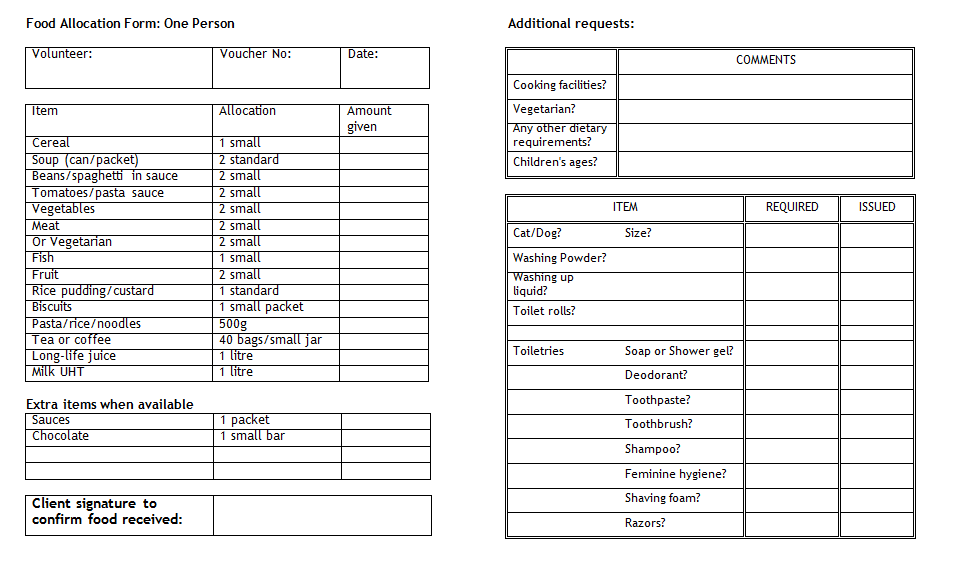
From this background research, I learned that those who use food banks have usually been referred through care providers (such as through school or through social workers), and there is a limit on the number of times they are able to use the food bank. Help is given in the form of an emergency food parcel containing at least three days’ worth of food, and users are often offered help and advice which aims to resolve the issues that have led them there. Although there has been nutritional guidance on the food parcels, the reality is that a lot of the food comes from public donations. Therefore, as the donations vary, so will the food parcels. Within the team, we considered possible changes to the parcels that could be suggested, in order to benefit those who have to use food banks. It was quickly decided that any work we did would be with the food banks themselves, rather than those using the food bank. We devised a plan with three ‘phases’, including:
  • Phase one involved a consideration of how to suggest very small changes to the ‘food call outs’. For example, typical foods that are given in food parcels, and are regularly requested in the call outs, include breakfast cereals, soups, pasta and pasta sauces, rice, tins (beans, meat, vegetables, and fruit), tea or coffee, sugar, biscuits, snacks, jams, and fruit juice. Due to the variation in these particular food groups, and the variation in the foods that are donated to the banks, the nutrient content of the packages will also vary widely. Our suggested changes to the call outs will include requesting tinned fruit in juice rather than syrup, reduced sugar/salt baked beans and tinned pasta in sauce, tinned vegetables without added salt or sugar, and higher fibre/lower sugar breakfast cereals.
  • Phases two and three will involve creating some user-led resources for the food banks such as recipe cards, which will provide inspiration for different meals that could be made from the foods in the parcels. We also hope to include a ‘community access card’, which will provide information on nutrition, healthy weight ranges and local support available. The local support would involve signposting to free cooking classes, food banks and ‘pay as you feel’ supermarkets, community groups, and computer facilities at libraries.
Food parcel single person packing list from the Trussel Trust


As I approached the end of my placement (which felt like it was ending just as quickly as it started!), we made plans to keep in contact about the ongoing development of the resources. We planned meetings with a food poverty group and with those running the food banks, and felt that good progress was being made. However, during the last week of my placement Covid-19 put a halt to our work. The last meeting that I attended in the council was geared towards how it could help to mitigate the impacts of the inevitable poverty that the virus would induce, as schools and food banks began to close, and many people expected to lose their jobs. Current projects at the council are now on ‘pause’ and those working in Public Health are tasked with devising solutions to the increasing number of problems that are arising from the pandemic.

At a time in which increasing numbers of people may need to access food banks and services, projects in Public Health and nutrition seem particularly relevant. I hope to be able to continue the project that we started during my placement in the future, taking into account new factors that may develop through this pandemic.

Maisie has worked at Newcastle University for over five years, collaborating with colleagues and researchers in Public Health England, charities such as Coeliac UK, international nutrition research centres, and the media.


Images:

1. Bob Castle, CC BY-SA 3.0, via Wikimedia Common

Friday, 17 July 2020

The long and winding (and emotional) road to impact

Posted by Mandy Cheetham, Research Associate, Teesside University

Having submitted written evidence to the Work and Pensions Select Committee inquiry on the impact of the 5 week wait for Universal Credit (details here), I had not anticipated being invited to give evidence by Zoom to a panel of MPs in the midst of lockdown. The evidence submitted (available here) drew on qualitative research into the experiences of claimants in North East England (Cheetham et al 2019) and quantitative research showing the mental health impact of Universal Credit, undertaken by colleagues from Liverpool University (Wickham et al 2019). Dr Sophie Wickham and I were both invited to be part of a panel for the second evidence session. I had watched the first evidence session to see the lines of inquiry pursued, realising (with dismay) it was available live on parliament tv.


As witnesses, we had been given a broad indication of the areas on which MPs would focus their questions. These included the effects of the 5 week wait, its impact on mental health, and our thoughts on what could be done to mitigate the adverse effects. I had read and re-read our research paper, digested more recent reports and published literature and carefully prepared my responses to the anticipated questions. I had emailed colleagues in local advice organisations to see if the issues identified in the research were still relevant. I had a chat with a university colleague who had given evidence to a different committee drawing on our research on energy drinks 2 years previously. A final check that the technology worked in a test call the afternoon before and all was set.

Following advice from the friendly and efficient clerk of the committee, I had moved my laptop away from the background distractions of grandchildren’s Batman costumes and toys. I woke up early on the morning of 17 June feeling nervous with anticipation. ‘Trust you know enough’ were the calm words of advice offered by one committee official.’ ‘Stick to the evidence; be focused and don your cloak of authority’ came texted advice from a senior academic colleague with a good luck message. I have a tendency to talk too much when I’m nervous, and knew I needed to avoid waffling, so this was a helpful reminder. But I wasn’t sure I had a suitable cloak of authority handy.

In the event, the preparation paid off. I stuck to my bullet points and weaved in quotes from participants when I could. It wasn’t perfect and there’s always more to say. I’m not sure it’s possible to do justice to the harrowing experiences which had been shared by research participants, but I tried. There is a big focus in academia on impact, and I sometimes feel limited recognition of the time and multi-layered approaches needed to achieve it. Immediately after the evidence session, which lasted an hour, I was contacted by a journalist from the Independent asking about a paper I had mentioned in my evidence. Within an hour the Sun online quoted our evidence in an article supporting their campaign to make Universal Credit work.

Evidence is clearly not the only, or the most important deciding factor in the messy world of policy making. I believe we need to use a combination of political levers of influence at our disposal to affect changes when opportunities present themselves. This felt like a huge moment. The priorities and timeframes of academia and policy making do not always align. The study I was reporting grew out of embedded research with community members in Gateshead who talked about their fears about Universal Credit being rolled out in 2017, fieldwork was undertaken April – October 2018, written up and paper submitted in November 2018 and published in 2019. Following the select committee, a colleague posted links to the evidence session on the Facebook pages of organisations who had supported the research for community members to see. It felt right to let participants know what had happened.

Since 2018, we have shared the research findings at numerous conferences and with Department for Work and Pensions staff, but with limited effect. COVID-19 has prompted temporary changes to be made to Universal Credit, which will help. My experience in the shielding hub demonstrates how many families claiming Universal Credit, particularly those with children, continue to struggle with the additional costs of lockdown. Last month, Therese Coffey announced the re-instatement of conditionality requirements and sanctions, which will add to Universal Credit claimants’ stress at a time of economic insecurity, rising unemployment, unprecedented job losses, and anxiety about the future. Even a global pandemic can’t halt political will it seems.

In my view, public health is political. Lobbying and advocacy are a core part of our role, particularly when government policy has such a crucial role to play in addressing inequalities. We need to continue to highlight the harmful impacts of policy on particular groups and be part of the process of informing solutions. Researchers need to seek out these opportunities for ‘academic activism’ (Askins 2009) to help shape policy. We need to provide training and support to academics at all levels, and accept the emotional investment these efforts require. After all, the drive to impact is fuelled by emotional as well as scientific engagement with our subject matter.

Reference:
Images:
  1. Screenshot taken from parliamentlive.tv: https://parliamentlive.tv/event/index/5d5e46b8-c323-4a64-8bca-53e2ed17cb4f 16/07/2020
  2. Screenshot taken from The Sun website: https://www.thesun.co.uk/news/11883566/universal-credit-wait-12-weeks-severe-hardship 16/07/2020

Saturday, 9 May 2020

This crisis has shown how many people were only just about managing

Mandy Cheetham, Research Associate from Teesside University, on the community response to the coronavirus crisis


I have been working as an embedded researcher at Larkspur House, a community project run by the charity Edberts House, funded by Big Lottery, to build happier, healthier and safer communities since October 2019. I started there, not long after it opened, to explore what difference the project is making, and fieldwork was well underway when COVID-19 struck. The project reluctantly had to take the decision to close and the groups and activities temporarily stopped. Like many others, I started working from home, feeling helplessly disconnected from people that I’d got to know, and wondering how everything was going.

A phone call from a colleague at 6pm on 30 March changed all that with an invitation to get involved in the multi-agency response to the COVID-19 crisis. Larkspur House was to morph into one of nine community hubs co-ordinated by Gateshead Council distributing food parcels, delivering prescriptions and offering support to people who are medically and socially vulnerable. I jumped at the chance, and since then, it has been something of a rollercoaster. We are a small, multi-disciplinary team, with complementary skills, talents and experience in an extremely busy hub. We phone people who have contacted the council for help to see what they need. In 4 weeks, we have delivered 250 food parcels to approximately 1000 people in the local community and three neighbouring estates. It’s important, exhausting, rewarding and at times frustrating work. It has revealed enormous generosity, neighbourliness, resilience, kindness and anxiety in the communities we serve. The crisis has also shown how many people were only just about managing day to day.

Since the lockdown started, I have listened to people who are fearful for their lives, worried about how they, their families and friends are going to manage through this crisis; the precariousness and embarrassment of people having to admit they are down to the last packet of pasta; people having to borrow from neighbours, family and friends; at the end of their resilience facing additional hurdles; people relying on Universal Credit, who’ve been sanctioned pre-lockdown and whose money has been stopped for 4 weeks during lockdown; the family with 4 children under 7 whose utility company cut off their gas supply leaving them without hot water or heating; the response of an unflappable team member who calmly and unquestioningly dropped off a food parcel and topped up the gas meter at 9pm on a Friday night to help a family through the weekend.

People who are routinely going out of their way to help people through this; pharmacists working flat out to process and deliver prescriptions, family members in touch with concerns about parents, grandparents and great-grandparents who they cannot help for fear of putting them at risk. The kindness and dependability of the volunteers from the estate who deliver daily packed lunches to children on free school meals, including on Good Friday and Easter Monday. The same volunteers who methodically planned, packed and delivered more than 300 craft packs to go out with donations of Easter eggs in the local area. The drivers and volunteers delivering the food; the unquestioning generosity of supermarket managers in local shops who I have approached for donations of bread, eggs, toiletries, nappies, baby wipes and fresh vegetables to include in the emergency boxes we distribute. The teachers, assistants and school staff looking after key workers’ children and children of families who need extra help. The humour of the Larkspur craft and natter group, formed by staff in response to being unable to meet weekly, so people can offer encouragement and support remotely, sharing tips, knitting hearts and NHS bears for patients and their families. People’s willingness to help where they can in creative and diverse ways; the unrelenting drive and ambition to help people through this awful, unprecedented crisis.

In such a short space of time, it has revealed so much of what can be achieved when we pull together, build on the trusting relationships and networks we have developed, sometimes over years, with respect, kindness, compassion, thoughtful leadership and careful co-ordination, non-judgemental and flexible approaches. It is, and continues to be a privilege to be part of this team. It couldn’t have happened in the way it has without the community members, staff and volunteers from Larkspur House whose nimble, agile response has made a tangible difference to local people. Relationships have been strengthened and cemented; bonds that will last.

Some people are saying the world has changed forever. I hope it is for the better. I hope the academic and research community has been able to show what a difference we can make when we work together, in collaboration with local communities, responsive voluntary organisations working alongside staff from local government, NHS, and education. Universities can claim to be part of a wider civic response, and at times like this, we can contribute in multiple ways. Whether our area of research is on vaccines, testing, contact tracing, epidemiology, modelling, food poverty, Universal Credit, welfare reform, nutrition or any other area of public health, there are multiple ways to be useful in the short, medium and long term. It involves working with others, as part of teams generating solutions together. We need to accept we do not have all the answers, we are part of a jigsaw of possible responses. That might mean moving out of our comfort zone, rolling up our sleeves and packing food parcels with colleagues and communities who will remember you were there with them when it mattered.

There are wider issues of course, longer term policy issues to focus our attention on, including policy issues to do with Universal Credit, welfare reform and its impact, which pushed people to the edge of coping before COVID-19 started. But for now, there are more pressing issues of food and prescriptions to deal with. Your local area will have its own responses and networks in place, formal and informal. If you’re shopping for others, that’s great. Can you safely check on neighbours around you? When you’re in the supermarket, foodbanks need your donations more than ever. Find out what they need. For the hubs, tinned meat, tinned fish, coffee, UHT milk, cereal, washing up liquid, shower gel and shampoo are useful. If you are in a position to donate, please do. Find out where your local voluntary organisations are helping and how you can support them. If you want to find out more about the charities involved in the Gateshead hubs, visit https://www.ageuk.org.uk/gateshead/help-pages/coronavirus/ or http://edbertshouse.org

Monday, 13 November 2017

Public health, social justice, and the role of embedded research

Posted by Mandy Cheetham, Fuse Post doctoral Research Associate and embedded researcher with Gateshead Council Public Health Team

On this date (13 November) in 1967, Martin Luther King was awarded an Honorary Doctorate in Civil Law from the University of Newcastle upon Tyne. The speech he gave at the award ceremony is both powerful and moving. It was the last public speech he made outside the US before his assassination in April 1968. You can read it for yourself here or watch it here.


Newcastle was the only UK University to award an honorary degree to Dr King in his lifetime. In accepting the honour, he said “you give me renewed courage and vigour to carry on in the struggle to make peace and justice a reality for all men and women all over the world”. As I listened to the speech, it struck me that the three “urgent and indeed great problems” of racism, poverty and war, which Dr King described in his speech, are just as relevant today as they were then. It made me reflect on our role in universities now and on my role as an embedded researcher in Gateshead Council.

That's me on the left
On Sunday 29 October, I had the privilege of being part of the Freedom City 2017 celebrations held on the Tyne Bridge to mark this significant anniversary, inspire people, and stimulate academic debate about potential solutions. Performances across Newcastle and Gateshead came together to mark different civil rights struggles across the globe, including Selma, Alabama 1965, Amritsar, India 1919, Sharpeville, South Africa 1960, Peterloo, Manchester 1819, and the Jarrow March, Tyneside 1936.

The celebrations were timely, as I am just finishing an embedded research project in Gateshead, undertaken less than a mile from where we stood on the Tyne Bridge. It has been an inspiring year. I’ve learnt a lot, but I have also seen the devastating effects of austerity and poverty on North East families and communities. The research findings demonstrate all too clearly the continuing impact of the social injustices which Martin Luther King talked about fifty years ago.

I believe our role as writers and researchers in public health is not just to highlight the effects of these grave injustices, but to be part of the solutions, developed with the communities affected. If we accept that we are all caught up in what Dr King described as “an inescapable network of mutuality”, then universities have an important part to play in changing attitudes, working with others, facilitating connections, and inspiring efforts to “speed up the day when all over the world justice will roll down like waters and righteousness like a mighty stream”. (Dr Martin Luther King Jr. Speech on Receipt of the Honorary Degree, November 13, 1967).

I believe embedded research affords us valuable opportunities, to work alongside local communities with colleagues in public health and voluntary sector organisations, to challenge injustices and push for the kinds of social and political change advocated by Dr King.


Photo credits:
  1. Martin Luther King Honorary Degree Ceremony: http://www.ncl.ac.uk/congregations/honorary/martinlutherking/. Courtesy of Newcastle University.
  2. Photo by Bernadette Hobby of "the judge", representing the establishment, about to receive the Jarrow Marchers petition. The judge was made by Richard Broderick sculptor.
  3. Freedom on the Tyne, The Pageant: http://freedomcity2017.com/freedom-city-2017/freedom-city-tyne/. Courtesy of Newcastle University.

Friday, 28 July 2017

A week and a day in the life of an embedded researcher

Posted by Mandy Cheetham, Fuse Post doctoral Research Associate and embedded researcher with Gateshead Council Public Health Team

Standing to deliver my presentation at the UKCRC Centres of Excellence conference recently held at the Royal College of Physicians last week, I felt oddly out of place. I was describing my experiences of embedded research in a community centre in an estate characterised by high levels of poverty, health inequalities and persistently high rates of childhood obesity. The contrast between this setting and the auspicious environment of the RCP was marked. The lecture theatre represented an entirely different world.

Presenting at the UKCRC Public Health Research Centres of Excellence Conference

At the pre-conference dinner, I’d had lively discussions with researchers and practitioners from the four corners of the UK about different approaches to, and experiences of knowledge exchange and about advocacy. Presenters earlier in the day were clear that advocacy was not part of their role. And yet, it felt at the heart of my role as an embedded researcher as a way to affect change.

As my presentation began, photos of the community centre, the events and activities I’ve been involved in, beamed on to the enormous screen, and gave a flavour of the different worlds we inhabit as researchers. One of the slides showed a picture of the international athletics stadium near the estate where I’m based. I explained how during the research, local people said they didn’t feel the stadium was for people like them. Some had never been inside, despite growing up on the estate just across the main road.

Back at the community centre on Monday, I talked about the conference. I had invited the stadium manager for community lunch and was full of anticipation about the possibilities of exploring closer links. He arrived, chatted to community members and staff, and stayed 2 hours. He was really receptive and people shared plenty of ideas. It’s the start of a dialogue. Who knows where it will lead.

Working with the community to involve children in cooking and trying healthy options

I love this aspect of my job, the variety, the networking. The rest of my working week involved a focus group with the steering group of the community centre and another with year 4 children from the local school. My role as a researcher is many and varied. The organisation where I’m embedded, and the public health team who commissioned the research, have been extremely receptive and welcoming, open to scrutiny, feedback and learning. Collaboration requires multiple skills, which are not always taught or easily learned, including sensitivity, diplomacy, tenacity and assertiveness, recognising the nuances of the local context and existing relationships in place. Researchers can contribute by offering new perspectives and working alongside existing stakeholders as equal partners.

If we are to make progress in efforts to turn the tide on entrenched health inequalities, I believe we need to work differently as researchers. Embedded research offers opportunities to engage communities who would rarely volunteer to take part in formal university research projects. It involves co-producing public health research with communities and researcher users, sharing knowledge, identifying and generating solutions together, and including children and young peoples’ views as part of that, as experts by experience. As academics, we are not the experts. Children and adults who have participated in the research process are only too aware of what makes us fit and healthy and the constraints on their choices and decisions. The opportunities to act on that knowledge are limited by their environment and sometimes by the assumptions of others. As researchers, I believe we have a responsibility to challenge some of those limiting assumptions and collaborate with others working proactively in community settings to facilitate positive change where we can. By co-producing and combining different types of knowledge we can create meaningful impact, both in communities experiencing health inequalities and in auspicious academic lecture theatres.


Photo courtesy of the National Children's Bureau (NCB) report (p10): 'Working together to reduce childhood obesity' authored by Emily Hamblin, Andrew Fellowes and Keith Clements (May 2017)