Showing posts with label workforce. Show all posts

Friday, 11 September 2026

Strengthening partnerships to improve primary care in the Deep End

Posted by Dr Angela Wearn, Associate Member of Fuse and Advocacy and Engagement Lead for the Deep End Network North East and North Cumbria

In this blog, Angela reflects on what people living in some of the region’s most disadvantaged communities have told the Deep End Network about challenges they face when it comes to accessing primary care, including attending appointments, and what we can do to improve this.

The Deep End Network is a growing GP-led international movement that began in Glasgow in 2009 as a response to the ‘inverse care law’, which is that those who need care the most often struggle the most to access it.

The North East and North Cumbria Deep End Network was established in 2020, with support from Fuse, the Centre for Translational Research in Public Health, and the NIHR Applied Research Collaboration North East and North Cumbria, creating a space for practitioners working in areas of severe socioeconomic disadvantage to share experience, shape solutions, and influence how primary care can better meet the needs of the people it serves.

Funded by the North East and North Cumbria Integrated Care Board, the Deep End Network focuses on four core priorities:
  • Workforce: Building and retaining a well‑supported workforce in high‑need communities.
  • Education: Strengthening training at all levels so current and future health professionals understand health inequalities and access to opportunities
  • Advocacy: Ensuring Deep End practices and communities shape local and regional decisions on funding, access and service design.
  • Research: Evaluating Deep End initiatives to understand what works, why it works, and how effective approaches can be scaled to improve outcomes.
Since 2023, I’ve been working as Advocacy and Engagement Lead to build and strengthen partnerships between Deep End communities, practitioners and researchers, ensuring the experiences and perspectives of underserved patients and communities inform both our research portfolio and the wider support and initiatives we offer practices.

Over this time, additional funding and support from across NIHR infrastructure, including the NIHR Applied Research Collaboration North East and North Cumbria, NIHR Three Schools and NIHR Research Delivery Network, has further supported targeted involvement and engagement work with those living in Deep End neighbourhoods, the majority of whom have had no previous experience of involvement in research or service development.

Support through the NIHR Three Schools collaboration was made possible through membership of Fuse, which is part of the NIHR School for Public Health Research, one of the three NIHR schools within the collaboration.

What we’re hearing from Deep End communities

Many Deep End patients face multiple, overlapping challenges including low income, insecure housing, poor mental or physical health, caring responsibilities, trauma, or homelessness. These pressures make it harder to engage with primary care, even when people want to.

Through conversations, workshops, and community-led sessions, people have shared why engagement can feel difficult:
  • Personal pressures: the emotional and practical effort of attending can feel overwhelming and ‘too much’ on the day of the appointment.
  • Feeling unheard or stigmatised: which makes reaching out feel pointless.
  • Time and capacity: life can be busy, chaotic, and demanding, with health often taking a backseat.
  • Overwhelming contact routes: getting through to the practice or accessing a suitable appointment can feel impossible.
  • Negative past experiences: GP practices don’t always feel welcoming or safe.
Overall, I regularly hear that disengagement is rarely about disinterest, it’s about the collective barriers that build up and make staying connected to care difficult.

What communities say needs to change

Improving patient engagement in Deep End areas is complex. There is no single fix, and practices are working under significant resource constraints. But through our involvement work, communities have highlighted three priorities for investment and change that they feel would make a meaningful difference:
  • Improve connection and communication
  • Strengthen co‑design approaches
  • Build sustainable, community‑based partnerships
These priorities align strongly with national ambitions around personalised care, prevention, and reducing inequalities, and they reflect what people say would help them feel more able to engage with primary care as the wider system shifts towards more integrated neighbourhood-level working.

Moving forward together

The NHS encourages practices to work closely with Patient Participation Groups (PPGs), but Deep End practices face additional challenges: limited resources, diverse patient needs, and complex barriers to involvement. From the community perspective, awareness of PPGs is low, confidence is often limited, and many people are unsure whether their voice will genuinely matter. To support better partnership working, the Deep End Public Advisory Group identified three simple involvement principles that are easy to remember and act upon, and clear enough to come back to when things get busy or complex:
  • Make it easy
  • Make it worthwhile
  • Value patient experience
These principles are practical, community-informed and can be applied across a range of contexts to guide diverse involvement.

New one‑page resources for practices

To help bring these messages to life, we’ve co‑developed two infographics with Deep End patients, communities, and Nifty Fox. They distil community insights into quick, usable one-page resources that GP practices and other decision-makers can draw on to strengthen engagement and build more inclusive partnerships.

Supporting Patient Engagement in the Deep End: insights from the community
Working Better Together in the Deep End: patients and GP practices as partners

These resources will sit alongside a wider collection of materials, including a public‑facing animation and an illustrated impact report, which will be shared over the coming months. A celebration event is planned for early next year.


Why this matters

The Deep End Network exists because tackling health inequalities requires more than goodwill, it requires meaningful partnerships and system‑level commitment. These new resources are an important step in supporting practices and others to work alongside communities in ways that feel respectful, realistic, and rooted in the experiences of people who face the greatest barriers to accessing and influencing the care they receive.

We hope they support teams across the North East and North Cumbria and beyond to strengthen relationships, reduce barriers, and create primary care environments that are more responsive to the needs of communities most affected by health inequalities.

If you would like to know more about partnership working, co-production or our involvement work in the Deep End please contact Dr Angela Wearn (angela.wearn@newcastle.ac.uk)

Find out more about the Deep End Network

About the author
Dr Angela Wearn is Advocacy and Engagement Lead for the Deep End Network North East and North Cumbria and a Research Fellow with the NIHR Applied Research Collaboration North East and North Cumbria. She is also an Associate Member of Fuse, the Centre for Translational Research in Public Health.

Friday, 21 August 2026

Training tomorrow’s Public Health leaders: impact, innovation and prevention

Posted by Liz Morgan, Head of School for Public Health North East, NHS England

The North East Public Health Postgraduate Specialty Training Programme holds an event annually to showcase the work that has been done by trainees over the previous year. This annual showcase highlights how public health trainees in the North East are delivering practical, high‑impact work across the health and care system, demonstrating the value of prevention-led leadership at a time of increasing system pressure. It not only celebrates the tremendous work our trainees have been doing but also provides an opportunity to share that work with public health colleagues in multiple settings During this time, our trainees will have been immersed in communities, health and health-related systems and research environments, identifying challenges, designing solutions and implementing projects that demonstrate innovation and impact. The projects presented at our last meeting ranged from heath protection and health improvement to policy development and healthcare public health. Each one reflected the commitment, curiosity and compassion that defines our public health workforce.


Tackling air pollution through NHS leadership


Most NHS Trusts in the North East employ at least one public health consultant, valuing the broad benefits that this can bring, but also providing greater capacity for public health training. Dr Laura Keast had been undertaking a placement in Northumbria NHS Trust, implementing the Clean Air Hospital Framework and demonstrated the value of collaboration between public health and sustainability teams. Air pollution remains the single greatest environmental threat to public health in the UK, contributing to an estimated 30,000 deaths annually and worsening health inequalities. By making air pollution a tangible and locally relevant issue through accessible monitoring of nitrogen dioxide levels and clear health messaging, the initiative has generated engagement and momentum for action. Importantly, the project highlighted that public health leadership, data expertise, powerful health messaging and alignment with national policy levers are critical in overcoming uncertainty and organisational resistance to change.

Reducing missed outpatient appointments for children

Dr Mark Riley presented a service evaluation undertaken at South Tees NHS Trust exploring why children are not brought to outpatient appointments, an issue with significant implications for health outcomes and system efficiency. Using surveys and follow-up telephone calls, the evaluation identified five key themes:
  • appointment timing
  • forgotten appointments and reminders
  • administrative barriers
  • health literacy
  • cost of attendance.
Forgotten appointments were the most common reason for non-attendance, with parents strongly favouring clearer and more frequent text reminders. Difficulties rearranging appointments, confusing letters and limited awareness of travel cost reimbursement schemes further contributed to missed care. The findings underscore how relatively small, system-level changes, such as health-literate communications in multiple languages and flexible appointment scheduling to include evenings, can reduce inequalities and improve service use. Finding a champion in the organisation to enable change was also critical.

How leaders make difficult priority-setting decisions

As pressures on the NHS intensify, difficult decisions about how to allocate limited resources are unavoidable. Dr Tom Seasman explored how senior health leaders justified priority-setting decisions. Qualitative in‑depth interviews with leaders across the English health system show broad support for prevention and reducing health inequalities. However, when faced with real-world trade-offs, decisions often favour short-term frontline clinical care over long-term preventative investment and leaders differ in their responses. Clinical leaders often prioritise immediate need and the “rule of rescue”, while those approaching the same problem from a public health perspective place greater emphasis on maximising population health gains through prevention. Political constraints, emotional proximity to patients and fragmented funding structures frequently limit leaders’ ability to shift resources from acute care to prevention, despite widespread recognition that long-term sustainability depends on doing so. These findings raise important questions about how the health system can better support leaders to make transparent and ethical trade-offs.

Policing and public health: prevention in action

Prevention also featured strongly in work exploring collaboration between policing and public health. This is important because of shared commitments to improve lives, reduce harm, reduce unnecessary demand on services, reduce vulnerability, improve equity and maintain public trust. Since the publication of a national consensus statement in 2018, prevention has become more explicitly embedded within policing policy and inspection frameworks. A 2025 review concluded that, while the original vision remained relevant, a refreshed consensus was needed to reflect current challenges and language. Kylie Murrell led on this national project, chairing the policing and public health collaborative, leading on the re-drafting of the document and sign off and associated ministerial briefing. The work highlights both the appetite within policing to engage more fully in prevention and the ongoing need for public health professionals to support cross-sector partners to identify upstream opportunities to reduce harm, vulnerability and demand. It's also an excellent example of how our trainees have led on national initiatives.

Supporting wellbeing within the public health workforce

Alongside the ongoing system-level challenges, attention to the wellbeing of the public health workforce itself is increasingly recognised as essential. Vineeta O’Key reflected on the work the trainees had been doing to support their own wellbeing and on how a Wellbeing Away Day could demonstrate how evidence-based wellbeing approaches could be embedded within training and professional development. Grounded in the “Five Ways to Wellbeing”, the day prioritised connection, learning, physical activity and engagement with nature through volunteering with Durham Wildlife Trust. Feedback highlighted the value of protected time for relationship-building, reflection and compassionate leadership, reinforcing the role of wellbeing as both a personal and professional competency in public health practice.

Julie Lowe presented her experience of travelling to Canada and the Netherlands on a Churchill Foundation fellowship. The Foundation funds approximately 100 Fellows each year to travel overseas to explore an issue of societal importance. This project focused on community interventions to improve the health and wellbeing of unpaid caregivers, who, as a population, experience poorer mental and physical health outcomes known informally as the ‘carer burden’. She shared reflections from her own experience as a young carer and motivation for choosing a career in public health. Findings from her experience included the importance of listening to diverse groups of carers to understand their needs and preferences, and the need for interventions that reduce carer burden rather than responding to health needs as they arise.

Taken together, these projects reflect a common theme: public health impact is maximised through leadership, collaboration and a commitment to prevention, even in constrained systems. Our trainees are already having an impact in their placements and communities by shaping national priorities, supporting workforce wellbeing and building partnerships beyond health. Creating spaces like this conference where recent projects and ideas can be shared, and challenges are explored are vital and demonstrates how public health continues to be pivotal in navigating complexity and working towards more equitable and sustainable futures. I would strongly encourage all of our public educators and senior public health colleagues to attend this event. As Public Health influencers, the task of considering, adapting and altering these ideas and interventions for the benefit of the populations we serve rests with us.

Friday, 7 March 2025

Bringing dietetics into Public Health

Posted by Alex O'Connor-Sherlock, MSc Dietetic student, Teesside University.
Introduction by Steph Sloan, Senior Lecturer in Dietetics and Course Leader MSc Dietetics at Teesside University.

Practice-based learning (PBL) is a key part of dietetic training, with students required to complete 1,000 hours of hands-on experience in a practice setting. Traditionally, this has mostly taken place in NHS settings, with students working one-on-one with supervisors. However, as healthcare demands grow, diversifying placement opportunities is becoming increasingly important - not just to support student learning, but also to strengthen public health initiatives.

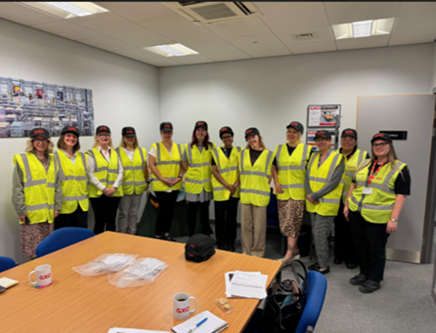
Suited and booted to present to a factory workforce
The Allied Health Professions (AHP) Strategy for England highlights the role of AHPs in disease prevention and health promotion, helping to reduce the burden on already stretched health and social care services. Diet-related diseases remain a major public health challenge, yet dietetic care is still largely focused on treatment rather than prevention. If the profession is to play a greater role in supporting population health, then equipping students with strong public health knowledge and skills is crucial.

To support this, Teesside University’s MSc Dietetics programme now includes public health placements alongside traditional NHS clinical placements. Here, Alex shares her experience of working in a Public Health practice-based learning setting. A must read in National Careers Week for anyone considering a future career as a dietitian!

------------------------------------------------------------------------------------------------------------------------------------------------------------------------------------------------------

What I worked on

During my placement, I was involved in three projects focused on health improvement and disease prevention. My work involved meeting with stakeholders, conducting research, presenting findings, and engaging with the public. The projects covered a wide range of population groups, including expectant mothers, school-age children, local workforces, and food bank users.

1. Supporting parents with child nutrition

A key part of my placement involved reviewing the nutrition education available to parents of children aged six months to four years.

What I did:
  • Conducted a literature and policy review
  • Spoke to parents, NHS staff, and school representatives
  • Attended a breastfeeding class to hear directly from parents
  • Presented my findings to several teams, including the Director of Public Health
Why it matters:
The insights from this work will help shape future research and improve nutrition support for families in the local area.

2. Linking oral health and nutrition


There is a strong connection between what we eat and oral health, but not everyone has access to clear, easy-to-understand information about this link.

What I created:
  • Infographics and presentations to educate local workforces
  • Materials designed in an easy-read format, avoiding jargon
Why it matters: 
My presentation was really well received, and I was even asked to record it for wider distribution, so it could be shared with professionals working with children and people with additional needs.

 
Infographics to educate local workforces

3. Reducing food waste in a local food pantry


Many food pantry users rely on short-dated products, and without clear guidance, a lot of good food can go to waste.

What I did:
  • Designed simple, visual signs with food storage and cooking tips (e.g. "Chop me then freeze me")
  • Introduced a ‘Freeze me’ sign for bread and monitored its impact
What happened?
Twice as much bread was sold the day after the sign was put up compared to the previous two weeks combined!


Signs made to reduce food waste

What I learned
  • Public health plays a key role in patient care - I saw first-hand how wider social factors impact people’s ability to manage their health and access services.
  • Being proactive is crucial - I reached out to stakeholders independently, which helped me build confidence and leadership skills.
  • Flexibility is a great learning experience - managing my own projects and working in a less structured environment improved my time management and adaptability.
  • Self-care matters - the flexibility of this placement meant I could work in different settings, including from the park on sunny days!
Final thoughts

Introducing dietetic placements into public health settings is a win-win. It helps students gain a broader skillset, supports NHS capacity, and brings dietetic expertise into community settings.

Of course, doing things differently comes with challenges. Expanding placements into public health settings has required commitment from everyone involved - academics, placement providers, and students. But we’re constantly learning and improving, and we’re proud to be making a real impact on the health of our local communities.

Friday, 21 February 2020

Workplace Health and the Cauldron of Evidence

Scott Lloyd and Sarah Slater, Advanced Public Health Practitioners, Public Health South Tees 

Systematic reviews are brilliant. They take all the available evidence for a particular topic, do something special (stick the results into a big cauldron) and churn out a finding that informs us mere mortals in policy and practice where we should and shouldn’t be investing our money and capacity.

Double, double toil and trouble...
In these austere times, such evidence about what works and what doesn’t is so important – especially when combined with the how and why. This recent review by Jenna Panter and colleagues is an excellent example of what works and how.

However, there is one sphere of public health where we feel that systematic reviews may not paint a full and fair picture.

Let us explain.

Workplace Health


Most public health colleagues have a speciality or five. This might be a topic (e.g. nutrition or addiction) or part of the life-course (e.g. children and young people or older adults).

We are Workplace Health Specialists with 28 years of combined experience. We’ve supported employers of all descriptions, including businesses of different sizes and in different sectors. We’ve worked on national workplace health programmes, such as the Well@Work programme led by the British Heart Foundation between 2005 and 2007, and have been involved in the North East Better Health at Work Award since its launch in 2009 (arguably the biggest and most successful workplace health programme in England). We’ve a lot of experience of supporting NHS organisations who are trying to improve the health of staff – sometimes successfully, sometimes less so.

Working with such a variety of employers to improve staff health is a challenge of both knowledge and skill because they are looking to you, as the expert, to come up with evidence-based suggestions. Consider how you might support the below employers (real examples for us) to encourage physical activity in their workforce:
  • A tea factory which operates 24 hours a day with mixed shifts and a predominantly female, part-time workforce
  • A call centre for a bank employing 1,200 mostly young staff, in a mainly sedentary occupation
  • A call centre for a public sector organisation employing workers typically aged 40 plus, in a mainly sedentary occupation
  • A mining company at which the majority of the workforce arrive, take a lift down a shaft for 20 minutes, work a shift underground in 40 degree heat, resurface in the lift and get straight in the car to head home
  • A category B prison. 
How would you support an employer to encourage physical activity in a call centre?
What you might suggest to each of the above five employers (and what might work) could be completely different (and probably would be). At least in each of those scenarios, the workforce is likely to be pretty homogenous. Consider working with a huge employer such as a Local Authority or NHS Trust which arguably have massive internal differences in staffing groups in terms of age, gender, hours, and roles (e.g. office staff vs refuse collectors).

We believe that these differences make workplace health a different kettle of fish compared to other settings, such as schools, colleges, universities, and prisons, which could be comparatively homogeneous. They aren’t of course – there are massive differences between schools for example, but our suggestion is that they have the potential to be very similar if all variable things (e.g. culture, policies etc.) were the same. 

What’s our point?

Firstly, that lumping trials of workplace health interventions and programmes into a systematic review masks these potentially huge differences. We’re not sure how we get around this issue but we are raising it as an issue.

Secondly, to suggest that there is a lot more research to be done. There are some workplaces that should be considered a priority. For example, the majority of the working population in the private sector (60%) are employed by small-to-medium sized enterprises (less than 250 employees) and this is an area that no-one has cracked in terms of health and wellbeing via the workplace. Another example is call centres: given the sedentary, pressured nature of the work. One feasibility trial has recently been completed (Morris et al. 2019)[1] and another is underway (involving Scott). We can’t do individual studies for every type of workplace but some should be considered a priority.

Thirdly, to highlight the skills possessed by our peers who lead on workplace health. Employers and employees can throw all sorts of issues at you from bread and [low fat] butter stuff like physical activity and mental wellbeing to stuff like menopause awareness and sleep. Not only does a workplace health specialist need to maintain a base knowledge of all these topics, but they also need to understand how it might be tackled in the various types of workplace highlighted above.

It would be remiss of us not to plug the North East Better Health at Work Award. It needs a stronger evaluation building on previous work (Braun et al. 2014)[2], but we’re talking about a programme that was launched in 2009 and has actively engaged hundreds of employers every single year since (456 currently engaged at January 2020), supporting them to promote the health and wellbeing of their staff (potential combined reach of 202,962 working adults as of January 2020) and the wider community. We’re always recruiting more businesses so if you would like to know more visit www.betterhealthatworkne.org.


References
  1. Morris, A.S., Murphy, R.C., Shepherd, S.O., Healy, G.N., Edwardson, C.L. & Graves, L.E.F. (2019). A multi-component intervention to sit less and move more in a contact centre setting: a feasibility study. BMC Public Health, 19 (1), 292                                    https://bmcpublichealth.biomedcentral.com/articles/10.1186/s12889-019-6615-6
  2. Braun, T., Bambra, C., Booth, M., Adetayo, K. & Milne, E. (2014). Better health at work? An evaluation of the effects and cost–benefits of a structured workplace health improvement programme in reducing sickness absence. Journal of Public Health, 37 (1), 138 –142  https://academic.oup.com/jpubhealth/article/37/1/138/1559494


Image 2: Photo by Arlington Research on Unsplash