Showing posts with label NIHR SPHR. Show all posts

Friday, 24 July 2026

Sparking curiosity with Twinkle, Twinkle Arti

Posted by Nicola Aldridge, Research Associate, and Cassey Muir, Research Associate / Co-lead of the Fuse Early Life and Adolescence Research Cluster, both from Newcastle University

We were recently given the exciting opportunity to showcase the Twinkle, Twinkle Arti project at Discover Festival, a free, one-day festival organised by Newcastle University that brings together families, communities, and researchers through interactive activities and inspiring ideas.

Nicola and Cassey
Discover Festival is designed to spark curiosity, build connections, and encourage people of all ages to explore new ideas. Each year, the university creates a packed programme of family-friendly events, and this year, we were delighted to be part of it as members of the Twinkle, Twinkle Arti research team.


Bringing Arti's story to life

Throughout the day, we invited families to step into Arti’s world through the Twinkle, Twinkle Arti storybook. Developed by Fuse researchers at Newcastle University, with funding from the NIHR School for Public Health Research, the book was created and co-produced with families to support the wellbeing of children experiencing challenging family circumstances, such as drug and alcohol use. While these experiences inspired the story, its themes of feelings, belonging, resilience, and hope resonate with all children.

Visitors to our stall in the Great North Museum had the chance to watch a CBeebies Bedtime Stories style video of it being read aloud by the author. They could also explore puppets and original illustrations from the book, and view artwork created by primary school-aged children who had participated in a pilot study of classroom lessons based on the story.

Families were also able to take home a free copy of the storybook, along with a link to the online read-aloud video and a set of simple conversation prompts designed to encourage creativity, emotional expression, and meaningful family time at home. We handed out nearly 80 copies on the day!


Conversations that matter


Beyond engaging with families, it was equally exciting to see the conversations that the project sparked among professionals attending the festival. We spoke with people from a range of sectors, including teaching, school governance, clinical psychology, and general practice with social prescribing links. Their curiosity about the project and enthusiasm for its potential applications highlighted the broad relevance of Twinkle, Twinkle Arti and the importance of creating accessible resources that support children's emotional and social wellbeing.

One particularly rewarding conversation was with a family who shared their personal experience of the impact of alcohol on family life and how they might be able to use the book. Hearing their reflections was both moving and affirming. It served as a powerful reminder of why the project began in the first place and reinforced the continued need for resources that help children navigate difficult experiences. Moments like these bring the research to life, reminding us that behind every study, storybook, and activity are real families whose experiences matter and whose voices continue to shape our work.

Creating a community star mural

Another highlight of the day was our evolving community star mural. We invited children to create their own star by drawing, colouring, or writing ideas about what they or Arti could do when they felt sad or worried, with 114 stars being created on the day. It was wonderful to see children enthusiastically embracing the activity, and even more special to watch parents, carers and grandparents join in too, talking to their children about the messages in the book. The excitement on their faces as they added their stars to the mural was a lovely reminder of the power of creativity to bring people together.


A colourful celebration of hope and resilience

By the end of the day, the mural had grown into a colourful display of hope, kindness, and imagination. It was a privilege to share the Twinkle, Twinkle Arti project with so many families and to see first-hand how children connected with Arti’s story and messages of hope, resilience and belonging. Events like Discover Festival provide a fantastic opportunity to bring research into the community, and we were grateful to be part of such an inspiring day.


Find out more about Twinkle, Twinkle Arti

Friday, 5 June 2026

Why safer spaces matter for young people’s physical activity

Posted by Caroline Dodd-Reynolds, Professor of Physical Activity, Durham University

Fuse Associate Professor Caroline Dodd-Reynolds explores what can be done to create environments in which LGBTQ+ young people feel safe to enjoy physical activity. Fuse blog in Pride Month.

This work forms part of the Joyful and Safe Physical Activity (JASPA) project, funded by the National Institute for Health and Care Research (NIHR). This project, and the funding that supports it, are only possible through Fuse, the Centre for Translational Research in Public Health, and its membership of the NIHR School for Public Health Research (SPHR).


The 2026 Commonwealth Games come to Scotland this summer, showcasing elite athletes at the top of their game. But for most of us, physical activity looks much more ordinary: walking to school, joining a PE lesson, dancing in the kitchen or going to the gym.

Now think about how that kind of movement feels. Easy? Enjoyable? Safe?

For many LGBTQ+ young people living in disadvantaged areas, the answer to those questions is no.

In our creative joyful and safe physical activity project, young people aged 14-21 showed us how adults can make physical activity feel more fun, safe and inclusive. They did this by reimagining what it means to be active, and by bringing colour, creativity and vibrancy into traditional sport and exercise spaces.

Around 80% of adolescents globally do not do enough physical activity, and global physical inactivity has remained largely unchanged for the past two decades. This affects growth, development, mental health and physical health. We also know that some young people face greater barriers than others, including those living in poorer areas, disabled and neurodivergent young people, and those with questions around their gender or sexuality.

Every child and young person should be able to take part in movement and physical activity without feeling disengaged, excluded or unsafe. Physical activity can, and should, bring joy. But this is not only about competitive sport, PE or joining a gym. Movement can also mean walking, dancing, playing active games, skating in the park, or simply feeling able to move through a space without fear.

In our earlier research, young people often knew exactly where they could be active: outdoors, at school or college, or in a local leisure centre if one was available. But knowing where to go was not the same as feeling able to take part. They described feeling harassed, worried, unsafe or excluded from physical activity.

We call this “physical activity insecurity”: when a young person’s ability to be active is limited because a space feels uncomfortable, exposing or unsafe. This can be especially acute for young people whose experiences of poverty, disability, neurodiversity, gender or sexuality overlap. Some transgender and non-binary young people in our research described harassment, exclusion and gender discrimination that made ordinary movement feel difficult or risky.

We worked with young people to explore what safer, more joyful physical activity spaces could look like.

Creating inclusive spaces

So what can adults, schools, youth workers, leisure centres and other community organisations do?

First, the language we use matters. Terms such as sport, gym or exercise can be immediately off-putting for some young people, especially if they already associate these words with embarrassment, exclusion or previous bad experiences.

Thinking about physical activity more holistically and using the term “movement” instead can help. Physical activity can be something as simple as walking.

Second, adults need to have honest conversations with young people about how they relate to physical activity. This might include talking about stereotypes around sport, PE or exercise, and how these make young people feel. It might also mean recognising that some young people have many other pressures in their lives, making physical activity feel like one more difficult or exposing thing.

Young people are most likely to engage with someone they already know and trust, in a calm and welcoming space. From there, adults can help reimagine physical activity as movement that might be enjoyable, informal and part of everyday life. This could mean dancing in the kitchen, roller-skating in the park, going for a walk, or simply feeling able to enter a room without bracing for judgement. More traditional sporting examples may work too, but they should not be the only starting point.

Third, adults can ask what might help organised and formal physical activity spaces feel more like the spaces young people imagine for themselves. That means listening to young people’s ideas, being open to challenge and rethinking what counts as a good physical activity space. For example, a good space may not be the one with the best equipment. It may be the one where young people can choose whether to join in, wear clothes they feel comfortable in, see signs that they are welcome, and leave for a quieter area if they need to.

Welcoming and safe

On a practical level, most physical activity spaces, whether indoor or outdoor, can be made to feel more inclusive and safe. Small changes can make a big difference. These might include using more vibrant colours, displaying friendly messages and avoiding long lists of rules and instructions.

It can also help to make participation optional rather than compulsory, provide a quiet space where young people can step away when needed, and reconsider clothing rules, which can be a major barrier for some.

The point is not to make every young person love sport. It is to ask why some spaces make movement feel exposing, difficult or risky. If adults want young people to be more active, the first step is not another rule, target or campaign. It is creating places where they do not have to brace themselves before joining in.

Find out more


Adapted with thanks to The Conversation

Friday, 12 December 2025

Nourishing our tomorrow needs to start today

Posted by Professor Amelia Lake, Fuse Deputy Director, and Professor of Public Health Nutrition at Teesside University

How do we create a future where every child has access to healthy, affordable food?

That question took centre stage at the British Nutrition Foundation annual conference, which brought together academics, policymakers, and practitioners to tackle one of the most pressing public health challenges of our time: improving the diets of children and young people.

The event was given a special highlight with the attendance of Her Royal Highness The Princess Royal, Patron of the British Nutrition Foundation, who delivered a powerful address on the importance of food in society and education.

Professor Amelia Lake and collegues meeting Her Royal Highness The Princess Royal
Children’s health and children’s diets are hugely important. Yet, rising rates of obesity, food insecurity, and exposure to unhealthy food environments challenge the ability to have affordable and healthy food.

This conference explored both the challenges and solutions, offering evidence-based insights and practical strategies.

I spoke in the morning session alongside my Fuse colleague Professor Greta Defeyter (Northumbria University) and 
Professor Maria Bryant (University of York). A great representation of Northern University academics!

Profs Maria Bryant, Greta Defeyter, Amelia Lake (L-R) 
Our morning session had a very special guest in the audience, Patron of the British Nutrition Foundation, Her Royal Highness The Princess Royal. Earlier the speakers were invited to meet The Princess Royal and individually talk to her about our work. A good ear for accents, Her Royal Highness. quickly recognised I wasn’t a Teesside native. Those who know me will be aware that I am from Northern Ireland, and I very much sound like I am.

My talk was titled: “Unpacking the Food Environment: Implications for Children and Families” and I discussed Healthy Planning and was able to introduce the audience not just to our academic evidence but also our evidence informed free online training on the topic aimed both at public health and planning teams in local authorities.

I presented our recent ‘Dark Kitchens’ research. The rise of online meal delivery and “dark kitchens” is reshaping how families access food, increasing exposure to calorie-dense options at the click of a button and increasing the availability of accessibility of less-healthy food choices.

While planning allows us to shape our food environment there is much we can do around food retail to create healthier food environments. I discussed some findings from our Fuse Foodscape study funded by the NIHR School for Public Health Research.

We cannot describe the food environment without acknowledging that many households face significant barriers to accessing affordable, healthy food, with direct consequences for children’s health and wellbeing. Food insecurity is real and affects families across the UK. At Teesside, we have worked with communities and organisations using innovative methods to produce healthy food within local social supermarkets such as our healthy ready meal.

Amelia speaking at the event
I called for stronger planning policies and interventions to create healthier food environments, emphasising the importance of collaboration between communities, professionals within local authorities, government and industry.

Improving dietary health isn’t simply about individual choice - it’s about transforming the food environments in which those choices are made.

Her Royal Highness The Princess Royal has been patron of the British Nutrition Foundation since 1988 and delivered a powerful speech at the conference, emphasising the importance of food in society and within education. Her remarks reinforced the British Nutrition Foundation’s mission to ensure every family can access a healthy, sustainable diets.

The conference showcased many impactful speakers and left us with the key message that Nourishing our tomorrow, needs to start today.


The British Nutrition Foundation hosted its annual conference, Nourishing Tomorrow: Equipping Children and Young People for Better Dietary Health in the Future took place on Tuesday 25 November 2025.

Friday, 31 January 2025

Our experience co-producing a zine with LGBTQIA+ young people

Posted by Scarlet Hall, Research Assistant, Durham University and Fuse

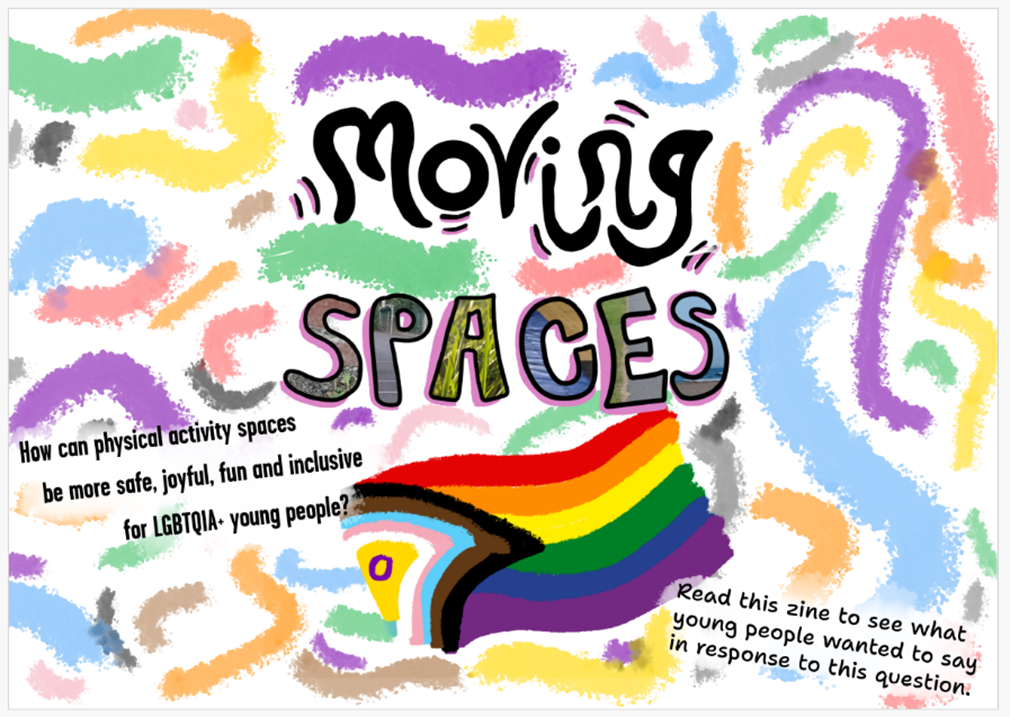
We have been collaborating with LGBTQIA+ young people in the North East and South Yorkshire, through Fuse led research funded by the NIHR School for Public Health Research (SPHR) exploring how physical activity spaces could be more joyful and safe. This blog describes how the ‘Moving Spaces’ zine was made and makes suggestions for those wishing to co-produce creative research outputs.

This blog draws from reflective conversations between Caroline Dodd-Reynolds (Fuse), Mary Crowder (University of Sheffield) and Shevek Fodor (Sounds Like Shevek) during the making of the zine. It is written with contributions from Caroline, Mary and Shev.

Seek continuity between research methods and research outputs

At the start of our research project we knew we wanted to host a series of research workshops and then co-produce a physical activity resource with the young people we were working with. After seeing the results of using visual creative approaches in our workshops, we knew we wanted a highly visual and creative resource that would connect and resonate with people.

Shevek Fodor
Working with the right designer and format

We sent an advert out to LGBTQIA+ networks for a graphic designer who would understand the lives of diverse LGBTQ+ people, in particular young neurodiverse people. When Shevek Fodor shared their zines with us our eyes and hearts lit up. We invited Shev to lead on making a collaborative zine. We chose the zine because of its DIY ethos, radical history of self- publishing and as a vehicle for self or group expression of thoughts and feelings.

What is a zine?

Zines originated through people writing letters and sharing information about things they were driven and passionate about. They’ve been used as a way for people who were overlooked within mainstream media to have their voices heard.

Practice reciprocity

We thought the young people would be inspired meeting Shev, a young neurodiverse queer artist. For Shev, this role offered a new opportunity to experiment with collaborative zine-making in a research setting. We offered hands-on guidance (budgeting, finance systems, mentoring) as part of co-production principles of reciprocity. We introduced Shev to the young people prior to the zine session and their curiosity was piqued…’is this person one of us or one of them.…?’

Involving artists at later stages of research is not straightforward. We aimed for a balance between giving Shev space to design and lead the sessions while also sharing our own knowledge, ideas and learning. The trust built in earlier research workshops meant we could also pass on an established  quality of ease in the group when it came to the zine making workshops.

Trust the creative process of each person and the group

Shev laid the zine making table out in a beautiful, organised chaos of found images, stickers, magazines and cards. Young people made creative contributions to the zine, inspired by earlier conversations about physical activity. They found ways to take part and to also hang out in their safe space – which we were encroaching on. Some people chewed and chewed over the right words to express themselves with contributions coming together at the end. One person got stuck and did their piece later with a youth workers’ support. Two zine contributions were made that involved multiple voices, through Scarlet documenting conversations around particular images. Scarlet also made contributions from a researcher’s perspective. Shev took these contributions – writings, drawings and collages – and wove them together into a first draft.

Allowing the time for collaborative editing – it brings difference into conversation

We shared this draft with the youth groups, the SPHR and Fuse communications teams and academic colleagues. We received a lot of feedback – the zine was provoking conversations. The young people gave detailed feedback on what they liked, what was missing, and sequencing of ideas. They spoke the words that became the introduction and expressed their small hopes for a few people to engage with the zine. There was a thoughtful conversation across the youth groups, about whether to personalise individual contributions or depersonalise to show that it could be any LGBTQIA+ young person saying this.

Academic colleagues also read and shared reflections with us, including feedback that policymakers might struggle to engage with the zine’s non-linearity and various people suggested we include a page of key take-home messages and recommendations ‘so things don’t get lost’. The young people responded to this feedback saying that people needed to listen and pay more attention to the messages that were implicitly in there. This dialogue led to the writing of a framing document for the zine. 

Value queer embodied theory and practice 

Another dialogue arose around authorship. Some reviewers found it confusing not knowing who had written what and had a strong wish to know who – a young person or adult – had written different bits – a desire perhaps for a clear identification of distinct voices. For Scarlet, a queer researcher, the ‘queer polyvocality’ (Brice et al., forthcoming) of the zine – many voices that weaved together in to more than sum of their parts – reflected queer practices of overflowing notions of stable identity, disrupting predetermined binaries and unsettling ideas of authenticity (Lescure, 2023).

This somewhat aligned with ideas from the young people. For some, there was a wish for attribution so ‘friends and family would know I made this’, and there was also a wish for zine contributions to be unnamed ‘because any queer young person could have made any piece’ and ‘we made it all together’.

One young person said they appreciated that researchers ‘weren’t butting in with your opinions but also giving your views when right to do so’ and another adding ‘it’s important that the adults’ voices are also in there as you were part of the conversation, and some adults have also had similar experiences’. The young people decided to make creative doodles in place of signatures which were mixed in with academic doodles/logos to show the talking and making and editing together – the polyvocality – of the zine making process.

Through this collaborative editing process (over three months), the young people began to converse indirectly with interested adults who wanted to help, including with the funders. These conversations happened with the young people keeping editorial control. We sense this may open up and shape more generative future encounters between these young people and further influential adults.

Indeed, some of the young people involved have made a plan to hand deliver zines to local venues around town (hairdressers, surgeries etc.). It seems empowerment and co-ownership inadvertently leads to physical activity!

Explore the zine

To find out more about this work, please contact Scarlet scarlet.hall@durham.ac.uk or Caroline caroline.dodd-reynolds@durham.ac.uk 


References

Lescure, R.M., 2023. (Extra) ordinary Relationalities: Methodological Suggestions for Studying Queer Relationalities Through the Prism of Memory, Sensation, and Affect. Journal of Homosexuality, 70(1), pp.35-52.

Brice, S. Marston, K. Wright, R. and Hall, S. (forthcoming). ‘Mycelial Love’ in Harrison, P. Joronen, M. and Secor, A. Love and Catastrophe in Cultural Geography. Edinburgh University Press

Thursday, 7 March 2024

Creating an out of this world children’s book to help families affected by substance use

Cassey Muir, Research Associate from Newcastle University


To celebrate #WorldBookDay, Cassey tells us about going beyond the research to co-produce a children's story book to help families affected by substance use which is now freely available.

“To take the findings from our lived experience and create something real for families and people beyond the world of research has been brilliant” 
Young person involved in the project


Creating something real: How we produced a children’s story book

When I had the opportunity to create a children’s story book based on some of my PhD research that could help families affected by substance use, I was really excited to get started with the project. Ever since I was little, I wanted to write a children’s storybook and I had even mentioned this at my PhD interview panel, so being part of this project was a dream come true in many ways. 

To be able to create a book that has such meaning for the children and families involved has been incredibly rewarding, if not emotionally challenging at times. To help shape the plot and character development based on the stories of the young people that I had talked to during my PhD, felt like an enormous privilege but also a weight to get right. I wanted to make sure the story reflected the different experiences of children, while other members of the team were making sure the story reflected parents and caregivers’ experiences. Working with the talented Danielle Slade (author) and Josie Brookes (illustrator) helped make this process go as smoothly as possible. They were empathetic to the stories of families and wanted to keep to the integrity of family’s experiences and impacts, while making a story that was engaging.

With the creative minds of Danielle and Josie, we worked with 15 family members who were affected by parental alcohol or drug use, three teachers, Coram Life Education, and Coram Beanstalk to co-produce this storybook. Using techniques like free writing to music, drawing different characters, and storyboarding ideas, we involved children and parents in the creative process from the start. Families were also able to see early mock-ups of the book and feedback their ideas on improvements to the story and share their preferences on illustrations. Josie and Danielle were really receptive to the ideas from children and parents and valued their input.


We met with teachers from local primary schools and practitioners from Coram to think about who the target age range of the book would be, how the book could be used within schools and practice, and how to help adults have conversations with children. Through these discussions we developed conversation prompts for adults that are at the back of the book. These prompts (for example, what do you think of the Yozzle?) can help with discussing the characters and themes within the book with children in one to ones, in groups, or within a whole class setting. Anyone can follow along with this story of Arti, a wishing star. We have received positive feedback from practitioners where this book has been used with younger children (5-8 years), older children as a discussion point for reflecting on childhood (14-16 years) as well as with children who have special educational needs and disabilities.

We have also recently collaborated with Newcastle Film Club to produce a ‘story time’ video of the book being read by the author. This video allows the book to be accessed more widely and can be used alongside the book. Being able to produce this video, with Amy Mains (Director and Editor) and Scott Anderson (Director of Photography), who are also both teachers, was a fun and unique experience. We set up the equipment and reshuffled the backdrop in Fenham Library and managed to shoot the film in under two hours, just in time for the library opening to the public. I think this video adds an extra bit of magic to the story, with soft music and twinkling sounds!


Beyond the world of research: Creatively disseminating research findings

For context on the book, Twinkle, Twinkle Arti is a free story book co-produced with and for children who experience parental alcohol and drug use. This book helps start conversations between trusted adults and affected children. The messages within the book are based on two linked studies around the needs of affected families, led by Fuse Researchers.

The Safe Space project, led by Ruth McGovern, found that many parents and caregivers find it difficult to talk to their child about substance use and the impact upon the child and family. Parents and caregivers spoke about wanting resources to help with these conversations. Alongside this, research led by me, explored the experiences and support needs of children and young people. Children and young people told me that they valued the importance of confiding in a trusted adult such as a teacher, social worker, or family support worker but often did not know who they could trust or talk to, and prioritised approaches within schools which promoted conversations about parental substance use.

The story book captures the emotional and social impacts of living in a difficult family situation, from the perspective of the child and the parent or caregiver, and highlights helpful strategies to support the child’s wellbeing, for example talking about your feelings.

Using out of this world storytelling and fictional characters, the findings from these two studies are told in a way that makes them accessible to families and practitioners and offers positive messages and validation not only to children but to parents/caregivers and practitioners who find it challenging to know how to broach this sensitive topic.


We are freely sharing this book with families, schools, and practitioners across the country. To help understand the usability and impact of the storybook, we are gathering feedback from practitioners with a short online survey. This feedback will contribute to informing further development of the book and additional resources that are needed. I hope the book can be used across many different settings (schools, social care, and voluntary organisations) and can be shared with families who want to have those conversations. Within schools, we hope it is used in whole class situations, to reduce the stigma and show children they are not alone. It’s a fun story with fictional characters, and I hope families feel the book is engaging and non-stigmatising.

Here is some of the feedback that we have received so far about the book.

A practitioner told us: “It is so meaningful for children to know about the Yozzle [fictional character depicting alcohol or drugs in the book] and how it makes them feel. What a very complex idea to get across to children and yet it has been achieved with such skill!”

A child who reviewed the book shared: “It [the story] shows you’re not on your own and that there are other stars [fictional character depicting trusted adults] to support you.”

A primary school teacher shared the following: “There were no problems at all using Twinkle, Twinkle Arti in a whole class situation. In fact, I think it worked well as an introduction because it wasn't only alcohol use that the children discussed it was mental health, feelings, and how to overcome problems.”

A parent who helped co-produce the book reflected: “I am proud of the book because other children won't have to go through what my children have."

I think it is really important for researchers to work collaboratively with public, practice, and policy partners and to engage in creative processes that open their research to wider audiences. Through this process, you might learn something new and have fun doing it. But don’t just take my word for it, here are the perspectives of the illustrator and young person involved in the project:

Josie, the story’s illustrator, says: “This has been a really inspirational project, and a joy to work with Danielle, the research team, and all the families involved. We collectively believed in the power of storytelling to get these important issues across, and the resulting book is something I am so proud to have been a part of making. I think children will connect with Arti, her colourful world, and her story. I am excited for it to be used as a positive resource with children and families, in opening up those very crucial conversations, whilst simultaneously being so enjoyable to read!”

A young person reflected: “This book is something I would have loved to have been able to give to ‘little’ me, having something that related to my home situation when I was a child. I feel rewarded to be able to do this for ‘me’ now, for little me going through all those hard times and for all the children who will read this book, who are going through something, have a hard home life, have parents who are struggling, anything.

I hope through the book, we are able to show them that they are not alone and that there are people around them who are there to give them love and support. Hopefully, the book can help reach them earlier than I was reached out to. To create a book that would educate and support whomever read it, no matter their age or background, to be more than a storybook and to be able to help them, even in a small subtle way. It is a chance to reach the children that need it through a storybook that they come across all the time in life. It is incredibly rewarding to have a book that exists, that will last and be passed on to different children who are in a variety of situations for years to come. I am very proud of it.

I sincerely hope the book not only entertains children at bedtime, but that it can in some ways soothe a child's worries. It was an honour to hear the brave accounts from families and even more so, that they have trusted us to put their feelings and stories into this book.”

Fuse researchers and lived experience expert at book launch event. From left to right: Ruth McGovern, Kira Terry, Cassey Muir and Debbie Smart 

If you would like to learn more about this research, then please go to the links at the bottom of this page. And if you would like to join Arti on her journey of bravery, self-discovery, and learning about the important of talking about your feelings then take a look at the story book or watch the video.

Find out more
  • Download the book free.
  • Listen to this Fuse podcast to hear Cassey discussing her research on social and emotional resilience in children and young people affected by parental substance use.
  • Read this Fuse news article about Twinkle, Twinkle Arti.
  • Read this Alcohol Action Ireland blog and listen to the podcast.


All illustrations by Josie Brookes

Friday, 23 February 2024

School's out for stigma: Understanding the mental health needs of LGBTQ+ youth

Posted by Liam Spencer, Fuse Associate and Research Assistant at Newcastle University


February is LGBTQ+ History Month, an annual month-long observance of lesbian, gay, bisexual and transgender history, and the history of the gay rights and related civil rights movements. The 2024 theme celebrates LGBT+ peoples’ contribution to science and medicine both historically and today. 


In this blog, Liam reflects on his research of LGBTQ+ young people’s mental health.


As LGBTQ+ History Month unfolds, it offers us an opportunity to reflect on the strides we’ve made, the challenges we still face, and the incredible diversity within our communities. This month holds particular significance for me – a chance to not only honour the struggles of those who came before us, but also to celebrate the progress we’ve achieved and recommit to the work that lies ahead.

With a background in youth and community work practice, my research interests are primarily focused on children and young people’s mental health, particularly early and preventative interventions, and school-based interventions. My journey as a member of the LGBTQ+ community and as a researcher has been intertwined with a deep sense of purpose – to shed light on the unique mental health challenges faced by LGBTQ+ individuals. This is a mission born out of personal experience, and a desire to contribute meaningfully to the wellbeing of this community. 

I have recently been involved in several Fuse projects funded by the NIHR School for Public Health Research (SPHR) Public Mental Health programme, and I’ve had the privilege of being able to delve into the complex dynamics of LGBTQ+ mental health, particularly in school environments. One of these projects, led by Professor Liz McDermott, aimed to investigate the impact of school-based interventions on LGBTQ+ young people’s mental health.

In the first phase of our study, we did a realist review (a type of evidence review that assesses the specific contexts in which a certain intervention may or may not work) of published evidence and identified positive interventions that supported LGBTQ+ mental health in school environments. However, the focus tended to be upon outcomes and studies rarely detailed underlying processes. The second phase of our study aimed to develop a theory that explained how, why, for who, and in what context school-based interventions prevent or reduce mental health problems in LGBTQ+ young people, through participation with key stakeholders.

We interviewed LGBTQ+ young people aged between 13 to 18 years attending secondary schools; intervention practitioners; and school staff in the UK. We then analysed this data to identify relationships across different interventions that improved mental health outcomes. The theory we produced explains how school-based interventions that directly tackle dominant cisgender and heterosexual norms can improve LGBTQ+ pupils’ mental health. Specifically, our theory proposes three interventions that may improve these outcomes:
  1. Interventions that promote LGBTQ+ visibility and facilitate usualising, school belonging, and recognition.
  2. Interventions for talking and support that develop safety and coping.
  3. Interventions that address institutional school culture (staff training and inclusion polices) that foster school belonging, empowerment, recognition, and safety.
Ultimately, our research underscores the importance of providing a school environment that affirms and normalises LGBTQ+ identities, promotes school safety and belonging, and addresses systemic issues within educational institutions. By implementing evidence-based interventions informed by our theory, we can pave the way for improved mental health outcomes for LGBTQ+ pupils.

This month serves as a powerful reminder of our collective resilience, our shared struggles, and our unwavering commitment to justice and equality. Let us continue to push boundaries, challenge norms, and advocate for a world where difference is celebrated and all are embraced for who they are – within academia, our personal lives, and beyond.


Images:

Friday, 16 February 2024

Beyond stats and diseases: my summer internship in Public Health

Posted by Bethany Henshaw, NIHR School for Public Health Research (SPHR) Intern in Fuse, undergraduate at Newcastle University

The NIHR School for Public Health Research (SPHR) recently asked its members (including Fuse) if we would like to host an internship this summer. The summer internships are aimed at undergraduate students with an interest in a career in public health research. The internships offer support for 6-8-week projects supervised by SPHR Early Career Researcher (ECRs), Fellows and PhD students. 

In this post, Beth (pictured right) tells us about her internship experience last year at Gateshead Council. 


When you think of the term ‘public health’ what comes to mind? According to the World Health Organization, it is:
“the art and science of preventing disease, prolonging life and promoting health through the organised efforts of society.” 
If you had asked me this question in early 2023, I would probably have given a very general, slightly muddled answer which was focused on the disease aspect of the field. What my answer would have highlighted was that I had very little understanding of just how broad and wide ranging the field of public health is.

Last year I undertook a NIHR School for Public Health Research (SPHR) summer internship in Fuse, looking at the perspectives of social prescriber link workers (who connect people to community-based support) on the promotion of active travel. Active travel refers to modes of travel that involve a level of physical activity such as walking and cycling. I was interested in understanding how social prescriber link workers felt the prescription of this to their patients would impact them.

The findings will be used to inform the development of an active travel pilot in Gateshead. The internship was a fantastic experience in many ways: it enabled me to develop my qualitative research skills, for example, I developed a topic guide for the social prescriber link worker focus group, and gave me valuable insight into professional working life. However, my biggest take-away was the insight it gave me into career options within public health.

Behind the stats are real people with their own unique story
As a biomedical science undergraduate, I spent two years studying topics like physiology, pharmacology, and immunology largely at the molecular level. I understand how many different diseases invade the body and make a patient ill. However, for a while now I have been interested in understanding disease at a population level. Rather than the cellular mechanisms of disease, I have grown more interested in why some people are more susceptible, and how we can reduce this disparity and prevent further people from becoming ill in the future. Before my internship, I mainly considered public health from a disease related perspective and thought that health protection covered the vast majority of the field. However, by speaking to both researchers and members of the Public Health team at Gateshead Council, it became clear to me that it covers significantly more than this! Issues such as environmental health, health services and health improvement are all things I previously wouldn’t have thought about when trying to define what I considered public health to be.

Something that surprised me during my internship was just how central recognising the individuality of each patient’s situation is in public health. I came to the realisation that when I had read research papers on disease outbreaks or rates of chronic disease as part of my degree, I had been overlooking this important detail: that behind the stats are real people with their own unique story. Talking to members of the active travel social prescribing team at the Council, made me realise just how individual and unique the journey is for each patient. Summarising, for example, how many patients continued to regularly use active travel for the time period they were prescribed it as a percentage does not reflect the reality of what these patients go through, something that will only be understood by talking to the patients to understand their experience. I found this outlook on viewing patients as people and not just statistics to be incredibly refreshing, and it has provided me with a new perspective to take into my final year of university and beyond.

My internship offered me a view of what life could be like working within public health research and the broader field. My understanding of what public health is, has been challenged and has been significantly changed from the disease focused perspective I had before. However, one of the main things I will take away is that behind all the statistics we see in the news and read in research papers regarding rates of disease, it is vital to remember that each statistic is a patient whose own unique experience should not be undermined.

Friday, 5 January 2024

Using board games to increase inclusion in research - a trivial pursuit?

Posted by Lesley Haley, AskFuse Research Associate, Teesside University 

Did you play any board games over the holidays? As we scrabble into 2024, have you ever thought about how they could be used as a way to engage people in your research?

I hadn’t, until I went to a recent Creative Methods in Research conference, where Kath Maguire (University of Exeter/NIHR School for Public Health Research) showcased how using board games in research was anything but trivial! Kath demonstrated the concept of using board games in public involvement and engagement can increase participation by reaching people less comfortable with standard formats of engagement or data collection, such as interviews or questionnaires.

Kath brought examples, like a “pairs” game used with public partners to break down barriers of understanding around the jargon used in research. Pairing research jargon, concepts or acronyms (‘randomised control’, ‘double blinded’, ‘SPHR’, ‘NIHR’ for example) with their plain English explanations allowed all participants to probe the underlying assumptions and constructs, and perhaps to reduce the power imbalance between the knowledge giver (usually researchers) with the knowledge receiver (usually public partners). And of course this game can be used to redress that balance by public partners sharing their knowledge with researchers.

However, the most surprising game that Kath has used in increasing involvement was the repurposing of that classic multicultural game, Snakes and Ladders.

While AskFuse (the responsive research and evaluation service run by Fuse) created the pictured Snakes and Ladders game as an interactive way to explore successes (Ladders) and setbacks (Snakes) of getting research knowledge used in practice, Kath has taken the game to a whole new level.

Kath has a wealth of experience in using board games as a creative method of inclusion to reach people less comfortable with more literacy-based research methods. They bring a blank paper board and a variety of stick-on snakes and ladders as a visual prompt to generate discussion and reflection using the metaphor of the game to explore a range of experiences. The aim is not necessarily to play the game, but to use the building of a bespoke “game” to reflect and “illustrate” narratives and experiences.

Participating in Kath’s interactive workshop was, for me, a real game changer. We explored how using snakes and ladders enabled discussion, reflection and inclusion. We could design our own individual game to tell our story, or do it collaboratively. We used the game layout as a metaphor for exploring changes through time or to illustrate a “journey” (for example, exploring access or barriers to health services). It allowed us to describe and reflect on different pathways or starting points. Being a physical representation of our narrative meant that, at times, “gaps” emerged which led to questions around “what was happening here?” and “what are we missing?” The grid could also used to reflect emotional journeys in response to a given (research) question or situation. We explored how focussing on a game allowed for different viewpoints to emerge and for less vocally confident people to engage without having to “carry” a conversation or justify their experience. The game squares could be filled with comments, contributing factors, and ideas. We reflected that the snakes and ladders could be reconfigured for creative re-imagining of time/place/situations - “what would happen if we did this”? And of course the complexities of the research process can be illustrated through the metaphor of Snakes and Ladders.

At the end of the session, there was a tangible product and graphic representation of the research question, the process and the outcomes of the exploration. We reflected that over several sessions, the game would perhaps change and this progress could be captured in photos. The “game” could also then be used creatively to disseminate the research (Coon et al 2022).

We also explored the risk that a gaming method for engagement or data collection, especially in the “Snakes & Ladders” format, could be seen by some people as trivialising the serious business of research, as in the UK it is perceived as a child’s game. However the game is not all it appears. Originally known in “Moksha Patamu”, it was a philosophical game of actions and consequences for adults developed in ancient India (Museum of Gaming 2015). Over time and locality, the game has evolved into other versions, with snakes transformed into “drainpipes” or “chutes (Start the Week 2023). So the game has a tradition of being adapted and re-purposed and perhaps we should not be shy of re-purposing it to make research more accessible?

Since Kath’s workshop, I’ve had a quick look around to see if there are other researchers using gaming. While there is literature on using board games in health education and promotion (Nakao 2019) and public health policy (Spitters 2018) there seems less on the use of board games in public involvement and engagement in health.

Of course, snakes and ladders doesn’t have the monopoly on being the only board game that can be used. So, do you use board games in your research to engage with people and communities? What's been your experience of what works for who? How do you pitch it? What have you found the setbacks and successes of using board games as a creative way of engaging people and communities?

As you scrabble to fit all the board games back into the cupboard after Christmas, maybe it’s time to reflect that participatory board games in research could be for the rest of the year too, not just for Christmas.

With thanks to Kath Maguire for the interactive workshop and to SPHR for funding attendance at the conference.


References:

Coon, J.T., Orr, N., Shaw, L. et al. (2022) Bursting out of our bubble: using creative techniques to communicate within the systematic review process and beyond. Syst Rev 11, 56 https://systematicreviewsjournal.biomedcentral.com/articles/10.1186/s13643-022-01935-2

Kath’s work:

Museum of Gaming Newsletter (2015) Issue 2 Snakes and Ladders History. Accessed 2 Jan 2024 Available at: https://www.museumofgaming.org.uk/documents/Newsletter2.pdf https://www.museumofgaming.org.uk/index.cfm

Nakao M (2019) Effects of board games on health education and promotion” board games as a promising tool for health promotion: a review of recent literature BioPsychoSocial Medicine (2019) 13:5 https://doi.org/10.1186/s13030-019-0146-3

Spitters H.P.E.M , van de Goor L.A.M, Juel Lau C, Sandu P , Eklund Karlsson L , Jansen J, van Oers J.A.M (2018) Learning from games: stakeholders’ experiences involved in local health policy Journal of Public Health | Vol. 40, Supplement 1, pp. i39–i49 | doi:10.1093/pubmed/fdx149 https://academic.oup.com/jpubhealth/article/40/suppl_1/i39/4925598

Start the Week: Playing Games (2023) BBC Radio 4 Monday 4th December 2023 09.00 Available at: https://www.bbc.co.uk/sounds/play/m001t2xq?partner=uk.co.bbc&origin=share-mobile (Accessed 8 Dec 2023)

Friday, 21 April 2023

A public partner’s guide to podcasting

Posted by Victoria Bartle, Fuse Public Partner, with tips for guests from Cassey Muir, Fuse & NIHR School for Public health Research (SPHR) funded PhD Researcher from Newcastle University


Everyone seems to have a podcast these days and there are lots discussing research, but how many can say that they are totally led by the public? I have been participating in public involvement in research since 2016 and believe that it is a vital part of improving everybody’s health, but find that getting other people involved and informing the public about research projects is really difficult.

I was excited to be involved with the Fuse podcast Public Health Research and Me as I’ve wanted to start my own for a while now, and felt as if this would be a perfect opportunity to learn about podcasting and give it a try, as well as being part of creating a platform to help engage the public in research and hopefully increase awareness and involvement. I joined the podcast team made up mainly of other public partners and took part in some excellent training which went through equipment, hints and tips for selecting guests, how to phrase and deliver questions, different podcast formats, as well as recording and editing. I was buzzing after the training and keen to get started.


I was lucky enough to be selected to be the first host for the podcast and was matched with Cassey Muir, one of the Fuse researchers who is working with children and young people who have been affected by parental substance use. Her work is fascinating and I was soon enthralled reading everything I could to prep for the interview and come up with a very long list of questions. As brevity is not my forte the rest of the team helped to cut these down to around five or six questions which is about all that you need to create a 30 minute podcast.

We then had a pre-record meeting with Cassey, where we discussed the questions. Talking to her about her work helped me to edit and refine the questions for the interview. Once the questions had been finalised and approved by the podcast team and Cassey, we set a recording date.

I was quite nervous before the record. I’d been a panel member on a podcast before and had so many technical issues that I was really stressed and anxious by the time I managed to get everything sorted. So for this recording I made sure I had tried all of the equipment and was all set up with my notes, drinks, tissues and cough medicine…because of course I had a cold! Recording when one of the presenters keeps coughing is really difficult for the editor, but Cassey was a pro and kept pausing whenever I coughed so that we would have a second or two to edit it out. We talked for ages and the record went really well. I was able to bring in some of my own lived experience of the topic and this helped to make the conversation more natural and less like me firing questions at Cassey, although I did say “wow” and “that’s amazing” a lot which I was determined not to do as much the next time.

Now to the technical part! Although we had had some training on editing podcasts, the team decided to use an external editor as we wanted it to sound as professional as possible, and none of us were confident in using the software just yet. Listening to the edited version we were able to make requests for changes, but I felt that it generally sounded great, and asking to cut out all of my embarrassing “wows” was my own issue and not necessary. We had to write our bios to go with the podcast, an overview of what it was about, and make sure that the projects and references that we discussed were all available for the listeners to link to directly from the podcast page.

Going live was exciting, I sent the link to all of my friends and family, it was tweeted on the Fuse twitter feed and is also on the Fuse website so everyone can access it. We’ve had over 100 listens and the bonus video has had nearly 300 views so far. I’ve had lovely feedback from my friends and family who said they found it really interesting. My Mum was especially impressed as she now has something that she understands to tell people when she’s trying to explain what public involvement in research is and what I do.

Round two  


The second recording went a bit differently. I had loads of background information to read about Eugene Milne, his career history, his involvement in establishing Fuse, his role in public health and his recent MBE which was all very exciting. I had lots of questions about all of the different projects that he had been involved in, their impact on public health in the North East, as well as his plans for retirement, but during the pre-record chat I decided to take a more focused direction as his responses to some of the topics were just so interesting. We narrowed it down to his involvement in establishing Fuse, what his initial expectations were and how he feels it has developed over the past 15 years; the impressive results from the public health initiatives that he oversaw (including North East tobacco and alcohol control programmes Fresh and Balance); as well as responding to Covid-19 during his time as the Director of Public Health for Newcastle.

Again the public partner team reviewed the questions and the theme of the podcast and we went ahead with the recording. This time I didn’t have a cough which made recording much easier, but I still responded with lots of “wow’s” and “that’s amazing” as I found Eugene very engaging and his career so interesting. I then got myself a bit confused towards the end of the record. I’d skipped a question as it didn’t fit with how the conversation was flowing, but I wanted to come back to it at the end. I’d already said the outro lines so I had to pause for a second or two, ask the missed question, and then remind the editor to swap the order of the last two sections around. I was a bit embarrassed about this, but it was absolutely fine and you can’t tell in the final version.

Things don’t always go to plan


The third recording with PhD student Joanne McGrath has been different again. We had already decided to focus on one of Joanne’s current projects looking at women experiencing homelessness as it fitted in with International Women’s Day and an event that Fuse was hosting for the occasion. This meant that I had a bit less reading to do while prepping the questions this time. They were approved by the podcast team and Joanne, and she steered the direction of the podcast from the outset as she knows her research best and which areas are being focused on currently. The recording has been beset with challenges, technical issues, diary clashes and unavoidable life events that have meant that we have had to postpone the recording three times. Is it cursed!?

These challenges actually led us to writing this blog, as well as the hints and tips below. We have all learnt so much from the first three podcasts and as I pass the hosting responsibilities to the next public partner we wanted to make sure that we were learning from our experiences. At the point of writing this blog, we have now managed to record Joanne’s episode, so keep an eye out for it. Her work with women experiencing homelessness is so important and will benefit an often overlooked group of people by supporting positive changes in their lives.

Our top tips for podcasting


For hosts


Preparing for the podcast:

  • Give yourself enough time to read through all of the guest’s work and discuss with them and the team the possible theme of the interview.
  • Write down all the questions you can think of; you can always edit and rearrange the order later.
  • Have a pre-record meeting with the guest; this helps you and your guest to feel comfortable, and to try out the microphone and recording platform. This can also help to define the questions and theme of the podcast.
  • After the guest and the team have reviewed the questions and decided on five or six to use, arrange them in an order that should flow like a conversation.
  • Write your own intro, a couple of sentences about yourself to introduce you to the listeners and practice this a few times so that you are familiar and comfortable saying it.
  • Also practice the intro and outro sections that have already been created, changing some of the words if it fits better with how you speak.
The podcast recording:
  • Login to the meeting for the record early, have everything you need set up around you, and make sure you have all devices on silent so you won’t be disturbed.
  • Check the mic in advance, you may need a USB port to attach to your computer and headphones with a connector jack. If you use an Apple Mac (or similar) you may have to use a USB adapter.
  • Place the mic approximately 15cm (6”) in front of you.
  • Find a small quiet room that is preferably well furnished to absorb any echo.
  • Have a little chat with the guest, try to make them feel comfortable and start when you’re both ready.
  • Mute yourself if you need to cough, sneeze or drink etc.
  • Avoid rustling any paper or notes that you may have prepared.
  • Turn off non-essential devices using wifi and reduce the tabs/windows on your device. This will reduce the likelihood of buffering during the Zoom/Teams call.
  • If you do cough, sneeze or make a mistake then pause for a second or two and start again (or mark by saying “edit point”), this gives the editor a space to remove the noise.
After the recording:
  • Re-record any sections you feel necessary, or let the team know if you think a section will need to be moved, cut or edited and they can pass this on to the editor.
  • Once the edited version comes back, with the “umms”, “aaahhhhs”, coughs (etc.) removed, you will be able to listen through and request any further edits that you’d like.
  • Write a bio and provide a photo to go on the podcast platform.
  • Help with any promotion through your own networks, and enjoy listening!

For guests


Preparing for the podcast:
  • Identify and share your relevant publications, resources, and information with the host and podcast team, which allows them to focus the conversation and questions (e.g., do you want to provide a wide variety of resources or only those on a specific topic?).
  • Help clarify any specific points of interest or themes you would like to get across about your work as this will help with determining relevant questions.
  • Pre-record meetings and/or emails are helpful, which can take away some of the nerves by building a relationship with the host or testing out the equipment.
  • Ask for a copy of the questions if you would like to make notes and think about your answers ahead of time.
The podcast recording:
  • This should be/is a fun experience where you get to talk about your work with someone who is keen to listen and explore different topics with you. It is a great chance to discuss your research in a way that you might not normally and possibly from a different viewpoint, so try to ease into it and enjoy it. If you lose your train of thought or stumble over your words it is okay, that is the benefit of editing and not being live.
  • If you have made them, have your notes to hand, either printed (but not rustling) or on the screen to help you remember important points that you want to make during the podcast.
  • As this is meant to be somewhat conversational, remember to go with the flow of questioning as some of your answers may spark interesting follow-up questions that you are unprepared for.
After recording:
  • Ensure you have provided links to the important items you discussed during the podcast, which can then be shared alongside the podcast.
  • You get to listen/watch through the edited podcast before it goes live, which is your chance to highlight any changes you would like to be made (although the editing team do a fab job, so there may be no necessary changes at this stage).
  • Once the podcast is live, this is a great opportunity to share your work and the podcast with relevant networks and/or on your social media.
  • Enjoy listening or watching the podcast!