
When you receive letters from the hospital or the doctors, what do they look like? Text heavy, with no pictures, and in a small font size? That is how the letter looked when I received my invitation to cervical screening.
 |
| Traditional appointment letter |
Now imagine that instead of getting that letter, you received a letter which was written in a large font, used shorter sentences and included pictures. How would you react? Would you feel like the information was simple and clear to understand? Would you feel like you were being patronised and treated like a child? Or, would you even care?
Public Health England, have developed a cancer screening invitation letter in an ‘easy read’ format along with an easy read booklet. Both of which can be provided to support women with learning disabilities to access cervical screening.
Public Health England, have developed a cancer screening invitation letter in an ‘easy read’ format along with an easy read booklet. Both of which can be provided to support women with learning disabilities to access cervical screening.
 |
| PHE cervical screening: easy read invitation letter template |
However, women with a learning disability, do not receive these easy read versions as standard. Every women invited to screening is given a booklet along with the invite letter which goes some way to explain both what happens during the appointment and the content of the letter. However, would it not be better for everyone to receive an easy-read version in the first instance?
Someone may only receive additional information in an easy read format, if they are identified by their GP surgery as having a learning disability, or because they receive support from healthcare services for people with a learning disability.
What about women who have a mild learning disability and do not receive any support? Or people who struggle to understand written information? It is possible these groups of people will be less likely to attend cancer screening simply because they do not understand the invitation letter.
Four in 10 adults in the UK struggle to understand and use typical medical information designed for the public (NHS, 2020). This is called ‘health literacy’. Having low health literacy has been linked to a range of problems, including poor general health, inappropriate use of health services and reduced life expectancy (NHS, 2020). One mechanism to limit the effects of poor health literacy, is having information in plain English, with simple and short sentences, without jargon.
Therefore, if the NHS is to use standardised letters, should they all be in a simplified, easy read format? This could help services meet the requirements of the Equality Act (2010) which stated that services need to make “reasonable adjustments” to their provision including to the information they provide.
The need for reasonable adjustments within the cervical and breast cancer screening programmes has been highlighted in my PhD research. The research is exploring the attitudes and opinions of women with a learning disability, family carers, and paid care workers towards cervical and breast cancer screening. Within the interviews each participant completes a Q sort (a card sorting task) to identify whether participants agree, disagree, or are neutral towards 28 statements. Each statement is placed on an individual card. The card is then placed onto a grid, to reflect how much they agree or disagree with the statement. Upon completion, it represents a picture of a participant’s range of attitudes and opinions towards cervical and breast cancer screening. The below figure shows a completed Q sort by a women with a learning disability.
Someone may only receive additional information in an easy read format, if they are identified by their GP surgery as having a learning disability, or because they receive support from healthcare services for people with a learning disability.
What about women who have a mild learning disability and do not receive any support? Or people who struggle to understand written information? It is possible these groups of people will be less likely to attend cancer screening simply because they do not understand the invitation letter.
Four in 10 adults in the UK struggle to understand and use typical medical information designed for the public (NHS, 2020). This is called ‘health literacy’. Having low health literacy has been linked to a range of problems, including poor general health, inappropriate use of health services and reduced life expectancy (NHS, 2020). One mechanism to limit the effects of poor health literacy, is having information in plain English, with simple and short sentences, without jargon.
Therefore, if the NHS is to use standardised letters, should they all be in a simplified, easy read format? This could help services meet the requirements of the Equality Act (2010) which stated that services need to make “reasonable adjustments” to their provision including to the information they provide.
The need for reasonable adjustments within the cervical and breast cancer screening programmes has been highlighted in my PhD research. The research is exploring the attitudes and opinions of women with a learning disability, family carers, and paid care workers towards cervical and breast cancer screening. Within the interviews each participant completes a Q sort (a card sorting task) to identify whether participants agree, disagree, or are neutral towards 28 statements. Each statement is placed on an individual card. The card is then placed onto a grid, to reflect how much they agree or disagree with the statement. Upon completion, it represents a picture of a participant’s range of attitudes and opinions towards cervical and breast cancer screening. The below figure shows a completed Q sort by a women with a learning disability.
 |
| Q sort by a women with a learning disability |
When designing my PhD research, woman with a learning disability where involved in Patient and Public Involvement (PPI). PPI is defined as “research being carried out ‘with’ or ‘by’ members of the public rather than ‘to’, ‘about’ or ‘for’ them” (INVOLVE, 2020). The Health Research Authority (HRA) has acknowledged that public involvement can positively impact upon the design of research, especially in the design stage (Health Research Authority, 2017). By including Experts-by-Experience it is possible to find out what matters most to the public, especially when the research is controversial or on a sensitive topic. This is the primary reason that I wanted to use PPI during the research. Additionally, there has been very limited research conducted in England on this topic, and involving people with a learning disability in the design of the research.
The PPI in my research was split into three consecutive phases; identifying women’s preferences for how they would like written information to be presented to them; checking the easy-read documentation developed for the research, and obtaining the women’s preferences on the design of the Q grid. The importance of removing jargon and medical terms was highlighted in the results of the PPI, when the phrase ‘lady bits’ was used, women with a learning disability understood the location and some of the problems they might face going for screening, but didn’t always understand the word ‘cervix’. This is an important consideration for the invitation letters to cancer screening.
The invitation letters for cancer screening use terminology such as ‘cervical’, ‘cervix’ and ‘Human papillomavirus’ and assume that people will know what these words mean. What impact could using jargon and medical terminology have on the women receiving the letter? One problem is that women could misunderstand the procedure. Whereas, in an easy read document, the anatomically correct terms could be used, alongside an image, or further description. As the below image depicts:
The PPI in my research was split into three consecutive phases; identifying women’s preferences for how they would like written information to be presented to them; checking the easy-read documentation developed for the research, and obtaining the women’s preferences on the design of the Q grid. The importance of removing jargon and medical terms was highlighted in the results of the PPI, when the phrase ‘lady bits’ was used, women with a learning disability understood the location and some of the problems they might face going for screening, but didn’t always understand the word ‘cervix’. This is an important consideration for the invitation letters to cancer screening.
The invitation letters for cancer screening use terminology such as ‘cervical’, ‘cervix’ and ‘Human papillomavirus’ and assume that people will know what these words mean. What impact could using jargon and medical terminology have on the women receiving the letter? One problem is that women could misunderstand the procedure. Whereas, in an easy read document, the anatomically correct terms could be used, alongside an image, or further description. As the below image depicts:
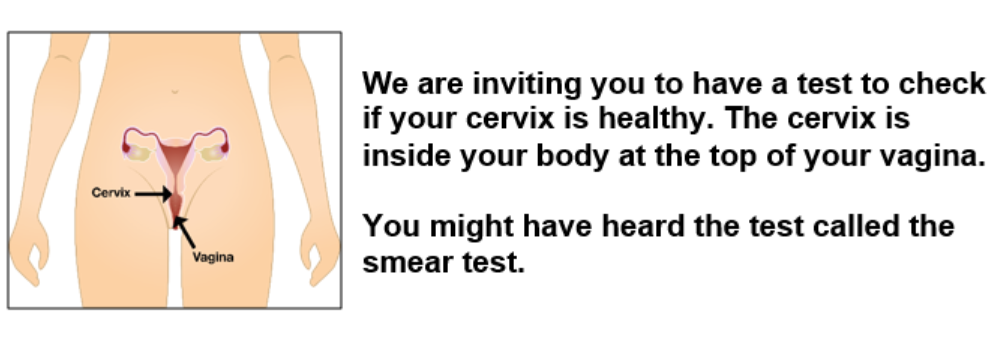 |
| PHE cervical screening: easy read invitation letter template |
Ultimately, should there be standard information provided to all, which is written in a way that everyone can understand? Would more people be able to understand the information? Would this have an impact on uptake of services such as screening, and would this result in a more inclusive healthcare system?
Images:
1. Capture taken from the BBC News website, 18 April 2019, HEALTHWATCH/NHS ENGLAND The template for the letters is drawn up by Public Health England (https://www.bbc.co.uk/news/uk-england-tyne-47946395).
2/4. Courtesy of Public Health England: https://www.gov.uk/government/publications/cervical-screening-supporting-women-with-learning-disabilities


