Showing posts with label brokering. Show all posts

Friday, 21 July 2023

How to choreograph a dance between policy makers and academic researchers?

Posted by Peter van der Graaf, Associate Professor in Public Health at Northumbria University and AskFuse Research Manager


Dancing is a key move in public health, particularly if you want to make an impact with your research. Knowledge exchange is not just a science or even an art, but very much a dance between researchers and policy makers about the use of research evidence. To complete this dance successfully and get evidence used in decision making, both partners need to follow certain steps. However, learning the steps (science) or performing them perfectly (art) is not sufficient: it requires instinct and feel for where you are in the dance and why you are doing it.

To develop a dance plan for your interactions between policy makers and academic researchers, Fuse hosted a special session (or dance class) at the European Implementation Event in Basel, Switzerland on 8 June. The EIE2023 brought together over 300 implementation scientists, practitioners and funders from across health, social welfare, education and other sectors in Europe. Over two days through fishbowls, science slams, workshops, inspiring keynotes and oral presentations, participants explored how to create a new normal for implementation science in society.

Our session explored dance challenges (e.g. moving too slow, bad timing, outfit malfunctions, and unsynchronised performances) and new routines in response (see: ‘What did we learn?’ below) that we have developed in Fuse over the last 15 years collaboratively with our partners. In the session, we highlighted examples of creative communication (the art of knowledge exchange), research performance both backstage and frontstage (AskFuse), and dancing together (embedded research) to set the scene for a discussion about what makes a successful dance between policy makers, health practitioners and academic researchers. We invited conference participants to share their own reflections of dance routines they have developed to support knowledge exchange and implementation of research evidence in practice and policy making.

What did we learn? 10 dance lessons


1. Academic researchers need to learn four basic steps for dancing with policy makers (see the Fuse knowledge exchange model):
  • Raising awareness, using creative communication.
  • Knowledge sharing through joint events.
  • Making evidence fit for purpose (localising and tailoring).
  • Supporting uptake and implementation (e.g., capacity, co-production, linking activities).
2. A deviant knowledge broker can help to facilitate backstage conversation and protect policy makers and academic researchers from missteps.

3. Go with the music: as the context and process in which evidence is useful changes constantly, it is an important skill for researchers to be able “to go with the music” based on ongoing relationships with policy and practice partners.

4. Emotional engagement between researchers and policy makers is essential to get a better feel for the music. A heart-to-heart or moaning about bad performances helps you to improve dance routines and hide missteps. Don’t forget the power of cookies!

5. Embedded research helps to develop an instinct for the dance, based on a better understanding of each other’s organisational contexts. Embedded research allows you to be part of solutions, developed with the communities affected, not just report on the effect on interventions and their implementations.

6. Public health is political; lobbying and advocacy are a core part of the embedded research roles.

Choreographing your own dance routine

We presented participants with the following questions to help develop their own dance routines: 


In response, conference participants started to develop their own dance metaphors for describing their experiences with collaborative research between academics and policymakers. Someone referred to their routines as a ‘silent disco’, where academics and policymakers were dancing to different pieces of music without knowing what the other where listening too. Other participants emphasised the need to spend time together first before you start picking music, to get a better understanding of each other’s musical tastes (classical meets punk?).

Overall, participants felt inspired to start to think more deeply about their own dance plans. How would you answer the above questions and what would your dance plan look like? 

Friday, 10 December 2021

Once upon a time in research... the power of storytelling for scientific communication

Posted by Peter van der Graaf, Associate Professor, AskFuse Research Manager & NIHR Knowledge Mobilisation Research (KMR) Fellow, Teesside University

A Christmas story about gifting knowledge (featuring Evidence Man)


It was the week before Christmas. After a long day in the office at her university, Ana Lyst rushed out to do some last-minute Christmas shopping. She had been too busy writing grant applications and journal papers to even think about presents for family and friends. It was already dark, with a stiff, cold breeze and snow started falling around her.

As she approached the high street, Ana noticed a bookshop she hadn’t seen before. It looked rather grand, a bit like an ivory tower, but with more doors. Through large windows at the front, she could spot frantic people in white lab coats running between the shelves, carrying big loads of paper and folders. ‘Bingo!’, she thought: books make great Christmas presents and I can sort out all my gifts in this one shop. She merrily stepped inside and was greeted by a large, vaulted ceiling underneath which stood endless rows of books in all shapes and sizes, reaching all the way to the ceiling. On first impression, the books looked rather dull and colourless, many of them gathering dust, with long, incomprehensible titles edged on their spines in gold.


Undaunted by the ambush of knowledge and people, Ana walked over to the applied research section (which sported a large swirly sign, fusing five different colours) and spotted several books that looked like decent presents for friends. Taking them to the till, she was met by a stern looking clerk, named Pierre View, who inspected the books carefully and with an authoritative tone explained that many of the selected books were not yet ready to leave the bookshop, as they needed more work and review. Could she please come back in 17 years to collect them? The 14% of books that were ready to leave, were neatly packaged in shiny, glossy covers with pictures and key phrases all over them that Ana Lyst was sure would really impress her friends.

However, when she tried to leave, Ana noticed that there were many doors to exit the shop (the entrance was no longer visible) and when she tried the first door in front of her, it wouldn’t open. She went to the next five doors with the same result: all of them were firmly locked, or the ones that did open led to a dead-end. Ana started to panic and her earlier optimism
 quickly melt away, replaced with visions of being stuck in the bookshop over Christmas with not a mince pie in sight.

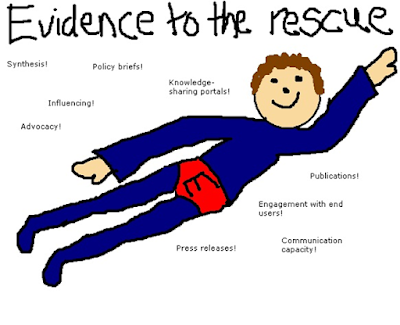
At that moment, a small backstage door hidden in a corner of the shop opened and a bold bespeckled man stepped out, fully dressed in a superhero outfit with bright blue tights and top (that looked a bit too tight), over which she wore red underpants featuring a large letter ‘E’. Ana Lyst didn’t know what to make of this man, but he looked friendly enough and was walking over to her to offer his services. As the man came closer, he produced a large set of antique brass keys from beneath his cape and began opening several doors. “Are you a bit lost?”, asked Evidence Man (for that is who he was) in an accent with a Dutch lilt. “Stuck between here and the outside world? Not to worry! I know the way out to some safe spaces with a friendly audience who would love to hear all about the books you just bought. They would even be interested in the ones that are not ready yet, and they might have a few books of their own to share with you. Shall we go?”

True to his word, when Ana stepped through the first door unlocked by Evidence Man, she emerged back in the now snow-covered high street, where a group of her friends were waiting and, even better, one of them was carrying a large plate of mince pies! Ana Lyst’s spirits lifted immediately, and she vowed to tell her friends all about the helpful Evidence Man in the bookshop. But when she turned around, the nice man had disappeared and through the windows of the bookshop could be seen flying to assist another confused customer.

The End.


The power of storytelling for scientific communication


I was inspired to write this Christmas tale (and blog) after attending a storytelling workshop at the Fuse end-of- year social event on 3 December, which was led by Duncan Yellowlees. Duncan is a Communications Trainer who works with researchers to improve their communications, confidence, and impact. Take a look at his online COMMunity website (Research Comms … but better) to find out more. 

In an engaging and entertaining way, he took us through the key elements of storytelling: from key principles (putting pictures in people’s heads; construct a narrative of causes and effects), to different types of stories (metaphorical, motivational or monster stories, stories as hooks, and point-of-view stories), their structures (problem, solution and results) and what to include in stories (the point, examples, people, heroes & villains, magical helpers, and tensions & conflicts). Did you spot any of these elements in my story? Scroll down to the bottom of this post for spoilers.

Overall, Duncan provided plenty of tips and tricks on how we can use storytelling as academic researchers to communicate our research findings to wider audiences. And this relates directly to the first point (and story) that he made during the workshop: researchers spend too much time throwing the ball (their research findings) but not nearly enough time on making sure there is someone there to catch it (knowledge users). Find your audience first and make them pay attention before you start talking about your research.

His second point was that all this might seem daunting: so many different techniques, plot lines and structures to think about, how can we ever get any good at this? But when comparing it to learning to drive a car, the same principles apply: keep practicing and it gradually (and sometimes quite quickly) becomes second nature. This is because storytelling is already embedded in everything we do in our daily lives: from telling our family and friends about our everyday experiences, to reading books or ‘binging’ on Netflix series.

Finally, Duncan suggested some simple techniques for storytelling in science communication: making stories relatable and relevant (e.g. stress before Christmas) by including named people and adding details (e.g. dark, snowy high streets and describing the interior of the bookshop), which start to paint a picture in people’s heads. Most importantly, start with a hook: a story to draw in your audience, so they want to hear more, or use a question or bold statement as bait (e.g. only 14 percent of research makes it into practice and policy after 17 years).

My story might not have been all you hoped for this Christmas, but the Fuse social event brought some useful gifts for the Fuse Communications toolkit and much needed festive cheer at the end of another challenging academic year. 

Merry Christmas everyone and happy storytelling!


Spoiler alert:
  • The point: knowledge mobilisation between academia and practice is facilitated by a knowledge exchange broker. Plus some points about the time it takes and difficulties faced by researchers when trying to get research into practice and policy.
  • Heroes: academics producing research and papers, while running between bookshelves.
  • Villain: Bookshop clerk (Reviewer 2).
  • Magic helper: Evidence Man (Knowledge Exchange Broker)
  • Tensions & conflicts: research dusting away on bookshelves or not being ready to leave the building, while access to knowledge users is restricted or confusing.
  • Type of story: metaphorical story, overlapping with stories as hooks (to introduce this blog and talk about the storytelling workshop).

Friday, 26 February 2021

Four practical steps to increase knowledge exchange between researchers and policymakers

Posted by Peter van der Graaf, NIHR Knowledge Mobilisation Research Fellow, Teesside University

Are you keen to have impact with your research but get lost in all the knowledge exchange frameworks and models that are out there? In this blog, Peter calls upon 10 years’ experience working in translational public health for Fuse to identify four practical steps to develop collaborative research and achieve meaningful change in policy and practice.


We know all about the challenges of using research to inform policy and practice, especially in public health where the evidence base for interventions or programmes is patchy or contested. In response to these challenges, countless models and frameworks have been developed that try to define the knowledge exchange process (how research evidence can be used, in combination with other types of knowledge, to change policy and practice). Practitioners and researchers venturing into the field of knowledge exchange can be bewildered by the options available which don’t go beyond concepts and fail to describe in practical terms what research translation looks like in reality.

Here I want to share practical guidance from our research on ‘how to do’ knowledge exchange by reflecting on a model that has been developed in Fuse over the last ten years. Our approach to achieving practice and policy change has been to engage with practitioners, policymakers and the public through communications and knowledge brokerage, to co-create relevant research, influence policy and practice debates and promote evidence uptake. Below I have broken this down into four practical steps:
  • Step 1. Awareness raising: Making evidence users, funders and support organisations aware of our existence, our research and engagement opportunities, including engaging our partners early in setting the agenda for future research.
  • Step 2. Sharing knowledge: Creating opportunities for research users and producers to come together to explore opportunities for mutual learning and knowledge exchange through collaborative events, our responsive research service (AskFuse), and patient and public involvement.
  • Step 3. Making evidence fit for purpose: Localising and tailoring evidence to context by offering a knowledge brokering service, embedded research, and increasing awareness of the different pressures faced by people in health policy, practice and academia.
  • Step 4. Supporting uptake and implementation of evidence: Developing long-term relationships with policy and practice partners to co-create evidence, build capacity for practice change, and change practice and policy.

It is important to link a range of knowledge exchange activities that engage policymakers and practitioners at different levels, intensities and points in their decision-making and development processes.

For example, before meeting with policy and practice partners, we develop tailored research briefs that summarise study findings in an accessible and visual way, and that emphasise recommendations and implications for policy and practice. Involving Fuse researchers in developing these briefs improves their knowledge exchange skills, while providing them with ‘calling cards’ to initiate relationships with policymakers for further collaborative work. These conversations are often followed by requests to AskFuse on how knowledge users can apply the research evidence in a specific context, invitations to engage in collaborative research, or to support capacity building and implementation.

Knowledge exchange between academia and public health practitioners and policymakers can be complicated and at times bewildering. Breaking the process down into practical steps illustrates that knowledge exchange is empirical and relational.

Friday, 29 November 2019

Bridging the research industry 'Valley of Death'

Posted by Peter van der Graaf, AskFuse Research Manager / Fuse Knowledge Exchange Broker, Teesside University

I was recently invited to attend a meeting in the British Library of the Bloomsbury SET. Not a group of subversive English writers, intellectuals, philosophers and artists but an Advisory Council for an innovative collaboration between four partner Colleges of the University of London. Namely, the Royal Veterinary College; London School of Hygiene and Tropical Medicine; School of Oriental and African Studies; and the London School of Economics and Political Sciences.

Death Valley, Eastern California
The partnership is funded by Research England and aims to bridge the ‘Valley of Death’: supporting research projects that get stuck between university and the market place. It does this by creating a knowledge exchange platform between the four Colleges that accelerates the delivery of innovative scientific and technical solutions in the field of infectious disease and antimicrobial resistance.

Pronouncing pathogen emergence, zoonotic disease and antimicrobial whatsit was hard enough, let alone my hope of making a meaningful contribution. I thought I would feel completely out of place as a public health researcher and the only social scientist in the room, but to my surprise I quickly discovered that the collaboration faces very similar challenges to Fuse.

For example, the project is trying to pool their commercialisation expertise across the Colleges and create a ‘single open door’ for government agencies, big pharmaceutical companies, small and medium sized enterprises, and overseas partners particularly in Africa. So, similar to our AskFuse service but with industry. In spite of their best efforts to engage researchers from the different Colleges, the project leads found that not all academics are keen to engage in partnership working outside their immediate area of expertise and that interdisciplinary partnerships, particularly with social sciences and humanities colleagues, proved challenging, as they speak a different language and have different cultures for sourcing funding.

It also proved challenging to develop trusting relationships with industry partners: academics don’t know how to find these partners and engage them in their projects, while industry partners allege that academics are ignorant of innovate technologies that have been developed in-house. This is akin to public health researchers not being aware of different types of knowledge that are being used in local government. It takes time to develop these relationships and exchange knowledge within them, for which the three-year grant funding is not long enough to show full results.

While the partnership is keen to engage with social scientists about the social aspects of the commercialisation process (e.g. work with local non-governmental organisations on engaging communities and identifying cultural and societal perceptions around vaccine use and human health), Research England is more interested in the commercialisation of ‘hard’ intellectual property through licensing or spin-out. Hence, the key performance indicators are all skewed towards these outputs. In other words, the incentive structure set by the funder is not encouraging the very thing that the partnership is trying to achieve. This sounds very similar to the lack of incentives and career opportunities within universities for engaging in knowledge exchange in public health.

Group photo (me, furthest right)
During the meeting, the need for creating an infrastructure within the Bloomsbury SET that can facilitate conversations between academics across the Colleges and broker relationships with industry partners was acknowledged by the Advisory Council members. Dedicated funding to develop collaborative proposals between industry partners and academic researchers that address this need was suggested as a useful knowledge transfer mechanism. Similar to the Public Health Practice Evaluation Scheme (PHPES) operated within the NIHR School for Public Health Research.

In summary, even if you don’t have any expertise in a particular scientific field (and can’t even pronounce their topics), chances are that you have more in common and face similar struggles when moving research findings outside academic institutions, whether that involves industry or policy and practice partners. The Colleges study transmittable diseases from animals to humans but to have impact with their research equal attention is needed to the transmission of knowledge from one human sector/ academic discipline to another.

Friday, 21 December 2018

The power of cookies

Posted by Peter van der Graaf, AskFuse Research Manager / Fuse Knowledge Exchange Broker, Teesside University

With the festive season upon us, many are looking forward to indulging in a mince pie or two and getting stuck in some extra helpings of turkey or brandy-soaked Christmas pudding. This often sparks some well-intentioned health warnings from public health folk about the risks of overindulging, binge drinking and the increasing obesity epidemic. Not wanting to dismiss these important messages, I would like to focus on a different message in this blog: food as a great tool for knowledge mobilisation (making information useable and accessible through working collaboratively).

If there is one thing that I have learned in my time as AskFuse Research Manager, it is that nothing is as useful as biscuits for bringing people together and contributing to a positive meeting between researchers and health professionals. 

This insight started from my own weakness: I have an incurable sweet tooth and my colleagues and students have quickly learned to exploit this asset for plying me with Dutch liquorice and other delicacies into supporting their requests and theses. So, I decided to turn their own weapons on them, with surprising results.

Stuck in a challenging debate about the usefulness of research evidence for commissioning local health services? Bring some cookies and fruit (to balance; I am a public health researcher after all!) and you will find that conversations all of sudden move in more fruitful directions.

Although my experience told me that cookies are a great conversation starter when brokering knowledge, I did not realise until recently that this was an area of serious academic study. In a recent paper published in Medical Education[1], Michael Hessler and colleagues from the University Hospital of Münster in Germany decided to put the power of cookies to the test and conducted their own Randomised Controlled Trial while delivering an emergency medicine course.

They were worried about the evaluations at the end of their course and suspected that these were not the measures of quality that the University was hoping for. Therefore, they were looking for a ‘content-unrelated’ intervention that would alter their evaluation results significantly and prove that their evaluations were seriously under-baked.

Third‐year medical students (n=118) were randomly allocated into 20 groups, 10 of which had free access to 500g of chocolate cookies during the course sessions (cookie group!) and 10 of which did not (control group). The groups had the same teachers and were taught the same content. After the course, all students were asked to complete a 38‐question evaluation form.

The results were very appetising: the cookie group evaluated teachers significantly better than the control group, they rated the course material as considerably better and overall satisfaction scores for the course were significantly higher. In summary: the provision of chocolate cookies had a significant effect on course evaluation.

One might conclude that course evaluations are seriously flawed but I prefer the ‘cookie-jar-is-always-half-full’ interpretation: providing cookies to participants is a great way to boost results! The German research adds baking powder to my own observations in UK knowledge brokering: cookies are a great way to boost exchange of knowledge and relationship building in conversations and meetings.

The ingredients of each meeting and conversation might be different but they all need a baking agent to rise to the occasion. So, whatever you do this Christmas, if you would like to avoid awkward questions during social and family gatherings about ‘what it is that you do as a researcher’ or ‘when are you finally going to finish your PhD?’, just bring a plate of cookies and subtly but swiftly change the conversation to a sweeter topic.

Happy Christmas!


Reference:
  1. Hessler M, Pöpping DM, Hollstein H, Ohlenburg H, Arnemann PH, Massoth C, Seidel LM, Zarbock A, Wenk M. Availability of cookies during an academic course session affects evaluation of teaching. Medical education. 2018 Oct;52(10):1064-72, https://onlinelibrary.wiley.com/doi/pdf/10.1111/medu.13627