Showing posts with label rural. Show all posts

Friday, 19 July 2024

From crisis to collaboration: Transforming support for people experiencing homelessness in North East England

Posted by Steven Thirkle, Research Associate, Newcastle University

People experiencing homelessness often have multiple and complex health and social care needs that require support from many services. However, accessing and coordinating this support can be difficult when services are disconnected geographically or relationally. Often the person who is experiencing these challenges is the one who has to reach out for help, and this can be extremely hard for someone also managing day-to-day homelessness.

During our workshop, More Than Minutes visually captured our discussions, providing a dynamic summary. These visuals encapsulate key insights and recommendations, offering an engaging snapshot of our collective journey towards transforming support for people experiencing homelessness.


Over the past two years, our team has been working with services that provide support to people experiencing homelessness in rural and coastal areas of North East England. Our goal has been to explore innovative ways to improve access to care and support for these vulnerable people. Here, we share our research findings, shed light on the challenges faced by people experiencing homelessness and present our co-produced recommendations for creating a more effective and holistic (whole person) support system.

What does hospital data tell us?

To understand why people experiencing homelessness in the North East often turn to emergency care services in rural and coastal areas rather than seeking alternative forms of support, we examined hospital data on people attending emergency care services who had no recorded address. We discovered that there are many contributing factors, including struggles with alcohol and drugs, mental health issues, and challenging social situations. These challenges often occur at the same time, exacerbating their complexity and approaches to treatment.

What is stopping homeless people accessing services?

While this numerical data provided valuable insights, it did not uncover the underlying reasons behind the lack of engagement with other support services. To gain deeper insights, we interviewed people experiencing homelessness as well as those providing support in rural and coastal areas. The interviews aimed to explore experiences with emergency care services, overall health, social lives, and past traumas. They revealed significant barriers to accessing services, such as limited resources, transportation challenges inherent to rural areas, and the isolation often felt in coastal communities. Additionally, rigid service criteria and thresholds prevented people from receiving the support they urgently needed, further compounded by the sparse availability of services in these regions.

What is the current picture?

A comprehensive and integrated approach tailored to the rural and coastal context was needed to provide effective support to people experiencing homelessness in these areas, so we mapped out existing services and their collaborative relationships in the areas. Our findings showed a fragmented system, with many services operating independently and lacking essential connections to the core network of services necessary for addressing the unique challenges faced by people in rural and coastal areas.

How do we address the gaps?

In response to these gaps, we organised a workshop at the Community Hub in Cramlington, Northumberland, bringing together over 70 people including professionals from health, housing, social services, local authorities, law enforcement, emergency response, and third-sector organisations, as well as people with lived experience of homelessness and mental health issues in these regions. Together we developed recommendations for a more effective and collaborative approach to supporting people experiencing homelessness in rural and coastal areas. Seven key areas for recommendations were identified:
  1. Long-term funding and resources: Campaign for sustained funding and increased resources to support comprehensive and ongoing assistance for homeless people.
  2. Coordination, connectivity, and communication: Establish robust ways to coordinate, foster better connectivity between services, and improve communication channels to ensure a seamless and integrated support system.
  3. Accessible services - pathways to support: Develop clear and accessible pathways for homeless people to access a wide range of support services, including health, housing, social services, and mental health resources.
  4. Building trust and co-developing services with lived experience: Foster trust and inclusivity by actively involving peoples with lived experience of homelessness in the design, development, and evaluation of support services.
  5. Trauma-informed practice: Implement trauma-informed approaches across all support services, recognising and addressing the underlying trauma experienced by homeless people.
  6. Improved data sharing: Establish efficient data-sharing agreements for support services to ensure comprehensive and up-to-date information, enabling better coordination and informed decision-making.
  7. Staff retention and wellbeing: Prioritise the wellbeing of support staff by providing resources, training, and support to prevent burnout and turnover, fostering continuity of care.
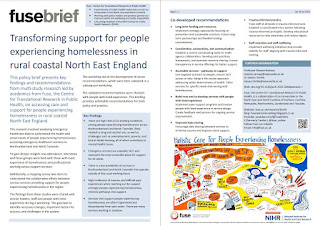
We have developed a handy two-page Fuse research brief which pulls out the key findings and recommendations for practice and policy co-developed with people with lived experience. 

Friday, 6 September 2019

Health inequalities in rural and coastal areas

Last November we, a team of Fuse academics, were successful in winning competitive funding from Public Health England (PHE) and given just four months to complete a rapid evidence review investigating health inequalities in older populations in coastal and rural areas. The team from Northumbria University and led by myself, consisted of Professor Katie Brittain a Social Gerontologist and Dr Sonia Dalkin Co-lead of the Fuse Healthy Ageing Research Programme (HARP). Read a case study about the review on the HARP pages of the Fuse Website.

The short timescale and vast quantity of literature made this a challenging project from the outset but the evidence was urgently needed to provide recommendations for taking an asset-based approach to reducing inequalities and promoting productive healthy ageing in rural and coastal areas. We worked closely, consulting and collaborating, with stakeholders including PHE Centre leads, Knowledge and Libraries Service, the Health Inequalities Team and Director of Public Health representatives from rural and coastal authorities. Key partners were approached from the start to recommend grey literature and case studies.

One hundred and eleven studies later the report is finally published and launched by our colleagues at Public Health England with this great blog showing how we age is strongly influenced by our environment, including where we live.

Katie Haighton, Associate Professor in Public Health, Northumbria University


How we age is strongly influenced by our environment, including where we live


Helen Brock - Programme Manager for Adults & Older Adults at Public Health England
Dr Rashmi Shukla - Director, Midlands and East of England at Public Health England

The impact of where we live

The long-term trend in life expectancy in the UK has been upwards; however, our experience of getting older varies across the nation. Some people have good physical and mental health well into old age, whereas others become frail or ill.

How we age is strongly influenced by our environment, including where we live. For both men and women, there is a 19-year difference in healthy life expectancy between those living in the most and the least deprived areas of the country.

Whether or not we live in an urban setting can also make a difference. While many of our country’s rural and coastal areas are picturesque, they can present significant challenges to protecting the health of the local population.

Our new evidence review builds on the existing evidence and suggests that older people living in rural or coastal areas may experience specific inequalities in their physical and mental health.

With almost 10 million of us living in rural areas, and older people making up a growing number of this group, it is important to understand why these health inequalities exist so that we can help to tackle them.

The evidence review aims to provide a synthesis of the evidence to support leaders in local areas in their efforts to reduce health inequalities.

Why are there public health inequalities in rural and coastal areas?

There are several drivers of health inequalities in rural and coastal areas.

One significant factor is social exclusion and isolation. Research suggests that loneliness can increase the risk of premature death by 30%.

Rural and coastal areas can face infrastructure challenges, with many villages and small towns lacking frequent and reliable public transport and high-speed internet. Having sufficient numbers of healthcare workers and carers in certain areas is an additional problem.

However, living in a rural or coastal area also has benefits. Rural places often have a strong sense of community, easier access to green space and lower crime rates than urban areas. ONS figures indicate that a higher proportion of people living in rural areas feel a sense of belonging and safety in their neighbourhood compared to people living in urban areas. Coastal environments may also provide benefits, through increased opportunities for physical activity as well as the restorative and stress-reducing impact of blue space (water).

What can we do to reduce these inequalities?

Local government and NHS partners, alongside the voluntary and community sectors, play a key role in taking action to improve the health and wellbeing of their populations.

PHE and NICE recognise that local interventions which bring communities together are some of the most valuable in addressing rural public health challenges.

Good social relationships and engagement in community life are necessary for good mental health and can help people become more resilient. By providing and maintaining community areas, green spaces and promoting public and community transport, councils can help to create a positive local environment and tackle social isolation.

Creating communities

Community activities such as lunch clubs can encourage older people to socialise and participate in community life. Bringing groups together in a village hall or other community space also provides the opportunity to reach older people with services, helping them to look after their wellbeing.

It is important to encourage social connections and contact for those in marginalised groups, who may be particularly affected by social exclusion. Involving older men who often find it harder than women to make friends later in life and may be reluctant to engage in community activities or social groups can also be a challenge.

Men’s Sheds is a programme that provides a place for older men in rural communities to participate in physical activities and projects such as gardening, woodwork and model-building. The initiative helps older men to meet, socialise and learn new skills, alleviating social isolation and creating a sense of purpose. With over 480 Sheds open in the UK, and more than 100 in development, it’s estimated that over 11,000 ‘Shedders’ are benefitting from Men’s Sheds across the country.

Promoting physical activity and making use of natural assets

There is potential for coastal and rural areas to use their natural assets to promote physical activity and reduce social isolation, for example, through volunteer-led walking groups or outdoor activities.

‘Stepping into Nature’ is a project led by Dorset Area of Outstanding Natural Beauty using Dorset’s natural and cultural landscape to provide activities and sensory-rich places for older people, including those with dementia and their carers. It seeks to increase physical and mental wellbeing, to reduce social isolation and loneliness, and to increase confidence and motivation for people to access the countryside.

Promoting and normalising physical activity as part of the experience of daily living for older people living in sheltered housing or residential care settings can result in further benefits.

In rural Norfolk, Active Norfolk – a partnership of organisations working to encourage people to participate in sport and physical activity – trialled Mobile Me, a physical activity programme for older people funded through Sport England.

For ten weeks, Mobile Me visited 65 sheltered housing and residential care homes to encourage them to get moving through games such as bowls and table tennis. The programme helped to reduce older peoples’ sedentary behaviour and fear of falling as well as increasing overall wellbeing.

Harnessing technology

Technology can be useful for providing care services to older people in the country’s most remote areas.

NHS Highland recently trialled video conferencing in remote care homes to allow doctors to speak to dementia patients in a familiar setting without the need for extensive travel.

The technology enabled care home residents to be assessed and reviewed more quickly and monitored more regularly. Video conferencing also helped care home staff to access specialist knowledge and advice more easily, helping them to feel more confident and actively involved in their residents’ care.

However, it’s important to find a balance between remote and direct face-to-face contact that many older people value.

Supporting local areas

With advances in healthcare and a greater understanding of how healthy lifestyles, supportive communities and environments can help us to live longer, enabling older people to lead fulfilling lives for as long as possible is more important than ever.

Recognising the health inequalities faced by people in different areas of the country, including rural and coastal places, is a crucial step to ensuring that all older people have the opportunities and care relevant to their needs, no matter where they live.

PHE’s evidence review seeks to share what is known about these issues, so that through Locality Plans, local Health and Wellbeing Strategies and other mechanisms, local authorities and the NHS locally are supported to prioritise work to address the health inequalities that exist within and between coastal and rural areas.

To find out more you can read the full report: An evidence summary of health inequalities in older populations in coastal and rural areas. You can also read our rural health report produced with the Local Government Association: Health and wellbeing in rural areas, and our recent health inequalities report: Place-based approaches for reducing health inequalities.


Reproduced with thanks to Public Health England and Exposure: 
https://publichealthengland.exposure.co/health-inequalities-in-rural-and-coastal-areas


Images:

Friday, 12 April 2019

Making the rural a bit more idyllic

Guest post by Christina Dobson, Research Associate, Institute of Health and Society, Newcastle University

Ah, the countryside. The home of all that is natural and healthy, the epitome of the ‘good life’. Where you can stroll down the lane to collect fresh eggs or veggies from your neighbour, simply dropping your money in the honesty box left at the end of their drive. I grew up in a rural area, and still live in one now. I love that I only have to walk (more like dawdle - I have a very curious and distractible three year old!) for 10 minutes (five minutes without said three year old) from my front door and I am in the North Yorkshire Moors National Park.

And it seems that living in a rural area could actually be good for you in a number of ways. You are likely to be more satisfied with your life, experience better health overall, and live an average of two years longer than people in urban areas. Maybe it’s the un-polluted air, the connection between land and food, the sense of belonging and community? Or maybe that is just a myth, sold to us all through Postman Pat?


Because, actually, living amidst the beautiful rolling hills may not be so good for you if you develop cancer. In fact, it may even put you at greater risk of developing certain cancers and make you less likely to survive your cancer. With roughly 20% of the population of England living in a rural area, this poses a serious public health problem.

However, we don’t really know why rural patients are facing poorer survival rates than urban patients. One of the strongest factors is that cancer is often diagnosed at a more advanced stage in rural patients, limiting the treatment options available to them. We know that delays in diagnosis are strongly linked to advanced stage cancers, and, as such, encouraging early diagnosis has been central to UK cancer policy for over a decade.

When we begin to think about where diagnostic delays may be occurring for rural patients, it seems that they are investigated and diagnosed just as quickly as urban patients, after referral to hospital for specialist assessment. It follows then that there may be problems prior to referral to hospital that are slowing down rural cancer patients’ diagnoses, either in the way patients respond to symptoms, or the way they are managed in primary care.

Thanks to funding from Yorkshire Cancer Research, and alongside colleagues from Aberdeen and Glasgow, we are starting to look for answers to some of these questions. This study will involve interviewing people in rural Yorkshire to understand their experiences of bowel cancer symptoms and decisions around if, how, and when to seek help about them. The findings from these interviews will be used to work with local communities to think about what interventions we may be able to design to encourage people in rural areas to present to their GP and, hopefully, increase the likelihood that their cancer is diagnosed at an earlier stage and that they will survive.

It is an exciting study, as there is so little known about symptom experiences in rural populations, with lots of issues to explore. For instance, availability and regularity of public transport, provision of health care services in rural areas, hidden poverty, cultural beliefs and experiences of ill health and employment, to name but a few. And then there’s the messy complexity of defining the ‘rural’, or maybe we should be looking to instead describe the multitudes of ‘rurals’? Plenty to keep me busy!

With the arrival of National Bowel Cancer Awareness Month it’s been valuable to reflect on the importance of this study and the opportunities and challenges that lie ahead. Understanding some of the barriers to timely presentation that exist for rural populations, and devising ways to overcome them is our challenge for the next two years, and beyond. Maybe, longer term, we can help to make the ‘rural’ a bit more idyllic.