Showing posts with label ARhodes. Show all posts

Thursday, 28 May 2015

52 weeks in public health research – the (very) rough guide

Guest post by Avril Rhodes

Remember the natty idea to take photographs representing a year of working in public health research? Well, how about a quick analysis of what we saw, snapped and submitted? Here are the exciting and indeed revealing results.

After looking at 198, or was it 200, images a portrait of researchers concerns emerges – not exactly Maslow’s hierarchy of needs, so much as the Rhodes' hierarchy of academic obsessions.


Bottom or is it top of the pile comes food. It’s official – no less than 42 pictures, close up and distance shots, ranging from individual snacks, drinks and meals to full size conference spreads and displays. I felt slightly queasy after looking at them all. Feed those academics!


The next most important thing is to feed the mind. Any passing course, lecture, symposium and the like weighing in with 20 pictures. But there’s lots more that get close to the mind-feeding category although making more cameo-esque appearances, such as degree ceremonies, IT, stands and posters, books, theses, work in progress and journal covers. Publication definitely counts. Completing work even more.


The office – no not the TV series, comes next, with 16 images, inflated perhaps with opportunities created by moving office and the delights of standing desks and desks tied to exercise apparatus. I would not have dreamed that taking a picture of the immediate work environment was so important. 


Travel ranks highly but possible to count in different ways. Railway stations are significant at 11 pictures, especially Newcastle Central – of world significance as stations go, but that’s just me. Car travel featured just slightly with a nod to cycling. Active travel (good and bad) is clearly a source both of delight, when stairs get favoured, and frustration, when lifts are promoted. Exercise equipment got a decent look in too. 


Signs and marketing really played on the collective academic mind. Labelling, the impact of shop placements and advertising, spelling mistakes, unintended humour, public health messaging, came in with around 12 images. Some of this felt a bit judgemental, when it came to cheap unhealthy food signs. Not too many wider determinants of health, it has to be said.
 

Field work related images scored a fairly respectable 9.
 

Culture kept creeping in. Museum visits, architecture, music, sculpture were all there. Nature played a relatively small part, but researchers did appreciate the cute, the beautiful, office plants and the changing seasons.
 

Then a whole rag bag of one-offs. Some were clearly novelty items or personal reminiscences, and some seemed like stream of consciousness, or pet concerns.


Curiously, the academic world was quite short of pictures of people, except in crowd shots doing serious lecture type stuff. It looked a camera shy world. So what do we have? A hard working, semi-office bound, nomadic community that likes writing, learning, unable to switch off form public health even when undertaking a leisure activity or just walking around the town, that enjoys high art and longs to sniff a flower. Is this what we are? The camera apparently doesn’t lie.

Wednesday, 6 May 2015

Party manifestoes, part 2: A war on junk food?

Guest post by Avril Rhodes

The Fuse blog has seen pieces on the marketing of junk food near supermarket checkouts in recent weeks. Interestingly, whilst all the political Parties profess many policies related to children and young people, this is a specific topic where they are silent. Perhaps it’s too micro an issue or maybe involves dealing with too many big business interests. Who knows? However, I wouldn’t wish to be called cynical and neither would our potential political masters, who are working hard on the junk food agenda…to varying degrees.

Conservatives will:
  • Act to reduce childhood obesity (how?) 
  • Continue to promote clear food information (not all that clear an aim, on reflection) 
  • Introduce a national evidence based diabetes prevention programme (sounds interesting) 
  • Invest more in primary care to prevent health problems (needs more detail)
Labour will:
  • Set a new national ambition to improve the uptake of physical activity (and this means…?) 
  • Set maximum permitted levels of sugar, salt and fat in foods marketed substantially to children (assuming we know what these foods are, and can get over the qualifier “substantially” without disappearing in a legislative quagmire, this, could, in the end improve the offer at the proverbial check out)
Liberal Democrats will:
  • Restrict marketing of junk food to children, including restricting advertising before 9.00pm, and maintain the ‘5 A DAY’ policy (more specific, but perhaps would have the unintended consequence of driving the advertising onto the internet, and what about the argument that the 9.00pm watershed is an anachronism in light of current TV viewing technology?)
  • Encourage traffic light labelling of food and publication of information on calorie, fat, sugar and salt content in restaurants and takeaways (and would this be better than dealing with the check-out offer? Or are people going out already committed to a more unhealthy option in the interests of convenience?)
Greens will:
  • Extend VAT at the standard rate to less healthy foods, including sugar, and spend the money raised on subsidising a third of the cost of fresh fruit and vegetables. This, it is stated, could prevent 5,000 premature deaths a year. (A bold one this. Could the money raised be tracked to ensure this happened? What about ensuring the quality of the subsidised produce? Who provided the calculations on lives saved?)
Before you despair and think that there are more questions than answers, there is some good news here. All the parties (well except perhaps UKIP, who don’t discuss junk food, though are loud on backing British farming and fishing) have got the message that action needs to be taken about what our food contains. This should encourage the world of public health research. 

All views expressed are exclusively those of the author.

Tuesday, 5 May 2015

Party manifestoes, part 1: Four lessons to untangle the public health policies

Guest post by Avril Rhodes

Hung over by the election talk? Worn down by the TV debates? Well how about reading the manifestoes? Be honest with yourself, when did you last read a manifesto? The Liberal Democrats’ manifesto is 158 pages, but the remaining largest national parties (Conservative, Labour, Green and UKIP) make do with around 70 to 80ish pages. And the public health policies are all over the place, under welfare, housing, transport, the environment, education, the economy and, occasionally, under health – so need some real work to find. However, that’s good, even if the party seems untroubled by, or hasn’t heard of, the wider determinants of health, at least they’re there…or somewhere. So, first lesson, be prepared to find a public health policy just about anywhere. 

Second lesson, be ready to make comparisons and choose your topic. Take the broad sweep and you will find the whole thing indigestible, and it may turn you into a floating voter after you’ve agreed and disagreed in about equal measure with all you’ve read.


So, here’s one of the easier examples: booze and fags.
  • Conservatives will end open display of tobacco in shops, introduce plain packaging and support people “struggling with addictions”. The latter is swept up in a review in how best to treat long term yet treatable conditions, which include alcohol addictions. 
  • Labour come in with a levy on tobacco firms to pay for NHS staff and they will target high strength, low cost alcohol products, their argument being that this fuels problem drinking. 
  • The Liberal Democrats want to reduce smoking rates, complete the introduction of plain packaging and also make a tax levy on tobacco companies, in their case to contribute to the costs of health care and smoking cessation services. They will also monitor evidence on e-cigarettes and “ensure restrictions on marketing and use are proportionate and evidence based”. Finally they will introduce a minimum unit price (MUP) for alcohol. 
  • The Greens will increase alcohol and tobacco taxes to help fund NHS spending increases and set a MUP of 50p. In a big section on road safety they will reduce the alcohol limit for drivers “to as close to zero as possible”. 
  • UKIP under their “Save the Pub” campaign will provide tax breaks for micro-breweries, amend the smoking ban to give pubs the chance to open smoking rooms, “properly ventilated and separated”, oppose minimum unit pricing and reverse the plain packaging rules. All of this, which you will have guessed, is in a chapter on “Heritage and Tourism”.
Third lesson, consider what’s not been said. Reading between the lines I think it’s probable, for example that Labour and the Greens would favour plain packaging, the Liberal Democrats might consider 50p for their MUP, and Labour might be amenable to, say, reducing the blood alcohol limits. But we can’t be sure.

Fourth lesson, if you’re going to have a debate with your friends about what’s on offer, anticipate the arguments they might offer, like, for example, that good local pubs, will combat loneliness, provide employment, and maintain community cohesion. Does that end justify the means? Or is UKIP’s claim that 6,000 pubs closed due to the smoking ban and ending the alcohol duty escalator worth bringing in the smokers from the cold?

All views expressed are exclusively those of the author. 

Thursday, 2 April 2015

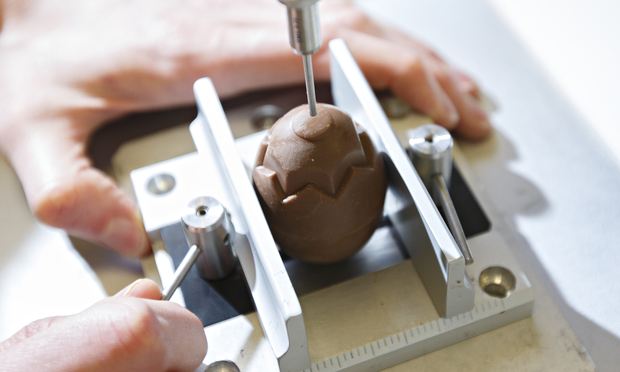
Hunting down the seasonal calories: an Easter eggs-ercise

Posted by Avril Rhodes

Will you be looking forward to an Easter egg hunt soon? Well, beware, those Easter treats are really loaded with calories, fat, and bizarrely, a little fibre. I’d love to say I’ve spent hours researching this, but I haven’t - just one trip to this weight loss website and I was overwhelmed with results. So, I picked a few favourites.

No Easter eggs were harmed in the writing of this blog (although some may have been consumed)
 Let’s go for some at the top end, weighing in at 1,250.2 calories, 67.7g fat and 4.0g fibre was the Kit Kat Chunky Easter egg from Nestle. Chunky indeed. Another in the heavyweight division for possibly more sophisticated palates, is the After 8 Giant (clue here) Chocolate egg also from Nestle which has 1,072 calories, per shell (possibly the calorie measuring people couldn’t bring themselves to estimate the whole egg). It has 64.6g fat and 16g fibre, which is a consolation but not as good as, say, porridge. How about the dark chocolate Easter egg from Green & Black’s, sneaking in at under 1,000 calories with 960, but 69.5g fat (ouch!) and strangely, 16.6g fibre? I know that Garfield, the cartoon cat, once said he’s never met a calorie he didn’t like, but there are limits to how you might increase your fibre intake. However, with Green & Black’s you are buying Fairtrade chocolate, which can’t be bad, and this also applies to Divine Chocolate.

Ding-ding! Round one goes to this heavyweight contender
And what about the children I hear you cry. The Buttons Easter egg by Cadburys is 858.6 calories per medium egg, (who said medium?) with 48.6g fat and 1.1g fibre. The Cadbury Caramel egg, per 38g egg (so a snack really), is 195 calories; with a mere 10.2g fat and 0.2g fibre. Parents might be tempted by the pack of two (to keep each other company, presumably) Cadbury Caramel bunnies, which come in at 200 calories, 10.8g fat and 0.2g fibre. And I couldn’t write this blog without paying homage to the Cadbury’s Crème egg which is 180 calories per egg with a fat rating of 6.3g. Although, I have overheard gossip about the Crème egg being downsized, bearing in mind that you seem to be able to buy these from December 26th onwards.

And what about the office snacking? More bad news. A single Lindt chocolate mini-egg, a mere 5g, is 30calories, a Malteaster bunny (ahhh) by Maltesers is 157 calories; and each Cadbury’s mini egg is 16 calories.

However, you can earn your calories. The same website that calorie counted the eggs, makes some suggestions that seem blatantly sexist…for example a 40 year old female weighing 12st 7lb who is moderately sedentary, can use 100 calories spending 30 minutes hovering/dusting/mopping floors, or, if you prefer, 20 minutes weeding the garden. What a way to earn about half of a Crème egg! I have no idea what you do with the other half.

Well, have a Happy Easter anyway from all at Fuse. That's all yolks!

Tuesday, 17 March 2015

A new cocktail – the McGonigles – gin and public health anyone?


Posted by Avril Rhodes

I went to Stockton High Street last Saturday (bear with me, this gets more exciting) and a vision opened before my eyes. A new business has opened (only to be applauded in the High Street which has been struggling for years despite the Herculean efforts of the Council) which is called Dr M’Gonigle’s Emporium. Now, Dr M’Gonigle (or more commonly McGonigle depending on where you look) is becoming an increasingly well- known Medical Officer of Health of Stockton, during the inter-war years, who tirelessly championed population health for local people, especially those who were feeling the effects of low income in general. He made compelling links between poverty and ill health. Despite this his name has been used for the branding of a pub – yes, a pub! Am I the only one who sees this as incongruous?

What Pub? Website, which operates for CAMRA (the Campaign for Real Ale) proudly declares…..

“About the Pub

Opened Dec 2014 and named after Dr George Cuthbert Mura M'Gonigle who fought hard to maintain the health of the poor people of Stockton. A pleasant open plan bar offering big screen TV and serving up to four real ales and a cider.”

The external décor made it absolutely clear that customers and passers-by alike were to see a link between the naming of the pub and the image of the great man himself, adapting an image of the good doctor that is frequently used in tributes to his work, see picture left, as a motif.

When I next down four pints of real ale and a cider, I shall of course be thinking about my health and my disposable income to enable me to cruise along the bar taps instead of settling down to a plate of healthy food.

This new development is sad to the point of being tear-jerking. Stockton High Street is at the end of a major refurbishment, one of many over the years to try and breathe new life into what was once a proud shopping centre of choice and indeed, branded the widest High Street in the UK. The latest work is impressive, but still can’t disguise that there are far too many voids, leaving too few shops attracting too few customers. I hope I’m proved wrong and that the current refurbishment will have the desired effect. At a time when there is much debate about licensing and public health, and the effect on drinking patterns, how, on top of the controversy did this strange name slip through the Local Authority’s scrutiny?

This, dear audience, is like opening a tobacconists named after Sir Richard Doll, who discovered the link between smoking and (ill) health. It really is, but then Dr McGonigle smoked and died young, but at least this was before the work of Doll was completed and published. Amber Taverns who own the establishment cannot claim ignorance.

Tuesday, 9 December 2014

The Stevens Factor – our man from Consett

Posted by Avril Rhodes and David J Hunter

Simon Stevens, the Chief Executive of NHS England is not as he seems. Behind the urbane witty manner, the man who likes, apparently, to speak without visual aids, is a man of real steel. Well, Consett steel actually, as at home speaking about his early experiences of working at the then Shotley Bridge General Hospital, as defending the NHS before the Public Accounts Committee and leading five year forward views. We have two gems here, someone who knows north-east England and relishes speaking almost exclusively about public health, despite the enormity of the operational responsibilities he carries, and definitely a force to be reckoned with, as his vertical rise from junior manager to CEO, via advising the Blair government at No 10, testifies.
Simon Stevens: a man of Consett steel
We shall soon be entering manifesto season. At his recent Centre for Public Policy and Health lecture at Durham University Queen’s Campus, whilst it wasn’t called a manifesto the audience were given an insight into six key priorities on Mr Stevens' mind, some of which built on the five year forward view released in October. Not in any kind of order these were:
  1. Re-conceptualising what we mean by the NHS – the NHS is now a pensioner, in organisational terms but is still revolving around dealing with problems as they arise, with too little spent on underlying prevention. It seems to be hard enough to co-ordinate the different services currently provided, let alone stepping up to a new level where there is no difference in health and social care, and any aspect of policy that affects life chances, and health and wellness, is integrated both in planning and delivery. But this is a goal that means a fundamental re-orientation of what’s provided, how and where.
  2. What about the unexploited advantages of primary care? The division between primary and secondary care in the UK, which has deep historical roots that pre-date the NHS is both a barrier, in terms of setting up a division that wouldn’t be recognised in some other countries, and also a positive, in providing personalised care, close to home. But what about the areas where primary care is all too thin on the ground, the unpopular parts of the country where GPs don’t want to work – the so-called ‘inverse care law’ which Stevens invoked. Can this be fixed through the development of a population-oriented primary care system?
  3. The NHS is a major buyer and employer and has a sizeable economic footprint in local communities. Back in his Consett days, the steel works had recently closed and the NHS took up some of the fall out as the local and large employer of alternative resort. This lesson has not been lost on Stevens. The NHS should be able to influence poverty and health through its own economic position in each locality.
  4. Work needs to be done on ensuring people get and stay in high quality jobs. The NHS can support this (partly linking back to the third point) through what it does as an employer but also could have a much stronger role in health interventions whilst people are at work. Unsaid at the time, but the workplace is somewhere people spend a lot of time, so why not? The NHS needs to set an example in being a good employer itself, but to its shame falls short, for example in the management of shift systems, or provision of healthy eating options at work. This was definitely a ‘can do better’ on the report card.
  5. Local Authorities have come back in from the cold with their new (or is it re-gained?) responsibilities in public health. There is an awakening to the scope local government could have, arising from the debate about devolution in England, set off by the Scottish referendum, and even within their existing powers, local authorities can reach the parts the NHS can’t reach in affecting population health and well-being. 
  6. And finally, what about the planning of new cities and towns? These could provide a test bed for working out new ways of place-shaping and designing health and wellness into the built environment and also new ways of delivering the NHS, given the blank sheet these major developments offer.
Let’s see how many party political manifestoes pay attention to these ideas in the Spring of 2015.

Tuesday, 4 November 2014

Knowledge exchange: just do it (but be mindful of what you say). Part 3 of the KE blog series

Posted by Peter van der Graaf

In the last two blogs about knowledge exchange Avril and Mandy did a great job outlining the opportunities and pitfalls of academics working with public health practitioners and commissioners to get research into practice (or practice into research as a more subversive strategy). “Putting yourself in the shoes of service partners”, “connecting with people in different ways”, “demystifying the language” all makes sense but how do you do it? The toolkit provides plenty of ideas but until you put those ideas in practice your translational research skills are still untested.

AskFuse was set up in June last year to ‘just do it’ (incidentally a research manager was hired with strong connections to the American company that came up with the slogan): ask our policy and practice partners what evidence they need and then find academics in Fuse who can help them access or develop that evidence in a timely, useful manner and in a usable format. Almost 16 months and 100 enquiries later, there certainly seems to be an appetite for working together.

That doesn’t mean pitfalls no longer exist: procurement procedures can trip up the best laid proposals, reorganisations are still not conducive for collaborative research, academic language can be intimidating and impenetrable, and academics can be just as invisible to each other as they can be for policy and practice partners.

However, having conversations seems to be at the heart of any successful (and unsuccessful) collaboration. Moreover, what happens in these conversations is key. Below is a hypothetical conversation between a Fuse academic and health practitioner based on similar experiences within AskFuse. What this exchange highlights is not only the stereotypical views that exist on different sides of the fence but more importantly the ability to change our views about doing research with policy and practice partners. That doesn’t mean academic rigour and peer reviewed publications are out of the window. 'Rigorous' is after all an adjective not a verb, and changing a health policy or intervention is what ultimately improves public health, not journal ratings or citation indexes.

In a sunny office somewhere in the North East:

Public Health practitioner in Local Authority: I would like to know if my child obesity programme in schools is going to work before I ask commissioners to sink millions of pounds into it.
Fuse researcher: No problem. What you need is a full RCT with three arms after a feasibility and pilot study, followed up by a mixed methods impact evaluation after 24 months.

Practitioner: Great! When will I have the results and what will it cost me?

Researcher: Only £1.2 million pounds and 7 years of research.

Practitioner: But I need to convince the elected member in the Council, who decides on my budget, in 6 months’ time and I have only £15,000 available for research within my million pound intervention programme.

Researcher: Right, so what you really want to know is: do the children in my programme lose weight. What? You are already measuring this within the programme? And you have comparable data available through the National Child Measurement Programme? This is highly unusual! You are also more interested in why children do or do not engage with the various activities on offer? Why didn’t you say so! All you need is a process evaluation: some interviews with delivery staff, group interview with some of the children and parents and Bob is your uncle! We can even use some comparable data from a previous research project to inform the questions and speed up the research design process.

Practitioner: Fantastic! I am sure if you write a short outline to explain this to my boss, nothing too fancy you know: just bullet points and a nice picture or story will do, we can find a way around those nasty procurement procedures. I might even invite a colleague from the neighbouring local authority to join in as he is doing something similar and also has some funding hidden away from his colleagues in other departments, who are all too keen to get their hands on our ring-fenced budgets. He is quite busy at the moment but is available in eight months’ time.
 
Researcher: But wait a minute: you said there was no money and time? How do we know if your colleague will still be interested eight months down the line and how will we know if the research findings will apply to his patch? Surely his boss will have different ideas about spending that money. 

Practitioner: I think that’s where we will need a full RCT. Wasn’t there something about complex interventions mentioned in an earlier Fuse blog?

Tuesday, 21 October 2014

Getting going in knowledge exchange: part 1 of the KE blog series

Posted by Avril Rhodes

This is the first in a series of three posts on knowledge exchange and translational research.

How do you explain and sell knowledge exchange in public health? This is a minefield. Definitions are legion. Hard words, like “translational” act like bumps in the road to trip up the unwary. And there are many harbingers of doom, talking about barriers at every turn. Wizards fret (rightly) about how long it takes to get research findings into practice, what counts as evidence, and how to engage with and keep people working in the field interested in projects and their results. It would seem that no sooner are research partners identified and engaged then they are spirited away by a re-organisation, a change of role or a new job entirely.  

AskFuse is shedding light on practice driven research and evaluation
Unfortunately, there is a dilemma at work here. The drivers of academic life (grant applications and production of papers) are activities that may not be of high priority to potential research partners. Researchers research the questions that funding bodies will support, publish in the most prestigious journals available, and present at the most significant conferences in the field. Curiously despite best efforts in the process taken to identify what will be researched by funding bodies, it seems it is still possible to end up with topics and questions that don’t resonate widely, and the sheer volume of publications holds no great incentive for extensive reading. An early casualty of any funding crisis can be training, reducing the number of people who might be interested in research results attending conferences, and those that do are open to criticism for appearing to take time out. The constant stream of short term operational pressures, new policies and initiatives, targets and deadlines will come first, and given the pressures in the practice environment, research soon fades into the background. The pace of events can be just too fast and too pressing.   

There is light at the end of the tunnel – and it’s not an approaching train. The experience of AskFuse over the past year has shown that there is a healthy appetite for practice driven research and evaluation, demonstrated in the number of queries raised (over 100 at the last count) and the breadth of topics from lifestyles and behaviour to system transformation has been both encouraging and enlightening. This has shown that research activity led by service providers can provide useful work for academic researchers. In addition, some of the elves in Fuse-land have produced a concise, handy Q&A resource, full of ideas and tips for working alongside people in the field, from the outset of thinking about a project. Thinking about it though, the key to this must be putting yourself (as an academic) in the shoes of the service partner, finding contact(s) in the service environment who are prepared to say what the realities of life are like for them so that the project and engagement with service partners is both realistic and rewarding. This may seem like a big ask, but what you’re really doing is asking your potential partners about their working life – and most people like to talk about themselves. It might even be therapeutic for both parties. Get into listening mode and prepare for new and exciting research territory.

Thursday, 16 October 2014

52 weeks in public health research, part 41

Posted by Amelia Lake and Mark Welford


From Amelia Lake: Is it really 19 years since I started my first degree in human nutrition & dietetics at Glasgow Caledonian University?? It is! Three years were spent living on Byres Road completely in the central hub of a vibrant neighbourhood. I was there last week reflecting on changes good and bad but mainly missing the buzz of the west end of Glasgow.


From Amelia Lake: New Fuse Director Prof Ashley Adamson presents about public health nutrition at the Human Nutrition Research Centre (HNRC) Newcastle University 20 year anniversary event.


From Mark Welford: I saw this illustration by Cartoonist André Carrilho on The Independent newspaper's website under the headline "What's wrong with how the West talks about Ebola in one illustration".  Coincidently a day earlier, Professor Eugene Milne had used the same image in his guest lecture "How Fit For Purpose Is The New English Public Health System?" at Durham University to illustrate his point about the response to Ebola.  


From Mark Welford: Martin White and Jean Adams use twitter to thank everyone in Fuse and the Institute of Health & Society at Newcastle University for a great send off (they're both heading to the University of Cambridge).  They were particularly impressed by the Fuse branded draft excluder/snake created by Avril Rhodes, our resident knitter extraordinaire!  But what's this got to do with public health?  Well this extract from the letter introducing Fuse snake to the pair might shed some light on the matter:

"We snakes have had a bad reputation since the Garden of Eden which I’m working to improve constantly. For example, I’m not without academic qualifications myself – I am a Graduate of the Royal Academy of Draught Excluders and have the letters GRADE after my name (at every opportunity). GRADE members have undertaken a number of prestigious and tough draught excluding assignments, including, the Castle of Mey, Wormwood Scrubs, the House of Lords, York Minster (brrgh – chilly one that!) and Parkside.

"GRADE members are at the cutting edge of public health. We know cold kills (statistics demonstrate this unequivocally) and that Winter warmth campaigns make a real difference – please, we don’t need a four year evaluation or a meta-analysis to tell us. Consequently, GRADE members are constantly rushing to new assignments.

"I am working tirelessly to get a minimum level of insulation in all British homes and compulsory inclusion of solar panels in all new builds, running a special competition to improve the aesthetics of these panels (don’t they look awful??) in conjunction with the Royal Institute of British Architects. I’m no stranger to slithering my way into the boardrooms of Wimpey, Persimmon, Councils up and down the land, and current party conferences to make my point, and present them with incontrovertible evidence without any reference to “p” values, and whilst speaking with forked tongue. I’ve worked personally with Everest (and all the rest) to improve window draught proofing – even though it could put me out of a job."


------------------
A reminder from the Fuse blog group:

Each Thursday of 2014 we’ll try and post around four pictures on the Fuse blog that capture our weeks in public health research, from the awe-inspiring to the everyday and mundane. Given that more of the latter than the former exists in most of our lives, we foresee problems compiling 208 images worth posting on our own. So this is going to have to be a group project. Send an image (or images) with a sentence or two describing what aspect of your week in public health research they sum up and we’ll post them as soon as we can. You don’t have to send four together – we can mix and match images from different people in the same week.

Normal rules apply: images you made yourself are best; if you use someone else’s image please check you’re allowed to first; if anyone’s identifiable in an image, make sure they’re happy for it to be posted; nothing rude; nothing that breaks research confidentiality etc.

Email your posts to m.welford@tees.ac.uk or contact any member of the Fuse blog group.

Thursday, 2 October 2014

52 weeks in public health research, part 39

Posted by Amelia Lake, Mark Welford and Jean Adams


From Amelia Lake: At the Fuse members' meeting new Director Ashley Adamson thanks Martin White for his leadership of the Centre and wishes him well in his new role with the Centre for Diet and Activity Research (CEDAR) and the MRC Epidemiology Unit at the University of Cambridge.


From Mark Welford: Avril Rhodes reveals the mysteries of being a Knowledge Exchange Broker during her table session at the Public Health Intelligence Northern England (PHINE) network meeting. If you think your event could benefit from a Fuse presence please email avril.rhodes@tees.ac.uk or m.welford@tees.ac.uk


From Amelia Lake: Managing the family actually eating against a busy work schedule means late night cooking! Sweet potato & coconut curry! Looking forward to it already!


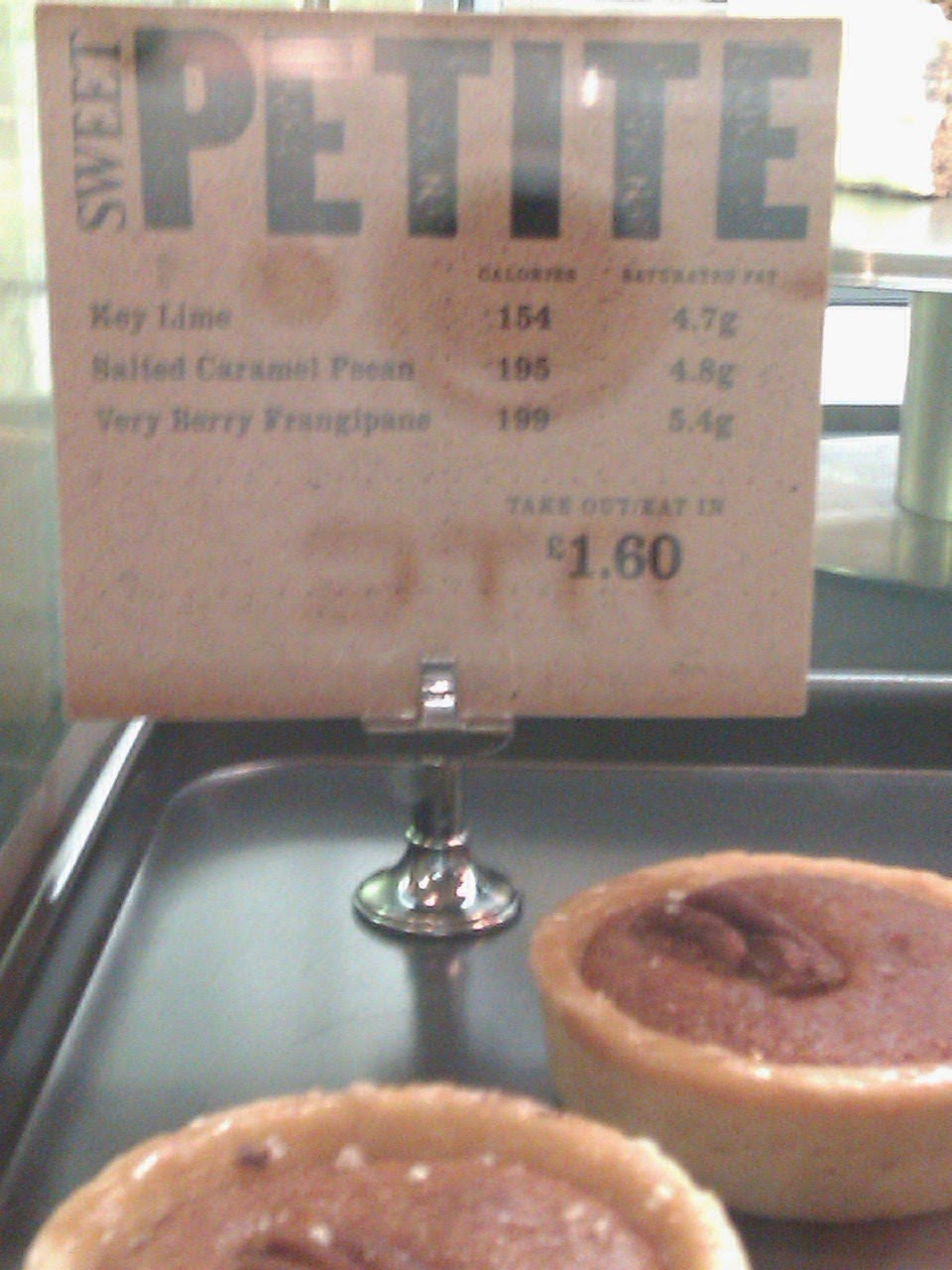
From Jean Adams: Research suggests that calorie labelling works to decrease intake in some people, some of the time. When I found out how many calories were in coffee shop cakes, I was slightly horrified and stopped buying them. It's also been suggested that forcing food companies to come clean on food content may encourage reformulation. So I was interested to see these 'petite' treats at Birmingham New Street, with a slightly more appropriate number of calories for a snack. Would love to know effect of these on choice and consumption.

------------------
A reminder from the Fuse blog group:

Each Thursday of 2014 we’ll try and post around four pictures on the Fuse blog that capture our weeks in public health research, from the awe-inspiring to the everyday and mundane. Given that more of the latter than the former exists in most of our lives, we foresee problems compiling 208 images worth posting on our own. So this is going to have to be a group project. Send an image (or images) with a sentence or two describing what aspect of your week in public health research they sum up and we’ll post them as soon as we can. You don’t have to send four together – we can mix and match images from different people in the same week.

Normal rules apply: images you made yourself are best; if you use someone else’s image please check you’re allowed to first; if anyone’s identifiable in an image, make sure they’re happy for it to be posted; nothing rude; nothing that breaks research confidentiality etc.

Email your posts to m.welford@tees.ac.uk or contact any member of the Fuse blog group.


Tuesday, 22 April 2014

Introducing Fuse duck: coming to a university near you to save Albert Park’s pond

Posted by Avril Rhodes and Peter van der Graaf

Remember when there was a brief outbreak of blog posts on knitting? Remember branded goods and the debut of the Fuse gloves? The gloves flopped spectacularly, strangely no one wanted them, at all. I have the world’s only pair. That was not terribly good news as I still had a wool mountain at home and a one pair of Fuse gloves didn’t make so much as a small dent in the mountain.

Undeterred and still working my way through the mountain, three years on, the latest product is the Easter Fuse duck. Easter Fuse duck is inspired by the brave ducks of Albert Park, who live just across the road from AskFuse HQ, Parkside, Teesside University.  These outstanding ducks co-exist with a number of environmental challenges. These include, without any trace of exaggeration, fishermen with their trailing lines (and a nice line in swearing), large quantities of unsuitable food thrown at them by passers-by, rubbish of all kinds floating around (humans are behind this too), unruly groups on outsize fowl shaped pedalos, and noise pollution from many sources including a café, play park, a roller skating track, and seasonally, a full size funfair. Otherwise it’s a rural idyll.

Albert Park duck pond, Middlesbrough
It’s a tribute to the persistence of nature that despite everything so-called sophisticated humans do to disrupt duck life they continue, and even flourish. Pollution might be one thing somewhat out of our hands (although  not entirely), but why do we keep dropping litter, paying others to tidy it all up, and making it difficult for wildlife? It’s such a commonplace public health hazard (especially in urban areas) spoiling everyone’s enjoyment and consuming resources in the clean-up.

Fuse duck decided it was high tide (boom-tish!) for action; luckily, Fuse duck recognises the value of collaboration wearing the life-belt featuring our combined University colours. He is appealing to all Fuse researchers for help in finding a new home for him after all the public health dangers he faced and to learn more about how to combat these dangers for his fellow feathery friends in Albert Park. With all the expertise in Fuse on tangled-up fishing lines (complex systems), unruly groups (behaviour change), healthy eating in the face of austerity (health inequalities), play parks and roller skating tracks (early life and adolescence), hearing aids (healthy ageing) and knowledge of duck language (translational research), Fuse duck is keen to meet the researchers that can save his pond!

Fuse duck hard at work
So our environmental warrior would like to go on a road trip to visit all the Fuse Universities and public health researchers within them: to sit in on their fascinating meetings, experience their randomised controlled trials (RCTs) first hand, join their physical activities, share coffee mornings and indulge in the latest evidence review with long and incomprehensible titles. If you would like Fuse duck to visit you for a week, please let us know and he could be winging his way in your direction. All we ask is that you let us know how he is getting on in your public health wonderland by writing about his adventures and posting photos on the blog.

After his tour de force, Fuse duck has plans to fly further afield to see our friends in practice and policy land, so watch this space!

Can you give Fuse duck a good home?  If so then email Avril Rhodes on Avril.Rhodes@tees.ac.uk

Tuesday, 25 February 2014

A blow for translational research – you eat what you (l)earn

Posted by Avril Rhodes and Mark Welford

Congratulations to CEDAR for making the National Diet and Nutrition Survey interesting and fully translated for ordinary people (muggles) like us. Take a look at the February CEDAR bulletin and the infographic illustrating what people eat proportionately more of by income and education, and we guarantee happy hours of wondering who fits into each box, whether the dietary stereotypes you held are correct or not, and dreaming up the ideal meal (culturally) for each sub-group. This is a wonderful case of the picture holding your attention so much more effectively than a written report would do on the same subject, and yet, the picture itself bringing together all kinds of data in one place. A challenge to academics – this is intellectually respectable enough for CEDAR, so what of your Fuse work would lend itself to the same treatment?

Food, income and education: who eats more of what? Foods appear only if they are consumed in quantities significantly greater than that of the UK population as a whole. 
And then you get to the fun part…..

• Fetch my gun, Jeeves. Clearly with all those game birds and smoothies being downed by the high income high education group there must be a new marketing opportunity for pheasant smoothies. Heston, move over!

• And what about the high income, medium education group, tucking into a hazelnut coated prawn or maybe fish rolled in sesame seeds? The boat certainly came in there.

• Having dinner with a professional footballer or Lord Alan Sugar? For the high income, lower education group save all your energies in the menu planning for the pudding – I’d recommend the most wine drenched trifle recipe you can find, or if it’s Christmas a boozy Christmas pudding would be just right.

• The middle of the chart – middle income and mid-range level of education are a real puzzle – average apparently for so much apart from the consumption of spirits and liqueurs, can anyone explain that?

• More tea vicar? The clergy must be in the low paid high educated square given the consumption of buns, cakes and pastries there, the staples of pastoral visits.

• And the Great British aversion to salad looks right.

And the more serious part…..

Some of our pre-conceived ideas are all too obviously supported from looking at the diagrams about consumption of processed meat products on lower incomes, and a greater variety and higher quality foods at the higher income end. As if we needed it another illustration of inequality in diet income related as much as anything else. Bring on the affordable healthy meal!
CEDAR has demonstrated that research findings don’t have to be hidden away in academic journals gathering dust. Research can be communicated in an interesting, engaging, innovative and exciting way. Along with the traditional methods of dissemination through papers, the media, research briefs, case studies, posters and presentations; how about making an impact using animation, podcasts, comics or even comedy?

Thursday, 19 September 2013

When is a sermon a knowledge translation message?

Posted by Avril Rhodes

I used to think I moved in two different worlds, especially on Sunday mornings, at that wobbly moment contemplating my sermon one final time before delivery, in the relative privacy of the vestry. Straightening my surplice (from J Wippell & Co who, by coincidence, make clerical and academic robes for some Universities) – and nothing could seem further from Fuse-land. 

Is it all preaching to the converted? 
Not so. Sermons get written, re-written, researched, laced with contemporary references and re-checked, and then they get delivered to the converted. Seminars get written, re-written, researched, laced with contemporary references and re-checked, and then they get delivered to those who know the topic already. Churches are probably the last place to find the non-Christian enquirer. Seminar rooms are probably the last place to find the non-academic enquirer. And yet we still invest time and effort in both, for good reasons of feeding our minds, and indeed souls. But it’s not outreach and we know it in both cases. 

So, we work on ‘church in the local’ (hiring a room in the pub to have a good open debate without the theological jargon) or Café Fuse (a very similar idea coming soon). We aim to join lots of local community groups (in the parish), or gain entry to meetings of key decision makers (in local government) to persuade those gracious enough to receive us on the other side of the table that it is worth asking Fuse. In both worlds we look hard for opportunities to exhibit and present ourselves, in one case a stand at the wedding fair, and in another a stall at a health conference. 

We do all of this because a direct conversation outside our usual environment beats the institution, a joint project trumps a single track approach, and, above all, we’re both in the field of behaviour change at population level with a long time horizon, as Jesus said in the now lost Gospel of St John (Snow). Medieval buildings with stained glass windows that people last visited years ago (I refer to the older University as well as ecclesiastical buildings) are not necessarily the right place for the message – much as we might preserve them and their crusty occupants as national treasures.

Last Saturday, I went to a conference entitled, “How to share your faith” (led by Bishop John Pritchard, one of those Bishops who writes in a very accessible style, despite being Bishop of Oxford which surely is a job title that’s a passport to academic gatherings) – and it’s given me pause for thought. What would be the equivalent day for knowledge translation and public health? 

Tuesday, 30 July 2013

Understanding how academics work: a summer crash course

Posted by Avril Rhodes

After two years of semi-undercover, ethnographic research, embedded in Teesside University, I can now reveal how academics work, for the benefit of other muggles in the world of public health delivery. I write as a muggle, struggling to hang on to my old identity so that I am welcome in previous haunts, which, is, by the way, what a knowledge broker is – someone who can still look up old friends and get an hour of their time.

The first Muggle family - The Dursleys 
Lesson Number 1 – Academics (or wizards) do not work regular hours – actually they don’t know when the working day starts or finishes.  You come in, as a muggle, after that Bank Holiday weekend, confident of a fresh start, and find your in-box full of messages from people who have blurred work and play.  And then there is a silence, when you’ve frantically caught up with the e-mails.  And then they ambush you again in the evening, in the early morning, and that old weekend trick.

Lesson Number 2 – Wizards prefer Mondays. The more the week goes on, the less likely they are to be found.  They are visible early on in the week and then start to fade away from the workplace, in favour of working at home, at night, whilst travelling, in cafes, anywhere outside the office, until by Friday lunchtime, as a muggle, you know you have the building almost to yourself. If you want to meet a wizard face to face, go for the first part of the week.

Lesson Number 3 – Wizards like casual clothes. Wear a suit, or what you think is standard business dress and you’ll stand out like a sore thumb.  Oxfam chic seems to sum up wizard dress.  But, if you want to maintain your distance, keep that muggle clothing in pristine condition.

Lesson Number 4 – Enjoy your lunch! (Calorie controlled)  Wizards like any excuse to eat lunch – properly and out of the office.  Be prepared at a moment’s notice to go off on these jaunts and don’t be deceived, they are just as likely to want to discuss work as anything else. Spaghetti and qualitative research methods are the same to a wizard.  You will also hear, “How about a coffee while we explore this further?” and before you know it you have cappuccino all over your mouth.

Lesson Number 5 – I thought I liked the written word, but I’d underestimated wizards. Everything, and I mean everything, has to be recorded, analysed, discussed, drafted, reflected upon, circulated and made into a journal article.  The absence of findings is data to a wizard.

Lesson Number 6 – and finally wizards don’t like sitting at desks and have forgotten about landlines.  As you’ll have gathered they are happiest working anywhere else apart from in the office, especially if it involves going to a conference and using mobile devices.  Want a wizard?  Ring them on their mobile and don’t flinch when they say they are in Canada.  

Tuesday, 9 July 2013

What’s wrong with “Policy and Practice Partners”?

Posted by Avril Rhodes

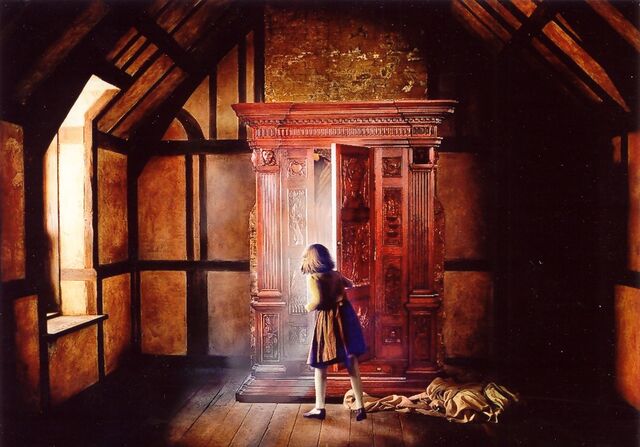
Before entering the wardrobe and coming out in Fuse-land, I had never heard the term “policy and practice partners”, but once the door closed behind me, I never stopped hearing it, and being shortened to PPPs as well, which foxed me for a while. You may think terminology doesn’t matter, but it really does. Stay with me and I’ll tell you why it’s important. 

Entering the wardrobe to Fuse-land
As touched upon by my colleague Mark Welford in a previous post, our partners in public health do not identify with this term and at worse feel alienated from or puzzled by it. Public health managers, specialists and consultants I’ve known rarely promulgate or formulate policy – they implement it, may be consulted about policy, influence policy or advise about it, may author and coordinate a local strategy to reflect it, but don’t actually make policy. Policy is made by government departments, and to some degree, Boards and high level Council meetings. I’ve sometimes heard the phrase “our partners working in policy roles…” and that’s rarely strictly true, as it seems to be said implying that these ‘partners’ somehow make policy. More likely they’re trying to manage the consequences of policy.

When partners hear the word practice, they think of primary care, and people like your family doctor and the clinical staff working with him/her spring to mind. Using the term practitioners makes this worse, as this refers not only to people directly providing patient or client care in the GP surgery, but also people working in secondary care (hospitals to you and I), specialist units and community services. I blush to remember one occasion when a former colleague of mine who continues to support Fuse and works in data intelligence said to me “But I’m not a practitioner – I don’t see patients”, on hearing the phrase used in his presence.

Our partners are not likely to feel that they are partners unless they are directly involved in one of the many Fuse or Fuse related research projects. A partner is someone who you have a direct relationship with, for example, via a contract, or a formal statutory obligation to collaborate. We run the risk of overstating the closeness or formality of the relationship by using the word partner, and appearing presumptuous.

As I’ve been wandering around the Fuse-forest, I’ve been almost constantly thinking about alternatives and also trying to recall what phrase I would have used, before I stepped into the wardrobe and the truth is I can’t remember – and maybe there wasn’t the language to describe it. One day a light bulb did flicker briefly, and I thought about ‘stakeholders’ as an alternative perhaps with qualifying adjectives, like, “external” or “public health and social services…” or whichever sector or grouping one wished to highlight.

I fret that we’ve got too used to this PPP thing to change our ways, but I would put in a plea that we come up with something that’s more acceptable, and, at the least avoid using it when we are in our valued stakeholder’s company.

Any ideas?

Tuesday, 23 April 2013

An Iron Fist in a Velvet Glove

Posted by Avril Rhodes

Many is the time in Fuse-land when we think and dream of little else but Fuse branded goods. I know what you’re thinking of, the inevitable parade of pens, pencils, post-it notes, folders, mouse-mats, highlighter pens and so on. I also know that you’ve got a stash of these at home when you’ve filled those plastic bags at conferences, and that sometimes you’ll look wistfully at a pen as you think, “What is that logo?” “What does that stand for?” perhaps ten years after the critical event. There are masses of these things in the Rhodes household – and most of the pens don’t work all that well!

Fuse-land has had its thinking cap on though with an eye to more imaginative branded items and yes, we’ve come up with the ultimate Fuse branded item. Superlative claims just don’t do it justice…..it….

  • Can be used uniquely to celebrate, and indeed, publicise “Fuse at Five” 
  • Is a fashion item of note 
  • Will keep you warm in the coldest of winters (and recent summers) 
  • Makes a useful gift for your gran 
  • Is cheap to produce…mmm… sorry I mean economic 
  • Will coordinate with any wardrobe 
  • Fits in with the latest trend for “yarn bombing” – this is really current 
  • Will appeal to all those crafty academics out there 
  • Might be the beginning of a new career if the research grants just dry up 
  • And will be the envy of all the other UKCRC Centres 
And what is this unique item? It is the Fuse gloves – each digit crafted in a Fuse colour following the order of the Fuse swirl – from the outside to the centre and from the centre to the outside; for reasons of egalitarianism. Dead easy for all you knitting folk – just get a standard glove pattern, a selection of wools, and away you go! And much cheaper than buying the Fuse Communications Officer a black sports car with a fuse logo on the driver’s door. Perish the thought!

Fuse gloves - designed, knitted & modelled by Avril, photo by Mark
So, of course this begs a question – what else could we make, and quickly? The Fuse scarf – a bit dull but could be done. The Fuse beanie hat – possibly only to be seen on a mountain top, which might defeat the object of spreading the word, but you have to admit, tempting to work the motif in the round. The Fuse tea cosy – maybe? Egg cosies for all the family? A laptop woolly cover or carrying case? A mobile phone sock?      

Having made Fuse proto-gloves, I now need further inspiration – what’s next? As I know the Fuse gloves will be such an attractive fashion item, I’m prepared, selflessly, to offer them as a prize to anyone who can come up with the best suggestion for an “alternative” branded good! I look forward to receiving your suggestions…now where are my needles?

Tuesday, 11 December 2012

Oh, you’ve been playing in the Sandpit again?

Posted by Avril Rhodes

When you mention to colleagues or to your nearest and dearest that you’ve spent your working day going around country hotels trying to find the best venue for the Fuse Sandpit residential training event some really sceptical looks are forthcoming. They don’t say it, but each is thinking “What a waste of time – hasn’t she anything better to do?” But, honestly, it really is hard work.

When M’Lord was building his country seat, he thought about creating spectacular grounds, rooms for an army of servants, stable blocks, fine dining rooms and a grand entrance. Strangely, he did not think about the post-aristocratic world of conferencing, or even imagine electricity and internet access. Consequently, whilst ambience, embossed wallpaper, log fires, wonderful views, and curtains that could be turned into seven man (sorry, person) tents are there in abundance, they do not necessarily make for suitable workshop or break out rooms. Country house eccentricity, whilst good for life-size Cluedo (was it Professor Plum in the drawing room with the digital projector or Research Assistant Scarlett in the library with the flip chart?), doesn’t always readily adapt to one’s conference needs.

The final decision: Linden Hall
Some of the country hotels adapted for conference purposes seem to have lost their individuality. The brochure might show a glorious Adam frontage or Palladian columns, but your event mysteriously turns out to be in a windowless, purpose-built block with polystyrene roof tiles, refreshment points (read rubbish coffee machines) or in a wing that separates you from other patrons as if you were somehow infectious.

Never mind, these monstrosities shouldered aside, we have a lovely venue which oozes individuality and charm. Now to envision our use of the space… Yes - the lounge makes a good plenary room, until you realise the public are going to troop through to the dining room. Yes – the library makes a good workshop, until you realise that it only has one socket. Yes – the so-and-so suite would be good until you realise that it’s the wrong shape or size, or might be cold, or doesn’t have enough clear wall space, or is miles away from the other workshop rooms. Debates break out like, “Well, if we use room A for B and space D for C, then we could use room E for G and that will still leave the informal seating area F untouched”, only for someone else to undermine everything you’ve said.

In the end if we’re going to invest properly in the Sandpit style of training, it is worth the effort to get things as right as possible, even if that involves some of us sinking, once again, into the period sofas, or forcing ourselves into yet another lunch in the conservatory. Get the venue right - then the creative juices will flow. The incisive ideas for responding to real problems out there in public health will come, and, everyone will be guaranteed a fun experience that truly beats your average university seminar room and is memorable for years to come!

Ahh… I think it’s time for afternoon tea. Earl Grey, Professor?

Tuesday, 8 May 2012

Another good yarn

Posted by Avril Rhodes

What a relief! After fretting that I would never be able to contribute to the Fuse blog (I mean what research have I ever done?) but feeling vaguely under pressure to produce something, along comes “Knitty Problems” focussing on knitting and meetings, two things that I definitely have a PhD in by virtue of longevity.

Until I joined Fuse I thought I was a member of an almost extinct breed, knitters, which would go down the evolutionary cul-de-sac of many a humanoid predecessor, known only for leaving strange artefacts behind (like circular needles) which archaeologists of the next millennium would think were instruments of torture. 

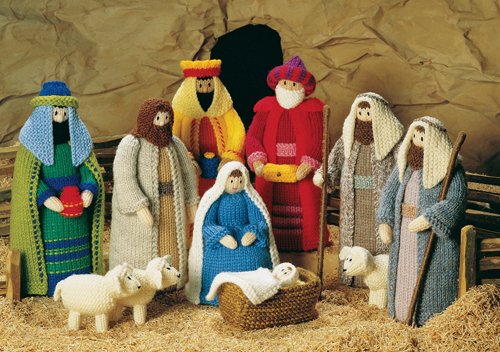
Believe you me there were no knitters in my old job(s) in the NHS – the last refuge for knitters was older ladies making action man clothing for premature baby units. No-one respectable knitted and certainly not if you had a real job. I kept my secret well hidden for years. In fact when I once lapsed and admitted to having knitted a Christmas crib, a colleague I still manage to call a friend was paralyzed with laughter at the thought of the knitted baby Jesus. What’s funny said I? Haven’t you done the diversity course?

Natty knitted nativity
However after decades I can now come out, because Fuse, and Parkside in particular, is full of academic knitters. My first inkling of this was when someone I didn’t know too well, asked me if I knew a good wool shop in Middlesbrough. These knitters knit in front of TV, on public transport, they even have to remove balls of wool to retrieve mobile phones, and they are happy to discuss patterns and stockists without batting an eyelid. 

But would they knit in meetings??? I’m not sure. I have seen people knitting before a carol service (well actually one person on one occasion) but knitting doesn’t seem to chime with the need to appear fully professionally engaged, or in the case of a carol service respectfully attentive. I personally harbour a desire to knit in conferences and seminars (following the rules, of course as I’d just get frustrated if I got stuck in the middle of a pattern) not because I’m not listening, but to do three things - to take up the spare brain power not focusing on the subject being spoken of, secondly, knitting really helps you not to go to sleep at the wrong times, and, thirdly, it ensures you don’t reach for the sweets or biscuits that still creep in when the public health police are engaged elsewhere. I challenge the reader which is worse – the gentle rhythmical clicking of needles, the embarrassment of snoring in the post-lunch presentation or someone trying to eat a hard biscuit noiselessly? The latter two are insufferable and will do much more reputational damage than being able to show off your latest scarf in the real break time as you virtuously sip water.

So, thank you Jean for helping me join the open-science blog!