Showing posts with label leadership. Show all posts

Friday, 17 March 2023

What can be done to improve the mental health of LGBTQ+ young people in schools?

By Liam Spencer, Research Assistant and ARC NENC Mental Health Research Fellow, Fuse & NIHR School for Public Health Research, Newcastle University

Young people who identify as lesbian, gay, bisexual, transgender, or queer/questioning (LGBTQ+) experience significant mental health inequalities in comparison with their peers. School environment is a major risk factor and is consistently associated with negative mental health for LGBTQ+ young people, as shown in research herehere and here. The UN Convention for the Rights of Child Committee has also specifically emphasised the need to take effective action to protect LGBTQ+ young people from all forms of violence, discrimination or bullying, and to improve mental health.

Our research

Our Creating LGBTQ+ Affirming School Environments (CLASS) research project aimed to investigate the impact of school-based interventions (schemes or initiatives) on the mental health of LGBTQ+ young people. In the first stage of our study, we reviewed published evidence, and identified positive interventions that supported LGBTQ+ mental health in school, however the focus tended to be on the outcomes rather than detailing how they were done.

We also interviewed 10 young people aged between 13 and 18 years, nine practitioners (e.g. people working in organisations who had delivered LGBTQ+ inclusivity interventions in UK schools), and three members of school staff, and analysed the data to identify interventions that improved mental health. We used this information to develop a theory model that aimed to explain how, why, for who, and in what context school-based interventions can prevent or reduce mental health problems in LGBTQ+ young people, in collaboration with these key stakeholders.
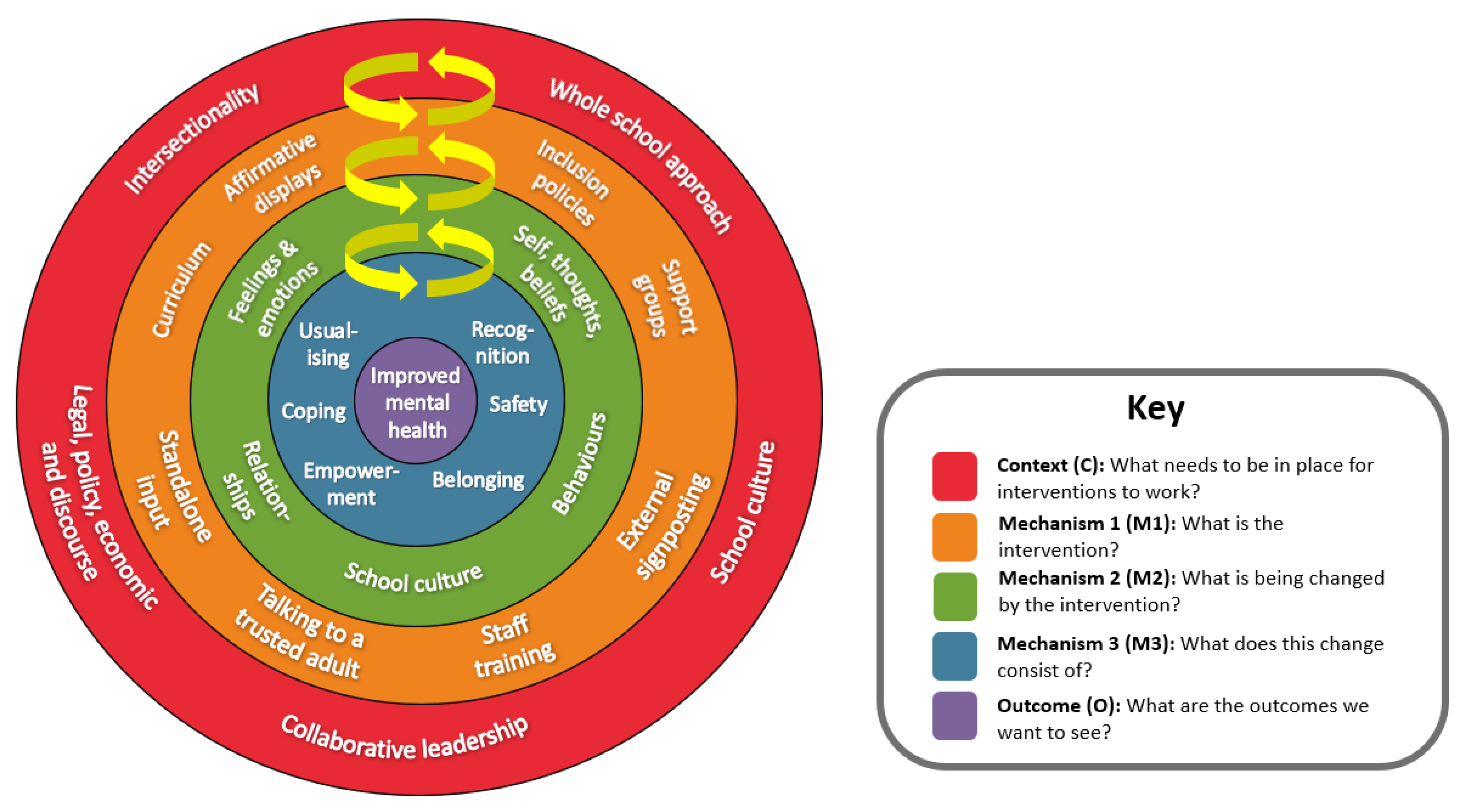
McDermott, E. et al. Understanding How School-Based Interventions Can Tackle LGBTQ+ Youth Mental Health Inequality:
A Realist Approach. Int. J. Environ. Res. Public Health 2023, 20, 4274. https://doi.org/10.3390/ijerph20054274

Our model (diagram above) has three levels at which interventions may work, on psychological, behavioural, emotional, cultural, and social levels. It explains how school-based interventions that directly tackle dominant cisgender and heterosexual norms can improve LGBTQ+ pupils’ mental health. 

Our findings

We found that contextual factors such as a ‘whole-school approach’ and ‘collaborative leadership’ were crucial to the delivery of successful interventions. Our theory suggests three ways (causal pathways) that might improve mental health:
  1. Interventions that promote LGBTQ+ visibility and ‘usualise’ the presence of LGBTQ+ identities, school belonging, and recognition.
  2. Interventions for talking and support that develop safety and coping.
  3. Interventions that address institutional school culture (staff training and inclusion polices) that foster school belonging, empowerment, recognition, and safety.
Our findings suggest that providing a school environment that affirms and ‘usualises’ LGBTQ+ identities, and that promotes school safety and belonging can improve mental health outcomes for LGBTQ+ pupils. The causal pathways we present are a starting point as theories, however more research to develop our understanding of how school interventions work to improve school climate and the mental health of LGBTQ+ young people is needed. We now need the UK, and other countries, to take seriously LGBTQ+ young people’s rights and ensure they are afforded equal respect and protection as their peers in schools. We may then find that the mental health of LGBTQ+ young people improves.

Read the full research paper here: Understanding How School-Based Interventions Can Tackle LGBTQ+ Youth Mental Health Inequality: A Realist Approach, 28/02/23

Funded as part of the NIHR School for Public Health Research (SPHR) Public Mental Health programme, the Creating LGBTQ+ Affirming School Environments (CLASS) research project, led by Professor Liz McDermott, aimed to investigate the mental health impact on LGBTQ+ young people of school-based interventions. Fuse is a founding member of the NIHR SPHR.


Friday, 29 July 2022

Part-time work can be a game changer for families and a smart strategy for organisations

Posted by Belinda Morgan, flexible work expert & author; Amelia Lake and Helen Moore, researchers from Fuse at Teesside University

Part-time work has the potential to change lives. Done well, it can drive hugely positive outcomes for individuals, families and society. But its potential isn’t widely understood, so part-time work still sits largely on the sidelines of organisational strategy – under-rated and under-utilised.

And even organisations who are leading the way with the accessibility and implementation of part-time work, are rarely doing it well at all levels. It’s still very uncommon to see senior leaders working part-time.

Amelia Lake, Fuse Associate Director, and Helen Moore, Fuse Associate, at Teesside University are bucking this trend. Both work in senior level roles in public health research, leading teams and both work part-time.

Amelia and Helen were two of the senior leaders I interviewed when writing my book Solving the Part-Time Puzzle: How to decrease your hours, increase your impact, and thrive in your part-time role. They shared their stories about how they make their part-time arrangements work, and the benefits they experience from working in this way.

Helen Moore (left) and Amelia Lake (right) both work part-time in public health research
Amelia said, “When I first started working at Teesside University, I would frequently get asked what was my ‘side hustle’ when I wasn’t at work and people were surprised to hear that I was doing family activities with my (then) young children. While I appreciate working part-time is a privilege, it allows me a better work-life balance and time with my children.

“During the pandemic, and post-pandemic, childcare has been difficult to access, and being part-time means some days of the week can be less stressful in terms of childcare. Working part-time means I work even more collaboratively with colleagues as their support when I am not at work is important. It can be hard to switch off emails and alerts on non-working days, and I don’t always do it, but I know it is important.”

Helen said, “It was, and is, important for me, as the primary carer of young children (I have two sets of twins) with a husband who works away in the Merchant Navy, to be able to have some flexibility around when and how I work. This supports me in being able to take them to, and pick them up from, school several days of the week, and to not have to rely all of the time on either family help (which can feel like an imposition) or paid childcare (which is both expensive and difficult to find when you have four children).”

So why is it so rare to see senior leaders working part-time? Largely because there’s an embedded belief that senior leadership roles are the most challenging to do part-time. Many people will tell you it’s impossible – and that it’s not even worth attempting.

Stories of leaders like Amelia and Helen are hugely important, because we badly need more senior leaders leading the way and working part-time. When senior leaders do so it demonstrates to others that part-time work is acceptable and encouraged, and that it’s possible to keep growing a career while working part-time.

The individual and family wellbeing benefits are quite clear, and should be reason enough for organisations to start creating more part-time work opportunities. But the reality is that more encouragement may be required.

The good news is that there are some other big reasons for organisations to get on board with this.

A clear and highly relevant advantage for employers is talent attraction and retention. In the context of the ‘great resignation’ of 2022 this is a critical consideration for organisations looking to find creative ways to solve the talent shortage.

Firstly, it allows employers to retain their talented people who reach a point where they want or need to work part-time.

In Amelia’s words, “We need to see more people in leadership roles working part-time. I was promoted to Professor in my part-time working pattern which illustrates that it is possible to do high quality impactful work building capacity and also doing research, while working part-time. Teesside University has both promoted me and supported me in my part-time role.”

It also enables employers to tap into a hidden talent pool of highly qualified people who either can’t or choose not to work full-time. They include people with caring responsibilities, people with health issues, and people at retirement age who would stay in the workforce longer if given the opportunity to work part-time.

Helen said, “I strongly believe that working part-time doesn’t equate to a reduction in performance, and that it is demonstrated by my promotion to Associate Professor and being one of two Teesside University Star Award Research Excellence finalists in 2021.

“Being supported by Teesside University to work part-time in a senior role enables me to both lead the work of the University’s successful Evaluation and Impact Team, and to be able to be present and care for my four children.

“Having managers who were willing to try something new, even take a risk, and recruit a person to work part-time hours to establish and lead a new team has paid off and worked well – it has enabled me to grow significantly as both a researcher and a research leader.

“Roles similar to mine which I have previously considered, have been strictly full-time hours only, and did not feel open to someone with other commitments like me. There are a lot of talented people who for various reasons would like to work less than full-time hours, and I’m hopeful that my experience shows it is possible.”

This is also, of course, about inclusion. The consulting firm Timewise warns that if a company’s diversity, equity and inclusion (DEI) programmes aren’t underpinned by a commitment to flexible working that includes part-time, they will struggle to be fully inclusive. 'This will not only have a negative impact on their gender pay gap, but is also likely to impact their employer brand'

As well as the talent related benefits, there are also productivity benefits to be reaped by organisations who are willing to introduce more part-time roles. Organisation for Economic Co-operation and Development (OECD) data confirms that productivity (defined as output per working hour) improves with shorter hours. Across the world’s richest countries, higher productivity correlates with lower working hours.

The power and potential of part-time work really is huge. It can be a game changer for families and a smart people strategy for organisations.


Friday, 22 May 2020

Covid-19 and the legacy of Edward Jenner: a tale of two pathogens

Posted by Lesley Haley, AskFuse Research Associate, Teesside University 

2020 is going to be a momentous year in world history as the year that the Covid-19 pandemic changed all our lives.

Edward Jenner, English physician who discovered the smallpox vaccine
Coincidentally, this year also marks the 40th anniversary of a significant historic milestone for another deadly disease, but in this case, one which maimed, killed and shaped global history for the past three thousand years (Flight 2011). That disease was smallpox.

On the surface, there is nothing in common between a dead disease and a newly emerging one. But there are some aspects of the history of smallpox that resonate with the unfolding story of the Covid-19 pandemic.

Smallpox was still a killer when I was vaccinated against it in 1967 as part of a routine public health intervention, although it was no longer endemic in the UK. For my mother’s generation, the reality of smallpox was very stark. She experienced the panic of an outbreak in her home town of Glasgow during the war when she was only 10, and again when she was 16, when smallpox killed front-line staff treating infected patients at the local hospital.

Although in 1967 outbreaks in the UK of smallpox were getting rarer, the worldwide picture was very different. Smallpox was still endemic in many countries, maiming and killing an estimated 10-15 million people a year (Baxby 1999). This was despite the fact that Edward Jenner had first introduced a prototype inoculation against smallpox in 1798, had translated his theories and ideas into practice, and had a huge impact during his lifetime (the academic dream!).

One aspect of Jenner’s life and work bears closer scrutiny in light of the current Covid-19 pandemic, and particularly on the emerging debate surrounding the development of a new vaccine. During his lifetime, Jenner made his research, his ideas and his smallpox inoculations freely available to everyone, irrespective of who they were (Baxby 1999). Jenner and his contemporaries appreciated the commercial opportunities of his discovery, but he continued to give free inoculations to everyone who approached him at his surgery, despite the detrimental financial impact this had on his personal and professional life (Britannica 2020). He understood exactly what the implications of his discovery meant for the common good.

So if Jenner’s work was freely available, (and although certainly not perfect), why was smallpox still endemic in some countries in the world in 1967? Millward (2019) proposed that one of the main issues had been the lack of global “joined up thinking” in the approach towards smallpox eradication. It took until 1967 for countries where smallpox was not endemic to realise that they would always be at risk of continual and increasing numbers of smallpox outbreaks, if the disease was still endemic in other parts of the world. Wherever in the world there was smallpox outbreaks, it caused mass panic, strained public health systems to the limit, maimed and killed, and even had economic impacts on national and international trade and travel (Millward 2019). It therefore became in every countries' interest to support a systematic, unified and global approach to smallpox eradication. Under the auspices of the World Health Organisation (WHO), the global strategy of surveillance, containment and vaccination free at the point of delivery and irrespective of ability to pay, worked. In 1980, the WHO declared the world free from smallpox (Baxby 1999) and it became the “first disease to be controlled by immunisation, the first to be eradicated” (Baxby 1999).

So what will historians say about the story of Covid-19? What will be the role of the global community in tackling the Covid-19 pandemic? Will Jenner’s altruistic example of free and accessible vaccinations be consigned to the history books in the 2020 global race to develop a lifesaving Covid-19 vaccine?

On the global front, 4 May 2020 saw world leaders, the UN, research institutions and philanthropic organisations pledge resources to find a vaccine for Covid-19 (albeit with the ominous absence of two major world powers) (BBC 2020). And the race for a vaccine has sparked debates on who, where, and how people would access a Covid-19 vaccine, with speculation for example, that pharmaceutical companies may have to change their business practices (Chu 2020). In the history of smallpox in the UK, vaccine stockpiles were held by private businesses, highlighting “that public health resources were not always in public hands” (Millward 2019, p. 64).

Global businesses have also contributed to an “Open Covid Pledge, “to make intellectual property available free of charge for use in ending Covid-19 pandemic and minimising the impact of the disease” (Open Covid Pledge 2020).

When global powers pulled together for the common good, it took just 13 years to rid the world of a disease that had killed millions across the continents of Africa, America, Australia, Asia and Europe in its 3000 year reign of terror. Prior to that, without global unity and treatment free at the point of delivery, it took 169 years. I wonder what Edward Jenner would have thought?

So as our Covid-19 story unfolds in 2020 and beyond, I wonder how future generations will judge the actions and decisions of our current global leaders and businesses?


References:
  1. Flight, C (2011) Smallpox : Eradicating the scourge. BBC History. Last updated 17 Feb 2011. Available: https://www.bbc.co.uk/history/british/empire_seapower/smallpox_01.shtml Accessed: 05 May 2020.
  2. Baxby, D (1999) The End of Smallpox. History Today Vol 49 Issue 3. Available: https://www.historytoday.com/archive/end-smallpox
  3. Britannica (2020) Edward Jenner. Available: https://www.britannica.com/biography/Edward-Jenner Accessed: 6 May 2020. 
  4. Millward G (2019) “Smallpox” Vaccinating Britain: Mass vaccination and the public since the Second World War, Chapter 2. [Internet]. Manchester (UK): Manchester University Press; 2019. Chapter 2. Available: https://www.ncbi.nlm.nih.gov/books/NBK545998/#!po=98.8688 Accessed: 5 May 2020. 
  5. BBC News (2020) Coronavirus: World Leaders pledge billions for vaccine fight. Available: https://www.bbc.co.uk/news/world-europe-52525387 Accessed: 5 May 2020. 
  6. Chu, B(2020) “To find a vaccine for coronavirus, pharmaceutical companies will have to Adamson the race for profit”. The Independent. Available at: https://www.independent.co.uk/voices/coronavirus-vaccine-uk-pharmaceutical-companies-patent-monopoly-a9467381.html Accessed: 16 April 2020. 
  7. The Open Covid Pledge (2020) Available: https://opencovidpledge.org. Accessed: 5 May 2020. 

Acknowledgements:
  • Mrs Patricia Hoyland (pers comm)
  • BBC Today programme. Thought for the day. David Wilkinson 4 May 2020.

Image: 
  1. Edwar Jenner” by Pan American Health Organization PAHO via Flickr.com, copyright © 2010: https://www.flickr.com/photos/pahowho/9525240640. Attribution-NoDerivs 2.0 Generic (CC BY-ND 2.0)
  2. The logo of Open COVID Pledge project, 27 August 2020. Creative Commons, CC BY-SA 4.0 <https://creativecommons.org/licenses/by-sa/4.0>, via Wikimedia Commons (https://commons.wikimedia.org/wiki/File:Open_Covid_Pledge_Logo.jpg).

Friday, 12 July 2019

Managing difficult conversations at work; ambulances, snow ploughs and submarines

Posted by Peter van der Graaf, AskFuse Research Manager / Fuse Knowledge Exchange Broker, Teesside University

We all face difficult conversations in our work; whether as a PhD student trying to tell a supervisor that they are not very helpful, or as post-doctoral researcher, explaining to your line manager that you really don’t want to take up any more teaching responsibilities. Or even as a practitioner having to point out to an esteemed researcher that their pet project is not relevant at all for your practice.

Like most people, I try to avoid these conversations as much as I can and prefer ‘flight’ rather than ‘fight’. Best to give in and avoid confrontation than have an uncomfortable row that will keep me up at night.

But could confrontations also be useful, and if so, how could you manage them in a way that they benefit you? This was the aim of the Courageous and Compelling Conversations Masterclass I attended in London as part of the NIHR Leadership Development Programme. Before starting the masterclass, I had to complete a self-assessment of my preferred response mode to confrontational conversations, which neatly confirmed my ‘flight’ status and gave me new labels for it: 60% Give In; 20% Run Away; and 20% Compromise.

What the masterclass taught me was that confrontation is not about preparing well for the other’s potential responses; for instance, by endlessly scripting clever and rational dialogues to counteract every accusation that a person could throw at me.

Instead, the course focused on better understanding my own response style in relation to other people. My light bulb moment was the realisation that you can’t control the response of the person you are talking to, but that you can manage yourself on how to respond, and take time to formulate this response during the conversation. Therefore, my nights (more preferably work hours) would be better spent understanding what I want to get out of the confrontation (outcome) and plan my conversations accordingly, instead of worrying what the other person will say and need.

During the course we were split into three groups, according to our preferred Motivation Value Style, with each group given its own emblem in the shape of a transport vehicle. Apparently, I am an ambulance, which is the symbol of the ‘carer’ group, who are motivated by the protection, growth and welfare of others. We prefer to ensure that everyone is happy, relationships are good and don’t want to be a burden to others. As an ambulance, I am responsive to other people’s needs and therefore go into conversations where I am needed (with blue lights if possible!).
In contrast, the ‘driver’ group (snow ploughs) - motivated by task accomplishment and achieving results - prefer to exercise persuasion. The third group, technicians (submarines) are different again in that they are motivated by meaningful order and thinking things through; they want to be practical and fair.

Although, these three styles feel quite stereotypical, I was surprised to see how much each of us on the course was conforming to these styles when explaining their behaviour in difficult conversations. We discovered that we incorporate elements of each style into our conversations but have a natural gravitas to a particular style. Realising your preferred style and working out the preferred style of your conversation partner, proved really helpful.

For example, someone who prefers to be a submarine (technician style), does not respond well to pressure to make an on the spot decision. Forcing them to agree to a solution at the end of the conversation will only escalate the confrontation. Instead, agreeing to give them time to mull the problem over and come back with a response later, will likely result in a much more favourable response and implementable solution.

Under stress, people tend to respond in either of two ways: they become more extreme in their preferred style (dig their heels in) or switch to a different style. What we were encouraged to do during the training course, was to play with different styles and practice switching during a confrontational conversation to a different style that would be more attuned to the person we were speaking to. In that sense, we are better able to manage ourselves and the responses we get from the person we are confronting.

A key part of this switching of styles was being assertive; not shouting over the other or ignoring what they say, but quite the opposite: taking more time to listen to the other and trying to understand what they say and where they are coming from. Are we really hearing what the other person is telling us or are we too busy trying to contain our emotions and constructing our next argument in our heads? Armed with this understanding, you will be better prepared to say what you think and feel, and, most importantly, what you want to happen.

As an ambulance, I need to be patient with submarines and focus on the practical, while being more competitive and assertive with snow ploughs, or team up with submarines to create new opportunities in joint conversation with snow ploughs.


Image:
  1. 'Arguments' by Jeff Eaton via Flickr. Attribution-ShareAlike 2.0 Generic (CC BY-SA 2.0): https://www.flickr.com/photos/jeffeaton/7436909698

Friday, 21 June 2019

Is there life beyond the PhD?

Posted by Priyanka Vasantavada, PhD researcher, School of Health and Social Care, Teesside University

Thomson-PP14
Living my Jane Austen fantasy
Don’t ask me if there is? It’s not afterlife. Or is it? But it is a question every PhD student has wondered about during the ups and downs of their PhD journey (unless you have a permanent job and are doing a part-time PhD). So how do you deal with it when this sort of ‘limited existentialism’ strikes? What do you say when the world around you repeatedly asks, “what next?”.

I just curl up in my bed and binge watch screen adaptations of Jane Austen novels or any good costume drama, science fiction series or even fantasy; for what can be better than some good old escapism? Does it answer the question? No! Does it help me forget it? Yes!

So last summer when I received an email from the Graduate Research School of my university regarding a Life Beyond PhD conference being held at Cumberland Lodge, Windsor; I jumped with excitement. I knew I wanted to go for it the moment I saw the pictures of the Lodge. Not unlike Pride and Prejudice protagonist Ms Elizabeth Bennet who started seeing Mr Darcy in a favourable light after visiting Pemberley. Don’t get me, or Ms Bennet, wrong for we both saw the merit in the conference and Mr Darcy respectively, but their residences certainly recommended them.

Cumberland Lodge, Winsor Great Park
Here was an opportunity blending my fantasy and reality - a four night residential conference with hospitality in the actual former residence of a real-life princess…. hello Disney! What more could I have asked for? (*cough*… Cumberland Lodge Scholarship …*cough*). The conference programme was designed to highlight the value of PhDs (both within academia and industry) and it also promised opportunities for sharing research and career aspirations, exploring collaborative and interdisciplinary ways of working, and presenting to a diverse, non-expert audience.


My supervisor considered it to be a good opportunity for me; owing to the nature of my PhD which marginally borders on public engagement in research and public health. She was kind enough to recommend me to the school for sponsorship and I daydreamed my way to the Windsor great park on a balmy summer afternoon.

Conference delegates
All the delegates were welcomed and given a tour of the historical building by the education officer of the lodge. The tour was followed by a session on research culture in the UK topped with a drinks reception. A delicious dinner was served shortly thereafter, and the delegates had fun in the group games session which included a pop quiz, table tennis, and snooker. I don’t think I ever made so many friends in such a short period of time!

The second day centred around PhD researcher development with sessions on self-leadership, speaking and writing techniques, and wellbeing and mental health. Unsurprisingly the session on mental wellbeing: research-based thoughts, issues and toolkit commanded most delegate participation, as the mental health of a PhD researcher is almost always never considered in academia. The conference drew delegates from disciplines across science, art and literature and yet everyone identified with mental health issues in PhD life!

Me and fellow Teesside University
PhD researcher David Oluwadere
On the third day, delegates were divided into four groups and were given the opportunity to present their project to their group mates who were of a different subject background. Every delegate received feedback from their peers on their overall presentation skills and comprehension of content. My colleague David Oluwadere, studying Environmental Sciences at Teesside University, presented on agronomic biofortification technique as a means of increasing zinc concentration and bioavailability in wheat using seaweed. I presented my project on the public perception of community water fluoridation in the UK. The presentations were followed by sessions by PhD graduates on their life after PhD and on public engagement in research.

The fourth day focussed on interdisciplinary research and working in designated groups we were challenged to address a problem by developing interdisciplinary research proposals within the day. These proposals were pitched to a panel of judges in order to seek funding. This was an exercise in developing our collaborative skills and emphasised the importance of interdisciplinary approaches to problem solving. It also demonstrated how a problem is viewed differently by people from various disciplines. Humble brag, but the team I was part of, won the proposal contest and were gifted a box of chocolates.
Winners of the interdisciplinary research proposal contest 


The conference closed with a session on, “Why is a PhD worth it?”. In addition to the conference presentations which were highly informative and relevant, I will always remember the experience for living in a historic aristocratic building, ‘taking a turn’ about the Windsor great park (channelling heroines of Jane Austen and Charlotte Bronte), the late night banter with friends in the sitting rooms of the lodge, playing games and striking the keys of an out of tune piano in the basement in evenings, and being served dinner in a fashion reminiscent of Downton Abbey.

If you feel that this is something for you (fantasising is optional), visit the the Cumberland Lodge website to find out more.

Getting a job after PhD is subject to availability and visa status, but life beyond PhD is open to endless possibilities. So, I believe that instead of speculating about the future, we should try to live in the moment and savour the #phdlife while it lasts!

Images:

Friday, 27 April 2018

Responsibility for addressing obesity in local authorities: a changing landscape?

Posted by Dr Amelia Lake, Fuse Associate Director, Reader in Public Health Nutrition at Teesside University and Tim Townshend, Professor of Urban Design for Health at Newcastle University 

Planning and obesity has been in the news again – it’s a topic that is hotly debated in local authorities across the country.

In April 2013 public health came ‘home’ to local government. This coming home meant a shift from the NHS to closer collaborations with other local authority colleagues. We wondered what it meant in reality, how did local authority staff from two disciplines - public health and planning - see their role around obesity prevention in this changed landscape? Our research [1], conducted between November 2013 and March 2014) explored the views of individuals working in public health and those working in planning within local governments on their responsibilities for addressing obesity using spatial planning.


We know that planning policy can impact on people’s wellbeing and health in terms of access to food and the environment encouraging physical activity. Using planning policy to tackle health problems such as obesity may not be novel but it could help tackle a global problem.

Our research was based in North East England. We interviewed three Directors of Public Health, one Deputy Director and four planners with a range of seniority.

There were some clear differences in their approaches to the issue of responsibility. Planners were asked about responsibility for obesity, physical activity and community nutrition. They saw a clearer link between planning and physical activity than with community nutrition, primarily citing sustainable transport, path provision and recreation, though one identified takeaways. One planner said, “At the end of the day, it’s down to the individual to address their obesity (Planner 4)”.

These differences in views on responsibility for health would suggest a difference of understanding amongst some within local government about the complex causes of obesity and how to address inequalities. However, one planner did point out that it is health professionals’ responsibility to “make the link” between planning and health, “because I don’t think people from planning would start from a health improvement stance”. This has implications for leadership and leadership roles.

Overall, our interviews identified a range of barriers to engaging with planners, including an insufficient understanding of the causes of obesity and the importance of addressing obesity via multi-agency approaches (involving cooperation between several organisations), fragmentation in the health system and conflicting priorities. Planners could be better engaged in the obesity agenda via formal incentives (e.g. written within planners’ job descriptions or regulations), and aligning priorities via ‘soft approaches’ (e.g. public health leadership roles).

There have been attempts to reunite health with planning. International evidence has highlighted the transdisciplinary (involving investigators from different disciplines) effort required to tackle obesity due to its multifactorial nature (it has, or stems from, a number of different causes or influences) and underpinning health inequalities. However, there appears to be little evidence that English planners have engaged with the new public health agenda. No detailed investigation has attempted to fully understand the barriers to engaging planners in health issues.

Gateshead City Council’s award winning
Supplementary Planning Document
Despite our region having national recognition for planning policies (see Gateshead City Council’s award winning Supplementary Planning Document), there are clearly some issues around increasing responsibility within the area of planning and health. However, this is a rapidly developing field. A recent survey of authorities in North East England, showed that all, bar one authority, now has, or is in the process of developing, guidance to prevent the proliferation of hot food takeaways (with some policy already being tested at appeal). Furthermore, a chance for planners and public health officers to meet to discuss the issue at a Fuse event on 21st May 2018 has been greeted with much enthusiasm. This suggests attitudes may be changing, particularly with planners engaged with policy development, who appreciate that health may line up with other planning aims such as protecting shopping area vitality. We will report on this soon.


The event on planning for health will be held on May 21st in Newcastle.  To register or find out more visit the event page on the Fuse website.

Reference:

Tuesday, 4 July 2017

What does a hung parliament hold for the future of Public Health?

Posted by Fuse Senior Investigator David J Hunter, Professor of Health Policy and Management & Director, Centre for Public Policy and Health, Durham University

The June general election threw a lot of things up in the air but resolved little. We are living in a suspended state awaiting resolution of what is clearly an unstable political landscape and a government hobbled by its own tensions and contradictions. Uppermost among these is of course Brexit. This will continue to consume all of government as it has already done for much of the past year. No part of government will be left untouched by it. The upshot is that other domestic policy areas are likely to receive minimal attention. This includes public health which rarely features high on the policy agenda.


Earlier in June, the Faculty of Public Health President, John Middleton, in a British Medical Journal editorial urged the next UK government ‘to make health central to all its policies’ (BMJ 2017, 2 June doi:10.1136/bmj.j2676). He concluded that just as local government had adopted a health in all policies approach, ‘national government must now become a public health government’. There seems little chance of that happening in the current febrile political climate.

Of course one can argue the merits of putting health into all policies as distinct from putting all policies into health which might hold more appeal for those who are suspicious of, or are opposed to, health imperialism. But the central point is valid. Most, if not all, of what government does impacts on the public’s health. Indeed, much of the support for political parties calling for an end to austerity was driven by a perception that the unrelenting assault on the public realm since 2010 was having unacceptably negative consequences for people’s health and wellbeing. It’s a small consolation that what has happened in regard to widening inequalities was predicted by the public health community.

So if we cannot look to national government for public health leadership in the foreseeable future, and that seems a forlorn hope given that the former public health minister lost her seat in the election and her successor is unlikely to make an impact anytime soon, what does the immediate future hold for public health? And where is the action likely to occur?

Having a disabled or incapacitated national government may not be entirely a bad thing if it allows local government and other agencies to go about their business without being subjected to a constant outpouring of policy initiatives and ministerial announcements and directives which invariably offer only distraction.

This suggests a need for the public health community to engage more vigorously than it has done hitherto in driving the 44 Sustainability and Transformation Plans (STPs) in England. Though flawed, deeply so in some cases, and poorly communicated with minimal public engagement, STPs and related developments like Accountable Care Systems (ACSs) offer an opportunity (perhaps the only one for the time being) to put public health centre stage in developing place-based approaches to improving population health.

STPs are underpinned by the Triple Aim (Berwick et al 2008Health Affairs 27(3): 759-69) which comprises: improving population health, focusing on patient-centred care, and achieving more efficient per capita spending. STPs and many of the other health system transformation activities underway, and being actively promoted by NHS England with back-up as appropriate from Public Health England, are aimed at managing demand on health care services.

This is not a new agenda – the Wanless reports from 2002 and 2004 commissioned by the last Labour government eloquently argued the case for making the NHS a health rather than a sickness service – but the drive for a systemic transformation has perhaps never been so evident.

The opportunity to bring about a much needed shift in health policy should not be lost and public health should be at the centre of STPs. They offer the best prospect of taking on the big beasts of the acute hospital jungle and wresting resources from them to put into public health. Yet, as research being carried out by colleagues in the Centre for Public Policy and Health (CPPH) at Durham examining the public health changes introduced in 2013 demonstrates, with few exceptions Directors of Public Health in Local Government and their teams and Health and Wellbeing Boards are failing to provide the system leadership that is urgently needed1,2.

Since New Labour introduced foundation trust status for hospitals, compounded by the Coalition government’s misconceived and unnecessary Health and Social Care Act 2012, the NHS has been bedevilled by fragmentation and an ethos of competition in place of collaboration. STPs and associated reforms including ACSs are an attempt to mitigate the worst features of the various reforms since the turn of the century.

It is vital that STPs succeed and bring about the whole system, place-based approach to health and wellbeing that they promise. But we are some way from reaching that goal and the risks are considerable especially when budget cuts affecting public health make it less likely that the necessary changes can be realised.

However, we must not make too much of the budget cuts invoking them to argue that it demonstrates how misconceived it was to relocate public health to local government. Had public health remained under the NHS, it is almost certain that it would be in an even poorer state than is the case at present. Those who remember the days of PCTs will recall the frequency of raids on public health budgets to offset overspends and prop up hospitals. At least public health under local government control remains visible and there is evidence despite the impact of austerity of authorities making serious efforts to become public health organisations and take health improvement and wellbeing seriously.


References:
  1. Commissioning Public Health Services - Centre for Public Policy and Health (CPPH), Durham University: https://www.dur.ac.uk/public.health/projects/current/cphs/
  2. Evaluating the Leadership Role of Health and Wellbeing - Centre for Public Policy and Health (CPPH), Durham University: https://www.dur.ac.uk/public.health/projects/current/prphwbs/

Photo attribution: "Exactly." by Sam Rodgers © 2017: https://www.flickr.com/photos/samrodgers/34779376735

Tuesday, 13 January 2015

Feeling welcome, getting lost and being my own woman: My first week as a Professor

Posted by Dorothy Newbury-Birch

On Monday last week I was asked to introduce myself to a room full of fellow new starters at Teesside University. For the first time, officially I said: ‘I’m Dorothy Newbury-Birch, Professor of Alcohol and Public Health Research’. WOW!!
Making the news
I remember when I started my last post as a Senior Research Associate at Newcastle University, seven and a half years ago and I was asked to do a presentation to introduce myself to the department and my very clever (I thought anyway) title was ‘I’m a criminologist let me into here’. I’ve been thinking about that presentation a lot over the last few days – not least because I am going to give a professorial inaugural lecture on the 26th January (have you booked yet?). What it has made me realise is that unlike when I have started jobs in the past this one is different.

You know that feeling you have in the first week you start a new job? The feeling of not fitting in; being afraid that people are going to realise you don’t know what you are doing? That feeling of wondering what you are supposed to be doing? That feeling you have that says, please let me in, please accept me which I think is what I was asking in my presentation all those years ago.
 
My new office
Well I’ve been in post for a week and for the first time in my career I feel that I have fit in from day one; that I do know what I’m doing (well mostly!) and that I am in the perfect place in my career, my institute and my life. I’ve been wondering why that is? Of course it’s because I have been made to feel so included and welcome in my new department. It's also because I was lucky enough to have a colleague come with me at the same time so we were able to share the asking of questions, and spend an hour driving around Middlesbrough looking for a car-park that we had been assigned and laughing so much about not being able to find it. But it's more than all this, it's about knowing that the time is right for me to lead the work I want to lead, to develop my own team to lead work that makes a difference to society. I’m also lucky to have told by my line manager that ‘I am my own woman’ in this job. What does that mean? Well for me, it means that I can spend some time working out a plan for my research and developing a team of likeminded people. I want to be moving forward, to interact with the people who can help me do this and I know that I will be supported to do this.

I can only see good things ahead. I will let you know in a couple of months how it is going and remember if you are at Teesside come and say hello – I’d tell you where I’m based but I keep getting lost!

Tuesday, 5 February 2013

Learning leadership

Posted by Jean Adams 

Sometimes you have to do things you don’t want to do. I didn’t want to go on a leadership course. I have been on leadership and management courses before. They do Myers Briggs, tell you the difference between urgent and important, show you some schematic models of management and send you home. If you’re lucky, there are nice cakes at coffee time.

But, you now. Another fellowship application, another training and development plan. Apart from the knowledge-based things I wanted to learn, I couldn’t think of much. But someone else before me showed my their previously successful form and they had ‘leadership’, so I thought it might be the sort of thing that funders like.

This current leadership course seems a little different from the last few. To begin with, there was an application process. It was made clear I wouldn’t automatically get a place. I had to complete an application form, take part in an hour long telephone interview, and submit a reflective self-enquiry (exactly what it sounds like). As you might be able to tell from the fellowship bit, I do a good line in convincing people that I am totally, passionately, and unfailingly dedicated to whatever it might be that I am trying to achieve today. I felt bad after the interview that I had done such a good job at talking leadership bollocks nonsense. Even worse when I got a place on the back of it.

Ashridge Business School, Hertfordshire
The course involves four residential stays at a Victorian gothic mansion in Hampshire, plus a whole bunch of other stuff. For goodness sake, do you know how long it takes to get from rural Northumberland to Hampshire (6 hours door-to-door)? I wasn’t awed when I finally arrived in the grand entrance hall. I was grumpy about the length of the journey, infuriated by the assumption that I need luxury to learn, and starting to calculate the monetary and opportunity cost of putting up 21 mid-career academics in this place for 48 hours. And the timetable started at 4pm and didn’t finish until 10pm. By bedtime I was tired and grumpy.

After being invited to record our overnight reflections in our leadership journals (yes, really), day two proper started with an hour creating a pictorial representation of our current leadership context. I was still a bit grumpy. But then I saw the table of art supplies laid out and my making streak took over. What a lovely way to spend a Wednesday morning – making a picture representing my university department with all the art supplies I could ever want. Sometimes I get paid to do the most amazing things.

My current leadership context: no you can't have an interpretation
After coffee we each presented our creation. After lunch we were invited to spend some time walking the grounds with another person we were interested in talking more to. Then, inevitably, Myers-Briggs. Again. By the time I phoned home on the end of day two I was feeling more positive about the whole experience. I’d had an interesting and fun, if long day. What had I learnt? Genuinely? Nothing much. I’d met some interesting and bright people. Perhaps I’d met the crème-de-la-crème of mid-career health researchers in the UK today. I’d established that we share many common experiences, without sharing much in the way of research topic commonality. Maybe I was on my way to making some friends. But I’m not sure I’d learnt anything.

Day three was almost entirely devoted to breaking into groups of seven and sharing our ‘stories’ with our groups. The stories of how we got to where we are today. The stories of the defining moments in our lives. Sometimes, the difficult, traumatic, deeply personal stories. The stories that have perhaps never been articulated before – certainly not to colleagues, but often not to friends either. There were tears – of laughter as well as pain. By the end of 48 hours we had arrived at the very unusual place of knowing each other well enough to share our stories. But not well enough to be scared of sharing our stories. I think the last time I experience this was at summer camp in my teens. It feels very special when you are in the middle of it.

We had learnt almost nothing in the way of leadership. Apparently that will come.