Showing posts with label LSpencer. Show all posts

Friday, 23 February 2024

School's out for stigma: Understanding the mental health needs of LGBTQ+ youth

Posted by Liam Spencer, Fuse Associate and Research Assistant at Newcastle University


February is LGBTQ+ History Month, an annual month-long observance of lesbian, gay, bisexual and transgender history, and the history of the gay rights and related civil rights movements. The 2024 theme celebrates LGBT+ peoples’ contribution to science and medicine both historically and today. 


In this blog, Liam reflects on his research of LGBTQ+ young people’s mental health.


As LGBTQ+ History Month unfolds, it offers us an opportunity to reflect on the strides we’ve made, the challenges we still face, and the incredible diversity within our communities. This month holds particular significance for me – a chance to not only honour the struggles of those who came before us, but also to celebrate the progress we’ve achieved and recommit to the work that lies ahead.

With a background in youth and community work practice, my research interests are primarily focused on children and young people’s mental health, particularly early and preventative interventions, and school-based interventions. My journey as a member of the LGBTQ+ community and as a researcher has been intertwined with a deep sense of purpose – to shed light on the unique mental health challenges faced by LGBTQ+ individuals. This is a mission born out of personal experience, and a desire to contribute meaningfully to the wellbeing of this community. 

I have recently been involved in several Fuse projects funded by the NIHR School for Public Health Research (SPHR) Public Mental Health programme, and I’ve had the privilege of being able to delve into the complex dynamics of LGBTQ+ mental health, particularly in school environments. One of these projects, led by Professor Liz McDermott, aimed to investigate the impact of school-based interventions on LGBTQ+ young people’s mental health.

In the first phase of our study, we did a realist review (a type of evidence review that assesses the specific contexts in which a certain intervention may or may not work) of published evidence and identified positive interventions that supported LGBTQ+ mental health in school environments. However, the focus tended to be upon outcomes and studies rarely detailed underlying processes. The second phase of our study aimed to develop a theory that explained how, why, for who, and in what context school-based interventions prevent or reduce mental health problems in LGBTQ+ young people, through participation with key stakeholders.

We interviewed LGBTQ+ young people aged between 13 to 18 years attending secondary schools; intervention practitioners; and school staff in the UK. We then analysed this data to identify relationships across different interventions that improved mental health outcomes. The theory we produced explains how school-based interventions that directly tackle dominant cisgender and heterosexual norms can improve LGBTQ+ pupils’ mental health. Specifically, our theory proposes three interventions that may improve these outcomes:
  1. Interventions that promote LGBTQ+ visibility and facilitate usualising, school belonging, and recognition.
  2. Interventions for talking and support that develop safety and coping.
  3. Interventions that address institutional school culture (staff training and inclusion polices) that foster school belonging, empowerment, recognition, and safety.
Ultimately, our research underscores the importance of providing a school environment that affirms and normalises LGBTQ+ identities, promotes school safety and belonging, and addresses systemic issues within educational institutions. By implementing evidence-based interventions informed by our theory, we can pave the way for improved mental health outcomes for LGBTQ+ pupils.

This month serves as a powerful reminder of our collective resilience, our shared struggles, and our unwavering commitment to justice and equality. Let us continue to push boundaries, challenge norms, and advocate for a world where difference is celebrated and all are embraced for who they are – within academia, our personal lives, and beyond.


Images:

Friday, 17 March 2023

What can be done to improve the mental health of LGBTQ+ young people in schools?

By Liam Spencer, Research Assistant and ARC NENC Mental Health Research Fellow, Fuse & NIHR School for Public Health Research, Newcastle University

Young people who identify as lesbian, gay, bisexual, transgender, or queer/questioning (LGBTQ+) experience significant mental health inequalities in comparison with their peers. School environment is a major risk factor and is consistently associated with negative mental health for LGBTQ+ young people, as shown in research herehere and here. The UN Convention for the Rights of Child Committee has also specifically emphasised the need to take effective action to protect LGBTQ+ young people from all forms of violence, discrimination or bullying, and to improve mental health.

Our research

Our Creating LGBTQ+ Affirming School Environments (CLASS) research project aimed to investigate the impact of school-based interventions (schemes or initiatives) on the mental health of LGBTQ+ young people. In the first stage of our study, we reviewed published evidence, and identified positive interventions that supported LGBTQ+ mental health in school, however the focus tended to be on the outcomes rather than detailing how they were done.

We also interviewed 10 young people aged between 13 and 18 years, nine practitioners (e.g. people working in organisations who had delivered LGBTQ+ inclusivity interventions in UK schools), and three members of school staff, and analysed the data to identify interventions that improved mental health. We used this information to develop a theory model that aimed to explain how, why, for who, and in what context school-based interventions can prevent or reduce mental health problems in LGBTQ+ young people, in collaboration with these key stakeholders.

McDermott, E. et al. Understanding How School-Based Interventions Can Tackle LGBTQ+ Youth Mental Health Inequality:
A Realist Approach. Int. J. Environ. Res. Public Health 2023, 20, 4274. https://doi.org/10.3390/ijerph20054274

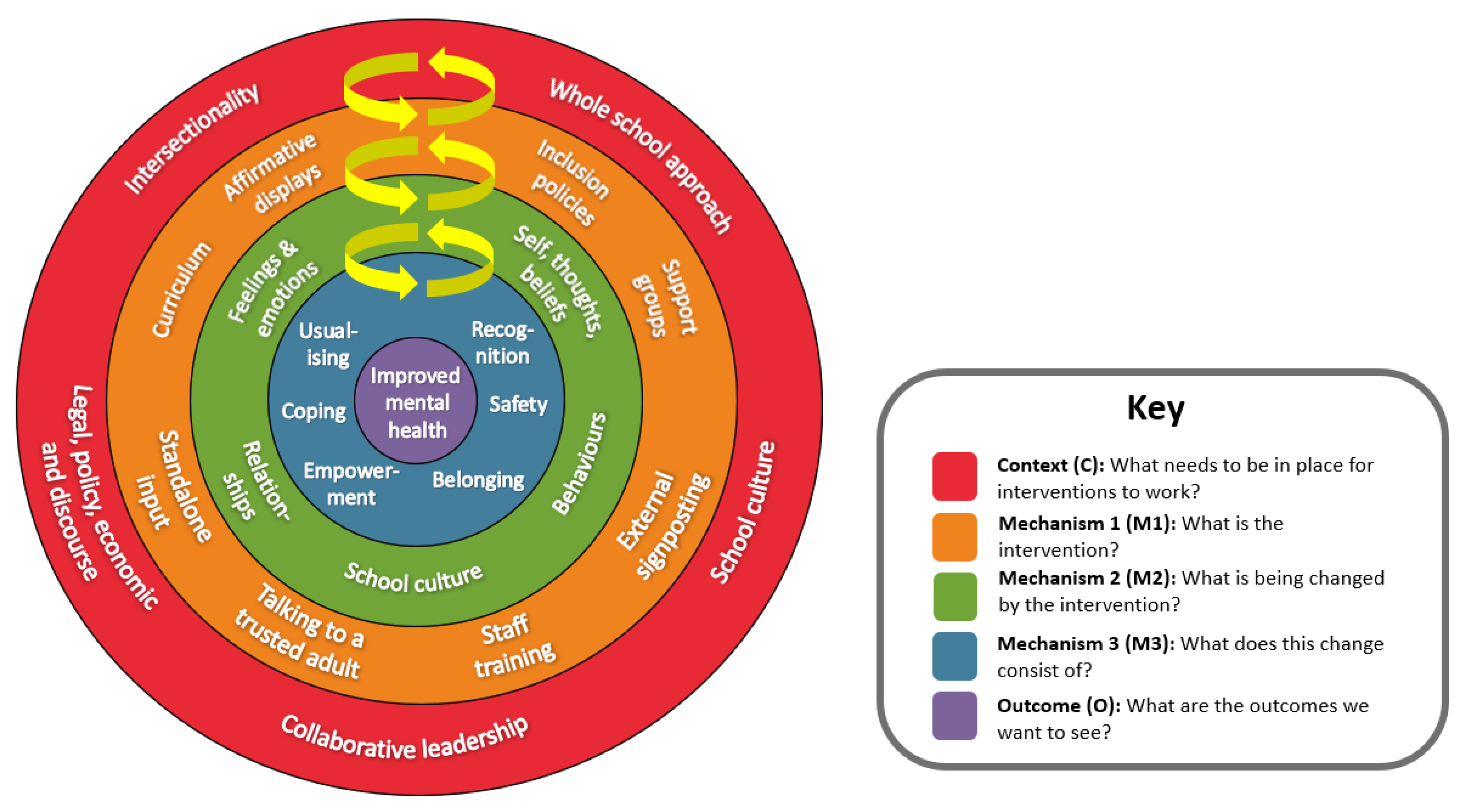
Our model (diagram above) has three levels at which interventions may work, on psychological, behavioural, emotional, cultural, and social levels. It explains how school-based interventions that directly tackle dominant cisgender and heterosexual norms can improve LGBTQ+ pupils’ mental health. 

Our findings

We found that contextual factors such as a ‘whole-school approach’ and ‘collaborative leadership’ were crucial to the delivery of successful interventions. Our theory suggests three ways (causal pathways) that might improve mental health:
  1. Interventions that promote LGBTQ+ visibility and ‘usualise’ the presence of LGBTQ+ identities, school belonging, and recognition.
  2. Interventions for talking and support that develop safety and coping.
  3. Interventions that address institutional school culture (staff training and inclusion polices) that foster school belonging, empowerment, recognition, and safety.
Our findings suggest that providing a school environment that affirms and ‘usualises’ LGBTQ+ identities, and that promotes school safety and belonging can improve mental health outcomes for LGBTQ+ pupils. The causal pathways we present are a starting point as theories, however more research to develop our understanding of how school interventions work to improve school climate and the mental health of LGBTQ+ young people is needed. We now need the UK, and other countries, to take seriously LGBTQ+ young people’s rights and ensure they are afforded equal respect and protection as their peers in schools. We may then find that the mental health of LGBTQ+ young people improves.

Read the full research paper here: Understanding How School-Based Interventions Can Tackle LGBTQ+ Youth Mental Health Inequality: A Realist Approach, 28/02/23

Funded as part of the NIHR School for Public Health Research (SPHR) Public Mental Health programme, the Creating LGBTQ+ Affirming School Environments (CLASS) research project, led by Professor Liz McDermott, aimed to investigate the mental health impact on LGBTQ+ young people of school-based interventions. Fuse is a founding member of the NIHR SPHR.


Friday, 26 April 2019

Could collective community power direct future public health research?

Guest post by Liam Spencer, Research Assistant, Institute of Health & Society, Newcastle University

The Tyne & Wear Citizens are a local division of Citizens UK, a community organising group, which comprises of schools, universities, faith groups and charities. The group launched a ‘Commission on Mental Health’, which aimed to map problems, and identify solutions around mental health services in the region. In early 2018, The Tyne & Wear Citizens approached AskFuse [Ed – Fuse’s responsive research and evaluation service] in order to identify researchers to contribute to the analysis and production of their final report, ‘Living Well: Mental Health and Public Life in the North East’.

Through Professor Eileen Kaner (Newcastle University/Fuse), I had previously been involved in another AskFuse-supported project called ‘PROMOTE:NE’, which looked at young people’s mental health across the North East, and we met with Dr Peter van der Graaf and Lesley Haley from AskFuse to discuss this piece of work. Following this, I met with Revd Dr Simon Mason and Dr Joe Barton from the Tyne & Wear Citizens, and they were very happy to have me working with them, with supervisory support from Eileen.

The Commission had collected over 300 individual written ‘testimonies’ from people across the region, who articulated what was good, and what was not so good about mental health services in the region. It was these testimonies, which formed the basis of the Living Well report, and helped shape what the Citizens were asking local politicians and organisations to commit to. Prior to being involved in this piece of work, I had no understanding of what community organising was, and initially it was a challenge to grasp the concept of what the Commission were aiming to achieve, and how I could best contribute to this. In order to gain a better insight, I attended one of the Mental Health Commission Public Hearings in Durham, where key themes were discussed in front of a public audience, and a meeting of the Mental Health Action Team, where the group refined the ‘asks’ of the report.

Due to my interest in mental health, and experience in this area of research, I wrote the ‘Context’ section of the report, which aimed to set the tone, and provide the audience with relevant information about mental health in the region, and further afield. I was also able to provide relevant literature for, and make comments on the themed sections of the report, which were written by the editor.

Coming from a qualitative research background, it was interesting to learn about the methodologies employed by the Citizens for this piece of work. Community organising is a process where people who live locally come together into an organisation that acts in their shared self-interests. This method was used in order to best capture the voices of those who may not engage with traditional methods of research. This was one of the most fascinating insights I gained from the process, and I believe this method of collective power from the community, could be utilised in directing future public health research, and that groups such as these may well be a starting point for meaningful patient and public involvement work. 

The Citizens had a small pot of money to support our involvement, and seven working days were costed for me to undertake the work. The biggest challenge I faced was the tight timescale. I was working full-time across other projects, and was in the process of writing my MSc dissertation, so the work had to fit around these existing commitments, which meant working outside of normal work hours.

The final report was launched in November 2018, at an event attended by over 500 people at Newcastle’s Civic Centre. Eileen and I were delighted to attend and speak at the event, and it was fantastic to see so many individuals interested in finding out about the work. Although the timescale was tight, I thoroughly enjoyed the opportunity to be involved in this important and innovative piece of work. I had a great working relationship with Simon and Joe, and was well supported by Eileen and Lesley. 

I am passionate about mental health research, and I am proud to have played a part in the production of a report, which aims to improve the lives of those in my home region.

Find out more about the work on the Citizens UK website.