Showing posts with label secondary care. Show all posts

Friday, 24 January 2020

Is Exercise Referral fit for a new decade?

Posted by Coral Hanson, Emily Oliver, Caroline Dodd-Reynolds and Paul Kelly

“Exercise referral doesn’t work”. We have heard this said time and time again, particularly by those who are peripherally aware of the field, but perhaps most worryingly by commissioners and those involved in public health policy. We’ve argued that this is simply not true. A different interpretation is that the exercise referral evidence-base, and the way it is used, hasn’t been working.

The term ‘exercise’ conjures images of Mr Motivator-style aerobics in eye-searing 1990’s lycra


Exercise referral is a decades-old process where professionals in primary care (GP/practice nurse) or secondary care (specialist doctor/physiotherapist) refer patients to a community-based physical activity scheme - often delivered by a leisure provider. National policy guidance (NICE, 2014) recommends that referrals are made where a patient is otherwise inactive or sedentary (both different parameters and not simple to classify in a primary care setting such as a GP surgery) and additionally has an existing health condition, or is at risk of having one.

Traditional evidence-generation for exercise referral has tended to be single-site studies that are then condensed using systematic-review-based methods. Given the considerable variation in how schemes are designed, delivered and evaluated at local level, this is problematic. Vague policy guidance and limited evaluation funding means that most scheme iterations are unsuitable for inclusion and interpretation in this outcome-driven way (Oliver et al., 2016). Collectively, the findings of such overviews are rather underwhelming.

Consequently, during times of tightened public health spending and commissioning, many UK exercise referral schemes have been de-commissioned. This seems misguided, given evidence that some schemes work, for some individuals, in some contexts. Understanding these nuances is at odds with the ‘best practice’ and ‘scaling-up’ that is so often seen as desirable within physical activity policy. Evidence must (and thankfully is starting to) account for consideration of local tailoring and best fit for a given community. Incorporating such evidence into policy is a different matter, of course.

To assist with collating evidence that can meaningfully inform policy and commissioning decisions in this area, our recent editorial in the British Journal of Sports Medicine proposes a sea change in how exercise referral is considered, categorised and reported. The term ‘exercise referral’ is outdated in 2020. ‘Physical activity referral schemes’ more appropriately describes the innovative and extensive range of programmes being delivered, and allows for other types of referral including self-referral, social prescribing and group-based needs assessments, to potentially contribute to the evidence base.
Personally, we’re not keen on the term ‘exercise’; it conjures images of Mr Motivator-style aerobics in eye-searing 1990’s Lycra. It sounds so imposed and constrained
You may have noticed we have replaced ‘exercise’ with ‘physical activity’ – surely a more inclusive term for what is ultimately a behaviour – and one which we are trying to change. Traditionally exercise referral schemes were mainly gym-based and we think that this image probably persists when we think of exercise referral today. Personally, we’re not keen on the term ‘exercise’; it conjures images of Mr Motivator-style aerobics in eye-searing 1990’s lycra. It sounds so imposed and constrained. Even a simple phrasing change can have far-reaching implications, and hopefully for the better in this case.

In the editorial, we propose a simple way of identifying, classifying, and recording key information about physical activity referral schemes that will enable better understanding of what exists and what is working. Our new reporting checklist (or taxonomy) encompasses all physical activity schemes that:
  1. have the primary aim of increasing physical activity,
  2. have a formalised referral process, 
  3. are provided for individuals who are inactive/sedentary, and/or have or are at risk of a health condition. 
The classification framework can be seen in figure 1 (below). The full reporting checklist can be found in the editorial. We propose that this be used by commissioners, practitioners and researchers alike: for auditing and monitoring, to capture service delivery and in generation of evidence reviews.

Figure 1
We are very keen to hear from anyone working in exercise/physical activity referral of any kind as we move forward with refining this idea. The model was proposed to policy-makers, practitioners and academics at a consensus event in late 2019, and we are currently refining it by undertaking a Delphi Survey. We are inviting further comment, critique and engagement to make the final version as accessible and ‘fit for purpose’ as it possibly can be, so please get in touch with Coral, Caroline, Paul, or Emily via twitter or email - details below.


Coral Hanson, Research Fellow, Edinburgh Napier University @HansonCoral / C.Hanson@napier.ac.uk

Emily Oliver, Associate Professor, Director of Research in the Department of Sport and Exercise Sciences, Durham University @_EJOliver

Caroline Dodd-Reynolds, Associate Professor, Department of Sport and Exercise Sciences, Durham University @carolinedod / caroline.dodd-reynolds@durham.ac.uk  

Paul Kelly, Lecturer in Physical Activity for Health, The University of Edinburgh @narrowboat_paul 


References:

Images: 
  1. ‘Mr Motivator 2’ by Dave Tett via Flickr. Attribution-NonCommercial-NoDerivs 2.0 Generic (CC BY-NC-ND 2.0): https://www.flickr.com/photos/66551670@N00/388434590 © 2007.
  2. 'Figure 1' reproduced from Hanson, CL, Oliver, EJ, Dodd-Reynolds, CJ & Kelly, P (2019). We are failing to improve the evidence base for “Exercise Referral” How a PhysicalActivity Referral Scheme Taxonomy can help. British Journal of Sports Medicine Published Online First: 17 December 2019. doi: 10.1136/bjsports-2019-101485 with permission from BMJ Publishing Group Ltd.

Friday, 13 July 2018

Putting the 'occupation' in Occupational Therapy and debating its role in Public Health

Guest post by Andrew Graham, Registered Occupational Therapist and PhD Candidate, Teesside University

Having recently made the move from NHS clinician into academia (I started my PhD at Teesside University in December 2017), I arrived in Belfast for the Royal College of Occupational Therapy Annual Conference with an appetite to hear new and interesting research in the profession.


In my welcome pack, I received a copy of the RCOT’s Strategic Intentions which represent the leadership response to the challenges of the changing landscape of health and social care. The principle that stood out for me was to ‘position the Profession, and our members, for the 21st century’.

With my background in amputee rehabilitation I have seen first-hand the impact of socio-economic inequalities and lifestyle trends on amputation rate in North East England. For example, the amount of amputations due to diabetes, and more shockingly intra-venous drug use, has spiked in the past 10 years or so. As an Occupational Therapist (OT), I view the person holistically and always try to take into account the social and psychological not just physical barriers they will need to overcome post amputation. My focus will always be on what the person needs and wants to do. The person’s meaningful activities (occupations).

The pledge tree

During the conference, we were asked to make a pledge about how we would do our part to ensure the new strategic intentions are met. The pledge tree seemed to have a recurring theme of ‘ensuring occupation is central to my work’.

My own pledge was to better explain ‘occupation’ and its meaning within occupational therapy to a range of audiences.

So, my attempt at articulating ‘occupation’? I’ll go with ‘doing things that we need to do and want to do (meaningful activities), which enable a sense of self-meaning and improved health and well-being.

I feel as a profession we are experts in using occupation as a goal (top down approach) and/or a means (bottom up approach) to ensure provision of high-quality, client centred services. Utilising the OT process from information gathering to evaluation we strive to enable growth, confidence and self-meaning.

Despite OTs generally being able to better define what they do and what the outcomes can be, it was a bit of a shock to see that the debate at the conference highlighted that the profession is still unsure about its stakeholders. The topic up for discussion was ‘This house believes that Occupational Therapy needs to be predominately based in public health, not in secondary or tertiary services’.

From my experience, this issue had been debated and answered years ago. My pre-registration training saw me working in the NHS, community mental health teams, a special needs school and a charity. The OTs all had a prominent and effective role in these sectors, so as intrigued as I was to hear the debate, I knew which way I would be voting!

For the purpose of this blog I’d like to highlight the case for OTs working in Public Health. A starting point would be the statement by the professional body, which points out that the Public Health Agenda has been of increasing importance and relevance for occupational therapists, who facilitate health promotion through working with people of all ages to enable their participation in meaningful occupations (RCOT 2004).

The evidence base is also pretty strong. A systematic review of Allied Health Professions and Health Promotion (Needle et al 2011) reviewed 28 studies related to occupational therapy and Public Health, and found related interventions in the areas of mental health, arthritis, pain and fatigue, pulmonary rehabilitation, stroke, drug and alcohol problems, and falls prevention.

Not only are OTs already working with people on aspects of Public Health and health promotion activity, but there is an expectation that this focus will form part of the delivery of all occupational therapy interventions in the future. For example, I remember reading about the ‘make every contact count’ campaign when working on an acute stroke ward and making sure I asked about smoking and drinking habits as part of my OT assessment.

So, it was with no surprise that the result swung against the motion at the conference. A particularly convincing rebuttal speech was given by Professor Diane Cox and Dr Jenny Preston, clearly showing the professions ability to address Public Health matters but also reach a wider audience through demonstrating outcomes in secondary and tertiary services.

Overall, I left the conference with a sense that the profession has strategically positioned itself to demonstrate that it is making a difference and will continue to make a difference to the health and well-being of people in the 21st century. It is time for OTs working in Public Health and other services to be proud. In my favourite quote of the conference….‘we are not the jack of all trades, rather we are the masters of human occupation’.


Andrew Graham is investigating ‘Sensory Discriminating Training for Phantom Limb Pain’, as a PhD candidate in the School of Health and Social Care at Teesside University.

Friday, 1 June 2018

Prevention by any other name would smell as sweet

Guest post by Tom Embury, Public Affairs Officer, British Dietetic Association

Next week, June 4th - 8th is Dietitians Week 2018, where the British Dietetic Association and its members and allies celebrate the work of dietitians. This year’s theme is “Dietitians Do Prevention”, which intends to highlight the important role that dietitians have to play in prevention and public health. We know nutrition and hydration underpin so much of our health and getting it right can reduce the impact of illness, aid recovery, or prevent some diseases and conditions altogether.


NHS England’s Five Year Forward View, in the most recent frameworks from NHS Scotland and the Northern Irish Health and Social Care Service and is embodied in the principles of the Wellbeing of Future Generations (Wales) Act.

It has been made clear by everyone from Marmot to the NHS Confederation that we need to strengthen prevention and that it should be everybody’s business. Despite this, many dietitians (and indeed healthcare staff in general) still don’t think of themselves as doing prevention or public health, especially as so many work in hospital settings, delivering acute care. Our recent 2018 member survey has shown that 40% of our members don’t feel that they do prevention or public health activity. This may be because they don’t have the time or resources, despite wishing to do so, but in some cases, it is because they don’t see public health as part of their remit.

Of course, we believe all our members “do prevention” and public health, but not everyone will call it by that name. Indeed, the term public health often seems to have quite a narrow definition, associated with the work of local government public health teams. This is important work, but by no means is that everything public health entails.

This is why, in preparation for Dietitians Week this year, we asked all our specialist groups for their view on how they do prevention. Our specialist groups cover pretty much all of the areas of dietetics - from paediatrics to older people, public health to critical care. What we found is that there are dozens of words and terms used to describe activity that is essentially a form of prevention.

Some were variations, like primary, secondary or tertiary prevention depending on where you work and what types of illnesses your patients have. Others, such as Making Every Contact Count or Healthy Conversations, relate to specific campaigns or initiatives. In areas like Mental Health or Paediatrics, a whole different language can exist. Even rehabilitation or recovery after acute illness is a form of prevention - preventing future episodes, further hospital visits or complications. One great example comes from Fuse itself – the research carried out into the impact of energy drink intake amongst young people has had an impact on national level policy making.

This is why we are trying to celebrate prevention in all its forms and with all its various names. Dietitians are and should to a greater extent be a core part of the public health workforce.

Our incoming Chairman, Caroline Bovey, highlighted this issue with terminology and understanding at our recent Annual General Meeting. She asked the crowd of over 100 dietitians to raise their hands if they were involved in public health. Some hands went up but they were definitely in the minority. She then asked who had a twitter account where they talked about diet and nutrition – far more hands shot up. “You are all”, she said, “doing public health dietetics”.

So, whether you’re having a healthy conversation or making every contact count, supporting rehabilitation or reducing hospital admissions, celebrate the way that you do prevention. We can’t let the terminology get in the way of sharing best practice or spreading good ideas. We’d love you to tell us about it as part of Dietitians Week! Get in touch via dietitiansweek@bda.uk.com

Thursday, 27 October 2016

Mapping collaboration and constructing a compass

Guest post by Lindy Turnbull, Senior Lecturer, Faculty of Health and Life Sciences, Northumbria University

Collaboration is promoted as a key aspect of commissioning and delivery in public health (NHS England, 2016) and health care (NHS England and NHS Improvement, 2016). Joint working and integration of services are seen as the way forward for the future NHS with new integrated models of care at the forefront of service redesign, and collaboration core to managing increased demands with diminishing resources. Although collaboration is a familiar concept and has been the subject of research and discussion it is still an area of practice which is poorly understood. It is striking that existing definitions of collaboration identify professional sharing with the focus on patient care, yet there is little representation of patients in most studies and the role of patients in collaboration seems to be missing from the existing theory.


I began my research after leading the development of Outpatient Parenteral Antimicrobial Therapy (OPAT) a new model of care which required collaborative working across secondary and primary care to deliver treatment in patient homes. The development of this service was challenging and required strong collaborative relationships to overcome the organisational barriers to integration. Having experienced the challenges of collaborating to develop an integrated service I wondered if these difficulties continue into the delivery of the service in practice, and how collaboration takes place within the challenging environment of the constantly reorganised NHS.

The aim of my research was to develop substantive theory about what collaboration means in the delivery of integrated care, the way it is manifested in day-to-day practice and how it is shaped by the situation in which it takes place. I viewed patients and professionals as participants in collaboration and interviewed three patients and 21 professionals. I have used a social constructionist approach to grounded theory (Charmaz, 2008) and a range of situational mapping techniques (Clarke, 2005)1 to map collaboration within the situation of integrated care delivery. Analysis was a fascinating and absorbing experience as I used mind mapping software to analyse and compare the perspectives of those involved in collaboration and then to combine perspectives to map and analyse the complexity of the situation.

Participants expressed a number of interactive mechanisms (trusting, communicating, co-ordinating and rehearsing) which were influenced by a range of situational co-ordinates (goals, limits, certainty, uncertainty and power) and these were used together to navigate the complexity of the healthcare situation and direct the process and outcomes of collaboration. The capability of individuals to act, or interact was informed by their interpretation of the situation and this directed the capacity for collaboration within the care situation. Positional mapping techniques identified four directions of collaboration: developing, maintaining, limited and disrupted, and I found that limiting factors were significant in changing the direction of collaboration. The communication of some social limitations such as terminal illness, professional roles or work requirements altered an individual’s capability to collaborate and the capacity for collaboration within the situation.

My analysis has constructed a collaboration compass which is used to navigate the situation and direct the collaboration experienced by patients and professionals. I am in the process of writing up and still fighting my enthusiasm to write about everything I found and learned during my study; there simply aren’t enough words!

Reference:
  1. Clarke, A. (2005). Situational analysis: Grounded theory after the postmodern turn. Thousand Oaks, CA: Sage.
Health Research Authority summary: The Meaning and Manifestation of Collaboration in Domiciliary Outpatient Parenteral Antibiotic Therapy: A Grounded Theory Situational Analysis.

Thursday, 14 April 2016

'Inappropriate' A&E attendance: One out of four ain't bad

Guest post by Dr Simon Howard, Associate Lecturer in Public Health, Northumbria University

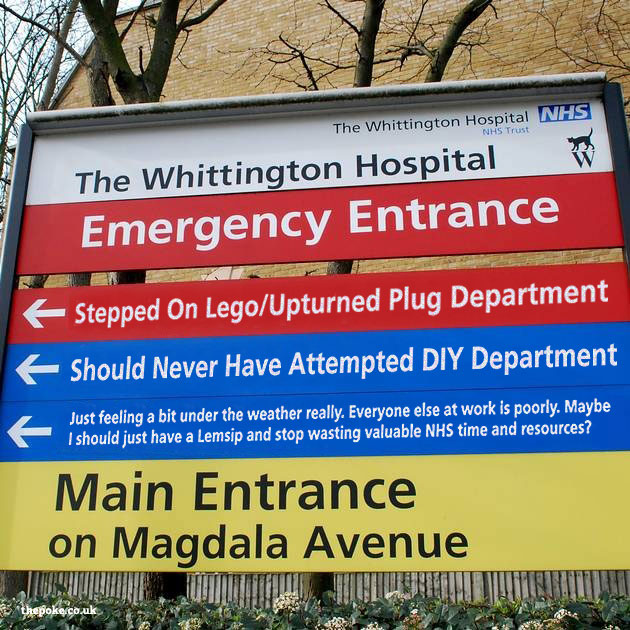
Last week on the blog, Emma Dorée wrote about a statement from South Tees NHS Foundation Trust urging people not to attend Accident and Emergency departments for stomach aches caused by excessive consumption of Easter Eggs. Emma explained that one in four A&E attendances is considered inappropriate, and highlighted the NHS Choose Well campaign which helps people to select the right place to take their symptoms.

Photo attribution: www.thepoke.co.uk
This made me wonder… is one in four A&E attendances being ‘inappropriate’ really so bad?

Clearly, the NHS is stretched at the moment, and nowhere more so than A&E, where only 83% of patients are seen and sent on their way within four hours, as compared with a target of 95%. It is natural for us to want to see performance improve, and waiting times are doubtless inflated by ‘inappropriate’ attendees.

Of course, we should wonder what is meant by ‘inappropriate’ in this context. There are many possible classifications. Of course, attending A&E seeking treatment for a sick dog is undoubtedly inappropriate. But is it inappropriate to attend for ‘hangover help’? What if the symptoms of your hangover are difficult to distinguish from the symptoms of meningitis? The final diagnosis and healthcare provider’s perspective is not necessarily the best viewpoint from which to determine ‘appropriateness’.

Even if we assume that one in four attendances truly is inappropriate, it’s reasonable to question whether that is so bad. Considering the problem in terms of sensitivity and specificity, it is vastly preferable that the self-triaging process is sensitive (i.e. all people who really need A&E attend A&E), even if that’s at the expense of a degree of specificity (i.e. some of the people who don’t need A&E still attend A&E). As a doctor, I want everyone who has a life-threatening emergency to attend A&E, not for one or two to go to their local pharmacy, and I’m willing to accept that making that happen might mean that some less urgent cases also slip through the net.

People presenting to services inappropriately is anything but a new problem. Writing in The Lancet in 1849, Joseph Hodgson - the founder of what is now known as the Birmingham Midland Eye Centre - complained of the “growing evil” of “the indiscriminate admission of out-patients to charitable institutions”. His problem was, perhaps, a little different: people referring themselves to charitable hospitals even though “one half of the patients can afford to pay the surgeon his fee”. In order to avoid detection, many of his patients chose to “dress shabbily, and even borrow their servants’ bonnets and shawls”.

To my mind, the root of the modern problem is that we expect people, most of whom rarely use the health service, to self-triage between six (or more) levels of care. This is not sensible. Campaigns admonishing people for making obviously incorrect choices don't help this core problem, and may even counteract campaigns like Be Clear on Cancer, which encourage people to consult health services with symptoms which they may not recognise as ‘red flags’.

One solution to this problem is to introduce professional triage. Back in 1849, Hodgson suggested that “each applicant be compelled to bring a note of recommendations from the clergyman”; perhaps not quite such a useful recommendation for the 21st century. NHS Direct, and its successor NHS 111, were perhaps intended to provide the modern equivalent of the clergyman’s note, but do not enjoy a high degree of public or professional confidence. This is probably because triage over the phone is very difficult, even if it has been shown in research to reduce A&E demand. Perhaps options such as embedding GPs within A&E, as proposed by South Tees CCG, will provide an answer.

For now, here’s the bottom line: even as someone working in the system, I couldn't tell you where I'm supposed to take myself if I develop an unclear symptom. Telling me how inappropriate other people’s attendances are don’t help signpost me to the right place if I have, for example, sudden hearing loss or eye pain. Like very many other people, in situations of uncertainty, I am likely to err on the side of accessing a higher level of care, as I would not want to delay urgent treatment. Though I probably wouldn’t turn up wearing my servant’s bonnet.

Thursday, 23 July 2015

Mind over matter in Fuse?

Posted by Peter van der Graaf, AskFuse Research Manager

Mental health is a rising star on national and local agendas. At national level, mental health was for the first time ever included in all of the main political party election manifestos and features significantly in the NHS Five Year Forward View. At local level, Public Health teams across the North East are reviewing their mental health services and upskilling themselves in the best ways to reduce self-harm and suicide. You may ask what all the fuss is about?

Various reports have pointed out that poor mental health is costing the UK economy £105bn per year, including £8bn annually in sickness absence, and a further £15bn in lost productivity absenteeism (where people are at work, but under-perform due to mental health issues). The Care Quality Commission (CQC) recently sounded the alarm over the state of mental health services in England. In its first ever review of mental health crisis care, the regulator found that 42% of patients did not get the help they needed.

The picture is particularly bleak in the North East, which has the highest suicide rates in the UK and rates have been going up steadily since the economic recession and public sector cuts (after a long period of stabilisation) and are likely to increase further with additional cutbacks planned in recent spending reviews. Not surprisingly, mental health issues are higher in deprived areas, among men, those who are unemployed, and related to alcohol problems, all of which the North East is leading on in national league tables. Mental health services, described by one of our practice partners as “the Cinderella of Public Health”, are bearing the brunt of these cuts, in times when you could argue that their service users need them most.


To make the most of existing intelligence and services, the Public Health Intelligence Northern England (PHINE) network recently organised a dedicated event on self-harm and suicide, offering participants access to various interactive data sets (e.g. Community Mental Health Profiles) to help local authorities make sense of national data for their own patch. Where are the suicide hotspots in different localities? Who are most at risk and what services can they access? The data profiles were well received by the audience but were also met with some criticism around lack of integration with local data, such as counselling data collected by GPs in the North East. Moreover, although this data helps to identify what is happening where, it does not allow for answers to the question why? Public health commissioners need help to interpret this data and understand why suicide and risks are going up in one area or user group but not in another.

What can Fuse do to support this? Are we making our research on mental health issues available to decision makers and professionals? For instance, where can Public Health practitioners find information about the lessons learned in the award winning Change UR Mind about Young People project (evaluated by our Translational Research programme); or about the literature review on self-harm produced by the Knowledge to Action Group within our Complex Systems programme? Moreover, is our research responding to local concerns and needs? Do we help them in interpreting national data and matching this with their own data? And do we support them in developing interventions to address hot spots? How can Fuse work more effectively with partners in the region that are working on suicide prevention strategies, post-event services and mental health research?

Partners are closer than you might think. For instance, The Westgate Unit at HMP Frankland is a therapeutic, personality disorder treatment service based in a high security prison setting.  The Unit helps prisoners diagnosed with Borderline Personality Disorder who are most at risk of self-harm and suicide. The unit has developed its own research on why different prisoners self-harm but is struggling with budget cuts and would welcome support from academics in developing and conducting further research. You might counter that this is not public health, but given the significant impact of mental health on the UK economy, the NHS and, last but not least, the impact on families and communities, I would argue that this is a unique opportunity for Fuse to get involved.

Our region already has a wealth of clinical expertise available on mental health: the Mental Health Research Group (MHRG) is a joint initiative of the Tees Esk Wear Valleys (TEWV) NHS Foundation Trust and Durham University, in which clinicians, academics and service users, including young people, collaborate to improve local health services. The group recently showcased their research during their annual conference. Unfortunately, Fuse is not a partner in this network. However, clinical staff in the Trust are keen to develop their research skills and contribute to a better understanding of mental health issues and interventions in the North East and would welcome collaborative research with Fuse.

This might be a good time to ask: should Fuse put mind over matter when it comes to mental health?

Tuesday, 9 December 2014

The Stevens Factor – our man from Consett

Posted by Avril Rhodes and David J Hunter

Simon Stevens, the Chief Executive of NHS England is not as he seems. Behind the urbane witty manner, the man who likes, apparently, to speak without visual aids, is a man of real steel. Well, Consett steel actually, as at home speaking about his early experiences of working at the then Shotley Bridge General Hospital, as defending the NHS before the Public Accounts Committee and leading five year forward views. We have two gems here, someone who knows north-east England and relishes speaking almost exclusively about public health, despite the enormity of the operational responsibilities he carries, and definitely a force to be reckoned with, as his vertical rise from junior manager to CEO, via advising the Blair government at No 10, testifies.
Simon Stevens: a man of Consett steel
We shall soon be entering manifesto season. At his recent Centre for Public Policy and Health lecture at Durham University Queen’s Campus, whilst it wasn’t called a manifesto the audience were given an insight into six key priorities on Mr Stevens' mind, some of which built on the five year forward view released in October. Not in any kind of order these were:
  1. Re-conceptualising what we mean by the NHS – the NHS is now a pensioner, in organisational terms but is still revolving around dealing with problems as they arise, with too little spent on underlying prevention. It seems to be hard enough to co-ordinate the different services currently provided, let alone stepping up to a new level where there is no difference in health and social care, and any aspect of policy that affects life chances, and health and wellness, is integrated both in planning and delivery. But this is a goal that means a fundamental re-orientation of what’s provided, how and where.
  2. What about the unexploited advantages of primary care? The division between primary and secondary care in the UK, which has deep historical roots that pre-date the NHS is both a barrier, in terms of setting up a division that wouldn’t be recognised in some other countries, and also a positive, in providing personalised care, close to home. But what about the areas where primary care is all too thin on the ground, the unpopular parts of the country where GPs don’t want to work – the so-called ‘inverse care law’ which Stevens invoked. Can this be fixed through the development of a population-oriented primary care system?
  3. The NHS is a major buyer and employer and has a sizeable economic footprint in local communities. Back in his Consett days, the steel works had recently closed and the NHS took up some of the fall out as the local and large employer of alternative resort. This lesson has not been lost on Stevens. The NHS should be able to influence poverty and health through its own economic position in each locality.
  4. Work needs to be done on ensuring people get and stay in high quality jobs. The NHS can support this (partly linking back to the third point) through what it does as an employer but also could have a much stronger role in health interventions whilst people are at work. Unsaid at the time, but the workplace is somewhere people spend a lot of time, so why not? The NHS needs to set an example in being a good employer itself, but to its shame falls short, for example in the management of shift systems, or provision of healthy eating options at work. This was definitely a ‘can do better’ on the report card.
  5. Local Authorities have come back in from the cold with their new (or is it re-gained?) responsibilities in public health. There is an awakening to the scope local government could have, arising from the debate about devolution in England, set off by the Scottish referendum, and even within their existing powers, local authorities can reach the parts the NHS can’t reach in affecting population health and well-being. 
  6. And finally, what about the planning of new cities and towns? These could provide a test bed for working out new ways of place-shaping and designing health and wellness into the built environment and also new ways of delivering the NHS, given the blank sheet these major developments offer.
Let’s see how many party political manifestoes pay attention to these ideas in the Spring of 2015.