Showing posts with label engagement. Show all posts

Friday, 24 July 2026

Sparking curiosity with Twinkle, Twinkle Arti

Posted by Nicola Aldridge, Research Associate, and Cassey Muir, Research Associate / Co-lead of the Fuse Early Life and Adolescence Research Cluster, both from Newcastle University

We were recently given the exciting opportunity to showcase the Twinkle, Twinkle Arti project at Discover Festival, a free, one-day festival organised by Newcastle University that brings together families, communities, and researchers through interactive activities and inspiring ideas.

Nicola and Cassey
Discover Festival is designed to spark curiosity, build connections, and encourage people of all ages to explore new ideas. Each year, the university creates a packed programme of family-friendly events, and this year, we were delighted to be part of it as members of the Twinkle, Twinkle Arti research team.


Bringing Arti's story to life

Throughout the day, we invited families to step into Arti’s world through the Twinkle, Twinkle Arti storybook. Developed by Fuse researchers at Newcastle University, with funding from the NIHR School for Public Health Research, the book was created and co-produced with families to support the wellbeing of children experiencing challenging family circumstances, such as drug and alcohol use. While these experiences inspired the story, its themes of feelings, belonging, resilience, and hope resonate with all children.

Visitors to our stall in the Great North Museum had the chance to watch a CBeebies Bedtime Stories style video of it being read aloud by the author. They could also explore puppets and original illustrations from the book, and view artwork created by primary school-aged children who had participated in a pilot study of classroom lessons based on the story.

Families were also able to take home a free copy of the storybook, along with a link to the online read-aloud video and a set of simple conversation prompts designed to encourage creativity, emotional expression, and meaningful family time at home. We handed out nearly 80 copies on the day!


Conversations that matter


Beyond engaging with families, it was equally exciting to see the conversations that the project sparked among professionals attending the festival. We spoke with people from a range of sectors, including teaching, school governance, clinical psychology, and general practice with social prescribing links. Their curiosity about the project and enthusiasm for its potential applications highlighted the broad relevance of Twinkle, Twinkle Arti and the importance of creating accessible resources that support children's emotional and social wellbeing.

One particularly rewarding conversation was with a family who shared their personal experience of the impact of alcohol on family life and how they might be able to use the book. Hearing their reflections was both moving and affirming. It served as a powerful reminder of why the project began in the first place and reinforced the continued need for resources that help children navigate difficult experiences. Moments like these bring the research to life, reminding us that behind every study, storybook, and activity are real families whose experiences matter and whose voices continue to shape our work.

Creating a community star mural

Another highlight of the day was our evolving community star mural. We invited children to create their own star by drawing, colouring, or writing ideas about what they or Arti could do when they felt sad or worried, with 114 stars being created on the day. It was wonderful to see children enthusiastically embracing the activity, and even more special to watch parents, carers and grandparents join in too, talking to their children about the messages in the book. The excitement on their faces as they added their stars to the mural was a lovely reminder of the power of creativity to bring people together.


A colourful celebration of hope and resilience

By the end of the day, the mural had grown into a colourful display of hope, kindness, and imagination. It was a privilege to share the Twinkle, Twinkle Arti project with so many families and to see first-hand how children connected with Arti’s story and messages of hope, resilience and belonging. Events like Discover Festival provide a fantastic opportunity to bring research into the community, and we were grateful to be part of such an inspiring day.


Find out more about Twinkle, Twinkle Arti

Friday, 1 December 2023

Getting creative to make research more accessible and inclusive

Posted by Victoria Bartle, Fuse Public Partner

We were throwing balls of wool around, picking picture cards to describe ourselves and having a thoroughly inspiring time. This was not your typical research conference!

It was day one and keynote speaker Pam Burnard was encouraging us to challenge the system using creative methods to subvert common assumptions.

Many of the researchers at the International Creative Research Methods Conference in Manchester are independent, not linked to a specific university or funder and this allows them to approach research from a variety of unusual and unfamiliar angles.

The conference is the brainchild of Dr Helen Kara: independent researcher, author, teacher, speaker and creative research methods (CRM) expert. Helen’s vision was to bring together the global CRM community to share knowledge, promote understanding, enable networking and have fun!

After the first day's keynote, I went to see Nicole Brown, a researcher looking at fibromyalgia, a condition that I also have. She had asked people living with fibromyalgia to collect objects to describe how the condition made them feel. One person had taken a photo of her chair - a really comfortable armchair, with a blanket, a table beside it holding drinks, snacks and distractions. This could have been a picture of my own living room! Due to chronic pain and fatigue I have what I call my 'nest'. I have reclining sofas with a side table with all of my remotes, chargers, creams, spare meds, thermostat, drinks, snacks, book, switch, lip balm (etc.) just so that everything I need is within reach and I don’t have to move too much or cause myself too much pain. I found the picture really impactful and saw the potential for objects, artwork and abstract thinking to be able to describe conditions like fibromyalgia which is extremely difficult to explain to someone who doesn’t have it. Using objects as data to assess and evaluate was really interesting and a methodology that I wasn’t previously aware of.

We were then given the task of picking some cards to describe ourselves as researchers.

These are the lego cards I chose to describe me during the sessions by Nicole Brown, who works with objects as data in research.

The skydiver because I feel like I just ask to do things and hope for the best, the singer because I like to present and talk about PPI (Patient and Public Involvement) in research. 

Black widow because she’s a superhero and fights for people who can’t and Rocket because he’s been made up with tech and I felt like he’s a disabled superhero :)


Jargon buzzing

On day 2 the Lawnmowers Theatre Company, run by and for people with learning difficulties, brought out jargon buzzers which were amazing! The characters pressed the buzzers every time someone used a term or word that they didn’t understand. I really want to use these in PPI meetings in the future, but we might not get anything done having to explain all the acronyms and research language that is often used!

Making a 'zine'

I didn’t know anything about zines and wasn’t aware of the Madzine project to help people with mental health conditions to explain how they feel, get things out and be creative. The session was really interesting giving us some history on zines before we were able to create our own. I made one about a project that I have been working on using some paper with stars on to represent the PPI Group members. A black page for accessibility as we all had different barriers to involvement and some of them were difficult to address, hidden or unknown. Some of the zines that they showed us were amazing: creative, visual, unusual, thought provoking and touching. They plan to create a mobile Madzine library that tours around the country so that people can read the zines and share in the experiences of the creators to increase awareness and understanding of living with mental health conditions.

Board games, rockpools and podcasts  

Kath McGuire (University of Exeter/NIHR School for Public Health Research), led our session talking about working with creative methods, public involvement and research dissemination. I briefly introduced the Fuse podcast and explained the collaborative approach to creating it. People were then able to take a look around the room at the variety of creative outputs that we had brought with us, and a video about how we have creatively communicated research in Fuse (see below). We had a snakes and ladders game to be used with PPI groups, or groups of researchers to evaluate their projects: snakes were barriers and challenges and ladders were successes and wins. We also took posters created by Fuse researchers showing their project results (Emma Adams) and Kath had a Blue Health Rockpool from another project. We took questions and explained how we created the podcast, what its impact had been and answered lots of technical questions about equipment, hosting and distribution. Hopefully accurately!


Attending the conference really broadened my view of research and public involvement. Lots of researchers at the conference felt that by making their work more creative it made it more inclusive. By reducing or removing established barriers to involvement such as language, terminology, education level and academic preconceptions they were able to engage with a wider, more diverse group of people. They could still be academically rigorous and produce research that stands up to peer review and meets publication standards whilst including more people, accessing people with appropriate lived experience of their topic of study and making involvement engaging, interesting and fun!

I have come away from the conference wanting to make Patient and Public Involvement meetings more creative, use games and objects to describe feelings and opinions, implement the jargon buzzer and design engaging dissemination methods that are relevant to the target audience of the study, drawing on the skills of the researchers and PPI teams.

A special thanks to Kath Maguire, Daniel Mutanda and Heather Boult (University of Exeter/NIHR School for Public Health Research), and the Fuse colleagues: Lesley Haley, who helped me with the podcast aspect of the workshop 'market place'; Ella Anderson for preparing the workshop activity; and Mark Welford for producing the Creatively communicating research video that we used in the session.

Friday, 30 September 2022

Going beyond research to empower involvement and smash stereotypes

Posted by Sheena Ramsay, Professor of Public Health & Epidemiology, (and team: Emma Joyes, Emma Adams, Laura McGowan) in collaboration with Fulfilling Lives Newcastle Gateshead Experts by Experience

The way researchers approach some groups is often not sensitive to or inclusive of their needs. For example, the information can use technical language (such as ‘licit substances’ or ‘quasi-experimental’) which can be difficult to understand and off-putting. This can lead to people not wanting to take part in studies. Which means that new research insights, including changes to practice, can exclude those who are often most impacted.

Over the last two years, we have been working with Fulfilling Lives Newcastle Gateshead and their Experts by Experience Network of individuals with lived experience of multiple disadvantage. We have explored perceptions of services and programmes relating to oral health and related health behaviours - such as substance use, smoking, and diet - for people who experience severe and multiple disadvantage (a combination of homelessness, substance misuse, and offending). From the beginning, the Experts by Experience Network has shaped our work and helped us ensure it is accessible to those we want to speak to the most.

One of the ways that the Network has shaped our research is by helping us to create a video to help reach out to potential participants for our research - particularly people who are often excluded in research studies, such as people experiencing homeless.


Our team worked with the Experts by Experience Network to look at ways to get people involved in the research. We wanted to work with those who had insights into the issues we hoped to study, so that we could communicate the research in a way that would resonate with people. Together, we co-created an animated video as a means of reaching out to people, so they could find out about the research and how to take part.

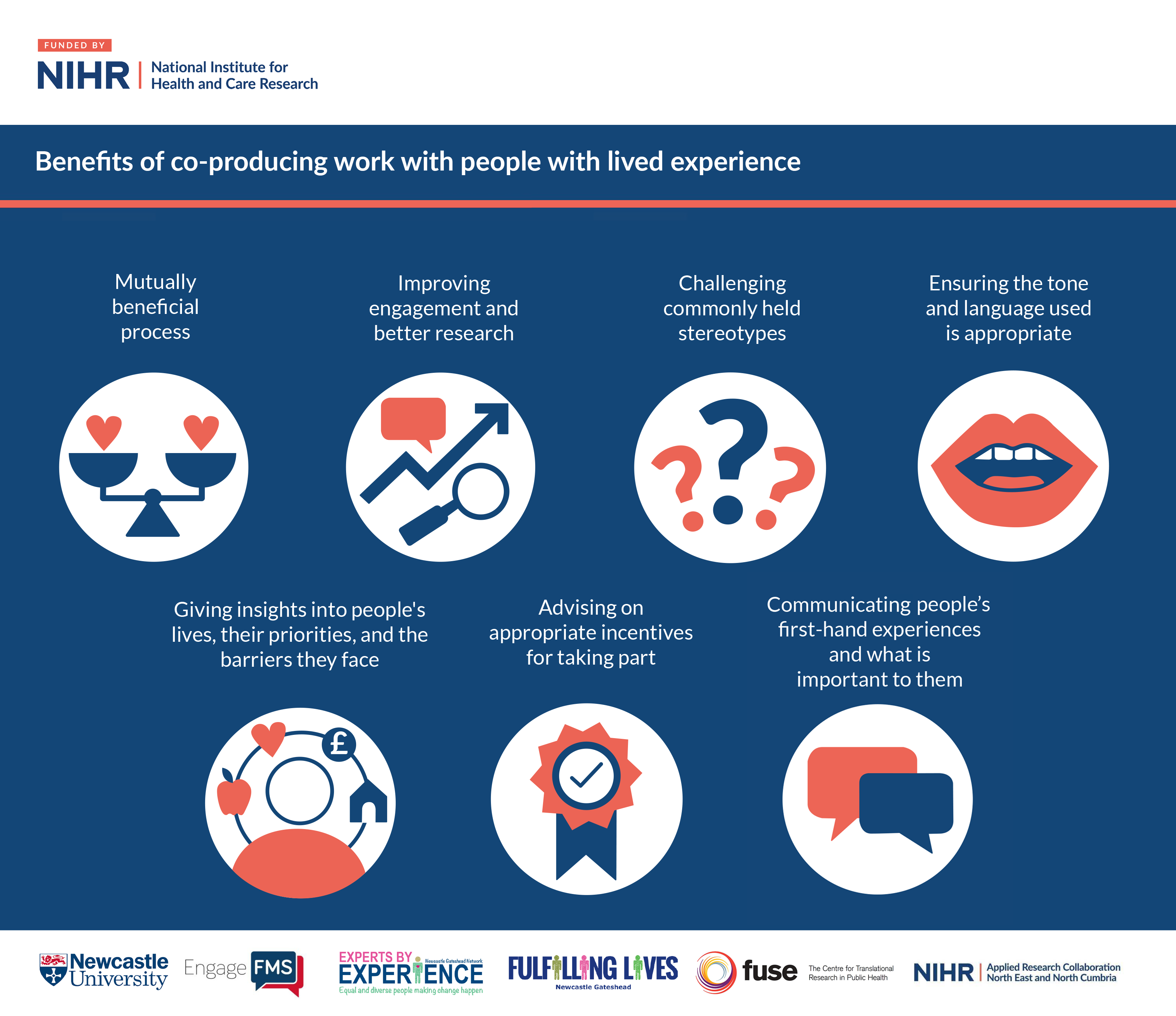
The infographics in this blog show what we have learnt from this process of co-creating the video and the value of co-production.


Creating a video provided an easy way in which organisations (such as Crisis, Fulfilling Lives, and other providers) and local Expert by Experience networks could share information about the study.

Those involved in creating the video were able to draw upon their experiences to help shape the content. One of the members of the group shared their experience of the process:
“Some of us in the Network feel really strongly about this issue and have personal experience of it ourselves so we were keen to be involved and share our ideas and opinions.”
Another member said:
“I joined this project because my own oral health has been something I've been embarrassed about in the past so I thought I could add something useful to this work.”
We have tried to map out how we designed our video in the image below.


The video has also been shared nationally with a wide range of organisations that support severe and multiple disadvantage groups in Newcastle and Gateshead, London, and Plymouth to promote engagement with policy and commissioners, local authority, criminal justice system, primary care, and third sector organisations. Producing a video was no easy feat, but it was a simple way of sharing our research with people who are pressed for time. You can check out the video below.


A clear benefit of engaging with people with lived experience was having their input on how best to communicate our research widely. They provided real-life stories and examples, which helped create the narrative for the video. They helped challenge stereotypes of ways in which people can be portrayed in research studies - this resulted in modifying the images and language used in the video which were much more realistic and sensitive to the people we were wanting to engage. This has helped our research team become more aware of and appreciate the importance of stereotyping and how it can result in putting people off taking part in research.

The benefits reached beyond the research team and the video (the below infographic highlights some of these), as many of the Experts by Experience echoed how involvement has led to them feeling empowered and one member wrote a blog about their experience.


We plan to build on this collaboration as we continue our research and gain further input on findings from our study and next steps.


This study ‘Improving the oral health and related health behaviours of adults experiencing severe and multiple disadvantage: evidence synthesis and qualitative stakeholder research’ is funded by the NIHR Policy Research Programme (grant reference NIHR200415). The video was supported by Newcastle University Engage FMS. The views expressed are those of the author(s) and not necessarily those of the NIHR or the Department of Health and Social Care.

Friday, 25 March 2022

Is a picture truly worth a thousand words?

Posted by Emma Adams, NIHR ARC NENC Mental Health Fellow at Newcastle University, and Experts by Experience from Fulfilling Lives Newcastle Gateshead & #HealthNow Newcastle

An illustration of me! Taken from one of the images
below created by Siân from More than Minutes
We have all heard some variation on the saying “a picture is worth a thousand words”, and yet often information is shared through large reports with thousands of words and few images. A 2019 paper published in Nature Communications highlighted that with all the information people can read, gaining people’s attention is increasingly difficult.

Take the image of me (right), it tells you about my hair colour, glasses, outfit, that I'm partial to a tea or coffee and that I am sitting at a table. If I had written a description of everything that you can get from the picture, it would have likely taken up far more space. If it were me, I would probably only have skimmed the text. As a public health researcher, part of my job is finding ways to share research findings in a way that will engage people to want to learn more and have a conversation (something we in Fuse like to call knowledge translation).

Alongside my Experts by Experience (individuals with lived experience of homelessness, mental ill-health, and/or substance use) we began to ponder how to share what we learned from our NIHR School for Public Health Research (SPHR) funded study exploring access to community based mental health and substance use support during the COVID-19 pandemic for individuals experiencing homelessness and those providing support. We had finally reached a point where there was a light at the end of the tunnel, as we moved away from understanding to sharing the findings. Yes, we figured we would write a couple of papers, attend some conferences, and likely write a report, but the bigger question was would the people in policy and practice and individuals experiencing homelessness read those documents? While trying to be nice, one person levelled with me and said Emma, “I’m probably not going to share a PowerPoint with a friend” and another said, “I don’t even know what that journal is”. Quickly the realisation sunk in that we were going to have to come up with a better solution for sharing our findings.

I began to think about visuals but realised my failed attempts at drawing stick people meant I probably would not be able to do this on my own. Two of the Experts by Experience spoke about a visual they had seen designed by More than Minutes for a peer research study around barriers to accessing care and treatment for people experiencing homelessness (#HealthNowManchester). I realised in that moment we had found our answer. Suddenly the Zoom call was abuzz with energy as everyone got excited about what story our visual might tell. As one person said, “it’s aimed at people who can’t read or write, or have a disability - someone like my brother”. Perhaps even more insightful was the comment that, “it [a visual] could have a different meaning for each person depending on their own experience”. 

We met with Siân (an illustrator from More than Minutes) and began planning the image and figuring out how to depict our endless pages of ideas into a visual that was engaging without being overwhelming. Over the next few months, we had a bit of back and forth on what we were envisioning. When the initial pencil sketch arrived, we were shocked at how the images captured so much of what we wanted to share without being a visual overload. Like kids at Christmas, we sat in suspense waiting to see what the final colour version would look like. We knew it captured exactly what we wanted when we saw the coloured versions. It was the physical depiction of everything we had learned and would proudly adorn our homes and offices! Through working with Experts by Experience and having input from colleagues in practice, we believe we have created a poster that depicts the experiences without some of the stigma we often see. Each of us saw something a little bit different in the poster, and we could not wait to share it with friends, colleagues, and providers. 

Created by Siân from More than Minutes; See the full images on the NIHR School for Public Health Research website.

Having had the experience of seeing words and quotes come to life, I cannot wait to do it again. Although we will continue to write papers and reports, the ability to share the images from our phones or by email with anyone has made us think about other creative ways to communicate research in the future.

So, I end this post with a question for you, do these pictures tell a better story of the findings than a one-page summary would have? Between you, me, and our Experts by Experience, we will be returning to this visual time-and-time again whereas the paper and report might not have the same reach and engagement. 

-----------------------------------------------------------------------------------------------------------------------------------------------------------------------------------------------------

To make this visual freely accessible, we would welcome organisations printing their own copies. If you are printing the poster, please print it in its entirety and email Emma Adams emma.adams@newcastle.ac.uk so we can see all the places sharing our findings. A limited number of printed posters are available directly from Emma for pick up from Newcastle University.

Initial findings from Emma’s study have now been published in the International Journal of Environmental Research and Public Health.

A Fuse Research Programme Meeting is planned to share more information about Emma’s study. Stay tuned for the save the date and further information. 

-----------------------------------------------------------------------------------------------------------------------------------------------------------------------------------------------------


Emma is a Mental Health Fellow for the NIHR Applied Research Collaboration (ARC) North East and North Cumbria (NENC) and a previous NIHR School for Public Health Research (SPHR) Pre-Doctoral Fellow.  Her study 'Exploring and understanding access to community-based mental health and addiction services in Newcastle and Gateshead' is NIHR SPHR ResNet funded.

This project is funded by/supported by the National Institute for Health Research (NIHR) School for Public Health Research (SPHR) (Grant Reference Number PD-SPH-2015-10025). Emma was supported by the NIHR SPHR Pre-doctoral Fellowship Funding Scheme (Grant Reference Number PD-SPH-2015). Emma is now supported by the NIHR Applied Research Collaboration (ARC) North East and North Cumbria (NENC) (NIHR200173). The views expressed are those of the author(s) and not necessarily those of the NIHR or the Department of Health and Social Care.

Friday, 5 November 2021

Cookies, coffee and co-production during Covid

Posted by Emma Adams, Fuse/NIHR School for Public Health Research (SPHR) Pre-doctoral Fellow at Newcastle University, in collaboration with Experts by Experience from Fulfilling Lives Newcastle Gateshead and #HealthNow Newcastle

Photo taken by Jeff Parker (one of the individuals with lived experience involved in our
co-production) of the masks he made for each of us at our first face-to-face meeting. 
COVID-19, has forced all researchers to re-think engagement and how we work with people with lived experience. I like many, have been navigating how best to do this within my study that aims to explore and understand access to community-based mental health and substance use support in Newcastle and Gateshead for those experiencing homelessness during the pandemic.

Since March 2020 I have been collaborating with five people with personal experience of homelessness, mental health, and/or substance use to co-produce the analysis for this study. During that time we have discovered a very helpful approach (albeit with an imposing name) - Interpretative Phenomenological Analysis.

Here comes the science…


This approach was very reflective and recognised that we were trying to understand how our participants made sense of what had happened to them. We wrote exploratory comments to reflect on the word-for-word text from interviews and then used both to develop themes. This approach lent itself really well to our analysis, as we found it was less rigid than other coding-based approaches (such as thematic analysis) and had more opportunity for reflection. 

The saying ‘no two things are alike’ describes how we ran our co-production meetings given COVID-19 restrictions. We sent out printed packages with anonymised transcripts for comments, held Zoom meetings to discuss our comments and thoughts, hosted in-person meetings with sticky notes and marker pens to develop themes and unpick key ideas, and used physical and virtual highlighters to identify our top quotes. Accompanied with a healthy amount of coffee, baked treats, and fruit, we set our sights on trying to understand our data. We broke down each analysis into three sessions, with the first session focussed on reviewing the transcripts and writing comments, the second focussed on developing some initial themes, and the third focussed on identifying and refining all the themes and key quotes.

Friendship, findings and reflections


We are now starting to share initial findings and determine creative ways to present the information. Having built a strong friendship, we reflected on how much we enjoyed the collaborative co-production experience, despite the circumstances created by COVID. We also reflected that not all co-production is positive. Here we share a few thoughts from the experience.

Why did you become involved in the study?
Everyone in our group felt motivated by the opportunity to have their voices heard and make a difference.
"Because I am interested in how the pandemic has affected people and am a member of the Experts by Experience and would like to change things for the better" – Joanne
"I wanted to do a different sort of user health research having done some last year in Newcastle for Crisis and Groundswell. Getting involved in analysing the anonymised data was a fantastic opportunity for myself" – Tony

What did you enjoy and learn?
Everyone enjoyed being involved as the research continued to grow and their continuous involvement meant we could develop friendships.

"Actually being involved from start to finish, Emma baking" – Jeff

"Analysing some of the data and the group! I feel new friendships have been made" – Fiona

 Although different learnings were shared, it was clear that everyone enjoyed working in a team to try out new things and have a ‘behind the scenes’ peak into doing research.

"One day I would really like to do more of this work in a permanent position as part of my continuing personal development. So it was very nice to get the opportunity to find out what this sort of work entailed and whether or not I would enjoy doing it too" – Tony

"Co-production can really work if it's formulated with an organic and lived experience perspective at the heart of the study, the information gathered was not lost in translation and the language from participants' interview was not tampered with" – Des

What did you find challenging and wish researchers knew?
Forcing ourselves to think about some of the things we all found challenging, we realised it is important to touch base with people involved in co-production to understand what they are struggling with and how they can be better supported.

"Biggest problem I have is getting to a venue, I have anxiety issues travelling by bus" – Jeff

"Emma would send me a gentle reminder a few days before work was due and it would spur me to either start, or finish off and get the work sent in. This really helped me" – Fiona
What would you say to a friend about getting involved in research?
Across the board, everyone said they want to continue to be involved in research projects and would encourage friends to do so.
"At first it might fly over the top of your head, but give it time and you will learn things you never knew you were capable of" – Joanne

"Go for it, maybe you can help affect change that will help others who have been through what you have. Plus, you’ll make some new friends and may enjoy yourself too" – Jeff

What are you most excited about?
When asked about what they were most looking forward to and anything else they wanted to share, responses ranged from gaining specific experience, to celebrating successes.

"It made a nice change to be more involved and now I’m doing more research with Crisis its helped me to help them shape how it can be done and how sense making is carried out" – Jeff

"The biggest rush of the project was to receive an email from the Lancet after we submitted a piece on the work. If it gets published, I’m throwing a party" – Fiona

"Emma has kept us updated throughout and involvement moving forward looks bright … and on the back of this there is confidence to come back to the university and vice versa in other research projects" – Des

Lessons learned from a researcher perspective


The depth and richness gained through co-producing my analysis is something I could have never done on my own. I learned that it is okay to admit when you are feeling a bit lost about the best approach, as that allows for an open dialogue to determine what can be done to make things better. Through our co-production, I realised how to make findings more accessible and engaging for everyone. The pandemic has meant that we have all missed out on in-person contact. Listening to our group I was shocked and humbled by how much the little touches mattered; well-timed cookies or an invite for a coffee chat can make a big difference. These small touches allowed me to develop relationships with everyone and have frank and honest conversations. From this experience, I have learned that you do not need to wait until you have findings to make a difference, rather you have a chance through co-production to make lasting impacts across the span of your research project.


Emma's study 'Exploring and understanding access to community-based mental health and addiction services in Newcastle and Gateshead' is NIHR School for Public Health Research (SPHR) ResNet funded.

This project is funded by/ supported by the National Institute for Health Research (NIHR) School for Public Health Research (Grant Reference Number PD-SPH-2015-10025). The views expressed are those of the author(s) and not necessarily those of the NIHR or the Department of Health and Social Care.

Saturday, 12 October 2019

Research journey for hospice evaluating its innovative dementia care

Posted by Nicola Kendall, Namaste Lead, St Cuthbert’s Hospice and Dr Sonia Dalkin, Senior Lecturer in Public Health and Wellbeing and Lead of the Fuse Healthy Ageing Research Programme

To celebrate World Hospice and Palliative Care Day, we wanted to share part of St. Cuthbert’s Hospice’s research journey, in collaboration with Northumbria University. Specifically, we wanted to share some of the innovative activity that has been taking place in practice surrounding ‘Namaste Care’ and the evaluation of it with Fuse funding.

What is Namaste Care?

As dementia progresses, family carers describe a changing relationship and sense of loss, which can cause significant distress. Finding new ways of communicating is important to help the family carer and person with dementia to maintain a good quality of life. ‘The End-Of-Life Namaste Care Program for People with Dementia’ (Namaste Care) challenges the perception that people with advanced dementia are a ‘shell’, a ‘living death’; it provides a holistic approach based on the five senses. Early evidence suggest that it can improve communication and the relationships families and friends have with the person with dementia.

How has St. Cuthbert’s Hospice used it?

St Cuthbert’s Hospice in Durham has started to provide Namaste Care in the person’s own home, as opposed to its more traditional use in care homes. We train volunteers who are then matched with a person with dementia, in terms of personality, abilities and interests, for example. Volunteers visit the person, usually weekly for two hours and try to build a bond with the person living with dementia and the family.

Why did we want an evaluation?

Evaluating Namaste Care has proved challenging for many organisations. It is straightforward to measure reduced number of falls, less infections and reduced agitation, but teasing out the nuances of why the approach works requires more detailed study. Also, we were aware that our use of Namaste was somewhat novel, with only one other hospice in the UK implementing Namaste Care in people’s own homes. A team at Northumbria University, led by Dr Sonia Dalkin applied to the Fuse Pump Prime fund and was successful in attaining a small pot of funding to do some preliminary evaluation of our use of Namaste Care.

What did the evaluation find?

The preliminary research found that when used in people’s own homes Namaste Care has positive outcomes, such as increasing engagement and social interaction. Previously, social interaction had potentially been overlooked in the literature as an important outcome of Namaste Care. This was particularly important for carers who felt that their loved ones with dementia often didn’t have any interaction with others, beyond those living with them. The importance of matched volunteers was also highlighted, and special relationships were built between volunteers and the person with dementia. Family members would often use the time when the volunteer was present as respite as opposed to taking part in the session, and this highlighted interesting perspectives on their involvement in Namaste. The evidence suggested that those who care for a person with dementia at home provide continuous care and have little input from other services, therefore provision of two hours contact with a trained Namaste Care volunteer allowed them to concentrate on other things, knowing that the their loved one was in safe hands. This is in contrast to the usual delivery of Namaste Care in care homes, where family members may feel more able to get involved as they do not provide continuous care.

What next? 

Book for organisations and carers
interested in using the approach
  • Delivery of Namaste Care in various settings
  • The ethos of the Namaste Care approach has proved transferable into various care settings at St Cuthbert’s hospice. We now run a Namaste inspired ‘Potting Shed’ Men’s Group and we deliver Namaste Care at the bedside in an acute hospital. We are also in the early stages of discussions about taking Namaste Care into prisons, either via staff training or training prisoner buddies. We are very proud to say that due to this and other work we have been shortlisted as finalists for ‘Best Team Award’ in the 10th National Dementia Care Awards 2019.
  • Research
  • Nicola has just attended the Namaste Care International Conference and continues to take Namaste Care from strength to strength at St Cuthbert’s Hospice. We are now planning to further evaluate our work, building on the findings of the preliminary evaluation and the guide book… Watch this space!

Thursday, 10 October 2019

Policy, procedure, practice and plate-spinning - how to achieve a work-life balance

Posted by Susanne Nichol, Better Health at Work Award Programme Coordinator, Northern TUC

I regularly wish for an extra hour in the day, or a day in the week and I even more regularly feel like my frenetic movement from place to place whilst grabbing various coats, bags, children, laptops, papers and other extraneous articles is accompanied by the Benny Hill theme tune. And I know that I am absolutely not alone in this daily plate-spinning, multi-tasking blur that is reality for the vast majority of parents, carers – and well, everyone else!

However, I am fortunate to work for an employer that has a raft of measures in place to help me restore some balance. For example, having flexi-time means I can get a much needed hit of endorphins by going to the gym or out for a power-walk on my lunch hour, or before I have to sprint through the school gates lest my youngest child becomes an accidental boarder.

The Better Health At Work Award (BHAWA) is a regional flagship public health programme that is the result of a long-standing (currently celebrating a decade of making workplaces healthier), progressive partnership between 11 of the regional local authorities. This was evaluated in 2012 by Durham University, received a RAND Europe award in 2018 for its impact on health and wellbeing, and due to cross-organisational working between Local Authority specialist public health practitioners, academics and Fuse, was a featured element in the Prevention stream of the recently awarded regional NIHR Applied Research Collaboration (ARC) funding.

As BHAWA Coordinator I have contact with literally hundreds (currently over 400) workplaces across North East England and Cumbria, who cumulatively employ nearly a quarter of a million workers. One of the mandates of the BHAWA is that participants survey their staff biennially (at a minimum) and ask them what topics/ issues they’d like to see addressed or get more information/ support on and more often than not, work-life balance is ubiquitous in the top 5.

To me, this presents more of a challenge for both employer and employee than some of the other regular top 5 entries such as healthy eating, physical activity and mental health. Work-life balance encompasses all of those things and more, and whilst the application of all health topics is subjective, this even more so, as we all have our fulcrum in a different place – with a large measure of economics thrown in. Most of us would like to work less time for the same pay, but currently business demands and finances often make this unviable; conversely, whilst going to 3 days instead of 5 might give you perfect work-life balance, most of us wouldn’t be able to sustain a 40% reduction in salary.

Unfortunately, there is no quick fix or magic wand. However, there are multiple ways and means to mitigate work-life imbalance and to actively facilitate a redress in the right direction. The BHAWA takes a holistic approach to workplace health that emphasises making positive changes to all aspects of the workplace, from the infrastructure and logistics, to the pervading culture of staff and management engagement and interaction – and everything in between.

So, how do they do it and what does ‘good’ look like? Well, based on my six years of experience I can safely say that the best employers take a wholesale approach and embed health and wellbeing into the holy workplace triumvirate of policy, procedure and practice.

It all starts with having fit for purpose policies in place, specifically such as Flexible Working; one of our workplaces operates a best practice ‘Adult Working’ policy, which is uber-flexible, employee-led and based around a mutually trusting relationship, so if Costa is a conducive place for them to deliver their work in between school-runs or meetings, then so be it. More and more participants are also introducing ‘stuck not sick’ policies that allocate a bank of ‘reserve’ hours that people can use to deal with unexpected issues, such as an ill child or a flooded kitchen.

Then there are underpinning procedures like regular and supportive line management, meetings/1-2-1s that start with the question ‘How are you?’ which allows for an open dialogue and an easier conversation around any issues and hopefully a subsequent resolution. But, what is of paramount importance is the active implementation of policy and procedure. If an employer has the best policy in the world, yet nobody actually knows about it, then it’s not worth the paper it’s written on. Awareness, buy-in, good communication/training and a practical approach is imperative here.

Having managers who are properly supported to understand and apply the policy in practice is fundamental. They can do this in various ways; by advertising jobs as flexible from day one, supporting a range of flexible working options such as home-working, flexi-time, or compressed hours; reminding colleagues that they can (and should) take their lunch break/leave and can attend medical appointments or workplace campaigns or activities like on-site flu jabs, or a lunch-time yoga class, without it being detrimental to pay.

One thing is for certain - work-life balance is for life and not just for a week


Image:

  1.  'plate spinning' by Clancy Mason via Flickr. Attribution-NonCommercial 2.0 Generic (CC BY-NC 2.0): https://www.flickr.com/photos/clancy123/1805082629
  2. 'I'm working through my lunch hour. Work - life balance survey' by David Austin via University of Kent, British Cartoon Archive (Reference number: 84983, Published by: The Guardian, with thanks to Copyright holder: Janet Slee): https://archive.cartoons.ac.uk/Record.aspx?src=CalmView.Catalog&id=84983

Friday, 21 June 2019

Is there life beyond the PhD?

Posted by Priyanka Vasantavada, PhD researcher, School of Health and Social Care, Teesside University

Thomson-PP14
Living my Jane Austen fantasy
Don’t ask me if there is? It’s not afterlife. Or is it? But it is a question every PhD student has wondered about during the ups and downs of their PhD journey (unless you have a permanent job and are doing a part-time PhD). So how do you deal with it when this sort of ‘limited existentialism’ strikes? What do you say when the world around you repeatedly asks, “what next?”.

I just curl up in my bed and binge watch screen adaptations of Jane Austen novels or any good costume drama, science fiction series or even fantasy; for what can be better than some good old escapism? Does it answer the question? No! Does it help me forget it? Yes!

So last summer when I received an email from the Graduate Research School of my university regarding a Life Beyond PhD conference being held at Cumberland Lodge, Windsor; I jumped with excitement. I knew I wanted to go for it the moment I saw the pictures of the Lodge. Not unlike Pride and Prejudice protagonist Ms Elizabeth Bennet who started seeing Mr Darcy in a favourable light after visiting Pemberley. Don’t get me, or Ms Bennet, wrong for we both saw the merit in the conference and Mr Darcy respectively, but their residences certainly recommended them.

Cumberland Lodge, Winsor Great Park
Here was an opportunity blending my fantasy and reality - a four night residential conference with hospitality in the actual former residence of a real-life princess…. hello Disney! What more could I have asked for? (*cough*… Cumberland Lodge Scholarship …*cough*). The conference programme was designed to highlight the value of PhDs (both within academia and industry) and it also promised opportunities for sharing research and career aspirations, exploring collaborative and interdisciplinary ways of working, and presenting to a diverse, non-expert audience.


My supervisor considered it to be a good opportunity for me; owing to the nature of my PhD which marginally borders on public engagement in research and public health. She was kind enough to recommend me to the school for sponsorship and I daydreamed my way to the Windsor great park on a balmy summer afternoon.

Conference delegates
All the delegates were welcomed and given a tour of the historical building by the education officer of the lodge. The tour was followed by a session on research culture in the UK topped with a drinks reception. A delicious dinner was served shortly thereafter, and the delegates had fun in the group games session which included a pop quiz, table tennis, and snooker. I don’t think I ever made so many friends in such a short period of time!

The second day centred around PhD researcher development with sessions on self-leadership, speaking and writing techniques, and wellbeing and mental health. Unsurprisingly the session on mental wellbeing: research-based thoughts, issues and toolkit commanded most delegate participation, as the mental health of a PhD researcher is almost always never considered in academia. The conference drew delegates from disciplines across science, art and literature and yet everyone identified with mental health issues in PhD life!

Me and fellow Teesside University
PhD researcher David Oluwadere
On the third day, delegates were divided into four groups and were given the opportunity to present their project to their group mates who were of a different subject background. Every delegate received feedback from their peers on their overall presentation skills and comprehension of content. My colleague David Oluwadere, studying Environmental Sciences at Teesside University, presented on agronomic biofortification technique as a means of increasing zinc concentration and bioavailability in wheat using seaweed. I presented my project on the public perception of community water fluoridation in the UK. The presentations were followed by sessions by PhD graduates on their life after PhD and on public engagement in research.

The fourth day focussed on interdisciplinary research and working in designated groups we were challenged to address a problem by developing interdisciplinary research proposals within the day. These proposals were pitched to a panel of judges in order to seek funding. This was an exercise in developing our collaborative skills and emphasised the importance of interdisciplinary approaches to problem solving. It also demonstrated how a problem is viewed differently by people from various disciplines. Humble brag, but the team I was part of, won the proposal contest and were gifted a box of chocolates.
Winners of the interdisciplinary research proposal contest 


The conference closed with a session on, “Why is a PhD worth it?”. In addition to the conference presentations which were highly informative and relevant, I will always remember the experience for living in a historic aristocratic building, ‘taking a turn’ about the Windsor great park (channelling heroines of Jane Austen and Charlotte Bronte), the late night banter with friends in the sitting rooms of the lodge, playing games and striking the keys of an out of tune piano in the basement in evenings, and being served dinner in a fashion reminiscent of Downton Abbey.

If you feel that this is something for you (fantasising is optional), visit the the Cumberland Lodge website to find out more.

Getting a job after PhD is subject to availability and visa status, but life beyond PhD is open to endless possibilities. So, I believe that instead of speculating about the future, we should try to live in the moment and savour the #phdlife while it lasts!

Images:

Friday, 7 June 2019

Take it away: a masterclass in healthy takeaways

Post by Scott Lloyd, Advanced Public Health Practitioner at Public Health South Tees and Karen Pearson, Catering Monitoring & Advisory Officer at Redcar & Cleveland Council

Whether it is the Golden Cod or the Taste of India, independent hot food takeaways get a bad rap in Public Health circles. They serve food and drink that is predominantly higher in fat, salt and sugar and may contribute to noise pollution and other environmental ills. Furthermore, they may not be the best option for our beleaguered high streets as they tend to be shuttered up during the daytime.

Up to March 2018, for a variety of reasons (including health), 164 out of 325 Local Authorities (50.5%) have introduced powers through Local Plans or Supplementary Planning Documents (SPD) that aim to restrict the proliferation of hot food takeaways (Keeble et al. 2019)[1].


Watch this video to find out more about how we worked with takeaway owners
(click here if the video doesn't appear above)

But let’s be honest – that horse has already bolted. Analysis by Public Health England has shown that there is an average of 96.1 hot food takeaways per 100,000 population in England (Public Health England, 2018)[2].

Where we work in Redcar and Cleveland, the Local Authority introduced a SPD in 2008 that restricted the percentage of hot food takeaways (A5 class use in planning terminology) in any commercial centre to no more than 5% - but even then, each commercial centre already had more than 5% hot food takeaways.

So we have to accept that hot food takeaways are here to stay – at least for the foreseeable future. Many Local Authorities have implemented interventions such as award schemes that engage these businesses to support them to improve the healthiness of their food offerings, but with limited evaluation (Hillier-Brown et al. 2017)[3]. Indeed, we have a Food4Health award in Redcar and Cleveland, which is open to all out-of-home caterers. We were doing OK in engaging hot food takeaways but we wanted to try something different.

In 2015, the Foodscape team organised a Fuse Quarterly Research Meeting on developing interventions with out-of-home caterers. One of the presentations was by Louise Muhammad from Kirklees Council on the healthy takeaway masterclass that they had developed and delivered to over 20% of the eligible businesses on their patch. The masterclass was described as a three-hour session in which hot food takeaway owners and managers learn about the small, sustainable changes they can make so their food is a little healthier without costing a huge amount or that will actually save them money/generate new custom.

A few months later, we travelled down to Huddersfield to watch a masterclass being delivered. It was clear from the start that this was something that engaged businesses and had potential. The decision to repeat it in Redcar and Cleveland was easy.

Takeaway owners and managers learning about small changes to make their food healthier
We worked with the teams from Kirklees and Foodscape to deliver our first masterclass in May 2016. In line with what Kirklees do, we invited hot food takeaways with a food hygiene rating of three or above – the feeling was that any outlets with less than this really needed to concentrate on food hygiene first. In total, 181 invitations were sent out and 18 attended, representing 10% of those eligible – a figure that we practitioners were happy with (if not all the academics!).

The Foodscape team conducted a mixed methods evaluation to explore the acceptability and feasibility of the masterclass intervention (Hillier-Brown et al. 2019)[4]. The takeaways businesses that attended made a variety of pledges – the ones that required less effort and cost (e.g. reducing salt and sugar in pizza dough) were implemented more so than other more potentially costly or difficult changes (e.g. stocking reduced sugar tomato ketchup).

Pledging to use healthier alternatives
Has this work made the hot food takeaways in Redcar and Cleveland healthy? No it hasn’t. Like the rest of us, businesses owners have a living to make and will cater to what their customers want. But as an example, Carol - the owner of a sandwich shop in Guisborough who stars in the film above - pledged to take 10% of the sugar out of her baking. Did her customers notice? No. Did, this make her flapjacks ‘healthy’? Of course not but they are now a little healthier. Hence, has the masterclass via all the pledges made their food offerings a little healthier? Probably.

We have since delivered a further six masterclasses, with the offer extended to other out-of-home caterers such as restaurants. About 30% of all eligible takeaways in Redcar and Cleveland have now attended a masterclass, with follow up support provided by the Food4Health award.

Engaging with hot food takeaways can be difficult. We are now struggling to attract new businesses onto the masterclass and may hit a saturation point at 35% or 40% of those who are eligible. Some owners have other priorities and some may not accept the healthy eating messages. Also, some hot food takeaway owners are not even resident to the UK so engaging them is nigh on impossible. But we have to continue to try.

Another key learning point is that we need to work more closely with suppliers. The majority of masterclass attendees pledged to start using healthier alternatives, such as reduced sugar tomato ketchup or reduced salt soy sauce but they were unable to source these items from suppliers at a reasonable cost or not at all. Hence, wider work is needed with suppliers which, as one of the other Foodscape projects showed, is possible (Goffe et al. 2019)[5].

But the masterclass is an acceptable and feasible intervention to engage a good proportion of hot food takeaways. We will continue to deliver it once or twice a year as long as there is sufficient demand. We’re hoping to run the next class in September, so lookout for that.

What the masterclass doesn’t do is engage the big operators such as McDonald’s and Just Eat, accepting that the latter works mainly through local independent takeaways (but what requirements can the national corporation specify on their local deliverers?). It’s likely that national work is needed with those corporations, continuing the good work of Public Health England and others.

We also need to be mindful of the potential impact of “dark kitchens” – potentially the “satanic mills of our era”. But I’ll save that for another time…


Read our handy Fuse research brief to find out more about the Foodscape study.


References:
  1. Keeble, M., Burgoine, T., White, M., Summerbell., C., Cummins. S., Adams, J. (2019). How does local government use the planning system to regulate hot food takeaway outlets? A census of current practice in England using document review. Health & Place, 57, 171 – 178. https://doi.org/10.1016/j.healthplace.2019.03.010
  2. Public Health England (2018). Fast Food Outlets: Density by Local Authority in England. Available at: https://www.gov.uk/government/publications/fast-food-outlets-density-by-local-authority-in-england [accessed 27 May 2019] 
  3. Hillier-Brown, F.C., Summerbell C.D., Moore, H.J., Wrieden, W.L., Adams, J., Abraham, C., Adamson, A., Araújo-Soares, V., White, M., Lake, A.A. (2017). A description of interventions promoting healthier ready-to-eat meals (to eat in, to take away, or to be delivered) sold by specific food outlets in England: a systematic mapping and evidence synthesis. BMC Public Health, 17 (1), 93. https://doi.org/10.1186/s12889-016-3980-2
  4. Hillier-Brown, F. C., Lloyd, S., Muhammad, L., Goffe, L., Summerbell, C., Hildred, N. J., ... Araújo-Soares, V. (2019). Feasibility and acceptability of a Takeaway Masterclass aimed at encouraging healthier cooking practices and menu options in takeaway food outlets. Public Health Nutrition. https://doi.org/10.1017/S1368980019000648
  5. Goffe, L. Hillier-Brown, F., Hildred, N., Worsnop, M., Adams, J., Araújo-Soares, V., Penn, L., Wrieden, W., Summerbell, C.D., Lake, A.A., White, M., Adamson, A.J. (2019). Feasibility of working with a wholesale supplier to co-design and test acceptability of an intervention to promote smaller portions: an uncontrolled before-and-after study in British Fish & Chip shops. BMJ Open, 9 (2), e023441. https://doi.org/10.1136/bmjopen-2018-023441