Showing posts with label knowledge mobilisation. Show all posts

Tuesday, 12 July 2022

The Fuse conference in four Public Partner poems

How to capture the essence of a conference about setbacks, successes and 'brilliant failures' in public health research - an event report, a news story, the results of a survey?  What about in the prose of our public partners who provided their expertise as panellists?  That is what they suggested and here they are.

The 5th Fuse International Conference on Knowledge Exchange in Public Health took place between 15-16 June 2022 in Newcastle upon Tyne.  Find out more about the event, speakers and panellists on the conference website.


..the Fuse experience

PJ Atkinson, public member of Gateshead Poverty Truth Commission

PJ in the centre of a fishbowl conversation
Recently I was Invited to chat with Fuse.

Well it was a Wednesday, had nowt to lose.

They numerify and storify researching for Public Health.

And let me tell you, with very little wealth.

We had main stage speakers, panels, and side room topics, it was never droll, even sat in a fish bowl!!!

We discussed, pyramid breaking, old ideas smashing, and reforming, these people are fun never boring.

But most of all, they turn setbacks into learning, with passion and resolve.

Fuse and its people, want to adapt, grow and evolve.


Knowledge Flow

David Black, Fuse public partner and hospital governor 

(r-l) David and Irene providing their expertise on how to turn setbacks in knowledge exchange into successes

After waiting too long the day came along and it's off to the conference for me.

Knowing where I'm going, despite the traffic slowing, I'm knowing I'll be on time.

Must listen today then whisk my thoughts away to plan what I'll say tomorrow.

A script's what I need after taking heed of the need for brevity.


We're off and running, the introductions are made and it's welcome to one and all.

A programme, like life, which can be subject to change.

Reflections on knowledge mobilisation and mistakes.

Evidence of local knowledge exchanged at place.


Amid the plethora of parallel sessions and plenary panels.

The exchange of views over coffees and teas.

The paper presentations and interactive poster sessions.

Fishbowls of hot topics and Cabaret of dangerous ideas.


A modicum of the local and a smorgasbord of internationalism.

I entered to play at the start of the day, full of eagerness to learn.

To share a thought and to be taught a lesson by all in attendance.

Public health, its impacts and strength of this particular human endeavour.


Day two is here and I'm ready, with no fear.

Up on the stage, knowing what to say and trying to keep it brief.

Then before you know it's off, we go and ending with applause all-round.

To have a voice and speak it out, it's a great place to be.


Good feedback I'm feeling, plenary speaking's appealing.

Networking and knowledge sharing, I'm doing.

A supportive, safe space, it's a real great place.

For setbacks and solutions to be shared.


So, to the end game, the main themes and learning all noted.

My highlight, the brilliant afternoon keynote.

Institute of Brilliant Failures with celebration, laughter, a new way of thinking.

A refreshing concept, informing my future knowledge sharing and learning.


My First Fuse Conference

Margaret Ogden, Patient and Public Involvement (PPI) representative from County Durham

Margaret (right) sharing her experience of the importance of setbacks in knowledge exchange in public health

I went to the Fuse conference in mid June 22

PPI members were invited, I met more than a few

The focus was knowledge exchange, so meaningful to me

In presenting I’d soon see how dynamic I could be

I loved the international element to this annual conference

Diversity was a theme that would get so much reference

Seldom heard communities, always a huge challenge

Dissemination of info too, a challenging thing to manage

Just how effective can knowledge exchange be

With the right expertise, it can be achieved quite easily.


I began my talk with detail of a planned PPI event

That didn’t go well, in spite of the hours which we spent

Planning, collaborating, finding the right venue

But with few attendees present, it can all go askew

We’d do better next time, was our overriding thought

For on that occasion, limited data was caught

I also referred to a further memorable meeting

Where conflict had arisen, it could have been defeating

It was really a clash of people with strong wills

I had to dig deep for new negotiating skills.


As a panel, I felt we made a great team

This experience had totally elevated my self esteem

My first face to face high profile event

At a nearby location, that was heaven sent

My mobility had worsened in the last two years

Confidence had been dented, I now had fears

I needed to get stamina back and level of fitness

I imagine my struggles were hard to witness

But as I move forward with determination and fortitude

I thanked my hosts for the invite which I’d accepted with gratitude

I didn’t make the second day of this interactive event

That had been a real shame, was my only lament.


Knitting out the Knots 

Irene Soulsby, Fuse public member from Gateshead
 

We talked a lot 

Knitting out the knots 

We talked and talked and talked 

A LOT! 

Knitting out the knots 

Comparing designs 

Line by line 

Reknitting stiches  

Holes and lines 

Redesigning our designs 

Comparing setbacks and successes 

Knitting them into things that would impress us  

Learning from each other 

With enthusiasm and sharing 

Creating our new designs.


Many thanks to our public partners for taking the time to write their fantastic poems for this Fuse Open Science Blog. 

If you are interested in joining the Fuse Public Partner Network please visit the dedicated Public Involvement section on our website.

Friday, 10 December 2021

Once upon a time in research... the power of storytelling for scientific communication

Posted by Peter van der Graaf, Associate Professor, AskFuse Research Manager & NIHR Knowledge Mobilisation Research (KMR) Fellow, Teesside University

A Christmas story about gifting knowledge (featuring Evidence Man)


It was the week before Christmas. After a long day in the office at her university, Ana Lyst rushed out to do some last-minute Christmas shopping. She had been too busy writing grant applications and journal papers to even think about presents for family and friends. It was already dark, with a stiff, cold breeze and snow started falling around her.

As she approached the high street, Ana noticed a bookshop she hadn’t seen before. It looked rather grand, a bit like an ivory tower, but with more doors. Through large windows at the front, she could spot frantic people in white lab coats running between the shelves, carrying big loads of paper and folders. ‘Bingo!’, she thought: books make great Christmas presents and I can sort out all my gifts in this one shop. She merrily stepped inside and was greeted by a large, vaulted ceiling underneath which stood endless rows of books in all shapes and sizes, reaching all the way to the ceiling. On first impression, the books looked rather dull and colourless, many of them gathering dust, with long, incomprehensible titles edged on their spines in gold.


Undaunted by the ambush of knowledge and people, Ana walked over to the applied research section (which sported a large swirly sign, fusing five different colours) and spotted several books that looked like decent presents for friends. Taking them to the till, she was met by a stern looking clerk, named Pierre View, who inspected the books carefully and with an authoritative tone explained that many of the selected books were not yet ready to leave the bookshop, as they needed more work and review. Could she please come back in 17 years to collect them? The 14% of books that were ready to leave, were neatly packaged in shiny, glossy covers with pictures and key phrases all over them that Ana Lyst was sure would really impress her friends.

However, when she tried to leave, Ana noticed that there were many doors to exit the shop (the entrance was no longer visible) and when she tried the first door in front of her, it wouldn’t open. She went to the next five doors with the same result: all of them were firmly locked, or the ones that did open led to a dead-end. Ana started to panic and her earlier optimism
 quickly melt away, replaced with visions of being stuck in the bookshop over Christmas with not a mince pie in sight.

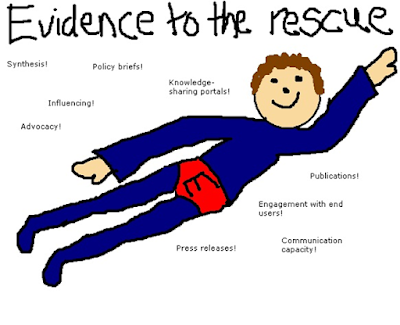
At that moment, a small backstage door hidden in a corner of the shop opened and a bold bespeckled man stepped out, fully dressed in a superhero outfit with bright blue tights and top (that looked a bit too tight), over which she wore red underpants featuring a large letter ‘E’. Ana Lyst didn’t know what to make of this man, but he looked friendly enough and was walking over to her to offer his services. As the man came closer, he produced a large set of antique brass keys from beneath his cape and began opening several doors. “Are you a bit lost?”, asked Evidence Man (for that is who he was) in an accent with a Dutch lilt. “Stuck between here and the outside world? Not to worry! I know the way out to some safe spaces with a friendly audience who would love to hear all about the books you just bought. They would even be interested in the ones that are not ready yet, and they might have a few books of their own to share with you. Shall we go?”

True to his word, when Ana stepped through the first door unlocked by Evidence Man, she emerged back in the now snow-covered high street, where a group of her friends were waiting and, even better, one of them was carrying a large plate of mince pies! Ana Lyst’s spirits lifted immediately, and she vowed to tell her friends all about the helpful Evidence Man in the bookshop. But when she turned around, the nice man had disappeared and through the windows of the bookshop could be seen flying to assist another confused customer.

The End.


The power of storytelling for scientific communication


I was inspired to write this Christmas tale (and blog) after attending a storytelling workshop at the Fuse end-of- year social event on 3 December, which was led by Duncan Yellowlees. Duncan is a Communications Trainer who works with researchers to improve their communications, confidence, and impact. Take a look at his online COMMunity website (Research Comms … but better) to find out more. 

In an engaging and entertaining way, he took us through the key elements of storytelling: from key principles (putting pictures in people’s heads; construct a narrative of causes and effects), to different types of stories (metaphorical, motivational or monster stories, stories as hooks, and point-of-view stories), their structures (problem, solution and results) and what to include in stories (the point, examples, people, heroes & villains, magical helpers, and tensions & conflicts). Did you spot any of these elements in my story? Scroll down to the bottom of this post for spoilers.

Overall, Duncan provided plenty of tips and tricks on how we can use storytelling as academic researchers to communicate our research findings to wider audiences. And this relates directly to the first point (and story) that he made during the workshop: researchers spend too much time throwing the ball (their research findings) but not nearly enough time on making sure there is someone there to catch it (knowledge users). Find your audience first and make them pay attention before you start talking about your research.

His second point was that all this might seem daunting: so many different techniques, plot lines and structures to think about, how can we ever get any good at this? But when comparing it to learning to drive a car, the same principles apply: keep practicing and it gradually (and sometimes quite quickly) becomes second nature. This is because storytelling is already embedded in everything we do in our daily lives: from telling our family and friends about our everyday experiences, to reading books or ‘binging’ on Netflix series.

Finally, Duncan suggested some simple techniques for storytelling in science communication: making stories relatable and relevant (e.g. stress before Christmas) by including named people and adding details (e.g. dark, snowy high streets and describing the interior of the bookshop), which start to paint a picture in people’s heads. Most importantly, start with a hook: a story to draw in your audience, so they want to hear more, or use a question or bold statement as bait (e.g. only 14 percent of research makes it into practice and policy after 17 years).

My story might not have been all you hoped for this Christmas, but the Fuse social event brought some useful gifts for the Fuse Communications toolkit and much needed festive cheer at the end of another challenging academic year. 

Merry Christmas everyone and happy storytelling!


Spoiler alert:
  • The point: knowledge mobilisation between academia and practice is facilitated by a knowledge exchange broker. Plus some points about the time it takes and difficulties faced by researchers when trying to get research into practice and policy.
  • Heroes: academics producing research and papers, while running between bookshelves.
  • Villain: Bookshop clerk (Reviewer 2).
  • Magic helper: Evidence Man (Knowledge Exchange Broker)
  • Tensions & conflicts: research dusting away on bookshelves or not being ready to leave the building, while access to knowledge users is restricted or confusing.
  • Type of story: metaphorical story, overlapping with stories as hooks (to introduce this blog and talk about the storytelling workshop).

Friday, 22 October 2021

Misinformation, data uncertainty and the cat scale of wellbeing - global lessons on knowledge exchange during a pandemic

Posted by Peter van der Graaf, Associate Professor, AskFuse Research Manager & NIHR Knowledge Mobilisation Research (KMR) Fellow, Teesside University and Roland Bal, Professor of Healthcare Governance at Erasmus University Rotterdam

While the evidence base on successful practices in knowledge exchange is growing rapidly, the COVID-19 pandemic presents unprecedented global challenges. During an online taster event for the upcoming Fuse international conference on knowledge exchange in public health, international experts shared their learning from the pandemic.

Perhaps the biggest challenge during the pandemic has been communication. Governments demanding quick access to the latest scientific evidence to inform their decision making in the fight against COVID-19; researchers dealing with a lack of data and uncertainty in interpreting emerging data on spread of the virus and risks to health; and both struggling with the spread of misinformation on social media and in other places of power. 

In spite of these challenges, awareness of public health and research evidence has increased significantly during the pandemic. Some public health figures, such as England's chief medical officer Chris Whitty, have become household names ("next slide please") and ‘R numbers’ are now common knowledge. We learned to be more flexible in funding, designing and conducting collaborative research, with gold-standards being replaced by ‘good enough’. 

Maureen Dobbins from the National Collaborating Centre for Methods and Tools within McMaster University in Canada, demonstrated how they were able to develop new synthesis methods and dissemination plans with local government to mobilise evidence for decision making within less than a month. For example, they conducted a rapid review on household food insecurity for the Public Health Agency of Canada with support from Public Health Advisor Leanne Idzerda. They dealt with uncertainty in these rapid reviews by grading the evidence by asking: ‘How likely are the findings to change with more evidence?’

As professionals, we learned to deal with the uncertainty of data by making better use of our personal connections. Roland Bal from the School of Health Policy and Management at Erasmus University in Rotterdam showed how Dutch clinicians mobilised their informal network of colleagues at the local, regional and national level to coordinate beds for COVID-19 patients across hospitals in the Netherlands and reduce uncertainty about available intensive care unit capacity. This resulted in a dedicated bus service for transporting patients between hospitals.

Existing monitoring and coordinating structures between hospitals no longer worked in the pandemic and were replaced with new informal ones, in which emotions and politics played a much larger part. Roland dubbed this the importance of ‘relational epistemology’ and also drew attention to the ‘dark side’ of these new coping strategies, where people outside these relational structures were seldom heard and the patient voice and experience not included. 

However, researchers also developed new ways of engaging with their partners in research. For example, Jane Powers and Mandy Purington from the Bronfenbrenner Center for Translational Research at Cornell University, USA engaged with youth workers and health care providers in their ACT for Youth project by transitioning to innovative remote and virtual formats, including game and role play, using avatars. Part of these formats is an acknowledgment of the emotional impact that the pandemic has on partners and therefore the need to create a space in these activities to check in on partner wellbeing. Perhaps their greatest innovation is the ‘cat scale’ which Heather Wynkoop Beach from the Bronfenbrenner Center introduced during the event - which cats represent you today?

Finally, policy makers, professionals and researchers have had to learn to deal with misinformation about COVID-19. Peter Lurie, President of the Center for Science in the Public Interest, in Washington, D.C., USA showed that the actual amount of primary misinformation about COVID-19 is very small but can do plenty of damage, due to many people simply referring to it online. Of the 479,225 articles he found in his review on COVID-19 vaccines in a wide range of media outlets, only 3.7% contained misinformation, and of those only 3% contained what he called ‘primary misinformation’, with the vast majority of articles simply referring to a very small number of primary sources of misinformation. However, some of these articles were sent to more than 400 million subscribers, indicating that the reach of misinformation can be vast!

C-WorKS: COVID-19 Consequences – Want it? or Know it? Share it!
To counteract misinformation and lack of knowledge, Mia Moilanen, who works as an Analytical Programme Manager at Public Health England* in the UK, demonstrated an online knowledge sharing platform called C-WorKS, which was developed during the pandemic. On this platform, health professionals, service commissioners and academic researchers across North East England and Yorkshire share knowledge, expertise and resources on the non-COVID consequences of COVID-19 (e.g. delayed representation of other health conditions, mental health and increasing health inequalities). So far, over 700 members have shared more than 300 resources through C-WorKS.

What the pandemic has taught us more than anything, is the importance of collaboration: to work together to find solutions and that, during public health crises, we need to find new ways of connecting knowledge users, producers and brokers. This requires flexibility in roles, structures, research methods and funding arrangements, which will have a lasting impact on the future of knowledge exchange in public health. We hope to address the complex challenges faced during the pandemic, what we have learned about knowledge exchange, and how we can use this knowledge to improve research and practices in the future at the Fuse conference next year in June in Newcastle, UK. We can’t wait to see you there!

*Public Health England has been replaced by UK Health Security Agency and Office for Health Improvement and Disparities

Watch a recording of the online taster event below


Images:
  1. Capture from the BBC News website, 19 December 2020. Covid at Christmas: 'Chris Whitty is more popular than Britney Spears'. Source: TWISTED PICKLE. https://www.bbc.co.uk/news/uk-55333205

Friday, 18 June 2021

When, what and how to engage and disseminate research evidence during a pandemic?

Posted by Peter van der Graaf, Teesside University, Jenni Lynch, University of Hertfordshire, and Liz Such, University of Sheffield, three NIHR Knowledge Mobilisation Research Fellows

In this blog, we share lessons from working with local authorities on the development of action learning sets (bringing people together to reflect on research evidence) when they are faced with the many challenges of COVID-19.

Why do we need action learning? 
(Best-laid plans)

We know that local authorities value research evidence to improve their decision-making about public services in times of austerity; however, making evidence fit for purpose and getting it actively used in local government remains challenging.

So, we decided to test a potential new approach to knowledge mobilisation by convening and supporting action learning sets (ALS) across three local authorities (Hertfordshire, Gateshead and Doncaster Councils). This was supported by the NIHR Centre for Engagement and Dissemination (NCED), which not only aims to share knowledge and outputs from NIHR-funded research, but to develop the evidence base about “what works” in knowledge mobilisation.

The ALS would bring together a group of approximately 15 stakeholders in each local authority, including public health and social care commissioners, front-line practitioners, third-sector representatives, service users and local academics to reflect on research related to a priority topic of their choice. Using deliberative dialogue, including structured questioning and reflection, participants explored different types of knowledge and relationships between knowledge producers, users and mobilisers. By applying this approach, the ALS aimed to help mobilise research and other forms of knowledge on wellbeing and equity in local government into collectively agreed action plans.

As we started discussions with our local authority partners in Spring 2020, the full implications of the COVID-19 pandemic hit. Despite various attempts to start the ALS we regrettably had to decide to abandon the project in its current form. In this blog, we share our lessons from working with the local authorities on the development of ALS during a pandemic and what this means for future knowledge mobilisation activities from NCED when engaging with public health and social care. Our reflections focus on the when, what and how of knowledge mobilisation with local authorities.

Research capacity during a pandemic: unethical conversations? (When)

What the pandemic taught us is that when public health and social care research is most needed (e.g. to inform the response to COVID-19), capacity for using this research is very limited. With local authority staff being spread thin and reassigned to other parts of their councils, it was not feasible and even borderline unethical to ask them to join and prepare for action learning set (ALS) meetings. In particular senior staff within local government, who are key participants for the ALS, were in some cases absent from our early conversations. A serious question was posed: 
"How could we mobilise research evidence to help local government in their response to COVID-19, when they hadn’t got the time or mind space to even look at a one-page summary brief?"
We tried to make the process more accessible by moving the ALS meetings online, involving smaller groups to optimise interaction (five instead of 15 participants) and shorter sessions, with individual activities and reflection time between sessions. This helped to some extent to engage with local authority partners, but the capacity problem remained and even short online meetings where often not feasible for senior staff. However, it illustrated the value of a blended approach to ALS with a potential combination of online and face-to-face sessions to allow stakeholders to engage differently at various times in the process. We also urged them to consider topics that were immediately relevant to their current situation, e.g. working virtually through the pandemic.

The need for relevant evidence (What)


The Hertfordshire County Council Social Work team chose to reflect on how to interpret the Mental Capacity Act and apply strengths-based approaches when discharging patients from hospitals into the care of local authorities (discharge to assess pathways). Strengths-based approaches are a collaborative process between service users and providers to determine an outcome that draws on the person’s strengths and assets. We found a small number of NIHR funded studies but also identified useful knowledge from other sources, such as a Health Services and Delivery Research (HS&DR) Evidence Synthesis Centre Topic Report, which provided a systematic review of evidence on different strengths-based approaches within adult social work, and guidance documents produced by a law firm.

Knowledge Mobilisers Assemble!
Similarly, Gateshead Council selected the topic of community-based approaches to public health, focusing on how to implement these approaches with staff within the Council across different departments by applying a whole system approach. We were able to identify relevant work through our network of NIHR-funded Knowledge Mobilisation Research Fellows. For example, researchers at the University of Hertfordshire had teamed up with Hertfordshire County Council to set up a whole systems programme team and developed a joint masterclass on the topic that summarised the latest evidence.

This illustrated a need to tap into a wide range of databases that included studies and evidence from sectors beyond health and links to a network of knowledge mobilisers to access ongoing work and publications that were not routinely published on scientific databases. We plan to support this in the development of our own website as Knowledge Mobilisation Research Fellows united in the Knowledge Mobilisation Alliance.

Localising and tailoring of evidence: the value of dialogue (How)

Thirdly, our conversations with partners about the planning of the action learning sets (ALS) demonstrated that local authority staff value conversations with academic researchers about the meaning of research and how-to tailor evidence to their local needs. Evidence is made fit for local commissioning and planning purposes by localising it (relating evidence to local context and needs) and tailoring it (presenting actionable messages). ALS provide a mechanism for this translational activity and a collaborative space for local authority staff to take time out from their busy jobs and reflect on research evidence (and other types of knowledge).

Constructive dialogue was seen as most useful in supporting decision
 making, instead of researchers parachuting in with findings   
Various staff members in local government who we talked to were already research active, engaging with research through conferences and some by undertaking PhD studies themselves. They were already mobilising local intelligence, national data and tacit knowledge in their decision making. Instead of academic researchers parachuting in with their research findings, constructive dialogue about the meaning of different types of knowledge - and where researchers and practitioners worked together as equal partners - was seen as most useful for supporting local government decision making. Facilitated conversations over a series of meetings would enable them to effectively blend different types of knowledge together to inform the commissioning of health and social care services.

Being humble and open to challenge and dialogue are key components of any knowledge mobilisation strategy for engaging with local authorities and dissemination of health research findings.


More commentary on action learning sets and engaging with local authorities in knowledge mobilisation below:
  • Van der Graaf P, Cheetham M, Redgate S, Clare H, Adamson A. Co-production in local government: process, codification and capacity building of new knowledge in collective reflection spaces. Workshops findings from a UK mixed methods study. Health Research Policy and Systems. 2021 Jan;19(12). https://rdcu.be/cesKm
  • Van der Graaf P, Blank L, Holding E, Goyder E. What makes a ‘successful’ collaborative research project between public health practitioners and academics? A mixed-methods review of funding applications submitted to a local intervention evaluation scheme. Health Research Policy and Systems. 2021 Jan;19(1):1-3. https://rdcu.be/cdWGC

Images:
  1. "… of Mice And Men …" by Kristian Bjornard via Flickr.com, copyright © 2010: https://www.flickr.com/photos/bjornmeansbear/4294131461 (CC BY-SA 2.0)
  2. Pat Loika, CC BY 2.0, via Wikimedia Commons

Friday, 9 April 2021

Feeling like an imposter? Learn to get comfortable with ambiguity

Peter van der Graaf, Fuse Knowledge Exchange Broker, Teesside University and Travis Sztainert, Knowledge Mobilization Specialist, Frayme

Do you ever feel like your lack of ability or knowledge is going to be exposed? In that case, you might suffer from Imposter Syndrome! Knowledge Mobilisers work across boundaries and are asked to perform tasks that they don’t feel “qualified” for, triggering feelings of anxiety and failure. What causes these feelings and how can we overcome them? In an attempt to answer these questions, we compared experiences across the pond by reflecting on our roles as Knowledge Mobilisers in Canada and in the UK. We argue that these feelings should not be avoided but harnessed by turning imposter syndrome into a useful repertoire for the role.

"Piled Higher and Deeper" by Jorge Cham www.phdcomics.com


In March the annual UK Knowledge Mobilisation Forum took place, which brings together practitioners, researchers, students, administrators and public representatives who are engaged in the art and science of sharing knowledge and ensuring that it can be used. This year, the Forum was held online for the first time, and one of the sessions was dedicated to interactive posters. Participants could preview posters in GoogleDocs and leave comments and questions for the presenters, who were later interviewed to respond to the feedback left on their posters.

In our poster, we explored why Knowledge Mobilisers are particularly prone to feelings of being an imposter. They work in a competitive specialist profession; everyone strives to be a guru, but at the same time their work occurs in the background. It often goes unrecognised if done well (and shows up particularly bad if it fails!) but is time-intensive with work often being unclear, making it feel like you’re not moving forward.

Our poster - see the full version here


Developing trusting relationships between knowledge producers and users often requires complex and lengthy conversations, which only increase the risk of being exposed as an imposter. At the same, there are limits to collaboration (not everybody wants to work together or share their knowledge), which can add to feelings of failing at your job as a knowledge broker.

Moreover, the role requires you to be a neo-generalist with varied expertise and, therefore, there is always more to learn. Organisational change and consequently personal change (the one certainty of working in the health and care sector) are always on the horizon, meaning that you have to continuously adapt your role. In addition, system changes often change the knowledge and evidence that is required by users and this increases transaction costs (time and resources spent on adapting knowledge) for boundary workers.

However, there is a lack of ‘professionalisation’ of the field and training is scattered: this can make you feel like you’re missing essential skills and knowledge. During the poster session we conducted a quick poll to ask how many participants had received formal training in knowledge mobilisation: 83% had not. Or as one of the participants summarised: Knowledge Mobilisation is a Cinderella service. Being undervalued by funders, universities and professional organisations means you are often faced with a lack of resources and unable to do your job. In fact, it is often expected that Knowledge Mobilisation can be done “off the side of the desk” or in addition to work as a researcher or policy maker. Thus, a paucity of time and space is set aside to adequately tackle complex issues.

To overcome these challenges, the first rule of Knowledge Mobilisation is that you need to be comfortable with ambiguity. Feeling like an imposter is not (in itself) bad, is a normal part of the learning process, and can be harnessed. Skills are most often developed on-the-job, and feelings of imposter syndrome can help drive you to learn more, do better, and be open to new concepts and experiences. Overconfidence can lead to a lack of insight into your weaknesses, which in turn can lead to actually becoming an imposter. Accept that you have shortcomings and areas for improvement. It’s okay not to know what you’re doing, or not to have all the answers. Think of yourself as an enthusiastic learner who is gaining experience and expertise - imposter syndrome will help you to stay humble.

Being open and honest about not having all the answers can actually be seen as a strength. As one participant pointed out in response to the poster: it helps to level power differences between partners by showing that you don't hold all the power (and are human like everyone else) and therefore empowers those working with you. It's ok for them not to know it all too and therefore may prompt questions that people may otherwise have been afraid to ask, leading to more open conversations, and strengthening relationships and trust. It can also mean that, when you are sure of answers, others know that they can trust you because you have previously shown that you would not say you knew something when you did not.


Participants described this as a cyclical process, where feelings of imposter syndrome drive new learning, which increases your confidence to go into new situations that lead to fresh experiences of imposter syndrome, starting the cycle again. Forum members also emphasised the importance of operating as a team: the vast amount of skills required as a Knowledge Mobiliser (keynote speaker Annette Boaz mentioned connectivity, charm, inclusivity, empathy, creativity, integrity, curiosity, diplomacy and humility for starters), means it is almost impossible to develop these skills as an individual. Teams of Knowledge Mobilisers can bring these skills together and use different skills at the same time.

Moreover, acting like an imposter can be a valuable role: by communicating out of character a knowledge broker can help to make sense of differences in knowledge use. Adapting to the audience and stage required helps knowledge brokers to translate differences in performances between policymakers, practitioners and academics. Knowledge Mobilisers should not fear being an imposter but instead learn to embrace imposter syndrome!


If you are interested in learning more about imposter syndrome in knowledge mobilisation, take a look at:

Friday, 5 April 2019

What fairy tales and pinball machines can tell us about using research

Posted by Peter van der Graaf, AskFuse Research Manager / Fuse Knowledge Exchange Broker, Teesside University

Once upon a time... the UK Knowledge Mobilisation Forum 2019 took place in Newcastle at Seven Stories, the National Centre for Children’s Books. The Forum brings together practitioners, researchers, students, administrators and public representatives who are engaged in the art and science of sharing knowledge and ensuring that it can be used. This year I was part of the organising group and we deliberately chose Seven Stories as location for the Forum with its focus on stories, which are an important mechanism for exchanging knowledge.

5 points awarded to Dan Wolstenholme of House Gryffindor 
The Centre, spread out over seven floors, provided plenty of exercise to get to the different rooms for interactive poster sessions, knowledge fayres, fishbowls and workshops. The Harry Potter themed conference room also allowed me (not pictured right) to dress up as a Ravenclaw student while serving coffee. But the real highlight of the conference for me were the stories being shared by the key note speakers, Ishbel Smith from Heart in Mouth, who reflected on her practical experiences, and Andree le May and John Gabbay from the University of Southampton, who provided an in-depth research perspective. I will relate two of their stories: the first involves a house made of sweets, the second is about a pinball machine.

The power of stories is often underestimated in research but has gained some traction in academia, particularly for evaluating new interventions and because they make great impact case studies. At the same time, it has proven notoriously difficult to capture any impact in a story: we don’t really know what happens to research findings once they leave academia and trying to trace impact is like Hansel and Gretel clinging onto tiny bread crumbs in a large wood.

This brings me to the first story. Ishbel Smith used the story of Hansel and Gretel to highlight that the siblings missed the blindingly obvious (a house made of sweets is too good to be true and likely to be a trap), because they were too focused on the breadcrumbs and did not see the wider picture or context in which they were walking (a deep dark wood inhabited by a hungry witch). As knowledge mobilisers it is vital to understand where we are in a given situation to be able to unlock the relevant knowledge in that context.

Ishbel reiterated that contextual knowledge is just as important as content. Understanding the context in which research evidence is used and, perhaps more importantly, what happens to that evidence in a practice or policymaking context, is vital for mobilising it. To clarify this, Andree Le May and John Gabbay, told a story about how research evidence is transformed by using the analogy of a pinball machine.

In this second story, research evidence gets batted around across various groups of people within organisations as they interact with it. In each interaction, the evidence is slightly changed: people put their own spin on it and adjust it slightly for their own needs. The evidence literally receives a battering but in this process the evidence is made fit for a particular context and socially reconstructed. Like the pinball getting batted around inside the machine, with every contact the evidence changes shape. Perhaps not noticeably at first but you end up with something quite different and unrecognisable from the research evidence that you put into the dissemination process at the start. This means that, if you don’t understand as a researcher that your research findings will be transformed when it is being used by practitioners and policy makers, then you will never be able to find and follow it for your impact case studies.

Andree and John persuasively pointed out that the craft of knowledge mobilisation is not only using the right skills to get evidence into practice, but also to be able to be part of the story of how evidence is used. This requires not only technical skills (which are mostly studied by implementation science) but also the use of soft skills, such as the striking the right tone and style, being able to get your message across and contextualise knowledge; for example, do we know what the right problem and the right solution is for the context in which we are trying to mobilise knowledge?

Perhaps the most important skills we can develop for mobilising knowledge is how to enable learning: what did work and didn’t work in this context? How can we help others to apply research evidence into their own context? Stories provide a powerful tool for this: not to highlight what we have achieved as research institutions in the next REF submission, but to create a space to reflect on our experiences of using research evidence in different practice and policy context. To make these stories impactful, they have to be told by the people who used the research evidence. And we as researchers have to be willing to listen and be able to reflect on them with the evidence users.

Friday, 21 December 2018

The power of cookies

Posted by Peter van der Graaf, AskFuse Research Manager / Fuse Knowledge Exchange Broker, Teesside University

With the festive season upon us, many are looking forward to indulging in a mince pie or two and getting stuck in some extra helpings of turkey or brandy-soaked Christmas pudding. This often sparks some well-intentioned health warnings from public health folk about the risks of overindulging, binge drinking and the increasing obesity epidemic. Not wanting to dismiss these important messages, I would like to focus on a different message in this blog: food as a great tool for knowledge mobilisation (making information useable and accessible through working collaboratively).

If there is one thing that I have learned in my time as AskFuse Research Manager, it is that nothing is as useful as biscuits for bringing people together and contributing to a positive meeting between researchers and health professionals. 

This insight started from my own weakness: I have an incurable sweet tooth and my colleagues and students have quickly learned to exploit this asset for plying me with Dutch liquorice and other delicacies into supporting their requests and theses. So, I decided to turn their own weapons on them, with surprising results.

Stuck in a challenging debate about the usefulness of research evidence for commissioning local health services? Bring some cookies and fruit (to balance; I am a public health researcher after all!) and you will find that conversations all of sudden move in more fruitful directions.

Although my experience told me that cookies are a great conversation starter when brokering knowledge, I did not realise until recently that this was an area of serious academic study. In a recent paper published in Medical Education[1], Michael Hessler and colleagues from the University Hospital of Münster in Germany decided to put the power of cookies to the test and conducted their own Randomised Controlled Trial while delivering an emergency medicine course.

They were worried about the evaluations at the end of their course and suspected that these were not the measures of quality that the University was hoping for. Therefore, they were looking for a ‘content-unrelated’ intervention that would alter their evaluation results significantly and prove that their evaluations were seriously under-baked.

Third‐year medical students (n=118) were randomly allocated into 20 groups, 10 of which had free access to 500g of chocolate cookies during the course sessions (cookie group!) and 10 of which did not (control group). The groups had the same teachers and were taught the same content. After the course, all students were asked to complete a 38‐question evaluation form.

The results were very appetising: the cookie group evaluated teachers significantly better than the control group, they rated the course material as considerably better and overall satisfaction scores for the course were significantly higher. In summary: the provision of chocolate cookies had a significant effect on course evaluation.

One might conclude that course evaluations are seriously flawed but I prefer the ‘cookie-jar-is-always-half-full’ interpretation: providing cookies to participants is a great way to boost results! The German research adds baking powder to my own observations in UK knowledge brokering: cookies are a great way to boost exchange of knowledge and relationship building in conversations and meetings.

The ingredients of each meeting and conversation might be different but they all need a baking agent to rise to the occasion. So, whatever you do this Christmas, if you would like to avoid awkward questions during social and family gatherings about ‘what it is that you do as a researcher’ or ‘when are you finally going to finish your PhD?’, just bring a plate of cookies and subtly but swiftly change the conversation to a sweeter topic.

Happy Christmas!


Reference:
  1. Hessler M, Pöpping DM, Hollstein H, Ohlenburg H, Arnemann PH, Massoth C, Seidel LM, Zarbock A, Wenk M. Availability of cookies during an academic course session affects evaluation of teaching. Medical education. 2018 Oct;52(10):1064-72, https://onlinelibrary.wiley.com/doi/pdf/10.1111/medu.13627

Friday, 16 March 2018

Knowledge mobilisation: relationship guidance for ‘stubborn’ practitioners and ‘smug’ scientists

Posted by Peter van der Graaf, AskFuse Research Manager, Teesside University

Last week, I presented at the UK Knowledge Mobilisation Forum in Bristol, which is an annual event for all those with a passion for ensuring that knowledge makes a positive difference to society. The Forum brings together practitioners, researchers, students, administrators and public representatives who are engaged in the art and science of sharing knowledge and ensuring that it can be used.

Getting creative sticking to ‘unconference’ principles
One of the key note speaker, Dez Holmes who is the Director of Research in Practice with 20 years of experience in championing evidence-informed practice in social care, vented her frustration about a question she was often asked by people interested in knowledge mobilisation (KMb): where can I access training in this? Her response: you can’t! Knowledge sharing is personal and therefore a social skill that you can only develop by practising it.

The skills needed to practice KMb are everyday skills, such as listening, emotional intelligence and persuasion. Reciprocity and mutual respect are crucial in relationships and therefore in knowledge mobilisation. Knowledge mobilisers use these skills to make knowledge relatable and therefore relevant to people’s lives. Dez used a Japanese word to sum up these skills: ‘ikigai’ (meaning “reason for being”): if we can’t relate knowledge to people’s sense of self they won’t be inclined to use it.

Acknowledging feelings in knowledge mobilisation is therefore important, not least because implementation barriers for knowledge are often personal. Dez quoted the common misperception between practitioners and academics that are at the heart of the so-called knowledge-to-action gap: “scientist blame the stubbornness of practitioners for insisting on doing it their way, believing they know their patients best, while practitioners lamented the smugness of scientists who believe that if they publish it practitioners will use it”. These misperceptions signify emotions at work in the knowledge gap that need to be addressed before we can start mobilising knowledge.

A great example of on the job knowledge mobilisation learning was captured in a story told by Vicky Ward, Associate Professor in Knowledge Mobilisation at Leeds University and one of the organisers of the Forum, who reflected on her research about knowledge sharing between professionals in social care. The story, titled ‘Dealing with the carousal of knowledge’, illustrates how practitioners continuously added new and different types of knowledge to their team meetings but never really made use of this knowledge until Vicky started asking some ‘constructively clue less’ questions. These questions helped them to recognise the emotions they attached to the client cases that they were discussing and enabled them to discover patterns in their carousel of knowledge. Identifying patterns allowed the professionals to select knowledge that was most useful for each case and made this knowledge transferable.

The conference format itself acknowledged the relational and context-specific work involved in knowledge mobilisation: participants were encouraged to hone their skills in randomised coffee trials, open space discussions, interactive poster sessions, market stalls, short presentations and practical, interactive workshops. The programme was deliberately based on ‘unconference’ principles, which means that it focused on offering opportunities for conversations, creativity and collaborative learning, with much of the direction being driven by the participants instead of the conference organisers. In this sense, the conference was a training ground for knowledge mobilisers to practice and learn new skills.

Wednesday, 8 November 2017

Spice up your research life: match-making in public health

Posted by Peter van der Graaf, AskFuse Research Manager, Teesside University

Three years ago, we had a crazy idea: what if Fuse had its own dating service for academic researchers and health professionals? Instead of innovative research findings gathering dust on lonely bookshelves, we wanted to provide a stage for academics and health professionals to meet and discuss how that evidence could be used in practice. We were keen to facilitate early conversations on how to collaborate on research that is useful, timely, independent, and easily understood.

Instead of health practitioners wandering around University campuses, trying to find the right academic to work with, we envisioned an open door leading to a welcoming friendly-faced guide. Someone who could do the matchmaking and help them to find or create evidence for spicing up their policies or interventions.

After checking our idea with various health practitioners in the region to make sure that it would make their hearts beat faster, we launched AskFuse in June 2013: Fuse’s very own rapid responsive and evaluation service with a dedicated match-maker (research manager) in post – that’s me!

Coming from an applied research background in social sciences, this post was certainly a challenge but also an incredibility exiting opportunity to develop something new with the support of an enthusiastic group of people across Fuse. The job has been a steep learning curve, but also a great way to meet a lot of people working in public health across the region, getting to understand their passions and … what keeps them up at night.


I quickly learned that there were many great public health projects and programmes being developed and delivered locally that deserved more attention and research (e.g. My Sporting Chance, Ways to Wellness, Boilers on Prescription).  I was encouraged by a real appetite among academics to support this work but felt the frustrations of health professionals caused by budget cuts and the need to decommission services rather than to develop them. I also noticed the limited research evidence informing some of these decision-making processes and the lack of knowledge among academics about how to influence these processes and mobilise their research evidence effectively.

AskFuse has supported more than 270 enquiries from a wide range of sectors, organisations and on topics ranging from Laughter Ball Yoga to Whole Systems Approaches to obesity. We have helped to develop new interventions and evaluated existing ones, made research evidence accessible and understandable, organised events to explore new topics, and pioneered new methodologies; all in collaboration with our policy and practice partners. We have also made mistakes, misunderstood procurement procedures, were not able to help in time, could not find relevant expertise or did not always follow-up on conversations.

Despite these challenges - or perhaps because of them - we have been able to build a dating service that (I think/hope) is perceived as useful by our policy and practice partners, that has helped us to build relationships (even in times of considerable system upheaval with public health moving to local authorities), and has informed new research agendas for Fuse going forward over the next five years as a member of the national School for Public Health Research.

As the service is expanding and my role is changing (I recently became a NIHR Knowledge Mobilisation Research Fellow, which I will talk about in another blog), we are looking for a new AskFuse Research Associate to work with me on strengthening the service and taking it in new directions. If you are interested in mobilising knowledge, fancy a challenge and want to work with a fantastic team, why not be part of it?

Saturday, 8 April 2017

Passionate Advocacy versus Dry Evidence

Posted by Peter van der Graaf, AskFuse Research Manager, Teesside University

Should public health researchers be passionate advocates of their work when engaging with policy makers or should they present their findings in the most neutral way possible, sticking to the facts only (and preferably economic figures) to encourage take up of their research? This question was the focus of a heated debate at the recent national School for Public Health Research Annual Scientific Meeting, bringing together researchers from eight different centres of excellence across the UK and a selection of senior health practitioners at the Royal Society in London.

Chris Whitty: academics should present their findings neutrally
to politicians without making any advocacy statements
The tone for the debate was set by Professor Chris Whitty, Chief Scientific Adviser for the Department of Health, who challenged the audience to be more ambitious in their public health goals. At the same time, he warned academics to play to their strengths: if they wanted to ensure impact of their work, academics should present their findings neutrally to politicians without making any advocacy statements, as this would deter politicians. Advocacy should be reserved for politicians, who in turn are supported by economic advisors. Therefore, academics would do well to present their data in terms of opportunity costs and trade-offs; without solid economic back-up, any evidence claim would be quickly dismissed by politicians, according to Whitty.

This provoked strong reactions from audience members and particularly on Twitter, where a lively discussion ensued throughout the rest of the day. People questioned whether it is possible or even desirable to leave advocacy at the door when dealing with politicians. Some argued that, from a social science perspective, there is no such thing as neutral evidence and that it is our duty as public health scientists to take a stand and advocate against increasing health inequalities. Others disputed the need from politicians for dry evidence, stating that purely evidence based approaches can leave politicians cold without a persuasive narrative. Instead, emotionally informed and narrative research was important to persuade local government. Researchers needed to align themselves with local government concerns and cultures and acknowledge the importance of context to have any impact.

Duncan Selbie: academics should be more ruthless, coordinated and angry
in the interactions with policy makers to get them to act on the evidence
Duncan Selbie, Chief Executive at Public Health England, poured oil on the fire in the afternoon by appealing for the exact opposite to Chris Whitty’s call for more neutrality: academics should be more ruthless, coordinated and angry in the interactions with policy makers to get them to act on the evidence that academics have generated. He encouraged public health researchers to make more use of behavioural science to help policy makers take notice and implement their findings. This provoked several reactions, with some participants highlighting the role that advocacy played in the public health fight against the tobacco industry, while others made passionate pleas on soapboxes for the re-politicising of public health science, arguing that it was unhelpful to divide science and politics into two separate worlds.

The storm seemed to settle towards the end of the day, when Twitter users and audience members started suggesting solutions for the debate, which was dubbed “Passionate Advocacy vs. Dry Evidence”. One suggestion was that public health researchers should develop a ‘horses for courses’ approach: at certain times some people needed to be passionate advocates, while others at different times needed be neutral scientists to get the listening ear of politicians. The different approaches were related to different levels at which politicians operate: local politicians were more persuaded by narratives emerging from research and advocacy, while national politicians valued neutrally presented evidence and data.

Others suggested the use of intermediates to make the advocacy case for public health, such as voluntary community organisations that represent the will of the people, and by focusing research on the key questions that front line workers are struggling with. Or even better, persuade policy makers to become advocates of research evidence!

Overall, participants agreed that science needed to be pushed more up the policy agenda, as research is currently losing out to politics and economics. Therefore, in some circumstance researchers need to consider accept that submitting good enough evidence quickly is better than waiting too long for perfect peer reviewed publications. Furthermore, we need to be aware that different kinds of evidence are used in decision making processes.

My favourite solution was proposed by Professor John Frank, Director of the Scottish Collaboration for Public Health Research & Policy: if you want good policy influencers, you need to change the academic model to produce them. The biggest barriers to knowledge mobilisation are structural and often in academia. As long as we don’t train public health students in engaging with policy and practice partners, fail to teach and reward them in how to use different types of evidence and do not involve them in collaborative research, we will keep returning to this debate for many Annual Scientific Meetings to come.

Thursday, 4 June 2015

Complexity in health organisations: setting ourselves up for chaos or enjoying the simple things in life?

Posted by Peter van der Graaf

Can applying a complexity lens to health organisations be more than an academic exercise with practical applications for service delivery? This question was central to a two-day meeting last week in London at the Health Foundation between researchers, policy makers and health practitioners. The event was organised by The Knowledge to Action Group (KTAG), an international team of senior academics and coordinated by two leading members of Fuse’s Complex Systems research programme, Prof David Hunter and Dr Emily Henderson. The group brought together the crème de la crème of health research and knowledge mobilisation, with about 40 handpicked participants from across the UK to debate a green paper on the topic (which is a tentative government report and consultation document of policy proposals for debate and discussion).


The essence of this meeting was about getting to grips with the consequences of doing research and developing interventions in a world that is inherently complex (which is not to be confused with just being complicated!). The green paper (Knowledge-to-Action: Addressing Complex Problems in Health Systems, May 28/29 2015) described complex systems as non-linear; dynamic; and having no single point of control.  Because of these characteristics, outcomes in a complex system are unpredictable and resistant to interventions. So are health systems really complex? Anyone trying to get research evidence into practice will quickly discover that knowledge mobilisation is prone to all the characteristics outlined above for complex systems.

In one of the breakout sessions during the event the difference between complicated and complex was illustrated with the example of building a rocket versus raising a child.  Building a rocket is complicated but will lead to a predictable outcome (successful launch) if all the different pieces are correctly assembled according to the guidebook. However, raising a child is complex (as many parents will testify) and often leads to chaos in many academic households. This is bad news for academic parents and health service managers: you cannot steer the thing (but you are still accountable for it) and even if you find the solution to a problem in the system it is likely not to work when you try it again. The dynamic nature of systems means that what works in one context or at one point in time may not work the same as the system changes.

How do you work within such a system? Fortunately, the event provided four case studies of research projects where the academics had managed to work within a complex health system to produce change across different areas, often in co-production with policy makers and health practitioners. The authors of the green paper distilled four themes from these case studies to inform future research and interventions:

  1. the balance of central and distributed authority in organisations and systems; 
  2. the importance of emergence (continuous learning and adaptation); 
  3. the need for co-produced knowledge; and 
  4. a range of leadership positions and styles.
These four themes were discussed in more detail in various breakout sessions over the two days.

Participants embraced the spirit of the event and discussed a wide range of topics (from the need for a critical discourse department to finding positive deviants), whose relationships with the four themes were sometimes unclear and mostly unpredictable. Nevertheless, some key messages emerged from the event that will soothe the nerves of academics and service managers. By visualising complex organisations as “patterns of conversations between interdependent individuals” (as quoted in a presentation from Allan Best on the first day), working in complex systems becomes conversation management and engagement. According to the researchers involved in the successful case studies, this works all the better outside the normal context of everyday work by taking commissioners to the pub or baking a cake for a meeting with service managers to get the conversation really going. Isn’t it ironic that to work inside complex systems, one needs to go back to basics in a more simple system?