Showing posts with label involvement. Show all posts

Friday, 19 December 2025

Spark ideas, inspire change and fuel innovation - sharing research creatively

Posted by Ella Anderson, Fuse Public Involvement and Engagement Manager, Newcastle University

Have you ever wondered how to share your research in a way that engages with new and diverse audiences? Are there ways to share your work in a way that reaches the people it was designed to serve? If the answer is yes, then read on!

Research can spark ideas, inspire change and fuel innovation but all too often it gets buried in academic journals and dense reports that few people read, particularly the communities the research intends to serve. So what if there were more engaging, creative and accessible ways to share your findings? From interactive infographics and animations, to events, theatre and podcasts, Fuse researchers are re-imagining how to communicate their work with wider audiences.

Whether you are looking to captivate the public, influence policy makers or engage fellow experts, this post explores some creative ideas to make your research truly resonate.
  • In the first instance, reach out to any people who you have worked with as part of your research including public partners, young people, charities and voluntary organisations. What would they like to see? Actively liaise with and listen to the communities your research is intending to serve - how do they want findings presented?
  • Infographics and visual summaries can be a useful way to transform your findings into a simplified visual. Infographics are a graphic representation of information, data or knowledge to present complex content quickly and clearly. Emma Adams has worked with More than Minutes to summarise research about co-located services in a visual and accessible way. Steph Scott worked with Nifty Fox - specialists in visual storytelling - to produce a flipbook drawing on content from the ‘Divided Households’ report relating to children and parental imprisonment. Fuse Deputy Director Amelia Lake, Shelia Visram and team co-produced the Hyper Energy drink leaflet with young people to communicate key findings. Or what about a zine (DIY-style booklet or magazine) like this, ‘Moving Spaces’, co-produced by Caroline Dodd-Reynolds with LGBTQIA+ young people, exploring how physical activity spaces could be more joyful and safe.
    • Theatre and performance is an exciting way of communicating research. For example, Cap-A-Pie and researchers including Mandy Cheetham were involved in developing an emotive theatre production called Credit, based on stories and experiences of people living on Universal Credit.
       
    • Creative and engaging community events and workshops (with catering if you have budget!) are always a popular option. The more interactive, accessible and collaborative the better. Use the opportunity to close any feedback loops with people, charities, organisations who you have engaged with throughout the research. Show how you listened, what you found out, how findings are applicable to people's lives and work, and what happens next... keeping people in the loop is so important. Be sure to include opportunities for plain language Q&As and conversations, both informal (through breaks) and formal (via panel discussions). At one of Fuse’s International Women’s Day events, there was an optional gong bath for people attending the event. Although a sound bath may not have been directly linked to the research, the event was about creating a welcoming, inclusive and ‘safe space’ for people to come together.
    • If you have the budget, consider having an event doodled in real-time. We have had colleagues who have worked with Camille Aubry, Josie Brookes and Nifty Fox who offer this skill. Get in touch with us if you would like any other recommendations when sourcing quotes.
    • Have you thought about gamification of research findings or using interactive digital tools? You can create interactive quizzes or clickable maps to allow people to explore findings in an engaging way, applying insights to local contexts. Simulation tools allow public partners and individuals to visualise the impact of different public health interventions based on research findings. Take a look at Joanne McGrath's online Maze, which provided an interactive resource portraying women’s narratives of multiple exclusion, homelessness and accessing support.
    • Storytelling has long been a way to share information. Case studies lend themselves well to this, as human-centric narratives show the research in action. It can demonstrate how a specific person or community has benefitted or will benefit from the findings. Stories are a different way to 'humanise' data or translate findings in a way that is appropriate for the intended audience. For example, Cassey Muir and Ruth McGovern’s co-produced Twinkle Twinkle Arti children’s story book communicated messages about parental substance use in a gentle, age-appropriate manner. The book is available as a physical copy, an electronic copy and also has been made into a CBeebies style story time video.
    • Are there any opportunities for the use of creative methods throughout the project that you could bring together as part of an exhibition in a public space e.g. library, community centre, schools? Documenting the research and experience through photography, crafts or art can be a creative way of capturing interest and making research more understandable. Sarah Martin-Denham’s crochet blanket made up of 2,999 squares representing the number of children excluded every day from schools in England (2021/22 academic year) is a great example of this, and has been on a national tour engaging with 24 organisations - including the Children’s Commissioner Office and multiple councils.
    • You can share bite-sized research or findings through social media channels using visuals, animations, short videos - or even livestreaming to provide information and engage with people in real-time. Have a hashtag at the ready to encourage people to join the conversation and share perspectives. In a similar vein, there are opportunities to share research and knowledge via 'Ask Me Anything' style forums, for example as seen on Reddit. Yes, this is low cost but it comes with risks as questions are unpredictable! However, it is worth flagging as an option and is a creative, ‘non-traditional’ way to share research and answer questions.
    • Blogs, like the award-winning one you are reading right now, are a great way to share your research. Posts can make complex information more accessible to a wider audience. It allows you to present findings in a clear, engaging and informal style, reaching readers outside of academic circles, including policy makers, practitioners and the wider public. For guidance and support in writing your own blog post, contact Fuse Communications Manager, Mark Welford: m.welford@tees.ac.uk.
    • Could you take your research findings to places in the local community? Fuse colleagues Balbir Singh (Artistic Director of the Balbir Singh Dance Company) and Paul Chazot displayed art works from their Unmasking Pain project in pop-up displays in GP surgeries and a repurposed shop in a shopping centre. There is now a dedicated space at the Grainger Market, Newcastle-upon-Tyne called the Being Well Place, which is a place to connect and engage with the local community.
    • Do you have the option of translating materials/outputs for different audiences, and communities with diverse language needs? Translated summaries and visuals e.g. in multiple languages, work well and ensure inclusivity in dissemination. For example, Nicola Heslehurst worked with local designer, Twentyseven Design to develop English and Welsh infographics relating to pregnancy outcomes.
    • And finally what kind of Fuse Public Involvement and Engagement Manager would I be if I wasn’t promoting the wonderful and award-winning public partner-led podcast Public Health Research and Me?! Accessible, informative, flexible and friendly - this is a great way to share quality research with a diverse and international audience. 

    There are many more creative ways to share research and remember - there is a no ‘one-size-fits-all’ approach to sharing your findings. Always take into account your research topic, your findings and above all your target audience.

    Why not send us a message today if you have used a creative or innovative way to share your research or findings? We would love to hear from you and find out more ways to promote and share high quality research.


    Following strong interest from Fuse members, we have launched a Community of Practice (CoP) focused on creative research, involvement and dissemination.

    The first meeting will take place in the New Year. Places are limited for the first event but please register or get in touch (info@fuse.ac.uk), as there will be plenty more opportunities in future!

    A CoP is a network of people who share common interests and goals, creating a space for knowledge exchange, learning, and mutual support.

    Friday, 3 May 2024

    How volunteering at 'biscuit club' helped me build bridges between parents and researchers

    Posted by Ella Anderson, Fuse Public Involvement and Engagement Manager, Newcastle University


    “volunteering feels like the morally right thing to do – we can’t just ‘take’ from groups and not offer something in return”


    MumSpace volunteers together
    Supported by the Newcastle University’s staff volunteering scheme and Fuse colleagues, I had the opportunity to volunteer with MumSpace. As Fuse’s Public Engagement and Involvement Manager, this meant that I could spend some time away from my desk learning more about the voluntary sector within a grass roots organisation, build sustainable community relationships, collaborate with volunteers who have valuable connections to local communities and, above all, help out in a way that was specific and useful to the needs of the community group.

    What is MumSpace?

    MumSpace is a warm, welcoming and inclusive community group for parents, carers and their little ones. Here, the focus is on building supportive networks and providing children with a safe space to play. MumSpace is part of Parents and Communities Together (PACT), set up by Citizens UK. PACT was first set up in London as a community-led social support project and has since been successfully piloted in North Tyneside too. The project aims to empower parents and improve the health and development of young children.

    The community group meets twice a week in North Tyneside during term-time. There is no cost to attend, although it’s possible to leave a small optional donation that goes towards drinks and snacks.

    Toy time at MumSpace
    Why did I choose to volunteer with MumSpace?

    There are both personal and professional reasons why MumSpace was an obvious choice as a place for me to volunteer. On a personal level, I was lucky enough to attend MumSpace myself with my two children, in particular with my little boy. I always found this to be a welcoming space, no matter how I was feeling or what kind of day I was having. It was a place where you could chat with other parents and carers or just have a quiet cuppa whilst your little one whizzed about and played. I have made some brilliant friends at this group and I witnessed first-hand the value groups like this have on people’s wellbeing. It felt like the natural thing to do to give something back.

    When I joined Fuse in 2021, I was already a regular at MumSpace with my son. Every week, there would be new faces and new people to speak with. It was evident that everyone’s experiences and backgrounds were unique - the one constant was that we were all caring for a little person. Each parent or carer has their own story, and it shows beautifully how one person alone cannot represent all thoughts, feelings and experiences of an entire parenting community. It was this diversity of experience that I could see would be a valuable addition to the Fuse Public Partner Network, as we seek to celebrate and share a wide range of voices and experiences in public health research.

    In some ways, it felt like a natural next step to see if the group organiser, Wendy McConnell, might like to talk about involvement in public health research. Nevertheless, I admit that I felt a little nervous speaking with Wendy about a possible collaboration with Fuse, not least because I didn’t want to change the general feel of this space that felt miles away from my ‘work life’. But I needn’t have worried. Wendy and I chatted easily about our respective roles, about Fuse more generally, and about how there might be opportunities for working together. It felt a bit strange to be talking about work whilst at the same time chasing after my 4 year-old and trying to encourage him to play with the toys rather than steadily work his way through all of the biscuits on offer. After all, this was the group he fondly called “biscuit club”...

    Looking back, I suspect that it was this informal and gentle approach - building on an existing foundation of trust and knowing one another - that in turn has made the relationship between Fuse and PACT more meaningful and fruitful.

    MumSpace disco
    How has MumSpace been involved with Fuse?

    Wendy, PACT and the MumSpace parents and carers have played a significant role across a number of public health research projects. Wendy, for example, originally joined as a Fuse Public Partner in a personal capacity. But her role as a Parent and Community Organiser also lends itself well to building bridges between members of community groups and researchers. For example, parents and carers from MumSpace are collaborating on a project around poverty-proofing maternity services, have contributed to research around barriers to returning to work and childcare costs, and a researcher will be visiting the group in May 2024 to discuss a new project relating to food insecurity during pregnancy. Wendy has also spoken at a Fuse Public Involvement and Engagement Group meeting to share what it was like to belong to a community group involved in health research and to reflect on the associated benefits.

    Mam’s time
    What have the benefits of involvement in research been for the group?

    Wendy explained that benefits of involvement have included the feeling of empowerment for parents and carers, feeling ‘heard’ and making positive changes, for example to services. There have also been benefits from collaboration with researchers, for instance, the development of a formal evaluation of MumSpace. This evaluation played a key role in securing new funding* to continue running the group. This demonstrates that research relationships can be positive for all involved. It also shows how reward and recognition for involvement can extend beyond remuneration – there can be other ways for university-based researchers to usefully and meaningfully ‘give back’. Volunteering can fall into this category too.
    Arts and crafts

    Has volunteering been useful for building relationships within community groups?

    There have been notable benefits to Fuse and wider health research as a result of the volunteering and community engagement activities with MumSpace. It has helped to build trust; shows a commitment to truly listening to people and their stories; acts as a gentle stepping-stone towards the inclusion of diverse voices and perspectives within the Fuse Public Partner Network; and offers a greater sense of transparency about what involvement in health research is and what it can look like. It aligns with many of the core principles of the NIHR Community Engagement Toolkit. Newcastle University have also added PACT as an organisation who university staff and students can volunteer with in the future, so even after I have left there will be opportunities for continuity. In short, volunteering feels like the morally right thing to do – we can’t just ‘take’ from groups and not offer something in return.

    What has it been like to volunteer?

    Volunteering has been an incredibly positive and rewarding experience. To be on the ‘other side’ of the group and helping to set up, offering people what would often be their first teas and coffees of the day, and welcoming new people to the group and then seeing them return the following week has been brilliant. I can still only remember a maximum of two drink orders at a time (!!) but I hope people have felt as welcome and included as I did when I first joined.

    Want to find out more? Get in touch!

    For more information, please email Ella Anderson, Fuse Public Involvement and Engagement Manager on eleanor.anderson@ncl.ac.uk.

    For more information about MumSpace, PACT and Citizens UK in particular, email Parent and Community Organiser Wendy McConnell: wendy.mcconnell@citizensuk.org

    New faces are always welcome at the group:

    Tuesdays – 12.30pm to 2pm at St. Luke’s Church, 10 Frank Street, Wallsend NE28 6RN
    Thursdays – 9.15am to 11.15am at St. Cuthbert’s Church, Albion Road West, North Shields NE29 0JB


    *From March 2020 to August 2023, MumSpace was funded by Comic Relief and, following a successful funding bid, it is now funded by Public Health North Tyneside.

    Friday, 30 September 2022

    Going beyond research to empower involvement and smash stereotypes

    Posted by Sheena Ramsay, Professor of Public Health & Epidemiology, (and team: Emma Joyes, Emma Adams, Laura McGowan) in collaboration with Fulfilling Lives Newcastle Gateshead Experts by Experience

    The way researchers approach some groups is often not sensitive to or inclusive of their needs. For example, the information can use technical language (such as ‘licit substances’ or ‘quasi-experimental’) which can be difficult to understand and off-putting. This can lead to people not wanting to take part in studies. Which means that new research insights, including changes to practice, can exclude those who are often most impacted.

    Over the last two years, we have been working with Fulfilling Lives Newcastle Gateshead and their Experts by Experience Network of individuals with lived experience of multiple disadvantage. We have explored perceptions of services and programmes relating to oral health and related health behaviours - such as substance use, smoking, and diet - for people who experience severe and multiple disadvantage (a combination of homelessness, substance misuse, and offending). From the beginning, the Experts by Experience Network has shaped our work and helped us ensure it is accessible to those we want to speak to the most.

    One of the ways that the Network has shaped our research is by helping us to create a video to help reach out to potential participants for our research - particularly people who are often excluded in research studies, such as people experiencing homeless.


    Our team worked with the Experts by Experience Network to look at ways to get people involved in the research. We wanted to work with those who had insights into the issues we hoped to study, so that we could communicate the research in a way that would resonate with people. Together, we co-created an animated video as a means of reaching out to people, so they could find out about the research and how to take part.

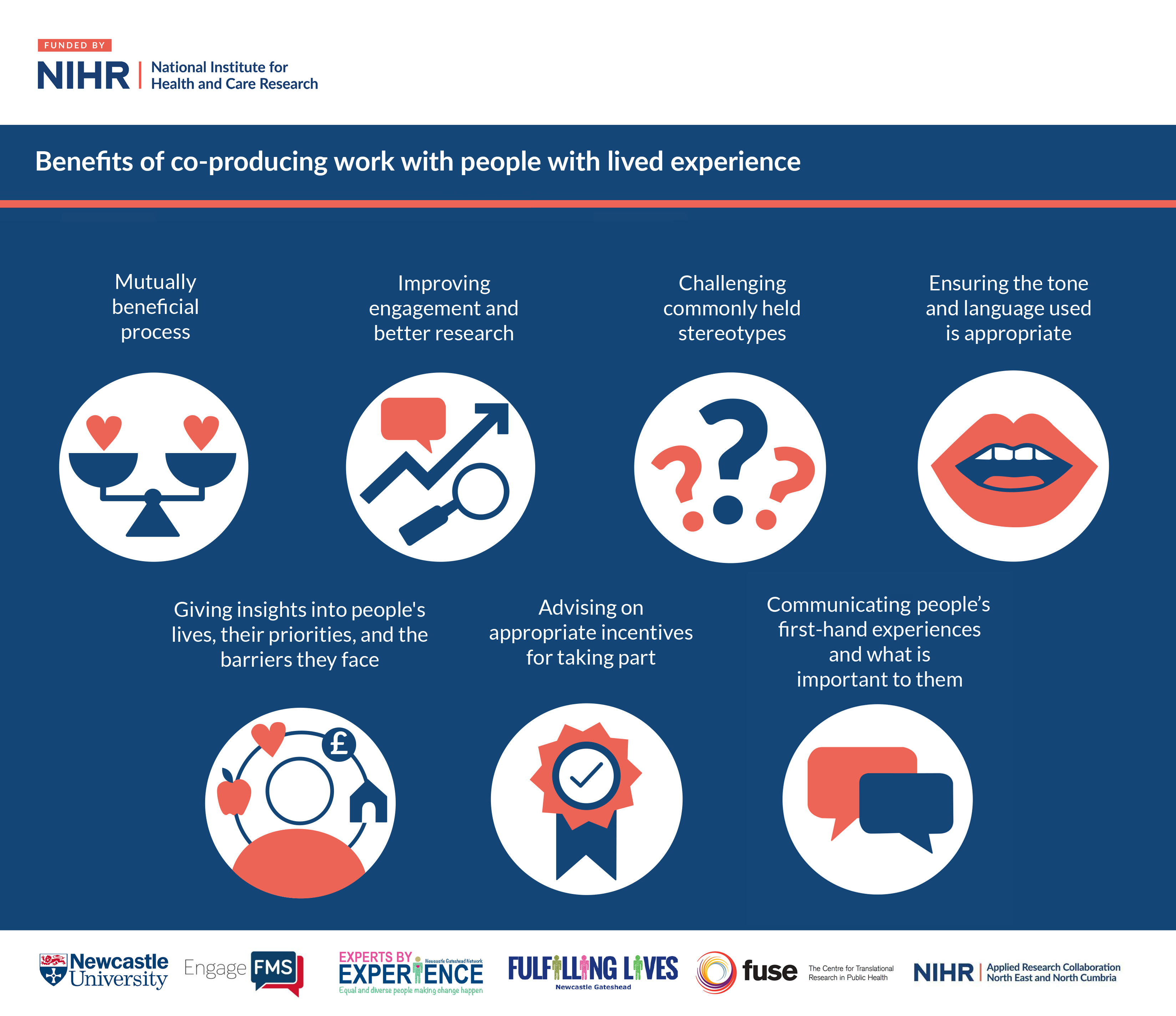
    The infographics in this blog show what we have learnt from this process of co-creating the video and the value of co-production.


    Creating a video provided an easy way in which organisations (such as Crisis, Fulfilling Lives, and other providers) and local Expert by Experience networks could share information about the study.

    Those involved in creating the video were able to draw upon their experiences to help shape the content. One of the members of the group shared their experience of the process:
    “Some of us in the Network feel really strongly about this issue and have personal experience of it ourselves so we were keen to be involved and share our ideas and opinions.”
    Another member said:
    “I joined this project because my own oral health has been something I've been embarrassed about in the past so I thought I could add something useful to this work.”
    We have tried to map out how we designed our video in the image below.


    The video has also been shared nationally with a wide range of organisations that support severe and multiple disadvantage groups in Newcastle and Gateshead, London, and Plymouth to promote engagement with policy and commissioners, local authority, criminal justice system, primary care, and third sector organisations. Producing a video was no easy feat, but it was a simple way of sharing our research with people who are pressed for time. You can check out the video below.


    A clear benefit of engaging with people with lived experience was having their input on how best to communicate our research widely. They provided real-life stories and examples, which helped create the narrative for the video. They helped challenge stereotypes of ways in which people can be portrayed in research studies - this resulted in modifying the images and language used in the video which were much more realistic and sensitive to the people we were wanting to engage. This has helped our research team become more aware of and appreciate the importance of stereotyping and how it can result in putting people off taking part in research.

    The benefits reached beyond the research team and the video (the below infographic highlights some of these), as many of the Experts by Experience echoed how involvement has led to them feeling empowered and one member wrote a blog about their experience.


    We plan to build on this collaboration as we continue our research and gain further input on findings from our study and next steps.


    This study ‘Improving the oral health and related health behaviours of adults experiencing severe and multiple disadvantage: evidence synthesis and qualitative stakeholder research’ is funded by the NIHR Policy Research Programme (grant reference NIHR200415). The video was supported by Newcastle University Engage FMS. The views expressed are those of the author(s) and not necessarily those of the NIHR or the Department of Health and Social Care.

    Friday, 5 November 2021

    Cookies, coffee and co-production during Covid

    Posted by Emma Adams, Fuse/NIHR School for Public Health Research (SPHR) Pre-doctoral Fellow at Newcastle University, in collaboration with Experts by Experience from Fulfilling Lives Newcastle Gateshead and #HealthNow Newcastle

    Photo taken by Jeff Parker (one of the individuals with lived experience involved in our
    co-production) of the masks he made for each of us at our first face-to-face meeting. 
    COVID-19, has forced all researchers to re-think engagement and how we work with people with lived experience. I like many, have been navigating how best to do this within my study that aims to explore and understand access to community-based mental health and substance use support in Newcastle and Gateshead for those experiencing homelessness during the pandemic.

    Since March 2020 I have been collaborating with five people with personal experience of homelessness, mental health, and/or substance use to co-produce the analysis for this study. During that time we have discovered a very helpful approach (albeit with an imposing name) - Interpretative Phenomenological Analysis.

    Here comes the science…


    This approach was very reflective and recognised that we were trying to understand how our participants made sense of what had happened to them. We wrote exploratory comments to reflect on the word-for-word text from interviews and then used both to develop themes. This approach lent itself really well to our analysis, as we found it was less rigid than other coding-based approaches (such as thematic analysis) and had more opportunity for reflection. 

    The saying ‘no two things are alike’ describes how we ran our co-production meetings given COVID-19 restrictions. We sent out printed packages with anonymised transcripts for comments, held Zoom meetings to discuss our comments and thoughts, hosted in-person meetings with sticky notes and marker pens to develop themes and unpick key ideas, and used physical and virtual highlighters to identify our top quotes. Accompanied with a healthy amount of coffee, baked treats, and fruit, we set our sights on trying to understand our data. We broke down each analysis into three sessions, with the first session focussed on reviewing the transcripts and writing comments, the second focussed on developing some initial themes, and the third focussed on identifying and refining all the themes and key quotes.

    Friendship, findings and reflections


    We are now starting to share initial findings and determine creative ways to present the information. Having built a strong friendship, we reflected on how much we enjoyed the collaborative co-production experience, despite the circumstances created by COVID. We also reflected that not all co-production is positive. Here we share a few thoughts from the experience.

    Why did you become involved in the study?
    Everyone in our group felt motivated by the opportunity to have their voices heard and make a difference.
    "Because I am interested in how the pandemic has affected people and am a member of the Experts by Experience and would like to change things for the better" – Joanne
    "I wanted to do a different sort of user health research having done some last year in Newcastle for Crisis and Groundswell. Getting involved in analysing the anonymised data was a fantastic opportunity for myself" – Tony

    What did you enjoy and learn?
    Everyone enjoyed being involved as the research continued to grow and their continuous involvement meant we could develop friendships.

    "Actually being involved from start to finish, Emma baking" – Jeff

    "Analysing some of the data and the group! I feel new friendships have been made" – Fiona

     Although different learnings were shared, it was clear that everyone enjoyed working in a team to try out new things and have a ‘behind the scenes’ peak into doing research.

    "One day I would really like to do more of this work in a permanent position as part of my continuing personal development. So it was very nice to get the opportunity to find out what this sort of work entailed and whether or not I would enjoy doing it too" – Tony

    "Co-production can really work if it's formulated with an organic and lived experience perspective at the heart of the study, the information gathered was not lost in translation and the language from participants' interview was not tampered with" – Des

    What did you find challenging and wish researchers knew?
    Forcing ourselves to think about some of the things we all found challenging, we realised it is important to touch base with people involved in co-production to understand what they are struggling with and how they can be better supported.

    "Biggest problem I have is getting to a venue, I have anxiety issues travelling by bus" – Jeff

    "Emma would send me a gentle reminder a few days before work was due and it would spur me to either start, or finish off and get the work sent in. This really helped me" – Fiona
    What would you say to a friend about getting involved in research?
    Across the board, everyone said they want to continue to be involved in research projects and would encourage friends to do so.
    "At first it might fly over the top of your head, but give it time and you will learn things you never knew you were capable of" – Joanne

    "Go for it, maybe you can help affect change that will help others who have been through what you have. Plus, you’ll make some new friends and may enjoy yourself too" – Jeff

    What are you most excited about?
    When asked about what they were most looking forward to and anything else they wanted to share, responses ranged from gaining specific experience, to celebrating successes.

    "It made a nice change to be more involved and now I’m doing more research with Crisis its helped me to help them shape how it can be done and how sense making is carried out" – Jeff

    "The biggest rush of the project was to receive an email from the Lancet after we submitted a piece on the work. If it gets published, I’m throwing a party" – Fiona

    "Emma has kept us updated throughout and involvement moving forward looks bright … and on the back of this there is confidence to come back to the university and vice versa in other research projects" – Des

    Lessons learned from a researcher perspective


    The depth and richness gained through co-producing my analysis is something I could have never done on my own. I learned that it is okay to admit when you are feeling a bit lost about the best approach, as that allows for an open dialogue to determine what can be done to make things better. Through our co-production, I realised how to make findings more accessible and engaging for everyone. The pandemic has meant that we have all missed out on in-person contact. Listening to our group I was shocked and humbled by how much the little touches mattered; well-timed cookies or an invite for a coffee chat can make a big difference. These small touches allowed me to develop relationships with everyone and have frank and honest conversations. From this experience, I have learned that you do not need to wait until you have findings to make a difference, rather you have a chance through co-production to make lasting impacts across the span of your research project.


    Emma's study 'Exploring and understanding access to community-based mental health and addiction services in Newcastle and Gateshead' is NIHR School for Public Health Research (SPHR) ResNet funded.

    This project is funded by/ supported by the National Institute for Health Research (NIHR) School for Public Health Research (Grant Reference Number PD-SPH-2015-10025). The views expressed are those of the author(s) and not necessarily those of the NIHR or the Department of Health and Social Care.

    Friday, 1 October 2021

    “Next slide, please!” Newcastle children’s reflections on the pandemic

     Posted by Laura Basterfield, Research Associate, Newcastle University

    Often in research, once we’ve collected the data, analysed and published it, we don’t have the opportunity to go back to the participants to discuss what we found. When children are involved, we may give a feedback presentation at a school assembly, but let’s be honest it can be difficult to make Powerpoint fun!


    I’ve worked closely with Walkergate Community School over the last few years on my research into children’s physical fitness and mental wellbeing and I wanted to deliver my feedback in an assembly that the children would enjoy. I thought the best way to do that might be to let them do it themselves, as who knows what children like better than other children? And I am so pleased I did; it was a fascinating process. 

    The ‘Young Science Communicators’ project was due to have taken place in June/July 2020, but had been delayed due to the COVID-19 school closures. Whilst I was initially disappointed last year, the realities of the past 12 months brought an added dimension, intensity and poignancy that would not have been there otherwise.  

    There weren’t many rules, but the assembly should include some of the results of the study, including both the physical and mental benefits of physical fitness and activity. Other than that I was happy for the children to take the assembly wherever they saw fit. To start, thirteen Year 6 pupils (aged 10-11 years) discussed with me the project specifically, fitness in general, and about the impact the COVID-19 lockdowns and school closures had on them and their families. Then I taught the children some of the key skills they would need to do my research. I wanted them to really understand why I do what I do, and what better way than to then practice on your friends?! There were some wonderful comments from the children about how they liked the experience: “I enjoyed it because I want to do your job when I’m older” and “I liked being in control!” (which must be quite unfamiliar at 11 years old), and they quickly learned both the techniques and how to talk politely to their class-mates! 

    The following week it was over to the children and their ideas. The goal was for them to create an assembly, film their performance, and share it with the rest of the school – all within three days. Scott and Claire are practitioners with local theatre company Mortal Fools and they led the children on a games-based journey to increase their confidence, public speaking and team-working skills. The children were all totally engaged and willing to share their thoughts, feelings and experiences to create a collegiate and supportive atmosphere. For me as an observer at this point, I was struck by the children’s recreations of the school closure periods and how they articulated their feelings: “I had no motivation to do anything”, “I was lonely”, “frustrated”, “isolated”. This was especially the case for those without their own mobile phone – some were unable to speak to friends for weeks. They also showed a mature insight into how the adults in their life had been affected, acting out money worries, family health issues, the stress of getting children to do schoolwork and go to bed on time, when there was nothing to get up for the next day…

    As the group moved on to the awkwardness of meeting up with people after such a long time “Errr… so have you been up to much?!”, to their joy and excitement of seeing family, friends and teachers again, the whole process felt reflective and cathartic. Claire and Scott’s skill was evident as the children’s confidence grew before my eyes. Along the way the children had us in stitches with impressions of Boris Johnson, ‘next slide please’, and Joe Wicks.

    Finally, they got to film their creation with the help of a proper film-maker. Most scenes only took a couple of takes, and the children showed incredible focus and concentration throughout. The final co-produced 9-minute film is informative, funny and affecting, and the children should be incredibly proud of their efforts. We still weren’t able to completely escape COVID, as three children missed the filming day due to a positive case in their class, but their input on the previous days made it a true team effort. 

    The process showed me how important it is that we involve children not just in our research but in everything that affects them – simply asking children how they are, what they are feeling, and what they would like to be involved in gives us a hugely important insight into their world. 

    I hope you enjoy their film.


    Thanks go to all the children and staff at Walkergate Community School; Scott Wilson, Clare Rimington and Helen Ferguson at Mortal Fools, and Matt Jamie the film-maker. Permission to share this film has been granted by the parents and school of the children involved. 

    Funding from EngageFMS at Newcastle University supported this project. 

    Originally written for VOICE.

    Friday, 30 October 2020

    Summer school at home: Learning online and adapting research to reach the ‘hard to reach’

    Posted by Emma Adams, Newcastle University, and Jo Dawes, University College London, NIHR School for Public Health Research (SPHR) Pre-Doctoral Fellows

    Starting a new post in a new institution just as a global pandemic and lockdown sweeps the UK is not how we envisaged beginning our NIHR School for Public Health Research (SPHR) fellowships. When our training and development allowance letters came through initial thoughts were to delay booking any training until it was possible to attend in person. However, as time passed, it became clear we may be waiting some time. This realisation coincided with hearing about the “Applied Research Methods with hidden, marginal and excluded populations” course run by Nuffield College, University of Oxford. The course is usually a weeklong residential summer school, but this year it was offered online. The idea of spending five full days sitting at home doing online learning seemed a disappointing second best to a week in Oxford and somewhat limited our enthusiasm. However, these concerns were misplaced. We could not believe how engaging the course was, with tutor Andrea Rossi doing an excellent job of varying the activities, keeping us captivated and packing the course with relevant, interesting, and interactive tasks. 

    For this ‘participatory research method’ we were given 5 minutes to create a map of our childhood community, using items we could easily reach. The task was designed as an ‘icebreaker’ activity to start a conversation about our childhoods. Using available objects, rather than drawing, takes away any pressure interviewees might feel about their aptitude for drawing. This activity could be adapted in rural communities using found items outside. Once my map was created, I talked about the map and why I had highlighted specific aspects of my community - this is the point at which ‘data collection’ might start.


    Beginning with what makes a population ‘hard to reach’, we were armed with the linguistic tools to define whether our population was hidden, marginal, elusive, rare, excluded, or blurred (see Table 1 for breakdown). By breaking down populations into these different categories, we were better able to understand approaches for reaching and involving them in research. People experiencing homelessness may be perceived as ‘hard to reach’, when in fact they might just be elusive (purposely hiding or not reporting). If we, as researchers, recognise individuals may be making a conscious decision not to report, then perhaps we need to build a foundation of trust. The responsibility a researcher has to find ways to reach the ‘hard to reach’ was one of the most important things that we learned. 


    With optimism that the virtual learning might not be as onerous as we had feared, we jumped into three days of research methods (both qualitative and quantitative). Challenging us to approach every technique from both the researcher and participant perspective, we were pulled out of our comfort zones and into creatively mixing research techniques. Opportunities to transform recruitment strategies (such as respondent driven sampling into a data collection tool for analysing social networks were explored. Learning to make the interview experience more interactive challenged our preconceptions of data collection - ever thought about asking a participant to reconstruct an important/memorable place with only items in their kitchen? Having experienced this first-hand, we both agree it was a great facilitation tool as a participant and researcher. The breadth of material in the course left us feeling that it was a week well spent, despite the initial apprehension and sitting at a computer in the blistering summer heat.

    As a result of attending this course, we have already adapted how we approach our research activities. Jo was struggling to define a ‘hard to reach’ population in a patient and public involvement (PPI) paper. The course provided real clarity about this topic and helped her confidently address this definition in her writing. Emma was trying to find a way to approach recruitment and the re-shaping and framing of populations has provided me with optimism about my future recruitment strategy.

    There is no doubt that by learning online instead of face-to-face, we really missed out on networking opportunities with our course peers - nothing could really replace a good natter over coffee. Conversely, the online nature of the course really opened up the cohort - we were learning with people sitting in their homes in England, Wales, Switzerland, France and Germany, while our tutor taught us from his apartment in Bangkok. Perhaps without being online, we would have been a far less international cohort. After undertaking this excellent course, we certainly feel more positive about online learning, how engaging it can be and how - in these uncertain times - it is important to not simply wait for face-to-face learning to return as the norm. The variety of learning and research activities we used online challenged us to translate so much of what we usually do face-to-face to our ‘virtual classroom’. As a result, we developed skills in how to adapt our current methods of communication in our research.

    Our take home messages from the course:
    1. Online research and learning can work well if you are creative and willing to be flexible.
    2. Researchers must consider reasons some populations are ‘hard to reach' (are they rare, hidden, elusive, marginal, excluded or blurred?).
    3. When you recognise WHY a group of people are ‘hard to reach’, you must adapt your research methods to better reach them.
    4. Through mixing methods/data sources you can strengthen your understanding of ‘hard to reach’ groups.

    Friday, 15 May 2020

    Experts by Experience challenge us to create opportunities for them to take the lead in research

    Posted by Ang Broadbridge (Research and Evaluation Lead) and Ged Hazlehurst (Expert by Experience) Fulfilling Lives Newcastle Gateshead

    Earlier this year Fuse and Fulfilling Lives Newcastle Gateshead co-chaired a Quarterly Research Meeting sharing initial findings from a joint research project that explored the reasons underlying high death rates among people with multiple and complex needs (MCN). There we asked attendees to consider the findings and help shape recommendations.

    Now as we write up the findings during the height of the Covid-19 pandemic, we are reminded that drug related deaths and MCN issues have been a public health crisis long before the pandemic, though it has drawn an even sharper focus on health inequalities at this time.

    The findings from the study will be available in a forthcoming end of project report but in this blog we wanted to go behind the scenes with Experts by Experience to share our experiences of co-production in public health research.

    Some background

    So what is Fulfilling Lives Newcastle Gateshead (FLNG), and what are Experts by Experience? FLNG is an eight-year learning programme looking to improve the lives of people with complex needs and build a trauma-informed approach within the services that support people across Newcastle and Gateshead. Experts by Experience are people with lived experience of multiple and complex needs, and have vital things to say that can help shape the future of how systems and services work for their peers.

    Co-producing research

    Co-production is bringing together the people using services and the people providing those services to share power and work collectively to design, develop or deliver improvements to them. This also involves seeing services and staff as agents for change and seeing people who use services as assets with skills, who in turn, gain from their contributions and move towards positive change. For example, Experts by Experience on the FLNG programme have developed training resources for Department for Work & Pensions staff raising awareness of MCN issues, which were rolled out across JobCentre Plus.

    FLNG wants research to be genuinely co-produced and has invested in creating a National Vocational Qualification accredited peer research skills training package and local Peer Research Network. This is to support a shift from involvement led by professionals to an approach in which peers define the remit and research questions, leading on all aspects of the research design, delivery and dissemination.

    Experts by Experience defining research problems

    The beauty of the Fulfilling Lives programme has been our small team and the small caseloads; with at the most eight frontline practitioners each working full time with just 10-12 people. We work intimately with these people, building strong trusting relationships, getting to know their families, and being by their side through crisis.

    Between 2014 and 2020 we worked with 267 people, during which time we experienced 27 deaths on programme. That is around 10% of the client cohort, so you can perhaps imagine the impact of that 10% on a small team who have been deeply involved in the lives of the people they have navigated through services.

    We talked to our Experts by Experience Network about this and as the programme research lead I (Ang) was really wary about the sensitive subject matter and its potential for re-traumatising. My thinking was challenged when the Experts Network were really passionate about deaths in their community and told us they were already talking about it, often without much support, so not to shy away. Then they challenged us to think about how our co-production and peer research offer could dig deeper to explore this issue. We asked Experts by Experience to help us explore what it would look like for them to take a peer-led approach to this work. They really helped shape the ethics process, for example they told us to look within their Network for participants, as we could guarantee good support for people to discuss any issues that emerged out of participation. In doing so they, the Experts by Experience, identified the topic for this project.

    What was the feedback from our co-produced research event? 

    When we met for the Fuse QRM the purpose of the session was to study the initial findings gathered from the series of focus groups we ran exploring MCN deaths. It was interesting then that the feedback we received from the event, asking people’s views on what we found and what was surprising, clustered around co-production in research. This suggests that this research has the potential to challenge beliefs about the involvement of people with lived experience in public health research:
    • People were surprised by the extent to which Experts by Experience were able to take on such a difficult subject, and;
    • People were surprised by the normalisation of death within our Expert by Experience community. 
    It is our hope that this acts as a springboard for more and better involvement of people with lived experience of multiple and complex needs in public health research. We have explored a sensitive and challenging subject with Experts by Experience who challenged us to create opportunities for them to take the lead. We hope that as our Peer Research Network grows, other researchers can build on the peer research model we utilised in this study to shape their own research projects.

    FLNG is one of twelve programmes linked across England funded by the National Lottery Community Fund, looking to influence the system nationally. A Core Partnership of Changing Lives (lead partner), Mental Health Concern and Oasis Community Housing lead the programme’s activity, for more information visit http://www.fulfillinglives-ng.org.uk/


    Images courtesy of http://www.fulfillinglives-ng.org.uk

    Friday, 31 January 2020

    Does reaching the ‘hard-to-reach’ mean leaving traditional academia at the door?

    Angela Wearn, PhD Researcher, Department of Psychology, Northumbria University

    “You tend to find the ones that are protesting and telling you to go and get your smears are the ones that have their cushy little jobs and that lovely flash car that they can just jump in and dive down to the doctors”


    From all the conversations I’ve had throughout my research career, this is one of the quotes that has stuck with me the most. For over three years I have been working on my doctoral research, conducted across Newcastle, which explores barriers to cervical screening participation in areas of high relative deprivation. We know that uptake rates tend to be lower in areas of socioeconomic disadvantage, but reviewing existing literature showed very little insight from women who lived within these communities themselves. Incidentally, I am one of these women. I grew up, and still live, within a neighbourhood which, according to the Index of Multiple Deprivation, falls within the 10% most deprived areas in the country. It’s therefore no accident that I ended up with a programme of research which aimed to prioritise the voice of this community.

    Graffiti walls can be a simple and effective way of starting conversations
    Initially, I had dreams of a wonderfully participatory project, where I formed a steering group and we worked together to find answers and seek solutions. As often happens in research, time ticked on and it didn’t work out the way I had planned. My participatory ideals had to take a backseat for a less time-consuming participant-researcher approach. I suspected my ‘insider’ status might open doors for me and to be fair, it did. I found myself being able to quickly connect and build a rapport with others when I discussed my own background and why I wanted to do this project. However, getting to the point of even having these conversations was by no means easy. I spent days, weeks, months trying to speak to community groups, charities and community members about my research. Some were very open and interested, others were not. I attended community get-togethers handing out cakes alongside research information, making ‘graffiti walls’ with post-its, even chatting about life over freshly made biryani at a cookery club. Actually, these were the most rewarding and enjoyable moments over the past three years, but the more I did this the more I felt I was straying from what academia expected of me. I also began to feel my status as an academic researcher was a hindrance to what I was aiming to do at community level. For a lone PhD researcher, bringing together these two worlds, at times, felt completely impossible.

    "community get-togethers...were the most rewarding and enjoyable moments over the past three years, but the more I did this the more I felt I was straying from what academia expected of me"

    Attending community events was a great way to connect with 
    people who were otherwise unfamiliar with research
    The quote at the beginning of this blog was when it all clicked into place. Although we were talking about cervical screening, I acknowledged something that I had already known all along - the same issues of accessibility and trust apply to involvement with academic research. If I put my working-class hat on for a minute, academic research feels neither accessible nor promotes interpersonal trust. From the outside, academia appears to be filled with people who think they know better than you, patronising you, sometimes even using you to showcase the poor decisions people make in life. I had to work hard to reassure people that I wasn’t there to pass judgement on their screening status. I’m still not sure many believed me. ‘Eat a healthy diet’, ‘Stop smoking’, ‘Engage in physical activity’, ‘Attend your screening appointments’. These are the messages that come through, focusing on the individual and discounting all the structural and social barriers that exist for people living in communities like mine. If you are trying to figure out how to afford the weekly food shop, the kids have come home with a tear in the coat you only bought a fortnight ago and you’re worried about not getting enough work from your zero hours contract, there is no mental space for ‘living your best life’ (and certainly no space for sitting with a stranger from some university taking part in a research study).

    Those living in socioeconomically disadvantaged areas are often described as ‘hard-to-reach’. This often implies that despite best efforts to reach out, these groups are disinterested and disengaged. I tend to believe the reverse is true. Some groups are hard to reach because academic research is too disengaged from the community. I know of many academics who are so obviously committed to tackling the avoidable and unjust disparities in health, and for this reason I do feel positive for the future. However, as someone who is positioned in between the ivory towers of academia and the working-class neighbourhoods at home, I know there is still a lot of work to do. There is a long history of mistrust and marginalisation to put right. If we are serious about tackling inequality and involving so called ‘hard-to-reach’ groups in research, then we need more focus on developing trust and togetherness…and occasionally, this might mean leaving traditional academia at the door.