Showing posts with label Health and Social Care. Show all posts

Friday, 19 July 2024

From crisis to collaboration: Transforming support for people experiencing homelessness in North East England

Posted by Steven Thirkle, Research Associate, Newcastle University

People experiencing homelessness often have multiple and complex health and social care needs that require support from many services. However, accessing and coordinating this support can be difficult when services are disconnected geographically or relationally. Often the person who is experiencing these challenges is the one who has to reach out for help, and this can be extremely hard for someone also managing day-to-day homelessness.

During our workshop, More Than Minutes visually captured our discussions, providing a dynamic summary. These visuals encapsulate key insights and recommendations, offering an engaging snapshot of our collective journey towards transforming support for people experiencing homelessness.


Over the past two years, our team has been working with services that provide support to people experiencing homelessness in rural and coastal areas of North East England. Our goal has been to explore innovative ways to improve access to care and support for these vulnerable people. Here, we share our research findings, shed light on the challenges faced by people experiencing homelessness and present our co-produced recommendations for creating a more effective and holistic (whole person) support system.

What does hospital data tell us?

To understand why people experiencing homelessness in the North East often turn to emergency care services in rural and coastal areas rather than seeking alternative forms of support, we examined hospital data on people attending emergency care services who had no recorded address. We discovered that there are many contributing factors, including struggles with alcohol and drugs, mental health issues, and challenging social situations. These challenges often occur at the same time, exacerbating their complexity and approaches to treatment.

What is stopping homeless people accessing services?

While this numerical data provided valuable insights, it did not uncover the underlying reasons behind the lack of engagement with other support services. To gain deeper insights, we interviewed people experiencing homelessness as well as those providing support in rural and coastal areas. The interviews aimed to explore experiences with emergency care services, overall health, social lives, and past traumas. They revealed significant barriers to accessing services, such as limited resources, transportation challenges inherent to rural areas, and the isolation often felt in coastal communities. Additionally, rigid service criteria and thresholds prevented people from receiving the support they urgently needed, further compounded by the sparse availability of services in these regions.

What is the current picture?

A comprehensive and integrated approach tailored to the rural and coastal context was needed to provide effective support to people experiencing homelessness in these areas, so we mapped out existing services and their collaborative relationships in the areas. Our findings showed a fragmented system, with many services operating independently and lacking essential connections to the core network of services necessary for addressing the unique challenges faced by people in rural and coastal areas.

How do we address the gaps?

In response to these gaps, we organised a workshop at the Community Hub in Cramlington, Northumberland, bringing together over 70 people including professionals from health, housing, social services, local authorities, law enforcement, emergency response, and third-sector organisations, as well as people with lived experience of homelessness and mental health issues in these regions. Together we developed recommendations for a more effective and collaborative approach to supporting people experiencing homelessness in rural and coastal areas. Seven key areas for recommendations were identified:
  1. Long-term funding and resources: Campaign for sustained funding and increased resources to support comprehensive and ongoing assistance for homeless people.
  2. Coordination, connectivity, and communication: Establish robust ways to coordinate, foster better connectivity between services, and improve communication channels to ensure a seamless and integrated support system.
  3. Accessible services - pathways to support: Develop clear and accessible pathways for homeless people to access a wide range of support services, including health, housing, social services, and mental health resources.
  4. Building trust and co-developing services with lived experience: Foster trust and inclusivity by actively involving peoples with lived experience of homelessness in the design, development, and evaluation of support services.
  5. Trauma-informed practice: Implement trauma-informed approaches across all support services, recognising and addressing the underlying trauma experienced by homeless people.
  6. Improved data sharing: Establish efficient data-sharing agreements for support services to ensure comprehensive and up-to-date information, enabling better coordination and informed decision-making.
  7. Staff retention and wellbeing: Prioritise the wellbeing of support staff by providing resources, training, and support to prevent burnout and turnover, fostering continuity of care.
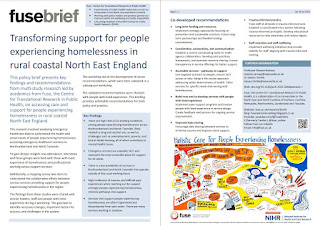
We have developed a handy two-page Fuse research brief which pulls out the key findings and recommendations for practice and policy co-developed with people with lived experience. 

Friday, 30 June 2023

One size fits none, watch your language, and keep pondering...

Insights from the Integrated Community Care to Promote Healthy Ageing event

Posted by Hamdi Hamzah, Research and Evaluation Coordinator with NECS Research & Evidence

It was my first time attending an event that saw people (some of us dressed in red) from across different professions – academics, healthcare professionals, voluntary, community and social enterprises (VCSE) professionals and members of the public – come together to share common interests and explore future opportunities or collaborations.

Being new to the health and social care sector and a career changer with experience working with large corporations through strategic human resource roles, the Integrated Community Care to Promote Healthy Ageing event co-hosted by Fuse introduced something that I felt was closer to what was happening on the ground, especially when research and practice interweave. From this event, I have identified seven insights that I felt were worth sharing.


But first... what exactly is Integrated Care? The NHS England website describes Integrated Care Systems as: “…partnerships of organisations that come together to plan and deliver joined up health and care services, and to improve the lives of people who live and work in their area.” They also provide a helpful video explainer.

So, on to my magnificent seven:

1. There is no “one-size fits all” approach to care


Throughout the event, this was a common theme from both presenters and attendees, who continued to stress the importance of putting individual needs at the forefront in providing care. To echo Dr Bethany Bareham (pictured right), Fuse Associate and NIHR fellow at Newcastle University through her talk on providing support to older adults with co-occurring alcohol and mental health problems, support for one individual may not be needed for someone else.

2. Similarly, there is no one way to answer a research question

The event brought together different questions, methods and groups of people to enhance our understanding of promoting healthy ageing. For example, a video presentation by Dr Vanessa Davey, a Research Associate at Newcastle University, on the feasibility of developing a data set in care homes to assist in care delivery and commissioning decisions was eye-opening. You might think that digital GP records could readily be used in one form or another to build this data set, but it is clearly not that straightforward as data from other systems, namely social care, could (and should) provide additional insights into this dataset. Most importantly, while we might take different approaches and target different populations, we are all aiming towards achieving the same goal.

3. Language can have an important effect on how we approach a question


Simply put, are we talking about the same thing? We might think that the terminologies that we are using are similar but they could mean different things to different people. For example, Dr Dan Cowie (pictured right), clinical lead with the North East and North Cumbria (NENC) Ageing Well Network (who also spoke about the Frailty iCARE platform) posed the question: are "personalised care," "personhood" and "person-centred" the same thing for the groups of people that researchers are interested in studying? How we phrase the topic we are researching could also help or hinder what we get out of our work.

4. Co-production of research through VSCE organisations

Local communities should be involved in every activity within the research lifecycle, such as research planning, analysis and dissemination, and not just during the delivery stage of the study – an opinion shared by Greta Brunskill from Voluntary Organisations' Network North East (VONNE) in one of the workshops. Patient and public involvement (PPI) is a useful platform to involve members of the public and co-produce research, but there is the risk of “professionalising” these platforms, which may lead to voices from certain communities not being heard.

5. But what about before we reach a specific age?

There was interest from the audience in exploring personal and environmental factors before someone even reaches a specific age. The idea of testing the impact of, for instance, universal basic income among young people on healthy ageing was food for thought and suggests that a lot of where we are now or – perhaps will be in the future – could depend on factors in the present such as lifestyle, socioeconomic status and access to relevant services.

6. Addressing health inequalities remains challenging

Expanding on points 4 and 5 above, health inequalities remain a hot topic in this field of work. Access to care, health literacy (a person’s ability to understand and use information to make decisions about their health), personal qualifications and involvement of underserved communities were mentioned by attendees either during the talks or workshops as challenging areas. Introducing care or support may not work if barriers to accessing care remain.

7. Keep pondering

The entire event not only provided the opportunity to know what research is being conducted but showed the tremendous volume of research questions left to be explored! One of the themes that came out of Tania Jones' workshop on maximising the use of pharmacy services was the bigger role that they may play in primary care, especially in 2026 once pharmacy graduates enter the job market with prescribing qualifications. This could in turn lead to more questions, for example, is there an inclination for pharmacists to prescribe pharmaceutical over non-pharmaceutical treatments?

While the possibilities are endless, identifying questions that are crucial and impactful may be the first step to starting a research journey and finding the right collaborators. Regardless, we should continue to think about things that we are working on, as Lesley Bainbridge (pictured right), clinical lead in the NENC Ageing Well Network, quite aptly put it, "Some of the best research questions come from what we ponder."


Images: provided with thanks to NHS NECS Research & Evidence Team

Friday, 27 January 2023

Public Health at a crossroads again: meeting the challenge of a reformed system in England

Posted by David Hunter, Newcastle University, Peter Littlejohns, King’s College London, and Albert Weale, University College London


With health policy understandably preoccupied with the pressures on, and changes occurring in, the NHS arising from the impact of COVID-19, implementation of the Health and Care Act 2022, and various strikes among the workforce, it is imperative not to overlook the public health system reforms in England.

Public Health England’s (PHE) sudden demise in August 2020 followed mounting criticisms of its performance during the early stages of the pandemic and general unpreparedness.1 Rather than consider how PHE might be reformed, the government rushed to replace it with two new bodies: UK Health Security Agency (UKHSA), and Office for Health Improvement and Disparities (OHID). Like PHE, the UKHSA is an executive agency with close ministerial oversight while still permitting ‘independence in the delivery of policy advice’. It will act as a ‘system leader’ for health security with responsibility for pandemic preparedness and external threats across the UK while bearing in mind that health is a devolved responsibility.

PHE’s remaining functions in respect of the wider public health, including health improvement and population health, lie with OHID. Located within the Department of Health and Social Care (DHSC) and jointly accountable to the Secretary of State for Health and Social Care and the Chief Medical Officer for England, it enjoys even less independence than the UKHSA. Building on the work of PHE, OHID’s priorities include tackling obesity, improving mental health, promoting physical activity and other population health issues, notably inequalities.

There is merit in taking stock to identify any lessons which might be gleaned from the mixed life of PHE and whether the new bodies offer hope to do things better.2

Learning the lessons

The findings from a research project to explore the circumstances surrounding the rise and fall of PHE may assist with the learning process.3 Five broad underlying issues were identified in the research which contributed to PHE’s demise.
  • PHE did not possess the capacity to undertake a testing regime
     of the size and complexity required by the pandemic
    Severe funding cuts in public health spending, nationally and locally, since 2010 meant that PHE functioned with reduced capacity when the pandemic struck
  • PHE did not possess the capacity to undertake a testing regime of the size and complexity required by the pandemic, the absence of which was the basis of the case against the organisation
  • The governance of PHE as an executive agency meant it lacked independence
  • While decisions made by PHE at the start of the pandemic were later considered mistakes (and judged outside the law by a judicial review) at the time there was little information about the nature and possible effects of the virus and limited capacity in the health system which required tough prioritisation decision to be made
  • The sudden closure of PHE without any consultation was widely reported to be due to blame-avoidance behaviour on the part of key actors, principally Dominic Cummins (as former Chief Advisor to the Prime Minister, Boris Johnson) and Matt Hancock (as former Secretary of State for Health and Social Care). There was also a view that the decision was based on policy favouring use of the private sector and contracting out functions like test and trace.
Key lessons from these findings centre on two major areas of concern: the respective remits of the new bodies, and their governance.

Remits


The respective remits of UKHSA and OHID need to be clearer and more transparent if the risk of fragmentation is to be avoided. A welcome feature of PHE was its attempt to bring together the key public health functions that had previously operated in separate silos. As things now stand, separating communicable diseases (CDs) from non-communicable diseases (NCDs) is a retrograde move since, as the pandemic highlighted in stark terms, close links exist between them when it comes to those groups and communities which suffered most in terms of illness and death. A syndemic understanding of diseases and their underlying social factors is pivotal in preventing disease in the future and avoiding fragmentation.4

Governance


Governance of the new public health bodies requires careful attention. As an executive agency, PHE was criticised for its lack of independence from government which restricted its ability to ‘speak truth to power’. Given UKHSA enjoys the same status, it remains unclear how it intends to avoid a similar fate. The problem is a deep-seated and pervasive one within government. The idea that OHID being housed in the DHSC will allow it to exercise greater influence and have a closer collaboration with ministers could be a good move, or, more likely if history is any guide, it may be overly optimistic. There is a risk that OHID may disappear into Whitehall and become invisible, lacking even the limited degree of independence PHE had. To succeed, OHID has to be visible and have allies inside government.

A further issue concerning the governance and working style of both agencies, especially OHID, centres on their ability to operate effectively across government. Public health comprises numerous ‘wicked issues’, that is, multi-faceted problems that are complex and for which there are no simple or single solutions. Confronting them will be especially challenging for a government which, for all its rhetoric about ‘levelling up‘, remains topic- and department-focused, operating in silos rather than concerned with cross-government issues.5

OHID has a steep hill to climb if it wants to lead a transformational agenda across the wider determinants of health which demands a whole-of-government approach. The hill just got steeper following government delays in tackling child obesity and its failure to implement a national food strategy. In keeping with the prevailing political ethos, there is a renewed focus on individual behaviour change and lifestyle choices rather than tackling the influence on health of commercial interests via taxation and regulation.6,7 If significant inroads into the population health agenda are to be made, then confronting powerful vested interests in, and lobbying from, the food and drinks industry and their ’friends’ in government engaged in what has been termed ’institutional corruption’ cannot be avoided.8 Whether OHID has either the backing from government or competences for such a struggle remains doubtful in the extreme.

Conclusion

Public health once again finds itself at a crossroads. It can either continue to ‘muddle through’ with a broken political and public policy system that is not fit for purpose.9 Or there is an opportunity to construct a strong and confident public health system that is well-placed to confront the challenges facing it. The aftermath of COVID-19 should make the choice of options self-evident. However, as things stand, it is unlikely that the UK’s broken political system with its focus on short-term fixes is up to the challenge. Without major systemic change aimed at overhauling the UK’s political system, a risk of further deterioration in the state of the public’s health may be unavoidable.


References:
  1. Calvert J, Arbuthnott G. Failures of state: the inside story of Britain’s battle with coronavirus. London: Mudlark, 2021. https://harpercollins.co.uk/products/failures-of-state-the-inside-story-of-britains-battle-with-coronavirus-jonathan-calvertgeorge-arbuthnott?variant=39528280391758
  2. Vize R. Controversial from creation to disbanding, via e-cigarettes and alcohol: an obituary of Public Health England. British Medical Journal 2020; 371:m4476 http://dx.doi.org/10.1136/bmj.m4476
  3. Littlejohns P, Khatun T, Knight A, Hunter DJ, Markham S, Coultas C, Kelly MP, Ahuja S. (2022) Lessons from the demise of Public Health England: where next for UK public health? London: NIHR ARC South London. https://arc-sl.nihr.ac.uk/sites/default/files/uploads/files/public-health-report-sept-2022-final.pdf
  4. Horton R. Offline: COVID-19 is not a pandemic. The Lancet 2020; 396: 874. https://doi.org/10.1016/S0140-6736(20)32000-6
  5. Pope T, Shearer E, Hourston P. What levelling up policies will drive economic change? The need for a long-term focus on skills and cities. London: Institute for Government, 2022. https://www.instituteforgovernment.org.uk/publications/levelling-up-policies?
  6. British Broadcasting Corporation (BBC). Junk food: obesity strategy falling apart, Jamie Oliver says. 15 May 2022 https://www.bbc.co.uk/news/uk-61449921
  7. Ralston R, Smith K, O’Connor CH, Brown A. Levelling up the UK: is the government serious about reducing regional inequalities in health? British Medical Journal 2022; 377:e070589 https://doi.org/10.1136/bmj-2022-070589
  8. Draca M. Institutional corruption? The revolving door in American and British politics. SMF-CAGE global perspectives series: 1. 2014. http://www.smf.co.uk/wp-content/uploads/2014/10/Social-Market-FoundationInstitutional-Corruption-the-revolving-door-in-American-and-British-politics.pdf
  9. Ricketts P. Hard choices: the making and unmaking of global Britain. London: Atlantic Books, 2022. https://atlantic-books.co.uk/book/hard-choices

David J Hunter, Emeritus Professor of Health Policy and Management, Population Health Sciences Institute, Newcastle University

Peter Littlejohns, Emeritus Professor of Public Health, Centre for Implementation Science, Institute for Psychiatry, Psychology and Neurosciences, King’s College London

Albert Weale, Emeritus Professor of Political Theory and Pubic Policy, University College 
London


The views and opinions expressed by the authors are those of the authors and do not necessarily reflect those of Newcastle University, King’s College London, University College London, or Fuse, the Centre for Translational Research in Public Health.

Tuesday, 4 July 2017

What does a hung parliament hold for the future of Public Health?

Posted by Fuse Senior Investigator David J Hunter, Professor of Health Policy and Management & Director, Centre for Public Policy and Health, Durham University

The June general election threw a lot of things up in the air but resolved little. We are living in a suspended state awaiting resolution of what is clearly an unstable political landscape and a government hobbled by its own tensions and contradictions. Uppermost among these is of course Brexit. This will continue to consume all of government as it has already done for much of the past year. No part of government will be left untouched by it. The upshot is that other domestic policy areas are likely to receive minimal attention. This includes public health which rarely features high on the policy agenda.


Earlier in June, the Faculty of Public Health President, John Middleton, in a British Medical Journal editorial urged the next UK government ‘to make health central to all its policies’ (BMJ 2017, 2 June doi:10.1136/bmj.j2676). He concluded that just as local government had adopted a health in all policies approach, ‘national government must now become a public health government’. There seems little chance of that happening in the current febrile political climate.

Of course one can argue the merits of putting health into all policies as distinct from putting all policies into health which might hold more appeal for those who are suspicious of, or are opposed to, health imperialism. But the central point is valid. Most, if not all, of what government does impacts on the public’s health. Indeed, much of the support for political parties calling for an end to austerity was driven by a perception that the unrelenting assault on the public realm since 2010 was having unacceptably negative consequences for people’s health and wellbeing. It’s a small consolation that what has happened in regard to widening inequalities was predicted by the public health community.

So if we cannot look to national government for public health leadership in the foreseeable future, and that seems a forlorn hope given that the former public health minister lost her seat in the election and her successor is unlikely to make an impact anytime soon, what does the immediate future hold for public health? And where is the action likely to occur?

Having a disabled or incapacitated national government may not be entirely a bad thing if it allows local government and other agencies to go about their business without being subjected to a constant outpouring of policy initiatives and ministerial announcements and directives which invariably offer only distraction.

This suggests a need for the public health community to engage more vigorously than it has done hitherto in driving the 44 Sustainability and Transformation Plans (STPs) in England. Though flawed, deeply so in some cases, and poorly communicated with minimal public engagement, STPs and related developments like Accountable Care Systems (ACSs) offer an opportunity (perhaps the only one for the time being) to put public health centre stage in developing place-based approaches to improving population health.

STPs are underpinned by the Triple Aim (Berwick et al 2008Health Affairs 27(3): 759-69) which comprises: improving population health, focusing on patient-centred care, and achieving more efficient per capita spending. STPs and many of the other health system transformation activities underway, and being actively promoted by NHS England with back-up as appropriate from Public Health England, are aimed at managing demand on health care services.

This is not a new agenda – the Wanless reports from 2002 and 2004 commissioned by the last Labour government eloquently argued the case for making the NHS a health rather than a sickness service – but the drive for a systemic transformation has perhaps never been so evident.

The opportunity to bring about a much needed shift in health policy should not be lost and public health should be at the centre of STPs. They offer the best prospect of taking on the big beasts of the acute hospital jungle and wresting resources from them to put into public health. Yet, as research being carried out by colleagues in the Centre for Public Policy and Health (CPPH) at Durham examining the public health changes introduced in 2013 demonstrates, with few exceptions Directors of Public Health in Local Government and their teams and Health and Wellbeing Boards are failing to provide the system leadership that is urgently needed1,2.

Since New Labour introduced foundation trust status for hospitals, compounded by the Coalition government’s misconceived and unnecessary Health and Social Care Act 2012, the NHS has been bedevilled by fragmentation and an ethos of competition in place of collaboration. STPs and associated reforms including ACSs are an attempt to mitigate the worst features of the various reforms since the turn of the century.

It is vital that STPs succeed and bring about the whole system, place-based approach to health and wellbeing that they promise. But we are some way from reaching that goal and the risks are considerable especially when budget cuts affecting public health make it less likely that the necessary changes can be realised.

However, we must not make too much of the budget cuts invoking them to argue that it demonstrates how misconceived it was to relocate public health to local government. Had public health remained under the NHS, it is almost certain that it would be in an even poorer state than is the case at present. Those who remember the days of PCTs will recall the frequency of raids on public health budgets to offset overspends and prop up hospitals. At least public health under local government control remains visible and there is evidence despite the impact of austerity of authorities making serious efforts to become public health organisations and take health improvement and wellbeing seriously.


References:
  1. Commissioning Public Health Services - Centre for Public Policy and Health (CPPH), Durham University: https://www.dur.ac.uk/public.health/projects/current/cphs/
  2. Evaluating the Leadership Role of Health and Wellbeing - Centre for Public Policy and Health (CPPH), Durham University: https://www.dur.ac.uk/public.health/projects/current/prphwbs/

Photo attribution: "Exactly." by Sam Rodgers © 2017: https://www.flickr.com/photos/samrodgers/34779376735

Friday, 31 March 2017

Do public health practitioners make good fire fighters?

Posted by Peter van der Graaf, AskFuse Research Manager, Teesside University

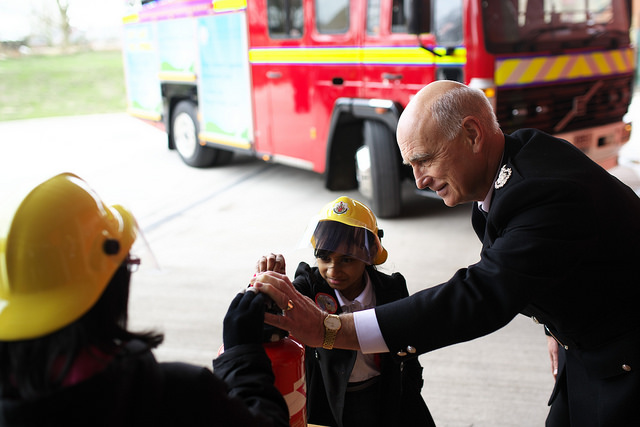
Given ongoing budget cuts and diminishing local capacity, one might be forgiven for thinking that soon public health practitioners will only be responding to emergencies, such as disease outbreaks and substance abuse epidemics. Fighting these public health fires would leave little time and resources for prevention and working with other public organisations. An event co-organised by Fuse, Durham County Council and Darlington Fire & Rescue Service recently proved quite the opposite: fire fighters and other public organisations are very capable of ‘doing’ public health.

Can public health researchers learn a trick or two from fire fighters?
The increasing focus of the Fire and Rescue Services on prevention over the last 10 years has seen the development of innovative approaches that support public health: from helping people with dementia, to tackling child obesity and getting people active (for some excellent examples, see the Local Government Association (LGA) report Beyond fighting fires).

In Durham, the Fire and Rescue Service implemented so-called Health and Wellbeing Visits. As part of home visits to check fire safety, fire fighters ask residents questions about their health and wellbeing (e.g. about falls, smoking and alcohol use, heating and loneliness and isolation) and provide them with advice or signpost residents to relevant services to address any health concerns.

Over the past year (Feb 2016 – Jan 2017), no less than 15,732 Health and Wellbeing Visits have taken place with over 1,800 referrals to various services in Durham and Darlington, accessing vulnerable residents that are often not on public health’s radar. Because of their trusted reputation, the Fire and Rescue Service can get behind the front doors of these people and help them access health services. Perhaps not surprisingly most referrals relate to loneliness and isolation, with an ageing population keen to live at home independently but with a social care system lacking resources to support these people in and outside their homes.

Even the police is getting in on the act of public health prevention with partnerships being established between health and the police across the UK to support, among others, suicide prevention and reduce alcohol-related harm, as was recently illustrated in a Public Health England paper.

In turn, public health practitioners are taking on new activities that were previously deemed outside of their scope. For instance, the Durham County Council’s public health team is actively supporting energy efficiency improvement schemes (such as Warm and Healthy Homes), in recognition of the link between excess winter death and cold houses. Poor quality housing, low incomes and high energy costs result in residents having to choose between food or fuel. To prevent residents from having to make that choice, council officers are providing tenants at high risk (e.g. people with cardiovascular and respiratory conditions) with new central heating, boiler repairs, home insulation and energy saving advice.

This blurring of boundaries between public professionals is not new, but public health moving back into local authorities has created opportunities for linking prevention activities across a wider range or organisations. The event provided many other examples of this, e.g. GPs prescribing boilers to patients with long-term conditions and Citizens Advice providing welfare rights advice to elderly residents.

This new boundary blurring builds on existing policy initiatives, such as Making Every Contact Count and Health in All Policies, which all involve the wider public health system. Participants at the event made it clear though that this is not a simple cost-saving exercise, allowing councils to pass the public health buck to other parts of the system. Instead, these new partnerships are characterised by a genuine exchange of knowledge and practices between public organisations at the front-line. It highlights a new way of working that recognised joint priorities and the values of other professions to achieve these priorities through the sharing of resources and by taking on new roles. As Professor David Hunter outlined in his presentation at the start of the event, these new partnerships require a different form of leadership, which is less hierarchical and formal, not so much concerned with Key Performance Indicators and commissioner-provider splits, but more focused on the value of relationship building, trust and 'soft' skills.

The event provided a platform for looking at these new partnerships and the evidence for their effectiveness. If anything, it highlighted a challenge for public health academics to research these new partnerships: how to make sense of the contribution of each partner in a system where boundaries are rapidly blurring? Maybe public health researchers can learn a trick or two from fire fighters.

Find out more about the event: Creating Healthy Places in the North East: the Role of Fire and Rescue Services and Fuel Poverty Partnerships

Photo attribution: "Rochdale Fire Station Opening Day" by Manchester Fire via Flickr.com, copyright © 2014: https://www.flickr.com/photos/manchesterfire/13288225965/

Thursday, 8 December 2016

The one where we ask you to vote...

Posted by Mark Welford, Fuse Communications Officer, Teesside University

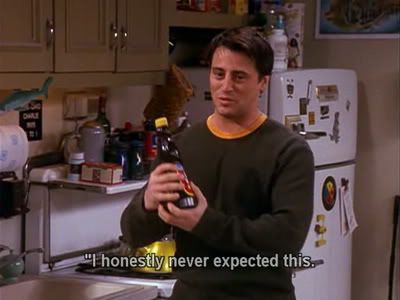
This post is a little like those episodes of Friends in which one of the cast says: “Do you remember the time when [cue wobbly vertical lines]…” and the rest of the 22-23mins is made up of clips from previous shows.

Courtesy of photobucket.com/user/xuyu79/media/blog/s7/s07e18 / Warner Bros.
Let me take you back to a post on Thursday 7 January in which we made a shameless plea to ask for your votes in the UK Blog Awards 2016.  In that post we told you how the blog’s 334 posts had received just over 167,000 views.  Eleven months on and 40 additional blog posts later, the page views have risen to nearly 325,000 - a fantastic achievement I hope you’ll agree!  I discovered this when an ambitious academic asked me if I could provide them with some killer stats about the blog to support their bid for a promotion. The power this blog wields!

This year we have had posts covering everything from Dry January, the ‘nanny state’, animation, Jamie Oliver's school dinner and sugar tax campaigns, to ‘fat shaming’, indigenous Australians, Baywatch, energy drinks, Grandmothers, e-cigarettes, and 'legal highs'.

Five years on from the blog's inception and we have reached the point where people are actively approaching us and generously giving up their time to write posts, rather than having to send in our crack team (the fear inducing) ‘blog working group’ to chase, harry and cajole*.  Could this - and the increased viewing figures - have something to do with the little matter of winning a UK Blog Award last year?  I'd like to think so.

And now, we come to the crux of this post.  It is you, our dear readers and contributors that make the blog a success and it is thanks to you that we won a national award.  So we've decided to go for it again in the UK Blog Awards 2017!

Here comes the shameless plug

The blog has again been entered into two categories: 'Health and Social Care', and 'Education'.  You can vote for us in either category but of course we would really appreciate it if you voted for us in both.

Vote now by following this link

The above link takes you to our profile page on the UK Blog Awards website in which we have chosen two of our favourite posts from 2016:
Voting closes at 10am on Monday 19 December.  One vote per email address.

Hopefully it won't be a maple syrup bottle we'll be holding aloft in celebration come April 2017!

Thank you for your support.

*We do still need your posts!  Please contact me (m.welford@tees.ac.uk) if you would like to write a post for the Fuse blog. Here’s how to take part.

Thursday, 22 September 2016

Is the UK an intolerant society for children?

Posted by Peter van der Graaf, AskFuse Manager, Teesside University

UNICEF statistics about child wellbeing among the 29 wealthiest countries in the world made for uncomfortable reading in 2007 with the UK bottom of the league table. Children and young people in Britain were among the unhappiest, unhealthiest, poorest and least educated in the developed world in the early years of the new millennium. Since then many initiatives and policies have been implemented to increase child wellbeing in the UK and when the league table was repeated by UNICEF in 2013 the UK moved up 15 places to a mid-table position of 16th.

However, we are still behind many European countries and with the ongoing austerity measures and continued disinvestment in health and social care services for children we could find ourselves back at the bottom league in the not too distant future. This begs the questions whether ‘simply’ improving health and other services for children is enough?

According to Sir Al Aynsley-Green, Professor Emeritus of Child Health at University College London and former President of the British Medical Association, the problem runs much deeper. He argued at the Fuse Knowledge Exchange Seminar yesterday in Newcastle, titled 'Think Adult - Think Child', that the real problem in the UK is that we are becoming an intolerant society for children. He pointed to the dire straits of politics for children in the UK: not only is the voice of children lacking from national policy making (an argument that he is well positioned to make as the first Children’s Commissioner for England), the policy making itself has often been poor.

The BMA published a damning report in 2013 in which it concluded that “the national focus on children has been short term, inconsistent and untrustworthy”. Specific policies to support children, such as Every Child Matters, have been systematically eroded by consecutive governments; the recent much watered-down Childhood Obesity Strategy is another example of this and Theresa May’s new enthusiasm for grammar schools strikes further fear into the hearts of child rights advocates.

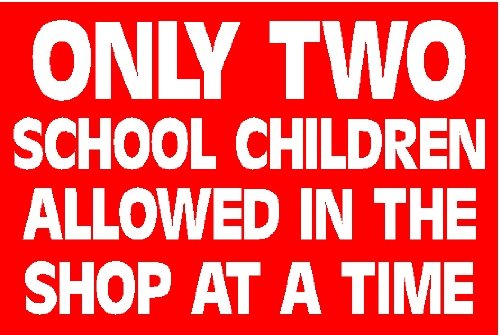
Politicians are not the only ones to blame according to Sir Al: the media regularly publish headlines about children and young people being a nuisance and causing crimes, while shops put up signs in their windows stating that dogs are welcome but that kids can only enter two at a time and, only then, without a backpack and when closely supervised. Most shockingly, public places such as railway stations are increasingly being fitted with high pitched devices that adults can’t hear but which are very unpleasant for young people and deliberately intend to drive them away.

One area where the neglect of children’s needs is particularly visible is bereavement: every 22 minutes a child in the UK loses a parent. While no routine data are collected in the UK on this group, estimates suggest that the majority of young people face the death of a close relative or friend by the time they are 16 years old. In spite of the many services available to families to help them stop smoking, exercise more and eat healthier, there is very little available for children who experience bereavement.

Sir Al presenting at the Fuse Knowledge Exchange Seminar
Specialist service providers attending the Knowledge Exchange (KE) seminar expressed their concern about not being able to cope with the current demand, as school teachers and parents lack basic skills in being able to talk to children about emotional problems, such as bereavement. In spite of this, we know from research that bereavement can have a lasting impact on the life of children long into adulthood. Bereavement in childhood has been linked to educational underachievement, joblessness, fractured adult relationships, adverse psychological and psychiatric consequences, together with poor physical health.

Sir Al’s presentation was therefore more a call to arms. What can we do in and outside Fuse to improve child health and wellbeing in the North East? Firstly, we can act as an advocate organisation to draw more attention to the needs of children and their position in society. Are their voices heard within Fuse? Do we engage with them in our projects?

Secondly, we can bring partners together across public health and related sectors in the North East to focus attention on this topic and bring together evidence and best practice to inform new collaborations. The KE seminar provided a platform for this that could be followed up. We also have a dedicated Early Life and Adolescence Programme (ELAP) within Fuse but does our research link to education and events later in the life course? For example, in Finland shops can rent a grandparent to help them engage with children when they visit their shop.

Thirdly, we need to turn this dialogue into a research agenda for child wellbeing in the North East. How can we mobilise evidence to change the prevailing attitude among politicians and the wider society so that they instead see children as valuable assets and a key policy priority for any government? This also involves challenging popular concepts, such as school readiness, which focus on individual responsibility. As Sir Al suggested at the end of the seminar, we should turn this concept around: are schools ready for children and what do they need to be able to be ready? Are they able to support children’s emotional development and can they help them to cope with bereavement experiences?

Making the UK a better place to live for children requires more than service redesign, it needs political will and consistent pressure from a coalition of organisations to achieve this, supported by actionable research to change hearts and minds.

Thursday, 5 May 2016

You are now reading the award winning Fuse blog

Posted by Mark Welford and Emma DoréeFuse Communications team, Teesside University

You may recall that in January we used this platform to make a shameless plea inviting readers to vote for the Fuse blog in the UK Blog Awards and a month later you may have heard the news that we had been shortlisted in the categories of Education, and Health and Social Care.

Well… (drum roll) …. We only went and won!  That’s right, you are now reading an award winning blog – fancy contributing?!


Last Friday (29 April), we took the Fuse blog monster on a road trip to the big smoke, that there London, where the streets are paved with, well… paving stones to attend the awards ceremony, in eager anticipation.

The awards ceremony was held at the swanky Park Plaza Hotel in Westminster, London and it is safe to say that it more than exceeded our expectations.  The invitation advised that we ‘dress to impress’ but some of the attire on show would have made Lady Gaga and James Bond feel underdressed.

We were welcomed to the event, themed on Roald Dahl’s The BFG with free drinks and canapes (not to mention all the frogsquinkers, buzzwangles, and bugwhiffles we could handle), while we networked with other bloggers and even the Big Friendly Giant himself. The most exciting part however was still to come: the awards ceremony itself.

Tech Reporter Kate Russell (you might know her from BBC show Click) hosted the evening and provided a great commentary, making every blogger there feel very welcome.  Her quirky comments worked to relax the atmosphere and ease frayed nerves.

Each category had two blogs that were highly commended by the judges, followed by an overall winner.  As the Education category came up on screen, we watched in anticipation - the Fuse Blog wasn't announced as Highly Commended - oh well there was still the other category - but then to our surprise as the overall winner of the category!

Having let out a little scream of excitement (and possibly the odd expletive), we went up onto the stage to collect our trophy – a rather lethal looking glass affair - and have our photograph taken with Kate and the judges. It was a surreal moment and very much unexpected with a dash of relief as there were no speeches.

Obligatory award selfie
Once the presentations were over, we were invited to have our photograph taken with the other winners. After which it was time to celebrate properly with more free prosecco (consumed in moderation), posh food and of course a little bit of disco dancing.

This was a great event to be a part of and the venue made it feel even more special and exciting. As the night drew to a close and we collected our certificate and goody bags (with complementary BFG themed dream jars), the fact that we had actually come away as winners had not yet sunk in - it still hasn't now to be honest!

Dream jars - also good for storing ginger biscuits
  
 This is a fantastic achievement for Fuse, as more than two thousands blogs were submitted. There were more than seventy eight thousand votes in total and it is great to think that the Fuse Blog has such a loyal following and a lot of support.

A special thank you must go to Jean Adams who founded the blog in 2011 and to everyone who has contributed over the years.  The posts have sparked great discussion and helped our readers learn what it is really like to work in public health.  Our many writers make the Fuse blog what it is.

We really hope that you will continue to enjoy reading our posts and don’t forget, if you would like to contribute to the Fuse Blog then please do not hesitate to get in touch.

If you would like to discuss a potential blog post or have something already written then please get in touch with Emma Dorée (E.Doree@tees.ac.uk).

Thursday, 14 April 2016

'Inappropriate' A&E attendance: One out of four ain't bad

Guest post by Dr Simon Howard, Associate Lecturer in Public Health, Northumbria University

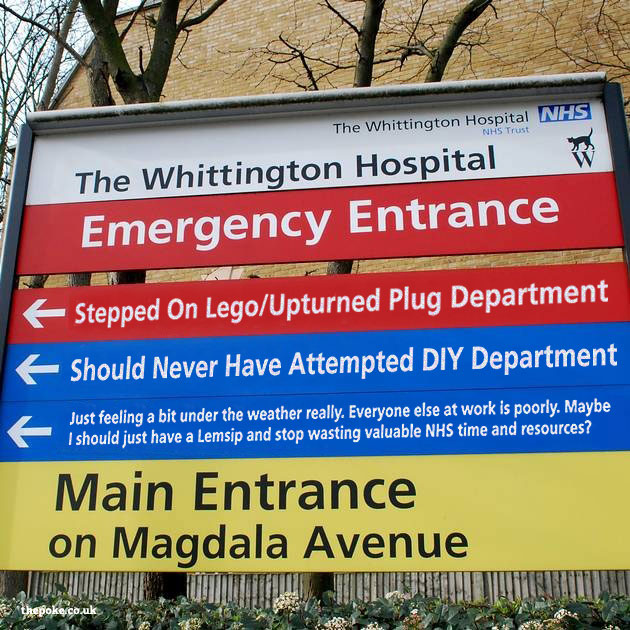
Last week on the blog, Emma Dorée wrote about a statement from South Tees NHS Foundation Trust urging people not to attend Accident and Emergency departments for stomach aches caused by excessive consumption of Easter Eggs. Emma explained that one in four A&E attendances is considered inappropriate, and highlighted the NHS Choose Well campaign which helps people to select the right place to take their symptoms.

Photo attribution: www.thepoke.co.uk
This made me wonder… is one in four A&E attendances being ‘inappropriate’ really so bad?

Clearly, the NHS is stretched at the moment, and nowhere more so than A&E, where only 83% of patients are seen and sent on their way within four hours, as compared with a target of 95%. It is natural for us to want to see performance improve, and waiting times are doubtless inflated by ‘inappropriate’ attendees.

Of course, we should wonder what is meant by ‘inappropriate’ in this context. There are many possible classifications. Of course, attending A&E seeking treatment for a sick dog is undoubtedly inappropriate. But is it inappropriate to attend for ‘hangover help’? What if the symptoms of your hangover are difficult to distinguish from the symptoms of meningitis? The final diagnosis and healthcare provider’s perspective is not necessarily the best viewpoint from which to determine ‘appropriateness’.

Even if we assume that one in four attendances truly is inappropriate, it’s reasonable to question whether that is so bad. Considering the problem in terms of sensitivity and specificity, it is vastly preferable that the self-triaging process is sensitive (i.e. all people who really need A&E attend A&E), even if that’s at the expense of a degree of specificity (i.e. some of the people who don’t need A&E still attend A&E). As a doctor, I want everyone who has a life-threatening emergency to attend A&E, not for one or two to go to their local pharmacy, and I’m willing to accept that making that happen might mean that some less urgent cases also slip through the net.

People presenting to services inappropriately is anything but a new problem. Writing in The Lancet in 1849, Joseph Hodgson - the founder of what is now known as the Birmingham Midland Eye Centre - complained of the “growing evil” of “the indiscriminate admission of out-patients to charitable institutions”. His problem was, perhaps, a little different: people referring themselves to charitable hospitals even though “one half of the patients can afford to pay the surgeon his fee”. In order to avoid detection, many of his patients chose to “dress shabbily, and even borrow their servants’ bonnets and shawls”.

To my mind, the root of the modern problem is that we expect people, most of whom rarely use the health service, to self-triage between six (or more) levels of care. This is not sensible. Campaigns admonishing people for making obviously incorrect choices don't help this core problem, and may even counteract campaigns like Be Clear on Cancer, which encourage people to consult health services with symptoms which they may not recognise as ‘red flags’.

One solution to this problem is to introduce professional triage. Back in 1849, Hodgson suggested that “each applicant be compelled to bring a note of recommendations from the clergyman”; perhaps not quite such a useful recommendation for the 21st century. NHS Direct, and its successor NHS 111, were perhaps intended to provide the modern equivalent of the clergyman’s note, but do not enjoy a high degree of public or professional confidence. This is probably because triage over the phone is very difficult, even if it has been shown in research to reduce A&E demand. Perhaps options such as embedding GPs within A&E, as proposed by South Tees CCG, will provide an answer.

For now, here’s the bottom line: even as someone working in the system, I couldn't tell you where I'm supposed to take myself if I develop an unclear symptom. Telling me how inappropriate other people’s attendances are don’t help signpost me to the right place if I have, for example, sudden hearing loss or eye pain. Like very many other people, in situations of uncertainty, I am likely to err on the side of accessing a higher level of care, as I would not want to delay urgent treatment. Though I probably wouldn’t turn up wearing my servant’s bonnet.

Thursday, 7 January 2016

The blog monster returns with a shameless plug

Posted by Emma Dorée, Fuse Communications Assistant

Just over a year ago, we wrote about how far the blog had come since it hatched and it’s safe to say that the waistline of the - now fully grown - ravenous blog monster continues to expand.

Feed me, Seymour!
Since its creation in May 2010, the Fuse blog has had just over 167,000 views and we’ve posted 334 blogs – a great achievement, right?!

As a result, we wanted to do something to celebrate this success and to see if we could reward all the contributors that make the Fuse blog what it is, so we have entered the UK Blog Awards 2016!

The blog has been entered into two categories: 'Health and Social Care', and 'Education'. You can vote for us in either category but of course we would really appreciate it if you voted for us in both.

You can vote for the Fuse blog once a day by following this link. We will be encouraging people to do this via our social media feeds but it would be even better if you could spread the word and encourage your friends and family to vote for us too.

http://www.blogawardsuk.co.uk/ukba2016/my-entry/fuse-open-science-blog
Click here to vote for the Fuse blog now

Most importantly however, we still need people to continue sending us blog posts so if you work in public health then please get in touch.

We want to hear about your aims, priorities and challenges or which issues you think need to be brought in to the public eye and debated. Could you give an insight into your role within public health for those not directly involved? Or is there a public health campaign in your area that you wish to promote or a topical news issue or event happening which could coincide with your post?

We post blogs at least once a week and publicise them via our Facebook page and Twitter account. The blog has its own website but of course, you can also view the blogs by visiting the Fuse website.

Email your posts to me (E.Doree@tees.ac.uk) and please let us know if you think there is anything we can do to improve the blog.

Thank you to everyone who has contributed to the blog so far. You have sparked great discussion and helped our readers learn what it is really like to work in public health, no matter what your role is.

The UK Blog Awards 2016 competition closes at 9pm on the 25 January so don’t forget to keep voting for us as much as possible until then!

Photograph ‘into the mouth’ by Len "Doc" Radin via Flickr.com © 2005: https://www.flickr.com/photos/drurydrama/1079598181

Thursday, 26 November 2015

Housing and health: aligning stars or weathering a perfect storm?

Posted by Peter van der Graaf, AskFuse Research Manager

Last Wednesday I attended the annual conference of the Housing Learning and Improvement Network (LIN), which explored how the housing and health sectors can work more closely and effectively together.

The case for this partnership was well made by the keynote speakers: not only are there already strong historic roots but the present day challenges faced by both sectors make them obvious partners. With the recent move of Public Health to Local Authorities, the central message from the Marmot review - improving social determinants is central to improving population health and wellbeing - has taken on a new significance for public health commissioners faced with the needs of other local government departments.


Housing is one of the key social determinants and has received much attention in recent Government policies that seek to redefine the remit of health. For instance, the Care Act outlines an overarching vision for adult social care and emphasises various housing solutions that can help to support the integration of health and social care.

The NHS has also recognised the role of housing and has proposed a new care model around housing in its Five Year Forward View, such as the Healthy New Towns initiative. As Neil Revely from Sunderland City Council and Chair of the Association of Directors of Adult Social Services (ADASS), proclaimed: “the stars seem to align once more to bring housing and health together”. For this reason, ADASS has worked closely with NHS England to develop a Memorandum of Understanding on Housing and Health.

However, the same politics that bring both sectors together could be stumbling blocks for the partnership to take off. As members of the audience pointed out, prevention services have been hardest hit by austerity measures and many local authorities have decommissioned the services that are now most needed. With a growing and ageing population, demand is likely to increase while resources are more likely to decrease with continued budget cuts. Moreover, the ageing population means an increase in complex needs that cannot be addressed by a prevention agenda alone and in which (supported) housing is just one part of the solution.

In short, the current political and financial climate might provide a perfect storm, making it difficult for housing and health to work effectively together. The balance might be decided by the ability of the partnership to access new resources and powers, for instance, by claiming a stake in the North East devolution plans, mirrored on the success of the Greater Manchester Devolution Agreement that includes an MOU on Health and Social Care worth £6bn each year (see also the Fuse blog post by Patrick Vernon on this topic).

To make the business case for these claims, the partnership will need to build the evidence base around the impact of a joint housing and health programme in the North East. An abundance of data is available to highlight the problem areas and populations, supporting the call to arms, but limited evidence was presented at the conference on what housing providers, public health teams and care providers can effectively do to address these problems and populations. Much of the current evidence is anecdotal and in the format of case studies.

The need for more evidence of the impact of the home/housing on health and wellbeing was also reiterated by Gill Leng from Public Health England (PHE) and this is an area where Fuse could provide helpful support. What research evidence do we have available within our Centre to support the North East partnership between housing and heath? What support can we provide in developing the monitoring and evaluation framework for their programme? The recent Fuse Quarterly Research Meeting (QRM) and corresponding research brief on health and housing is a first step in this direction and the upcoming QRM in April 2016 on planning and health another, but more practical evidence is required to align the stars of local policy, practice and research and help the North East health and housing partnership to weather the current political and financial storm.

Photograph 'Incoming Storms No. 2' by Mike Lewinski via Flickr.com © 2013: https://www.flickr.com/photos/ikewinski/9448689046

Did you enjoy reading this post? If so, please vote for Fuse in the UK Blog Awards 2016 by clicking here

Saturday, 10 October 2015

End of life care: looking through a different lens

Guest post by Joanne Atkinson, Director of Programmes, Northumbria University to coincide with World Palliative Care Day 2015.

When reflecting on my professional journey I often ask myself how did I get where I am today? The thing is your personal story has great resonance for you as a professional; this is an insight into my doctoral journey.

I have worked in palliative care for many years, firstly as a Macmillan Nurse in the acute sector, and then at Northumbria University teaching palliative care. Commencing a professional doctorate I had a stuttering start, but eventually arrived at where I am now with my research which is a study using Foucauldian discourse analysis. My research explores the influence and impact of emerging, competing and overlapping discourses on practice in end of life care, and provides insight into the discursive tendencies impacting on end of life care practice in the hospital setting.

Recent years have seen unprecedented media interest in end of life care, and the emergence of powerful discourses that influence health care professionals delivering care. My research focusses on the tensions, challenges and possibilities that emerge from this intersection.
You may recall some time ago the tragedy that occurred in Greater Manchester when Harold Shipman, a GP, killed his patients. The media coverage that occurred as a result of this has had a significant impact on the way in which doctors and nurses caring for people at the end of life. The public and other professionals questioned the prescribing of opiates for pain and symptom relief. This cultured the germ of a research idea. So my research journey started.
As I commenced my professional doctorate the media frenzy related to end of life care and the Liverpool Care Pathway developed, and I found myself at the cutting edge of end of life care. It is fair to say that I was taken aback by some the media outputs. 

I undertook an analysis of artefacts from journalistic press not tabloids (although this did include the Daily Mail!) and terrestrial television (factual outputs). Initially this was to be over a period of six months, but this was extended due to the profile of end of life care at the time. In addition tape-recorded narratives were taken from four consultants and six clinical nurse specialists working in palliative care, and a cancer centre. Participants recorded the narratives over a two-week period.

The media artefacts and narratives have reaffirmed the metaphorical language utilised when discussing end of life care, and highlighted the impact that the sensationalisation of end of life care has on practice, instilling a moral panic that both disables and fuels the need for change. Prominent discursive formations have emerged related to the power of representation and the impact on practice when caring for people at the end of life.
Back to my personal story which is inextricably linked with the research journey, having life happen throughout this research has no doubt enriched my understanding, but holding a very old man’s hand when he thinks he is going to be killed because he is so ill makes the impact discussed above so real especially when that very old man is your father.

Did you enjoy reading this post? If so, please vote for Fuse in the UK Blog Awards 2016 by clicking here

Photograph (5138623107_b05613223b_o) by More Good Foundation via Flickr.com © 2009: https://www.flickr.com/photos/moregoodfoundation/5138623107

Thursday, 11 June 2015

The Troubled families Programme: what's health got to do with it?

Guest post by Stephen Crossley, PhD student in the School of Applied Social Sciences at Durham University

A couple of weeks ago, the expansion of the Troubled Families Programme was formally announced during the Queen’s Speech. This formality came two years after the government itself announced their plans to expand it, around 10 months after they announced further details such as the criteria to be called a ‘troubled family’ under Phase 2 of the programme, and around six months after some local authorities started working with ‘troubled families’ as part of the expanded programme.

Another troubled family?
There have been numerous criticisms of different elements of the Troubled Families Programme since the programme was announced in the wake of the riots in England in 2011, with David Cameron promising to ‘turn around’ the lives of the most troubled and troublesome families in England by the end of the Parliament that finished in May 2015. Ruth Levitas and Jonathan Portes highlighted that the figure of 120,000 ‘troubled families’ used by the government (characterised as ‘neighbours from hell’ in the prime Minister’s launch speech), actually referred to research published four years earlier on families thought to be experiencing multiple disadvantages such as maternal mental health, poverty, material deprivation, poor quality or overcrowded housing. Levitas argued it was a discursive strategy which succeeded in feeding vindictive attitudes towards the poor.

A report carrying a series of interviews with families, written by Louise Casey, the senior civil servant in charge of the programme, was criticised for its lack of ethical process and the government admitted it was a ‘dipstick’ process which didn’t meet the government criteria for research and therefore didn’t require ethical approval. My own investigations revealed that a ‘survey’ used by Casey to highlight the need for ‘radical reform’ didn’t actually exist. In a series of speeches during 2013, Casey told audiences of a survey which showed that, in one deprived area in the North East, not one out of 3000 children had attended a dentist for a routine check-up, but that 300 had presented at A&E for emergency dental care. The survey was, in fact, an anecdote shared during a meeting about a different government programme, which Casey never thought to check before sharing with audiences, preferring instead to tell them it ‘encapsulates the problem’ of ‘troubled families’ in a single example. Casey also told the 2013 RCGP conference that these 120,000 families ‘dominated NHS budgets. That’s the long and the short of it’, which isn’t exactly true either.

To date, however, health has played a relatively minor part in the Troubled Families Programme (TFP) and health issues were not mentioned in either the criteria for families in Phase 1, or the outcomes expected in order for their lives to be considered ‘turned around’. But this is starting to change. The government published a report in July 2014 entitled: ‘Understanding Troubled Families’ which included information on the characteristics of families entering the programme in its early stages (my brief (Mis)understanding Troubled Families is available here). The data showed that the majority of the families being worked with under the banner of the TFP were not particularly anti-social, weren’t serial offenders and most of the children were in education, albeit not all of the time. In fact, the only characteristics that could be applied to a majority of families included in the report were that they were white, they lived in social housing, they had an adult on out-of-work benefits (although we don’t know why) and they had a family member with a serious health issue or a disability. In short, and if any personal characteristic can adequately explain unemployment, these families were probably more likely to be out of work because of health, disability or caring issues than because of any intergenerational culture of worklessness.

In the expanded second phase of the programme, ‘parents and children with a range of health problems’ is included as one of the six criteria for families, who have to hit two of the criteria to be labelled ‘troubled’. Other criteria include ‘children who need help’ and ‘children who have not been attending school regularly’. These vague criteria are open to interpretation and councils will be encouraged to go out and find ‘troubled families’ in order to ‘turn them around’ (or make ‘significant and sustained progress’ in phase 2) and claim the cash bonus, via the Payment By Results process, for doing so. A health bulletin on ‘troubled families’ was also published when the new criteria were announced, highlighting the health related issues some ‘troubled families’ faced, and a ‘leadership statement’ followed shortly after, accompanied by information on skills and training and interim guidance on data sharing amongst partner agencies. With health visitors and school nurses now under the remit of local authorities in England, it is likely that many will become involved with the TFP.

All of these developments should concern health professionals. The TFP assumes that the answer to the families problems lie firmly within the four walls of the family home, with a strong rhetorical focus on ‘getting in through the front door’ and working with the family ‘from the inside out’. In short, there is no room in the narrative for wider determinants of people’s circumstances. Its alleged success has never been proven. There is scant evidence to justify such an approach and it is unlikely that having a determined, non-specialist key worker will make much difference to many of the health problems ‘troubled families’ experience. The programme is a good example of what David Hunter and Jenny Popay and others have called ‘lifestyle drift’, where the focus of interventions drifts towards attempting to change individual behaviour, despite the wealth of evidence pointing to other solutions. But this ‘responsibilization’ strategy is also a punitive, stigmatising discourse which is targeting some of the poorest and most vulnerable families in England, telling them that they are the architects of their own misfortune and that they just need to try harder and follow a routine. A simultaneously fascinating and alarming article in the BMJ recently, exploring the role of psychology in government workfare programmes highlights that this approach is not a unique aspect of the government’s welfare ‘reforms’. Health professionals should tread carefully.

Stephen Crossley's first peer-reviewed article on ‘troubled families’ can be found here.

Did you enjoy reading this post? If so, please vote for Fuse in the UK Blog Awards 2016 by clicking here