Showing posts with label SHoward. Show all posts

Thursday, 14 April 2016

'Inappropriate' A&E attendance: One out of four ain't bad

Guest post by Dr Simon Howard, Associate Lecturer in Public Health, Northumbria University

Last week on the blog, Emma Dorée wrote about a statement from South Tees NHS Foundation Trust urging people not to attend Accident and Emergency departments for stomach aches caused by excessive consumption of Easter Eggs. Emma explained that one in four A&E attendances is considered inappropriate, and highlighted the NHS Choose Well campaign which helps people to select the right place to take their symptoms.
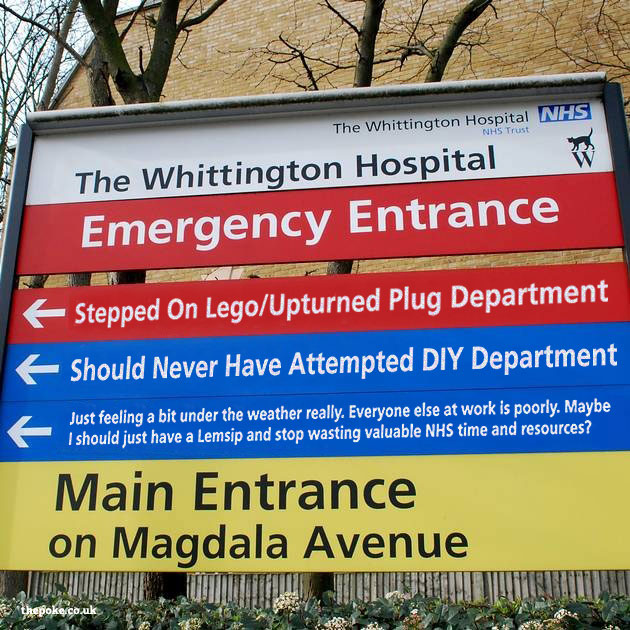
Photo attribution: www.thepoke.co.uk
This made me wonder… is one in four A&E attendances being ‘inappropriate’ really so bad?

Clearly, the NHS is stretched at the moment, and nowhere more so than A&E, where only 83% of patients are seen and sent on their way within four hours, as compared with a target of 95%. It is natural for us to want to see performance improve, and waiting times are doubtless inflated by ‘inappropriate’ attendees.

Of course, we should wonder what is meant by ‘inappropriate’ in this context. There are many possible classifications. Of course, attending A&E seeking treatment for a sick dog is undoubtedly inappropriate. But is it inappropriate to attend for ‘hangover help’? What if the symptoms of your hangover are difficult to distinguish from the symptoms of meningitis? The final diagnosis and healthcare provider’s perspective is not necessarily the best viewpoint from which to determine ‘appropriateness’.

Even if we assume that one in four attendances truly is inappropriate, it’s reasonable to question whether that is so bad. Considering the problem in terms of sensitivity and specificity, it is vastly preferable that the self-triaging process is sensitive (i.e. all people who really need A&E attend A&E), even if that’s at the expense of a degree of specificity (i.e. some of the people who don’t need A&E still attend A&E). As a doctor, I want everyone who has a life-threatening emergency to attend A&E, not for one or two to go to their local pharmacy, and I’m willing to accept that making that happen might mean that some less urgent cases also slip through the net.

People presenting to services inappropriately is anything but a new problem. Writing in The Lancet in 1849, Joseph Hodgson - the founder of what is now known as the Birmingham Midland Eye Centre - complained of the “growing evil” of “the indiscriminate admission of out-patients to charitable institutions”. His problem was, perhaps, a little different: people referring themselves to charitable hospitals even though “one half of the patients can afford to pay the surgeon his fee”. In order to avoid detection, many of his patients chose to “dress shabbily, and even borrow their servants’ bonnets and shawls”.

To my mind, the root of the modern problem is that we expect people, most of whom rarely use the health service, to self-triage between six (or more) levels of care. This is not sensible. Campaigns admonishing people for making obviously incorrect choices don't help this core problem, and may even counteract campaigns like Be Clear on Cancer, which encourage people to consult health services with symptoms which they may not recognise as ‘red flags’.

One solution to this problem is to introduce professional triage. Back in 1849, Hodgson suggested that “each applicant be compelled to bring a note of recommendations from the clergyman”; perhaps not quite such a useful recommendation for the 21st century. NHS Direct, and its successor NHS 111, were perhaps intended to provide the modern equivalent of the clergyman’s note, but do not enjoy a high degree of public or professional confidence. This is probably because triage over the phone is very difficult, even if it has been shown in research to reduce A&E demand. Perhaps options such as embedding GPs within A&E, as proposed by South Tees CCG, will provide an answer.

For now, here’s the bottom line: even as someone working in the system, I couldn't tell you where I'm supposed to take myself if I develop an unclear symptom. Telling me how inappropriate other people’s attendances are don’t help signpost me to the right place if I have, for example, sudden hearing loss or eye pain. Like very many other people, in situations of uncertainty, I am likely to err on the side of accessing a higher level of care, as I would not want to delay urgent treatment. Though I probably wouldn’t turn up wearing my servant’s bonnet.

Thursday, 11 September 2014

52 weeks in public health research, part 36

Posted by Simon Howard and Jean Adams

From Simon Howard: after the photo of the Messi Pepsi can, I thought this one I took on holiday in Naples took the biscuit - the Napoli football team as tins containing chocolate chip cookies! Judging from the end product, I'm not sure they thought too hard about the aesthetics, let alone what the public health consequences might be!

From Jean Adams: In October we are moving to Cambridge and we've been using our East Coast rewards points to house hunt in style. But all that time spent searching property websites during the week means that we are making use of the peace and space of first class to catch up on work.

From Jean Adams: I was in London earlier in the summer at one of those meetings that looks like you are being invited to contribute your expertise, but is actually someone very politely asking you to stop making so much fuss. The meeting ended early and I took the opportunity to visit the V&A's Disobedient Objects exhibit before my train. This Nicholas Klein quote made me feel just a little alone and ignored.

From Jean Adams: the 'big move' means that I have finally had to find the time to clear out my desk and cupboard. After ten years of not looking at any of them once, I am parting with my PhD notes. Both a little bit gut wrenching and a little bit liberating.

------------------
Just to remind you:

Each Thursday of 2014 we’ll try and post around four pictures on the Fuse blog that capture our weeks in public health research, from the awe-inspiring to the everyday and mundane. Given that more of the latter than the former exists in my life, I foresee problems compiling 208 images worth posting on my own. So this is going to have to be a group project. Send me an image (or images) with a sentence or two describing what aspect of your week in public health research they sum up and I’ll post them as soon as I can. You don’t have to send four together – we can mix and match images from different people in the same week.

Normal rules apply: images you made yourself are best; if you use someone else’s image please check you’re allowed to first; if anyone’s identifiable in an image, make sure they’re happy for it to be posted; nothing rude; nothing that breaks research confidentiality etc.

Thursday, 27 February 2014

52 weeks of public health research, part 8

Posted by Bronia Arnott and Simon Howard

From Bronia Arnott: Healthy snacks for a meeting at the Human Nutrition Research Centre.

From Bronia Arnott: not so healthy snacks when it is my turn to cater a meeting.

From Simon Howard: the newly opened Beautiful Science exhibition at the British Library which charts the history of data visualisation, including a whole (brilliant) section on public health. 

From Simon Howard: this cartogram is from the Chief Medical Officer's forthcoming annual report, which I'm editing. It represents the number of fast food outlets per person at local authority level (darker = more), with the area of local authorities distorted to be proportional to the population. It raises really interesting questions about association with obesity, and shows the complexity of public health - we know there's an association between population density of fast food outlets and deprivation, but there are also weird outliers like Westminster, which is likely related to tourism, and coastal towns, which is likely related to fish and chip shops.


------------------

Just to remind you:

Each Thursday of 2014 we’ll try and post around four pictures on the Fuse blog that capture our weeks in public health research, from the awe-inspiring to the everyday and mundane. Given that more of the latter than the former exists in my life, I foresee problems compiling 208 images worth posting on my own. So this is going to have to be a group project. Send me an image (or images) with a sentence or two describing what aspect of your week in public health research they sum up and I’ll post them as soon as I can. You don’t have to send four together – we can mix and match images from different people in the same week.

Normal rules apply: images you made yourself are best; if you use someone else’s image please check you’re allowed to first; if anyone’s identifiable in an image, make sure they’re happy for it to be posted; nothing rude; nothing that breaks research confidentiality etc.

Also, this doesn’t mean we wont also be posting words. You word-based posts are, as always, much appreciated.

Thursday, 13 September 2012

On evidence

Posted by Simon Howard

In my first week at medical school, one of the professors warned that most of what we were to be taught was factually wrong. It was an arresting statement, but it may have been true: Studies have shown that textbooks and experts frequently lag behind evidence, sometimes recommending “treatments” that are actually known to be harmful.

Do Primary Care Trusts do the same? PCTs, like the one I work in, currently commission the majority of NHS services provided to patients in their catchment areas (though not for much longer). Sometimes, academics get frustrated with PCTs for seemingly doing things that either have little evidence, or appear to contradict it altogether. Given that evidence is the bedrock of public health, and given the potential for decisions to affect whole populations, this might seem worrying.


In defence of PCTs, a lot of evidence based work does happen. Most major pieces of work include a review of academic literature at an early stage, and follow the findings. The annual Joint Strategic Needs Assessment and regular detailed Health Needs Assessments also take into account published literature and local and national data in a fairly systematic way.

But there are lots of barriers to following the evidence. Books and books could be written on this topic, from the applicability of evidence in the real-world to deciding if research is really relevant to a particular population. But I’m no expert, and I’m not going to try and describe anything technical, complicated, or even remotely clever. These are just a few examples of practical barriers to following the letter of the academic evidence in public health.

One huge barrier is – as with most things in life – money. In a world of ever-tightening budgets, an academic’s seemingly reasonable intervention can be unaffordable. As an extreme example, research by the FAA and CAA suggests that three or four lives would be saved in an average aircraft fire if all passengers were provided with smoke hoods. However, the vanishing rarity of in-flight fires, the enormous cost of supplying and maintaining smoke hoods, and the cost of the fuel required to propel them around the world, all make this proposal financially unjustifiable.

Not all examples are quite so clear-cut. Sometimes, instead of choosing not to do something, PCTs try to cherry-pick the best bits of interventions in a way that is almost certainly infuriating to the academics who pioneered them, and possibly less effective in practice. But, sometimes, doing something is better than doing nothing.

Often, there can be a big lag between publication of evidence and its implementation. One reason is the complex contractual nature of commissioning: it’s often difficult to make small changes to services that have already been commissioned. The constant pressure to reduce costs incentivises longer contracts which spread the financial risk, but which also increase the evidence-practice lag. I’m sure it’s deeply frustrating to be an academic shouting “there’s a better way to do this” while services continue unchanged.

There’s also a political element to public health. Decisions to cut services that are no longer supported by evidence are particularly tricky. In England and Northern Ireland, the evidence that cervical screening in women under the age of 25 causes more harm than good has led to a withdrawal of the service in this age group. The clear evidence, combined with clear recommendations from the World Health Organisation and National Screening Committee hasn’t stopped this becoming a topic for political debate and petition, and hasn’t (yet) changed policy in Wales or Scotland. It seems likely that this political element will play a bigger part in decision making as public health moves to the overtly politicised world of local authorities.

To me personally, the most frustrating barrier to following the evidence is an inability to access it. It continues to baffle me that the NHS doesn’t have anything like the level of straightforward desktop access to literature that university colleagues have. In the 21st century, it seems crazy that I sometimes have to ask the BMA to take a paper journal off a physical shelf, scan it in, and email it to me as the only practical cost-effective way to access a paper that’s of general interest, rather than something specific to any individual project.

I think a latent awareness of what’s going on in academia is important in public health. It might not matter so much when someone’s doing a big literature review prior to introducing a new service, but it can help with horizon-scanning, and with those little every day decisions that aren’t worthy of a trawl though the literature, and with planning for the future. This is something we can all play a part in: public health professionals probably need to broaden their awareness of the academic things going on around them, and academics probably need to shout louder about the latest developments in their fields. As an associate member, I’m probably biased, but I think FUSE is great at helping both groups.