Showing posts with label disadvantaged. Show all posts

Friday, 30 September 2022

Going beyond research to empower involvement and smash stereotypes

Posted by Sheena Ramsay, Professor of Public Health & Epidemiology, (and team: Emma Joyes, Emma Adams, Laura McGowan) in collaboration with Fulfilling Lives Newcastle Gateshead Experts by Experience

The way researchers approach some groups is often not sensitive to or inclusive of their needs. For example, the information can use technical language (such as ‘licit substances’ or ‘quasi-experimental’) which can be difficult to understand and off-putting. This can lead to people not wanting to take part in studies. Which means that new research insights, including changes to practice, can exclude those who are often most impacted.

Over the last two years, we have been working with Fulfilling Lives Newcastle Gateshead and their Experts by Experience Network of individuals with lived experience of multiple disadvantage. We have explored perceptions of services and programmes relating to oral health and related health behaviours - such as substance use, smoking, and diet - for people who experience severe and multiple disadvantage (a combination of homelessness, substance misuse, and offending). From the beginning, the Experts by Experience Network has shaped our work and helped us ensure it is accessible to those we want to speak to the most.

One of the ways that the Network has shaped our research is by helping us to create a video to help reach out to potential participants for our research - particularly people who are often excluded in research studies, such as people experiencing homeless.


Our team worked with the Experts by Experience Network to look at ways to get people involved in the research. We wanted to work with those who had insights into the issues we hoped to study, so that we could communicate the research in a way that would resonate with people. Together, we co-created an animated video as a means of reaching out to people, so they could find out about the research and how to take part.

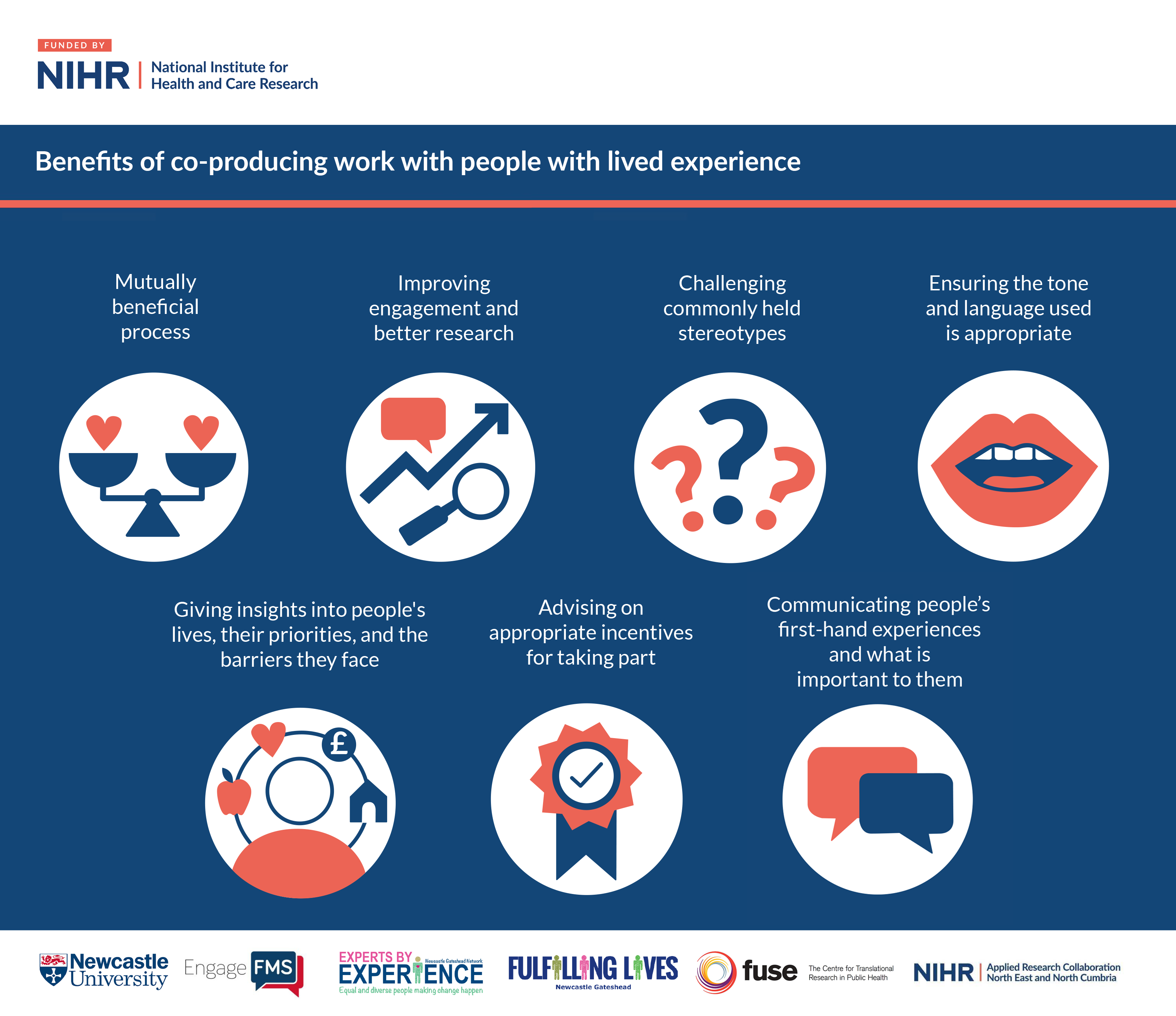
The infographics in this blog show what we have learnt from this process of co-creating the video and the value of co-production.


Creating a video provided an easy way in which organisations (such as Crisis, Fulfilling Lives, and other providers) and local Expert by Experience networks could share information about the study.

Those involved in creating the video were able to draw upon their experiences to help shape the content. One of the members of the group shared their experience of the process:
“Some of us in the Network feel really strongly about this issue and have personal experience of it ourselves so we were keen to be involved and share our ideas and opinions.”
Another member said:
“I joined this project because my own oral health has been something I've been embarrassed about in the past so I thought I could add something useful to this work.”
We have tried to map out how we designed our video in the image below.


The video has also been shared nationally with a wide range of organisations that support severe and multiple disadvantage groups in Newcastle and Gateshead, London, and Plymouth to promote engagement with policy and commissioners, local authority, criminal justice system, primary care, and third sector organisations. Producing a video was no easy feat, but it was a simple way of sharing our research with people who are pressed for time. You can check out the video below.


A clear benefit of engaging with people with lived experience was having their input on how best to communicate our research widely. They provided real-life stories and examples, which helped create the narrative for the video. They helped challenge stereotypes of ways in which people can be portrayed in research studies - this resulted in modifying the images and language used in the video which were much more realistic and sensitive to the people we were wanting to engage. This has helped our research team become more aware of and appreciate the importance of stereotyping and how it can result in putting people off taking part in research.

The benefits reached beyond the research team and the video (the below infographic highlights some of these), as many of the Experts by Experience echoed how involvement has led to them feeling empowered and one member wrote a blog about their experience.

We plan to build on this collaboration as we continue our research and gain further input on findings from our study and next steps.


This study ‘Improving the oral health and related health behaviours of adults experiencing severe and multiple disadvantage: evidence synthesis and qualitative stakeholder research’ is funded by the NIHR Policy Research Programme (grant reference NIHR200415). The video was supported by Newcastle University Engage FMS. The views expressed are those of the author(s) and not necessarily those of the NIHR or the Department of Health and Social Care.

Friday, 29 October 2021

Are zero and low alcohol alternative drinks just a drop in the ocean when it comes to tackling the real harms of alcohol?

Posted by Professor Peter Anderson, Professor Eileen Kaner and Dr Amy O’Donnell, Newcastle University

We’ve come a long way since Becks Blue was your go-to if you were looking for an alcohol-free alternative to beer.

The drinks industry now caters for a growing number of adults who are looking to reduce their alcohol consumption, or not drink at all.
‘Sober-curious’ and ‘Quit-Lit’ are buzzwords of our time, and Sober October and Dry January are now firm calendar fixtures for many.

Supermarkets offer shelves full of zero alcohol gin, 0% craft beer, prosecco – and more. A non-alcoholic Cobra with your curry? No problem. Even Guinness now offers an alcohol-free version.

They’re all a great alternative if you want to reduce or stop drinking, especially if you still want to ‘feel’ like you’re having a drink.

But who is this helping?


Our latest research has found that you’re more likely to buy zero or low alcohol alternatives if you’re younger, you fall into a higher earning bracket and you’re well-educated.

And that’s probably unsurprising, given that non-alcoholic alternatives aren’t cheap - and can sometimes be more expensive than their ‘normal’ equivalents.

For example, at the time of writing, a UK supermarket was selling a litre of Gordon’s Gin (37.5% ABV) at £15.99 a litre, alongside the new 0.0% version at £20 a litre. So if you want to switch, you’re going to have to pay a bit more.

It’s a similar story when it comes to other health-related behaviours, such as eating good quality, fresh food or having a gym membership, where those who are more affluent will lead the way – possibly because they can simply afford to.

Which leads to further questions – are zero or low alcohol drinks only able to make a small difference when it comes to harmful levels of drinking across all groups, including those who are economically disadvantaged? And - does the price and accessibility of these alternatives create some inequality in itself?

Headline findings from our study – do low or no alcohol drinks increase health inequalities?


We wanted to find out whether the purchase and consumption of zero or low alcohol beers differs by demographic and socio-economic characteristics.

To do so, we looked at purchase data from almost 80,000 households and surveys from over 100,000 adults, provided by Kantar World Panel.

We found that zero alcohol beer was more likely to be bought and drunk by younger people and more socio-economically advantaged consumers.

We also saw higher purchase levels in those who generally bought and drank the most alcohol – and this was higher in men, younger adults, and those with higher incomes.

Households that were more likely to buy low alcohol beer were also heavier buyers of alcohol overall, and more likely to be middle-aged (45-64 years).

We also found that for every purchase of a low or no alcohol alternative, there were just under 46 purchases of the alcoholic equivalent – so buying and drinking levels of the low or no alcohol products are still relatively low.

Proportion (%) of households that reported at least one purchase of zero alcohol beer (green, left vertical axis), low alcohol beer (orange, left vertical axis) and all other beer (red, right vertical axis) for any day that a household made an alcohol purchase by study day, 2015 to 2020. Data points: daily.


What does this mean?


The increasing availability of low or no alcohol alternatives might be a useful tool to reduce overall drinking in the more socially advantaged groups in society, but not so beneficial for the rest of the population.

Zero or low alcohol alternatives are great if you can afford them, but they’re not the whole answer when it comes to addressing the real issues around drinking alcohol – including some of the deeper and wider reasons that drive people to drink so much in the first place, the ready availability of alcohol, and its relatively low price.

In conclusion, we believe that promoting zero and low alcohol alternatives is not enough to address the harm done by alcohol, including alcohol-related health inequalities.

Additional evidence-based policy measures - such as a Minimum Unit Price and improved funding for alcohol treatment and intervention and prevention services - are needed to lessen harms of alcohol which are experienced by the most disadvantaged people in our society.


References

This blog is based on a paper published in September 2021 in the International Journal of Environmental Research and Public Health- ‘Is buying and drinking zero and low alcohol beer a higher socio-economic phenomenon? Analysis of British survey data, 2015-2018 and household purchase data 2015-2020.’ – by Peter Anderson, Amy O’Donnell, Dasa Kokole, Eva Jane Llopis, Eileen Kaner.

Professor Eileen Kaner, Professor Peter Anderson and Dr Amy O’Donnell are based at Newcastle University and members of the NIHR ARC North East and North Cumbria. This blog was produced by the NIHR ARC North East and North Cumbria on behalf of the report authors.

You can read the full paper, here.

Other linked research that may be useful for readers:

Friday, 29 January 2021

Bringing the voice of lived experience and community learning into research

Posted by Angela Broadbridge, Peer Research Lead, The Young Foundation (former Research and Evaluation Lead, Fulfilling Lives Newcastle Gateshead)

“There’s something really interesting in our data here, we don’t quite have the full picture, let’s talk to some people to puzzle it over more.”
This is something I hear myself or the team at Fulfilling Lives Newcastle Gateshead (FLNG) say really regularly. We’re an 8 year National Lottery Community Fund learning programme working to improve the lives of people facing multiple disadvantage and build a trauma-informed approach within the services that supports them. We have a wealth of data from supporting over 250 people locally, and we work with a team of Experts by Experience, people with lived experience working to bring about change across the systems they have been through, using their voices to be heard across different platforms.
Fulfilling Lives Newcastle Gateshead Experts by Experience Network co-design session

As the programme has developed our relationship with Fuse has changed and connections have grown, we now do much of our ‘puzzling over’ with Fuse colleagues! I joined Fuse as an associate member back in 2017 when I took up my post as research and evaluation lead for FLNG. I attended Fuse Quarterly Research Meetings to build up my contact base and learn from others operating in this interesting space between frontline practice and research and learning. As I began to see frontline practitioners come into those sessions, I invited some of our own frontline staff to join me to share their experience of working with people who have experienced complicated and challenging circumstances and struggled navigating systems.

I want to highlight some of our learning from building collaborative relationships through and with Fuse researchers, as this has proved to offer new platforms for the voice of lived experience not just to be heard in research, but to set research agendas and co-produce work alongside academics.

In 2018, Dr Sheena Ramsey (co-lead of the Fuse Healthy Ageing Research Programme) invited me to attend a Research Hub Initiative event with Public Health England and I pitched a seed grant funding idea with support from Fuse researchers. Our recently published work on deaths in the multiple complex needs community, an issue our Experts by Experience network encouraged us to explore, was borne out of this funding. We have since joined up with Sheena again in a new study identifying effective and sustainable interventions to improve the oral health of adults with severe and multiple disadvantage. This collaboration works because Sheena and other researchers associated with the study took the time to really get to know our programme, and our Experts by Experience network. Sheena visited us at the men’s accommodation project where we were based a few years ago, met some of our frontline staff and also built trusting relationships with the network, introducing us to academic and practice colleagues to further situate our programme learning within Fuse.

Brainstorm - what makes a good collaboration?
While this was happening, Prof Susan Carr (Fuse Associate Director), set up a meeting with her team at Northumbria University and FLNG peer researchers to talk about projects we were both working on and to explore collaborations. She also arranged for our peer researchers to present early findings from their work to Prof Kevin Fenton, Public Health Regional Director for London, and it was at this point that we started to see how people with lived experience could be involved in local research and practice beyond being participants. There were opportunities for genuine collaboration and learning together.

Fast forward to early in the pandemic and we were involved in two applications to the NIHR Applied Research Collaboration (ARC) for the North East and North Cumbria. One of these applications was exploring food insecurity with Fuse Associate Dr Steph Scott, and Kevin Dobson and Keith Gibson from FLNG’s research team set about exploring our own programme data around foodbank use. Our Lottery funded programme is quite unique in that we have a personal budget fund to use to support people on the programme with anything from their basic needs, including food and accommodation, to more creative uses like buying art materials or enjoying an afternoon at the cinema. Once again we had a ‘there’s something interesting here’ moment.

I sent Steph an email saying:
“we’ve worked with 259 people in Newcastle Gateshead over 6 years and of these 127 individual client records contained a reference to food insecurity or food poverty. We had 14 unique cases, interestingly all female, whose notes had 10 or more references to food poverty and we can see from the notes frequent references to benefits being suspended, people not eating, or missing the foodbank opening times.”
Working with partners to surface system barriers and solutions
The conversation that followed led to us talking to the Experts by Experience about food insecurity, they were similarly enthused by the topic and together we made a successful joint application to the Catherine Cookson Foundation within Newcastle University for a project exploring mutual aid during Covid-19. Using our Lottery funded programme learning and building on our experience co-producing research in other projects with Fuse researchers we are working with a group of Experts by Experience who have developed research questions to start a listening exercise with their peers around their experiences of food insecurity, mutual aid and Covid-19.

This relationship with Fuse is evolving and changing, and it now feels like a relationship truly rooted in the principles of co-production. Our team report that they feel their frontline experience is listened to and helps shape research projects, and our peer researchers are involved in numerous projects and have the confidence to approach Fuse researchers to develop new pieces of work building on the issues that are important to them and their communities. As our programme comes to an end in March 2022, the Experts by Experience network is now thinking about its legacy, we very much hope to continue to build on this strong foundation for collaboration and learning.

Friday, 6 October 2017

Looking for trouble: deceit and duplicity in the Troubled Families Programme

Introduced by Peter van der Graaf


Guest post by Stephen Crossley, Senior Lecturer in Social Policy at Northumbria University

Many families facing health problems, limiting illnesses, or with disabled family members have been labelled as ‘troubled families’ under the government’s Troubled Families Programme. Originally established following the 2011 riots to ‘turn around’ the lives of 120,000 allegedly anti-social and criminal families, the programme is now in its second phase and is working with a far larger group of families, many of whom experience troubles, but don’t necessarily cause trouble. In April of this year, the focus of the programme shifted again in an attempt to improve the number of so-called ‘troubled families’ who moved back into employment, despite the majority of them being in work and many of the remainder not being expected to be looking or available for work.

The programme has been dogged by controversy from day one. Research about families experiencing multiple disadvantages was misrepresented at the launch of the programme to provide ‘evidence’ that there were 120,000 troublesome families in England. The government has since been accused of suppressing the official evaluation of the first phase of the programme after it found ‘no discernible impact’ of the programme and also of ‘over-claiming’ the 99% success rate of the first phase. 

David Cameron with Louise Casey, former Director General of Troubled Families

Many health workers will be involved with the delivery of the Troubled Families Programme in their day-to-day work, although there is also a good chance that they will not be aware of it. Many local authorities do not refer to their local work as ‘troubled families’ because of the stigmatising rhetoric and imagery associated with it. Many families are not aware that they have been labelled as ‘troubled families’ for the same reason, and because it would undoubtedly hinder engagement with the programme. They are not always made aware that the data that is collected on them as part of the programme, is shared with other local agencies and, in an anonymised format, with central government.

My PhD research, conducted in three different local authority areas, found that the programme was based on, and relied upon duplicity from design to implementation. Despite government narratives about the programme attempting to ‘turn around’ the lives of ‘troubled families’, the programme appeared to be more concerned with helping to restructure what support to disadvantaged families looks like, and reducing the cost of such families to the state.

For example, support – both symbolic and financial - for universal services, such as libraries, children’s centres and youth projects, is reducing. Direct financial support to marginalised groups is also being cut, with welfare reforms hitting many of the most disadvantaged groups hardest. These forms of support, and many other more specialist services, are being replaced, rhetorically at least, by an intensive form of ‘family intervention’ which allegedly sees a single key worker capable of working with all members of the family, able to ‘turn around’ their lives no matter what problems, health-related or otherwise, they may be facing or causing.

The simplistic central government narrative of the almost perfect implementation of the Troubled Families Programme was not to be found ‘on the ground’, where there were multiple frustrations and concerns about the depiction of the families and the programme, and numerous departures from the official version of events. Despite the rhetoric of ‘turning around’ the lives of ‘troubled families’, in the face of cuts in support and benefits to families, my PhD thesis concluded that the Troubled Families Programme does little more than intervene to help struggling families to cope with their poverty better, despite the efforts of local practitioners.

Put simply, the programme does not attempt to address the structural issues that cause many of the problems faced by ‘troubled families’, but instead encourages them to ‘learn to be poor’. In my previous Fuse blog, I drew on the concept of ‘lifestyle drift’ advanced by David Hunter and Jenny Popay: where the focus of interventions drifts towards attempting to change individual behaviour, despite the wealth of evidence pointing to other solutions. There is no room in the narrative for wider determinants of people’s circumstances. Because of this, the government’s Troubled Families Programme will do little to turn around the lives and health of the families it claims to help.


A summary of Stephen Crossley’s PhD research can be found here. His first book In Their Place: The Imagined Geographies of Poverty is out now with Pluto Press. He tweets at @akindoftrouble


Photograph ‘Almost 40,000 troubled families helped’ (14087270645_3453006d12_c) by ‘Number 10’ via Flickr.com, copyright © 2014: https://www.flickr.com/photos/number10gov/14087270645