Showing posts with label writing. Show all posts

Friday, 1 May 2020

Jerry-rigging, day chunking and comfy slippers: Coping with working from home

Posted by Jack Nicholls, Graduate Tutor, Northumbria University

I am a huge fan of Firefly. For the uninitiated, it’s a TV series centred on a rag-tag quasi-criminal crew, working for themselves on a tired but solid cargo spaceship, taking jobs as they can. It has a phenomenal amount to recommend it, and is rich and complex in terms of plot, dialogue and morality. Given that the ship serves as home, workspace, transport and social space, no-one discusses work-life balance. Maybe it’s not such an issue in sci-fi.

In the real world, most of our homes have over the last couple of months been 'jerry-rigged'* into offices, studio, workshops and lecture podiums. Some of us are sharing our new occupational spaces with family or flatmates with their own needs and pressures. Some of us are completely on our own, missing our colleagues. All possible permutations come with challenges and difficulties, and the one commonality is that there aren’t necessarily that many commonalities.

As the diversity of experiences became apparent, I decided to seek and compile a range of different coping strategies from colleagues in my department. What follows is the thematised synthesis of those colleagues’ input and ideas.


Getting writing (or anything else) done
My 'jerry-rigged' free-form workstation
  • Short bursts of focused concentration throughout the day - Pomodoro technique is a variant of this.
  • Daily goal of one substantial work task and one admin task
    • ....or a day given over wholly to one or the other
    • ....or a few small achievable goals.
  • Shutting emails / twitter/ phone off for allotted time periods.
  • Ending the day mid-sentence or with the next idea ready.
  • Content drafting or form/language editing when writing, but never both at the same time 


Structure and timing
  • Choose a daily time to start and definitely finish work, with regular breaks and small treats.
  • Differentiate between the working week and the evenings/weekends/(bank) holidays.
  • Alternatively......giving up on the 9-5... some are working in short bursts when able. 
  • Use your best available thinking time for the more complex/academic/difficult/thinky work (generally morning for me).
  • A ‘panic to do list’ - dump everything out of your head onto paper (work and otherwise) – then prioritise.
  • To-do-list for the next day – 3 things max.
  • Forcing yourself to do the worst job first - (known in some circles as ‘eat the frog’ – I can’t advise taking this literally ☹). 
  • Split tasks up to reduce boredom/weariness. 
  • If able, work early in the day on internet-reliant tasks (internet speed can slow in the afternoon).
  • Spread the admin tasks throughout the week.
  • Open the curtains in the morning, turn the lights on in the evening and then off before going to sleep - good for psychological rhythm.
  • Agree to morning video calls - it forces you to get dressed.
  • Clean and tidy up, either first or last thing - you will feel a sense of accomplishment and peace. 

Habits
  • Get dressed for work – not necessarily what you’d wear to the office/library/placement – but something that is different to your ‘comfy’ wear. When you're finished working get changed.
  • Alternatively...some find it freeing and comfortable to work in their pyjamas if they don’t have a Skype call.
  • Comfy slippers, but smart/casual wear for torso (just in case anyone Zooms, FaceTimes or Teams you).
  • Exercise at some point in the day – that could be anything – online pilates, weights, a stroll.
  • Don’t work excessive hours and be realistic about expectations (it will never all be done).
  • Get some fresh air – if you or one of your household are among the shielded, an open window will do.
  • Give yourself a bedtime and try observing some sleep hygiene.
  • Sing (or even dance) when you have a break and interact with pets if you have them.
  • Keep in regular contact with colleagues and friends, but also be prepared to turn off contact devices when you need to concentrate.
  • Keep your work space organised if possible – if space is limited, some people find it helpful to put all their work things on a tray, then it can be moved to wherever there is space, and quickly out of the away. 
  • Some find working in the same place suits them, others move around for variety, or depending on the task.
  • Switch the background on your Word document to something other than bright white – less strain on the eyes. Any pastel shade is good. 

Pickle & Missy failing to follow social distancing rules
These tips are diverse, and some contradict one another. This is neither a surprise nor a bad thing – academic staff, like anyone else, vary in their personal circumstances, geography, family situation, preferences and strengths. I don’t have caring responsibilities (rabbits aside) but am in a risky health category, so my time is possibly more flexible, but my ability to leave the house extra-limited. The way to look at this list is as a broad range of suggestions, and to take or try things that you think might work for you and your situation. It may be that some things work better under some circumstances than others, and there will be things here that just don’t work in your personal situation. Customise, reverse-engineer, and fit to your needs.


I’ll end where I started – with Firefly. The following exchange takes place after a tumultuous, dangerous escapade.
"We're still flying." 
"That's not much." 
"It's enough" 
Stay as safe as you can, and good luck.

*for those of a less nautical persuasion, 'jerry-rigged' or 'jury-rigged' means having temporary makeshift rigging. In this case my improvised workstation!


Contributors:
Melanie Gibson, Sarah Lonbay, Katie Haighton, Tim Rapley, Monique Lhussier, Natalie Foster, Sonia Dalkin, David Nichol, Julie-Anne Lowe, Kay Heslop, Peter Kruithof, Donna Carlyle

Image:
  1. "Firefly boxset cover" by Tom Mulrooney via Flickr.com, copyright © 2006: https://www.flickr.com/photos/mullers/232714398. Attribution-NonCommercial-ShareAlike 2.0 Generic (CC BY-NC-SA 2.0)

Friday, 21 June 2019

Is there life beyond the PhD?

Posted by Priyanka Vasantavada, PhD researcher, School of Health and Social Care, Teesside University

Thomson-PP14
Living my Jane Austen fantasy
Don’t ask me if there is? It’s not afterlife. Or is it? But it is a question every PhD student has wondered about during the ups and downs of their PhD journey (unless you have a permanent job and are doing a part-time PhD). So how do you deal with it when this sort of ‘limited existentialism’ strikes? What do you say when the world around you repeatedly asks, “what next?”.

I just curl up in my bed and binge watch screen adaptations of Jane Austen novels or any good costume drama, science fiction series or even fantasy; for what can be better than some good old escapism? Does it answer the question? No! Does it help me forget it? Yes!

So last summer when I received an email from the Graduate Research School of my university regarding a Life Beyond PhD conference being held at Cumberland Lodge, Windsor; I jumped with excitement. I knew I wanted to go for it the moment I saw the pictures of the Lodge. Not unlike Pride and Prejudice protagonist Ms Elizabeth Bennet who started seeing Mr Darcy in a favourable light after visiting Pemberley. Don’t get me, or Ms Bennet, wrong for we both saw the merit in the conference and Mr Darcy respectively, but their residences certainly recommended them.

Cumberland Lodge, Winsor Great Park
Here was an opportunity blending my fantasy and reality - a four night residential conference with hospitality in the actual former residence of a real-life princess…. hello Disney! What more could I have asked for? (*cough*… Cumberland Lodge Scholarship …*cough*). The conference programme was designed to highlight the value of PhDs (both within academia and industry) and it also promised opportunities for sharing research and career aspirations, exploring collaborative and interdisciplinary ways of working, and presenting to a diverse, non-expert audience.


My supervisor considered it to be a good opportunity for me; owing to the nature of my PhD which marginally borders on public engagement in research and public health. She was kind enough to recommend me to the school for sponsorship and I daydreamed my way to the Windsor great park on a balmy summer afternoon.

Conference delegates
All the delegates were welcomed and given a tour of the historical building by the education officer of the lodge. The tour was followed by a session on research culture in the UK topped with a drinks reception. A delicious dinner was served shortly thereafter, and the delegates had fun in the group games session which included a pop quiz, table tennis, and snooker. I don’t think I ever made so many friends in such a short period of time!

The second day centred around PhD researcher development with sessions on self-leadership, speaking and writing techniques, and wellbeing and mental health. Unsurprisingly the session on mental wellbeing: research-based thoughts, issues and toolkit commanded most delegate participation, as the mental health of a PhD researcher is almost always never considered in academia. The conference drew delegates from disciplines across science, art and literature and yet everyone identified with mental health issues in PhD life!

Me and fellow Teesside University
PhD researcher David Oluwadere
On the third day, delegates were divided into four groups and were given the opportunity to present their project to their group mates who were of a different subject background. Every delegate received feedback from their peers on their overall presentation skills and comprehension of content. My colleague David Oluwadere, studying Environmental Sciences at Teesside University, presented on agronomic biofortification technique as a means of increasing zinc concentration and bioavailability in wheat using seaweed. I presented my project on the public perception of community water fluoridation in the UK. The presentations were followed by sessions by PhD graduates on their life after PhD and on public engagement in research.

The fourth day focussed on interdisciplinary research and working in designated groups we were challenged to address a problem by developing interdisciplinary research proposals within the day. These proposals were pitched to a panel of judges in order to seek funding. This was an exercise in developing our collaborative skills and emphasised the importance of interdisciplinary approaches to problem solving. It also demonstrated how a problem is viewed differently by people from various disciplines. Humble brag, but the team I was part of, won the proposal contest and were gifted a box of chocolates.
Winners of the interdisciplinary research proposal contest 


The conference closed with a session on, “Why is a PhD worth it?”. In addition to the conference presentations which were highly informative and relevant, I will always remember the experience for living in a historic aristocratic building, ‘taking a turn’ about the Windsor great park (channelling heroines of Jane Austen and Charlotte Bronte), the late night banter with friends in the sitting rooms of the lodge, playing games and striking the keys of an out of tune piano in the basement in evenings, and being served dinner in a fashion reminiscent of Downton Abbey.

If you feel that this is something for you (fantasising is optional), visit the the Cumberland Lodge website to find out more.

Getting a job after PhD is subject to availability and visa status, but life beyond PhD is open to endless possibilities. So, I believe that instead of speculating about the future, we should try to live in the moment and savour the #phdlife while it lasts!

Images:

Friday, 31 May 2019

Can cancer ever be a good thing?

Post by Fiona Menger, Research Associate, Institute of Health and Society, Newcastle University

Dr Menger blogs about how she was inspired early in her career by Times Journalist John Diamond and has recently returned to his writing while working on a study on the positive consequences of having cancer.


John Diamond, author of “C, Because cowards get cancer too”
As a newly qualified speech and language therapist in the late 90s, I was an avid reader of Times journalist John Diamond’s weekly columns on his experiences of being treated for head and neck cancer. Diamond was one of the UK’s first ‘cancer columnists’, writing about his reaction to his diagnosis and treatment, and the correspondence he received from his thousands of concerned readers. His columns became two books, a documentary, a play, a TV drama, and were followed by many other cancer survivors writing about their experiences in the media or on personal blogging platforms.

John Diamond conveyed to his readers not only that it was ok to write about personal experiences of cancer, but that it was positive to share his story. He was adamant that he was neither brave nor strong, but that he was, in his own words, ‘a coward’, a passenger on a journey where he had very limited control. For me, John’s strength lay in his writing and his reflection. He was simultaneously eloquent and rude. Each day when the radiologist would ask, “How are you today?” he would grumpily reply, “Well, since you ask, I’ve got cancer.” I loved that about him. He was honest and funny and had a natural ability to convey the serious level of crap he was living through. He also taught me a great deal about viewing care from a patient’s perspective, something I have tried to carry with me throughout my career.

I recently returned to John Diamond’s writing because, twenty plus years later, I find myself working on a head and neck cancer-related project with a focus on a phenomenon called post-traumatic growth. Around 20 years ago, psychologists began to investigate post-traumatic growth in survivors of traumatic experiences such as natural disasters or accidents, but more recently the concept has begun to receive attention within the cancer research community. The principle of post-traumatic growth is that a person can, over a period of months and sometimes years, come to perceive positive benefits as a result of their trauma (in this instance, cancer). It might mean, for example, that a person feels emotionally stronger, that they appreciate their life and relationships more, or that they feel they have renewed focus and direction. The researchers who coined the term report that to experience post-traumatic growth, a person must go through a process of rumination and reflection. They write that it is necessary to work through a period of recurrent thinking about the event with the aim of trying to make sense of what has happened, to problem solve and to reminisce. These were skills that John Diamond demonstrated in spades. In the final chapter of his book, ‘C – Because cowards get cancer too’, Diamond recounted a conversation with his wife, the chef and author Nigella Lawson:

‘It’s such a strange time, isn’t it?’ I said.

‘How so strange?’

‘Oh you know. Strange in that I’ve never felt more love for you than I have in the past year, that I’ve never appreciated you as much, nor the children. In a way I feel guilty that it should have taken this to do it, I suppose. But it is strange, isn’t it?’

For the first time, I found myself talking like this without resenting that it had taken cancer to teach me the basics, without resenting that there was part of me capable of talking like a 1950s women’s magazine article without blushing.

I still don’t believe that there is any sense in which the cancer has been a good thing but, well, it is strange, isn’t it?
Quote from: Diamond, J. C. Because cowards get cancer too. Vermillion. 1999

So, is there ever any sense in which cancer can be a good thing? Research across different types of cancer survivors suggests that post-traumatic growth is a common occurrence but that it doesn’t happen for everyone. There is also some limited evidence to suggest that people with cancer who experience higher degrees of post-traumatic growth may have better health-related quality of life. What we don’t understand is what helps or hinders people to experience these positive changes. This is what our project – “Life after Head and Neck Cancer” aims to determine. We plan to interview people who have finished treatment for head and neck cancer and have had time to reflect on their experiences. We will explore coping mechanisms, support systems and beliefs about the impact head and neck cancer has had on people’s lives. Why is it important to better understand post-traumatic growth? Well, if researchers can somehow identify and understand how people develop post-traumatic growth, this could inform the development of services to support people to have more positive outcomes after cancer.

This Sunday (2 June) marks National Cancer Survivors Day. We are hopeful that, if post-traumatic growth can in some way be encouraged and supported, more and more cancer survivors can live well following their experiences. This work is in its very early stages, but I am extremely proud to be part of it.

John Diamond died in 2001, following a recurrence of his throat cancer.


Figure image: reproduced with permission from: Diamond, J. Close encounters of an alternative kind. BMJ 2000; 321:1163

All articles posted on this blog give the views of the author(s), and not the position of Fuse, the Centre for Translational Research in Public Health; the five North East Universites in the Fuse collaboration, or funders.

Thursday, 8 October 2015

Animation designers…'the day in the life of a researcher'

Guest post by Megan and Glen (TeamAlpha)

TeamAlpha (The alcohol team at Teesside University: Professor Dorothy Newbury-Birch, Dr Emma Giles, Dr Grant McGeechan, Dr Victoria McGowan, Gillian Waller, Lisa Anderson, Robert Sayer) were joined by two young people from local schools - Megan and Glen – who helped the team to develop the groundwork for an animation video. This video is part of the SIPS JR-HIGH trial, a multi-centre individual-randomised controlled trial of the effectiveness of brief alcohol intervention for 14-15 year olds in a school setting. This animation video is currently being developed to show to young people in the school setting, and will be used to provide advice on how to complete the questionnaire component of the trial. This animation replaces the need for individual researchers to enter all the schools in the trial to inform the young people about the study process.

In order to develop the animation Megan and Glen spent two days drawing storyboards, drafting scripts, searching for background music, and even thinking of examples of voices for the characters. This blog was drafted by Megan and Glen to highlight their thoughts on being a researcher and graphic designer for two days.


Day one

Brainstorming and initial storyboards were created as we worked hard all morning. We had a jolly start to the day and thought it was quite interesting and fast going, however more tiring than anticipated!

Individual tasks were completed as we both researched ideas for the animation, even though we had to overcome difficulties associated with having to think of our own ideas for the initial designs for the animation. We definitely thought it was more hands on than we thought it would be, given the number of tasks planned throughout the day. We developed character images and screen shots for the video and really liked the process of doing this.

Storyboards

We felt that we worked hard during the first day at the University but we really enjoyed ourselves. This is partly due to the fact that we’d both like graphic design careers, and so a ‘taster’ of the process was really helpful. We were busy most of the time throughout the day; this was tiring, but also stopped the boredom setting in. This project showcased our skills in graphic design and our use of technology that we have learnt from school. Our experience of drawing, researching pictures and mood board designs really impressed TeamAlpha. As the day went by we described our visit to TeamAlpha as interesting but “full on” given that we did a 9-4 job!

TeamAlpha was very welcoming and Dot (the Professor!) helped us with our ideas and team work. Emma also mentored us throughout the two days, helped guide our ideas, and helped us to showcase our skills as designers. Initially it was hard to build a rapport with each other, since we came from different schools, but by the end of the first day we worked as a duo much better.

Day two

The second day was more relaxing since we knew who we were working with in terms of TeamAlpha, and we were also getting used to each other. Additionally, the environment felt more relaxing since we had been there before; this helped us to interact better with each other and helped us to work on our tasks much more quickly. The day was very interesting, particularly when we found out what the animation script was – basically what each character says during each scene. We enjoyed editing this script to make it relevant for the target audience, which will be Year 10 students. It was good to see all of the different components coming together to become the animation.

Overall reflections

The two days were interesting for us both and I think our experience with TeamAlpha was brilliant. We thought the team were really cooperative and they communicated very well with each other – particularly during our ‘picnic’ lunches. We feel that the work that we created and produced on these two days will enhance our CVs and help inform the work that we will be doing in school and college next year. We were really surprised by the range of tasks that researchers undertake, and the amount of thought and research that has to go into making such a short (2 minute!) animation. We really feel that we have learnt the basics of research, working independently and as part of a team, and overall we really enjoyed being in such a creative environment. We’re really excited to see the finished animation later in the year, to see how our thoughts and work have helped shape the final video.

TeamAlpha

Thursday, 25 June 2015

Go for the plums!

Posted by Mark Welford, Fuse Communications Officer

The title of this post was the provocative take home message from a session on ‘Writing for the media and Public Health Today’ at the Faculty of Public Health (FPH) conference held at the Sage in Gateshead earlier this week.

Public Health Today is the quarterly magazine for FPH members, featuring a range of articles from topical news items, to in-depth interviews with key public health figures. It is distributed to over 3,300 public health professionals in the UK and internationally.

Led by Richard Allen, Productions Editor of the magazine, the session aimed to give attendees an idea of what he and his team are looking for from contributors. The FPH want to hear about your research, but there are ways in which you can make it more likely that what you provide ends up in the magazine. Much of this also applies to the media and providing journalists with stories through press releases.


As the title says: ‘go for the plums’. Hit readers with the most important, unexpected or unusual fact, anecdote, or quote first. Your top line may not be the most important message but the ‘sweetie on the top’ designed to draw readers in and convince them to read on.

The first sentence should get across the key message and/or provide a brief summary of the research in 20 words. Many articles that the FPH receive start from the beginning. Instead, reverse history and put the background in later with the conclusion first.

Be concise. Richard and his team are looking for articles of 550 words – stick to the word count. Remove the long words and jargon, the public health and management speak. Use everyday language and write acronyms in full in the first instance. The news stories on the BBC website provide a good example of this.

Include short quotes that add opinion or emotion. This humanises the story and brings it to life. Write as though you’re describing your research to an educated friend.

Each issue of Public Health Today is themed. June's edition is on sex. The themes of future issues aren’t easy to find but I did eventually discover them in the latest FPH e-bulletin.

The special features for the other editions in 2015 are:
  • September: Disasters & emergencies
  • December: Healthcare public health
An editorial board decide on the themes for the year ahead at a meeting in December. Could you suggest a theme?

Here are Richard’s top tips in a handy list:
  1. Go for the plums!
  2. Is there anything ‘new’ in my article – what’s current?
  3. Is there anything unusual or unexpected about it?
  4. Would this be of interest and understandable to anyone outside of public health?
  5. What, who, when, where and why?
  6. Reverse history 
  7. Be concise
  8. Keep sentences short
  9. Avoid jargon
  10. Avoid management speak
  11. Avoid acronyms
  12. Use quotes to provide insight, not information
  13. Stick to the word count
  14. No references /footnotes
  15. No multiple bylines
  16. Provide contact details
Richard, like me, was once a journalist and it’s helpful to be reminded of good practice. So I’m going to follow no.13 and keep to the 550 word limit.

Did you enjoy reading this post? If so, please vote for Fuse in the UK Blog Awards 2016 by clicking here

Thursday, 22 January 2015

ESRC vision includes plans to promote bold new approaches to knowledge exchange

Posted by Mandy Cheetham
An ESRC grant writing workshop last week organised by Durham University gave us some insight into the ESRC's vision and priorities for 2015 / 2016.


In a helpful overview, Sally Johnson at Durham Research Office, summarised the plans, which include a continued focus on excellent research, quality, timeliness, value for money and potential impact, both in and outside academia. ESRC’s vision is to support ‘transformative’ research, pioneer methodological and theoretical innovation, extend partnerships in priority areas and deliver new, more effective approaches to knowledge exchange. And you don’t have to be a senior academic to submit, as fresh ideas from Early Career Researchers are encouraged. Proposals which include international collaboration are particularly welcomed. There’s more guidance available on the ESRC website.

We heard about a range of current ESRC funding opportunities, including the Transformative Research call which encourages novel developments of social science enquiry, and supports research activity that entails an element of risk (closing date 19th Feb 2015).

Information about all the ESRC funding streams is available here on the ESRC website.  If you’re not sure whether and how your plans fit, you can email remit queries to: esrcremit@esrc.ac.uk
Drawing on their experiences of ESRC grant writing Emma Flynn and Peter Tymms from Durham University shared some of their reflections on lessons learned. Thanks for their permission to share these top tips;
  • Take your time, plan ahead and identify the appropriate funding stream for your proposal. 
  • Identify stakeholders and possible co-applicants with interest and expertise. Engage them early on in the development of the research.
  • Look at other people’s successful grant applications, if available.
  • Turn up at public meetings and events organised by the funding board.
  • Start small and build up towards larger grants over time. Be realistic.
  • Apply for seed corn funding from your University to start to build a track record. Make step changes into new and different areas.
  • Write clearly, avoid jargon. Think about content, structure, headings and format. Put yourself in the position of the reviewer.
  • State clearly why you, why this research, why now, why this university?
  • Seek comments from those with a track record from the relevant funder. 
  • Read, re-read, revise, revise and revise again.
  • Think about who to suggest as reviewers. Build in time to approach them and seek permission before you submit the application. Send them a draft outline copy of the proposal for comment.
  • Learn from reviewers comments, even when (perhaps especially when) they are critical. Rejections are common and everyone gets them. Treat them as a learning experiences. Don’t take them personally, reviewers are not perfect, and keep trying.
  • Accept constructive feedback in a positive spirit. Work from it. Be persistent.


There’s helpful guidance on the ESRC website too about how to write a good research grant proposal.

Good luck!

Tuesday, 25 November 2014

Bitten by the blogging bug

Posted by Sarah Smith

On the 1st of October 2014 I started my PhD. I felt excited and happy at the prospect and keen to get started, although I was a little sad to be leaving the research group that had taken me under its wing again. I feel very fortunate to be in this position and know it’s in part due to them really. My first task is to move my ‘things’ to the PhD office, all the way next door! Two years’ worth of research work needs sorting and it takes me a while (most goes into recycling) but finally I am set up in my new office space. I meet new officemates and all seems well. I meet with my supervisor, we chat about my work and I head off back to my new desk to begin my journey as a PhD student. Student? [thoughtful pause].

Using the word ‘student’ to describe myself seems strange. I’ve worked in research for 10 years already and feel that at my age I’m too old to be even a mature student. It’s made even stranger by the fact that I’ve worked in the same University, department and corridor even up until only yesterday. My whole status has changed overnight. I start to waiver a little. But after a coffee break and chat with new officemates I feel this newly acquired student status could work out just fine.

My fear of blogging is actually that of the unknown
During the first week, after the usual student-related teething problems I start to join up to activities offered by my department, and workshops and reading groups. I have the time to attend these now. The daily pace is slower than my previous role, there seem to be fewer demands on my time, I get headspace, I can think, I get to read, a real luxury! Things are looking more and more on the up.

My first student outing is to attend the Qualitative Health Research Writing Group Network meeting where Jenni Remnant introduces me to the world of blogging, something I’ve heard other people doing but never dared myself. She really sells it to me, that it’s a great way to network, and collaborate even with other academics, some out of reach normally. Then she sets us a practical exercise, to write a blog. Panic ensues. I draw a blank. I’m only a PhD baby of a week old; I have nothing to blog about. I glance around the room and everyone else seems to ‘get it’, writing notes, chatting about their existing blogs with others. I admit ‘I’ve never written a blog, I’ve never even read one’ to which people repeat my words back to me ‘you’ve never read a blog?!’. Am I so out of touch? Am I cut out for this? More panic ensues.

Then I start to think rationally and realise that my fear of blogging is actually that of the unknown and that I might do something I shouldn’t and once I do it’s out there in the ether. I’m reassured that as a first time blogger I can submit my blog, editors read it and will bounce it back to me if they think it or parts are not suitable for the public domain [sigh] I feel more comfortable about the idea now. But still, what do I blog about. Apparently anything, but it still seems daunting. I decide to embrace it and write a blog, but I’ll start tomorrow, then I’ll start the next day and it doesn’t happen, until I’m gently persuaded once more.

So today is the day, blog writing day. I open a blank word document and write ‘Blog’ at the top, the cursor blinking at me expectantly, and I have no idea what to write. Then I think back to where the blogging story began, the Qualitative Health Research Writing Group Network, and I remember my blog-writing fear, and I realise I’ve partly conquered that fear by even opening a Word document and being willing. I recall Sally Brown’s presentation at the meeting and a quote plays back through my head ‘don’t get it right, get it written’. And so I start typing, and typing. And the rest is history….

Tuesday, 8 April 2014

10 top tips for getting publishing (tips 1-5)

Posted by Jean Adams

The Institute of Health & Society at Newcastle University has recently set up an Early Career Researchers group. I was invited to speak at their inaugural meeting on ‘publishing’. The brief was to speak for about 20 minutes and cover 10 top tips. I think I was an ECR just on the edge of the time when the phrase started being used, and the research community started to recognise ECRs as a group worthy of attention and nurturing. Sometimes the younger researchers at conferences were invited to pub crawls (not really my thing), but I don’t remember much in the way of encouragement to organise and support each other. The attendance at the IHS ECR meeting was huge and there was a definite buzz in the room. I felt quite excited, and flattered, to be there.

‘Publishing’ is a big topic and so much of how to do it seems to be about experience, working out what works in what situations, and a mixture of good luck and persistence. But I managed to come up with 10 things that felt worth saying – maybe not the toppest tips of all, but some things worth thinking about. The first five are here. I’ll cover the next five sometime in the next few weeks.

1. Know what your paper did (aims) and what it adds (message)


I think there are two sentences that almost all peer-reviewed papers hang on – the aims and the message. The introduction justifies the aims, the methods describe how the aims were achieved, and the results describe what the ‘answer’ to the aims were. You probably know what the aims were (perhaps you shouldn’t have started the research if were clear what you were trying to achieve?). The message might be harder. This is the one thing you want people to remember from your paper. The ‘what this study adds’ box; the ‘citable sentence’. The message is what drives much of the discussion and in some cases may be open to interpretation. So you might have to discuss it with your team to get it clear.

Knowing your aims and message are about knowing where your paper's come from and where it's going; map by Max Roberts

2. Write a detailed plan as a team


I think I have only written a paper plan as a team once in my career. So I can’t promise that this works. But I get the feeling that much drafting and re-drafting could be avoided if a detailed plan for each paper was agreed within the team before the real business of writing got underway. If we all agreed the general argument put forward in the introduction, the sub-headings required in the methods, the crucial tables/quotes/figures to include in the results, and the three or four main points under each sub-heading of the discussion, then perhaps there would be little more than re-wording required at the comments stage. Perhaps?

3. Pay attention to your laziness


We are all lazy. Different people just express it in different ways, and hit the point of can’t be bothered at different points. I’m sure we all do that thing of arguing there is a good scientific reason not to do something, when the truth is we just really cannot find the will to do it. There is a lot of self-discipline required in lots of areas of research, and sometimes you run out. This is okay, understandable, and expected. But it feels to me worth noticing and being truthful – at least to yourself – about when the real issue is laziness and when there is good scientific justification for stopping. Then at least you know what the problem is and how you should address or justify it.

4. Know when good enough is good enough


Which brings me to knowing when to stop. Because hardly any (no?) piece of research is perfect and there does come a point where you have to agree that what you have is good enough for what you are trying to achieve. This point might be different for different things. But you do have to be able to draw a line and move on or else you'll never get to the next project - which is always more exciting/interesting/likely to change the world than the current one.

5. Review, review, review


Papers in peer-reviewed journals are remarkably formulaic. I think the best way to learn to write them, is to read others. And the best way to make yourself pay attention to how other papers are written as you read them is to do so as a peer-reviewer. If you aren’t routinely asked to peer-review for journals (and generally you need a publication record for this to happen), the more senior people you work with probably are. It’s fairly normal either to pass reviews officially on to a colleague via the journal office, or to do a review together with a less experienced colleague. So ask if you want more experience of this. Informal peer-review can also be very valuable – to reviewer and reviewed. We all know that feeling of being too close to a piece of work and needing someone with fresh eyes to notice the glaring mistakes.


OK. That’s it for today. I promise to get around to writing up tips 6-10 in the next few weeks. In the meantime, what are your top tips for getting published?

Thursday, 10 October 2013

How to finish your PhD on time

Posted by Lynne Forrest

So, with a few minutes to spare, I submitted my PhD thesis within the three-year deadline. But, don’t worry, this isn’t going to be some smug blog on how I successfully managed to do this. No, the writing-up period was a total nightmare that involved 90-hour working weeks and then staying up all night to send the thesis off for binding at 4.30am on the day of submission. There has to be a better way.
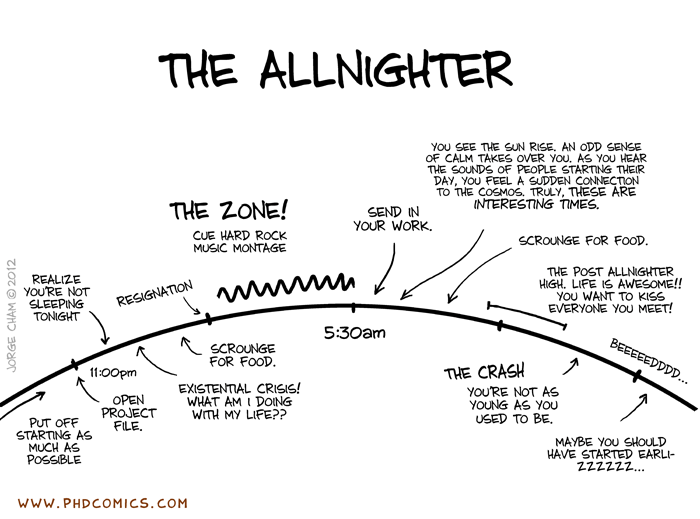
"Piled Higher and Deeper" by Jorge Cham; www.phdcomics.com
These are my rules for successfully submitting on time, all of which, on reflection, are pretty-much common sense but yet, somehow, I (mostly) failed to do:

Go on a course to ‘how to manage large documents’ if your institution offers it. 
I’ve been using Word for years so was pretty blasé and thought I didn’t require this. But, a bit too late, I realised there was a lot of functionality that I had never used. With two days to go I had to learn how to create a Table of Contents automatically, as well as a Table of Tables and Figures, so that I didn’t have to manually update page numbering each time I moved text and tables. Really useful, but I should have done it far earlier.

Don’t leave the document-formatting until the last minute. 
It takes far longer than you think to do all this and I left it to the final fortnight. I had dozens of tables that I then interspersed within the text, some of which were landscape and thus required the insertion of section breaks and different, customised margins to the portrait text. Once the custom margins were inserted tables had to be re-sized to fit. Tables split over pages needed headings repeated. All of this is tedious and very, very time-consuming.

Don’t go on holiday shortly before your submission date. 
Save your holidays until post-submission. It’s really no fun trying to get a dodgy wi-fi connection as everyone else enjoys themselves, and thesis drafts do not make for relaxing poolside reading.

Don’t go to a conference 2 weeks before your submission date. 
I’d barely returned from holiday when I went off to SSM2013. I’d seriously thought of cancelling but luckily my presentation was written well in advance and actually the conference turned out to be really revitalising during a real low-point in my write-up. So maybe not such a bad thing to do after all if you can handle the stress…

Write the literature review and methods early on – in the first year if possible. 
At the beginning of the PhD it feels like you have plenty of time but you really don’t. So get on with the stuff you can do as soon as possible. Then it just requires some last minute tweaking and updating in the last few months. I did actually do this one!

Focus single-mindedly on the write-up. 
My husband lost his job shortly before the end of my write-up. I coped with this by ignoring it and ploughing on. Personal-life crises will inevitably happen and sometimes you just have to be ruthlessly single-minded and concentrate on getting finished. You can have the meltdown once you submit.

Know when to stop. 
I think the best piece of advice I received was being told that your thesis does not have to be perfect, it just has to be good enough to pass. If I’d had a few more weeks my thesis could definitely have been better but I also think there are diminishing returns here. The more time you have the more you revise and re-edit. If you’ve made the changes recommended by your supervisors and they say it’s fine then just STOP. (However, I haven’t had my viva yet so we’ll need to see how this one pans out…)


Ultimately I finished on time because I was given a non-negotiable deadline. If I didn’t submit on time I would lose the three month funding available to write-up papers. This was such a good opportunity that drifting on was not an option. I’d have preferred to have done it without putting in ridiculous hours, never seeing friends or family and doing nothing but working in the final weeks, but it’s done.
It is possible so good luck!


Thursday, 17 January 2013

Thesis looming

Guest post by Sadie Boniface

I knew it was coming. I am envisaging months of isolation. I remember the long hours I spent at the Robinson Library when I wrote my Masters dissertation (supervised by Martin and Jean). But that was only for two months, and I have budgeted nine for this. A word limit of 15,000 cannot be compared with one of 100,000.

Yes, I am on the cusp of starting what every PhD student dreads: the writing-up phase.

I will survive
In preparation, I did a swift ‘audit’ of all the work I’ve done so far towards my PhD, which is on under-reporting of alcohol consumption in England. This includes my upgrade report and presentation, conference papers, journal articles (at various stages of completion), along with personal notes and musings. This has boosted my confidence. I didn’t quite realise it before, but I have done lots of work already. My thesis is going to write itself! As my opposite desk neighbour and I keep saying to each other: ‘it’s going to be fine’.

Doing this allowed me to put together a chapter outline. ‘Excellent!’ I thought once I had finished, pleased to see a structure I can dissect into manageable chunks. Eight chapters, each with all their relevant little sub-sections. And my supervisor said the outline was good. This is going to be easy.

Despite my deliberate optimism, truthfully, I know it won’t be easy (and perhaps that’s why I’m procrastinating by writing my first blog post). Writing up has a reputation for being difficult. Google “PhD write up” and the three of the top ten hits are about how to survive the writing-up process. Books have whole chapters dedicated to it. The focus is on coping and perseverance. When I speak to fellow students in my Department who are in the writing up phase they seem numb. The thesis takes over. It is almost as if pulling together the threads of the previous two-to-five years - to weave the tapestry that is the thesis – is best done robotically, not by hand.

Due to make this transition to automaton myself, I am anxious about how I am going to manage. I experience a definite slump in productivity when I am working on the same thing day after day. Without a doubt the part of my PhD I have enjoyed the most so far has been the process of collecting data for two of my four studies. I really like getting out and speaking to members of the public. Without this interaction, I expect time to pass more slowly. It’s looking like a long nine months.

This is partly why* I have taken on additional commitments. I am tutoring schoolchildren with the aim of widening access to top universities, and I will also soon be helping to collect data for a large new study. I hope that the extra experience I’m getting will make me more employable. I’m also hopeful that this time away from working on my thesis will give me space to reflect, allowing me to come back to it with ‘new eyes’. Ultimately, I expect these breaks to improve my writing.

Juggling writing up with other (unrelated) work is going to be a challenge. I’m not sure when or how I’ll know if I’ve got the balance right. My PhD is undoubtedly my priority, but perhaps it will be a mistake not to focus my attention fully on my thesis. I am determined to hand in by the time my funding runs out. Whether I will or not, only time will tell. With luck, I might be able to spare an afternoon to share my experience of the writing up process on this blog in a few months’ time.

If you are doing a PhD, do you have similar fears about writing up? If you have a PhD, how did you ‘survive’ the write up? What tips would you give to PhD students to help them write their theses?


*another contributor is the unfortunate fact that my MRC doctoral training grant studentship stipend has been frozen since 2010!

Tuesday, 15 January 2013

Winter is coming? Surviving the final months of a PhD

Posted by Amy O'Donnell

At the end of 2012, I officially stopped being a full-time funded PhD student, and re-entered the world of the tax-paying worker (staying here at Newcastle University – thanks for having me!). In theory, of course, this means I should be about to submit my leather bound, gold embossed thesis to some lucky examiners. Sadly, I’m not quite there (although, come April, a couple of eminent academics should beware of the ominous thud through their letterbox).

Apparently, these final months of frantic write-up will be quite the endurance test: the tough hardship of George R.R. Martin’s never-ending winter compared to those halcyon summer days of first and second year studentdom. I’ve been warned that I will basically have to give my children up for adoption, withdraw from polite society and hole myself up in some ivory tower for the interim (which is starting to feel like a pledge to the Night’s Watch but I’ll put the poorly-disguised Game of Thrones references aside for a moment).
 Sorry, one more totally undisguised Game of Thrones reference
In some ways, these warnings are starting to come true. I can’t remember the last weekend I didn’t do at least a day’s work and my school runs are down to the absolute bare minimum (I almost forgot Children in Need costumes!!!). I am constantly thinking about deadlines, drafts and discussion sections (sometimes way too early in the morning for my liking). And yet, I’m not even remotely hating any of this. Far from it. I can honestly say I’m loving my PhD more than ever and, if anything, dreading the whole adventure coming to an end. It’s all finally (mostly) making sense, and of all the elements that comprise the mysterious business of research, writing is definitely my favourite. I’ve also been getting ‘out there’ more, including being lucky enough to enjoy a fantastic conference trip to Barcelona, emboldened by a sense of possibly having something to say at long last.

Of course, the ‘party’ is far from over. About 30,000 words away from being over to be precise, and I intend to enjoy everyone one of them. Returning to Game of Thrones, I read somewhere that there are around 1,500,000 words in the five tomes of the Song of Ice and Fire series so far, and I’ve read and enjoyed most of them. Much like the PhD, all its left me with is a desperate need to see how things finish. So on that note, I’ll leave the final word to the marvellous George R.R. Martin:

“Some battles are won with swords and spears, others with quills and ravens.”

Thursday, 10 January 2013

Some top tips on publishing from some editors of top journals

Posted by Jean Adams

I was recently asked to take part in a panel discussion on publishing for the UK Society of Behavioural Medicine's Early Career Network.

Also on the panel were: Professors Paul Aveyard (senior editor of Addiction, and an editor of the Cochrane Tobacco Addiction Review Group), Ronan O'Carroll (associate editor of Health Psychology and British Journal of Health Psychology, member of the editorial boards of Psychology & Health, British Journal of Clinical Psychology and Journal of Behavioral Medicine) and David French (associate editor of British Journal of Health Psychology and Psychology & Health, member of the editorial board of Annals of Behavioral Medicine).

I was the token non-male, non-professor on a panel of rather eminent male professors. So whilst they poured forth of their wisdom on publishing, I took notes. With their permission, I've tried to summarise some of the top tips on publishing research of some of the top UK editors of behavioural medicine journals.
Calvin & Hobbes on writing

1. The best way to write a paper is to write a paper. Stop procrastinating and get something, anything, down on paper. Don't expect your first draft to be any good. Writing is mostly about editing and re-editing.

2. Know what your paper is about before you start. One suggestion was to write a structured abstract first to force yourself to condense your work and thoughts into 2-300 clear words.

3. Be clear about the "so what" factor. The editors were particularly scathing about wishy-washy, discussion section stalwarts such as "more research is needed". They wanted to see clear statements about the implications of results and suggestions for exactly what further research is needed.

4. Make sure your work is internally consistent. Don't be afraid to revert to the old skool approach of saying what you're going to do (aims and methods), doing it (results), and then saying you've done it (discussion). This structure of covertly repeating yourself helps keep everyone focused.

5. Learn to deal with rejection. Someone pointed out that the best journals reject more than 80% of the stuff they're sent. Even the next tier of merely 'good' journals still reject at least 50% of submissions. So everyone (even eminent professors) have papers rejected on a fairly regular basis. Don't take it personally and be open with your colleagues about the experience. Focus on what you might be able to learn from any feedback you receive and get on with getting your manuscript ready for the next submission

6. Seek constructive criticism from colleagues before submitting. Don't just find someone who'll say your paper is lovely. Find someone who'll give you substantive comments on how you could improve it.

7. Don't annoy the reviewers. Reviewers are busy researchers and academics - just like you. Bad writing, poor grammar, and non-standard formatting all have the potential to put them in a bad mood with almost inevitable negative effects on the review they write about your manuscript.

8. Focus on what's generalisable about your work and don't get bogged down in local details. There was a strong feeling that to be published in an international journal, work has to be internationally relevant. If you performed your work in Huddersfield, make clear that this setting was merely an exemplar for proving a more widely applicable point.

9. There were fairly mixed feelings on the importance of cover letters. There was much more clarity on the importance of getting the response to reviewers letter right. Ensuring this letter is polite was seen as crucial. One editor admitted that he often writes a fairly sweary first draft of this to vent his rage, before editing to make it more presentable.

10. Don't be a slave to the impact factor. Whilst high impact papers are definitely considered important, one editor also stressed the importance of a journal's standing within its field. So a fairly low impact factor journal that is the best within its field is likely to be considered better than a similar impact factor journal that is mid-ranked in its field. Others felt that, especially for an early career researcher, being able to show that you can write and publish by having a reasonable number of publications on your CV, is arguably more important than having a few papers in very high ranking journals.

11. Don't be afraid to take a punt. Everyone agreed that editors and reviewers can be unpredictable. It is a system based on opinion, so one person might have a very different opinion of your paper than another. Don't automatically think your paper is only worthy of the Journal of Universal Rejection if JAMA turn you down. There are many options in between and another very good journal might still be interested, even if JAMA isn't.

12. Consider making informal per-submission enquiries. This was not something that anyone in the room had substantial experience of, but one member of the panel had once emailed a senior editor with a structured abstract to ask if he would consider the paper for his journal. The answer was no, but at least the response was provided quickly and without any messing around with reformatting references and completing online submission forms.


Thursday, 15 November 2012

Diary of a Wimpy Wordsmith

Posted by Steph Clutterbuck

I can’t write. Not this blog post, I have no difficulty waffling on, verbally or otherwise, about trivial things to anyone in the general vicinity willing to listen (just ask my fiancé! *Ba doom ching!*). Rather, I can’t write my thesis.

This poses a bit of a problem to someone trying to successfully complete her Ph.D. I don’t think it is an issue of being lazy as I had no problem getting stuck into all the other areas of my research, i.e. the ethics, the recruiting participants, the running experiments, the sorting the data, the analysing the data. Nope all of these tasks I took on with enthusiasm, gusto even. But now it’s time to write and I am stuck. Luckily, I know I am not alone. Inevitably postgrad student small talk at conferences or in lunchrooms will at some point turn to the reluctance/inability to write. It is the most daunting part of the wild ride that is the postgraduate degree. But why is it so daunting? Why does something that we are clearly capable of doing and exercise hundreds of times each day by way of emails, texts, various research related documents and reports, suddenly seem so impossible?

Well, since you asked, the following is my sage opinion: There is no place for hiding anymore.

Canadian women’s 2012 Olympic soccer team. Our valiant warriors of the Great White North! (Photo by: Toru Hanai/Reuters)
When I was growing up I played a lot of soccer. Apologies, but I am Canadian with a die-hard Dallas Cowboys fan for a father. Football to me will forever be synonymous with giant muscle laden men wearing very tight stretchy pants and overhyped million dollar Superbowl commercials. 

Anyway, sometimes when playing a particularly good team our coach could be heard screaming from the sidelines, ‘Clutterbuck! Stop hiding out there and get in the bleeping game!!’. Coaches aren’t always known for their diplomacy skills. What I imagine he was attempting to communicate, if he had taken a moment to compose himself was, ‘Stephanie, please refrain from shying away from your responsibilities on the field as a defensive midfielder. Your teammates would appreciate it if you would mark your opponent properly and stop cowering behind the keeper.’ 

Now I loved playing soccer, I loved my teammates and I was generally able to hold my own, so to speak, on the field. So why was I hiding? I was hiding because the girl I was meant to be marking was stronger or faster or more skilled than me. Sometimes she was all three of these things at once. The dreaded triple whammy. Quite simply she was a challenge and a challenge can be terrifying. Don’t get me wrong when you think you stand a chance challenges are exciting and even energizing. However, when you think you won’t quite cut the mustard a challenge can be paralyzing. And at those times it always seems easier to hide. If you hide then no one finds out you are actually a crummy soccer player and your spot in the starting line up must have been a fluke. Likewise, if you never get down to writing your thesis no one realizes that you actually know nothing, are in fact a fraud and your supervisor(s) have made a massive mistake in giving you the Ph.D. post.

So how did I manage to stop hiding on the field when my opponent threatened to damage my pride? Well, to unabashedly steal and conjugate a catch phrase, I just did it. I did it to stop my coach yelling at me. I did it to avoid being benched for the rest of the season. I did it because I loved the game and I knew it wasn’t always going to be easy but that’s what I signed up for. 

As for writing my thesis, again, I will just do it. I will do it to stop my supervisors yelling at me (they don’t actually yell but disapproving silences are somehow worse). I will do it because I don’t want to be kicked out of grad school. And I will do it because I love the game (i.e. research) and I know it isn’t always going to be easy, but that’s what I signed up for.

Thursday, 8 November 2012

Healthy Escapism…

Posted by Sara McCafferty

My mother lent me a book at the weekend, her only sales pitch: ‘it’s a little high brow for me’.

On the one hand this hardly encouraged me to read it, a novel – I hardly have time for novels at the minute – I am in the, somewhat dreaded, ‘writing up phase’, so the last thing I feel like doing after a long day at the office is more reading. On the other hand, my (healthy) competitive nature spurred me on to at least pick it up: my mother is not one to easily admit defeat, nor is she lacking academic qualification herself.

Without going into the whole plot, for one I haven’t finished yet, for another you can find a synopsis of the book here, the author (who has a background in economics and psychology) essentially describes how the world would be if she ran it, in the modestly named ‘Darcy’s Utopia’.

Fay Weldon's Darcy's Utopia
Now I was interested – you see, these sorts of things tick over constantly in my mind, (not running the world specifically, I am not some sort of power crazed junkie), more generally how should we best make things work? Granted, not just how anything works…mainly with regard to health, and probably the NHS. How can we stop people eating ‘junk’ food? How can we get people to exercise more? Should we provide gastric band surgery on the NHS? If people were happier would we have better health? When is down to personal responsibility? How should we organise the NHS? Does policy work?...the list goes on.

This is something that they* didn’t warn me about before I embarked on a PhD. When you spend so much of your time critiquing articles and exploring concepts, you are required to ask a lot of questions. [How does that sit with x? Isn’t that in conflict with y? Is that not dependent on a range of other conditions being present? Can you really illustrate that this is a causal link?] Coupled with considerable quest to provide a solution, or at least an adequate attempt to address your thesis question**, this is a powerful concoction that seemingly conditions one’s mind to adopt a position of continually questioning. Sometimes the questions themselves are circular, which can result in many hours whiled away in procrastination. This is true for me at least, and I have been known to drive friends and family slightly barmy over a glass of wine, when I am floundering around in the ‘big questions’, provoking them to join me in at least proffering solutions, when really they would much rather discuss frivolities of ‘Downton Abbey’, or ‘X-Factor’.

Aside from the implications of a reduced quality socialising on a Friday night, a more pressing implication is the need to find a way to ‘switch off’. Fortunately, or perhaps unfortunately, I have found marathon training a really useful endeavour to help me run away with my thoughts for an hour or two and return centred and all out of questions. It is, however, Newcastle and winter, thus running, at least outdoors, in the dark and rain is quickly becoming an unfeasible option.

As such, I am very grateful for the loan of said novel which has reawakened me to the joys of fiction, helps me to switch off, and all this can be done whilst curled up snugly indoors – result!


*who this elusive ‘they’ applies to is not quite clear, however it must remain in order for me to devoid myself of personal responsibility for fully identifying all the pros and cons pre-PhD registration.

**this may of course change, to be more in line with the solution that you have actually unearthed over the course of your research.

Thursday, 11 October 2012

Collaborative writing

This post is reposted with permission from PhD2Published.com


Posted by Peter Tennant

I once showed my brother one of my papers.

"Why is it written in such a dull and lifeless style?"

"Oh, that’s the editor’s fault. It read much better when I submitted it."

Neither of us was convinced.

There’s no shame in being a scientist who can’t write. Science is fairly well populated by people with exceptional skills in the most extraordinary areas, but who can’t write for toffee. Then again, even the best communicator would struggle writing a scientific paper. Because scientific papers are almost always written in teams.

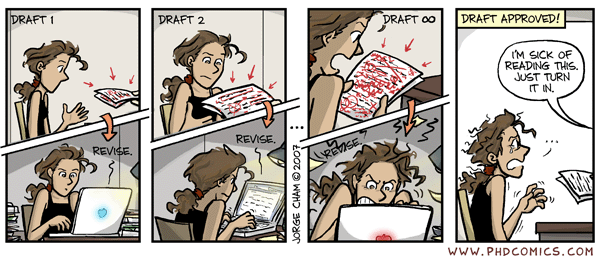
"Piled Higher and Deeper" by Jorge Cham
This is fairly sensible, given most scientific studies are performed in teams, but there are also some serious advantages. For a start it allows contribution from people with a range of skills. Having medical co-authors means my papers can discuss the clinical significance without risking a life-threatening blunder. It also means you’ve got plenty of people to celebrate with when the paper gets accepted. And, it gives you someone else to blame if anyone ever calls your paper, 'dull and lifeless'.

But, did I mention, it’s also very challenging? As the lead author (most commonly the first name on the authorship list, though not for all disciplines), the main challenge is to your sanity. As long as it might take crafting the first draft, this is nothing compared with the time spent sending it back and forth to your co-authors for more and more comments. It’s this process that I think produces that instantly recognisable multi-author style (the one my brother kindly referred to as ‘dull and lifeless’). Like washing a colourful shirt a hundred times. This is why (against the advice of senior authors like Martin White and Jean Adams, see bullet point 3) I rarely waste time overcooking my first drafts. There’s simply no point spending days writing a stunning introductory paragraph, only for it to be completely mauled by your co-authors.

Broadly speaking, co-authors come in one of three factory settings; the Rampant Re-writers, the Sweeping Suggestion-Makers, and the Utterly Useless.

The Rampant Re-writers get the most flack. These are the people who so heavily drench your draft in tracked-changes that, by the end, it stops feeling like your paper. Draining as this can be, these co-authors are actually the nice ones, generously spending their time to improve the paper. Until they start changing bits that everyone’s already agreed on. That’s when they get really annoying. And when it’s especially important to remember the Golden Rule of Rampant Re-writers: edits are only suggestions – as the lead author, you should always have the final say.

Next there are the Sweeping Suggestion-Makers. Wielding the deadly comment box, they add things like, 'this bit needs shortening' or 'I think you should add something about X'. Sometimes I’m tempted to send it back and say, 'I think YOU should add something about X if YOU think it’s so important!' But they’re usually too busy. And they’re usually right. Damn them with their helpful comments.

By far the most harmful authors are the Utterly Useless. The ones who don’t reply to emails, or who get back saying vague things like, 'looks great'. In the absence of praise from your other authors (sadly the academic for, 'this is amazing, fantastic work' is often simply, 'no further comments'), these people can seem like your friends, but they’re not. They’re useless. That’s why I call them Utterly Useless. In fact, these authors are the ones that can cause genuine ethical dilemmas. Do they even satisfy the conditions of authorship? Occasionally a senior academic will insist on being an author due to some historical connection with the study, even if they then add nothing to the paper. This is unethical. But not something that the average PhD student is in a position to do anything about. More pertinent is the risk of being pushed down the author order, despite doing the most work. It’s common throughout the history of science. It’s also morally repugnant. Always try to discuss the authorship list and the author-order before starting writing a paper and this risk can be reduced (though, sadly, not eliminated).

If being the lead/first author is most difficult, it’s not necessarily easy being a support author, where the big challenge is in getting the right balance of comments. Despite years of therapy, I still fall firmly into the Rampant Re-writer category. On more than one occasion, I’ve made the first author cry by overdoing the edits. Some support authors try to soften the blow by spreading their edits over several revisions, e.g. making the 'essential' changes first, then the less major changes later. But I’ve experienced this as a first author and actually found it more depressing! It’s like getting to the end of a marathon, only to be told to run another five miles. Short of making them cry, over-editing might still annoy your co-authors, especially if they are senior. For some reason, Professors don’t always react very well to having their words rewritten by a PhD student. So here’s my advice, try and get all your comments in first time, but make sure they are all essential. If in doubt, leave it out. Unless you’re happy making your colleagues cry.

Thursday, 5 July 2012

How to improve your productivity: don’t read this blog

Posted by Jonathan Ling

One of my first office mates was Roger.

He was an older academic who had just been recruited by my department. As I helped him carry boxes of books into our room, I noticed that at the top of one of them was a book with his name on the cover. I was impressed – I was sharing my office with an author! I told him how great it must be when someone said to him: “I’ve read your book”. He agreed that it was a nice feeling, but what felt even better was when, having written a couple more books, he was able to say: “Which one?”

I’d never really thought about writing a book myself, until I was asked a couple of years ago to co-author a short textbook. It was on a topic I knew a bit about, but I’d never met the co-author who came from a university at the other end of the country. The editor suggested that the process would be reasonably straightforward and fairly speedy. As he had written several books himself I thought he obviously knew what he was talking about.

With hindsight I now realise he must be significantly more methodical in his approach to writing than I am.

I eventually finished my part of the book and it was published last year. Mostly by trial and error, I learnt a few things as I went along:

1. Have a writing routine. Take time out of every day to write. If you don’t block out a specific time each day to write (and stick to it), you won’t get anything written. It doesn’t matter when it is (I work better in the afternoons), just hang a “Do not disturb” sign on your door, or around your neck, and get going.

2. Don’t get side-tracked. See point 1. Your writing time is for writing – it’s not time for admin, catching up with emails, fitting in meetings or reading engaging and erudite blogs.

3. Seek feedback from your target audience. Unless it’s your diary, everything you write is for an audience. Think about who the audience is, and make sure they get a look at it. For a textbook, this was undergraduate students and other lecturers. For a journal article, most likely it would be fellow academics, as well as practitioners or policy makers.

Egg timer, by Martin Lopatka

4. When all else fails, get an egg timer. There were some parts of the book where I really struggled – topics I was unfamiliar with, that required lots of reading and which I wasn’t particularly interested in. But I just had to grind these sections out. In one of my more (possibly only) fruitful side-tracks, (see point 2), I came across the Pomodoro technique. In essence, this is just working on your chosen task for 20 minutes (no email, no looking out of the window – just work!) and then having a 5 minute break before another 20 minute session. Try it sometime – it did the trick for me.

Eventually, with the help and support of my co-author, editor and publishers, the book was finished, proofread and published. It is nice to have a book on the shelf with my name down the spine. But it was a huge amount of work, on something that’s not REF-able. So it’s not something I can see myself doing again.
Although, in my weaker moments I can’t help but think that one day it might be quite nice to say “Which one?” when someone tells me that they’ve read my book….