Showing posts with label Patient & Public Involvement. Show all posts

Friday, 11 September 2026

Strengthening partnerships to improve primary care in the Deep End

Posted by Dr Angela Wearn, Associate Member of Fuse and Advocacy and Engagement Lead for the Deep End Network North East and North Cumbria

In this blog, Angela reflects on what people living in some of the region’s most disadvantaged communities have told the Deep End Network about challenges they face when it comes to accessing primary care, including attending appointments, and what we can do to improve this.

The Deep End Network is a growing GP-led international movement that began in Glasgow in 2009 as a response to the ‘inverse care law’, which is that those who need care the most often struggle the most to access it.

The North East and North Cumbria Deep End Network was established in 2020, with support from Fuse, the Centre for Translational Research in Public Health, and the NIHR Applied Research Collaboration North East and North Cumbria, creating a space for practitioners working in areas of severe socioeconomic disadvantage to share experience, shape solutions, and influence how primary care can better meet the needs of the people it serves.

Funded by the North East and North Cumbria Integrated Care Board, the Deep End Network focuses on four core priorities:
  • Workforce: Building and retaining a well‑supported workforce in high‑need communities.
  • Education: Strengthening training at all levels so current and future health professionals understand health inequalities and access to opportunities
  • Advocacy: Ensuring Deep End practices and communities shape local and regional decisions on funding, access and service design.
  • Research: Evaluating Deep End initiatives to understand what works, why it works, and how effective approaches can be scaled to improve outcomes.
Since 2023, I’ve been working as Advocacy and Engagement Lead to build and strengthen partnerships between Deep End communities, practitioners and researchers, ensuring the experiences and perspectives of underserved patients and communities inform both our research portfolio and the wider support and initiatives we offer practices.

Over this time, additional funding and support from across NIHR infrastructure, including the NIHR Applied Research Collaboration North East and North Cumbria, NIHR Three Schools and NIHR Research Delivery Network, has further supported targeted involvement and engagement work with those living in Deep End neighbourhoods, the majority of whom have had no previous experience of involvement in research or service development.

Support through the NIHR Three Schools collaboration was made possible through membership of Fuse, which is part of the NIHR School for Public Health Research, one of the three NIHR schools within the collaboration.

What we’re hearing from Deep End communities

Many Deep End patients face multiple, overlapping challenges including low income, insecure housing, poor mental or physical health, caring responsibilities, trauma, or homelessness. These pressures make it harder to engage with primary care, even when people want to.

Through conversations, workshops, and community-led sessions, people have shared why engagement can feel difficult:
  • Personal pressures: the emotional and practical effort of attending can feel overwhelming and ‘too much’ on the day of the appointment.
  • Feeling unheard or stigmatised: which makes reaching out feel pointless.
  • Time and capacity: life can be busy, chaotic, and demanding, with health often taking a backseat.
  • Overwhelming contact routes: getting through to the practice or accessing a suitable appointment can feel impossible.
  • Negative past experiences: GP practices don’t always feel welcoming or safe.
Overall, I regularly hear that disengagement is rarely about disinterest, it’s about the collective barriers that build up and make staying connected to care difficult.

What communities say needs to change

Improving patient engagement in Deep End areas is complex. There is no single fix, and practices are working under significant resource constraints. But through our involvement work, communities have highlighted three priorities for investment and change that they feel would make a meaningful difference:
  • Improve connection and communication
  • Strengthen co‑design approaches
  • Build sustainable, community‑based partnerships
These priorities align strongly with national ambitions around personalised care, prevention, and reducing inequalities, and they reflect what people say would help them feel more able to engage with primary care as the wider system shifts towards more integrated neighbourhood-level working.

Moving forward together

The NHS encourages practices to work closely with Patient Participation Groups (PPGs), but Deep End practices face additional challenges: limited resources, diverse patient needs, and complex barriers to involvement. From the community perspective, awareness of PPGs is low, confidence is often limited, and many people are unsure whether their voice will genuinely matter. To support better partnership working, the Deep End Public Advisory Group identified three simple involvement principles that are easy to remember and act upon, and clear enough to come back to when things get busy or complex:
  • Make it easy
  • Make it worthwhile
  • Value patient experience
These principles are practical, community-informed and can be applied across a range of contexts to guide diverse involvement.

New one‑page resources for practices

To help bring these messages to life, we’ve co‑developed two infographics with Deep End patients, communities, and Nifty Fox. They distil community insights into quick, usable one-page resources that GP practices and other decision-makers can draw on to strengthen engagement and build more inclusive partnerships.

Supporting Patient Engagement in the Deep End: insights from the community
Working Better Together in the Deep End: patients and GP practices as partners

These resources will sit alongside a wider collection of materials, including a public‑facing animation and an illustrated impact report, which will be shared over the coming months. A celebration event is planned for early next year.


Why this matters

The Deep End Network exists because tackling health inequalities requires more than goodwill, it requires meaningful partnerships and system‑level commitment. These new resources are an important step in supporting practices and others to work alongside communities in ways that feel respectful, realistic, and rooted in the experiences of people who face the greatest barriers to accessing and influencing the care they receive.

We hope they support teams across the North East and North Cumbria and beyond to strengthen relationships, reduce barriers, and create primary care environments that are more responsive to the needs of communities most affected by health inequalities.

If you would like to know more about partnership working, co-production or our involvement work in the Deep End please contact Dr Angela Wearn (angela.wearn@newcastle.ac.uk)

Find out more about the Deep End Network

About the author
Dr Angela Wearn is Advocacy and Engagement Lead for the Deep End Network North East and North Cumbria and a Research Fellow with the NIHR Applied Research Collaboration North East and North Cumbria. She is also an Associate Member of Fuse, the Centre for Translational Research in Public Health.

Friday, 1 December 2023

Getting creative to make research more accessible and inclusive

Posted by Victoria Bartle, Fuse Public Partner

We were throwing balls of wool around, picking picture cards to describe ourselves and having a thoroughly inspiring time. This was not your typical research conference!

It was day one and keynote speaker Pam Burnard was encouraging us to challenge the system using creative methods to subvert common assumptions.

Many of the researchers at the International Creative Research Methods Conference in Manchester are independent, not linked to a specific university or funder and this allows them to approach research from a variety of unusual and unfamiliar angles.

The conference is the brainchild of Dr Helen Kara: independent researcher, author, teacher, speaker and creative research methods (CRM) expert. Helen’s vision was to bring together the global CRM community to share knowledge, promote understanding, enable networking and have fun!

After the first day's keynote, I went to see Nicole Brown, a researcher looking at fibromyalgia, a condition that I also have. She had asked people living with fibromyalgia to collect objects to describe how the condition made them feel. One person had taken a photo of her chair - a really comfortable armchair, with a blanket, a table beside it holding drinks, snacks and distractions. This could have been a picture of my own living room! Due to chronic pain and fatigue I have what I call my 'nest'. I have reclining sofas with a side table with all of my remotes, chargers, creams, spare meds, thermostat, drinks, snacks, book, switch, lip balm (etc.) just so that everything I need is within reach and I don’t have to move too much or cause myself too much pain. I found the picture really impactful and saw the potential for objects, artwork and abstract thinking to be able to describe conditions like fibromyalgia which is extremely difficult to explain to someone who doesn’t have it. Using objects as data to assess and evaluate was really interesting and a methodology that I wasn’t previously aware of.

We were then given the task of picking some cards to describe ourselves as researchers.

These are the lego cards I chose to describe me during the sessions by Nicole Brown, who works with objects as data in research.

The skydiver because I feel like I just ask to do things and hope for the best, the singer because I like to present and talk about PPI (Patient and Public Involvement) in research. 

Black widow because she’s a superhero and fights for people who can’t and Rocket because he’s been made up with tech and I felt like he’s a disabled superhero :)


Jargon buzzing

On day 2 the Lawnmowers Theatre Company, run by and for people with learning difficulties, brought out jargon buzzers which were amazing! The characters pressed the buzzers every time someone used a term or word that they didn’t understand. I really want to use these in PPI meetings in the future, but we might not get anything done having to explain all the acronyms and research language that is often used!

Making a 'zine'

I didn’t know anything about zines and wasn’t aware of the Madzine project to help people with mental health conditions to explain how they feel, get things out and be creative. The session was really interesting giving us some history on zines before we were able to create our own. I made one about a project that I have been working on using some paper with stars on to represent the PPI Group members. A black page for accessibility as we all had different barriers to involvement and some of them were difficult to address, hidden or unknown. Some of the zines that they showed us were amazing: creative, visual, unusual, thought provoking and touching. They plan to create a mobile Madzine library that tours around the country so that people can read the zines and share in the experiences of the creators to increase awareness and understanding of living with mental health conditions.

Board games, rockpools and podcasts  

Kath McGuire (University of Exeter/NIHR School for Public Health Research), led our session talking about working with creative methods, public involvement and research dissemination. I briefly introduced the Fuse podcast and explained the collaborative approach to creating it. People were then able to take a look around the room at the variety of creative outputs that we had brought with us, and a video about how we have creatively communicated research in Fuse (see below). We had a snakes and ladders game to be used with PPI groups, or groups of researchers to evaluate their projects: snakes were barriers and challenges and ladders were successes and wins. We also took posters created by Fuse researchers showing their project results (Emma Adams) and Kath had a Blue Health Rockpool from another project. We took questions and explained how we created the podcast, what its impact had been and answered lots of technical questions about equipment, hosting and distribution. Hopefully accurately!


Attending the conference really broadened my view of research and public involvement. Lots of researchers at the conference felt that by making their work more creative it made it more inclusive. By reducing or removing established barriers to involvement such as language, terminology, education level and academic preconceptions they were able to engage with a wider, more diverse group of people. They could still be academically rigorous and produce research that stands up to peer review and meets publication standards whilst including more people, accessing people with appropriate lived experience of their topic of study and making involvement engaging, interesting and fun!

I have come away from the conference wanting to make Patient and Public Involvement meetings more creative, use games and objects to describe feelings and opinions, implement the jargon buzzer and design engaging dissemination methods that are relevant to the target audience of the study, drawing on the skills of the researchers and PPI teams.

A special thanks to Kath Maguire, Daniel Mutanda and Heather Boult (University of Exeter/NIHR School for Public Health Research), and the Fuse colleagues: Lesley Haley, who helped me with the podcast aspect of the workshop 'market place'; Ella Anderson for preparing the workshop activity; and Mark Welford for producing the Creatively communicating research video that we used in the session.

Friday, 30 June 2023

One size fits none, watch your language, and keep pondering...

Insights from the Integrated Community Care to Promote Healthy Ageing event

Posted by Hamdi Hamzah, Research and Evaluation Coordinator with NECS Research & Evidence

It was my first time attending an event that saw people (some of us dressed in red) from across different professions – academics, healthcare professionals, voluntary, community and social enterprises (VCSE) professionals and members of the public – come together to share common interests and explore future opportunities or collaborations.

Being new to the health and social care sector and a career changer with experience working with large corporations through strategic human resource roles, the Integrated Community Care to Promote Healthy Ageing event co-hosted by Fuse introduced something that I felt was closer to what was happening on the ground, especially when research and practice interweave. From this event, I have identified seven insights that I felt were worth sharing.


But first... what exactly is Integrated Care? The NHS England website describes Integrated Care Systems as: “…partnerships of organisations that come together to plan and deliver joined up health and care services, and to improve the lives of people who live and work in their area.” They also provide a helpful video explainer.

So, on to my magnificent seven:

1. There is no “one-size fits all” approach to care


Throughout the event, this was a common theme from both presenters and attendees, who continued to stress the importance of putting individual needs at the forefront in providing care. To echo Dr Bethany Bareham (pictured right), Fuse Associate and NIHR fellow at Newcastle University through her talk on providing support to older adults with co-occurring alcohol and mental health problems, support for one individual may not be needed for someone else.

2. Similarly, there is no one way to answer a research question

The event brought together different questions, methods and groups of people to enhance our understanding of promoting healthy ageing. For example, a video presentation by Dr Vanessa Davey, a Research Associate at Newcastle University, on the feasibility of developing a data set in care homes to assist in care delivery and commissioning decisions was eye-opening. You might think that digital GP records could readily be used in one form or another to build this data set, but it is clearly not that straightforward as data from other systems, namely social care, could (and should) provide additional insights into this dataset. Most importantly, while we might take different approaches and target different populations, we are all aiming towards achieving the same goal.

3. Language can have an important effect on how we approach a question


Simply put, are we talking about the same thing? We might think that the terminologies that we are using are similar but they could mean different things to different people. For example, Dr Dan Cowie (pictured right), clinical lead with the North East and North Cumbria (NENC) Ageing Well Network (who also spoke about the Frailty iCARE platform) posed the question: are "personalised care," "personhood" and "person-centred" the same thing for the groups of people that researchers are interested in studying? How we phrase the topic we are researching could also help or hinder what we get out of our work.

4. Co-production of research through VSCE organisations

Local communities should be involved in every activity within the research lifecycle, such as research planning, analysis and dissemination, and not just during the delivery stage of the study – an opinion shared by Greta Brunskill from Voluntary Organisations' Network North East (VONNE) in one of the workshops. Patient and public involvement (PPI) is a useful platform to involve members of the public and co-produce research, but there is the risk of “professionalising” these platforms, which may lead to voices from certain communities not being heard.

5. But what about before we reach a specific age?

There was interest from the audience in exploring personal and environmental factors before someone even reaches a specific age. The idea of testing the impact of, for instance, universal basic income among young people on healthy ageing was food for thought and suggests that a lot of where we are now or – perhaps will be in the future – could depend on factors in the present such as lifestyle, socioeconomic status and access to relevant services.

6. Addressing health inequalities remains challenging

Expanding on points 4 and 5 above, health inequalities remain a hot topic in this field of work. Access to care, health literacy (a person’s ability to understand and use information to make decisions about their health), personal qualifications and involvement of underserved communities were mentioned by attendees either during the talks or workshops as challenging areas. Introducing care or support may not work if barriers to accessing care remain.

7. Keep pondering

The entire event not only provided the opportunity to know what research is being conducted but showed the tremendous volume of research questions left to be explored! One of the themes that came out of Tania Jones' workshop on maximising the use of pharmacy services was the bigger role that they may play in primary care, especially in 2026 once pharmacy graduates enter the job market with prescribing qualifications. This could in turn lead to more questions, for example, is there an inclination for pharmacists to prescribe pharmaceutical over non-pharmaceutical treatments?

While the possibilities are endless, identifying questions that are crucial and impactful may be the first step to starting a research journey and finding the right collaborators. Regardless, we should continue to think about things that we are working on, as Lesley Bainbridge (pictured right), clinical lead in the NENC Ageing Well Network, quite aptly put it, "Some of the best research questions come from what we ponder."


Images: provided with thanks to NHS NECS Research & Evidence Team

Friday, 16 June 2023

The Power of Partnership

Our Top Tips for co-production with inclusive and meaningful Public and Patient Involvement and Engagement 


Posted by Rosemary Nicholls, Patient and Public Involvement and Engagement (PPIE) member, and Charlotte Parbery-Clark, Fuse researcher at Newcastle University and Public Health Registrar

This image was co-produced with members of the public, researchers and film production company Kaleidoscope CFA as part of the UNFAIR research programme. You are welcome to use and share the animation or images whilst acknowledging the source (https://bit.ly/UNFAIRstudy) when doing so. 


Earlier this year, members of the public with researchers at Newcastle University launched an animation that explores public views of health inequalities. The animation was created as part of the UNFAIR project, which is funded by the National Institute for Health and Care Research (NIHR).

Here Rosemary and Charlotte share their experiences as co-applicants on the project and give some top tips for members of the public and researchers.


Rosemary

"A key factor in the success of this project was the leadership style of the professional UNFAIR researchers. Their excitement and commitment to the study and to us as members of the Patient and Public Involvement (PPI) advisory team was infectious. The timely exchange of emails kept us all informed of progress and involved in deciding next steps. There was ongoing respect for what we had to offer.

"I was confident in my views and sometimes doubtful about the practicalities of what was being proposed, thinking: “This isn’t going to work.” But I found various methods much more successful than I expected and I learned through my surprise that I’d been wrong!

"A risk of consulting people in disadvantaged settings is that they may assume that the researchers will be able to effect immediate improvement in their circumstances, so it’s important to be clear from the outset about the aims and likely outcomes of a project and I feel we succeeded in this. The people we met in community groups emphasised how vital it is for them to be treated with respect and I’m confident that we put their needs at the top of our agenda when we asked them questions.

"There were occasions when we had to reassess our approach and resilience became a useful quality. The excellent teamwork that Charlotte and I had developed over previous months enabled us to undertake a successful review of our methods and move forward."

Charlotte

"When the opportunity came up to co-lead the project, I was excited but also a bit apprehensive as I was new to this type of work and was unsure about how to 'get it right'. One thing I was sure of was that I wanted to involve members of the public throughout the project in a meaningful way and avoid it being 'tokenistic'. So, the start of my PPIE journey involved lots of reading and reflecting about how to approach it!

"Co-leading with Rosemary and working with the UNFAIR PPIE contributors was invaluable as we could bounce ideas off each other and consider a variety of perspectives. They kept me right with the 'academic speak' I would sometimes slip into. I learnt so much with so many firsts, such as applying for funding for this type of work (and being successful!), creating flyers, navigating remuneration, as well as being involved in creating an animation."


Top tips for members of the public (especially if considering a co-applicant role)
  • Be confident about taking up the role, if you would like to do it. The researchers have asked you because they’re confident you can contribute relevant skills and experience.
  • Check that you have the time to commit to being a co-applicant. In terms of hours, the commitment may not be very great, but being able to respond to emails quickly (within 48 hours) and to attend online and in person meetings at arranged times can be important. It’s likely that you will be consulted about suitable times, perhaps by doodle poll, but there may be occasions when you need to prioritise the project to ensure continuity and re-arrange your diary. Ongoing dialogue between you and the researchers to figure out the best approach together works well.
  • Each stage of the project will be well-planned and costed in advance by the researchers and the lay co-applicant is paid by the hour in my experience, depending on the nature of the work. However, there may be occasions when lay co-applicants feel that they can offer further insights and they should feel freely encouraged to check that comments outside the box will be welcome and if so, volunteer their thoughts to the researchers by email.
  • Be willing to ask questions of the researchers and put your point of view across with confidence, but be prepared to find that your assumptions may be proved wrong as the project progresses. Remember that it’s a learning process for us all. Be resilient when necessary and work together to keep the project on track.

Top tips for researchers

Ways of working:

  • Decide how you will involve public contributors at each stage of the project in line with your budget.
  • If working with a specific group of PPIE contributors on a project, decide together how you would like to work. There are tools to help you with this, such as Working Together.
Diversity and inclusion:
  • Remove barriers for involvement as much as you can. For example, provide options such as different online and/or in-person sessions on different days/times, go to community groups and be flexible about timings to ensure it suits public contributors (not expecting people to come to you), or use online platforms, such as Padlet, for people who want to be involved but can't attend the session.
  • Language is really important, be as clear and as simple as possible.
  • To increase diversity of public contributors, networks can help promote the opportunities particularly in public health research compared to disease related research as public health research typically has a wider remit.
Time:
  • Building relationships is key and takes time. It is good practice to keep people updated and adapt according to need where you can.
  • Make sure you know how to remunerate public contributors in your organisation before any PPIE sessions to reduce delays.
  • Build in extra project time for unforeseen events.
Challenges:
  • Any challenges that may come about with PPIE work or co-production are opportunities to make the project even better, see them as gifts.
  • Sometimes, what is feasible in the time/resources available may not align with the feedback so be clear that you may not be able to act on all suggestions at the outset. Compromise as well as sharing why you have not been able to act on certain suggestions is useful. Have a way of deciding what you will do if the feedback conflicts with others' feedback is important.

Involving members of the public is incredibly worthwhile strengthening the project in so many ways. Also, undertaking PPIE and/or co-leading provides opportunities for rich learning and skill development for both researchers and public contributors. There is lots of support especially if this is your first time doing this type of work, as either a member of the public or researcher. To find out more about PPIE or public co-applicants, the following resources may be useful:

Guidance:
Opportunities for public involvement:
 

-----------------------------------------------------------------------------------------------------------------------------------------------------------------------------------------------------

Rosemary Nicholls is a Patient and Public Involvement and Engagement (PPIE) Representative and Consumer Panel Member, National Institute for Health and Care Research (NIHR) Research Design Service (RDS) North East North Cumbria (NENC) and one of the UNFAIR PPI members.

We would like to thank the UNFAIR PPIE and research team, members of staff who helped facilitate the online workshop as well as everyone who took part in the workshops.

This project was funded by the Tilly Hale Award from Newcastle University and the National Institute for Health and Care Research (NIHR) (ref CA-CL-2018-04-ST2-010).The views expressed in this blog are of the authors and not necessarily those of the NIHR, the Department of Health and Social Care or Newcastle University.

Tuesday, 12 July 2022

The Fuse conference in four Public Partner poems

How to capture the essence of a conference about setbacks, successes and 'brilliant failures' in public health research - an event report, a news story, the results of a survey?  What about in the prose of our public partners who provided their expertise as panellists?  That is what they suggested and here they are.

The 5th Fuse International Conference on Knowledge Exchange in Public Health took place between 15-16 June 2022 in Newcastle upon Tyne.  Find out more about the event, speakers and panellists on the conference website.


..the Fuse experience

PJ Atkinson, public member of Gateshead Poverty Truth Commission

PJ in the centre of a fishbowl conversation
Recently I was Invited to chat with Fuse.

Well it was a Wednesday, had nowt to lose.

They numerify and storify researching for Public Health.

And let me tell you, with very little wealth.

We had main stage speakers, panels, and side room topics, it was never droll, even sat in a fish bowl!!!

We discussed, pyramid breaking, old ideas smashing, and reforming, these people are fun never boring.

But most of all, they turn setbacks into learning, with passion and resolve.

Fuse and its people, want to adapt, grow and evolve.


Knowledge Flow

David Black, Fuse public partner and hospital governor 

(r-l) David and Irene providing their expertise on how to turn setbacks in knowledge exchange into successes

After waiting too long the day came along and it's off to the conference for me.

Knowing where I'm going, despite the traffic slowing, I'm knowing I'll be on time.

Must listen today then whisk my thoughts away to plan what I'll say tomorrow.

A script's what I need after taking heed of the need for brevity.


We're off and running, the introductions are made and it's welcome to one and all.

A programme, like life, which can be subject to change.

Reflections on knowledge mobilisation and mistakes.

Evidence of local knowledge exchanged at place.


Amid the plethora of parallel sessions and plenary panels.

The exchange of views over coffees and teas.

The paper presentations and interactive poster sessions.

Fishbowls of hot topics and Cabaret of dangerous ideas.


A modicum of the local and a smorgasbord of internationalism.

I entered to play at the start of the day, full of eagerness to learn.

To share a thought and to be taught a lesson by all in attendance.

Public health, its impacts and strength of this particular human endeavour.


Day two is here and I'm ready, with no fear.

Up on the stage, knowing what to say and trying to keep it brief.

Then before you know it's off, we go and ending with applause all-round.

To have a voice and speak it out, it's a great place to be.


Good feedback I'm feeling, plenary speaking's appealing.

Networking and knowledge sharing, I'm doing.

A supportive, safe space, it's a real great place.

For setbacks and solutions to be shared.


So, to the end game, the main themes and learning all noted.

My highlight, the brilliant afternoon keynote.

Institute of Brilliant Failures with celebration, laughter, a new way of thinking.

A refreshing concept, informing my future knowledge sharing and learning.


My First Fuse Conference

Margaret Ogden, Patient and Public Involvement (PPI) representative from County Durham

Margaret (right) sharing her experience of the importance of setbacks in knowledge exchange in public health

I went to the Fuse conference in mid June 22

PPI members were invited, I met more than a few

The focus was knowledge exchange, so meaningful to me

In presenting I’d soon see how dynamic I could be

I loved the international element to this annual conference

Diversity was a theme that would get so much reference

Seldom heard communities, always a huge challenge

Dissemination of info too, a challenging thing to manage

Just how effective can knowledge exchange be

With the right expertise, it can be achieved quite easily.


I began my talk with detail of a planned PPI event

That didn’t go well, in spite of the hours which we spent

Planning, collaborating, finding the right venue

But with few attendees present, it can all go askew

We’d do better next time, was our overriding thought

For on that occasion, limited data was caught

I also referred to a further memorable meeting

Where conflict had arisen, it could have been defeating

It was really a clash of people with strong wills

I had to dig deep for new negotiating skills.


As a panel, I felt we made a great team

This experience had totally elevated my self esteem

My first face to face high profile event

At a nearby location, that was heaven sent

My mobility had worsened in the last two years

Confidence had been dented, I now had fears

I needed to get stamina back and level of fitness

I imagine my struggles were hard to witness

But as I move forward with determination and fortitude

I thanked my hosts for the invite which I’d accepted with gratitude

I didn’t make the second day of this interactive event

That had been a real shame, was my only lament.


Knitting out the Knots 

Irene Soulsby, Fuse public member from Gateshead
 

We talked a lot 

Knitting out the knots 

We talked and talked and talked 

A LOT! 

Knitting out the knots 

Comparing designs 

Line by line 

Reknitting stiches  

Holes and lines 

Redesigning our designs 

Comparing setbacks and successes 

Knitting them into things that would impress us  

Learning from each other 

With enthusiasm and sharing 

Creating our new designs.


Many thanks to our public partners for taking the time to write their fantastic poems for this Fuse Open Science Blog. 

If you are interested in joining the Fuse Public Partner Network please visit the dedicated Public Involvement section on our website.

Friday, 11 March 2022

Universal Credit experiences and research co-production

Introduction by Mandy Cheetham, Research Fellow in the Applied Research Collaboration North East and North Cumbria (ARC NENC), Northumbria University

I contacted David in my role as public involvement lead for the NIHR funded study on Universal Credit. As a research team, we made a commitment to include the views of people with experience of claiming Universal Credit as part of our public involvement and engagement activities. David very kindly offered his assistance and has been one of the contributors who have helped shape the study so far.

------------------------------------------------------------------------------------------------------------------------------------------------------------------------------------------------------

Posted by David Black, Fuse Public Partner and Expert by Experience

David takes part in a wide variety of public involvement and engagement activities  
I had noted many observations during my experience of engaging with the Universal Credit system and had a little experience of welfare benefits in a previous roll assessing applications for legal aid. As I'd been involved in co-production work relating to clinical research and healthy ageing in a number of patient and public involvement roles, I knew what would be expected of me in terms of sharing my perspectives about Universal Credit with the research team. Preparation prior to the initial meeting was key to getting my messages across, so I made some notes and checked out dates and relevant facts about the benefit online.

The messages I wanted to share about Universal Credit related to my direct experience and also what I'd see at local libraries when other people had been trying to use computers to apply for the benefit and respond to requests from the Department for Work and Pensions (DWP) that were expected to be done online. Some of the people trying to use computers were clearly struggling and I found myself and the librarians were regularly asked for assistance. I'm a helpful kind of person, so I would try my best to assist. Many of the people I met did not have the basic computer skills necessary to complete what was requested and with a time limit on computer access at the library, it was often a struggle.

As part of my co-production work I shared my experience of the initial application process and explained to the researchers that I had to go to my local library with all of my personal data in document form in order to complete the online application. It took me an hour and I was concerned that I had all the information to complete the form in full in one go. One of the frustrations I had related was the process of proving your identity via an online checking tool. Having initially been relieved once I'd got the main online form completed and saved, I found myself beaten by the simple process of proving who I was! The system simply did not work for me in this regard and after going home and phoning the DWP I was given an appointment to go to a Jobcentre to complete this process manually.

It was clear to me what information I wanted to share with the researchers and the fact that they were good listeners and gave me the time and space to explain my experiences helped a great deal. In the past I'd always found the process of seeking help from the unemployment benefit system to be relatively easy, but Universal Credit was a disaster for me. Not only did the DWP assume all claimants had access to the internet all of the time - something that I did not have until the pandemic started, which was years after my experiences of Universal Credit - but a constant stream of text messages in relation to Universal Credit created a state of panic and worry for me.

An important message I got across to the researchers was that ultimately I was deemed to not qualify for Universal Credit and left without any help or assistance. Something I'd never experienced when I'd previously reached out for help from the state system. Continuing my co-production work with researchers in this area of study has given me an immense sense of pride and satisfaction. I hope that in working on this research in some small way I can assist in the future understanding of how changes to benefits and the wider government welfare system can have real impact on the lives and wellbeing of people.


If you are interested in becoming a Fuse Public Partner, please visit the Public Involvement page on the Fuse website.

Friday, 28 January 2022

Science, and the art of communication

Posted by Louis Goffe, Research Associate, NIHR Policy Research Unit in Behavioural Science

Brian Deer - Copyright cleared
“He’d found no cure for Crohn’s, or remedy for autism, no vaccine, no nothing in medicine. But now he was a man delivering fear, guilt, and disease to everywhere with an internet connection.”
Brian Deer, The Doctor Who Fooled the World


It wasn’t a scientist, not a medical doctor, nor an esteemed health institution, but Brian Deer, an investigative journalist, who researched, compiled, and detailed to the world ‘The fraud behind the MMR scare’. While the adjective to his profession alludes an expectation to the discovery of truth, it’s his journalistic craft that effectively communicates with passion and clarity how the now struck off doc and his associates formulated the non-existent relationship between MMR and autism.

Health promotion takes more than good science, there is
 an art to the delivery.  Photo by Jon Tyson on Unsplash

Deer lays out the complete narrative in his book The Doctor Who Fooled the World. It’s as gripping as your favourite thriller, though with the added heart-sinking poignancy that it is not a work of fiction. While I was keen to write a book review, others do this better, I considered what’s the take-home for those of us in translational research in public health.

I’m a researcher for the NIHR funded Policy Research Unit in Behavioural Science, where we ‘use behavioural science evidence, theory and methods to support decision-making’. Our approach is rigorous and grounded in scientific theory. However, the pandemic has brought into sharp focus that health promotion takes more than good science, there is an art to the delivery. I mean, how else have the sceptics convinced so many that wearing a face covering could be detrimental to health?

Prior to the Medicines and Healthcare products Regulatory Agency approval of the first COVID-19 vaccines, research institutions, health, and Government bodies had been virtually silent on the development process. Some were also critical of how the initial results were released to the world. This reservation to engage with a non-academic audience is partially understandable, we deal in uncertainty and it’s much more than simply crossing the i's and dotting the t's. No researcher worth their h-index wants to put something out into the world that they can’t back-up empirically. The sad fact is though, if we’re not on the front foot keeping the public informed of the vaccine trial process and approval milestones, then there’s a flock of 'quacks' more than happy to work their grift.

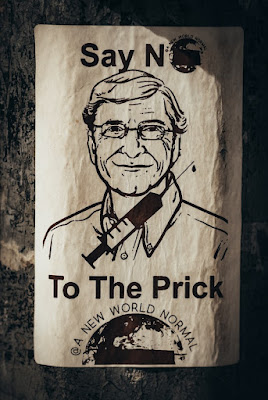
To their credit, they work with the religious zeal of a missionary, flooding every corner of the internet knowing our vulnerability to the illusory truth effect. While promotion is focused on social media, their word is also preached in podcasts and proliferated through e-commerce. Take a look at Amazon. Their charitable programme AmazonSmile has reportedly donated thousand of dollars to a vaccine misinformation soil pipe, and high ranking books on “vaccines” include: ‘Anyone who tells you vaccines are safe and effective is lying’, ‘The COVID vaccine: and the silencing of our doctors and scientists’, and ‘Vaccine-nation: poisoning the population, one shot at a time’. There is also the subtly titled: ‘******’s review of critical vaccine studies’, that gives the allusion of a systematic review (though don’t expect it to be listed in the Cochrane Library) but shares a publisher with the essential intergalactic phrasebook ‘Ambassador between worlds’ that provides answers to: What do extraterrestrials think about our religious beliefs, sexual attitudes, and goals in life? But most depressing of all, prominence is given to the book authored by the struck off doc, the man at the centre of Deer’s investigation.

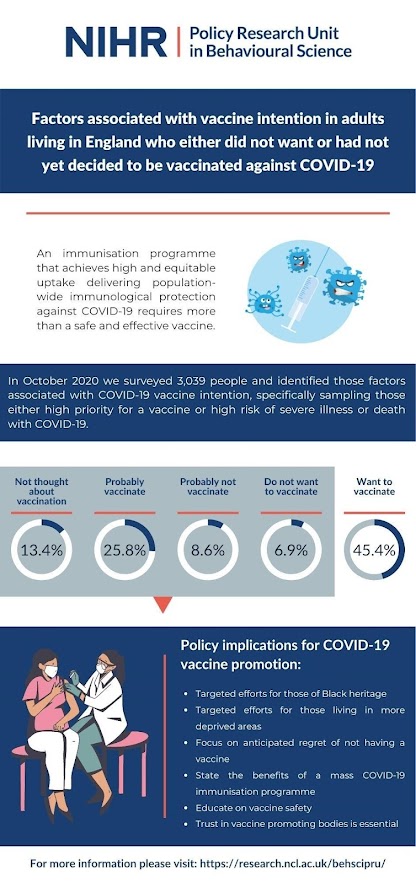
Before the first COVID-19 shots were available, to understand vaccine attitudes my Unit delivered a survey using belief-based statements in adults living in England who did not want, were yet to consider, or were not sure whether to vaccinate against COVID-19. This included their agreement to some of the more 'out-there' theories, including our own fictionalised theory that “Mass coronavirus vaccination is a ploy by environmental lobbyists to sterilise billions of people to reduce population growth”, to which 117 (7%) of respondents agreed to. While my literary intention here is to shock, I suspect that the pandemic has made you immune to such statistics. The problem is that once such views have taken root the typical counter arguments using facts are insufficient, and potentially detrimental in combating misinformation.

The vaccine rollout has been the biggest, most ambitious immunisation programme ever in the UK. It’s a historic achievement by the NHS, ably supported by the Vaccine Taskforce. But as we now reflect, it’s my view that if the Government, healthcare providers and research institutions had provided a cohesive, timely, and responsive informative service that detailed and provided a status update on vaccine development, this would have gone a long way to allay many people's rightful concerns. Sadly this reticence to comment continues as speculation increases over approval of jabs for younger children.

The public has shown an enthusiasm to learn a wealth of terminology during the course of the pandemic. My Unit’s work on the comprehension of antibody testing has shown that this isn’t easy, but it’s something that we shouldn’t shy away from. Patient and public involvement in research is vital to ensure that our lay outputs are fit for purpose and we should all consider how we can be better at science translation. Speaking on camera or on live radio is incredibly nerve-racking and not for all, but as I recently discovered following a two-hour training course, you don’t need a degree in design to produce a half decent infographic.

While I am advocating for your individual action, we also need to consider what systems, for example the new UK Health Security Agency, could put in place to fulfil the role that was missing during the pandemic. Most pressingly on our horizon is the delayed childhood vaccine strategy. The struck-off doc will be feeling emboldened. He understands and has mastered the artistic skill of communication, delivering his message with the gentle assured cadence of a BBC continuity announcer. In the absence of substantiated evidence, he expertly sows doubt and fear to the masses, and as the infodemic has shown, he is not alone. This is a huge challenge for us in public health research and the online vitriol is scary. But building the evidence-base isn’t enough, we all need to work on at least one aspect of the artistic craft of research promotion. Because if it’s not you, you can be assured that someone else most certainly is.


The views and opinions expressed by the author are those of the author and do not necessarily reflect those of the Policy Research Unit in Behavioural Science, the NIHR, the Department of Health and Social Care, Newcastle University or Fuse, the Centre for Translational Research in Public Health.

The Policy Research Unit is funded by the National Institute for Health Research (NIHR) [Policy Research Programme (Policy Research Unit in Behavioural Science PR-PRU1217-20501)]. The views expressed are those of the author(s) and not necessarily those of the NIHR or the Department of Health and Social Care.


Images: 

1) Lourenço Veado, CC BY-SA 4.0, via Wikimedia Commons
2) Photo by Jon Tyson on Unsplash

Friday, 23 April 2021

How do we improve diversity in research?

Posted by Vicki McGowan, Research Associate, Newcastle University

Public involvement and engagement in research is not a new concept. Without members of the public engaging with our work as participants, we would not have advanced our knowledge and understanding of the social world over the last few hundred years. More recently the Covid-19 vaccination would not have been so rapidly produced without generous support from the public in giving up their time (and bodily fluids) to advance our understanding. What seems to be a more relatively recent idea is the involvement of the public in developing the research itself and setting the agenda based on their experiences. Newer still is the idea that there should be a diversity of voices at the table where these decisions are made. In 2014 the Due North report made a series of recommendations to address inequalities between the North and South of England.


In order to take forward these recommendations academics across the North developed the Fuse led Equal North network which aimed to build a community of academics, policy makers, and practitioners across the region to work collaboratively on addressing the North-South health divide. This community came together in workshops to identify priorities for addressing this spatial inequality, and around 250 professional participants highlighted poverty, austerity, and unemployment as key research areas to ‘level up’ the northern regions (Addison et al, 2019).

Equal England academic and practitioner priority setting workshop hosted by Fuse

But, this was only one part of the story.

It was an important side of the story, and I’m sure many members of the public would agree that poverty, austerity, and unemployment were – and indeed are – priority topics, but we needed their perspectives to ensure we were developing research that addresses these drivers of inequality and doesn’t widen them further.

But also, we’d been talking about tackling inequality at the same time as maintaining unequal access to decision-making by not including all key stakeholders in the discussion. So, when the NIHR School for Public Health Research funded the expansion of Equal North to become Equal England, we increased our practitioner membership to over 800, but we also ensured that we could take forward recommendation 3 from Due North: 
“Share power over resources and increase the influence that the public has on how resources are used to improve the determinants of health”
The Equal England Public Network was born in late 2019. Following the practitioner model developed in Equal North, we aimed to create a space for members of the public to share lived experiences and influence the work that we do and undertake some public priority setting exercises to see how these align with the Equal North work. We’d also share information about key events, new evidence, and generally keep people updated with health inequalities research as we do the practitioner network.

That was the plan, now the action. How do you develop a diverse network to engage with members of the public with lived experience of poverty, austerity, and unemployment?

One option could be to contact the numerous, and brilliant, existing Public and Patient Involvement (PPI) groups that operate across the country. Why reinvent the wheel? If that wheel only comes in one style and doesn’t fit my bike then we may have a problem. These established groups might not accurately represent the diversity we see in our communities.

Also, these can be established groups that by their tenure already have the confidence and capacity to exert influence over research agendas and I wanted to make sure we had representation from people who don’t usually have their voices heard in the communities that are affected by the priority areas identified through Equal North.

To ensure we were accessible to a diversity of voices we aimed to pilot the network in North East England to build on the Equal North findings and implement three phases:

Phase 1: Connect with local grassroots groups that are embedded in their communities, promote the network at relevant community events, generally get out into communities across the North East and get to know people, develop trust and sign people up to our mailing list.

Phase 2: Invite members to a series of local conversations, present the findings from Equal North and discuss whether people thought these were important for their communities, whether there were other priorities, and what we needed to do to address them.

Phase 3: Co-develop research proposals around these priorities and dissemination activities with academics and practitioners – making sure the public experiences were disseminated widely and incorporated into future planning.

By February 2020, Phase 1 was going well with 35 members of the public signing up to the network. And then…


We were forced to cancel all face-to-face activities due to Covid-19. The country shut down and the vast majority of people I’d engaged with over the past few months were now focused on supporting their communities through the crisis.

People are furloughed and so volunteer at food banks, people lose their jobs, they lose loved ones to the virus, the grassroots level is not interested in me trying to encourage them online to talk about inequalities that PRE-EXISTED the virus and are now being made even worse. The public network gets locked down and we pause activity thinking it won’t be long before we’re back chatting over coffee.

A year later and we’re still not able to get together in person and our coffees are stone cold! However, during this time of crisis I focused on maintaining the network rather than trying to grow it. I kept in contact with our members via the mailing list and shared opportunities for engagement and to participate in, and develop, research. It didn’t seem right to actively pursue growth during a pandemic but, as our members represent wider groups within their communities, they have shared these opportunities and this has resulted in more members of the public signing up. We now have 57 official members from across the country who have been supporting and influencing the work we do. Amazingly during a pandemic, our public partners have supported the development of several health inequalities projects, contributed to covid-related inequalities research and influenced decisions over national priority funding around inequalities and prevention from the NIHR Applied Research Collaboration (ARC).

Key messages for ensuring diversity in research 

Identify trusted partners


Engage with your existing networks but identify people who are already trusted in their community. These people are probably the most important, whether we’re in a Covid or non-Covid world. Find them and work with them. Approach grassroots organisations, church leaders, sports groups, charities, hang out in coffee shops, community centres, pubs (when permitted!).

Actively seek out diverse groups

Don’t assume members of diverse groups will respond to your advert on Twitter, you must actively engage with groups and organisations that represent marginalised communities. If you’re unsure use tools like PROGRESS+ and HIAT as a guide to check you’re providing equity of access for members of diverse communities (these consider ethnicity, LGBT+, rural/urban, age, disability, economic disadvantage etc.).

Boots on the ground

Leave the comfort of your (home) office! Opportunity does not knock at your door, you need to go out and seek it. Pre-Covid this means being present in community spaces, libraries, coffee shops, markets and schools. During Covid this means using existing networks, online sessions, and setting up WhatsApp groups.

Give something back

Always give something back, that may be reimbursing people for their time or providing opportunities for training and skills sharing – and here I don’t just mean assuming we have skills that they want, perhaps members of the community want to share their skills with us. Develop reciprocal relationships, don’t just take from communities to boost your career!

Be patient

Developing trusted, meaningful, and reciprocal relationships takes time. Be patient. Do not underestimate how long it can take – I’ve been working with some groups for 6 years!

Manage expectations

But if you don’t have 6 years, be honest with people that your work is time sensitive and clearly articulate what you need and how people will be reimbursed if they’re able to help you. Don’t promise the moon on a stick if you can’t deliver!

Finally, blogs are also a great way to connect with diverse groups so don’t forget to add some shameless promotion: if you’re a member of the public reading this and would be interested in joining our network you can sign up here.

For more information about the development of the network, and other experiences of improving diversity in research, you can view a recording below of a recent joint NIHR School for Public Health Research / School for Primary Care Research webinar.

Friday, 5 March 2021

Patient and Public involvement with Parents during a Pandemic: the four ‘P’ challenge

Posted by Hannah Batten, Food and Human Nutrition undergraduate student, Newcastle University.  Hannah is on a placement year with the Population Health Sciences Institute, as part of the MapMe intervention team.

If you have a primary school age child, then you’ve probably heard of the National Child Measurement Programme (NCMP). For 13 years, it has collected data on the height and weight of children aged 4-5 and 10-11 years old in England. This information is used to calculate what is called the ‘weight status’ of a child and the results reported to parents via letter. Unfortunately, these letters often receive a mixed response, with many parents mistrusting the results.

Research has also shown that parents often struggle to recognise if their child is overweight, preventing them from taking action to address this.
Body image scales on the MapMe website are currently being updated for MapMe2


This issue sparked the development of the MapMe intervention, led by Fuse Director Prof Ashley Adamson and Angela Jones, which aims to help parents assess child overweight / obesity. The MapMe tool includes:
  • sex and age specific body images of children ranging from underweight to very overweight
  • information on the consequences of being overweight in childhood
  • advice on healthy eating, physical activity and links to further support.
Funded for large scale testing by the National Institute for Health Research, the MapMe tool will be delivered as part of the National Child Measurement Programme across nine areas, aiming to improve how parents respond to the letters and the NCMP process, supporting parents to take action.

The project originally had a 3-year time frame, with the intervention scheduled to be delivered in 2020/21. But, as with many other things, COVID-19 got in the way and with schools closed this prevented the delivery of the NCMP, which delayed the project by a year. Although this was disappointing, it has allowed extra time for us to focus on preparing for the next part of the study focusing on Patient and Public Involvement (PPI).

Doing PPI during a pandemic

PPI involves gaining insight during the research process from members of the public, improving research by providing additional expertise from a non-researcher perspective. One key task for the MapMe2 study was to figure out how we could recruit and run an online Parent Involvement Panel (PIP) to help review documents and study materials, when parents are already dealing with a global pandemic.

Recruitment and communication

To accommodate people being stuck at home during COVID-19, parents were recruited through social media and network sites such as the Newcastle University staff pages. Once the Panel was created, we asked parents how they wanted us to communicate with them and kept in frequent contact via email and newsletter to keep them informed and engaged in the project. As this was unknown territory for everyone, good communication with the Parent Involvement Panel was essential.

Moving online

Pre COVID-19, we had planned to hold face-to-face meetings with the parents in easily accessible venues such as the Great North Museum in Newcastle upon Tyne. However, as has become the norm with lockdown and social distancing measures, in person gatherings have been replaced with Zoom meetings. On the plus side, this allowed the meetings to go ahead and parents to attend from any location, but did result in frequent technical issues! When preparing for remote meetings, we sent out documents to parents in advance and scheduled breaks to avoid ‘Zoom fatigue’. We also used ice breakers at the beginning of sessions to make parents feel at ease.

Making information accessible to all

COVID-19 has intensified the digital divide in the UK, with a large number of people having limited access to, or understanding of, devices. Reading information and training documents on the small screen of a smartphone or tablet is not a practical or enjoyable experience. In an attempt to address this, we send hard copies of the Parent Involvement Panel manual through the post.

We have also created videos that will be posted on YouTube (example below), making them easily accessible to parents whenever they wish. The videos include members of the study team welcoming and informing parents about the project and their role, as well as short animations providing training tips. Although these are perhaps not Oscar-winning performances, they provide the information in an alternative and accessible format for volunteers.


Learning from our experience in carrying out remote Patient and Public Involvement during COVID-19, information needs to be provided in an accessible way like videos, and volunteers need to be aware and comfortable with the options available to feedback their opinions.

Saying thank you

Finally, and most importantly, is to say to our participants that we are extremely grateful for their time and input, particularly during these uncertain times.

As long as we are mindful of these new challenges, online Patient and Public involvement can still be a valuable and effective way to work.


Part of our Fuse blog Student Series
The Fuse blog Student Series showcases posts by students who have been challenged to write a blog as part of their studies at one of the universities in the Fuse collaboration, the NIHR School for Public Health Research, or perhaps further afield. The authors may be new to blogging and we hope to provide a 'safe space' for the students to explore their subject and find their voice in the world of public health research.