Showing posts with label storytelling. Show all posts

Friday, 24 July 2026

Sparking curiosity with Twinkle, Twinkle Arti

Posted by Nicola Aldridge, Research Associate, and Cassey Muir, Research Associate / Co-lead of the Fuse Early Life and Adolescence Research Cluster, both from Newcastle University

We were recently given the exciting opportunity to showcase the Twinkle, Twinkle Arti project at Discover Festival, a free, one-day festival organised by Newcastle University that brings together families, communities, and researchers through interactive activities and inspiring ideas.

Nicola and Cassey
Discover Festival is designed to spark curiosity, build connections, and encourage people of all ages to explore new ideas. Each year, the university creates a packed programme of family-friendly events, and this year, we were delighted to be part of it as members of the Twinkle, Twinkle Arti research team.


Bringing Arti's story to life

Throughout the day, we invited families to step into Arti’s world through the Twinkle, Twinkle Arti storybook. Developed by Fuse researchers at Newcastle University, with funding from the NIHR School for Public Health Research, the book was created and co-produced with families to support the wellbeing of children experiencing challenging family circumstances, such as drug and alcohol use. While these experiences inspired the story, its themes of feelings, belonging, resilience, and hope resonate with all children.

Visitors to our stall in the Great North Museum had the chance to watch a CBeebies Bedtime Stories style video of it being read aloud by the author. They could also explore puppets and original illustrations from the book, and view artwork created by primary school-aged children who had participated in a pilot study of classroom lessons based on the story.

Families were also able to take home a free copy of the storybook, along with a link to the online read-aloud video and a set of simple conversation prompts designed to encourage creativity, emotional expression, and meaningful family time at home. We handed out nearly 80 copies on the day!


Conversations that matter


Beyond engaging with families, it was equally exciting to see the conversations that the project sparked among professionals attending the festival. We spoke with people from a range of sectors, including teaching, school governance, clinical psychology, and general practice with social prescribing links. Their curiosity about the project and enthusiasm for its potential applications highlighted the broad relevance of Twinkle, Twinkle Arti and the importance of creating accessible resources that support children's emotional and social wellbeing.

One particularly rewarding conversation was with a family who shared their personal experience of the impact of alcohol on family life and how they might be able to use the book. Hearing their reflections was both moving and affirming. It served as a powerful reminder of why the project began in the first place and reinforced the continued need for resources that help children navigate difficult experiences. Moments like these bring the research to life, reminding us that behind every study, storybook, and activity are real families whose experiences matter and whose voices continue to shape our work.

Creating a community star mural

Another highlight of the day was our evolving community star mural. We invited children to create their own star by drawing, colouring, or writing ideas about what they or Arti could do when they felt sad or worried, with 114 stars being created on the day. It was wonderful to see children enthusiastically embracing the activity, and even more special to watch parents, carers and grandparents join in too, talking to their children about the messages in the book. The excitement on their faces as they added their stars to the mural was a lovely reminder of the power of creativity to bring people together.


A colourful celebration of hope and resilience

By the end of the day, the mural had grown into a colourful display of hope, kindness, and imagination. It was a privilege to share the Twinkle, Twinkle Arti project with so many families and to see first-hand how children connected with Arti’s story and messages of hope, resilience and belonging. Events like Discover Festival provide a fantastic opportunity to bring research into the community, and we were grateful to be part of such an inspiring day.


Find out more about Twinkle, Twinkle Arti

Friday, 19 December 2025

Spark ideas, inspire change and fuel innovation - sharing research creatively

Posted by Ella Anderson, Fuse Public Involvement and Engagement Manager, Newcastle University

Have you ever wondered how to share your research in a way that engages with new and diverse audiences? Are there ways to share your work in a way that reaches the people it was designed to serve? If the answer is yes, then read on!

Research can spark ideas, inspire change and fuel innovation but all too often it gets buried in academic journals and dense reports that few people read, particularly the communities the research intends to serve. So what if there were more engaging, creative and accessible ways to share your findings? From interactive infographics and animations, to events, theatre and podcasts, Fuse researchers are re-imagining how to communicate their work with wider audiences.

Whether you are looking to captivate the public, influence policy makers or engage fellow experts, this post explores some creative ideas to make your research truly resonate.
  • In the first instance, reach out to any people who you have worked with as part of your research including public partners, young people, charities and voluntary organisations. What would they like to see? Actively liaise with and listen to the communities your research is intending to serve - how do they want findings presented?
  • Infographics and visual summaries can be a useful way to transform your findings into a simplified visual. Infographics are a graphic representation of information, data or knowledge to present complex content quickly and clearly. Emma Adams has worked with More than Minutes to summarise research about co-located services in a visual and accessible way. Steph Scott worked with Nifty Fox - specialists in visual storytelling - to produce a flipbook drawing on content from the ‘Divided Households’ report relating to children and parental imprisonment. Fuse Deputy Director Amelia Lake, Shelia Visram and team co-produced the Hyper Energy drink leaflet with young people to communicate key findings. Or what about a zine (DIY-style booklet or magazine) like this, ‘Moving Spaces’, co-produced by Caroline Dodd-Reynolds with LGBTQIA+ young people, exploring how physical activity spaces could be more joyful and safe.
    • Theatre and performance is an exciting way of communicating research. For example, Cap-A-Pie and researchers including Mandy Cheetham were involved in developing an emotive theatre production called Credit, based on stories and experiences of people living on Universal Credit.
       
    • Creative and engaging community events and workshops (with catering if you have budget!) are always a popular option. The more interactive, accessible and collaborative the better. Use the opportunity to close any feedback loops with people, charities, organisations who you have engaged with throughout the research. Show how you listened, what you found out, how findings are applicable to people's lives and work, and what happens next... keeping people in the loop is so important. Be sure to include opportunities for plain language Q&As and conversations, both informal (through breaks) and formal (via panel discussions). At one of Fuse’s International Women’s Day events, there was an optional gong bath for people attending the event. Although a sound bath may not have been directly linked to the research, the event was about creating a welcoming, inclusive and ‘safe space’ for people to come together.
    • If you have the budget, consider having an event doodled in real-time. We have had colleagues who have worked with Camille Aubry, Josie Brookes and Nifty Fox who offer this skill. Get in touch with us if you would like any other recommendations when sourcing quotes.
    • Have you thought about gamification of research findings or using interactive digital tools? You can create interactive quizzes or clickable maps to allow people to explore findings in an engaging way, applying insights to local contexts. Simulation tools allow public partners and individuals to visualise the impact of different public health interventions based on research findings. Take a look at Joanne McGrath's online Maze, which provided an interactive resource portraying women’s narratives of multiple exclusion, homelessness and accessing support.
    • Storytelling has long been a way to share information. Case studies lend themselves well to this, as human-centric narratives show the research in action. It can demonstrate how a specific person or community has benefitted or will benefit from the findings. Stories are a different way to 'humanise' data or translate findings in a way that is appropriate for the intended audience. For example, Cassey Muir and Ruth McGovern’s co-produced Twinkle Twinkle Arti children’s story book communicated messages about parental substance use in a gentle, age-appropriate manner. The book is available as a physical copy, an electronic copy and also has been made into a CBeebies style story time video.
    • Are there any opportunities for the use of creative methods throughout the project that you could bring together as part of an exhibition in a public space e.g. library, community centre, schools? Documenting the research and experience through photography, crafts or art can be a creative way of capturing interest and making research more understandable. Sarah Martin-Denham’s crochet blanket made up of 2,999 squares representing the number of children excluded every day from schools in England (2021/22 academic year) is a great example of this, and has been on a national tour engaging with 24 organisations - including the Children’s Commissioner Office and multiple councils.
    • You can share bite-sized research or findings through social media channels using visuals, animations, short videos - or even livestreaming to provide information and engage with people in real-time. Have a hashtag at the ready to encourage people to join the conversation and share perspectives. In a similar vein, there are opportunities to share research and knowledge via 'Ask Me Anything' style forums, for example as seen on Reddit. Yes, this is low cost but it comes with risks as questions are unpredictable! However, it is worth flagging as an option and is a creative, ‘non-traditional’ way to share research and answer questions.
    • Blogs, like the award-winning one you are reading right now, are a great way to share your research. Posts can make complex information more accessible to a wider audience. It allows you to present findings in a clear, engaging and informal style, reaching readers outside of academic circles, including policy makers, practitioners and the wider public. For guidance and support in writing your own blog post, contact Fuse Communications Manager, Mark Welford: m.welford@tees.ac.uk.
    • Could you take your research findings to places in the local community? Fuse colleagues Balbir Singh (Artistic Director of the Balbir Singh Dance Company) and Paul Chazot displayed art works from their Unmasking Pain project in pop-up displays in GP surgeries and a repurposed shop in a shopping centre. There is now a dedicated space at the Grainger Market, Newcastle-upon-Tyne called the Being Well Place, which is a place to connect and engage with the local community.
    • Do you have the option of translating materials/outputs for different audiences, and communities with diverse language needs? Translated summaries and visuals e.g. in multiple languages, work well and ensure inclusivity in dissemination. For example, Nicola Heslehurst worked with local designer, Twentyseven Design to develop English and Welsh infographics relating to pregnancy outcomes.
    • And finally what kind of Fuse Public Involvement and Engagement Manager would I be if I wasn’t promoting the wonderful and award-winning public partner-led podcast Public Health Research and Me?! Accessible, informative, flexible and friendly - this is a great way to share quality research with a diverse and international audience. 

    There are many more creative ways to share research and remember - there is a no ‘one-size-fits-all’ approach to sharing your findings. Always take into account your research topic, your findings and above all your target audience.

    Why not send us a message today if you have used a creative or innovative way to share your research or findings? We would love to hear from you and find out more ways to promote and share high quality research.


    Following strong interest from Fuse members, we have launched a Community of Practice (CoP) focused on creative research, involvement and dissemination.

    The first meeting will take place in the New Year. Places are limited for the first event but please register or get in touch (info@fuse.ac.uk), as there will be plenty more opportunities in future!

    A CoP is a network of people who share common interests and goals, creating a space for knowledge exchange, learning, and mutual support.

    Friday, 10 December 2021

    Once upon a time in research... the power of storytelling for scientific communication

    Posted by Peter van der Graaf, Associate Professor, AskFuse Research Manager & NIHR Knowledge Mobilisation Research (KMR) Fellow, Teesside University

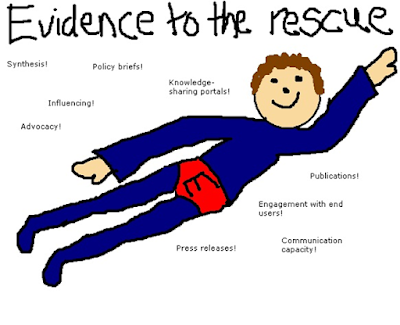
    A Christmas story about gifting knowledge (featuring Evidence Man)


    It was the week before Christmas. After a long day in the office at her university, Ana Lyst rushed out to do some last-minute Christmas shopping. She had been too busy writing grant applications and journal papers to even think about presents for family and friends. It was already dark, with a stiff, cold breeze and snow started falling around her.

    As she approached the high street, Ana noticed a bookshop she hadn’t seen before. It looked rather grand, a bit like an ivory tower, but with more doors. Through large windows at the front, she could spot frantic people in white lab coats running between the shelves, carrying big loads of paper and folders. ‘Bingo!’, she thought: books make great Christmas presents and I can sort out all my gifts in this one shop. She merrily stepped inside and was greeted by a large, vaulted ceiling underneath which stood endless rows of books in all shapes and sizes, reaching all the way to the ceiling. On first impression, the books looked rather dull and colourless, many of them gathering dust, with long, incomprehensible titles edged on their spines in gold.


    Undaunted by the ambush of knowledge and people, Ana walked over to the applied research section (which sported a large swirly sign, fusing five different colours) and spotted several books that looked like decent presents for friends. Taking them to the till, she was met by a stern looking clerk, named Pierre View, who inspected the books carefully and with an authoritative tone explained that many of the selected books were not yet ready to leave the bookshop, as they needed more work and review. Could she please come back in 17 years to collect them? The 14% of books that were ready to leave, were neatly packaged in shiny, glossy covers with pictures and key phrases all over them that Ana Lyst was sure would really impress her friends.

    However, when she tried to leave, Ana noticed that there were many doors to exit the shop (the entrance was no longer visible) and when she tried the first door in front of her, it wouldn’t open. She went to the next five doors with the same result: all of them were firmly locked, or the ones that did open led to a dead-end. Ana started to panic and her earlier optimism
     quickly melt away, replaced with visions of being stuck in the bookshop over Christmas with not a mince pie in sight.

    At that moment, a small backstage door hidden in a corner of the shop opened and a bold bespeckled man stepped out, fully dressed in a superhero outfit with bright blue tights and top (that looked a bit too tight), over which she wore red underpants featuring a large letter ‘E’. Ana Lyst didn’t know what to make of this man, but he looked friendly enough and was walking over to her to offer his services. As the man came closer, he produced a large set of antique brass keys from beneath his cape and began opening several doors. “Are you a bit lost?”, asked Evidence Man (for that is who he was) in an accent with a Dutch lilt. “Stuck between here and the outside world? Not to worry! I know the way out to some safe spaces with a friendly audience who would love to hear all about the books you just bought. They would even be interested in the ones that are not ready yet, and they might have a few books of their own to share with you. Shall we go?”

    True to his word, when Ana stepped through the first door unlocked by Evidence Man, she emerged back in the now snow-covered high street, where a group of her friends were waiting and, even better, one of them was carrying a large plate of mince pies! Ana Lyst’s spirits lifted immediately, and she vowed to tell her friends all about the helpful Evidence Man in the bookshop. But when she turned around, the nice man had disappeared and through the windows of the bookshop could be seen flying to assist another confused customer.

    The End.


    The power of storytelling for scientific communication


    I was inspired to write this Christmas tale (and blog) after attending a storytelling workshop at the Fuse end-of- year social event on 3 December, which was led by Duncan Yellowlees. Duncan is a Communications Trainer who works with researchers to improve their communications, confidence, and impact. Take a look at his online COMMunity website (Research Comms … but better) to find out more. 

    In an engaging and entertaining way, he took us through the key elements of storytelling: from key principles (putting pictures in people’s heads; construct a narrative of causes and effects), to different types of stories (metaphorical, motivational or monster stories, stories as hooks, and point-of-view stories), their structures (problem, solution and results) and what to include in stories (the point, examples, people, heroes & villains, magical helpers, and tensions & conflicts). Did you spot any of these elements in my story? Scroll down to the bottom of this post for spoilers.

    Overall, Duncan provided plenty of tips and tricks on how we can use storytelling as academic researchers to communicate our research findings to wider audiences. And this relates directly to the first point (and story) that he made during the workshop: researchers spend too much time throwing the ball (their research findings) but not nearly enough time on making sure there is someone there to catch it (knowledge users). Find your audience first and make them pay attention before you start talking about your research.

    His second point was that all this might seem daunting: so many different techniques, plot lines and structures to think about, how can we ever get any good at this? But when comparing it to learning to drive a car, the same principles apply: keep practicing and it gradually (and sometimes quite quickly) becomes second nature. This is because storytelling is already embedded in everything we do in our daily lives: from telling our family and friends about our everyday experiences, to reading books or ‘binging’ on Netflix series.

    Finally, Duncan suggested some simple techniques for storytelling in science communication: making stories relatable and relevant (e.g. stress before Christmas) by including named people and adding details (e.g. dark, snowy high streets and describing the interior of the bookshop), which start to paint a picture in people’s heads. Most importantly, start with a hook: a story to draw in your audience, so they want to hear more, or use a question or bold statement as bait (e.g. only 14 percent of research makes it into practice and policy after 17 years).

    My story might not have been all you hoped for this Christmas, but the Fuse social event brought some useful gifts for the Fuse Communications toolkit and much needed festive cheer at the end of another challenging academic year. 

    Merry Christmas everyone and happy storytelling!


    Spoiler alert:
    • The point: knowledge mobilisation between academia and practice is facilitated by a knowledge exchange broker. Plus some points about the time it takes and difficulties faced by researchers when trying to get research into practice and policy.
    • Heroes: academics producing research and papers, while running between bookshelves.
    • Villain: Bookshop clerk (Reviewer 2).
    • Magic helper: Evidence Man (Knowledge Exchange Broker)
    • Tensions & conflicts: research dusting away on bookshelves or not being ready to leave the building, while access to knowledge users is restricted or confusing.
    • Type of story: metaphorical story, overlapping with stories as hooks (to introduce this blog and talk about the storytelling workshop).

    Thursday, 3 October 2019

    This is my truth, now tell me yours

    National Poetry Day was launched in 1994 with the aim of inspiring people to enjoy, discover and share poems.

    To mark this year's event on the theme of Truth, we issued a challenge to our followers on Twitter @fuse_online to write a poem about public health research.

    Below are the literary masterpieces we received!


    Wordsworth's Work-Balance

    Mark Green, Senior Lecturer in Health Geography, University of Liverpool
    @markalangreen


    I wondered lonely as a cloud,
    Over the summer where I found,
    That working was not always for me,
    Papers and grants failed to bring me glee.

    So I chose to work a little less,
    And I admit I must confess,
    I’ll write a little less this year,
    But be happier, and smarter, without that fear.


    Changing the story

    Emma Halliday, Senior Research Fellow, Lancaster University
    @halliday_e

    Illustration © Joe Decie 2018
    We were ranked deprived,
    left behind, always maligned;
    that place - nobody moved to.
    Public health called time
    on booze and smoking islands.
    Newspapers traded fears of
    crime and wild west violence -
    no one counted the human cost
    or listened to the local voice.
    When did reality get so lost?

    So, the community took control
    of a more powerful story -
    it started with a conversation
    about the decisions they’d make
    to improve their place;
    what they wanted to change
    to reclaim this space.
    Now, carnivals attract crowds,
    lanterns of hope light the town;
    residents fight back with pride.

    These days, when they label us;
    we don’t believe what they say.


    A poem inspired by the Communities in Control study


    Buckfast Free Zone

    John Mooney, Senior Lecturer in Public Health, University of Sunderland
    @StandupforPHlth


    Once upon the Tyne, there was disorder, there was crime,
    Cos’ everyone was pickled on the bevvy,
    But that all came to grief,
    When the Police and the Council Chief,
    Introduced a top-up charging late night levy!

    Now stags and hens all go tae Durham
    Cos’ there’s nothing left here ‘fur them’
    An all-night drinking parties have been banned!
    They've installed the impact zone on their google map and phone
    And the Toon’s the safest city in the land!


    A poetic reflection on Public health alcohol policies in Newcastle, which have included the introduction of a late night levy and a cumulative impact zone for alcohol licences. 

    Extract from my Stand-up comedy set: ‘Buckfast Free Zone’ performed at The Stand Comedy Club as part of Bright Club Newcastle. 

    Friday, 5 April 2019

    What fairy tales and pinball machines can tell us about using research

    Posted by Peter van der Graaf, AskFuse Research Manager / Fuse Knowledge Exchange Broker, Teesside University

    Once upon a time... the UK Knowledge Mobilisation Forum 2019 took place in Newcastle at Seven Stories, the National Centre for Children’s Books. The Forum brings together practitioners, researchers, students, administrators and public representatives who are engaged in the art and science of sharing knowledge and ensuring that it can be used. This year I was part of the organising group and we deliberately chose Seven Stories as location for the Forum with its focus on stories, which are an important mechanism for exchanging knowledge.

    5 points awarded to Dan Wolstenholme of House Gryffindor 
    The Centre, spread out over seven floors, provided plenty of exercise to get to the different rooms for interactive poster sessions, knowledge fayres, fishbowls and workshops. The Harry Potter themed conference room also allowed me (not pictured right) to dress up as a Ravenclaw student while serving coffee. But the real highlight of the conference for me were the stories being shared by the key note speakers, Ishbel Smith from Heart in Mouth, who reflected on her practical experiences, and Andree le May and John Gabbay from the University of Southampton, who provided an in-depth research perspective. I will relate two of their stories: the first involves a house made of sweets, the second is about a pinball machine.

    The power of stories is often underestimated in research but has gained some traction in academia, particularly for evaluating new interventions and because they make great impact case studies. At the same time, it has proven notoriously difficult to capture any impact in a story: we don’t really know what happens to research findings once they leave academia and trying to trace impact is like Hansel and Gretel clinging onto tiny bread crumbs in a large wood.

    This brings me to the first story. Ishbel Smith used the story of Hansel and Gretel to highlight that the siblings missed the blindingly obvious (a house made of sweets is too good to be true and likely to be a trap), because they were too focused on the breadcrumbs and did not see the wider picture or context in which they were walking (a deep dark wood inhabited by a hungry witch). As knowledge mobilisers it is vital to understand where we are in a given situation to be able to unlock the relevant knowledge in that context.

    Ishbel reiterated that contextual knowledge is just as important as content. Understanding the context in which research evidence is used and, perhaps more importantly, what happens to that evidence in a practice or policymaking context, is vital for mobilising it. To clarify this, Andree Le May and John Gabbay, told a story about how research evidence is transformed by using the analogy of a pinball machine.

    In this second story, research evidence gets batted around across various groups of people within organisations as they interact with it. In each interaction, the evidence is slightly changed: people put their own spin on it and adjust it slightly for their own needs. The evidence literally receives a battering but in this process the evidence is made fit for a particular context and socially reconstructed. Like the pinball getting batted around inside the machine, with every contact the evidence changes shape. Perhaps not noticeably at first but you end up with something quite different and unrecognisable from the research evidence that you put into the dissemination process at the start. This means that, if you don’t understand as a researcher that your research findings will be transformed when it is being used by practitioners and policy makers, then you will never be able to find and follow it for your impact case studies.

    Andree and John persuasively pointed out that the craft of knowledge mobilisation is not only using the right skills to get evidence into practice, but also to be able to be part of the story of how evidence is used. This requires not only technical skills (which are mostly studied by implementation science) but also the use of soft skills, such as the striking the right tone and style, being able to get your message across and contextualise knowledge; for example, do we know what the right problem and the right solution is for the context in which we are trying to mobilise knowledge?

    Perhaps the most important skills we can develop for mobilising knowledge is how to enable learning: what did work and didn’t work in this context? How can we help others to apply research evidence into their own context? Stories provide a powerful tool for this: not to highlight what we have achieved as research institutions in the next REF submission, but to create a space to reflect on our experiences of using research evidence in different practice and policy context. To make these stories impactful, they have to be told by the people who used the research evidence. And we as researchers have to be willing to listen and be able to reflect on them with the evidence users.

    Friday, 29 September 2017

    Brands, bottles and breastfeeding: sharing stories of early motherhood


    Introduced by Nat Forster


    Guest post by Justine Gallagher, Lecturer at Northumbria University

    My own story of infant feeding is based in a community where breastfeeding was, and still is, not the norm. I was the first in my immediate family to breastfeed and I struggled with it in various ways. My breastfeeding journey ended much sooner than I had originally planned, when my son was just six weeks old. Two years later, my own sheer determination helped me to feed my second child, a daughter, for nine months.

    Justine's first steps into motherhood
    Later, in a professional capacity, I worked supporting families in my role as Community Development Worker in Sure Start Children's Centres. I worked with mothers who had similar feeding stories to my own, as well as many women who had never breastfed. They, like most of the people around me, never had any intention to breastfeed.

    The guilt I felt for breastfeeding my first child for a short time stayed with me for a long time. I did not understand why it had such an impact. Why did I feel the need to breastfeed when others around me did not appear to give breastfeeding a second thought? When the opportunity came for me to undertake PhD research, my choice of topic was never in doubt.

    My research, which is supervised by Dr Deborah James from Northumbria University, is focused on the infant feeding stories of nine women who live in an area where breastfeeding rates are low. All of the women’s stories are equally important however, for the purposes of this blog I would like to introduce you to Claire (names have been changed to preserve anonymity), who formula fed her baby Sophia from birth.

    Claire, her parents and grandparents have lived in the same local area all of their lives. Claire was a single parent and lived with Sophia’s grandparents when her daughter was first born. Sophia’s grandmother took an active part in her care. She looked after Sophia for two nights a week when she was first born, reducing this to just one night per week as time passed. Following a biographical narrative approach, which allows participants to tell their stories without interruption, I asked Claire for her story with the use of a single question;

    "So, please can you tell me the story of your experiences of feeding milk to your baby?"
    "Well I started when I was pregnant, erm, I’ve always wanted to bottle feed her er, cause there was pink bottles that I wanted to get her erm and also knew the milk that I wanted to put on her erm, and just bottle feeding become very easy to us."

    Claire’s story was dominated with discussion of branding and consumer goods. The pink bottles and the various brands of infant formula Claire gave to Sophia reveal the way media and advertising can influence infant feeding practice. Claire demonstrates that she was careful with her bottle-feeding choices. These choices were not arbitrary; she made clear decisions between brands and bottles. Claire wanted me to know that she had made the right choices for her and her daughter.

    It was also quite clear that Claire’s identity, as the mother of a daughter, was an important part of her story. The ‘pink’ bottles represent this in a very visible way, she could perform her identity as a mother of a daughter with the right choice of bottle. Claire’s relationship with her own mother was important to her and she appeared keen to demonstrate that this mother-daughter bond would continue for another generation.

    These stories help us to understand why some women breastfeed and others do not. Upon reflection, for me, I feel that breastfeeding was about being the best mother I could be, which explains the guilt I felt when I stopped. For Claire, feeding her baby was also about the same thing, only for Claire, being a good mother was about making the right consumption choices. In my thesis, I expand on how Claire’s choices were based on the social norms, the unwritten rules of how to be a mother, in the culture around her.

    Friday, 8 September 2017

    Postcards from a public heath tourist #2: Boston, Massachusetts, USA

    Guest post by Emma Simpson, Research Assistant, Newcastle University

    --------------------------------------------------------------------------------------------------------------------------------------------------------------------------------------------------
    A few of our academics are lucky enough to have the opportunity to travel around the world to speak at conferences or explore collaborations - all in the line of work and the translation, exchange and expansion of knowledge of course.

    The least we could expect is a postcard, to hear all about the fun that they're having while we’re stuck in the office watching droplets of rain compete in a race to the windowsill…

    Here’s the second from Emma Simpson.

    --------------------------------------------------------------------------------------------------------------------------------------------------------------------------------------------------

    Dear Fuse Open Science Blog,

    It’s not just academics who get amazing opportunities, PhD students do too!
    
    I am part of the Engineering and Physical Sciences Research Council (EPSRC) funded Digital Civics programme at Newcastle University and my research lies at the intersection of public health and human computer interaction (HCI) – broadly speaking. As part of this programme, I am are very fortunate to have the opportunity to undertake an exchange at another relevant institution.
    
    Wellness Lab (L-R): Herman Saksono, Lily Stowell, Me, and Andrea Parker
    (I also worked alongside Farnaz Irannejad Bisafar who is not pictured here)
    Earlier this year, I travelled 2,637 miles to Northeastern University, where I began a three month internship as a research scholar at the Wellness Lab. The Wellness Lab is directed by Professor Andrea Parker and sits within the Personal Health Informatics department in School of Computing and Information Science. After having completed all of my preceding degrees at Newcastle, I was super excited to spend time in a different research institute and it didn’t disappoint! I had such a rewarding experience and because the lab was much smaller than I had anticipated that meant I developed close friendships with the other three students advised by Andrea.

    Beautiful snowy view from Wellness Lab
    The Wellness Lab has some very interesting research projects (and beautiful views from the office). The research mainly focusses on how digital technologies can alleviate health disparities and improve health and wellbeing across different populations. Some interesting papers here, here and here. I worked specifically on two projects - supporting reflective thinking through family storytelling to encourage physical activity and designing games for encouraging physical activity and social connectedness in Alzheimer’s Disease caregivers. Two very different projects based on gaming and public health, offering very different experiences and skill development and - although not largely related to my projects in the UK - both offered invaluable contributions to my development as a researcher.

    I had the opportunity to lead some co-creation workshops with parents, creative writers and health experts to develop stories that could potentially encourage families to reflect on their physical activity behaviours – great fun and insightful, while introducing me to new methods and materials to facilitate important conversations around health, inspired by the value sensitive action-reflection model.

    Unfortunately, the second project working with Alzheimer’s Disease caregivers progressed much slower and I didn’t quite get to the data collection stage, but I did design some paper prototype games which made me realise I need to work on my drawing skills!

    Glass flower exhibition at the Harvard
     Museum of Natural History
    I spent time working alongside Catherine D’Ignazio, Assistant Professor at Engagement Lab and Faculty Chair of Boston Civic Media – both of which are leading the way for collaborative, participatory civic research in Boston. Catherine and I worked together within a team of feminist HCI researchers to organise a 'Hacking Women’s Health' workshop at the Conference on Human Factors in Computing Systems in Denver, Colorado, in May this year. The event was a two-day workshop with a mixture of 25 academics and PhD students from across the world working on projects related to women’s health and technology. It was my first ever experience of organising a hackathon style workshop and it was such a successful (and fun) weekend. You can read another blog about it here.

    Boston is a great city and the architecture is beautiful. My favourite and highly recommended leisure activity is to visit the Harvard Museum of Natural History where you can view the glass flower exhibition. It contains over 4000 different glass models representing more than 830 plant species that were made to teach botanicals all year round - super impressive. My inner science nerd was elated. A must see if visiting the city but avoid going in the winter! As beautiful as it was, the -12 degrees and two feet of snow every few days became tiresome.

    Thank you to my PhD supervisors Madeline Balaam, for helping organise this opportunity, and to Emma Foster and Ashley Adamson for their continued support.

    Please feel free to email me if you would like to know more about any of the projects or Digital Civics research – emma.simpson@newcastle.ac.uk