Showing posts with label LForrest. Show all posts

Thursday, 27 November 2014

52 weeks in public health research, part 47

Posted by Bronia Arnott, Dominika Kwasnicka, and Lynne Forrest


From Bronia Arnott: The only way (is Essex)? Recently I was in Essex and the queue of traffic with all of the “slow” warnings on the road resonated with me as I had just had a systematic review of interventions to reduce car use and increase more active and sustainable modes of travel accepted for publication.


From Dominika Kwasnicka: National Institute for Health and Care Excellence (NICE) strongly recommends that adults engage in any suitable form of physical activity. So you just need to pick and choose the one that’s best for you. Here is an adult version of a bouncy castle at a great event co-organised by one of Fuse's practice and policy partners Scott Lloyd. It’s always good to try new things. And if a bouncy castle isn’t your thing, how about some ice skating this winter?


From Lynne Forrest: A number of Fuse representatives, including myself, Shelina Visram and David Hunter, were among the 1500 delegates who attended the European Public Health (EUPHA) conference on Health Inequalities in Glasgow. This is my poster on a systematic review and meta-analysis that found no evidence of socioeconomic inequalities in stage at diagnosis for lung cancer.


From Bronia Arnott: An early morning trip to Newcastle Central Station which has recently been refurbished and is now looking much better. They even have some bike racks in decent places rather than stuck out of the way at the wrong end of the station. Coincidently, I was off to talk to people about active travel!


------------------
A reminder from the Fuse blog group:

Each Thursday of 2014 we’ll try and post around four pictures on the Fuse blog that capture our weeks in public health research, from the awe-inspiring to the everyday and mundane. Given that more of the latter than the former exists in most of our lives, we foresee problems compiling 208 images worth posting on our own. So this is going to have to be a group project. Send an image (or images) with a sentence or two describing what aspect of your week in public health research they sum up and we’ll post them as soon as we can. You don’t have to send four together – we can mix and match images from different people in the same week.

Normal rules apply: images you made yourself are best; if you use someone else’s image please check you’re allowed to first; if anyone’s identifiable in an image, make sure they’re happy for it to be posted; nothing rude; nothing that breaks research confidentiality etc.

Email your posts to m.welford@tees.ac.uk or contact any member of the Fuse blog group.

Thursday, 3 July 2014

52 weeks in public health research, part 26

Posted by Lynne Forrest and Jean Adams

So, week 26. That's half way. We haven't missed a week and there's been a full complement of four pictures each and every week. People, we are doing great. Only 26 weeks to go!

From Lynne Forrest: this is my family Saturday food shopping. I think it demonstrates the current confusion around healthy eating perfectly. The trolley contains fruit and muesli (good), fruit juice (used to be good but now the sugar is a concern), butter and cheese (used to be bad but fat is now potentially rehabilitated), as well as crisps, biscuits and pizza (definitely bad, and I'm clearly letting the public health side down here, but as they're from Marks and Spencer it's good quality bad food – does that make it any better?!)

From Jean Adams: My great uncle died recently. Although I'd never met him, I found myself tasked with finding his birth certificate in order to register his death. After looking absolutely everywhere else in his flat for it, I final flung open the kitchen cupboards in despair thinking maybe there was a secret stash of important documents under the bread. This is what greeted me: Morrison's saver's tinned soup, mushy peas, custard and fruit. I wasn't quite sure whether to laugh or cry. I finally found the birth certificate in a shared cupboard in the hallway of his apartment building.

From Jean Adams: Yeah, I didn't really find this funny. Yeah, I get that it's hilarious that 'pushy health types' like me don't even have a sense of humour. Yeah, I enjoyed a bag of crisps on the train with a cup of tea - what of it?

From Jean Adams: this supermarket convenience store isn't near a school. But this is some pretty heavy store-front alcohol marketing I'd say.

-------------------

Just to remind you:

Each Thursday of 2014 we’ll try and post around four pictures on the Fuse blog that capture our weeks in public health research, from the awe-inspiring to the everyday and mundane. Given that more of the latter than the former exists in my life, I foresee problems compiling 208 images worth posting on my own. So this is going to have to be a group project. Send me an image (or images) with a sentence or two describing what aspect of your week in public health research they sum up and I’ll post them as soon as I can. You don’t have to send four together – we can mix and match images from different people in the same week.

Normal rules apply: images you made yourself are best; if you use someone else’s image please check you’re allowed to first; if anyone’s identifiable in an image, make sure they’re happy for it to be posted; nothing rude; nothing that breaks research confidentiality etc.

Tuesday, 20 May 2014

Using social media for building an academic & professional network

Posted by Lynne Forrest

As part of a general session within our Institute on using social media for research, I was recently asked to talk about using social media for building a professional network. It was a good chance to reflect on why I think Twitter is such a good tool for doing this, particularly for those at the start of their academic career, who are lacking in publications, a wide academic network and an established reputation.

I first joined Twitter at the beginning of the second year of my PhD and, initially, I really couldn’t quite see the point. It wasn’t until I wrote a couple of posts for the Fuseblog and starting picking up some followers that I began to realise what a useful tool it could be. Now, over two years later, post-PhD I have a twitter network of around 600 people (large enough, but not too big as to be unmanageable), am on 23 Twitter lists ranging from Women in Science to Academics at Newcastle and Tweeting Epidemiologists, contribute regularly to the Fuseblog, and am a total social media convert.


Twitter has been a brilliant medium for connecting with other PhD students (and now early career researchers) in order to ask questions, get advice and generally provide moral support during what can be quite an isolating experience. It’s also been of practical support in highlighting interesting epidemiological and public health research I might never have found myself (the fabulous @SCPHRP is great for this), advertising jobs and conferences, sharing resources (a list of viva questions has done the rounds of my twitter network), raising my profile, and connecting me with a wide network of like-minded people in public health and beyond.

As someone who can come across as quite reserved in real life (despite the fact I am actually fairly stroppy and opinionated), I do find the whole networking thing quite stressful. I realise it’s a necessary part of academia and I need to get better at speaking up more, but in the early stages of academia it’s easy to think you’ve got nothing useful to contribute, as well as the worry of saying the wrong thing and looking stupid. But Twitter has again been an excellent tool for this sort of thing. Blogging has given me an academic voice and Twitter has allowed me to interact with senior academics that I’d be far too terrified to approach blind at a conference. As a recent member of my Twitter network said ‘Twitter is networking for people who hate networking’ (thanks @PhDGeek for allowing me to pinch this for my talk!).

So, if you do plan to use twitter to build an academic network what should you do? I’d advise keeping your personal and professional identities mostly separate. I do tweet non-work related stuff but decided fairly early on to stop following David Tennant, various members of Duran Duran and the cast of Merlin (no-one needs to know about my love for dodgy 80s bands and kids’ tv programmes). Use your profile to detail your research interests and help others find you. And use a sensible twitter name. I initially just planned to lurk so chose a daft name that I’ve now changed. Also, if you’re using other academic resources such as Researchgate and google scholar citations it seems sensible to have a consistent professional online identity.

The best way to build up a twitter presence is to start interacting and not just re-tweeting. If you are going to re-tweet then occasionally add some comment or opinion. Tweet from a conference or seminar. If your Institute or department has a blog then contribute to this. There’s only so much you can say in 140 characters and a blog post allows you to talk about your research or other aspects of the research process in a lot more detail. Reply to interesting tweets, start conversations and, most importantly, engage. There’s a great network of academics out there, you just need to find them.

Thursday, 17 April 2014

52 weeks in public health research, part 15

Posted by Lynne Forrest and Martin White

From Lynne Forrest: Having recently passed my viva and officially become Dr Forrest, my thesis has joined a colourful selection of other theses in the bookcase at our Institute, available for others to borrow. I’m not sure how often the hardcopy version will actually be read but it also gets published online 6 months later, which will hopefully increase access (the delay is to allow publication of papers from the thesis first).

From Martin White: This appealed to me on several levels. Fuse partners are working with collaborators across Europe to submit an application for a ‘Marie Skłodowska-Curie action’ – an application to the European Community for an Innovative Training Network (ITN), which will fund 25 PhD studentships. The acronym for our application is ÉTUDE (European Training hUb on behavioural Determinants), hence this musical quote and explanation of its relevance, which serves as frontispiece to our application.

From Martin White: Long delays are part and parcel of journeys on the East Coast mainline, which, if you work in the North East occupy a lot of our time, regularly commuting to and from meetings which inexplicably always have to be in London. On a recent journey, my train was ‘terminated’ at Peterborough and three train loads of people fought to secure a place on the only train going to London. I found a premium spot in the service area of First Class, where I set up my office and returned to reading a PhD. I was two hours late for my meeting…

From Martin White: When you spend 6-7 hours on trains in a day (see other references to East Coast mainline…), you need to seal yourself off from the rest of the carriage to focus on getting work done. My working day always starts (usually at 07.10) with Johan Sebastian Bach. Often a cantata, but sometimes solo cello or violin suites, or the incomparable keyboard works, such as the Goldberg variations. The rhythmic and harmonic structure of Bach makes it perfect for concentrated work.
-------------------

Just to remind you:

Each Thursday of 2014 we’ll try and post around four pictures on the Fuse blog that capture our weeks in public health research, from the awe-inspiring to the everyday and mundane. Given that more of the latter than the former exists in my life, I foresee problems compiling 208 images worth posting on my own. So this is going to have to be a group project. Send me an image (or images) with a sentence or two describing what aspect of your week in public health research they sum up and I’ll post them as soon as I can. You don’t have to send four together – we can mix and match images from different people in the same week.

Normal rules apply: images you made yourself are best; if you use someone else’s image please check you’re allowed to first; if anyone’s identifiable in an image, make sure they’re happy for it to be posted; nothing rude; nothing that breaks research confidentiality etc.

Also, this doesn’t mean we wont also be posting words. You word-based posts are, as always, much appreciated.

Thursday, 10 April 2014

52 weeks of public health research, part 14

Posted by Michael Heasman, Martin White and Lynne Forrest

From Martin White: The MRC has this jigsaw-like object in its 13th floor stair lobby. I think it celebrates 100 years of the MRC (Centenary last year). I attended two meetings: the Population Health Sciences Research Network board, which has overseen ‘methodological knowledge exchange’, including the hugely cited MRC Guidance on the development and evaluation of complex interventions; and the Public Health Interventions Development panel, which funds competitive, small scale research.

From Martin White: At the Public Health intervention Development research funding panel we reviewed 29 applications in less than 3 hours. Two panel members per application. You do the maths. The applications are short (a couple of pages) and the stakes not high (maximum of £150k over 18 months). But, only few will get funded. The MRC assessment criteria demand a high level of rigour and innovation. Only an agreed score of 8 or more can be considered for funding. There is no room for error as an applicant.

From Michael Heasman: no description required.

From Lynne Forrest: This poster appeared in the 3rd floor coffee room at IHS recently, urging us all to take the stairs for health and fitness reasons and also to ‘avoid awkward silences’ in the lift! I do wonder if it might be more useful if the notice were stuck beside the lift on the ground floor? And, as public health evidence is what we’re all about, is anyone evaluating its effectiveness?
-------------------

Just to remind you:

Each Thursday of 2014 we’ll try and post around four pictures on the Fuse blog that capture our weeks in public health research, from the awe-inspiring to the everyday and mundane. Given that more of the latter than the former exists in my life, I foresee problems compiling 208 images worth posting on my own. So this is going to have to be a group project. Send me an image (or images) with a sentence or two describing what aspect of your week in public health research they sum up and I’ll post them as soon as I can. You don’t have to send four together – we can mix and match images from different people in the same week.

Normal rules apply: images you made yourself are best; if you use someone else’s image please check you’re allowed to first; if anyone’s identifiable in an image, make sure they’re happy for it to be posted; nothing rude; nothing that breaks research confidentiality etc.

Also, this doesn’t mean we wont also be posting words. You word-based posts are, as always, much appreciated.

Thursday, 27 March 2014

52 weeks of public health research, part 12

Posted by Lynne Forrest and Jean Adams


From Lynne Forrest: Whilst buying a coffee for taking on the train, I noticed that Costa now list the calories in each cup. My flat white had 145 calories, which meant that two cups contain the calorie-equivalent of a Mars bar. This seemed shockingly high to me and I’m sure I can’t be the only person who had no idea of the large ‘hidden’ calorie count in drinks. Apparently most of the big coffee retailers use full-fat milk as standard. Perhaps we need a public health campaign (similar to those that aim to reduce hidden salt and sugar in food) to get them to switch to semi-skimmed as default.


From Lynne Forrest: As very much a fair-weather cyclist, now that the weather has improved I’ve started cycling in to work again. I’m trying to embrace the idea of active transport and cycling has the added advantage of being quicker than the bus. Most of my cycle is across Newcastle town moor, which isn’t the most scenic of routes but is traffic-free. Later in the year there are usually lots of cows blocking the path (which scare me!) but it’s currently blissfully cow-free.


From Jean Adams: I love a bit of retro-branding-as-art, but was particularly struck by this image in a hotel room I stayed in recently. How did a soft drink brand manage to become part of popular culture? When will we work out how to do that for apples?


From Jean Adams: Last week was my last visit to Ashridge for NIHR Leadership Training. Despite my initial reservations, I've really enjoyed the experience and hope I've learnt some useful things. I will particularly miss the splendid early 19th century country house setting. And the fabulous food.


-------------------

Just to remind you:

Each Thursday of 2014 we’ll try and post around four pictures on the Fuse blog that capture our weeks in public health research, from the awe-inspiring to the everyday and mundane. Given that more of the latter than the former exists in my life, I foresee problems compiling 208 images worth posting on my own. So this is going to have to be a group project. Send me an image (or images) with a sentence or two describing what aspect of your week in public health research they sum up and I’ll post them as soon as I can. You don’t have to send four together – we can mix and match images from different people in the same week.

Normal rules apply: images you made yourself are best; if you use someone else’s image please check you’re allowed to first; if anyone’s identifiable in an image, make sure they’re happy for it to be posted; nothing rude; nothing that breaks research confidentiality etc.

Also, this doesn’t mean we wont also be posting words. You word-based posts are, as always, much appreciated.

Thursday, 10 October 2013

How to finish your PhD on time

Posted by Lynne Forrest

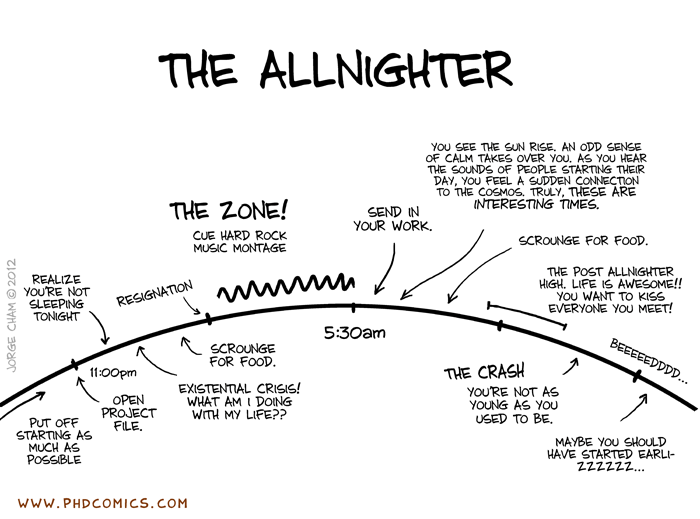
So, with a few minutes to spare, I submitted my PhD thesis within the three-year deadline. But, don’t worry, this isn’t going to be some smug blog on how I successfully managed to do this. No, the writing-up period was a total nightmare that involved 90-hour working weeks and then staying up all night to send the thesis off for binding at 4.30am on the day of submission. There has to be a better way.
"Piled Higher and Deeper" by Jorge Cham; www.phdcomics.com
These are my rules for successfully submitting on time, all of which, on reflection, are pretty-much common sense but yet, somehow, I (mostly) failed to do:

Go on a course to ‘how to manage large documents’ if your institution offers it. 
I’ve been using Word for years so was pretty blasé and thought I didn’t require this. But, a bit too late, I realised there was a lot of functionality that I had never used. With two days to go I had to learn how to create a Table of Contents automatically, as well as a Table of Tables and Figures, so that I didn’t have to manually update page numbering each time I moved text and tables. Really useful, but I should have done it far earlier.

Don’t leave the document-formatting until the last minute. 
It takes far longer than you think to do all this and I left it to the final fortnight. I had dozens of tables that I then interspersed within the text, some of which were landscape and thus required the insertion of section breaks and different, customised margins to the portrait text. Once the custom margins were inserted tables had to be re-sized to fit. Tables split over pages needed headings repeated. All of this is tedious and very, very time-consuming.

Don’t go on holiday shortly before your submission date. 
Save your holidays until post-submission. It’s really no fun trying to get a dodgy wi-fi connection as everyone else enjoys themselves, and thesis drafts do not make for relaxing poolside reading.

Don’t go to a conference 2 weeks before your submission date. 
I’d barely returned from holiday when I went off to SSM2013. I’d seriously thought of cancelling but luckily my presentation was written well in advance and actually the conference turned out to be really revitalising during a real low-point in my write-up. So maybe not such a bad thing to do after all if you can handle the stress…

Write the literature review and methods early on – in the first year if possible. 
At the beginning of the PhD it feels like you have plenty of time but you really don’t. So get on with the stuff you can do as soon as possible. Then it just requires some last minute tweaking and updating in the last few months. I did actually do this one!

Focus single-mindedly on the write-up. 
My husband lost his job shortly before the end of my write-up. I coped with this by ignoring it and ploughing on. Personal-life crises will inevitably happen and sometimes you just have to be ruthlessly single-minded and concentrate on getting finished. You can have the meltdown once you submit.

Know when to stop. 
I think the best piece of advice I received was being told that your thesis does not have to be perfect, it just has to be good enough to pass. If I’d had a few more weeks my thesis could definitely have been better but I also think there are diminishing returns here. The more time you have the more you revise and re-edit. If you’ve made the changes recommended by your supervisors and they say it’s fine then just STOP. (However, I haven’t had my viva yet so we’ll need to see how this one pans out…)


Ultimately I finished on time because I was given a non-negotiable deadline. If I didn’t submit on time I would lose the three month funding available to write-up papers. This was such a good opportunity that drifting on was not an option. I’d have preferred to have done it without putting in ridiculous hours, never seeing friends or family and doing nothing but working in the final weeks, but it’s done.
It is possible so good luck!


Tuesday, 25 June 2013

Research Career Pathways

Posted by Lynne Forrest

As I enter the final few months of my PhD, although I know I should be concentrating on writing up my thesis and getting it submitted on time, I have been somewhat distracted recently by thinking about what I’m going to do when it’s all over. It’s a difficult balancing act, finishing the piece of work that will allow you to move on to the next stage whilst simultaneously looking for that next opportunity, but I’m sure it’s one that most people working in research, at all levels, are familiar with.

I’m lucky in one respect in that I’m sure that I want to stay in academia. But it’s very disheartening to read endless articles about the surplus of PhD students and the bottlenecks that occur at each stage of the academic pathway. In fact, I think I’ve yet to read an article that promotes any positives of an academic career, although, as far as I can see, there are many. Perhaps because I’ve worked elsewhere I can definitely see that the grass isn’t greener. Yes, being a female academic with children is difficult but then so is being a professional female with children in any industry. The flexibility of academia can actually be a real advantage. The freedom of managing your own time and research and doing something you love shouldn’t be easily dismissed either.

The dreaded PhD surplus
I’m also lucky in that my PhD supervisors have been fabulously supportive and have found me funding that will allow me to analyse the cancer data that I didn’t have time to look at for my PhD and to write up any remaining papers from my thesis. It also looks hopeful that other funding will then become available to allow me to stay on at Newcastle and also write a Fellowship application so I can quickly move on from the temporary Research Associate (RA) route. And, unlike a lot of younger researchers who come straight in to a PhD after their undergrad degree, I have no illusions about how research and academia works. I don’t want to go down the endless RA-jobs route and although I’m not wholly convinced I have what it takes to be a ‘research leader’, I’m going to give it a go.

I know how things work as, in an irony that is not lost on me now, my previous job before my return-to-research mid-life crisis was as the Career Pathways Scheme Manager, a scheme that was being developed to help support researchers in their career management.

In this, a survey of RA attitudes to career development found that the majority of researchers did not want to become research leaders or academics, they just wanted to continue as RAs on a project, but without having to look for a new job every 3 years or so. The idea of the scheme was to develop a ‘third way’ so that the choice was not just between following the Fellowship-to-academic or RA paths but to offer a third option of becoming a Team Scientist, a specialist in their field, who was not an academic but held a permanent post. It was an admirable idea from Newcastle University but it didn’t take long to see the major flaw in the scheme as, apart from in a couple of cases, there was no funding for these posts.

I’m not sure what the answer to all this is. Without a system-wide change in the funding structure for research all the issues are going to remain. I fully understand why RAs who are constantly changing job and location become disillusioned and leave research. There’s undoubtedly a lot of stress and pressure. And yet, with optimism still intact, I’m prepared to give academia a go…

Thursday, 7 February 2013

The PhD ‘Journey’

Posted by Lynne Forrest

Now that I’m in the final year of my PhD (and possibly because I’ve been forced to watch too much bad Saturday evening television) I’ve been reflecting, in true X-factor-contestant style, over my PhD 'journey'. None of it has exactly turned out as planned…

Ryan's tearful journey
Looking back, the first year now seems fabulously self-indulgent. It mostly consisted of deciding on a research topic and then doing lots of reading, whilst eventually consolidating this reading into an early literature review. I also went on a couple of training courses and planned my ethics application and data analysis. This was a great opportunity to get immersed in the literature and I wished I enjoyed it more instead of being anxious to get some data and crack on with the analysis.

My project plan assumed I would get through ethics and obtain the cancer registry data I required, early in my second year. However, in case this didn’t happen, I had a back up plan. I would conduct a systematic review of inequalities in receipt of lung cancer treatment, to provide an evidence basis for my analysis and fill in a few months until the data arrived. In fact, as it turned out, I didn’t get all the data I required until my 3rd year.

So, in hindsight, my advice would be to assume that everything will take much longer than you originally think and to always have a contingency plan. And not to worry because sometimes the contingency plan actually works out to better than the original…

The systematic review turned out to be a far more major undertaking than I’d anticipated, in terms of scope, volume and time, but did ensure that I had some results in my second year, which meant I was able to submit abstracts for a couple of conferences. I was lucky enough to win a prize for best pre-doctoral abstract and the chance to present in a plenary session at SSM2012. From this, a professor in the audience contacted me to discuss my research and I’ve now been invited to speak at a clinical conference. So, although I still find conference presentations terrifying, I’m now convinced of the value of conferences as networking opportunities.

My supervisors encouraged me to write as I went along and I think this is excellent advice. I wrote up my systematic review as a paper and, although it was turned down by The Lancet (boo!), it was  accepted by PLoS Medicine, another high-ranking general medical journal. So, a piece of work I initially undertook as a fill-in exercise has somehow turned out fantastically well….

However, the pressure is now on to keep up the momentum. In my third year I need to complete the data analysis, write up, submit my thesis and get through the viva. I also need to start thinking about what I’m going to do when it’s all over. In eight months time my PhD funding will run out, and so I need to start planning ahead now. I want to stay in academia and so am thinking about a fellowship. Hopefully by the time I come to apply I will have more publications, as good, first-author publications do seem to be one of the major deciding factors for entry into academia. My plenary presentation, prize and PLoS paper should all look good on the CV. But nothing is certain, there are many others all fighting for the same prize and the fellowship process does seem to be something of a lottery.

So, anyone out there want to offer me a job?

Tuesday, 18 December 2012

Time management

Posted by Lynne Forrest

I constantly worry that I’m not spending enough time on my PhD. When I hear of other people who work weekends and do 60-hour weeks then I definitely feel that I’m not putting enough hours in. I struggle with fitting a full-time PhD around all my other life-commitments. And I worry that this makes me look like I’m not taking it seriously, when I definitely am.

I’m lucky enough to be a full-time, fully-funded PhD student and I’m totally in awe of those people who are fitting in a PhD around working. I really don’t know how they do it. It’s hard enough to find enough hours in the day without having to juggle a job as well.

I presume that if my supervisors thought I was skiving off, they'd have said something by now
Prior to the PhD I worked part-time whilst my children were little. So the switch to a full-time PhD commitment was initially a bit of a culture shock to everyone. I was no longer able to attend all the school plays, concerts and sports events I used to and my children did guilt-trip me with this. Once everyone had adjusted their expectations it became manageable.

When I started the PhD I decided to give up my gym membership as I couldn’t find the time to go. However, as I spend most of my working day sitting down analysing data I found that the weight was creeping on, so this was probably not the best idea. So I’ve decided I need to fit exercise back into my life – I’m just not quite sure how I’m going to manage this. I’m currently experimenting with going running and am in the early, enthused stage of taking up an exercise regime. So when this wears off it can give me something else to feel guilty about. When I’m exercising I can worry about not doing enough hours on the PhD and when I don’t get round to exercising I can feel bad about that too….

A couple of days a week I finish at 4pm to do the school pick-up and encounter the usual guilt as I furtively sneak off early out of the office. I do a further hour or so when I get home but this can be regularly interrupted and so isn’t ideal. I actually find working from home really difficult as it’s too easy to become distracted by all the domestic drudgery that needs done. I prefer to work in the office and, even though I have to factor in travel time, I’m definitely much more productive. To maximise work time I just eat a quick lunch at my desk and do sometimes feel I’m missing out on being more sociable, but I really can’t spare the time.

I am aware how lucky I am to be able to work this flexibly and I know how much more difficult it is outside academia. In one of my (many!) previous jobs I worked as a computer programmer for a large Scottish bank. All staff had to clock in and out and, although there was some flexibility, a core 7 hour day had to be worked. All time spent on a project also had to be logged weekly under different headings and I really hated having to account for every hour in this way. I love the flexibility of academia where, within reason, you can spend as long as you need on a task without your every action being scrutinised.

Anyway, I presume that if my supervisors thought that I was skiving off then they’d have said something by now. As it is, my PhD does seem to be going pretty well. As much as possible I’ve attended conferences, done external training courses that have meant staying away for days at a time and have also tried to get involved with other aspects of the Institute where I work. But I’m aware that other people are in earlier and work later. I just have to keep reminding myself that it’s quality not quantity that counts. And that I’d be worried if I didn’t have something to worry about…

Monday, 10 September 2012

Rules for the perfect supervisor

Posted by Lynne Forrest

We’ve previously had two blog posts explaining what makes a perfect research student. It was hard to disagree with any of it really, but, it’s a two-way relationship and in the interests of fairness, we students now get to respond and say what we require in the perfect supervisor.

Disclaimer: these traits are desirable in a generic ideal supervisor and any resemblance to any actual Fuse/IHS supervisor should not be implied. The views and experiences reported here reflect a consensus of opinion derived from the student body and are not necessarily mine (I’d really like a reference and a job at the end of my PhD…)

So, assuming that we’ve now all become the perfect research student, what can be done to further improve the research experience? Although comments ranged from ‘my supervisors are brilliant’ to ‘my supervisors constantly have me in tears!’ some common themes did emerge.

These are the things we think you should do to become the perfect supervisor:

1. Set ground rules at the first supervision meeting so that everyone knows what is expected of them.

2. Don’t spread yourself too thinly. Although having a ‘big name’ supervisor can be useful to students in terms of being able to utilise your experience, knowledge and connections, if you are always too busy to deal with us then this is somewhat negated. Possibly appoint a more junior colleague as the main supervisor.

3. Prepare for meetings and actually read the documents that the student sends you. If we follow the rules and send a document well in advance but you still don’t read it then this is a hugely frustrating issue. There is a power imbalance in the PhD/supervisor relationship that needs to be acknowledged, but not exploited. If we keep to our side of the agreement, then please can you do the same?

4. Be supportive, approachable and understanding.

5. Be constructive and remind the student that your comments shouldn’t be taken personally.
Criticism is fine as long as it is directed at the work rather than the person. A supervisory meeting is not an episode of ‘The Sweeney’ and you need never adopt the ‘bad cop’ role…(unless, of course, this has been agreed in 1.)

6. Promote a healthy work/life balance. 

Promote a healthy work/life balance

7. Forward any opportunities that you think might be relevant to the student. Please don’t just assume that we’ll know what is possible. For example, it was suggested that students should offer to supervise an undergraduate dissertation but I don’t think anyone knew that was even an option for PhDs. It’s hard to be proactive with things you know nothing about. Similarly with teaching opportunities.

8. Deal with each student as an individual. As one student eloquently put it ‘we’re like unique little snowflakes’! A one-size-fits-all approach just doesn’t work here. A mature student may need different handling to a younger one. However, on saying that you also need to…

9. Ensure equality of opportunities. Make sure that ALL students know what is available.

10. If you are not the main supervisor you still need to turn up for meetings occasionally. It’s very embarrassing when a student says hello to you in passing and you have no idea who they are. If you really aren’t interested in doing it then please hand the role to someone else.

11. Give lots of clear feedback. And if possible always try to end a supervisory meeting on a positive note. If your student constantly exits in tears then something has gone very wrong somewhere…

12. Sort out any supervisory disagreements outside the meeting. And don’t talk about other stuff over your student’s head. We only get an hour a month so let’s talk about us and our lovely project…

And I could go on and on….there was lots more! Do you agree? Please feel free to comment.

Thursday, 12 July 2012

From aged PhD to aged Intern

Posted by Lynne Forrest

I’ve previously blogged on why I’m doing a PhD in my forties and how I regard it as a career ‘second chance’, having not really quite got it together, career-wise, for the first 20 years of working life. As part of that spirit of positive thinking, when I started my PhD I decided I would embrace all the opportunities that came along. One of these was the chance to do a three month Internship, via my PhD funder the ESRC.

Now Internships don’t generally get a very good press, being pretty much regarded as a way for businesses to avoid paying someone a salary whilst offering ‘job experience’ that mostly consists of filing and making the tea.

However, I’d recently read that doing an internship was a good PhD career move. Also, as these were paid internships that were being offered by a range of high profile Government and charity organisations which required specific skills (of which tea-making wasn’t one), it seemed like a good idea. As a mature student, I didn’t need an internship to gain general work experience. I was looking for an opportunity to develop my skills base and gain experience in an area that wasn’t covered by my PhD.


The internship that I was interested in involved working in the Strategic Research Team at the Scottish Government conducting health research and translating the research into policy and practice. They were looking for someone with systematic reviewing experience, advanced quantitative skills and who had worked with large datasets, all of which applied to me. It seemed a perfect fit. And it was – they’ve offered it to me!

Although I’m very excited at this opportunity, the same age and status-related worries apply to doing an internship as to doing a PhD. However, for the most part, PhD students are treated similarly to staff in my department* and so I’m sure I will cope just as well as an aged Intern as I do being an aged PhD student. Unlike young interns I also have children, who are not best pleased that I will be away for 3 months. I’m hoping to negotiate flexible working hours and will be home every weekend, so I’m ignoring the emotional blackmail and guilt and am going anyway. It’s just too good an opportunity to turn down.

I think it’s going to be very interesting to be able to observe the reality of how the translation of evidence to policy actually works in a political environment and, indeed, to see how much policy is, in fact, evidence-based.

As well as the amazing career opportunity, the other positive for me is that I will be spending three months in Edinburgh, my home town. Having spent the past 15 years in Newcastle, I’ve latterly become terribly nostalgic for Scotland (getting all misty eyed over VisitScotland adverts and watching tartan and bagpipe-style programmes at New Year. I know. I need help). The reality of a few months in dreich Edinburgh over the winter may be just what I need to get over this.

Anyway, I’ll let you know how I get on….

*except that PhD students are required to ‘hot desk’. When I complained and got a proper desk it was on the understanding that I gave it up if someone ‘more important’ required it…

Monday, 28 May 2012

Routine Secondary Data

Posted by Lynne Forrest

We all know what a nightmare it is trying to recruit participants for research studies. So if you only have to get hold of some routine data that’s just sitting there, well, that’s going to be much simpler, isn’t it? You’d think....

The plan for my PhD was to look at inequalities in cancer care by linking cancer registry and Hospital Episode Statistics data for lung cancer, and also linking to audit data. This is routine data that has already been collected and so I naively assumed it was just a case of getting ethical approval to access the data, finding someone to cobble the data together and off we go. I wrote an optimistic project timetable where I would get my hands on the data about seven months into the PhD. Eighteen months in I’ve finally got hold of some unlinked data and I’m still waiting for the rest.

I don't work for News International, so what's the problem? Photo: Christian Sinibaldi
So, what went wrong?

I think my first mistake was assuming that just because the data was there it would be easy to get hold of. There are a lot of hoops you have to jump through first.

I thought that what I wanted to do was simple but it turns out that it’s not. This is apparently the most complicated linkage that the cancer registry has undertaken and the bottom line was, nobody wanted to do it. I spend a lot of time begging people to speak to me and basically being fobbed off, in the nicest possible way. Luckily I eventually found a newly-joined analyst who was willing to give it a go. I’m not sure that she’s thanking me now...

Issues then arose of whether the data I wanted might be identifiable. Variables such as date of birth and death are classed as identifiable and individual records are ‘potentially-identifiable’, even if they don’t include identifiable information (which is an excellent catch 22 – they are identifiable even though they are not identifiable...)!

Finally it seemed like it was all coming together. I’d agreed with the registry that they would supply me with anonymised data containing ages rather than dates, I’d made it through ethics, and I’d got some data. But, on checking, not exactly the data I wanted. So, currently I am discussing with the registry how it will be possible for me to calculate survival time if they won’t allow me to have data on the number of days from diagnosis to death. Survival from lung cancer is short and rounding to the nearest year isn’t going to identify survival differences with any degree of accuracy.

The sticking point is that although they are not supplying me with date of death I could theoretically work it out from this information and that makes the data (aaagh!) ‘identifiable’. However, as I don’t have an NHS number, date of birth, or place of death, I don’t know how I would identify anyone from the 140,000 records I have. Plus I’m a researcher, not a News International journalist, and I’m not interested in anyone individually, so I’m not going to attempt to do this.

Can’t I just sign something to that effect and have the data I need please?

Thursday, 5 April 2012

It's probably your mum's fault

Posted by Lynne Forrest 

I’ve just written a paper that I would like to get published in a high profile journal. Now I need to draft the cover letter explaining why they should publish. The rejection rate is high so I need to emphasise how brilliant and relevant my research is and the important implications my findings have for policy and practice.

The temptation is to exaggerate a bit. And it sometimes appears that the research with the most outlandish claims gets the most attention.

I have a general interest in epidemiology and health inequalities . Interesting new studies are flagged up every day on my twitter feed and in the mainstream media. I often read from a professional perspective, but it's hard not to also read these articles as me - wife, mother, Lynne. Although the usual culprits of alcohol, obesity and smoking all feature as things we should avoid if we want to live a long and healthy life, there appears to be a new risk factor in town. If you believe recent research then it seems that almost everything, from stupidity to earning potential, can be blamed on your mum.

Philip Larkin: This be the verse

Last week the Observer reported a study claiming that feeding babies on demand increases a child’s IQ. The implication is that if you were a regimented mother you may have reduced your child’s intellectual potential.

Yesterday I read that happy children are likely to earn more in the future, with a throwaway line at the end of the article suggesting how important it was that parents create an ‘emotionally healthy home environment’. 

However, my favourite finding from last week was non-mum-related. It was the study which concluded that eating chocolate makes you slim.

As someone who knows a bit about it, I am bamboozled by the endless amounts of contradictory research and advice that are presented in the media. So, I imagine that most other people are too. Although these are often epidemiological studies that examine trends at a population-level, it seems easy for everyone to forget this and to interpret the findings at an individual level. Just because people who eat more chocolate, overall, tend to be a little slimmer, doesn't mean that that bar of Dairy Milk I just scoffed is going to make me drop a jean size tomorrow. For me the result is an awful lot of parental guilt. And I should know better.

Perhaps some of the wilder conclusions have more to do with press releases and journalists then what the researchers themselves actually concluded. But still, shouldn't researchers have to take some responsibility for their work?

So now I am thinking that I need to be a bit more careful about overplaying the implications of my research. However much I want to ‘sell’ my paper to that high profile journal. 

From a mum’s point of view, it’s probably best to just accept that everything is my fault. At least I can eat as much chocolate as I like (that study is true, isn’t it?)

Thursday, 15 March 2012

Network or perish

Posted by Lynne Forrest

If you want to get on in academia you have to get published. That’s ok, I don’t have a problem with that. But there aren’t that many jobs available post-PhD and lots of people chasing them. So that means, as well as writing papers for journals, you’ve got to get out there and sell yourself - which translates as going to conferences and giving presentations. Even worse, you have to go to conference dinners and ‘network’. Just the thought of it is makes my heart sink. 

Networking
When I was growing up, ‘showing off’ was a bad thing so having to stand up and talk about how fabulous your research is, is a real trial. Plus I’m pale and Scottish so I go bright red. For those of us who’d really rather just sit at our desks and play with our data, this whole self-publicity thing is not fun. But I guess it is a necessary evil. You could be doing a brilliant job but if nobody knows about it then what’s the point?

I’m giving a presentation next week. Luckily it’s just an internal one but I’m stressing about it already. I’ve been on the training though. I know what I should be doing to give an effective presentation. But, by the time I’ve remembered to talk slowly and not look at my slides or stare fixedly at one person, I’ve forgotten what it was I was planning to say. Plus I’m presenting the results from my systematic review – I have a lot of data. There’s a danger of boring everyone to death with data overload. That’s a lot of things to stress about.

On the plus side, I am sharing the presentation slot with someone else. Is it wrong to hope that she’ll be rubbish to make me look better?

Actually it probably doesn’t really matter if it doesn’t go well as it’s just to give me some practice for the real thing. I’ve got a few conferences I need to attend this year. So I’ve drafted a couple of abstracts and submitted them. I’ve ticked the ‘poster or oral presentation’ box (because my supervisors made me) but you know that, really, I’m hoping it’ll be ‘poster’.

Friday, 9 March 2012

A PhD is hard work, or why I feel the need to justify doing a PhD

Posted by Lynne Forrest

I’ve tried telling people that doing a PhD is just like doing a job, just with slightly more flexible working patterns, but no-one seems to believe me. Honestly, doing a PhD is hard work.

As part of my PhD I’ve been able to go on training courses in quantitative methods, undertaken a systematic review and meta-analysis and published my first paper. All of which should be very useful for a future academic career. However, I get the impression that most people don’t really understand what a PhD actually involves and think that going back to university for another three years is a bit self-indulgent and, quite frankly, a major skive.
PhD = major skive
Luckily I have a supportive husband with a science background who understands what a PhD entails. Not everybody does. My parents wonder when I might actually get a proper job ("we were very proud of Lynne when she got accepted for university in 1986; we just didn’t realise she’d spend the rest of her life as a student”). Honestly mum, I worked for 15 years. This is a career move, really it is. And soon you’ll be able to tell everybody I’m a doctor.

Other people enquire how my ‘course’ is going and seem to think I spend my time attending a couple of lectures and having extended summer holidays. I’ve given up trying to explain that I do research, it’s full-time and I just get standard holidays.  It's a bit like a PROPER JOB, just with low pay and writing up an 80,000 word thesis at the end of it.

Ok, there are some perks. I get 25% off my council tax and student discount in New Look. The latter is not much good to me but excellent news for my daughter. As Jean has said, you get to wear jeans to work (and I know this shouldn’t be a reason to do a PhD but I did put it in my ‘pro’ column when weighing things up). If my supervisor thinks it’s ok to admit to this then I guess I can too. Getting to put ‘Dr’ rather than ‘Mrs’ when you fill in forms was on the list too, I’m afraid.

So, honestly, I’m not just farting about for three years. I work hard and I like to think that my research, even in a really small way, is actually important. I just hope that someone, somewhere gives me a ‘proper’ job at the end of it.

Thursday, 8 March 2012

Mid-life crisis or late-developer?

Posted by Lynne Forrest

So why would anyone decide to go back to university to do a PhD nearly 20 years after their first degree? I was going to put it down to a mid life crisis but maybe I’m just a late developer, career-wise.

Although I’d managed to sort out most of the things you’re supposed to do on the conventional route to mature adulthood (degree, marriage, kids, mortgage) somewhere along the way I’d forgotten to get myself a ‘proper’ career.

My pre-PhD CV could be described as eclectic (if you were being kind). Although I’d done loads of different things that were pretty interesting in themselves (lab-based researcher, computer programmer, Brain Bank Manager*, amongst others) they didn’t really join together to make a coherent career path. Taking a few years off when I had kids and then working part-time did nothing to help.

Fozen brain slice
So as I approached 40 (I told you it was a mid-life crisis), with children now in school, I decided it was time to sort out my career. As we’re all probably going to be working until we’re at least 70, I didn’t think it was too late, although my chances of ever making it to professor are probably slim.

Having systematically thought about what parts of my previous jobs I’d enjoyed - the health related aspects, data analysis (I know, I’m a sad geek, but I love that sort of stuff), constant variety (I think it’s fairly obvious I get bored easily) - a health-based research career began to make lots of sense.  Just so long as I never had to work in a lab again.

To pick up the necessary statistics and epidemiology skills I needed, I funded myself through an MSc in Public Health and Health Services Research. Which I hope makes me look serious about all this. I had planned to get a research job after my MSc but began to realise that, really, you need a PhD if you want an academic career. It’s very difficult to get your foot in the door without one and so a further 3 years as a ‘mature’ student were required.

I do have occasional qualms about doing the PhD. Will I ever earn a decent salary again? Will my age be a problem when I’m looking for a research job? I’m hoping that my previous work experience as well as my research training is a plus for future employment. But generally I’m really grateful to my supervisors for taking a chance on me. There’s quite a few of us ‘old’ PhDs in IHS so I presume they know how grateful, and therefore motivated, we are. In fact, I think we’re becoming a bit of a demographic trend. It might have taken us a bit longer to get here career-wise, but better late than never.

*Yep, that’s exactly what it sounds like. I looked after a bank which stores slices of frozen human brain used in dementia research