Showing posts with label time management. Show all posts

Friday, 26 April 2019

Could collective community power direct future public health research?

Guest post by Liam Spencer, Research Assistant, Institute of Health & Society, Newcastle University

The Tyne & Wear Citizens are a local division of Citizens UK, a community organising group, which comprises of schools, universities, faith groups and charities. The group launched a ‘Commission on Mental Health’, which aimed to map problems, and identify solutions around mental health services in the region. In early 2018, The Tyne & Wear Citizens approached AskFuse [Ed – Fuse’s responsive research and evaluation service] in order to identify researchers to contribute to the analysis and production of their final report, ‘Living Well: Mental Health and Public Life in the North East’.

Through Professor Eileen Kaner (Newcastle University/Fuse), I had previously been involved in another AskFuse-supported project called ‘PROMOTE:NE’, which looked at young people’s mental health across the North East, and we met with Dr Peter van der Graaf and Lesley Haley from AskFuse to discuss this piece of work. Following this, I met with Revd Dr Simon Mason and Dr Joe Barton from the Tyne & Wear Citizens, and they were very happy to have me working with them, with supervisory support from Eileen.

The Commission had collected over 300 individual written ‘testimonies’ from people across the region, who articulated what was good, and what was not so good about mental health services in the region. It was these testimonies, which formed the basis of the Living Well report, and helped shape what the Citizens were asking local politicians and organisations to commit to. Prior to being involved in this piece of work, I had no understanding of what community organising was, and initially it was a challenge to grasp the concept of what the Commission were aiming to achieve, and how I could best contribute to this. In order to gain a better insight, I attended one of the Mental Health Commission Public Hearings in Durham, where key themes were discussed in front of a public audience, and a meeting of the Mental Health Action Team, where the group refined the ‘asks’ of the report.

Due to my interest in mental health, and experience in this area of research, I wrote the ‘Context’ section of the report, which aimed to set the tone, and provide the audience with relevant information about mental health in the region, and further afield. I was also able to provide relevant literature for, and make comments on the themed sections of the report, which were written by the editor.

Coming from a qualitative research background, it was interesting to learn about the methodologies employed by the Citizens for this piece of work. Community organising is a process where people who live locally come together into an organisation that acts in their shared self-interests. This method was used in order to best capture the voices of those who may not engage with traditional methods of research. This was one of the most fascinating insights I gained from the process, and I believe this method of collective power from the community, could be utilised in directing future public health research, and that groups such as these may well be a starting point for meaningful patient and public involvement work. 

The Citizens had a small pot of money to support our involvement, and seven working days were costed for me to undertake the work. The biggest challenge I faced was the tight timescale. I was working full-time across other projects, and was in the process of writing my MSc dissertation, so the work had to fit around these existing commitments, which meant working outside of normal work hours.

The final report was launched in November 2018, at an event attended by over 500 people at Newcastle’s Civic Centre. Eileen and I were delighted to attend and speak at the event, and it was fantastic to see so many individuals interested in finding out about the work. Although the timescale was tight, I thoroughly enjoyed the opportunity to be involved in this important and innovative piece of work. I had a great working relationship with Simon and Joe, and was well supported by Eileen and Lesley. 

I am passionate about mental health research, and I am proud to have played a part in the production of a report, which aims to improve the lives of those in my home region.

Find out more about the work on the Citizens UK website.

Tuesday, 3 March 2015

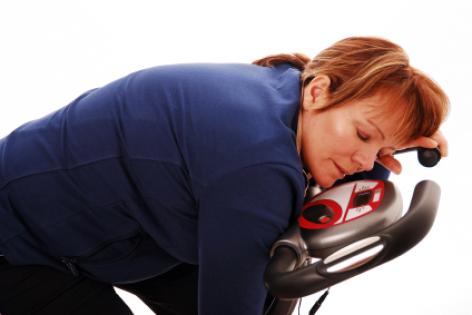
No time to run: is role overload contributing to physical inactivity in parents?

Posted by Caroline Dodd-Reynolds

Last night during a Twitter exchange, it somehow came about that I would write a #fuseblog on barriers to physical activity and a healthy diet in working mums. Interestingly, my one-year-old daughter had just gone nicely to bed at this point and so my husband and I treated ourselves to a healthy(ish) home-cooked dinner, albeit at 9pm. Normal service was resumed however at 12.30am when we were woken by the sound of the one-year-old vigorously banging on her cot and shouting, ‘Is DARK!’ (yes, it’s the middle of the night). So here I am typing this blog with two hours of sleep under my belt. Primarily this is why I no longer do very much exercise-based physical activity, or indeed eat as healthily as I used to. I am sure there are many who can relate to this sleep-deprived existence. Certainly the transition to parenthood can be an experience of life-changing proportion. For me, the transition back to work after months of no sleep and complete displacement from my previous identity was interesting.


There is guilt at leaving my little one at nursery and then there is the race through the day so that I can leave early enough for us to have an hour of (potentially active) play before bedtime. There is guilt at not being able to attend the evening functions at work, the interesting lectures that I know would be pure luxury to immerse myself in. There is pressure to succeed at work, not so much to prove that I can be both a parent and an academic, but more that if I don’t, then there is little point in having endured the guilt. And what of physical activity? Well, please see my previous points as to why this takes a seat so far back that I can barely see it.

The Chief Medical officers recommend 2hr 30min moderate-vigorous physical activity (MVPA) per week for adults; an individual is classed as inactive if achieving less than 30min moderate physical activity per week. Time spent engaged in MVPA declines with age and in 2012, 67% of men and 55% of women aged 16 years and over were meeting recommendations. These data were self-reported and objective monitoring methods suggest these figures are inflated. Guidelines for reducing sedentary behaviour are less clear but should involve avoiding prolonged periods of sitting. I am a full-time Lecturer in Physical Activity and Nutrition and so the irony of spending hours (sitting) writing lectures on the perils of sedentary behaviour and energy-dense snacks, is not lost on me. I did a quick PubMed search including physical activity and working mums as key terms and found a lonely but slightly reassuring 10 articles.

One article describes succinctly and astutely the fact that much is known about motherhood as a transitional influence on the physical activity habits of new parents, but actually very little about those new parents (or indeed any parents) who work. Emily Mailey and her colleagues, from the Dept of Kinesiology at Kansas State University, talk about ‘role overload’ and how this is associated with negative health outcomes such as elevated stress, depression and anxiety. I am starting to feel better here. The 25 mothers and fathers who participated in focus groups for this study reported barriers such as ‘scheduling constraints’ which I think many working parents may identify with – for me it is the Outlook calendar that keeps me on track and I know that if I schedule 30min into it on a Tuesday, I do have time to nip out for a run and I am more productive for it. But then what if someone requests a meeting or tutorial? Interestingly, ‘prioritising’ is noted as a facilitator. One mother comments that she had to get up at 5am to fit her physical activity into her day. Indeed this is a thought that often crosses my mind. Another, is that working parents may well comprise a special population in terms of physical (in)activity habits and sedentary behaviour; when I was on maternity leave I was certainly more active than I am now.

Anyway, I’m writing this on a Friday (thank goodness for the weekend). I really must clean the bathroom tomorrow, and the car needs a good wash, these will get my activity counts up, great. Oh but then there is that paper I need to write, and next week’s lecture I have yet to prepare. I know realistically what I will be doing this weekend – and it may not comprise any minutes of MVPA, nor help my preparation for next week at work, but I know it is the finest choice and that my little girl will laugh out loud with delight when she sees the animals on the farm.

Feeling slightly more awake after some strong coffee, I have just read this blog back and am sad that it sounds rather negative. It isn’t meant to, but it has made me think a little more about how I spend my days (and the potential to ask for a standing desk at work). And in case you were wondering, I would not swap my little girl for any amount of physical activity. Mailey and co. talk about being a role model and being active with your children. In a good week with no illness, sleepless nights or marking, we probably do manage to achieve this to an extent. And my little girl is happy, active and eats a healthy but balanced diet (vegetables and chocolate included) so perhaps we are doing things right after all?

Thursday, 6 November 2014

52 weeks in public health research, part 44

A day in the working life of Amelia Lake


Today has been about cars and traffic. Moving from one bit of the North East to another - all in the name of Fuse! Truly wish I'd been on a train - then I'd get work done...


Refuelled at Durham University and time to head to the Wolfson Research Institute for meetings with the rather fabulous Fuse energy drink team...


It's meeting 3 in a three location day hampered by horrendous traffic. I'm feeling weary but I'm energised talking about our Fuse energy drink research...


Big word of the week - courtesy of my colleague Stephen Crossley (@akindoftrouble).

------------------
A reminder from the Fuse blog group:

Each Thursday of 2014 we’ll try and post around four pictures on the Fuse blog that capture our weeks in public health research, from the awe-inspiring to the everyday and mundane. Given that more of the latter than the former exists in most of our lives, we foresee problems compiling 208 images worth posting on our own. So this is going to have to be a group project. Send an image (or images) with a sentence or two describing what aspect of your week in public health research they sum up and we’ll post them as soon as we can. You don’t have to send four together – we can mix and match images from different people in the same week.

Normal rules apply: images you made yourself are best; if you use someone else’s image please check you’re allowed to first; if anyone’s identifiable in an image, make sure they’re happy for it to be posted; nothing rude; nothing that breaks research confidentiality etc.

Email your posts to m.welford@tees.ac.uk or contact any member of the Fuse blog group.

Tuesday, 18 February 2014

Protected time

Posted by Jean Adams
When I was medical student, lunchtime training events were held in most hospitals I passed through. The presence of a free lunch made these high priorities for student attendance. However, I think there was only one hospital that put such a high priority on staff attendance that the time was protected – as signalled by a bleep collection at the door. The sessions were specifically for newly qualified doctors in their first year of practice. Staff deposited their bleeps in a basket outside the training room. If any went off during the session, a secretary would respond saying when the session was due to finish and asking that urgent issues were referred elsewhere. At other hospitals, training was something you went to if you had the time and left early if something more urgent occurred on the ward.

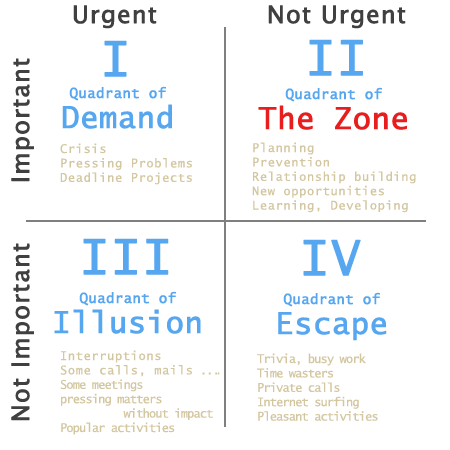
When you go to time management training, they always tell you about the important vs urgent matrix. Some things are important but not urgent, others are urgent but not important etc. The idea is that you identify the not important or urgent tasks and get rid of them. Then you allocate your time to the three other groups of tasks ensuring that the important gets done and you don’t end up focusing solely on the urgent. 

Surely there must be some 'pleasant activities' in The Zone?
Emergencies hardly ever happen in research. Which, for me, is part of the attraction. Lots of important deadlines exist – grant applications, conference submissions. But fair warning is generally given, meaning that it is theoretically possible to stop these becoming too urgent. Many, many other things that need attention crop up all the time. Quite often I find these are of the urgent and certainly important to someone else, but not massively important to me variety.

My – not entirely effective – approach to this is to routinely work at home on a Friday. The idea is that this provides me with one full day per week to focus on extended important but not urgent tasks that matter to me – writing papers, reading and commenting on large documents, catching up with the literature. The reality is that I mostly spend Fridays catching up on urgent and some-what important tasks that have accumulated through the week - nudging my me-tasks to next Friday at the earliest.

Sometimes, when my to-do list gets overwhelming (which is admittedly more often than not), I protect other time too. I schedule in a few hours to do a peer review for a journal, half a day to prepare teaching, 30 minutes to make a phone call that absolutely must happen. At the very least this makes me feel slightly calmer that there is definitely time available to do everything. It might also make me slightly more efficient by reducing the number of times I get to my desk with a few free hours ahead of me and have to work out which of the tasks on my list to do next.

But, like making the most of Fridays, the problem with protected time is the self-discipline required to actually do the scheduled task at the scheduled time, and not get distracted by apparently more urgent things. I find this is massively facilitated by having a secretary deal with meeting arrangements and I know that I am exceptionally lucky to have the luxury of even part-time secretarial support. Every time someone asks me directly for some of my protected time I feel I have to weigh up the pros and cons, wonder if their thing is more important than my scheduled thing, make a decision about when the scheduled thing is going to be re-scheduled, feel bad if I ‘choose’ to say no. A secretary, on the other hand, is slightly more remote. Obviously they want to be helpful and will try and fit people in as soon as they can. But they genuinely seem to be consummate experts in just saying no – without explanation or guilt.

This leads me to those pesky people who have worked out that if they ask me, instead of the secretary, they’re more likely to get a yes than a no.

What are your time management solutions?