Showing posts with label LGOffe. Show all posts

Friday, 3 February 2023

Welcome to your Wrapped, Fuse Open Science Blog

Posted by Mark Welford, Fuse Communications Manager, Teesside University

If you use Spotify (other streaming platforms are available) then you will no doubt have received your own personalised ‘Wrapped 2022’. A helpful (if somewhat creepy!) summary of your annual listening habits in one eye-searing psychedelically coloured package. Apparently, my most listened to song in 2022 was Baby Shark - I have a 3 year old.

Around this time of year I do a similar (if slightly less garish) job of pulling together the top 5 Fuse blog posts from the previous year.

But this year is a little different.

It’s award season and this year the blogs listed below were in the running for a coveted gong. Not at the GRAMMYs, Oscars, Emmys, BAFTAs, or BRITs but the (much more prestigious) first ever Fuse Awards!

Earlier this week (30 January), the post with the most views was crowned best blog of 2022 with the author awarded a shiny trophy at our ceremony in Durham *link may contain SPOILERS*.

So without further ado, here is the full list of the runners and writers in reverse order, culminating with the post that received the most views...


Posted by Tim Townshend, Professor of Urban Design for Health, Newcastle University


“...primarily designing around the needs of the private car - rather than humans - has been a disaster.”

Prof Townshend explores how we can plan for a healthier future by intervening in the built environment. From the 'toxic high street', to the green (and blue) spaces in our cities that encourage physical activity and social interaction, positive for physical health and mental wellbeing.

Posted: 13 May 2022


4. Science, and the art of communication


Posted by Louis Goffe, Research Associate, NIHR Policy Research Unit in Behavioural Science

"...building the evidence-base isn’t enough, we all need to work on at least one aspect of the artistic craft of research promotion."

COVID19 has brought into sharp focus that health promotion takes more than good science, there is an art to the delivery. In this post, Louis explores vaccine misinformation, the infodemic, involving the public and advocacy.

Posted: 28 January 2022


3. What support do children and young people actually want when their parents use drugs and alcohol?

Posted by Cassey Muir, Fuse & NIHR School for Public health Research (SPHR) funded PhD Researcher from Newcastle University and Kira Terry, Lived Experience Expert.

“No-one has ever asked me about how I feel in any of this.”

Fuse PhD student Cassey shares her research aiming to understand the experiences, perceived impacts and coping strategies of young people whose parents use substances. The post ends with Kira’s thoughts about contributing to the project as a Lived Experience Research Advisor.

Posted: 9 December 2022


2. Is a picture truly worth a thousand words?


Posted by Emma Adams, NIHR ARC NENC Mental Health Fellow at Newcastle University, and Experts by Experience from Fulfilling Lives Newcastle Gateshead & #HealthNow Newcastle

Find out how Emma and her Experts by Experience worked together to develop striking visuals to share what they had learned from a study exploring access to community based mental health and substance use support during the COVID-19 pandemic for individuals experiencing homelessness and those providing support.

Posted: 25 March 2022


And in at number one our award winner...


1. Universal Credit experiences and research co-production

Posted by David Black, Fuse Public Partner and Expert by Experience. Introduction by Mandy Cheetham, Research Fellow in the Applied Research Collaboration North East and North Cumbria (ARC NENC), Northumbria University

“In the past I'd always found the process of seeking
 help from the unemployment benefit system to be
 relatively easy, but Universal Credit was a disaster
 for me.”

Ever wondered how you could help shape research as a member of the public? In this Fuse blog, David shares his personal experiences of claiming benefits and how this has informed research to assess the impact of Universal Credit.

Posted: 11 March 2022


Below is a photo of David (second from the right) along with the other Fuse Award winners. Congratulations to all! 
 

Catch up with all the award winners using #FuseAwards23 or see the event programme on the Fuse website for all those shortlisted.

Join Fuse to be in with a shout of winning a coveted Fuse Award in 2024!

Friday, 28 January 2022

Science, and the art of communication

Posted by Louis Goffe, Research Associate, NIHR Policy Research Unit in Behavioural Science

Brian Deer - Copyright cleared
“He’d found no cure for Crohn’s, or remedy for autism, no vaccine, no nothing in medicine. But now he was a man delivering fear, guilt, and disease to everywhere with an internet connection.”
Brian Deer, The Doctor Who Fooled the World


It wasn’t a scientist, not a medical doctor, nor an esteemed health institution, but Brian Deer, an investigative journalist, who researched, compiled, and detailed to the world ‘The fraud behind the MMR scare’. While the adjective to his profession alludes an expectation to the discovery of truth, it’s his journalistic craft that effectively communicates with passion and clarity how the now struck off doc and his associates formulated the non-existent relationship between MMR and autism.

Health promotion takes more than good science, there is
 an art to the delivery.  Photo by Jon Tyson on Unsplash

Deer lays out the complete narrative in his book The Doctor Who Fooled the World. It’s as gripping as your favourite thriller, though with the added heart-sinking poignancy that it is not a work of fiction. While I was keen to write a book review, others do this better, I considered what’s the take-home for those of us in translational research in public health.

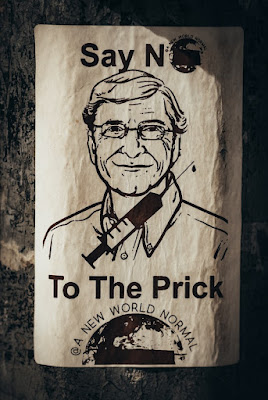
I’m a researcher for the NIHR funded Policy Research Unit in Behavioural Science, where we ‘use behavioural science evidence, theory and methods to support decision-making’. Our approach is rigorous and grounded in scientific theory. However, the pandemic has brought into sharp focus that health promotion takes more than good science, there is an art to the delivery. I mean, how else have the sceptics convinced so many that wearing a face covering could be detrimental to health?

Prior to the Medicines and Healthcare products Regulatory Agency approval of the first COVID-19 vaccines, research institutions, health, and Government bodies had been virtually silent on the development process. Some were also critical of how the initial results were released to the world. This reservation to engage with a non-academic audience is partially understandable, we deal in uncertainty and it’s much more than simply crossing the i's and dotting the t's. No researcher worth their h-index wants to put something out into the world that they can’t back-up empirically. The sad fact is though, if we’re not on the front foot keeping the public informed of the vaccine trial process and approval milestones, then there’s a flock of 'quacks' more than happy to work their grift.

To their credit, they work with the religious zeal of a missionary, flooding every corner of the internet knowing our vulnerability to the illusory truth effect. While promotion is focused on social media, their word is also preached in podcasts and proliferated through e-commerce. Take a look at Amazon. Their charitable programme AmazonSmile has reportedly donated thousand of dollars to a vaccine misinformation soil pipe, and high ranking books on “vaccines” include: ‘Anyone who tells you vaccines are safe and effective is lying’, ‘The COVID vaccine: and the silencing of our doctors and scientists’, and ‘Vaccine-nation: poisoning the population, one shot at a time’. There is also the subtly titled: ‘******’s review of critical vaccine studies’, that gives the allusion of a systematic review (though don’t expect it to be listed in the Cochrane Library) but shares a publisher with the essential intergalactic phrasebook ‘Ambassador between worlds’ that provides answers to: What do extraterrestrials think about our religious beliefs, sexual attitudes, and goals in life? But most depressing of all, prominence is given to the book authored by the struck off doc, the man at the centre of Deer’s investigation.

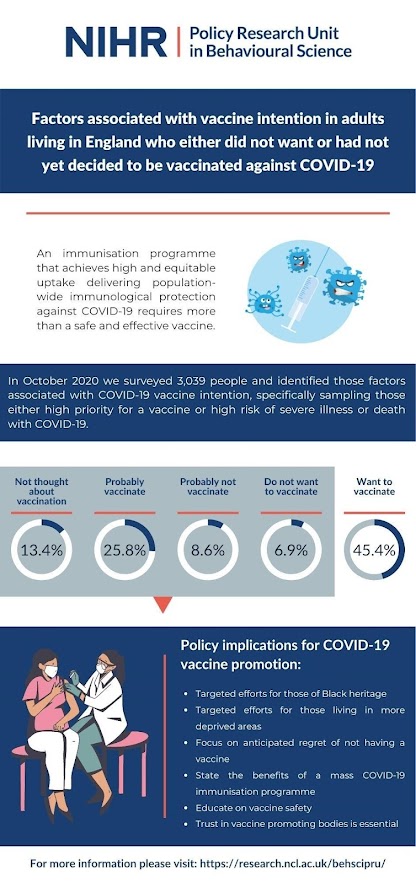
Before the first COVID-19 shots were available, to understand vaccine attitudes my Unit delivered a survey using belief-based statements in adults living in England who did not want, were yet to consider, or were not sure whether to vaccinate against COVID-19. This included their agreement to some of the more 'out-there' theories, including our own fictionalised theory that “Mass coronavirus vaccination is a ploy by environmental lobbyists to sterilise billions of people to reduce population growth”, to which 117 (7%) of respondents agreed to. While my literary intention here is to shock, I suspect that the pandemic has made you immune to such statistics. The problem is that once such views have taken root the typical counter arguments using facts are insufficient, and potentially detrimental in combating misinformation.

The vaccine rollout has been the biggest, most ambitious immunisation programme ever in the UK. It’s a historic achievement by the NHS, ably supported by the Vaccine Taskforce. But as we now reflect, it’s my view that if the Government, healthcare providers and research institutions had provided a cohesive, timely, and responsive informative service that detailed and provided a status update on vaccine development, this would have gone a long way to allay many people's rightful concerns. Sadly this reticence to comment continues as speculation increases over approval of jabs for younger children.

The public has shown an enthusiasm to learn a wealth of terminology during the course of the pandemic. My Unit’s work on the comprehension of antibody testing has shown that this isn’t easy, but it’s something that we shouldn’t shy away from. Patient and public involvement in research is vital to ensure that our lay outputs are fit for purpose and we should all consider how we can be better at science translation. Speaking on camera or on live radio is incredibly nerve-racking and not for all, but as I recently discovered following a two-hour training course, you don’t need a degree in design to produce a half decent infographic.

While I am advocating for your individual action, we also need to consider what systems, for example the new UK Health Security Agency, could put in place to fulfil the role that was missing during the pandemic. Most pressingly on our horizon is the delayed childhood vaccine strategy. The struck-off doc will be feeling emboldened. He understands and has mastered the artistic skill of communication, delivering his message with the gentle assured cadence of a BBC continuity announcer. In the absence of substantiated evidence, he expertly sows doubt and fear to the masses, and as the infodemic has shown, he is not alone. This is a huge challenge for us in public health research and the online vitriol is scary. But building the evidence-base isn’t enough, we all need to work on at least one aspect of the artistic craft of research promotion. Because if it’s not you, you can be assured that someone else most certainly is.


The views and opinions expressed by the author are those of the author and do not necessarily reflect those of the Policy Research Unit in Behavioural Science, the NIHR, the Department of Health and Social Care, Newcastle University or Fuse, the Centre for Translational Research in Public Health.

The Policy Research Unit is funded by the National Institute for Health Research (NIHR) [Policy Research Programme (Policy Research Unit in Behavioural Science PR-PRU1217-20501)]. The views expressed are those of the author(s) and not necessarily those of the NIHR or the Department of Health and Social Care.


Images: 

1) Lourenço Veado, CC BY-SA 4.0, via Wikimedia Commons
2) Photo by Jon Tyson on Unsplash

Friday, 15 March 2019

Have you haddock enough?

Posted by Louis Goffe, Research Associate, Newcastle University

That smell. That distinctive saline scent. Your subconscious has your saliva glands brimming before you’re cognisant of what you desire.


Fish & chips is arguably our most iconic contribution to the culinary arts. This most harmonious pairing of Jewish-style fried fish with chipped potatoes, first engaged in the 1860s and have been besotted with each other ever since. At their peak during the inter-war years, there was an estimated 35,000 shops around the country, while in today’s diverse and competitive fast-food market, there remains around 10,500 chippies.
Fish & chips Edwardian style

The interrelating factors that derive our weight are as unique as our fingerprint and untangling and finding solutions is a global challenge. There is no single determinant and competition for a slice of the obesity research funding pie, is as cutthroat as the local high street takeaway shop cluster.

Takeaways are not the prime suspect in unlocking the door to good health, but it’s clear that they do play a role. As such, we need to scope what aspects can change to help provide customers and communities with healthier options.

When it comes to food, there is no universally accepted metric for ‘health’. The term is open to interpretation and keenly fought over, see the fat Vs carbs debate. However, such considerations are rendered obsolete when considering the nutritional profile of independent takeaway food, where meals were found to be “excessive for portion size, energy, macronutrients and salt”. It is the sheer volume of food provided that is the intimidating/wondrous [delete as personally appropriate] factor.

Pizzas are the chart toppers when it comes to portion size, delivering a medium value over 1,800 calories, though fish & chips are not far behind on an excess of 1,600 calories. This is a hefty dollop of energy, given that an adult women is advised to consume 2,000 calories per day. Of course, just because a portion contains this amount of food, it doesn’t mean that one will consume it all. But the evidence is clear “people consistently consume more food and drink when offered larger-sized portions, packages or tableware than when offered smaller-sized versions”.

It was not our assertion that any particular cuisine type is to blame, but to find potential solutions to what has likely been an arms race by traders in response to their most vocal customers to provide the most calorific-kick per quid, as highlighted in this quote from a Scottish fast-food trader.
“They just want chips… they'll have a look and then go along have a look at their deals and then come back and they'll order… they like the value for money. The competition here is unbelievable.”
In our NIHR School of Public Health Research funded study based at Fuse in collaboration with The Centre for Diet and Activity Research at the University of Cambridge, we wanted to challenge the notion that quantity rules above all, to see if traders and their customers were accepting of promotion of smaller meals.

Louis throwing himself into the research
Fish & chips offered the ideal starting template. Their taste is as beholden to us, as espresso is to the Italians, therefore reformulation has limited potential. Despite their volume, they’re presented as a one-person meal, with smaller sizes mainly limited to children, pensioners or as lunchtime specials.

Engaging with traders is a huge challenge. Therefore, we asked Henry Colbeck Limited, an independent specialist fish & chip shops wholesaler, to give the project that foot-in-the-door via a trusted voice. We co-designed the intervention, but crucially, they led on delivery and we retained our independence as a research team for analysis and interpretation of the evaluation data.

We were operating in an intervention landscape reliant on traders’ voluntary participation. This meant an emphasis on the potential financial rewards of provision of smaller meals to traders’ businesses, through articulating the power of customers’ awareness and demand for healthier options.

Henry Colbeck were key to creating a meaningful dialog with and between traders and getting them on-board with the trial. We found both owners and their customers were broadly accepting of the prominent promotion of the lighter meals, with a reported increase in the proportion of smaller meals sales, however our sample size was too small to derive statistical inference.

Lite-BITE box developed by Henry Colbeck Ltd
Interestingly, during interviews with traders, one big question remained, ‘what constitutes a smaller meal?’ During the trial, it was left to traders to define and package accordingly. Concurrent to our independent evaluation, Henry Colbeck sensed an opportunity and developed a new product specific packaging, the ‘Lite-BITE’. They have subsequently sold, along with their partner suppliers across the UK, 12 million boxes in 2018, highlighting that there is the customer demand for a more modest and manageable portion.

Despite this success of raising the profile of smaller meals, how much of them we consume is still unknown and more work is required to better understand the health implications. Also, like the traders in our study, we the consumer, would also benefit from clearer, potentially standardised, portion sizes that could help support nutritionally informed choices.

Our study was formative in nature, but the Lite-BITE box sales show an appetite for smaller takeaway meals and the access to traders that Henry Colbeck provided far out numbers those we could have obtained through door-stepping as academic researchers. We should put all potential tools on the dinner table that could help create healthier environments, including harnessing customer power. So next time you’re in your favourite fish fryer, if it’s not on the menu, ask for a smaller meal and hopefully the owner will soon start to sniff out that saline scent of profit to be made from healthier options.

Louis stars in our video about the research


Image: 'Beamish offers Edwardian-style fish and chips' from BBC Wear 2011: http://news.bbc.co.uk/local/wear/hi/front_page/newsid_9386000/9386156.stm

Tuesday, 17 December 2013

Forgive me father for I have sinned…

Posted by Louis Goffe

Although I am not a man of faith I have been shouldering some of my wife’s catholic guilt for a while and I have chosen the church of the Fuse blog to repent my sins. My shame for which I deeply wish to apologise for is that I was a fattist. I don’t mean this as a glib remark, I feel genuinely remorseful and embarrassed.


As with many –isms their spread is the result of mistruths and manipulation. On a search for the aetiology of my own previous held prejudicial views I realised that they were born out of a combined biblical belief in “the energy balance” and “a calorie is a calorie is a calorie”. The zeal to which many of us hold these two principals up as beyond reproach has blinded us to the wealth of research into the role of leptin, insulin and satiety in response to each of the macronutrients, the thermic effect of food and the overwhelming influence of our genetics in our predisposition to gaining weight. As a result the failure of this regulatory process is not blamed rightly on the foods we eat but the twin sins of greed and sloth.

I have always been thin, but instead of viewing this fortune as the luck of the genetic hand that I was dealt I smugly believed that it was down to my excellent constitution. But arrogance is the preserve of the misinformed and I was content in my protective shield of ignorance and happy to vilify those overweight as lacking in that intangible latent variable of ‘will power’.

This shift of focus from a physiological to a behavioural discipline has not only resulted in a generally accepted persecution, and in many cases resultant self-loathing in overweight individuals, but it also plays into the hands of the food companies that got us there in the first place. A blatant disregard for some quality science has led us down the path of poor food regulation and as a result we have become addicted to the most toxic dietary substance, that of sugar and we are left fighting an almost unwinnable battle.

The saccharine fortified tentacles of these confectionary and soft drinks companies have become entwined in all aspects of our lives to the point in which we cannot untangle. They are promoted by the world’s biggest stars, i.e. the most powerful role-models, to the young and easily influenced. We‘ve allowed them to sponsor school programmes and our national game although “there’s no nutritional need or benefit that comes from eating added sugar”. And how do they get away with this crime? Because we have all colluded behind the excuse that they can be enjoyed “as part of a calorie controlled/balanced diet”. This shows a total disregard to both their addictive properties and the resultant metabolic response.

These companies are smart. They haven’t just been one small step ahead of us but one giant leap. They were acutely aware of physiologist John Yudkin’s work linking sugar consumption to heart disease and started a campaign not only to discredit him but also crucially buy them time. The intervening years have bought these companies great wealth and substantial lobbying power. But finally, it seems that the sweet tide is starting to turn and there is greater acceptance that sugar is the silent assassin in our diets. Unfortunately our love of their products runs deep, this combined with their formidable defence force has meant that any meaningful change will be incredibly difficult, as demonstrated by the New York soda ban. Therefore to win this war over the health of our hearts we must present a strong, clear message to win over people’s minds.

As much as the prejudices are born out of an oversimplification the excuse for a fix are blamed on an over-complication. Many a toothless smile would have beamed across the boardroom of Sugary Drinks Ltd. on the release of the Foresight obesity systems map. As this incomprehensible, impenetrable and unvalidated model was held up as highlighting the innumerable potential pathways to obesity. So instead of being the Ace of Spades in the most wanted list they quietly disappear into the ether as one minion amongst millions. As a result there are now too many competing interests in the quest to tackle the obesity epidemic and we have to filter the wheat from the chaff, or more appropriately the raw sugar from the harvested cane. There should be an increased focus on the metabolic effects of the macronutrients so that we have the full backing of the scientific community when we next have these companies backed into a corner so that we are able to disarm them of their twin-barrelled attack of ‘calories’ and ‘complexity’.

A further symptom of our collective inability to target the sugar-daddies is the perpetuation of the futile debate of whether obesity should be classified as a disease. All this does is to further stigmatise those that are suffering. Now whatever your personal opinion the clear fact remains that those of us that are clinically defined as obese are significantly at greater risk to a huge number of illnesses many of which are fatal. But instead of showing compassion a quick glance to the magazine rack would imply that we are happier in the role of Mr Nasty on a real-world talent show judged exclusively on weight status.

The sensation of hunger is paramount to our survival, but there is a catastrophic failure of our current diet to satiate and provide the appropriate nutrition for a sustainable lifestyle. But instead of pointing the finger at the food, the individual and their supposed ‘weak will’ has become the object of our ire. The shocking fact is not that one third of all adults are obese but how some still remain thin in an environment so predisposed to making us fat.

Feelings of distain towards the obese might provide you with some fleeting sense of misplaced superiority but crucially they contribute nothing to the solution. Chastising the victim of any given disease is never the basis to formulate effective public health policy. Ridiculing those of us that are overweight will not reverse the trend but just serve to elevate the level of infighting while those pumping the noxious substances into our bodies continue laughing all the way to the bank.

Tuesday, 19 March 2013

Horse dung

Posted by Louis Goffe

The horse meat ‘scandal’ has been dressaged by the red tops as a tragedy but for most it’s been a great source of comedy and we’ve been left to ask ourselves whether to eat, or not eat a Findus lasagne, though that is equestrian.

I had a giggle last week when Tesco chose comedy actor Julian Barratt, to front a radio ad apologising on their behalf for the loss of trust caused over the minced mule dishes. An actor made famous by his show The Mighty Boosh, whom once played a character called “The Crack Fox”: a lying, manipulative, power obsessed canid that survived on a diet of cat blood, shampoo and even less desirable items, that tricked its way into peoples’ homes before poisoning them with a noxious substance.

Before one even had chance to whip up one of these night-mare-ish burgers the story had turned from outrage to “what do you expect in a patty that costs you pennies”. Writers and commentators jockeyed with each other to write the most amusing articles and turn the tables on the public. They slopped up the liability for ignorance of the disconnect between food production and what’s on the dinner table into the public’s own bowl. There is little to be concerned with from a health standpoint about consuming a filet of filly. But it’s my hope that the outrage will act more as our feathered friend, the canary in the coal mine, about the wider dangers associated with high consumption of processed food.

The champion stakes, by Paolo Camera 
In the champion stakes to sell the cheapest produce between the thoroughbred supermarkets, the producers are being pushed up against the rails and the odd fence is being missed. But the old nag of blame doing the rounds according to many in the press is currently grazing in the paddock of the consumer. Collectively we should cart some of the responsibility, but the ethical argument needs to be more nuanced. We should assess the nature of each decision along the production chain, are they passive or active, as well as our own choices to put certain food in our mouths, before we attribute culpability.

I’m currently investigating how certain characteristics and demographic variables influence food consumption. Some of my results confirm the obvious: the more we know about food the healthier the choices we make. But beyond this we are starting to see in greater detail the relationship between diet and educational attainment; where those with school qualifications only eat less healthy diets than university graduates. There is more than a healthy serving of snobbery, particularly from the food writers, directed at the consumer. But when education plays such a key role shouldn’t more anger be directed towards the policy makers that have the power to better inform, particularly young minds, about the nutritional qualities of the different food groups?

I have a particular passion and fascination for coffee, to the point that I even enjoy its preparation as a spectator sport! I buy from micro-roasters that specify roast date, bean varietal, farm name and elevation as well as the processing method. I happily pay more for this premium product. As a result of the reduced number of links in the chain from farm to cup, the farmer receives a higher price for his beans and is encouraged to produce a higher quality product and to take greater care of their land. Such obsession with food is taken to the ultimate level by octogenarian, three Michelin starred sushi chef, Jiro - as witnessed in the beautiful documentary ‘Jiro Dreams of Sushi’. Jiro has a personal relationship with every producer he buys from - from shrimp trader to rice farmer.

I place high value on food, but I’m certainly no Hugh Fearnley-Whittingstall. My love for coffee isn’t matched elsewhere in the kitchen, and you will see me on occasion scoffing down my old student favourite of chips, beans and cheese in the Baddiley-Clark café. We all place a varying degree of value, from functional to sensual, on our food and whisked together with career and family life creates strong pressures on purchasing behaviour. Many are now focused towards an ethical standpoint, such as air miles or organic (frequently conflicting) and others simply want to purchase the best tasting food possible. But the vast majority shop for a combination of cost and convenience. Parents shouldn’t be criticised based on the values of those within the industry and certainly don’t deserve to have potentially hazardous food served up when their main aim is to provide a nutritious meal for their hungry kids.

We need to provide better nutritional education for our kids, particularly the most disadvantaged in society, to encourage them to place a higher value in what they eat and to develop a better understanding of the impact that food has on their body. In tandem we need improved labelling so we can state categorically that each individual is expressing freedom of choice, as opposed to freedom of influence, and hopefully increase our collective odds of consuming healthier food.