Showing posts with label health promotion. Show all posts

Friday, 28 January 2022

Science, and the art of communication

Posted by Louis Goffe, Research Associate, NIHR Policy Research Unit in Behavioural Science

Brian Deer - Copyright cleared
“He’d found no cure for Crohn’s, or remedy for autism, no vaccine, no nothing in medicine. But now he was a man delivering fear, guilt, and disease to everywhere with an internet connection.”
Brian Deer, The Doctor Who Fooled the World


It wasn’t a scientist, not a medical doctor, nor an esteemed health institution, but Brian Deer, an investigative journalist, who researched, compiled, and detailed to the world ‘The fraud behind the MMR scare’. While the adjective to his profession alludes an expectation to the discovery of truth, it’s his journalistic craft that effectively communicates with passion and clarity how the now struck off doc and his associates formulated the non-existent relationship between MMR and autism.

Health promotion takes more than good science, there is
 an art to the delivery.  Photo by Jon Tyson on Unsplash

Deer lays out the complete narrative in his book The Doctor Who Fooled the World. It’s as gripping as your favourite thriller, though with the added heart-sinking poignancy that it is not a work of fiction. While I was keen to write a book review, others do this better, I considered what’s the take-home for those of us in translational research in public health.

I’m a researcher for the NIHR funded Policy Research Unit in Behavioural Science, where we ‘use behavioural science evidence, theory and methods to support decision-making’. Our approach is rigorous and grounded in scientific theory. However, the pandemic has brought into sharp focus that health promotion takes more than good science, there is an art to the delivery. I mean, how else have the sceptics convinced so many that wearing a face covering could be detrimental to health?

Prior to the Medicines and Healthcare products Regulatory Agency approval of the first COVID-19 vaccines, research institutions, health, and Government bodies had been virtually silent on the development process. Some were also critical of how the initial results were released to the world. This reservation to engage with a non-academic audience is partially understandable, we deal in uncertainty and it’s much more than simply crossing the i's and dotting the t's. No researcher worth their h-index wants to put something out into the world that they can’t back-up empirically. The sad fact is though, if we’re not on the front foot keeping the public informed of the vaccine trial process and approval milestones, then there’s a flock of 'quacks' more than happy to work their grift.

To their credit, they work with the religious zeal of a missionary, flooding every corner of the internet knowing our vulnerability to the illusory truth effect. While promotion is focused on social media, their word is also preached in podcasts and proliferated through e-commerce. Take a look at Amazon. Their charitable programme AmazonSmile has reportedly donated thousand of dollars to a vaccine misinformation soil pipe, and high ranking books on “vaccines” include: ‘Anyone who tells you vaccines are safe and effective is lying’, ‘The COVID vaccine: and the silencing of our doctors and scientists’, and ‘Vaccine-nation: poisoning the population, one shot at a time’. There is also the subtly titled: ‘******’s review of critical vaccine studies’, that gives the allusion of a systematic review (though don’t expect it to be listed in the Cochrane Library) but shares a publisher with the essential intergalactic phrasebook ‘Ambassador between worlds’ that provides answers to: What do extraterrestrials think about our religious beliefs, sexual attitudes, and goals in life? But most depressing of all, prominence is given to the book authored by the struck off doc, the man at the centre of Deer’s investigation.

Before the first COVID-19 shots were available, to understand vaccine attitudes my Unit delivered a survey using belief-based statements in adults living in England who did not want, were yet to consider, or were not sure whether to vaccinate against COVID-19. This included their agreement to some of the more 'out-there' theories, including our own fictionalised theory that “Mass coronavirus vaccination is a ploy by environmental lobbyists to sterilise billions of people to reduce population growth”, to which 117 (7%) of respondents agreed to. While my literary intention here is to shock, I suspect that the pandemic has made you immune to such statistics. The problem is that once such views have taken root the typical counter arguments using facts are insufficient, and potentially detrimental in combating misinformation.

The vaccine rollout has been the biggest, most ambitious immunisation programme ever in the UK. It’s a historic achievement by the NHS, ably supported by the Vaccine Taskforce. But as we now reflect, it’s my view that if the Government, healthcare providers and research institutions had provided a cohesive, timely, and responsive informative service that detailed and provided a status update on vaccine development, this would have gone a long way to allay many people's rightful concerns. Sadly this reticence to comment continues as speculation increases over approval of jabs for younger children.
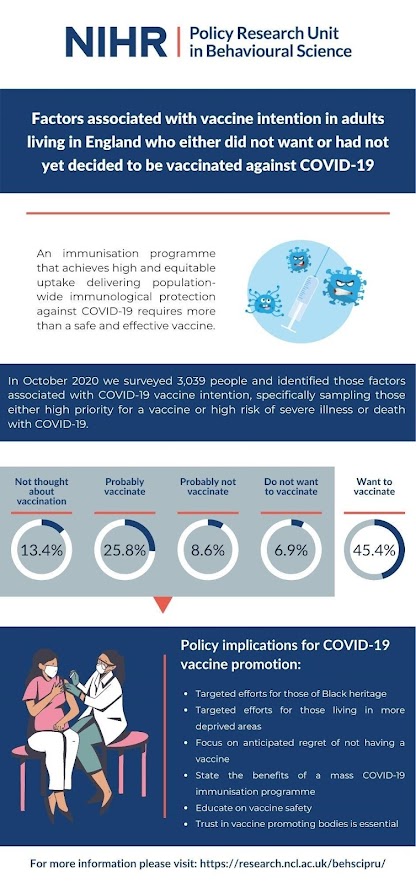
The public has shown an enthusiasm to learn a wealth of terminology during the course of the pandemic. My Unit’s work on the comprehension of antibody testing has shown that this isn’t easy, but it’s something that we shouldn’t shy away from. Patient and public involvement in research is vital to ensure that our lay outputs are fit for purpose and we should all consider how we can be better at science translation. Speaking on camera or on live radio is incredibly nerve-racking and not for all, but as I recently discovered following a two-hour training course, you don’t need a degree in design to produce a half decent infographic.

While I am advocating for your individual action, we also need to consider what systems, for example the new UK Health Security Agency, could put in place to fulfil the role that was missing during the pandemic. Most pressingly on our horizon is the delayed childhood vaccine strategy. The struck-off doc will be feeling emboldened. He understands and has mastered the artistic skill of communication, delivering his message with the gentle assured cadence of a BBC continuity announcer. In the absence of substantiated evidence, he expertly sows doubt and fear to the masses, and as the infodemic has shown, he is not alone. This is a huge challenge for us in public health research and the online vitriol is scary. But building the evidence-base isn’t enough, we all need to work on at least one aspect of the artistic craft of research promotion. Because if it’s not you, you can be assured that someone else most certainly is.


The views and opinions expressed by the author are those of the author and do not necessarily reflect those of the Policy Research Unit in Behavioural Science, the NIHR, the Department of Health and Social Care, Newcastle University or Fuse, the Centre for Translational Research in Public Health.

The Policy Research Unit is funded by the National Institute for Health Research (NIHR) [Policy Research Programme (Policy Research Unit in Behavioural Science PR-PRU1217-20501)]. The views expressed are those of the author(s) and not necessarily those of the NIHR or the Department of Health and Social Care.


Images: 

1) Lourenço Veado, CC BY-SA 4.0, via Wikimedia Commons
2) Photo by Jon Tyson on Unsplash

Friday, 2 June 2017

Can we achieve a healthy sustainable diet by 2030?

Guest post by Christian Reynolds, Knowledge Exchange Research Fellow (N8 AgriFood project), Department of Geography, Faculty of Social Sciences, The University of Sheffield.

I recently attended the REFRESH Food Waste 2017 conference in Berlin. In the keynote speech of the conference, Vytenis Andriukaitis, (Lithuania's European Commissioner and designate responsible for Health and Food Safety) closed with the remark that Europe’s target is to halve food waste by 2030, and asked the audience if the goal of halving food waste is feasible or a fairy tale promise? 2030 is only 13 years away after all!


Likewise, the sustainable development goals are aimed for 2030, these include: ending poverty, ending hunger, increasing good health and well-being, climate action, and ensuring sustainable consumption and production patterns – the latter encompassing the aim to halve food waste.

Many of these goals require large changes to production methods and systems, modes of consumption, and general societal shifts on a global scale. This got me thinking about the challenge of shifting populations towards healthy, sustainable diets; is 2030 an achievable and realistic time frame?

Over the last couple of years there have been a few studies discussing how the UK, and global diets need to shift to meet healthy sustainable diets, (I will admit that I also have two in peer review at the moment). Some of my favourite studies currently published are Macdiarmid et al (2012), Green et al (2015), and van Dooren et al (2015). I also recommend reading Dantzig (1990) to get a glimpse of how this field of enquiry began.

These studies use mathematical modelling methods such as linear programming to calculate diets that:
  1. are optimised to be sustainable (for most studies this means low in associated greenhouse gas emissions (GHGE));
  2. meet the current healthy eating guidelines; and
  3. are not ‘unacceptable’ to the population.
This final item is a crucial, as if you do not constrain for palatability, the linear programme will calculate diets that are healthy, but only feature the foods with lowest environmental impacts. For example, Macdiarmid et al (2012) found a diet of 7 foods: whole-grain breakfast cereal, pasta, peas, fried onions, brassicas, sesame seeds, and confectionery to be sustainable and healthy. Stigler (1945) on the other hand proposed the following 7 foods: wheat flour, evaporated milk, cabbage, spinach, dried navy beans, pancake flour, and pork liver. Both of these are very ‘worthy’ but not varied enough diets to pass muster with the general population.

With this acceptability constraint in play, diets that are healthy and have lower GHGE are achievable with as little as 20-40% dietary shift resulting in up to 30% reduction in GHGEs (see Figure 3 from Green et al (2015). The majority of the studies include a reduction in animal products. For instance Macdiarmid et al (2012)’s sustainable diet featured 60% of the current intake of all meat for women in the United Kingdom and 48% of the intake of red meat (see Figure 1 from Macdiarmid et al 2012).

Figure 3. Deviations of optimised diets from current average diet, with associated reduction in greenhouse gas emissions from Green et al 2015
Figure 1. Proportions (by weight) of food groups in the final sustainable diet compared with the average current intake
of women in the United Kingdom (National Diet and Nutrition Survey 2008–2010). from Macdiarmid et al 2012


So are these changes in food consumption and purchase reasonable in a 13-year time period? Can we shift towards a healthy sustainable diet in 13 years?

For a quick check I looked up the rate of dietary change in the historic reports of the Family Food Survey. Looking over 13 year periods from 1945 to 2000, I found differing rates of changes in consumption and purchase for each food item (check out these amazing visualisations of Britain’s diet from 1945-2000, or look at the table I provide below).

Within all the 13 year periods between 1945 to 2000, all food groups have at maximum shifted by over 20%. This is good news, and indicates that change is possible for all food items in the British diet. However, what is less heartening is that total consumption and purchase of meat and meat products has only shifted by a maximum of 40%, while beef and veal consumption has only changed by a maximum of 47%. These rates of change need to be this high - if not higher - if we are to successfully shift toward a healthy sustainable diet.

So are healthy sustainable diets achievable or just a goal? Only time will tell. However, for now, here are some things that we can do to help the shift towards healthy sustainable diets:
  1. Focus on the foods that need to shift for both health and sustainability. Studies are finding that we need to increase fruit and vegetable consumption, increase oily fish consumption and reduce red meat and processed meat consumption. These are the main goals that we can work towards across the population.
  2. Pick our battles: focus on the foods that people have an appetite to change. From the table below we can see there are some foods that are easier to shift than others, for example starchy foods (a core of many British diets) have had much smaller rates of change than fruits and vegetables. Our relationship is already used to changing fruit and vegetable consumption, let’s focus there instead. 
  3. Technology and dietary change is our friend, let’s harness it. As society and technology develops, food consumption changes. Look at the changes in consumption of canned vegetables as better quality fresh vegetables were introduced. Likewise, the reduction in flour consumption as ready-made bread and other starches (rice, pasta, etc.) began to appear in the shops. How can we work with modern technology, such as improved food storage and processing technology, faster food transfer, and the advent of online shopping? Can we make online meal deliveries and food box deliveries lead to healthier and more sustainable diets?
Table: Britain’s diet from 1945-2000

Maximum 13 year change in food consumption/purchase 1945-2000Minimum 13 year change in food consumption/purchase 1945-2000
Liquid wholemilk 65.3%4.4%
Skimmed milk 99.0%0.0%
Yoghurt and fromage frais73.0%0.0%
Total milk and cream 27.8%4.5%
Natural cheese 23.0%0.0%
Processed cheese44.3%0.0%
Total cheese 44.1%8.5%
Eggs 67.1%7.5%
Oranges and other citrus fruit 74.0%16.1%
Apples and pears26.9%10.3%
Bananas64.6%9.1%
Total fresh fruit 61.0%13.0%
Fruit juice 88.4%25.0%
Total other 50.4%9.6%
Total Fruit 68.3%11.4%
Potatoes38.8%13.2%
Fresh green vegetables36.8%15.2%
Other fresh vegetables24.5%7.8%
Canned vegetables92.0%11.5%
Frozen vegetables77.3%0.0%
Other vegetables and products 42.9%10.5%
Total vegetables and products22.2%6.9%
Bread33.9%9.4%
Flour63.3%18.7%
Cakes and pastries60.2%12.7%
Biscuits66.0%4.9%
Break-fast cereal55.8%11.4%
Total cereals (excluding bread) 19.9%5.0%
Bread & cereal products 23.1%6.4%
Sugar54.0%8.6%
Preserves 51.9%21.3%
Tea37.9%9.4%
Coffee52.3%15.0%
Total beverages 28.2%6.0%
Fresh white fish49.0%17.2%
Fresh fat fish65.3%32.3%
Shellfish71.7%38.5%
Cooked fish61.9%29.0%
Total fish and fish products 46.2%6.1%
Butter67.5%10.8%
Margarine82.8%24.0%
Lard82.1%9.6%
All other fats 74.0%23.4%
Vegetable and oils64.1%0.0%
Low fat spreads53.8%0.0%
Reduced fat spreads80.0%0.0%
Total fats 37.4%5.0%
Beef and veal47.4%19.5%
Mutton and lamb55.4%17.6%
Pork95.8%27.7%
Bacon and ham68.3%7.5%
Pork, bacon and ham75.9%11.1%
Poultry90.0%15.6%
Sausages38.0%8.6%
Total meat and meat products39.8%8.6%

Christian Reynolds
Email: C.Reynolds@sheffield.ac.uk
Twitter: @sartorialfoodie


Photo attribution: "2006_04_10 Food waste. Peering into a dumpster at the GI Market." by Taz © 2006: https://secure.flickr.com/photos/sporkist/126526910

Friday, 13 January 2017

A prescription for tackling riskier drinking?

Guest post by John Mooney, Fuse associate and Senior Lecturer in Public Health, University of Sunderland.

In keeping with the ‘Dry-January’ season, John Mooney reflects on a current initiative to assess the feasibility of alcohol brief interventions in high street pharmacies…

“A man walks into a high street chemist – and asks for a paracetamol and an Alka-Seltzer…” could be the start of a very unpromising joke or sketch outline… Thankfully, it’s neither, as it more accurately depicts a very common scenario, which might represent the basis of a potentially effective setting (namely pharmacy / high street chemist shops) for health promotion messages around the health risks from alcohol misuse and / or overconsumption.

AUDIT score card collection box, with prize incentive to participate
Alcohol unit indicator diagram


Unsurprisingly perhaps, it is by now fairly well established that “alcohol brief interventions” (ABIs) - in which short well-validated questionnaires about habitual drinking patterns and consequences are linked to tailored advice and feedback - can be an effective intervention in primary care based consultations / GP practices as evidenced in the SIPS trial. Evidence for the effectiveness of such interventions however is less convincing in other settings, even those where, as in a GP consultation, health is the primary focus of the interaction. Pharmacy outlets for example might be considered an obvious parallel candidate ‘setting’ where, as in the scenario above, there may clearly have been an alcohol related context surrounding the primary reason for the person’s visit.

Indeed, in addition to over-the-counter ‘remedies’ which might be sought out after alcohol over-indulgence, there are a number of ‘indicator-prescriptions’ which could be suggestive of a more chronic / long-term damaging level of alcohol consumption (such as stomach acid suppressants or high blood pressure medications). High street chemists therefore, by virtue of their community embedded location, specialist knowledge and windows of opportunity for engagement, could theoretically present a very promising setting for ABIs. The lack of evidence of effectiveness in studies where this has been rigorously evaluated, has prompted questions as to why this might be the case. Investigators have speculated on the explanation being attributable to anything from the variable attitudes of pharmacy staff to the additional time and resource constraints associated with modern pharmacy practice. A recent Master of Pharmacy dissertation at the University of Sunderland(1) – which explored possible reasons in interviews with pharmacy staff, provided some local corroboration for these potential explanations. Interviews with participating pilot sites had also however noted the value of the awareness raising aspect of the process:

“Some patients had been drinking a bottle of wine a night and didn’t realise that it could contain 9-10 units and they were really shocked when they realised”

Other potential strengths of pharmacies as a setting for ABIs might be the now well established practice of providing support to pharmacies looking to embrace a wider health promotion role. As part of NHS England’s current ‘Promotion of Healthy Lifestyles’ programme, pharmacies are now required to participate in up to six health promotion campaigns per year(2). This generally involves the display and distribution of leaflets provided by NHS England or other collaborating institutions or stakeholders. As a result, there are usually highly visible and engaging ‘health promoting and awareness raising materials’ adorning the display areas of high street pharmacies and messages around alcohol health risks and reducing them are often a focus of such displays.

Given that the brief questionnaires and tailored advice of alcohol brief interventions is a more pro-active approach than the passive display of information, a current UK pilot feasibility study for pharmacies in several UK regions funded by Drinkaware UK, involves participants self-completing a score card that is the basis of most ABI interventions. Abbreviated as AUDIT, the Alcohol Use Disorder Identification Test, developed by the World Health Organisation(3), involves a series of questions about drinking habits and the extent to which drinking might have impacted on daily activities. Not quite ‘shock tactics’, the revelation of a score that flags up concern – can give respondents some cause for reflection – especially after the season of excess! Of course the score cards themselves have information on where respondents can seek further help and participating outlets receive training in responding to questions that might arise. Essentially the pilot aims to examine how best to integrate ABIs, as unobtrusively as possible into the day-to-day working of the pharmacy.

Not a programme lacking in ambition, the same score cards are also being distributed by trained advisors in selected participating supermarkets and other community settings across the UK, the evaluation of which is set to be complex and challenging. Ultimately the organisers hope to be able to make best practice recommendations about the most effective way to implement ABIs in pharmacies and other settings, where traditionally ‘hard to reach groups’ including working age men (a key high risk group for developing alcohol related health problems) can be more easily targeted.

AUDIT score cards with information leaflets
Indeed the current Drinkaware national campaign (‘Have a little less’) of which the above initiative is a part, will be run to coincide with 'Dry-January'. With a particular focus on working age men aged between 45-60, the message is that ‘Having a little less’ alcohol can have significant health benefits. This is in line with an emerging expert consensus around some of the potential drawbacks of an over-emphasis on one month of the year(4) and that it would be more beneficial for example to achieve three drinking free days for every week of the year. With long term trends in UK consumption still on the rise and a 44 per cent increase since 2009 in those aged 50 and over accessing alcohol treatment, all initiatives exploring innovative ways of getting the message across are to be welcomed. Don’t be too surprised therefore if you are asked about alcohol consumption the next time you collect a prescription!


Note: The Sunderland University Team who are evaluating the Drinkaware community ABI pilot comprises: Prof Jonathan Ling, Mr John Mooney (PI), Dr Zeibeda Sattar and Dr Nicola Hall. Please address any correspondence to john.mooney@sunderland.ac.uk

References:
  1. Asghar S. Assessing the Feasibility and Practicality of delivering Alcohol Brief Interventions in Pharmacy Settings. MPharm Dissertation, University of Sunderland 2015/16.
  2. PSNC page on promoting healthy lifestyles: http://psnc.org.uk/services-commissioning/essential-services/public-health/ 
  3. PHE Guide to WHO AUDIT: https://www.alcohollearningcentre.org.uk/Topics/Latest/AUDIT-Alcohol-Use-Disorders-Identification-Test/ 
  4. http://theconversation.com/dry-january-is-it-worth-giving-up-alcohol-for-a-month-51956
Photography by Eileen Robinson Art ©