Showing posts with label feedback. Show all posts

Friday, 22 July 2022

Going hybrid: The best of both worlds?

Posted by Helen Moore, Associate Professor (Research), Teesside University

Since 2012 my ability to attend in-person and participate in seminars, conferences and workshops has been significantly reduced. This was partially due to a change in my mobility while I was pregnant with twins twice (!) (2012, 2015), and then after my pregnancies, due to the challenges of arranging childcare for four small children. It has become easier as they have got older, but after my second maternity leave, I returned to work but remained the primary carer for four children under the age of four as their father (my husband), was (and still is) a Merchant Navy captain, which involves working away for half of every year.

Make an enquiry about getting professional technical help as soon as you conceive the idea
 – don’t assume it will be prohibitively expensive
During this time, I had always felt very grateful to any event organiser who took the time to release the slides after their events or, as time progressed and technology moved on, to run an additional online version as this enabled me to participate, albeit in a less than perfect fashion, but I viewed it as certainly being better than nothing. I hadn’t really appreciated how many other people were also often unable to attend events in-person, due to other factors in their lives, but this was brought into sharper focus for me with the Covid-19 pandemic when I started reading, and joining in with, conversations on social media around event accessibility that had never been on my radar.

I’m sure everyone remembers that when lockdowns were imposed, initially events were completely cancelled but as time progressed and it became clear this was not going to be a ‘flash in the pan’, the planning stages of events began to include considerations of how best to run them entirely online, with many people having to rapidly learn and develop skills around using technology to engage with the maximum number of participants possible.

Between January-April 2021, I was part of a team that worked on a project commissioned by the Office for Health Improvement and Disparities (OHID) which looked at the impact of Covid-19 on the hot food takeaway planning regulatory environment in North East England. As the project drew to a close the team thought that this, alongside other work we had been involved in, or were aware of, would make an excellent Fuse Research Event, and my colleague Professor Amelia Lake and I decided we would work together to make it happen.

I was keen to explore the possibilities of having a, in my view, truly hybrid event, where participants could choose to attend in person or via a real time remote video stream, and where presenters could choose to be in the room or present via a MS Teams link. I had previously worked with the team from Teesside University’s Aurora House on other projects, and Amelia had worked with them to create the live stream of her inaugural professorial lecture, so we were confident that they possessed the skills, the technology and the will to ensure this could happen.

It took a lot of organisation to get this to work, and having organised many events pre-Covid, it was definitely more work than if we had decided to run a traditional event with in-person attendance only. I spent significant amounts of time thinking about how we could include the remote audience and presenters in the discussion in the most effective way. The entire event was live streamed on the Fuse YouTube channel, with a technician ensuring that the virtual audience saw a mix of angles and information during the session. We used sli.do to allow the remote audience to submit questions during each presentation, and then one of the organising team asked the questions using the same microphone that was used for questions from the room so everyone could hear.


We only had one minor hiccup, in that we used my personal Teams account to allow the external speakers to present, and I forgot to decline meetings that were scheduled to run at the same time – and, of course, the other meeting used the chat function, which meant everyone could read their messages! We managed to get a message to the other meeting and they quickly stopped using the chat function!

As usual, we asked for feedback on the event, and the comments were extremely positive, including the fact it was hybrid, with “Ability to attend online”, mentioned in more than one response.

I would absolutely encourage people to think about making the effort to run hybrid events. it widens your audience and opens up different avenues for discussion – posing a question via an online function is, for most people, less scary than standing up and speaking into a microphone! 

My top tips for running a hybrid event

While I was writing this blog, I thought about what my top five tips would be for anyone considering running a hybrid event in the future:
  1. Make an enquiry about getting professional technical help as soon as you conceive the idea – don’t assume it will be prohibitively expensive;
  2. Ensure you communicate with the presenters and attendees, before and during the event, about how they can interact and engage during the event;
  3. Use interactive apps such as sli.do.
  4. Avoid using personal accounts for external events, such as Teams or Zoom (or make sure to decline any other meetings scheduled at the same time!)
  5. Always ask for feedback to improve future events.

Friday, 1 October 2021

“Next slide, please!” Newcastle children’s reflections on the pandemic

 Posted by Laura Basterfield, Research Associate, Newcastle University

Often in research, once we’ve collected the data, analysed and published it, we don’t have the opportunity to go back to the participants to discuss what we found. When children are involved, we may give a feedback presentation at a school assembly, but let’s be honest it can be difficult to make Powerpoint fun!


I’ve worked closely with Walkergate Community School over the last few years on my research into children’s physical fitness and mental wellbeing and I wanted to deliver my feedback in an assembly that the children would enjoy. I thought the best way to do that might be to let them do it themselves, as who knows what children like better than other children? And I am so pleased I did; it was a fascinating process. 

The ‘Young Science Communicators’ project was due to have taken place in June/July 2020, but had been delayed due to the COVID-19 school closures. Whilst I was initially disappointed last year, the realities of the past 12 months brought an added dimension, intensity and poignancy that would not have been there otherwise.  

There weren’t many rules, but the assembly should include some of the results of the study, including both the physical and mental benefits of physical fitness and activity. Other than that I was happy for the children to take the assembly wherever they saw fit. To start, thirteen Year 6 pupils (aged 10-11 years) discussed with me the project specifically, fitness in general, and about the impact the COVID-19 lockdowns and school closures had on them and their families. Then I taught the children some of the key skills they would need to do my research. I wanted them to really understand why I do what I do, and what better way than to then practice on your friends?! There were some wonderful comments from the children about how they liked the experience: “I enjoyed it because I want to do your job when I’m older” and “I liked being in control!” (which must be quite unfamiliar at 11 years old), and they quickly learned both the techniques and how to talk politely to their class-mates! 

The following week it was over to the children and their ideas. The goal was for them to create an assembly, film their performance, and share it with the rest of the school – all within three days. Scott and Claire are practitioners with local theatre company Mortal Fools and they led the children on a games-based journey to increase their confidence, public speaking and team-working skills. The children were all totally engaged and willing to share their thoughts, feelings and experiences to create a collegiate and supportive atmosphere. For me as an observer at this point, I was struck by the children’s recreations of the school closure periods and how they articulated their feelings: “I had no motivation to do anything”, “I was lonely”, “frustrated”, “isolated”. This was especially the case for those without their own mobile phone – some were unable to speak to friends for weeks. They also showed a mature insight into how the adults in their life had been affected, acting out money worries, family health issues, the stress of getting children to do schoolwork and go to bed on time, when there was nothing to get up for the next day…

As the group moved on to the awkwardness of meeting up with people after such a long time “Errr… so have you been up to much?!”, to their joy and excitement of seeing family, friends and teachers again, the whole process felt reflective and cathartic. Claire and Scott’s skill was evident as the children’s confidence grew before my eyes. Along the way the children had us in stitches with impressions of Boris Johnson, ‘next slide please’, and Joe Wicks.

Finally, they got to film their creation with the help of a proper film-maker. Most scenes only took a couple of takes, and the children showed incredible focus and concentration throughout. The final co-produced 9-minute film is informative, funny and affecting, and the children should be incredibly proud of their efforts. We still weren’t able to completely escape COVID, as three children missed the filming day due to a positive case in their class, but their input on the previous days made it a true team effort. 

The process showed me how important it is that we involve children not just in our research but in everything that affects them – simply asking children how they are, what they are feeling, and what they would like to be involved in gives us a hugely important insight into their world. 

I hope you enjoy their film.


Thanks go to all the children and staff at Walkergate Community School; Scott Wilson, Clare Rimington and Helen Ferguson at Mortal Fools, and Matt Jamie the film-maker. Permission to share this film has been granted by the parents and school of the children involved. 

Funding from EngageFMS at Newcastle University supported this project. 

Originally written for VOICE.

Friday, 11 June 2021

Things I wish I’d known when I started my PhD… (part 2)

Posted by members of the Population Health Interventions Programme at the MRC Epidemiology Unit

This is Part 2 of our PhD SURVIVAL GUIDE. In Part 1 we found out that doing a PhD (or any research) is challenging but the ‘this might be okay’ stage always comes; continuously comparing your work, and yourself, to others is the thief of joy; and research is a team sport and you're the boss so start channelling your inner Arsène Wenger!

Like most research groups, ours comprises an ever-changing cast of early, mid and senior career researchers. Our training is in a variety of academic disciplines and we all have different short, medium and long term life and career aspirations. While our experiences of public health research are naturally individual, we have noticed some commonalities. We share these here to provide reassurance to those new to the game that whatever they’re feeling is almost certainly ‘normal’. Challenging experiences are often interpreted negatively, particularly when they are first met. We propose that they can often be reassessed and reframed in ways that make them positive parts of a continuous learning and career development journey. Other people might have different experiences, this is ours…


Licensed to YouTube by: UMG (on behalf of Walt Disney Records); UNIAO BRASILEIRA DE EDITORAS DE MUSICA - UBEM, ASCAP, AMRA, LatinAutorPerf, Walt Disney Music Company (Publishing), LatinAutor - SonyATV, LatinAutor - UMPG, CMRRA, UMPI, and 15 Music Rights Societies

4. We’re all in this together – don’t take it personally

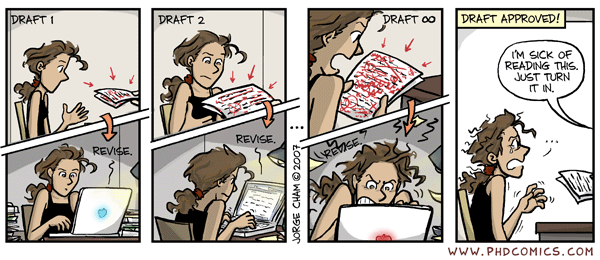
It is impossible to overstate the importance of not taking feedback personally. Opening a document containing feedback from your supervisor or peers and seeing a page full of colourful tracked changes and comments can sometimes feel like personal criticism. It’s all too easy to see this as a setback but in reality, this is what teamwork looks like. Your supervisor is there to ask the difficult questions, and to stretch you intellectually. All feedback is intended to be helpful, so you can produce a stronger output.

Trust us, your supervisor doesn’t expect perfection. Think they don’t receive similar feedback from their colleagues? Think again. But they’ve learned from experience that falling short of perfection is okay. Few imperfect ideas are that imperfect!

Also, what does perfect look like? There’s rarely a ‘right’ answer to any question, and there are different but equally valid ways to approach most things. Different is not necessarily better. Although you’re bound to immediately presume what you’ve done is ‘wrong’, our advice is to take a breath, remind yourself why you did what you did, and be prepared to defend that. This will be an essential skill for your viva! But remember to respect the time it took for someone to really consider your work, by reciprocating and carefully considering their ideas.

Your supervisor wants to see you succeed because your success is also theirs. Seeing your student flourish is immensely gratifying. It rewards everyone’s intellectual contribution to the work, and validates that seedling of an idea, planted by your supervisor, which has since blossomed under your care. Lastly, don’t forget that as much as you’re learning from them, they’re learning from you, too. You wouldn’t be doing that systematic review if they knew the answer already. 

"Piled Higher and Deeper" by Jorge Cham www.phdcomics.com
5. A PhD is a job, not a way of life

For most of us, reaching the start of a PhD represents lots of hard work and effort. It is tempting to think that means you should pour your life into research, and nothing but research, for three or more years, to do justice to that opportunity.

But your PhD can benefit from some down time. Giving yourself a mental break from research means you can return to work with renewed enthusiasm. Time away can also offer clarity and sometimes inspiration! Setting boundaries between research and the rest of your life can make the entire PhD process more sustainable and ultimately, more enjoyable. It can be easier to work efficiently and effectively in distinct working hours (even if those aren’t 9-5), with the incentive of doing something else that you enjoy at the end of it.

However, intending to take time off work and actually doing it are two very different things. During busy periods, it is easy to prioritise your PhD over other areas of life. It also becomes harder to switch off thoughts like “should I read that extra paper?” or “maybe I should do that analysis?” while you are trying to relax.

There are simple ways you can give yourself a better chance of achieving the elusive ‘work-life’ balance. Scheduling time – and protecting that time – to do a particular hobby, sport or social activity can help. It is much easier to rearrange a “hope to do yoga at some point this week” than a class you have booked at 7pm on Wednesday. Similarly, committing to doing things with other people is a great way to cultivate new friendships with colleagues, enjoy their company, and follow through with a plan. At times of self-doubt, it is also a good reminder that there are many other things you are capable of, and that life isn’t all about the PhD! 

6. Some bad things may happen that are not okay

A healthy PhD experience should be challenging, yes, but if this starts to have a negative impact on your physical or mental health and affects how you would normally function, something could be wrong. There are fantastic resources on the Mind website which are a great starting point to help you be more aware of your feelings. Struggling with mental health is very common in life and you are not alone. Seeking help and support is important though. Don’t be afraid to tell your supervisor if you’re struggling.

Sometimes though, the cause of these struggles can be external, and in particular, your relationships with supervisors. Supervisors are responsible for challenging you but also encouraging and supporting you. If there is a problem with your relationship, it is always wise to talk to your supervisor if you can, as they may not realise there is a problem. People are not always immediately compatible in their working styles; this is okay and can be worked through.

If a dysfunctional relationship is caused by a supervisor who is behaving inappropriately, this is not okay. Harassment or bullying of any kind should be escalated through the proper channels in your university. Speak to fellow students you trust candidly about your experiences too; you may not be the only one suffering and they could help support you through it.

The student always becomes the master
7. Enjoy every step of the journey

The good things that come from doing a PhD are not necessarily what you might expect. For some, the highest high is indeed right at the end, the crescendo, when the thesis is submitted. But for many this can feel like an anti-climax. The more you can learn to embrace and enjoy the process, and the less you anticipate what you think will be the good things, the more good things will come your way. A breakthrough with your data collection, your first set of meaningful results, mastering a new skill, or even just a meeting with your supervisor that goes particularly well, are all cause for celebration. Each milestone is a block that forms the foundation of your PhD and each one is a vital move towards your end goal. There is nothing more rewarding than the sense you are on the right track.

As you progress, you will also start noticing that people begin treating you like the expert you are becoming. You might not feel like it, but the student always becomes the master. As strange as these moments feel, you should enjoy them. They are an external reminder that you know more than you think you do. 

Occasionally you will sit back and realise, "I'm doing a PhD! And that’s pretty cool". Stop thinking that you need to have all the answers, or even that you know where your research is going, and instead realise you are there to learn and there to explore, wherever that takes you.

That’s it!

We hope that these points have been helpful, and that you are able to look back at these blog posts when it feels like everything is going wrong. Trust us, it most probably isn’t. We have all been where you are and have lived to tell the tale. Most of us would love to be in the position you are right now again, even just to spend time reading those papers that we still can’t get around to. Try your best to enjoy this incredible experience. You’ve got this!

Authors: Catrin Penn-Jones, David Ogilvie, David Pell, Dolly Theis, Emma Lawlor, Hannah Forde, Jean Adams, Jenna Panter, John Rahilly, Kate Ellis, Martin White, Matt Keeble, Nina Rogers, Rich Patterson, Roxanne Armstrong-Moore, Tom Burgoine, Yuru Huang.


Video: 
Song: We're All In This Together (From "High School Musical"/Soundtrack Version)
Artist: High School Musical Cast
Writers: Robbie Nevil, Matthew Gerrard
Licensed to YouTube by: UMG (on behalf of Walt Disney Records); UNIAO BRASILEIRA DE EDITORAS DE MUSICA - UBEM, ASCAP, AMRA, LatinAutorPerf, Walt Disney Music Company (Publishing), LatinAutor - SonyATV, LatinAutor - UMPG, CMRRA, UMPI, and 15 Music Rights Societies

Images:
1. "Piled Higher and Deeper" by Jorge Cham www.phdcomics.com

Friday, 13 January 2017

A prescription for tackling riskier drinking?

Guest post by John Mooney, Fuse associate and Senior Lecturer in Public Health, University of Sunderland.

In keeping with the ‘Dry-January’ season, John Mooney reflects on a current initiative to assess the feasibility of alcohol brief interventions in high street pharmacies…

“A man walks into a high street chemist – and asks for a paracetamol and an Alka-Seltzer…” could be the start of a very unpromising joke or sketch outline… Thankfully, it’s neither, as it more accurately depicts a very common scenario, which might represent the basis of a potentially effective setting (namely pharmacy / high street chemist shops) for health promotion messages around the health risks from alcohol misuse and / or overconsumption.

AUDIT score card collection box, with prize incentive to participate
Alcohol unit indicator diagram


Unsurprisingly perhaps, it is by now fairly well established that “alcohol brief interventions” (ABIs) - in which short well-validated questionnaires about habitual drinking patterns and consequences are linked to tailored advice and feedback - can be an effective intervention in primary care based consultations / GP practices as evidenced in the SIPS trial. Evidence for the effectiveness of such interventions however is less convincing in other settings, even those where, as in a GP consultation, health is the primary focus of the interaction. Pharmacy outlets for example might be considered an obvious parallel candidate ‘setting’ where, as in the scenario above, there may clearly have been an alcohol related context surrounding the primary reason for the person’s visit.

Indeed, in addition to over-the-counter ‘remedies’ which might be sought out after alcohol over-indulgence, there are a number of ‘indicator-prescriptions’ which could be suggestive of a more chronic / long-term damaging level of alcohol consumption (such as stomach acid suppressants or high blood pressure medications). High street chemists therefore, by virtue of their community embedded location, specialist knowledge and windows of opportunity for engagement, could theoretically present a very promising setting for ABIs. The lack of evidence of effectiveness in studies where this has been rigorously evaluated, has prompted questions as to why this might be the case. Investigators have speculated on the explanation being attributable to anything from the variable attitudes of pharmacy staff to the additional time and resource constraints associated with modern pharmacy practice. A recent Master of Pharmacy dissertation at the University of Sunderland(1) – which explored possible reasons in interviews with pharmacy staff, provided some local corroboration for these potential explanations. Interviews with participating pilot sites had also however noted the value of the awareness raising aspect of the process:

“Some patients had been drinking a bottle of wine a night and didn’t realise that it could contain 9-10 units and they were really shocked when they realised”

Other potential strengths of pharmacies as a setting for ABIs might be the now well established practice of providing support to pharmacies looking to embrace a wider health promotion role. As part of NHS England’s current ‘Promotion of Healthy Lifestyles’ programme, pharmacies are now required to participate in up to six health promotion campaigns per year(2). This generally involves the display and distribution of leaflets provided by NHS England or other collaborating institutions or stakeholders. As a result, there are usually highly visible and engaging ‘health promoting and awareness raising materials’ adorning the display areas of high street pharmacies and messages around alcohol health risks and reducing them are often a focus of such displays.

Given that the brief questionnaires and tailored advice of alcohol brief interventions is a more pro-active approach than the passive display of information, a current UK pilot feasibility study for pharmacies in several UK regions funded by Drinkaware UK, involves participants self-completing a score card that is the basis of most ABI interventions. Abbreviated as AUDIT, the Alcohol Use Disorder Identification Test, developed by the World Health Organisation(3), involves a series of questions about drinking habits and the extent to which drinking might have impacted on daily activities. Not quite ‘shock tactics’, the revelation of a score that flags up concern – can give respondents some cause for reflection – especially after the season of excess! Of course the score cards themselves have information on where respondents can seek further help and participating outlets receive training in responding to questions that might arise. Essentially the pilot aims to examine how best to integrate ABIs, as unobtrusively as possible into the day-to-day working of the pharmacy.

Not a programme lacking in ambition, the same score cards are also being distributed by trained advisors in selected participating supermarkets and other community settings across the UK, the evaluation of which is set to be complex and challenging. Ultimately the organisers hope to be able to make best practice recommendations about the most effective way to implement ABIs in pharmacies and other settings, where traditionally ‘hard to reach groups’ including working age men (a key high risk group for developing alcohol related health problems) can be more easily targeted.

AUDIT score cards with information leaflets
Indeed the current Drinkaware national campaign (‘Have a little less’) of which the above initiative is a part, will be run to coincide with 'Dry-January'. With a particular focus on working age men aged between 45-60, the message is that ‘Having a little less’ alcohol can have significant health benefits. This is in line with an emerging expert consensus around some of the potential drawbacks of an over-emphasis on one month of the year(4) and that it would be more beneficial for example to achieve three drinking free days for every week of the year. With long term trends in UK consumption still on the rise and a 44 per cent increase since 2009 in those aged 50 and over accessing alcohol treatment, all initiatives exploring innovative ways of getting the message across are to be welcomed. Don’t be too surprised therefore if you are asked about alcohol consumption the next time you collect a prescription!


Note: The Sunderland University Team who are evaluating the Drinkaware community ABI pilot comprises: Prof Jonathan Ling, Mr John Mooney (PI), Dr Zeibeda Sattar and Dr Nicola Hall. Please address any correspondence to john.mooney@sunderland.ac.uk

References:
  1. Asghar S. Assessing the Feasibility and Practicality of delivering Alcohol Brief Interventions in Pharmacy Settings. MPharm Dissertation, University of Sunderland 2015/16.
  2. PSNC page on promoting healthy lifestyles: http://psnc.org.uk/services-commissioning/essential-services/public-health/ 
  3. PHE Guide to WHO AUDIT: https://www.alcohollearningcentre.org.uk/Topics/Latest/AUDIT-Alcohol-Use-Disorders-Identification-Test/ 
  4. http://theconversation.com/dry-january-is-it-worth-giving-up-alcohol-for-a-month-51956
Photography by Eileen Robinson Art ©

Thursday, 22 January 2015

ESRC vision includes plans to promote bold new approaches to knowledge exchange

Posted by Mandy Cheetham
An ESRC grant writing workshop last week organised by Durham University gave us some insight into the ESRC's vision and priorities for 2015 / 2016.


In a helpful overview, Sally Johnson at Durham Research Office, summarised the plans, which include a continued focus on excellent research, quality, timeliness, value for money and potential impact, both in and outside academia. ESRC’s vision is to support ‘transformative’ research, pioneer methodological and theoretical innovation, extend partnerships in priority areas and deliver new, more effective approaches to knowledge exchange. And you don’t have to be a senior academic to submit, as fresh ideas from Early Career Researchers are encouraged. Proposals which include international collaboration are particularly welcomed. There’s more guidance available on the ESRC website.

We heard about a range of current ESRC funding opportunities, including the Transformative Research call which encourages novel developments of social science enquiry, and supports research activity that entails an element of risk (closing date 19th Feb 2015).

Information about all the ESRC funding streams is available here on the ESRC website.  If you’re not sure whether and how your plans fit, you can email remit queries to: esrcremit@esrc.ac.uk
Drawing on their experiences of ESRC grant writing Emma Flynn and Peter Tymms from Durham University shared some of their reflections on lessons learned. Thanks for their permission to share these top tips;
  • Take your time, plan ahead and identify the appropriate funding stream for your proposal. 
  • Identify stakeholders and possible co-applicants with interest and expertise. Engage them early on in the development of the research.
  • Look at other people’s successful grant applications, if available.
  • Turn up at public meetings and events organised by the funding board.
  • Start small and build up towards larger grants over time. Be realistic.
  • Apply for seed corn funding from your University to start to build a track record. Make step changes into new and different areas.
  • Write clearly, avoid jargon. Think about content, structure, headings and format. Put yourself in the position of the reviewer.
  • State clearly why you, why this research, why now, why this university?
  • Seek comments from those with a track record from the relevant funder. 
  • Read, re-read, revise, revise and revise again.
  • Think about who to suggest as reviewers. Build in time to approach them and seek permission before you submit the application. Send them a draft outline copy of the proposal for comment.
  • Learn from reviewers comments, even when (perhaps especially when) they are critical. Rejections are common and everyone gets them. Treat them as a learning experiences. Don’t take them personally, reviewers are not perfect, and keep trying.
  • Accept constructive feedback in a positive spirit. Work from it. Be persistent.


There’s helpful guidance on the ESRC website too about how to write a good research grant proposal.

Good luck!

Thursday, 11 October 2012

Collaborative writing

This post is reposted with permission from PhD2Published.com


Posted by Peter Tennant

I once showed my brother one of my papers.

"Why is it written in such a dull and lifeless style?"

"Oh, that’s the editor’s fault. It read much better when I submitted it."

Neither of us was convinced.

There’s no shame in being a scientist who can’t write. Science is fairly well populated by people with exceptional skills in the most extraordinary areas, but who can’t write for toffee. Then again, even the best communicator would struggle writing a scientific paper. Because scientific papers are almost always written in teams.

"Piled Higher and Deeper" by Jorge Cham
This is fairly sensible, given most scientific studies are performed in teams, but there are also some serious advantages. For a start it allows contribution from people with a range of skills. Having medical co-authors means my papers can discuss the clinical significance without risking a life-threatening blunder. It also means you’ve got plenty of people to celebrate with when the paper gets accepted. And, it gives you someone else to blame if anyone ever calls your paper, 'dull and lifeless'.

But, did I mention, it’s also very challenging? As the lead author (most commonly the first name on the authorship list, though not for all disciplines), the main challenge is to your sanity. As long as it might take crafting the first draft, this is nothing compared with the time spent sending it back and forth to your co-authors for more and more comments. It’s this process that I think produces that instantly recognisable multi-author style (the one my brother kindly referred to as ‘dull and lifeless’). Like washing a colourful shirt a hundred times. This is why (against the advice of senior authors like Martin White and Jean Adams, see bullet point 3) I rarely waste time overcooking my first drafts. There’s simply no point spending days writing a stunning introductory paragraph, only for it to be completely mauled by your co-authors.

Broadly speaking, co-authors come in one of three factory settings; the Rampant Re-writers, the Sweeping Suggestion-Makers, and the Utterly Useless.

The Rampant Re-writers get the most flack. These are the people who so heavily drench your draft in tracked-changes that, by the end, it stops feeling like your paper. Draining as this can be, these co-authors are actually the nice ones, generously spending their time to improve the paper. Until they start changing bits that everyone’s already agreed on. That’s when they get really annoying. And when it’s especially important to remember the Golden Rule of Rampant Re-writers: edits are only suggestions – as the lead author, you should always have the final say.

Next there are the Sweeping Suggestion-Makers. Wielding the deadly comment box, they add things like, 'this bit needs shortening' or 'I think you should add something about X'. Sometimes I’m tempted to send it back and say, 'I think YOU should add something about X if YOU think it’s so important!' But they’re usually too busy. And they’re usually right. Damn them with their helpful comments.

By far the most harmful authors are the Utterly Useless. The ones who don’t reply to emails, or who get back saying vague things like, 'looks great'. In the absence of praise from your other authors (sadly the academic for, 'this is amazing, fantastic work' is often simply, 'no further comments'), these people can seem like your friends, but they’re not. They’re useless. That’s why I call them Utterly Useless. In fact, these authors are the ones that can cause genuine ethical dilemmas. Do they even satisfy the conditions of authorship? Occasionally a senior academic will insist on being an author due to some historical connection with the study, even if they then add nothing to the paper. This is unethical. But not something that the average PhD student is in a position to do anything about. More pertinent is the risk of being pushed down the author order, despite doing the most work. It’s common throughout the history of science. It’s also morally repugnant. Always try to discuss the authorship list and the author-order before starting writing a paper and this risk can be reduced (though, sadly, not eliminated).

If being the lead/first author is most difficult, it’s not necessarily easy being a support author, where the big challenge is in getting the right balance of comments. Despite years of therapy, I still fall firmly into the Rampant Re-writer category. On more than one occasion, I’ve made the first author cry by overdoing the edits. Some support authors try to soften the blow by spreading their edits over several revisions, e.g. making the 'essential' changes first, then the less major changes later. But I’ve experienced this as a first author and actually found it more depressing! It’s like getting to the end of a marathon, only to be told to run another five miles. Short of making them cry, over-editing might still annoy your co-authors, especially if they are senior. For some reason, Professors don’t always react very well to having their words rewritten by a PhD student. So here’s my advice, try and get all your comments in first time, but make sure they are all essential. If in doubt, leave it out. Unless you’re happy making your colleagues cry.

Tuesday, 2 October 2012

Things I’ve learnt from being on a funding board

Posted by Jean Adams

A few years ago I was invited to join a research funding board. I said yes, because: I was flattered to be joining the esteemed ranks of ‘important’ people on such committees; I thought it would look good on my CV; and everyone says you learn a lot about writing grant applications from being on a funding board.

So, in the best tradition of reflexive practice, I thought it might be time to try and work out exactly what it is I have learnt from the experience. These are just some initial reflections and I think they’re probably fairly specific to the committee that I am on. Whatever else you think, do not think that this is a set of rules for winning research funding. I am nowhere near confident enough in my own grant winning ability to start offering anyone else advice.


First, an outline of the process. There are 17 members of the committee, including three ‘lay’ members. All applications go through an initial screening process where a sub-committee of three members confirm the application is in scope. At the full board, each application (which contains around 50-60 pages of application form, references, reviewers’ comments, budgets etc) is assigned a lead and second academic assessor, and a lay assessor. The lead academic assessor summarises the application to the rest of the committee, summing up both strengths and weaknesses. The second and lay assessors are then invited to add any additional comments before opening up the discussion to the full membership. Each application gets 15 minutes and once the lead, second and lay assessors have done their bits, this means around 5-7mins of actual discussion. We deal with anything between four and 16 applications per meeting.

Being a member of this board takes up a lot of time. I started out trying to read all applications in detail prior to each meeting. Then I noticed that other committee members didn’t seem to be doing this, and that it was taking me up to two days per meeting. Increasingly, I find that I don’t have time to read each application fully, so I concentrate on the applications I’m lead or second for and skim the others. This means that perhaps only four people (lead, second and lay assessors, and chair) have a really good knowledge of each application. It seems inevitable that some good applications will get rejected, and some not so good ones funded, just because of how these four individuals respond to them.

I find the meetings pretty scary. To begin with I found it absolutely terrifying having to present my critique of applications to a room full of my elders and betters. Now I’m used to that, but am still not immune to the late nights, Sunday afternoons, commitment, and life-compromise that has gone into preparing every application. Often I find it scary how quickly we deal with them. I worry that we don’t treat the applications we receive as we would want our applications to be treated. But, realistically, how could we do it better? The process has to be manageable. We can’t let each meeting turn into a three-day critical appraisal marathon.

The committee know the guidance that applies to our funding scheme pretty well. I am always surprised that applicants don’t read, don’t act on, or somehow don't think this guidance applies to them. It is all fairly standard stuff on the difference between a pilot study and a full trial; the sort of inter-disciplinary working we expect; and the level of patient and public involvement required. Why would people think that it somehow isn’t relevant to them?

Reviewers’ comments rarely make or break an application. I was pretty surprised by this, because when you’re writing, and re-writing, a grant “what the reviewers will think” seems to be a key determinant of what goes in. Maybe I mis-interpreted “reviewers” too literally and what is meant is just “the people who will make the decision”. But, really, we read the applications and make our own decisions then see if the reviewers picked up anything important that we missed. The reviews are often pretty superficial, so we don’t always expect to find much additional information there. The confusion might be that the applicants are fed back the reviews in full, but just a bullet-point summary of the committee's thoughts. So I guess it might feel that these are what matter the most.

And that might be it for what I've learnt. Does any of this surprise you? I’m not sure it will change the way I approach grant writing in the future. But it’s certainly an interesting experience and the hotel the meetings are held in does good cake.

Wednesday, 19 September 2012

Criticism is your friend. I mean it. Really.

Guest post from Emily Murray

Ah, criticism. It is the architecture of the scientific process. Manuscripts are written describing hypothesis of the way we think the world works. But before our hypothesis can be transmitted to the world, we must submit these little pieces of ourselves to others to rip to shreds.

After we’ve re-written the manuscript a few times until it vaguely resembles the work of art we created before, we must submit it to a whole new group of ‘criticizers’, aka reviewers.

Where they commence to rip it to shreds as well.


If we’re lucky, when writing this manuscript (and hopefully 10 others) we discover a hole in the literature. And some twisted part of our brain thinks it would be a fantastic idea to spend six months, weekends and evenings included, turning that ‘hole in the literature’ into a 100-page document of why you are the best researcher ever and will cure all of the world’s ills with this one research project, aka a ‘grant proposal’.

Where they won’t even bother to rip it to shreds. They will only tell you that it did not score high enough to be ripped to shreds.

As you may or may not be able to tell…I hate criticism.

During my student days, I used to loath the days I would receive feedback from my mentor; praying that at least one page wouldn’t be covered in red track changes. Sometimes I would have day dreams where papers were returned to me in their original black-and-white pristine condition with only a note on top saying, “This is fantastic! You must submit this to the Lancet at once!”


But then something happened. My dream came true! (Well, minus the Lancet comment.) I sent out a paper to co-authors and most were returned with nary a comment. I started to think that maybe all of those hours of writing and re-writing and re-re-writing were starting to pay off. Maybe something had clicked in my brain over the last fortnight to push me from a ‘so-so writer’ into a ‘fantastic writer’. Malcolm Gladwell, eat your heart out.

Well, you can guess what happened when I submitted the paper to a journal.

It was rejected. 

*cue copious weeping* 

But seriously, there was definitely a lesson here: Lots and lots of criticism and feedback from mentor and co-authors equaled acceptance. Little to no criticism from mentor and co-authors equaled rejection.

No, the lesson is not that I suck as a writer and should take up a profession in travel photography instead (although this does sound quite attractive in the middle of a second revise and resubmit).

What I drew from this is that sometimes *wait for it* criticism can be a good thing. That criticism is an opportunity in disguise. A way for others to point out the weaknesses in our work, not because they hate us or think our work is appalling, but because they want to help us make it better. Or at least that’s the way I like to think about it.

For those new to this way of thinking, I present both my ‘old’ and ‘present’ way of reacting to certain criticisms:

1. The Grammar Police have gone through my paper with a vengeance. Commas, active verbs, plurals, and future conditional tenses are apparently problems for me.

‘Old’ reaction: Obviously, all previous English Teachers were lacking. I suck.

‘Present’ reaction: Find colleague who is also ‘Grammar Police’ and bribe them to read all future papers.

2. “I don’t understand why you XXX…”

‘Old’ reaction: Obviously, my ability to express my thoughts in plain English is lacking. I suck.

‘Present’ reaction: Realize that I didn’t do a good job of explaining that section. Read it out loud to myself. Or have someone read the section who has never read it before. Like my mother. Oh wait, she has heard it like 50 times before…on to the next guinea pig… 

3. “Have you thought about this? Or tried this? What happens?” 

‘Old’ reaction: Great, there goes my weekend running all of this analysis over again. They suck.

‘Present’ reaction: Ah, I didn’t think of that. Doing this extra work will help me better understand the patterns in my data.

4. “… [no comments]”

‘Old’ reaction: I am a genius.

‘Present’ reaction: Hm, I need to find someone to read this who is willing to rip me to shreds. My paper will be much better for it.